Over the last six weeks, the Trichordist has chronicled the frozen mechanicals saga occurring at the Copyright Royalty Board in the government’s rate setting for the compulsory mechanical license commonly called “Phonorecords IV.” (Congress mandated that these government rate settings occur every five years and are numbered sequentially.)
Songwriters, independent music publishers, music lawyers and advocates have penned articles and contacted their representatives in Congress to express their concerns about the private party settlement which would extend the existing freeze on the statutory mechanical rate with respect to physical products and permanent downloads for yet another five years. That private party settlement among the Big Three record companies, the National Music Publishers Association and the Nashville Songwriters Association International is expected to be opened to public comment later today. (Friday news dump?) These entities then submitted that settlement to the Copyright Royalty Board asking the CRB to impose the terms of that private settlement on the rest of the world. And it now appears that these secret deals may be backfiring.
The frozen rate most prominently applies to permanent downloads and physical sales like vinyl. Why the Big Three want to freeze mechanical royalty rates on the booming vinyl business is anyone’s guess.
The sticking point for most people commenting in the Trichordist is that the terms of the private settlement are not disclosed to the CRB or to the public, especially a side deal between the Big Three and the NMPA. Songwriters around the world have no way of knowing the terms of these deals unless the Copyright Royalty Board forces their disclosure.
These entities who are before the CRB in Phonorecords IV, along with those vocal in opposition against their private party settlement have been in this arena for far longer than I. When the Phonorecords I proceeding occurred in 2006, I was merely a freshman in high school — and I was completing my final year of law school as the Phonorecords III proceeding began. Needless to say, there has been a significant amount of information and procedure to digest.
Upon learning of the settlement by the Big Three labels, the NMPA and the NSAI, several thoughts came immediately to mind:
1) The settlement and side agreement referenced must be disclosed immediately.
2) How can this freeze be rationalized, especially during the midst of a worldwide vinyl resurgence?
3) Why would an organization representing songwriters agree to such a freeze? (As an aside, as I was teaching a course on copyright and songwriter revenue streams to 30 older songwriters two weeks ago, they were shocked and moreover disheartened to learn this — as physical sales, not streaming revenue, pays their bills. One said: ”I can stand out on the street in Smithville, Texas, with my guitar and a tip jar and earn more in a couple hours than I will ever earn from streaming”).
4) This is perfect ammunition for the streaming services to use to justify their already abysmally-low mechanical “rates.”
While there is much to say on points 1-3, the focus here is on point 4. Chris Castle echoed the same sentiments on June 1:
“Streaming Royalty Backfire: If you want to argue that there is an inherent value in songs as I do, I don’t think freezing any rates for 20 years gets you there. Because there is no logical explanation for why the industry negotiators freeze the rates at 9.1¢ for another five years, the entire process for setting streaming mechanical rates starts to look transactional. In the transactional model, increased streaming mechanicals is ultimately justified by who is paying. When the labels are paying, they want the rate frozen, so why wouldn’t the services use the same argument on the streaming rates, gooses and ganders being what they are? If a song has inherent value—which I firmly believe—it has that value for everyone. Given the billions that are being made from music, songwriters deserve a bigger piece of that cash and an equal say about how it is divided.” (link: https://thetrichordist.com/2021/06/01/healing-with-sunlight-a-rate-based-solution-for-the-frozen-mechanicals-dilemma/)
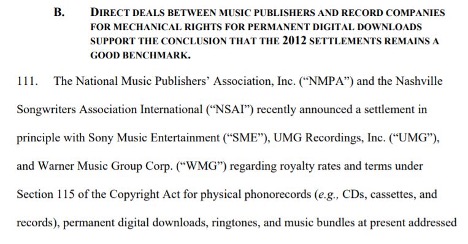
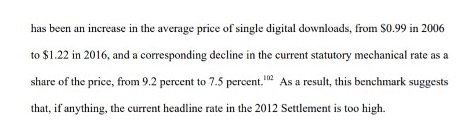
It did not take a soothsayer to foresee this result; the private settlement opened Pandora’s box – begetting misery for every songwriter. Since the CRB has been quiet for the last month with respect to this proceeding, yesterday, I began delving through some of the more recent Phonorecords III remand filings. And much to my unsurprise, I came across a statement from Pandora Media’s expert witness, Professor Michael Katz, who understandably used the proposed settlement as evidence that the streaming rates were fine as is. Katz’s statement was filed on April 4 – two months before songwriters became aware of the quiet filing of the private settlement and began speaking out. Here’s the link to Professor Katz’s testimony and you’ll find the text below beginning on page 65: https://app.crb.gov/document/download/23858 .
Pandora not only used the settlement to make the case that the streaming mechanicals rate in the 2012 settlement was a “good benchmark,” but also, even more disastrously, used this argument to rationalize the 2012 rate being TOO HIGH.
This is what happens when there are only a select few gatekeepers, privileged with endless resources and far removed from the plight of independent songwriters, making decisions that affect literally every songwriter’s future. This is why CRB proceedings must be more easily accessible for independent songwriters and their staunch advocates. This is the consequence of the “willing buyer” and “willing seller” appearing on different sides of the same corporate coin – (and if anyone wishes to challenge me on this point be ready for some “interlocking board” remarks based on extensive research into conflicts of interest). Songwriters deserve better than to have this crucial revenue stream frozen – especially immediately following an eighteen-month-long worldwide pandemic.
After the release of misery and misfortune with the private settlement, hope remained at the bottom of pandora’s box—hope that the CRB would allow the songwriters affected by the private settlement to at least have an opportunity to be heard in the exclusive and expensive environment of the Copyright Royalty Board. Once the CRB publishes their request for public comments (on the Friday before the July 4 weekend), songwriters may at last have their chance.
And I firmly believe that by the CRB providing every songwriter the opportunity to express how this settlement and the proposed regulations freezing mechanicals for another five years fails to represent her interest, it will exbibit to all the inherent value of songs and restore hope that every voice matters.
[Editor Charlie sez: Our great allies Ted Deutch and Darrell Issa are introducing a law to guarantee the key object of the #IRespectMusic campaign–artist pay for radio play!]
Reps. Deutch and Issa will be joined by legendary artists Dionne Warwick, Sam Moore, and others to introduce legislation to ensure music creators are fairly compensated when their songs are played on AM/FM radio
(Washington) On Thursday, June 24 at 1:15 pm ET, Rep. Ted Deutch (D-FL) and Rep. Darrell Issa (R-CA) are hosting a national press event alongside artist-advocates like Dionne Warwick and Sam Moore to introduce the American Music Fairness Act.
Members of the press can register here. This event will be live-streamed here.
After COVID-19 disrupted artists’ financial stability, it is more important than ever that legislation is passed to ensure music creators are compensated when their music plays on FM/AM radio stations. The American Music Fairness Act will require that performing artists are paid for the use of their songs on FM/AM radio — just like they already do on digital streaming services.
This bipartisan bill is a response to the Local Radio Freedom Act championed by the National Association of Broadcasters.
WHAT: A national press event announcing the American Music Fairness Act
WHO: · Rep. Ted Deutch (D-FL) · Rep. Darrell Issa (R-CA) · Dionne Warwick · Sam Moore · Additional artist-advocates
WHEN: Thursday, June 24, 1:15pm ET
WHERE: House Triangle, United States Capitol, Washington, DC
The Copyright Royalty Board has announced its decision on webcasting rates under §114 for 2021-25 and it’s good news for non-featured artists, featured artists and sound recording copyright owners. The rates are set for 2021, paid retroactively to January 1.
Service
New Rate Per Performance 2021
Old Rate Per Performance 2020
Increase
Commercial Nonsubscription
$0.0021
$0.0018
+17%
Commercial Subscription
$0.0026
$0.0024
+8%
Noncommercial Webcaster (Non-educational)
$1000 per station or channel up to 159,140 Aggregate Tuning Hours/month Overage at $0.0021 per performance
$500 per station or channel up to 159,140 Aggregate Tuning Hours/month. Overage at $0.0018 per performance
Per-station: +100% Overage: +17%
After 2022, these rates are adjusted by the Consumer Price Index (CPI-U for the geeks).
The Copyright Royalty Judges shall adjust the royalty fees each year to reflect any changes occurring in the cost of living as determined by the most recent Consumer Price Index for All Urban Consumers (U.S. City Average, all items) (CPI-U) published by the Secretary of Labor before December 1 of the preceding year.
So it is clear that the CRB can come up with reasonable rates when they’re asked. It’s also a great example of the power of strong bargaining groups including SoundExchange, the unions, indie and major record companies, and a broad cross-section of music users.
Rates for noncommercial educational webcasters, satellite radio, audio for business establishments and some others — are decided in a different process. Their 2021 rates for these service are on the SoundExchange website.
Since the 2000s, the development of download platforms, then streaming services, has both contracted and expanded the music market. However, despite recently accelerating growth, the value thus created is not shared fairly. Indeed, the performers whose music creates this value receive little or no revenue when their recordings are used online with relatively few exceptions.
The implementation of the fundamental principles set out below is essential to, at last, guarantee the payment of a fair remuneration to music performers for the value transfer from their work. Such implementation must, in particular, rely on the proven mechanisms of collective management or collective bargaining.
1. Right to a fair remuneration
All music performers, whether featured or non-featured, should receive fair remuneration for each online use of their recordings, regardless of the technology used to access or distribute them.
Any act that does not meet the conditions for a download (choice of track + choice of time + choice of location) should not be covered by the right of Article 10
2. Scope of the right of making available on demand
The right of making available on-demand (article 10 of the WIPO Performances and Phonograms Treaty) provides performers with “the exclusive right of authorizing the making available to the public of their performances fixed in phonograms, by wire or wireless means, in such a way that members of the public may access them from a place and at a time individually chosen by them”.
This right was formulated at the time of the transition from physical to digital distribution by download. The technological evolution that has allowed the development of streaming offers since 2008 was in no way anticipated when the WPPT was adopted in 1996. Article 10 could never have been the subject of a consensus if the community of performers had measured the risk of its erroneous application to all the uses offered by streaming platforms.
The right of making available on-demand is designed for cases where end-users choose what music they want to listen to, when to listen to it and where to listen to it. Thus, any act that does not meet the conditions for a download (choice of track + choice of time + choice of location) should not be covered by the right of Article 10.
In particular, it should not apply when a selection of tracks made by a third party (a natural person or an algorithm) is offered for listening to the consumer, following a personalization based on the choice of a style, an atmosphere, an artist or any other criterion leading to a limited and pre-established “playlist”.
3. Adaptation of remuneration schemes
Performers’ economic precariousness – highlighted during the COVID-19 pandemic – demonstrates that the exclusive right of making available on-demand (art. 10 of the WPPT), which can be assigned individually without any real compensation, is in itself unfit for embracing the current technological environment. The unilateral choice of platforms and the phonographic industry to apply this right to all forms of streaming, regardless of their level of interactivity or personalization, obviously serves the interests of these industries.
Non-featured performers generally receive a one-time, often purely symbolic, lump-sum payment in return for the transfer of their exclusive rights to the producer. Such unfair practices deprives them of a fair share of the revenue and value generated by their creative contribution. This structurally unbalanced contractual relationship can be corrected by resorting to collective bargaining.
More generally, collective bargaining constitutes a legitimate and effective means of improving the conditions for the transfer of a performer’s exclusive rights and their remuneration once assigned to the producer.
As grassroots protests by performers illustrate, the status quo is untenable. The streaming economy must switch paradigms to ensure fair remuneration for all performers and all types of online uses. Concerning non-interactive or partially interactive uses (playlists), the right to remuneration under Article 15, WPPT, which leads to an equal split of the equitable remuneration received from broadcasters and other users, constitutes a relevant reference model and precedent.
4. Transparency and access to information
All performers must receive and be able to access detailed information concerning the use of their recordings and the payments to which they are entitled. Payment of sums due to the artist must occur on the dates specified, must be subject to a compliance examination of platforms by performers to help assure correct payments, and must be accounted for regardless of the amount and without payment thresholds. National laws must include provisions guaranteeing the exercise of these rights.
5. Value of Music
Price competition between platforms and the priority they give to enterprise market valuation (as reflected in share price) over revenue may induce a devaluation of music in a race to the bottom on royalty payments while share price is booming. Access to a repertoire through output licenses set to grow endlessly for a flat-rate subscription – which has remained at the essentially same price point for more than ten years – does not seem capable of providing long-term sustainability for the creative sector given the dominant pro-rata royalty model.
6. User-centric model
In the vast number of cases, the pro-rata distribution of streaming revenues does not remunerate the featured artists’ right of making available, even when their contract provides (after the transfer of this right) for the payment of royalties. Instead, it creates a hyper-efficient market share distribution of revenue. This is not acceptable. It is also not acceptable for end-users to pay for music that they do not listen to, or that the music they listen to does not generate commensurate income for the artists concerned. This lack of direct correlation between listening and payment is a fundamental problem. Only the universal adoption of the “user-centric” distribution model can redress this injustice to both the fan and the performers. By allowing “niche” recordings, works or styles to generate remuneration, it also supports diversity and promotes local cultures. It should therefore be implemented, and the economic models adapted accordingly.
7. Duration of reference for the count of plays
The length of the tracks varies considerably according to the genre of music. Durations can range from less than two minutes for a variety track to several tens of minutes for a jazz or classical music track. The count of plays entitled to payment should take these differences into account by introducing a dose of proportionality. A longer track should trigger several payments as listening reaches certain thresholds to be negotiated.
By limiting the economic return on very short tracks, such an adaptation would avoid an excessively uniform offer. It would also positively affect diversity by partly redirecting payments towards less popular musical genres such as jazz or classical music. More generally, artistic creativity could be expressed more freely, without time constraints motivated by profitability objectives.
The Ivors Academy joins the campaign against frozen mechanical royalties for songwriters by the Copyright Royalty Board in the US. Ivors is the UK’s independent professional association for music creators and is a community of diverse, talented songwriters and composers across all styles. Their talent creates the music that the world loves. The organization was formerly known as the British Academy of Songwriters, Composers and Authors, and is home to the Ivors Awards named after Ivor Novello. Ivors Academy are leading advocates for songwriters across Europe and are leading the #BrokenRecord and #PaySongwriters campaigns that have resulted in an inquiry into music streaming by the UK Parliament. Follow them at @IvorsAcademy.
The Rolling Stones, Pet Shop Boys, Emeli Sandé, Barry Gibb, Van Morrison, Sir Tom Jones and the Estates of John Lennon and Joe Strummer have written to the Prime Minister “on behalf of today’s generation of artists, musicians and songwriters here in the UK”.
In an unprecedented show of solidarity, they have added their names to a joint letter with artists such as Annie Lennox, Paloma Faith, Kano, Joan Armatrading, Chris Martin, Gary Barlow, Paul McCartney, Melanie C, Jimmy Page, Boy George, Noel Gallagher and Kate Bush, calling on the PM to update UK law to “put the value of music back where it belongs – in the hands of music makers.”
This renewed call comes on the back of a report last week by The World Intellectual Property Organisation (WIPO)which said this is a “systemic problem [that] cries out for a systemic solution” and concluded that streaming should start to pay more like radio: “The more global revenues surge, the harder it is for performers to understand why the imbalance is fair—because it is not…streaming remuneration likely should be considered for a communication to the public right.”
More and more people are streaming music – heightened by the pandemic – but, as the artists point out, “the law has not kept up with the pace of technological change and, as a result, performers and songwriters do not enjoy the same protections as they do in radio,” with most featured artists receiving tiny fractions of a US cent per stream” and session musicians receiving nothing at all.
The letter suggests that “only two words need to change in the 1988 Copyright, Designs and Patents Act…so that today’s performers receive a share of revenues, just like they enjoy in radio” – a change which “won’t cost the taxpayer a penny but will put more money in the pockets of UK taxpayers and raise revenues for public services like the NHS” and which will contribute to the “levelling-up agenda as we kickstart the post-Covid economic recovery.”
The 234 signatories do not want streaming to be recognised as radio. Instead, they want streaming to share some of radio’s remuneration model so that they are paid more fairly. Legislation, despite recognising that streaming is replacing sales, is yet to recognise that the technology is on its way to replacing radio too.
The letter is backed by the Musicians’ Union, the Ivors Academy and the Music Producer’s Guild collectively representing tens of thousands of UK performers, composers and songwriters and producers, brought together in partnership with the #BrokenRecord campaign led by artist and songwriter, Tom Gray.
The Commons DCMS Committee has been examining this issue with its Economics of music streaming inquiry, expected to report by the end of this month, but it is understood that this issue falls between the remits of both the DCMS and BEIS departments, which is why the artists have chosen to address it to the Prime Minister.
The letter also recommends “an immediate government referral to the Competition and Markets Authority” because of “evidence of multinational corporations wielding extraordinary power” over the marketplace and the creation of an industry regulator.
They write that these changes “will make the UK the best place in the world to be a musician or a songwriter, allow recording studios and the UK session scene to thrive once again, strengthen our world leading cultural sector, allow the market for recorded music to flourish for listeners and creators, and unearth a new generation of talent.”
Tom Gray, Founder of the #BrokenRecord Campaign, said:
“It is amazing and timely that the World Intellectual Property Organisation, who create the global treaties that underpin UK law, are now reporting that we are right. This is the moment for the UK to lead the way. British music makers are suffering needlessly. There is an extraordinary amount of money in music streaming. It is a success story for a few foreign multinationals, but rarely for the British citizens who make the music”
“This letter is fundamentally about preserving a professional class of music-maker into the future. Most musicians don’t expect to be rich and famous or even be particularly comfortable, they just want to earn a crust.”
Horace Trubridge, General Secretary of the Musicians’ Union, said:
“I’m delighted to see so many artists, performers and songwriters backing our call. Streaming is replacing radio so musicians should get the same protection when their work is played on streaming platforms as they get when it’s played on radio.
“As the whole world has moved online during the pandemic, musicians who write, record and perform for a living have been let down by a law that simply hasn’t kept up with the pace of technological change. Listeners would be horrified to learn how little artists and musicians earn from streaming when they pay their subscriptions.
“By tightening up the law so that streaming pays more like radio, we will put streaming income back where it belongs – in the hands of artists. It’s their music so the income generated from it should go into their hands.”
Graham Davies, Chief Executive of the Ivors Academy, said:
“Paying music creators properly, which is what so many incredible artists have spoken up to ask for on behalf of present and future musicians and songwriters, will drive the streaming industry and sustain the UK creative economy. Music should and could be a major national asset, but its potential value is currently stripped by overseas interests.
We need to keep the value of British music in our nation by supporting, nurturing and investing in our creators, whilst ensuring the handful of foreign multinational corporations which dominate the music industry and have little interest in preserving British cultural heritage, contribute more value back into the UK. These easy steps will achieve exactly that.”
Crispin Hunt, Chair of the Ivors Academy, said:
“Major Music labels delude themselves that they are the sole providers of the music economy. They are not; the musicians, producers and composers who signed this letter are the true providers of the music economy; without them, no employment in music could exist.
“Britains Music Creators should be the primary beneficiaries of the value their creativity drives. The record companies are now glorified marketing firms, without manufacturing and distribution costs. Their extraordinary profits ought to be shared more equitably with creators. In streaming the song is king, yet songwriters are streaming’s serfs.
“British Music Creators want nothing more than a reasonable partnership with the companies that market and distribute our work. But a reasonable partnership should be based on shared rewards and responsibilities, not unilateral takings.
“With this letter, Britain’s greatest Music Creators say Music must reform, Government can and should help us fix it.”
The post is a very illuminating look inside the CRB process that many find mysterious, and also is a good demonstration of some of the concerns expressed by writers on The Trichordist on this subject. The three accomplished Nashville songwriters add some color commentary to the proceedings, particularly for those who may have been in high school or college during the 2006 CRB frozen mechanical rate setting that many think caused the problem.
The songwriters express a good deal of frustration and passion which is as understandable as the frustration and passion of those who feel that the CRB process is as inequitable, unwieldy and prohibitively expensive as these songwriters seem to be telling us that it is. Someone may want to do a point by point discussion of the many good issues that the three Nashville songwriters raise, but a couple things jump out.
First, they defend the streaming mechanical rate from the last CRB. No one criticized the streaming mechanical rate in the last CRB proceeding that is currently under appeal. If the rate survives the appeal and reworking at the CRB, and makes its way through the MLC, every songwriter should expect to see the promised increase in their streaming royalty check. That would be a great thing and everyone no doubt thanks everyone involved for the effort. The topic, though, was primarily the frozen mechanical not the streaming mechanical.
Also, who paid the $20 million cost for “our side” to participate in the CRB that the three Nashville songwriters refer to? Surely the publishers did not ask the songwriters to open up their own pocketbooks, even though each has been extraordinarily successful in their genre.
We couldn’t find any discussion by the three Nashville songwriters of what terms are in the private settlements referred to in their own filing. The point that many have made about public commentary about the private settlements is that the Copyright Royalty Judges can decide on who is “bound” by the settlements and that it is the motion at issue as filed that gets commented on unless the Judges ask that it be supplemented. Commenters said the “who” should be broadly construed. They also said that the “what” is crucially important. Many have made the point that public commentary about the settlements requires that all the terms of the settlements are made public. Until made public, the terms are private. The only thing we know about the settlements from the three Nashville songwriters’ own CRB filing is the terms that are disclosed—frozen rates. Even though their filing refers to settlements, we still don’t know anything further. Maybe we will in coming days. Any additional terms that exist may not be remarkable, but they might be. Presumably this is the kind of thing that important people in the negotiation process would know due to their special position. We just don’t know.
The three Nashville songwriters apparently believed they had a mandate to make decisions about what was worth pursuing in the CRB. If they did have that belief, presumably they base that belief on some kind of vote. Since their CRB settlement impacts every songwriter in the world, that’s the magnitude of decision that some might think is deserving of a vote of their membership, not just a board vote if that’s what happened—we just don’t know. It’s a real privilege to be in the position to make those kinds of decisions, so you might well think that it’s the kind of thing you wouldn’t want to take on by yourself or with only the approval of a limited number of people. But maybe not.
Be sure to read this post and thank these songwriters for their service to the community. They certainly deserve it.
Readers should now better understand the century of sad history for U.S. mechanical royalties that cast a long commercial shadow around the world. This history explains why extending the freeze on these mechanical rates in the current CRB proceeding (“Phonorecords IV”) actually undermines the credibility of the Copyright Royalty Board if not the entire rate setting process. The CRB’s future is a detailed topic for another day that will come soon, but there are many concrete action points raised this week for argument in Phonorecords IV today–if the parties and the judges are motivated to reach out to songwriters.
Let’s synthesize some of these points and then consider what the new royalty rates on physical and downloads ought to be.
1. Full Disclosure of Side Deals: Commenters were united on disclosure. Note that all we have to go on is a proposed settlement motion about two side deals and a draft regulation, not copies of the actual deals. The motion acknowledges both a settlement agreement and a side deal of some kind that is additional consideration for the frozen rates and mentions late fees (which can be substantial payments). The terms of the side deal are unknown; however, the insider motion makes it clear that the side deal is additional consideration for the frozen rate.
It would not be the first time that a single or small group negotiated a nonrecoupable payment or other form of special payment to step up the nominal royalty rate to the insiders in consideration for a low actual royalty rate that could be applied to non-parties. The rate—but not the side deal–would apply to all. (See DMX.)
In other words, if I ask you to take a frozen rate that I will apply to everyone but you, and I pay you an additional $100 plus the frozen rate, then your nominal rate is the frozen per unit rate plus the $100, not the frozen rate alone. Others get the frozen rate only. I benefit because I pay others less, and you benefit because I pay you more. Secret deals compound the anomaly.
This is another reason why the CRJs should both require public disclosure of the actual settlement agreement plus the side deal without redactions and either cabin the effects of the rate to the parties or require the payment of any additional consideration to everyone affected by the frozen rate. Or just increase the rate and nullify the application of the side deal.
It is within the discretion of the Copyright Royalty Judges to open the insider’s frozen mechanical private settlement to public comment. That discretion should be exercised liberally so that the CRJs don’t just authorize comments by the insider participants in public, but also authorize public comments by the general public on the insiders work product. Benefits should flow to the public–the CRB doesn’t administer loyalty points for membership affinity programs, they set mechanical royalty rates for all songwriters in the world.
2. Streaming Royalty Backfire: If you want to argue that there is an inherent value in songs as I do, I don’t think freezing any rates for 20 years gets you there. Because there is no logical explanation for why the industry negotiators freeze the rates at 9.1¢ for another five years, the entire process for setting streaming mechanical rates starts to look transactional. In the transactional model, increased streaming mechanicals is ultimately justified by who is paying. When the labels are paying, they want the rate frozen, so why wouldn’t the services use the same argument on the streaming rates, gooses and ganders being what they are? If a song has inherent value—which I firmly believe—it has that value for everyone. Given the billions that are being made from music, songwriters deserve a bigger piece of that cash and an equal say about how it is divided.
3. Controlled Compositions Canard: Controlled comp clauses are a freeze; they don’t justify another freeze. The typical controlled compositions clause in a record deal ties control over an artist’s recordings to control over the price of an artist’s songwriting (and often ties control over recordings to control over the price for the artist’s non-controlled co-writers). This business practice started when rates began to increase after the 1976 revision to the U.S. Copyright Act. These provisions do not set rates and expressly refer to a statutory rate outside of the contract which was anticipated to increase over time—as it did up until 2006. Controlled comp reduces the rate for artist songwriters but many publishers of non-controlled writers will not accept these terms. So songwriters who are subject to controlled comp want their statutory rate to be as high as possible so that after discounts they make more.
Because controlled comp clauses are hated, negotiations usually result in mechanical escalations, no configuration reductions, later or no rate fixing dates, payment on free goods and 100% of net sales, a host of issues that drag the controlled comp rates back to the pure statutory rate. Failing to increase the statutory rate is like freezing rate reductions into the law on top of the other controlled comp rate freezes—a double whammy.
It must be said that controlled compositions clauses are increasingly disfavored and typically don’t apply to downloads at all. If controlled comp is such an important downward trend, then why not join BMG’s campaign against the practice? If you are going to compel songwriters to take a freeze, then the exchange should be relief from controlled compositions altogether, not to double down.
4. Physical and Downloads are Meaningful Revenue: Let it not be said that these are not important revenue streams. [Ironically, Taylor Swift just broke the record for first week vinyl sales on her Evermore album.] As we heard repeatedly from actual songwriters and independent publishers, the revenue streams at issue in the insider motion are meaningful to them. Even so, there are still roughly 344.8 million units of physical and downloads in 2020 accounting for approximately $1,741.5 billion of label revenue on an industry-wide basis. And that’s just the U.S. Remember—units “made and distributed” are what matter for physical and download mechanicals, not “stream share”. If you don’t think the publishing revenue is “meaningful” isn’t that an argument for raising the rates?
U.S. Recorded Music Sales Volumes and Revenue by Format (Physical and Downloads) 2020
5. Inflation is Killing Songwriters: The frozen mechanical is not adjusted for increases in the cost of living, therefore the buying power of 9.1¢ in 2006 when that rate was first established is about 75% of 9.1¢ in 2021 dollars.
6. Willing Buyer/Willing Seller Standard Needs Correction: When the willing buyer and the willing seller are the same person (at the group level), the concept does not properly approximate a free market rate under Section 115. Because both buyers and sellers at one end of the market are overrepresented in the proposed settlement, the frozen rates do not properly reflect the entire market. At a minimum, the CRJs should not apply the frozen rate to anyone other than parties to the private settlement. The CRJs are free to set higher rates for non-parties.
7. Proper Rates: While the frozen rate is unacceptable, grossing up the frozen rate for inflation at this late date is an easily anticipated huge jump in royalty costs. That jump, frankly, is brought on solely because of the long-term freeze in the rate when cost of living adjustments were not built in. The inflation adjusted rate would be approximately 12¢ (according to the Bureau of Labor Statistics Inflation Calculator https://www.bls.gov/data/inflation_calculator.htm).
Even though entirely justified, there will be a great wringing of hands and rending of garments from the labels if the inflation adjustment is recognized. In fairness, just like the value of physical and downloads differ for independent publishers, the impact of an industry-wide true-up type rate change would also likely affect independent labels differently, too. So fight that urge to say cry me a river.
Therefore, it seems that songwriters may have to get comfortable with the concept of a rate change that is less than an inflation true up, but more than 9.1¢. That rate could of course increase in the out-years of Phonorecords IV. Otherwise, 9.1¢ will become the new 2¢–it’s already nearly halfway there. The only thing inherent in extending the frozen mechanicals approach is that it inherently devalues the song just at the tipping point.
Songwriters do not want the mechanical royalty rate for physical products and digital downloads to remain frozen through 2027 due to private party settlements without our input. Songwriters deserve transparency and a seat at the table. @thetrichordisthttps://t.co/rCJ8oYqhsW
— Austin Texas Musicians (@atxmusicians) May 27, 2021
Senator Richard Blumenthal 90 State House Square Hartford, CT 06103
Senator Chris Murphy Colt Gateway 120 Huyshope Avenue, Suite 401 Hartford, CT 06106
Hon. C.J. Jesse M. Feder Hon. J. David R. Strickler Hon. J. Steve Ruwe
US Copyright Royalty Board 101 Independence Ave SE / P.O. Box 70977 Washington, DC 20024-0977
Senators Blumenthal and Murphy, and Honorable Judges of the Copyright Royalty Board:
I am a Connecticut resident, attorney, and law professor, and the views expressed here are mine, and not necessarily those of any local or state bar association, or any employer. I am an active participant in politics local, state, and federal. I am a registered non-affiliate in New Haven. And I need your attention for about ten minutes.
On May 18, 2021, a “Notice of Settlement in Principle” was filed by parties to the proceedings before the Copyright Royalty Board about its Determination of Royalty Rates and Terms for Making and Distributing Phonorecords.[1] That Notice was followed on May 25, 2021 by a Motion To Adopt Settlement Of Statutory Royalty Rates And Terms For Subpart B Configurations, filed by the NMPA, Sony, Universal and Warner and NSAI.[2] I write today in reference to that proposed settlement.
This settlement outlines the terms by which mechanical royalty[3] and download rates will remain locked at the current rate of 9.1¢. The same almost-dime for each copy of a work manufactured and distributed. The same almost-dime that it’s generated since 2006. A paltry sum to be certain but a far cry from the 2¢ royalty rate mechanical royalties imposed for the better part of seventy years.[4] Starting in 1977, Congress mandated that the mechanical royalty be increased incrementally until 2006 when the rate of 9.1¢ was achieved. And there it has remained.
This proposed private settlement would extend that 2006 freeze until 2027.
In March 2017, a precursor to Phonorecords IV found the Copyright Royalty Board ruling that interactive streaming services must pay more in mechanical royalties over the course of the next five years.[5] Surely more than a simple inflation adjustment, but nonetheless a sign that the CRB thought costs and values needed to become more aligned for streaming—which is paid by the streaming platforms unlike the physical and download mechanical which is paid by the record companies. Now comes Phonorecords IV, and a proposed settlement from the major publishers and their affiliated major labels. Before this proposal can be accepted by the CRB, I asked for the simple opportunity of public comment.
As you well know, in nearly all other administrative proceedings public comment is an integral and indispensable component of the process. To see that the CRB may allow for a public comment period by members of the public beyond the participants in the proceeding or parties to the settlement is a step in the right direction, and my hope is that this development will be broadcast far and wide so that the CRB, and in turn, Congress, may get a full picture of the status of mechanical royalty rates, especially from those that are historically underrepresented. “Public comments” should be comments by the public and made in public; not comments by the participants made publicly.
Let me back up and state that I have a great deal of respect and admiration for the work put into the landmark copyright legislation that came about at the end of 2018, and for those that made it happen. So too for the members of the CRB, and in this space, I thank those Judges for taking the time to read a letter from an adjunct law professor with no economic stake in the outcome, but rather an interest in, and duty of, candor to the Court.
In an age of unprecedented political polarization, the consensus built in the passage of the Music Modernization Act showed that politics aside, when it’s time to make new laws that fix old problems, Congress can still get the job done. I know well the sweat-equity poured into its creation by the very same people that propose this settlement. I have found myself on the same side fighting the same fight as them many times. They have proven capable of navigating your halls and taking on those that would seek to devalue (or worse) the work of the songwriter, and musician. In this instance, I would like to see them fight the fight yet again. recognize the reasoning and intention behind the proposed settlement. Comment by the public made publicly is a way for that to happen.[6]
Our state, Connecticut, has a long and storied history with music. In 1956, The Five Satins recorded what would go on to be one of the most recognizable and beloved doo-wop songs in history. “In The Still of the Night” was ranked 90th in Rolling Stone’s list of Top 500 songs of all time.[7] Five years later, the 1961 Indian Neck Folk Festival was where a young Bob Dylan’s first recorded performance.[8] That young man turned into a fine songwriter, as evidenced by the 4,000+ covers recorded of his works, and his record sale last year of his publishing royalties.[9] And no one will forget Jim Morrison’s arrest at the old New Haven Arena, December 1967. Ticket price: $5.00. Connecticut is home to more than 14,000 registered songwriters, only a small percentage of whom have engaged a music publisher. These writers are considered “self-publishing”, but the reality is, they have no publishing. Ironically, it is these independent writers who rely disproportionately on physical sales, direct downloads, and Bandcamp Fridays.[10]
A year ago, I made the unilateral decision to pivot our consulting company, Ecco Artist Services, to purposefully work with, and advocate for, the traditionally and historically underserved and underrepresented in the music industry. Freezing the growth of rates for physical and digital sales that are already digging out of the residual effects of 70 years at 2¢ strikes at the heart of that community’s ability to generate revenues from their music.
Sadly, rate freezes for mechanical royalties are nothing new. I’ll tell you what has not been frozen since 2006: the cost of living. According to the U.S. Bureau of Labor Statistics, prices for rent of primary residence were 53.49% higher in 2021 versus 2006 (a $534.91 difference in value). Between 2006 and 2021 rent experienced an average inflation rate of 2.90% per year. This rate of change indicates significant inflation. In other words, rent costing $1,000 in the year 2006 would cost $1,534.91 in 2021 for an equivalent purchase. Compared to the overall inflation rate of 1.82% during this same period, inflation for rent was higher.[11] Milk? How about 19.48%.[12] Childcare? In Connecticut? Senators, you don’t even want to know.[13]
Now, it’s no secret the trade association for the US music publishing industry is funded by its music publisher members, and of course, as a professional trade organization, the association is bound to represent those members. Publishers have long enjoyed a better reputation amongst industry insiders than “the labels,” and for good reason, but the fact remains that writers signed to publishing deals are in contractual relationships with their publishers, and their interests are not always aligned. Such is the state of play in a consumer-driven marketplace, and especially now that publishers and labels are consolidating their businesses under the same tents.
Unfortunately, the independent songwriter lacks the resources to participate fully in the process, and although a signed songwriter may believe her interests and those of her publisher are one and the same, they may not always be. It would seem the economic analysis the publishers undertook in deciding the mechanical royalty was not worth the heavy cost and burden of fighting is the same calculus the writers need not do: they couldn’t afford the fight no matter the decision.
But I ask: if the mechanical royalty covered by the proposed settlement is a dying source of revenue, why would the fight be so onerous? By the RIAA’s 2020 year-end statistics, physical sales and downloads accounted for 15% of the music marketplace.[14] That’s a $12.2 billion marketplace, and that 15% amounts to $1.8 billion. Now, I know attorney’s fees can be exorbitant in regulatory matters, but I would think we could find a firm willing to take the case for less than that. As for sales, in 2020, 27.5 million vinyl LPs were sold in the United States, up 46-percent compared to 2019 and more than 30-fold compared to 2006 when the vinyl comeback began,[15] while some 31.6 million CD albums were sold.[16]
Median wages in the US, adjusted for inflation, have declined 9% for the American worker. Meanwhile, since the 9.1¢ rate freeze, the cost of living has gone up 31%, according to the American Institute of Economic Research[17]. The 2006 inflation rate was 3.23%. The current year-over-year inflation rate (2020 to 2021) is now 4.16%[18], which is all really to say, simply, an accurate cost-of-living increase would have a mechanical rate of at least 12¢ per sale. Twelve cents! You would think that would be an easy sell, but the streaming rates are fractions of that rate. The reality is a song would need to be streamed 250 times to generate enough money to buy it from iTunes. As my dear friend Abby North put it, the royalty amount for the digital stream of a song is a micro penny.[19]
An adjustment for inflation should require no briefing, let alone argument. If songwriters were employees, this would simply be line-item budgeted as a “cost-of-living adjustment.” If songwriters were unionized it would be a rounding error, but I digress.
A period and opportunity for the general public to comment publicly and on the record in these and other proceedings before the presentation to the CRB of this proposed settlement is in the interest of all involved. Even if it is true that the mechanical revenue is a lost and dying stream, by the RIAA’s own figures, there stand to be billions of dollars at stake. An opportunity to be heard, without having to sign with a publisher and then hope that publisher takes up the fight you want, maybe that’s all the independent writers of the industry—and, indeed, the world–need to be able to win.
In addition to a meaningful public comment period, and an inflation-adjusted cost-of-living update to the mechanical statutory royalty rate at issue, I’d ask that this letter be made a part of the Phonorecords IV public record and that you review the best practices of the Copyright Royalty Board. Not only so that those independent, self-published writers affected by its decision may voice their concerns through public comments that the CRB considers before it makes its final decision, but so that those of us that speak without financial stake in the matter can provide perspective from a policy and legal perspective.
I want to close by thanking the Board, and Copyright Office, the Judiciary Committee and the Intellectual Property Subcommittee, and the Copyright Royalty Board for their continued attention to the universe of copyright, licensing royalties, and the economy that exists therein. Lord knows there are lots of fires to be put out all over and the time spent and thought given to these policies is acknowledged and appreciated.
Kevin M. Casini New Haven, CT
Attorney-at-Law, Adj. Professor, Quinnipiac Univ. School of Law
[3] The term “mechanical royalty” dates back to the 1909 Copyright Law when Congress deemed it necessary to pay a music publishing company for the right to mechanically reproduce a musical composition on a player-piano roll. As a result, music publishers began issuing “mechanical licenses”, and collecting mechanical royalties from piano-roll manufacturers. The times, and the tech, changed, but the name stuck.
[6] The CRB arguably has the statutory obligation to publish the Motion in the Federal Register for public comment, but may have the discretion to construe those commenting to the participants in the proceeding and the parties to the settlement. 17 U.S.C. § 801(b)(7). It would be unfortunate if the Judges narrowly construed that rule to the exclusion of the general public, unlike the Copyright Office regulatory practice.
[7] “Rolling Stone’s 500 Greatest Songs of All Time”. Rolling Stone. April 2010.
[13] According to the U.S. Bureau of Labor Statistics, prices for childcare and nursery school were 52.57% higher in 2021 versus 2006 (a $5,256.98 difference in value).
Between 2006 and 2021: Childcare and nursery school experienced an average inflation rate of 2.86% per year. This rate of change indicates significant inflation. In other words, childcare and nursery school costing $10,000 in the year 2006 would cost $15,256.98 in 2021 for an equivalent tuition. Compared to the overall inflation rate of 1.82% during this same period, inflation for childcare and nursery school was higher.
You must be logged in to post a comment.