
TY @northmusicgroup + @thetrichordist 🚀
— ☠️ Kay Hanley Ξ (@kayhanley) May 25, 2021
The Copyright Royalty Board must allow songwriters + indy publishers to participate in CRB decisions. A public comments period would ensure that testimony not be limited to only wealthy, powerful interests.https://t.co/R1MQUwKadY
@NorthMusicGroup Letter to Congress on Frozen Mechanicals and the Copyright Royalty Board
May 13, 2021 – By Email
Senator Dianne Feinstein Senator Alex Padilla
United States Senate United States Senate
331 Hart Senate Office Building B03 Russell Senate Office Building
Washington, D.C. 20510 Washington, D.C. 2010
Re: Potential Settlement of Mechanical Royalty Rates in CRB Phonorecords IV
Dear Senators Feinstein and Padilla:
I am a California-based music publisher.
I’m writing to you to express my concern regarding the private party settlement submitted to the Copyright Royalty Board by the NMPA, NSAI, UMG, WMG and SME related to the Phonorecords IV physical and download mechanical rate.
My father-in-law was the composer and songwriter, Alex North. Alex worked for years, crafting scores to Hollywood feature films, and writing songs to accompany picture.
In 2015, Alex’s score to A STREETCAR NAMED DESIRE was added to the Library of Congress’ National Registry, as a recognition of the music’s importance as part of the fabric of United States arts and culture.
Alex composed the score to a 1955 film entitled UNCHAINED. The theme to that film became the melody to the song “Unchained Melody,” with the lyric written by Hy Zaret.
“Unchained Melody” has been recorded by thousands of artists, in all styles and genres. The lyric has been adapted to at least 20 different languages. “Unchained Melody” is among the most popular wedding songs of all time. Listeners still download recordings of “Unchained Melody.” They still buy CDs and vinyl releases.
I am the music publishing administrator of “Unchained Melody,” on behalf of my family and the Zaret family. I also administer over one hundred thousand other copyrights on behalf of legacy songwriters and their families, and on behalf of current songwriters and composers.
Songwriters struggle to earn a living wage. With the advent of digital streaming, physical and download sales have certainly declined. However, they have absolutely not disappeared. Anybody who says this royalty stream does not matter is simply not telling the truth.
The royalty amount for the digital stream of a song is a micropenny. Unless it is a top songwriter with hundreds of millions to billions of streams, there is an excellent chance that songwriter still may be driving Uber to support herself and her family.
It takes hundreds of streams of a recording to equal the 9.1 cent mechanical publishers receive for a physical sale or download. That’s why this physical and download mechanical rate is so important.
Vinyl sales are strong for many retailers including Amazon and Best Buy. CDs remain a significant media format, and many listeners still prefer to “own” rather than temporarily cache the music they listen to.
Increasing the statutory mechanical rate to simply adjust for inflation will dramatically (and positively) effect songwriters’ and publishers’ bottom lines. This fight is akin to the battle for an increased minimum wage.
Major music publishers do not face the same struggles as independent publishers and songwriters. Major publishers are part of multi-national conglomerates that own both the major publishers and major record labels. Major publishers that agree to fix the statutory rate simply are leaving more money in the pockets of the labels that are their sister companies.
Those of us that do not have sister companies have no such opportunity. That’s why we must fight to be heard.
Each quarter, I process statements from approximately 100 domestic and global sources, many of which include mechanical royalties for physical and download media. Each quarter, I make distributions to the multiple families that are heirs to, and owners of these copyrights. Songwriters and their families depend on royalties for food, mortgages, education and more.
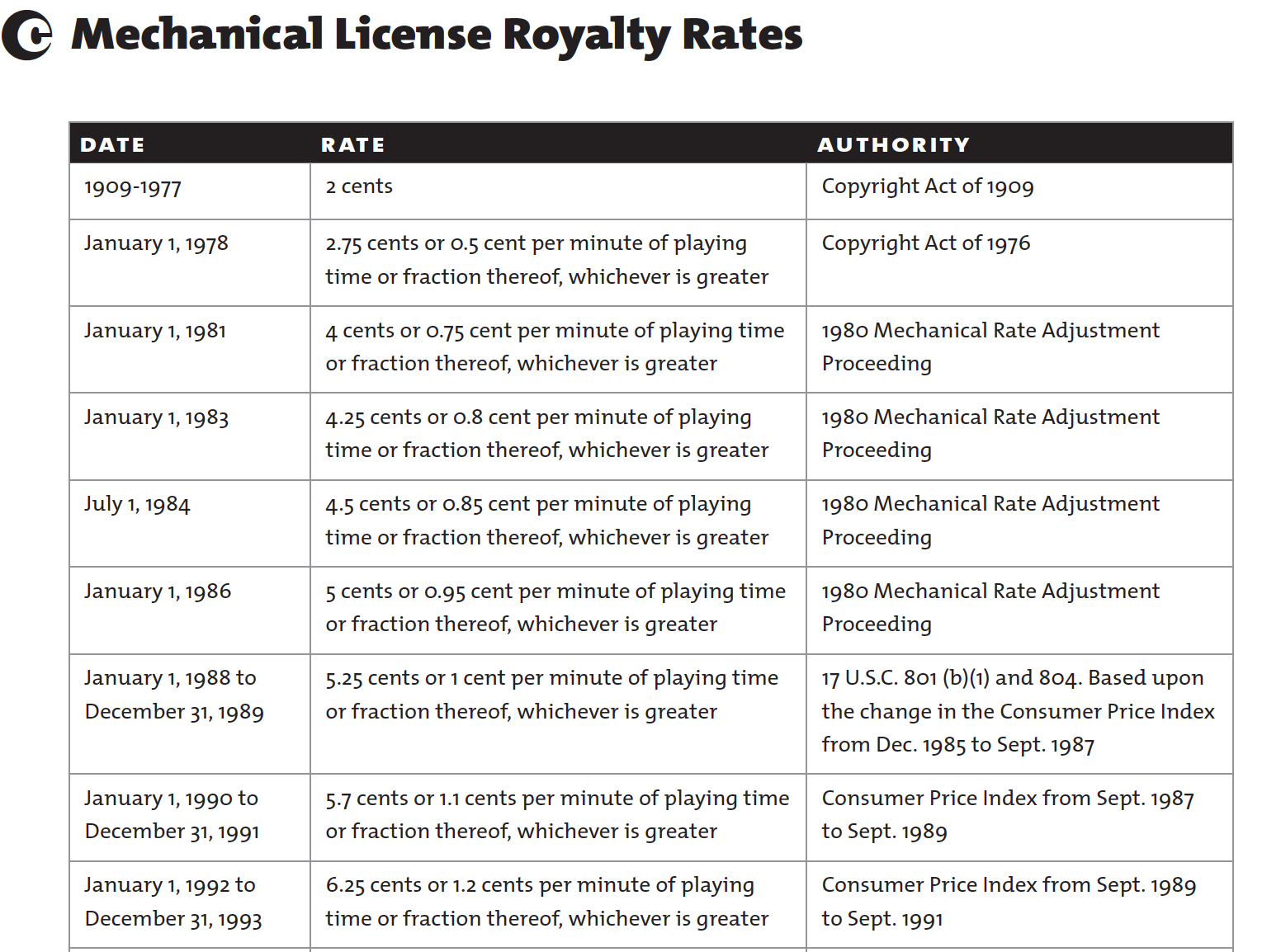
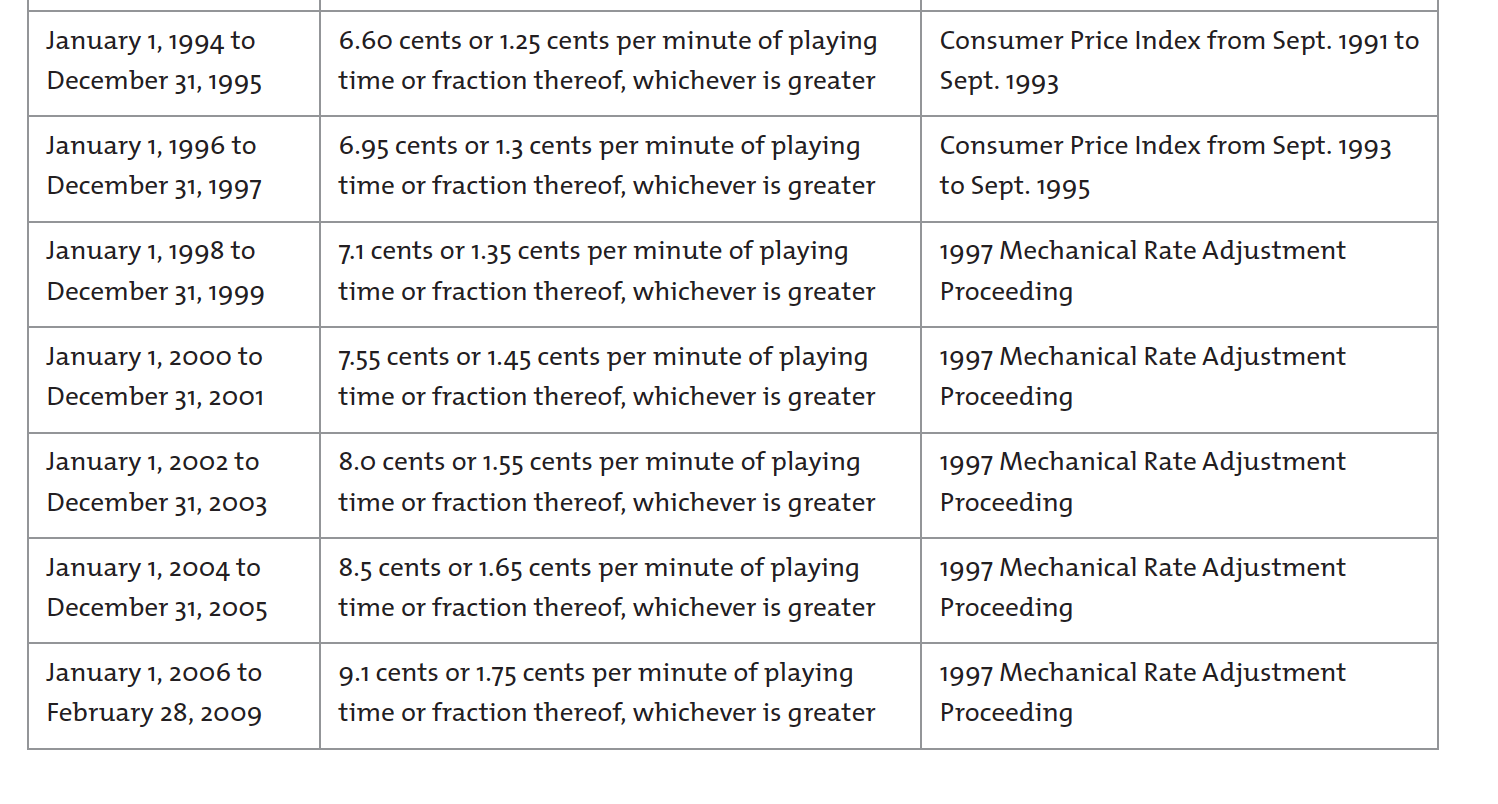
From the initial publication of “Unchained Melody” in 1955 through 2005 (approximately 50 years!), the statutory mechanical rate was fixed at 2 cents. Starting in 1977, the mechanical royalty incrementally increased from 2¢ to 9.1¢ per unit until 2006. But since 2006, the statutory rate again was frozen and remains so. The private settlement would extend that freeze until 2027.
I ask that you review the Copyright Royalty Board practices and consider allowing songwriters and independent publishers – who do not speak through trade organizations or major multi-national corporations — to voice their concerns through public comments that the CRB takes into account before it makes its final decision.
Best,
Abby North
@NorthMusicGroup Joins the List Opposing Frozen Mechanicals With the Copyright Royalty Board
We’ve been keeping track of those who are for freezing the statutory mechanical royalty rate for physical and permanent downloads for another five years out to 2027. The issue is currently part of the rate setting proceeding before the Copyright Royalty Board–which froze the same rate at 9.1¢ in 2006 and was first extended in 2009.

Here is the current list of those for and against freezing mechanicals on these categories for a total of 21 years:
| Against Frozen Mechanicals | Supporting Frozen Mechanicals |
| Songwriters Guild of America | National Music Publishers Association |
| Society of Composers and Lyricists | Nashville Songwriters Association International |
| Alliance for Women Film Composers | |
| Songwriters Association of Canada | |
| Screen Composers Guild of Canada | |
| Music Creators North America | |
| Music Answers | |
| Alliance of Latin American Composers & Authors | |
| Asia-Pacific Music Creators Alliance | |
| European Composers and Songwriters Alliance | |
| Pan African Composers and Songwriters Alliance | |
| North Music Group |
Copyright Royalty Board Responds to Coalition of Songwriter Groups on Frozen Mechanicals
A group of songwriter organizations from around the world wrote to the Copyright Royalty Board last week opposing a proposed private “settlement” between the major labels and the major publishers to freeze mechanical rates on physical and downloads at the 9.1¢ 2006 rate that was filed in the current Copyright Royalty Board (CRB) rate court hearing called “Phonorecords IV”. (You can find the entire list of filings in the case here.)
The twist here is that if the CRB approves the private settlement at the request of “the parties” and doesn’t take into account the views and evidence of people who actually write songs and have to earn a living from songwriting, it will be grotesquely unfair and possibly unconstitutional wage and price control. The CRB will have frozen the mechanical rate for physical and downloads at the 2006 rate when inflation alone has eaten away the buying power of that royalty by approximately 30%. This would be like the Minerals Management Service adopting a settlement written by Exxon.
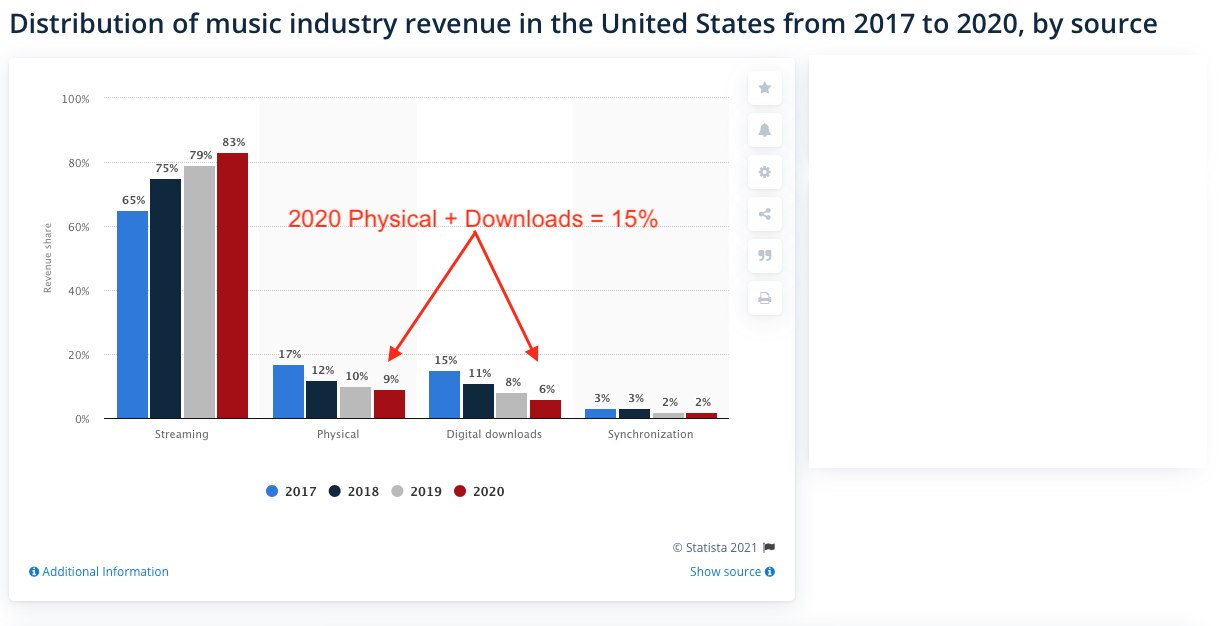
On average–on average–the physical and download configuration make up 15% of billing for the majors and for some artists vinyl is a welcome change from fractions of a penny on streaming. And then there’s Record Store Day–hello? These are a couple of the many reasons anyone who is paying attention should reject the terms of the settlement.
The Coalition had a simple ask: Let the public comment:
In the interests of justice and fairness, we respectfully implore the CRB to adopt and publicize a period and opportunity for public comment on the record in these and other proceedings,especially in regard to so-called proposed “industry settlements” in which creators and other interested parties have had no opportunity to meaningfully participate prior to their presentation to the CRB for consideration, modification or rejection. In the present case, hundreds of millions of dollars of our future royalties remain at stake, even in a diminished market for traditional, mechanical uses of music. To preclude our ability to comment on proposals that ultimately impact our incomes, our careers, and our families, simply isn’t fair.
The Copyright Royalty Board responded! According to our sources, the Copyright Royalty Board said that they would publish the private settlement in the Federal Register and give the pubic the chance to comment. This is great news!
But we will see what they actually do. The Copyright Royalty Board does not have a great track record in understanding songwriter interests in raising the mechanical rates as we can see in this except from their final rule freezing mechanicals again in 2009:
Copyright Owners’ argument with respect to this objective is that songwriters and music publishers rely on mechanical royalties and both have suffered from the decline in mechanical income. Under the current rate, they contend, songwriters have difficulty supporting themselves and their families. As one songwriter witness explained, “The vast majority of professional songwriters live a perilous existence.” [Rick] Carnes [Testimony] at 3. [Rick Carnes signed the Coalition letter as President of the Songwriters Guild of America.] We acknowledge that the songwriting occupation is financially tenuous for many songwriters. However, the reasons for this are many and include the inability of a songwriter to continue to generate revenue-producing songs, competing obligations both professional and personal, the current structure of the music industry, and piracy. The mechanical rates alone neither can nor should seek to address all of these issues.
We simply do not accept that the Founders put the Copyright Clause in the Constitution so creators could have a side hustle for their Uber driving which is exactly where frozen mechanicals take you, particularly after the structural unemployment in the music business caused by the COVID lockdowns.
Here is a summary of who is for and who is against frozen mechanicals.
| Against Frozen Mechanicals | Proposing Frozen Mechanicals |
| Songwriters Guild of America | National Music Publishers Association |
| Society of Composers and Lyricists | Nashville Songwriters Association International |
| Alliance for Women Film Composers | |
| Songwriters Association of Canada | |
| Screen Composers Guild of Canada | |
| Music Creators North America | |
| Music Answers | |
| Alliance of Latin American Composers & Authors | |
| Asia-Pacific Music Creators Alliance | |
| European Composers and Songwriters Alliance | |
| Pan African Composers and Songwriters Alliance |
Which side are you on? If you want to write your own comment to the Copyright Royalty Board about frozen mechanicals, send your comment to crb@loc.gov
Coalition of Songwriter Groups Call on Copyright Royalty Board for Fairness and Transparency on Frozen Mechanicals
[Editor T says this is a letter from a coalition of US and international songwriter groups to the Copyright Royalty Board about the frozen mechanical issue. If you want to write your own comment to the Copyright Royalty Board about frozen mechanicals, send your comment to crb@loc.gov]
MUSIC CREATORS
NORTH AMERICA
May 17, 2021
Via Electronic Delivery
Chief Copyright Royalty Judge Jesse M. Feder
Copyright Royalty Judge David R. Strickler
Copyright Royalty Judge Steve Ruwe
US Copyright Royalty Board
101 Independence Ave SE / P.O. Box 70977
Washington, DC 20024-0977
To Your Honors:
As a US-led coalition representing hundreds of thousands of songwriters and composers from across the United States and around the world, we are writing today to express our deep concerns over the “Notice of Settlement in Principle” recently filed by parties to the proceedings before the Copyright Royalty Board concerning its Determination of Royalty Rates and Terms for Making and Distributing Phonorecords (Phonorecords IV) (Docket No. 21–CRB–0001–PR<(2023–2027)). For reasons explained below, several highly conflicted parties to this proceeding have apparently agreed to propose a rolling forward to the year 2027 of the current US statutory mechanical royalty rate for the use of musical compositions in the manufacture and sale of physical phonorecords (such as CDs and vinyl records). This proposal (and related industry agreements yet to be disclosed by the parties— see, https://app.crb.gov/document/download/23825) should neither be acted upon nor accepted by the CRB without the opportunity for public comment, especially by members of the broad community of music creators for whom it is financially unfeasible to participate in these proceedings as interested parties. It is our livelihoods that are at stake, and we respectfully ask to be heard even though we lack the economic means to appear formally as parties. If procedures are already in place to accommodate this request, we look forward receiving the CRB’s instructions as to how to proceed.
The current U.S statutory mechanical rate for physical phonorecords is 9.1 cents per musical composition for each copy manufactured and distributed. That rate has been in effect since January 1, 2006. It represents the high-water mark for US mechanical royalty rates applicable to physical products, a rate first established in 1909 at 2 cents. That 2-cent royalty rate, in one of the most damaging and egregious acts in music industry history, remained unchanged for an astonishing period of sixty-nine years, until 1978. Nevertheless, the recording industry now seeks to repeat that history by freezing the 9.1 cent rate for an era that will have exceeded twenty years by the end of the Phonorecords IV statutory rate setting period.
Inflation has already devalued the 9.1 cent rate by approximately one third. By 2027, 9.1 cents may be worth less than half of what it was in 2006. How can the US music publishing industry’s trade association, and a single music creator organization (which represents at most only a tiny sliver of the music creator community) have agreed to such a proposal?
The answer to that question is an easy one to surmise. The three major record companies who negotiated the deal on one side of the table have the same corporate parents as the most powerful members of the music publishing community ostensibly sitting on the other side of the table. Songwriter, composer and independent music publisher interests in these “negotiations” were given little if any consideration, and the proposed settlement was clearly framed without any meaningful consultation with the wider independent music creator and music publishing communities, both domestically and internationally.
How on earth can these parties be relied upon to present a carefully reasoned, arms-length “Settlement in Principle” proposal to the CRB under such circumstances, fraught as they are with conflicts of interest, without at least an opportunity for public comment? Further, how can these parties be relied upon in the future to argue persuasively that mechanical royalty rates applicable to on-demand digital distribution need to be increased as a matter of economic fairness (which they most certainly should be), when they refuse to seriously conduct negotiations on rates applicable to the physical product the distribution of which is still controlled by record companies (who not so incidentally also receive the lion’s share of music industry revenue generated by digital distribution of music)?
The ugly precedent of frozen mechanical royalty rates on physical product has, in fact, already served as the basis for freezing permanent digital download royalty rates since 2006. Is this the transparency and level playing field the community of songwriters and composers have been promised by Congress through legislation enacted pursuant to Article I, Section 8 of the Constitution?
The trade association for the US music publishing industry is supported by the dues of its music publisher members, the costs of which are often in large part passed along to the music creators affiliated with such publishers. It is thus mainly the songwriter and composer community that pays for the activities of that publisher trade association, a reality that has existed since that organization’s inception. Still, the genuine voice of those songwriters and composers is neither being sought nor heard. Further in that regard, we wish to make it emphatically clear that regardless of how the music publishing industry and its affiliated trade associations may present themselves, they do not speak for the interests of music creators, and regularly adopt positions that are in conflict with the welfare of songwriters and composers. Their voice is not synonymous with ours.
Unfortunately, the music creator community lacks the independent financial resources –in the age of continuing undervaluation of rights, rampant digital piracy and pandemic-related losses–to rectify these inequities by expending millions more dollars to achieve full participation in CRB legal and rate-setting proceedings. Clearly, such an inequitable situation is antithetical to sound Governmental oversight in pursuit of honest and equitable policies and results.
In the interests of justice and fairness, we respectfully implore the CRB to adopt and publicize a period and opportunity for public comment on the record in these and other proceedings,especially in regard to so-called proposed “industry settlements” in which creators and other interested parties have had no opportunity to meaningfully participate prior to their presentation to the CRB for consideration, modification or rejection. In the present case, hundreds of millions of dollars of our future royalties remain at stake, even in a diminished market for traditional, mechanical uses of music. To preclude our ability to comment on proposals that ultimately impact our incomes, our careers, and our families, simply isn’t fair.
Finally, we request that this letter be made a part of the public record of the Phonorecords IV
proceedings. We extend our sincere thanks for your attention to this very difficult conundrum
for music creators, and further note that your consideration is very much appreciated.
Respectfully submitted,
Rick Carnes
President, Songwriters Guild of America
Ashley Irwin
President, Society of Composers and Lyricists
Officer, Music Creators North America Co-Chair, Music Creators North America
List of Supporting Organizations
Songwriters Guild of America (SGA), https://www.songwritersguild.com/site/index.php
Society of Composers & Lyricists (SCL), https://thescl.com
Alliance for Women Film Composers (AWFC). https://theawfc.com
Songwriters Association of Canada (SAC), http://www.songwriters.ca
Screen Composers Guild of Canada (SCGC), https://screencomposers.ca
Music Creators North America (MCNA), https://www.musiccreatorsna.org
Music Answers (M.A.), https://www.musicanswers.org
Alliance of Latin American Composers & Authors (ALCAMusica), https://www.alcamusica.org
Asia-Pacific Music Creators Alliance (APMA), https://apmaciam.wixsite.com/home/news
European Composers and Songwriters Alliance (ECSA), https://composeralliance.org
Pan-African Composers and Songwriters Alliance (PACSA), http://www.pacsa.org
cc: Ms. Carla Hayden, US Librarian of Congress
Ms. Shira Perlmutter, US Register of Copyrights
Mr. Alfons Karabuda, President, International Music Council
Mr. Eddie Schwartz, President, MCNA and International Council of Music Creators (CIAM)
The MCNA Board of Directors
The Members of the US Senate and House Sub-Committees on Intellectual Property
Charles J. Sanders, Esq.
Press Release: Nordic Musicians Union Condemns Copyright Buyouts
[Editor T says “Looking at you, Epidemic Sound!”]
At its meeting on the 21st of April 2021, the Nordic Musicians Union, NMU, discussed the issue of copyright buyouts.
Technological development has been rapid in connection with digitalisation and globalization. This has challenged existing remuneration models that have been developed over a long period of time. This includes legislation, agreements, and collective management organisations. This rapid development has affected the income of performers in a very negative way.
We note that the compensation levels generated via digital uses are unreasonably low. Therefore, the NMU, at both national and international levels, have introduced the need for stricter legislation regarding the balance of power in negotiations. This includes mandatory rules that ensure a reasonable remuneration for digital uses. The European Commission has acknowledged this need in the 2019 Copyright Directive by introducing provisions on appropriate and proportionate remuneration to authors and performers and further provisions to improve the bargaining position of performers. The Directive shall be implemented no later than 7 June 7, 2021.
The NMU recognise that business models are emerging that work around the legislation by maximizing the use of musicians’ and artists’ performances whilst ignoring long-standing practices and established copyright systems. Instead, they pay one-time compensation, undermine the moral rights, and might even demand that musicians and artists leave their own collection management organisations.
NMU’s view is that musicians should be paid fairly and correctly, both for their labour and for their copyright based on the actual exploitation over time. The moral rights must be fully respected and the choice to be a member of one’s own collective management organisation must be defended.
Performing artists receive far too little of the value that music generates when it is used. During the Corona pandemic, it has become all too clear that musicians need the backing and support of legislators as well as the audience and the music industry.
The NMU strongly opposes wholesale of rights for any possible use, known or yet to be discovered, against a one-off payment. Complete buyouts are not the future business model for performers!
Signed:
the Swedish Musicians Union
the Swedish Union of Professional Musicians, SYMF
the Finnish Musicians Union
the Danish Musicians Union, DMF
the Union of arts and culture of Norway, Creo
the Icelandic Musicians’ Union, FIH
Who Are These Law Clerks, Anyway?
[This post first appeared on Artist Rights Watch]
By Chris Castle
If you’re not a lawyer, you may not be that familiar with law clerks. The title sounds very…well, clerical. But make no mistake, they are very powerful people who are largely unknown to clients but who are in the room with their judges, often every step of the way. As Wikipedia tells us:
A law clerk or a judicial clerk is an individual—generally an attorney—who provides direct assistance and counsel to a judge in making legal determinations and in writing opinions by researching issues before the court. Judicial clerks often play significant roles in the formation of case law through their influence upon judges’ decisions.
Yet, we know virtually nothing about them from the outside. If your case is heard, wouldn’t you want to know about everyone who was influencing the outcome of your case?
There are ethical rules that cover judicial clerks, such as Maintaining the Public Trust: Ethics For Federal Judicial Law Clerks issued by the Judicial Conference Committee on Codes of Conduct which admonishes clerks that the rules apply to them, too:
During your clerkship, you will provide valuable assistance as your judge resolves disputes that are of great importance to the parties, and often to the public. The parties and the public accept judges’ rulings because they trust the system to be fair and impartial. Maintaining this trust is crucial to the continued success of our courts. That’s why, although you have many responsibilities that demand your attention, you must never lose sight of your ethical obligations.
While that all sounds good, how would anyone ever know exactly what the story is with the clerks who are writing opinions with their judge or justice that directly affect the outcome of your case. As the ethical rules clearly state:
Although many of your obligations are the same as those of other federal judicial employees, certain restrictions are more stringent because of your special position in relation to the judge. Some obligations continue after your service to the court concludes.
But again–how would you ever know? If you go to the bible of the revolving door, Open Secrets, you’ll notice someone is missing…the entire judicial branch of our government.
Let’s take the easy one: Conflicts of interest. When does a law clerk have a conflict of interest? The rulebook tells us:
Canon 3F(1) of the Code of Conduct advises judicial employees, including law clerks, to avoid conflicts of interest. Conflicts arise when you—or your spouse or other close relative—might be so personally or financially affected by a matter that a reasonable person would question your impartiality.
Note the disjunct: “personally or financially affected.” Either can give rise to a conflict or a question as to the clerk’s impartiality.
Conflicts come in several flavors, but two biggies are actual conflicts and potential conflicts, very routine inquiries in any conflict check. The ethical rules for clerks give examples of each: For example, an actual conflict is “The firm where you plan to work after your clerkship serves as counsel in a matter before your judge”. “Firm” in this case presumably applies to the situation where a company where the clerk plans to work appears before the judge.
A potential conflict includes “An attorney you met and talked with at a social function appears to argue a motion before your judge.” It’s not a far reach to think that the example would include a former professor, amicus, or author of an amicus brief filed or to be filed in a case before your judge.
But the point is, how would the litigants ever know any of these situations were an issue. Who keeps track of who knows whom among the clerks cloistered away in the ivory tower?
Let’s take a concrete example from the Above the Law Supreme Court Watch blog which handicaps U.S. Supreme Court clerk hires:
Joshua Revesz (Yale 2017/Garland) will be clerking for Justice Kagan in OT 2020. If his distinctive surname rings a bell, perhaps you’ve heard of his famous father: Professor Richard “Ricky” Revesz, former Dean of NYU Law School, and a former Supreme Court clerk (OT 1984/Marshall).
Readers of ARW may also recognize the name from a different place: The deep and abiding controversy over the American Law Institute’s failing Restatement of Copyright project. Professor Revesz joined the ALI in 2014 right after the noted Lowery insulter, Spotify lawyer, Lessig mentee and all round anti-copyright advocate Christopher Jon Sprigman joined the NYU faculty in 2013, presumably under then-Dean Richard Revesz.
Somehow–we don’t know exactly how–of all the lawyers in all the world, how ALI Director Revesz chose Professor Sprigman to run the Restatement of Copyright project, an undertaking that by all reports is devoted to weakening copyright and expanding loopholes for Big Tech. How do we know this? Because Sprigman pitched Revesz on the idea very soon after Revesz took over at ALI.

And the rest is history with everyone from authors to the Congress criticizing the very idea of a Restatement of Copyright; indeed, Professor Peter Menell of the UC Berkeley law school and Professor Shyamkrishna Balganesh of Columbia law school wrote an extensive critique that “explains why perfunctory extension of the common law Restatement model to copyright law produces incoherent, misleading and seemingly biased results that risks undermining the legitimacy of the eventual product.” (“The Curious Case of the Restatement of Copyright“). In other words–it’s bad.
It will come as no surprise that I would go further–I think that is exactly the purpose of the Restatement (and Professor Samuelson’s Copyright Principles Project it descends from).
Hold on, you say–what does this have to do with Clerk Revesz and his judge, Supreme Court Justice Elena Kagan, the former Dean of Harvard Law School (whose remarks at the 10 year anniversary celebration of the Berkman Center are illuminating (home to both Lessig and poker aficionado and alleged counsel to copyright infringer Mr. Tennenbaum, Charles Nesson)). Maybe nothing.
But isn’t it the kind of thing you might want to know about someone who was in close contact with someone who was deciding the outcome of your case? Or was in close contact with other clerks who were deciding the outcome of your case? How would you ever know what contacts the clerks had with anyone who might be influencing their case or who had donated money to an institution that benefited the family member of someone who had influence over your case? Either directly, over cocktail party conversation or the dinner table? I am not implying any skulduggery here, it could all have been very innocent or appear so as conflicts often do.
Did it happen? We don’t know, because when we go to Open Secrets there’s no judicial branch disclosure. Now certainly judges have to file public financial disclosures. (That’s how we knew about Judge Ware’s employment by Santa Clara Law School when he presided over the Google Buzz cy pres and ordered $500,000 be given to that university–“now-retired federal district judge James Ware rewrote the settlement to direct $500,000 to Santa Clara Law School, where he taught. The money went to fund a center for ethics.”)
While their judges are obligated to public financial disclosures, clerks do not have such obligations to litigants, much less to the public. Disposition of conflicts disclosed by clerks seem to be handled in chambers without consulting the litigants.
Given the number of clerks in chambers across the country, the possibility for conflicts are significant. When a lawyer has a conflict of interest that is waivable, she must give the client the option to waive the conflict with informed consent. But if the conflict is not waivable or the client refuses to waive, the lawyer must decline the representation.
Is there a corollary for law clerks? There definitely are rules and there definitely are processes. But are the litigants ever asked if they consent to a conflicted clerk working on their case?
I’ve never heard of it. Maybe there should be such a process.
Guest Post: What Would @TaylorSwift13 and Eddie @cue Do? One solution to the frozen mechanical problem
By Chris Castle [this post first appeared on the MusicTechSolutions blog]
Who can forget how Taylor Swift stood up for songwriters, producers and artists against Apple’s bizarre decision to impose a royalty-free three month trial period on the launch of Apple Music. (Of course, songwriters, producers and artists weren’t the only ones involved, but that’s a story for another day.)
What is equally memorable is how fast Apple changed course and all the goodwill that came to Apple as a result. Faster than you can say “Arsenal”, Eddie Cue announced that Apple would scale it back. Lemonade out of lemons. Of course, the issue should have been obvious, but sometimes smart people miss the point like everyone does sometimes. (Rolling Stone has a good short post on the backstory.)
The point of the story is that when you make a mistake, it’s better to fix it quickly than let it fester. So it is with the “frozen mechanical” problem that has become all the rage in recent days. The good news is the problem can be solved with the payment of money. It won’t be easy, but as a great man once said, this is the business we’ve chosen.
The Copyright Royalty Board decides on the statutory rate that’s paid under compulsory content licenses in the United States. For mechanical royalties, the CRB makes that decision every five years which means that if there isn’t a CRB hearing going on at any given moment, wait a little while and there will be one. (Needless to say, the volume of CRB hearings varies directly with full employment for lawyers and lobbyists in Washington, DC.) The “frozen mechanical” issue dates back to 2006 (or 2009 depending on how you count it) when the CRB allowed the end of rising mechanical royalty rates on physical and permanent downloads (and a couple others). However, the sour memories of frozen mechanicals date to 1909–also a story for another day.
Instead, the CRB has allowed a private agreement among the biggest players to become the law. This has happened at least one other time and it appears that it is about to happen again according to public documents filed with the CRB on March 2, 2021 (read it here). Contrast that private agreement to the bitter struggle against the streaming services over streaming mechanicals that is still in the appeal process. Different people paying, same songwriters getting paid.
If you haven’t heard about the tentative settlement by private agreement at the CRB, it admittedly was not well socialized.
The inescapable problem is that any fixed or “frozen” rate determined at one point in time but paid over relatively long periods of time is at the mercy of inflation in the economy that may rise in that intervening time period. The Congress and the industry recognized this harsh truth in the 1976 revision to the Copyright Act and eventually indexed mechanical rates, meaning that they floated upward with the Consumer Price Index. (CPI has its own problems, but it’s a bogey that lots of people use so it’s easier than reinventing the wheel with a bespoke factor.)
Given what has been happening in the economy, it was inevitable that inflation was about to come back strong in the U.S. and global economy. Sure enough, the Department of Labor announced yesterday:
The Consumer Price Index for All Urban Consumers (CPI-U) increased 0.8 percent in April on a seasonally adjusted basis after rising 0.6 percent in March, the U.S. Bureau of Labor Statistics reported today. Over the last 12 months, the all items index increased 4.2 percent before seasonal adjustment. This is the largest 12-month increase since a 4.9-percent increase for the period ending September 2008.
Yes, the CPI ignored the Fed and increased like the pesky little devil it is. There’s no reason to think that this is going to stop any time soon. (If you were born after 1960 or so, you may not remember that inflation and stagflation resulted in the prime interest rate peaking at 21.5% in December of 1980. That drove mortgage rates to 13.41% in 1981 (often plus points). And then there were the credit cards. That’s where inflation can lead. Personally, my money is on stagflation in the form of high inflation and high unemployment due to what Secretary Yellen called the scarring effects of the pandemic which the music business is experiencing in spades.)

It just wouldn’t be prudent to enter into a long term contract at a fixed rate that does not take into account inflation. Yet that is exactly what the tentative settlement wants to do with the mechanical rate for physical, downloads, and a couple other categories. Yet, we must acknowledge that it is very difficult to herd the cats to get them to agree to anything. But having gotten everyone to agree to freezing mechanicals and having gotten the CRB to agree to adopt that agreement in the past, it may be the case that the parties can get the CRB to let them increase mechanicals going forward.
In other words, take a lesson from Taylor Swift and Eddie Cue and do a quick course correction before the final settlement gets announced on May 18.
So what would that look like? Precedent suggests that the CRB (and its predecessors) have accepted two principal methods of increasing the rate, which is phased in over time: fixed penny-rate increases and CPI indexing. My suggestion would be to employ both methods in a greater of formula (so popular with streaming).
If phased in over 5 years like other rates, it seems that there could be an immediate step up to compensate songwriters for a rate was frozen starting at the time that physical was still a very significant percentage of sales back in 2006. That stepped up rate could then gradually increase with a greater of a fixed penny increase or CPI. I wouldn’t presume to tell anyone what that step up should be, but if you apply the CPI index, it should probably be about 4¢, bringing the minimum rate to 13¢ from 9.1¢. Given that big–albeit entirely justified–jump, increases over the out years might be more modest.
Now that we know that there’s a strong possibility that inflation will be in our lives for the foreseeable future, the good news is there’s still time to do something about it. The CRB has shown us that they are willing to accept radical changes in the mechanical royalty rate by adopting private settlements, so there seems to be no impediment. I’m not aware of a rule that says the CRB only adopts rules that freeze songwriters in place, so it should work to the songwriters betterment and not just to their detriment.
We should ask, what would Taylor and Eddie do?
Will the Copyright Royalty Board Leave Songwriters In the Deep Freeze?

In case you haven’t noticed, songwriter mechanical royalty rates are about to be set again at a faraway Congressional operation called the Copyright Royalty Board. You may say, hold on–I thought that mechanical royalties were being appealed?! True, but that’s just for the ha’penny streaming rates. The rate for physical, permanent downloads, ringtones and bundles are separate rates that were set as part of the last rate hearing.
Well…those rates were not really “set” in the traditional sense. There were no hearings, no evidence was presented, none of the usual back and forth that you see when a handful of the little intellectual elite in a far-distant capitol try to divine what a market rate should be for mechanical royalties–for which there has not been a free market in over 100 years. And you can take this to the bank–all that bluster about songwriters just want a free market that you hear from the lobbyists is a load of crap. Children have been put through years of prep school, college and law schools on what it costs to set these rates.
So when the anointed decide not to present any evidence and burn up legal fees by freezing a mechanical rate, you have to wonder what the motivation is.
The statutory rate for physical and permanent downloads have been frozen at 9.1¢ since 2006 because of these side deals that extended the 2006 rates. And they are about to do it again.
The way it works is that the publishers and the record companies get in a back room and decide to freeze the rate. Then they submit their settlement to the Copyright Royalty Board (who, unlike the judicial branch, ultimately work for Congress). The CRB then announces that “the parties” having agreed, the judges will adopt the rate without hearing any evidence. And presto changeo, as if by magic every songwriter in the world whose songs are exploited under the U.S. compulsory license are subject to a deal they had no part in deciding and probably didn’t even know was on offer.
It must also be said that U.S. songwriter rates ordered by the government cast a long shadow around the world, so it’s actually worse than that.
And guess what? It’s all happening again, and it’s happening in plain sight if you happen to be someone who reads through the CRB public docket which the smart money says you are not. Possibly because you trust the lobbyists who you made rich to do it for you.
Why is this important? For one thing, if this deep freeze is allowed to go into law, the rate will have been the same for 20 years. Remember that the mechanical rate in the U.S. was frozen at 2¢ for 70 years and this is exactly how it happened. Nobody came in back in 1909 and said, “hey, let’s freeze those rates for 70 years, OK?” Nope, it just creeped and creeped and creeped until one day a songwriter named Hoyt Axton of a predecessor of the Songwriters Guild of America had enough. He lobbied and lobbied and lobbied and finally got the rate increased and eventually got it indexed to inflation.
In the words of Alan Shepard, why are they doing this to us? There’s no easy answer. The first thing they often say is that they extend the rate because they are concerned it might go down. There is no CRB in history that has lowered a previously set rate. So that’s bullshit for starters.
Then they say it is because of declining sales in these configurations. Well that wasn’t true in 2006 when CDs made up 80% of US revenues. It wasn’t true in 2009 when CDs were 55%, and it wasn’t true in 2018 when these physical and digital formats were about 20% of revenue. It’s also not true today when these formats are about 15% of billing. Is there a label out there that would say 15% of billing is trivial? So that is also bullshit.
And yet, we are told there is a proposed settlement between NMPA, NSAI, Sony, Universal and Warner that extend the deep freeze another five years if it becomes law. We don’t have the detail, but it should be coming any day now. You can read it here.
The proposed settlement also includes this rather mysterious sentence at the bottom of page 1:
NMPA, UMG, WMG and SME have also reached an agreement in principle concerning a separate memorandum of understanding addressing certain related issues.
Big reveal to follow.
So what is that all about? It couldn’t possibly be a commissionable pending and unmatched settlement for those unimportant physical and download mechanicals? You don’t think it might have something to do with cash changing hands doya?
Ya think?
And it’s all legal.
1100 German Artists Say “The Horror Has No End” About Germany’s New Copyright Law
More than 1100 artists tell the German government: “The horror has no end”
For years we have seen massive encroachments on our artistic freedoms in favor of globally operating digital corporations. This anti-artist prioritization is also reflected in the federal government’s current draft law on the new copyright law.
As early as November 26, 2020, 657 musicians and bands made an appeal, “Do not play copyright against us!” to politicians. That paper disappeared into the drawers and the required respect for our artistic work failed to materialize. Instead, there are regular expert hearings with supposedly network experts, not with artists. From their ideological ivory tower they spin out unrealistic censorship scenarios and create the impression that the network is currently “free” and that the deluge of “upload filters” would only be imminent with the implementation of the European Copyright Directive.
We artists are familiar with platform uses because it is our day-to-day business. We know the problems of over- and underblocking firsthand. As a direct target group of global censorship efforts, we are sensitive to the protection of freedom of expression and artistic freedom. For us it is a slap in the face when network activists hijack the freedom narrative with slogans and catchphrases, argue against platform regulation as in the Copyright Directive and thus gain a greater influence than these global corporations already have.
In 2019, we were stunned to see how the SPD voted against the Copyright Directive. We are stunned to see how the SPD-led Federal Ministry of Justice undermines the European compromise. The federal government sent the draft law to the Bundestag [the German federal parliament] almost unchanged – regardless of our ongoing protests and regardless of all our explanations as to why the “Copyright Service Provider Act” in particular is largely unsuitable for practical use. We recognize in the German draft law the intention to thwart individual copyright claims as well as put real license agreements on an equal footing. Instead of creating a level playing field for our existing licensing market, the German special route restricts it to the maximum with the argument of freedom, of all things. Business models of global upload platforms are protected for the purpose of maximum availability of our plants, while our sales channels are torpedoed with a shrug.
Only the Federal Council takes our concerns about expected collateral damage seriously :
“The Federal Council reminds that copyright law is very often the economic basis for cultural and creative workers and the ability to refinance content is one of the essential foundations for media diversity. It therefore asks that, in the further legislative process, a comprehensive check is made as to whether the draft law as a whole exists The revenue and business models of authors and other rights holders in all affected industries (especially music, film, audiovisual, radio, book and press) are disproportionately impaired. […] The Federal Council points out that the effects of the copyright service provider Law on the German copyright market cannot be adequately assessed at the present time.Copyright Service Provider Act) affects various conflicting interests and has sparked a controversial discussion. Numerous critical voices from various business associations can also be found among them. In view of the largely understandable objections, it is proposed that the passage of the law be subject to the evaluation of its effects on the German copyright market at an appropriate interval. Due to the diversity of copyright-based markets such as the cultural and creative industries, it is important to check whether the regulations are appropriate and practicable and whether they actually lead to the intended balancing of interests. “
For all of us, Peter Maffay recently positioned himself in the Süddeutsche Zeitung and brought the problem to the point. He calls for uniform European regulations, the abolition of the – purely German – 15 seconds rule and the responsibility of the upload platforms for the uses that take place there.
The protection of our rights in the digital space is more urgent than ever for many with the measures taken in the corona pandemic and the accompanying existential threat. Upload platforms that generate considerable profits with our works must finally be effectively held responsible and liable. You may not be relieved by the factual reversal of the license responsibility, e.g. by the cumbersome and only subject to considerable legal consequences that can be challenged. The arbitrary and ironically called “minor use” presumption rules on “legally permitted uses” of non-licensed (!) works are a gateway for systematic copyright infringements, in particular our exclusive right to sole exploitation, but also our moral rights.
We want to continue licensing and retain individual control over our work. The European Copyright Directive takes the pressure off non-commercial uploaders and strengthens our ability to enforce law by making upload platforms responsible for ensuring that there is no need to do anything in the few but painful cases of harmful copyright infringements. It is intolerable that our moral right is now being sacrificed on the altar of supposed consumer protection just because those responsible refuse to give up on dubious and untenable promises of an Internet without a filter.
Filters are only necessary where works have expressly not been licensed. It is reasonable that in these cases the presence of a barrier has to be checked in case of doubt. The consolation of a new collecting society does not help us – especially since it is not certain how much and when and on what accounting basis we will receive our investments.
Copyright is our commercial and labor law. We therefore expect from the members of the Bundestag and especially the members of the Legal Affairs Committee:
· The withdrawal of the quantitative presumption rules for legally permitted uses.
· Maintaining the protection of melodies enshrined in copyright law for decades, regardless of the length of the melody.
The withdrawal of the restrictions on direct licensing by indirect rights holders and the compulsory remuneration through collecting societies despite existing licensing and distribution chains.
· A complete, unrestricted right to information about uses of which the platforms can gain knowledge with a reasonable effort.
· A regulation of the pastiche barrier, which excludes a self-evident subsumability of remixes and sampling.
We see with concern that the time for an expert healing of the failed Copyright Service Provider Law (UrhDaG) is running out and that even proponents of the bill only approve of individual aspects. The implementation of the other necessary aspects of the Copyright Directive should not suffer from this. A subsequent adoption of the UrhDaG and a temporary loophole will affect our work less than a non-practical special zone knitted with a hot needle.
For us and our professional future, the vote on the draft law is the decision in the election year 2021. We therefore call on all members of the Bundestag again not to interfere with our constitutionally protected intellectual property and not to use our copyright against us!
No incapacitation of the artists! No expropriation of the artists! No special German way!
The following artists have signed the enclosed letter “The horror has no end” as first draftsmen:
21 Sunstreet
Abel Lovac
Falling racing pigeons
Achim wet nurse
Achim Petry
Achim Radloff
Achim Rafain
Eight buckets of chicken hearts
Adele Walter
AFFKT
Afterburner
Agitation Free
Airwalk3r
Alan Dixon
Alex garlic
Alex Mayr
Alexander Binder
Alexander Kilian (Café del Mundo)
Alexander Klaws
Alexander King
Alexander Niermann (Botticelli Baby)
Alexander Sandi Kuhn
Alexandra Grübler
Alexis Herrera Estevez
Alf Ator (Knorkator)
Alfons Hefter (feathers)
Alina von der Gathen (KOJ)
All colors
ALLEVIATE
Alvaro Soler
Alvin Mills
Amanda
Amigos
Ana Carina Woitschack
Andhim
Andre Bratten
Andre Graute
Andre Kroenert
André Kunze
Andre Schoettler
Andreas Bayless
Andreas Bourani
Andreas Eckert (Pam Pam Ida & the Silberfischorchester)
Andreas Henneberg
Andreas Radloff
Andreas Rasmussen
Andreas Vitoria-Adzersen
Andreas Völk
Andy Birr (Bell, Book and Candle)
Andy Kouchen
Andy LaToggo
Andy Lutter
Andy Schmidt (Disillusion)
Angel’s Blue
Angela Gossow
Angelika Weiz
Aniko Kanthak
Anja Krabbe
Anja Morell
Anja Schneider
Anna Carewe
Anna-Marlene Bicking
Anne de Wolff
Anne Otto (air)
Annemarie Eilfeld
Anselm Kluge
Ansoumane Kaba
ANTIHELD
Antje Uhle
Antonina Hamann
apparatus
Aquabella
Aram Khlief (dyrtbyte)
Are Foss
Argile
Ariane Stoll (Jani)
Arne Häussermann (An Early Cascade)
Arne Heger & reinforcement
Arne Jansen
Arno Haas
Arnold Fritsch
Arsenii Efremenko
Asja Valcic
Atlantic
Audun Storset
August August
August Hoffmann (Krahnstøver)
August Zirner
Axel Bosse
Axel Fischer
Balbina
Banda Senderos
bar
Barbara Morgenstern
Bård Aasen Lødemel
Basem Darwish (Cairo Steps)
Basti M
Bastian Stein
Bayuk
Beach bag
Beat Agents
Beatrice Egli
Beatsteaks
Behrang Alavi (Samavayo)
Ben Metzner (dArtagnan)
Ben Münchow
Ben sugar
Benedikt Hoenes
Benny Hunter
Bernd Dellbrügge
Bernd Lhotzky
Bernd Römer (carat)
Bernhard Brink
Bernhard Lloyd (Alphaville)
Bertram Engel
Bettina Flörchinger (Östro 430)
Big Balls & The Great White Idiot
Binoculers
Birgit Maren Buschke
Bitume
Bjoern Schirmacher
Bjorn Heuser
Bjorn Störig
Bjørn Torske
BLANK & JONES
Bobbi Fischer (Berta Epple)
boy
Bring ring
Broilers
Bruno Böhmer Camacho
Bukahara
BUZZ DEE (Knorkator)
CJ Johnson
camouflage
Canda
Carom
Carina Hajek (Tinted House)
Carl Carlton
Carl Christian Steenstrup (Of Norway)
Carl-Ludwig Reichert
Carlos Cipa
Carolin No.
Carolina Nathalie Hudek
Carsten Daerr
Cash 22
CassMae
Cecile Verny
Charlotte Grewe
checkpoint Charlie
Children
Chock & Aré
Chono Chibesakunda
Chris Beier
Chris Cool
Chris Gall
Chris Hopkins
Chris Lindner
Chris Möhlenkamp
Chris van Baal
Christian Bruhn
Christian Burkhardt
Christian Engh
Christian Krischowsky
Christian Liebig (carat)
Christian Meyer
Christian Schroeder
Christian Torchiani
Christian Zach
Christin Stark
Christina Rommel
Christmas
Christof Lauer
Christoph Gaertner
Christoph Grab
Christoph Römer (Steven Liquid)
Christoph Stiefel
Cinthie Christl
Cioz
Circus Electric
Cladigal
Cläng
Clara Haberkamp Trio
Clara Rothlander
Claudius Dreilich (carat)
Claus-Robert Kruse
Clemens Benecke (CBGreen)
Cochise
Coppelius
Cornelius Claudio Kreusch
Corvus Corax
Culcha Candela
Cymo
Czech
Damae
Damnation Defaced
Daniel Lopez
Daniel Meteo
Daniel Nitsch
Daniel Schmidt
Daniel Schütter
Daniel Selke (Ceeys)
Daniel Slam
Daniel Stoll (vision string quartet)
Daniel Tejeda
Daniel Tjus Andersen
Daniel True
Daniel Wirtz
Daniela Alfinito
Daniela Liebl (Taming the Shrew)
Danny Zeremba (Daily Thompson)
Dario Klimke
The money is on the windowsill, Marie
the leak
The panic orchestra
Dave Seaman
David Berton
David Brandes
David Garrett
David Helbock
David Mayer
David Qualey
Debby Smith
Deepaim
Deer jade
Your friends
Denis
Denis Fischer
Dennis Hormes
Dennis Kuhl
Dennis Nutr
Dennis Sagittarius
Dennis Ward
The man
Désirée Nick
Detlef Blanke
Deva Premal
The fishing rod
The doctors
The Feuersteins
The happy
The highest railway
The League of Ordinary Gentlemen
The Mimmis
The Mukketier gang
The music students
The princes
The Schatzis
The dead pants
The doors
The customs officers
Diermaier Werner (Zappi)
Dieter “Machine” Birr (Ex-Puhdys)
Dieter Hallervorden
Dieter Ilg
Dieter Kraus
Dieter Weberpals
Dietmar Kawohl
Dietmar Lowka (Quadro Nuevo)
Dietmar Schmidt (Orgasm Death Gimmick)
Dimple Minds
Dirk Dresselhaus
Dirk Duderstadt
Dirk Flatau (Abisko Lights)
Dirk Michaelis
Dirk Sauer (Ed Guy)
Dirk Schelpmeier
Dirk Zöllner
Dissidents
DJ André Siddi
DJ Antoine
Doctor Dru
Dominik Marz
Donots
Dorette Gonschorek (Unplaces)
Doris Orsan
Dorothèe Kreusch-Jacob
Douglas Greed
Dr. Bernd Opinion
Dr. Peter Wegele
Dream Sound Masters
Drenchill
Duivelspack
Ecco Meineke
Echo loop
Edmond Dante’s Weinfeld
Edward Maclean
Edy Edwards
Einar Olsson
Eirik Seu Stokkmo
Eivind Henjum
ela.
Elaiza
Element of Crime
Eleonora Gelmetti
Elfenberg
Eleven morning
Elif
Elio Rodriguez Luis
Ella Finally
Eloy de Jong
Ender Irkdas
NARROW
epitaph
Eric Smax
Erik Skantze
Eva Claus (deEVA.)
Eva Kruse
Even Brenden
Ex machina
Fabian Altstötter (Jungstötter)
Fabian Krooss
Fabian kiss
Fabian Russ
Fabiana Striffler
Fabin Dammers (UDO)
Fabrizio Levita
Fatma Kar
Fairy Badenius
Fee Kürten
Fee Rent (Fee.)
Feline & Strange
Felix Deraed
Felix Gauder
Felix Janosa
Felix Kubin
Felix Lehrmann
Felix Volk
Felix Weis (rolling mill)
FINNA
Fiorella Geide
Flo mega
Florian Grießmann (ANOKI)
Florian Gutmann
Florian artist
Florian Sagner
Florian Willeitner
Folo Dada
Fools Garden
Franca
Frank Fischer
Frank Gala Gahler
Frank Kleingünther (Dieselknecht)
Frank Lehmann
Frank Loef
Frank Nimsgern
Frank Spilker (The Stars)
Frank Wedler
Frank Wiedemann (Âme)
Frank Zander
Frantz Jørgen Andreassen
Franz Rapid
Franziska Seelig
Fred Strand
Fredrik Øgreid Vogsborg
Free swimmers
Frida Gold
Frieder Klaris
Friederike Bernhardt
Deadline Puppel (City)
Frizz Feick
Fox devil game
Fur Coat (Sergio Muñoz)
Fury in the Slaughterhouse
FUTURE PALACE
Gabriel Kent
Gary Jones
Geir Hermansen
Geordie Little
George Geccoo
Georgie Fisher
Gerd Grabowski
Gerd janson
Get Well Soon
GG Anderson
Giorgio Gee
Giovanni Costello
Giovanni Zarrella
Gisbert zu Knyphausen
Giuseppe Pepe Solera
Glass bead game
Gloss
Gorge
Götz Alsmann
GProject Blues Band
Gracia Baur
Grandbrothers
Gregor Meyle
Gregor Tresher
Grizzly (Cris Vogt)
GSINDL
Gudrun Good
Guijaygoo
Günther Gebauer
Guru Atman
Well
Guts Pie Earshot
HP Baxter
Hannes Ringlstetter
Hans Nieswandt (solo & Whirlpool Productions)
Hans-Peter Lindstrøm
Harald Grosskopf
Hardy and Heroes
Harry Alfter (Brings)
Heiko Maile
Heiner Gulich
Heinz Ratz
Heinz-Rudolf Kunze
Helene Fischer
Helga Brenninger
Helge Schneider
Helmut Hattler
Helmut Josef Geier (Dj Hell)
Helmut Zerlett
Helmuth Rüssmann
Hendrik Bertram
Hendrik Röder (Bell, Book and Candle)
Henning Brandt-Hansen Severud (Telephones)
Henning Sedlmeir
Henning Severud
Henning Verlage (Unheilig)
Henri Bergmann
Henrik Mayer (MYR)
Henry Poetzsch
Herbert Grönemeyer
Mr. DK
Herwig Mitteregger
Hetzel Pascal (CYRK)
Hidden Empire
Hitfield
Hope
Horst Hansen Trio
Horst Wegener
Housefly
Howard Carpendale
Hill
Hundreds
Iben magpie
Iko Andrae
Illegal colors
In Extremo
Ines Gorka
Ines Weber
Inga Lühning
Ingo Bergsen
Ingo Politz
Inca Bause
Intourist
Ira Atari
Ireen Sheer
Isgaard
Isolation Berlin
Ivaylo Kolev
Jacek Brzozowski
Jack Rush
Jacki Reznicek (Silly)
Jakob Encke (vision string quartet)
Jakob Seidensticker
Jamaram
Jan Kerscher (Like Lovers)
Jan Pascal (Cafe del Mundo)
Jan Zehrfeld
Jana Groß (Bell, Book and Candle)
Janika Groß (Molllust)
Jan-Ole Lamberti (Nailed To Obscurity)
Janosch Korell
Jan-Philipp Wiesmann
Jaques Raupé
Jarle Bråthen
Jasmin Adgezalov (unloved)
Jasmina de Boer
Jazzy Gudd
Jean Jacobi
Jeanette Biedermann
Jean-Hervé Peron (Faust)
Jean-Jaques Kravetz
Jelena Kuljić
Jens Ewald
Jens child father
Jens Kosmiky (KrAWAllo)
Jens Loh
Jens Ophälders
Jens Thomas
Jens-Uwe Beyer (popnoname)
JEREMIAS
Jermaine Landsberger
Jey aux platines
Jiggler
Jimi Jules
Jirka Otte
Jo Ambros
Joachim Dyrdahl
Joachim Wolf
Jocelyn B. Smith
Jochen Klüßendorf
Jochen Leistner (The Shadow Lizzards)
Jochen Schmadtke (air)
Joe Fischer
Joe war
Johan Daansen
Johanna Borchert
Johanna Summer
Johannes Cernota
Johannes glorious
Johannes Maikranz
Johannes Oerding
Johannes Stankowski
Johannes Till (Tinted House)
Johannes Tonio Kreusch
Jon Berry
Jon Flemming Olsen
Jon Welch
Jonas Frömming (The Lumpenpack)
Jonny Glut
Joo Kraus
Jörg “Knickiknacki” carpenter
Jörg Seidel
Jörg Warthy Wartmann
Jörg Weißelberg
Joris
Joris Biesmans
Jorita Solf
Jörkk Mechenbier
Joshua Oldenburg
Joss Turnbull
Joy Denalane
Joyosa
Judy and The Gardeners
Julia Engelmann
Julia Kautz
Julia Müller
Julia Neigel
Julian Ortleb
Julian Stetter
Julian Wasserfuhr
Junkx
Jupiter Jones
Jürgen Fastje
Kai Brückner
Kai Havaii (extra wide)
Kai Schumacher
Kai Sichtermann (clay stones shards)
Kai Sonnenhalter
Kai Wingenfelder (Wingenfelder)
Kajetan Löffler
KALEA
Kalle Kalima
Kalle Risan Sandås
Kaman Leung
Kamil Müller (Django 3000)
Kåre Frisvold
Karibuni
Karl Bartos
Karl Brausch
Karl Ivar Refseth
Karmin Amun (sons of Mannheim)
Karolina Trybala
Karoshi
Katharine Mehrling
Kathrin Rettl (Mila Masu)
Katja Moslehner
Merchant
Basement child
Kelvin Jones
Ken Taylor
Kenn Hartwig (CAR)
Kerstin Ott
Ketil Kinden Endresen
Kevin Haselmeier
Kevin Krämer (Justis)
Kiki (Joakim Willich)
Kilian & Jo
Kilian Forster (Klazz Brothers)
Kilian Kemmer
Kiosk ID
Kitsch war
Kjetil Bjøreid Aabø
Klaas
Klaus Bechstein
Klaus Doldinger
Klaus Hoffmann
Klaus Meine (Scorpions)
Klaus Paier
Toilet TV
KMFDM
Knasterbeard
Knut Stenert (Samba, Knut and the bitter woman, Hans Maria Richter)
Kolbjørn Lyslo
Konstantin Wecker
Korbinian Kugler
Kramsky
Kristian Møller Johansen
Kristian Rädle (Âme)
L’aupaire
LaneCryspo
Lari Luke
Lars Christian Olsen
Laura Kipp (LAURA)
Laura Kozlowski
Laura Phillips
Lennard Eggers
Leonard Disselhorst (vision string quartet)
Leslie Mandoki
Liliath
Lilly dangling
Locust fudge
LoFiLu
Love A
Lovra
Luca Musto
Lucas Hunter
Luci van Org (Lucilectric, Meystersinger, Über Mutter, Lucina Soteira)
Lucina Soteira
Luis Baltes (Five Star Deluxe)
Lukas master
Lukas prank
Lukas Wiesemüller
Luke Woodapple
Luky Zappatta
Luna City Express
Lyane Hegemann (E-rotic)
M. Walking On The Water
Macho Cutie (Vegard Wolf Dyvik, Of Norway)
Mad Hatter’s Daughter
Mad Mark
Maenad Veyl
Magdalena Ganter
Magnus Sheehan
Maik Czymara (An Early Cascade)
Maik Pinto
Maike Lindemann
Maite Kelly
Majan
Malou
Mandy Capristo
Manfred Maurenbrecher
Manfred Zick (Zither Manä)
Manne Schlaier
Manuel Schmid
Mara Mutz
Marc Awounou
Marc Reason
Marcapasos
Marcel Thenee
Marco Buser
Marco Duderstadt
Marco Repetto (gray area)
Marco Resmann
Marcus Fischer
Marcus Forsgren
Marcus Green
Marcus Worgull
Marek Arnold
Margit Sarholz
Maria Perzil
Marian Gold (Alphaville)
Marianne Rosenberg
Mario Alsleben (Pimalo)
Mario Aparicio
Mario Noll
Mario Valley
Marion Welch
Marius Engemoen
Marius Sommerfeldt
Marius Våreid
Mark Barrott
Mark Meier
Markus Becker
Markus Hassold
Markus Rennhack (unloved)
Marteria
Martin Becker (carat)
Martin Brugger (Fazer)
Martin de Vries
Martin Gretschmann (Acid Pauli / Console)
Martin Hansmann
Martin Kälberer
Martin Langer
Martin Schrack
Martin Schröder
Martin Solli
Martina Eisenreich
Martina Weith (Östro 430)
Marv Endt
Marvin Müller
Masha Qrella
Mass defect
Mathias Petry
Mathias Roska
Mathias Schober
Matias Monsen
Mats Frantzvaag
Matt Karmil
Matthew Styles-Harris
Matthias Hamburger
Matthias Reim
Máni Orrason
Maurice sums
Mausio
Max Alberti (Jamaram)
Max Buskohl
Max Herre
Max Kaspar
Max Kleinschmidt (Lizot)
Max Lean
Max Martin Schröder
Max Mutzke
Max Paul Maria
Max prose
Max von Mosch
Maximilian Kennel (The Lumpenpack)
Maximilian Raine (VUG)
Maximilian Stadtfeld
Megaloh
Meike Schmitz (Schwarz and Schmitz, LUUM)
Meinhard
Meinhard Jenne
Mercedes Lalakakis (Daily Thompson)
Micha Moor
Michael Cores
Michael Girke (NOW!)
Michael Koschorreck
Michael Lorenz
Michael Mangels (Mijk van Dijk)
Michael Mayer
Michael Melchner
Michael Nass (BAP, Die Seilschaft)
Michael Schab (An Early Cascade)
Michael Uchner
Michelle Sara Lahn
Michi Leuscher
Michl Bloching (Levantino)
Mikimoto
Mikkel Haraldstad
Miland “Mille” Petrozza (Kreator)
mine
Mira
Miriam Arens (Liliath)
Missus Beastly
Miten
Fashion selector
Mona Mur
Monika Ehrhardt Lakomy
Monika Kruse
Monrath
Moonwalk
Moritz Müller
Moritz Reichelt (The Plan)
Morten Øby
Mr. Hurley & The Powder Monkeys
Mulay
Mulo Francel (Quadro Nuevo)
Mushroom People
Nadine thimble
Nadine Maria Schmidt
Naomi Camilla Straume Moen
Natalie Poppinger
Nathalie De Bora
Nathalie Dorra
nautilus
Neon light
Nice Brazil
Nick Curly
Nico Santos
Nico Stojan
Nicole Bolley
Niels Frevert
Nik Thaele
Nikel Pallat (clay stone shards)
Nikita Scion
Niklas Linzer
Niko Schwind
Nils Imhorst (Firasso)
Nils Landgren
Nils von der Gathen (KOJ)
Nils Wogram
Nils Wülker
Norbert Emminger
Norbert Grille Roth
Norbert Staudte (Taming the Shrew)
Olaf Malolepski
Ole Andreas Olafsrud
Ole Feddersen
Ole Martin Vilberg
Ole Rausch (Laith al Deen)
Ole Seelenmeyer
Oli Bott
Oliver Braun
Oliver Dunk
Oliver Hartmann
Oliver Huntemann
Oliver Koletzki
Oliver Lieb
Oliver Rohrbeck
Oliver Black
Oliver Thomas
Oliver West (POINT BLVNK)
Olivia Baer
Olympya
Omer Klein
Ostückenberg
OUR MIRAGE
Out of Berlin
OVE
Øyvind Morken
Pascal Kravetz
Paso Doble
Pat Appleton (De-Phazz)
Patric Catani
Patrick Foellmer (lilabungalow)
Patrick Hespeler
Patrick Kunkel
Patrick Legont
Patrick Milaa
Paul Pötsch (rubble)
Patrick Reerink
Patrick Siegfried Zimmer
Paul Schmitz-Moormann (Kid Paul, Energy 52)
Paul van Dyk
Paul Wetz
Paula Linke
Per Martinsen
Pete Mazell
Peter “Spiko” Spiecker
Peter Brandenburg
Peter Brings
Peter Bursch
Peter Fleming
Peter Hubert (VHF)
Peter light
Peter Maffay
Peter Renaud (Tiktaalik)
Peter Ries
Peter Schmidt (The Blues Experience)
Peter Schneekloth
Peter Schumann
Petra Zieger and band
Philip Lauer (Lauer)
Philipp Fein
Philipp Höcketstaller (Hundling)
Philipp Janzen (Vacation in Poland, Von Spar)
Philipp Schwab (Knorkator)
Philip Stoeckenius (Kaltenkirchen)
Philipp Stauber
Phillip Boa
Pit Baumgartner (De-Phazz)
Pit Budde
Plastic funk
pølaroit
Potsch Potschka
Prince Chaos II. (Alias Florian Kirner)
Prof. Esther Kaiser
Proj3ct 7
PURE
Purple Schulz
Quarterhead
Queenz of Piano
Rainer Max Lingk (ESTA * bien!)
Rainer Oleak
Rainer Scheithauer
Rainer Schober (Scotty Bullock)
Ralf Blümner (Goldkind, Lucilectric)
Ralf Hildenbag
Ralf Hütter (power plant)
Ralf Lübke (Monkeeman)
Ralf Zenker
Ralph Gustke
Ralph Siegel
Rammstein
Ramon Bessel
Ramon Zenker
Rana Merve Kilic
Rampage
Rantan plan
Raoul Walton
Rave Busterz
Re.You (Marius Maier)
Real Ax Band
Rebekka Salomea Ziegler (SALOMEA)
Reiko Gohlke (Knorkator)
Reinhold Heil
René Kollo
Richie Arndt
Richie Necker
Ritchie Barton (Silly)
Ritchy Fondermann
Robbie shoulder
Robby Kranz (Disillusion, Far Or Near)
Robert Gemmel (Elephants on Tape)
Robert Lippok
Robert Seidel (Arpen)
Robin Craaford
Robin Schulz
Rocco
Rock house
Rocko Schamoni
Roedelius
Roland Fidezius
Roland Kaiser
Roland nephew
Roman Wasserfuhr
Ron Last
Ronny
Rosa Hoelger
Snot-nose theater
Roy Stroebel (Strobe, Ravers Nature, RAT)
Rüdiger Badlauf
Rudolf Moser (Einstürzende Neubauten)
Rudolf Schenker (Scorpions)
Rumble Militia
Rummel racke
Lindbæk rune
Sabine Kaufmann
Sahraoui Sami (CYRK)
Sain (Ningu Storm)
Sam Shure
Sam Vance-Law
Sammy Kandler (Tillmann)
Samuel Dickmeis (Manni)
Sander Stuart (vision string quartet)
Sandra Grether (Doctorella)
Santiano
Saprize
Sarah Lesch
Sarah Stewart
Sarah Wild
Sascha Panknin
Schiller
Tow spirit
Schneider TM
Scrap border
Scooter
Seb Iphone
Sebastian Dold (KrAWAllo)
Sebastian Gramss
Sebastian Hackel
Sebastian Schütze (TinTin, Baru)
Sebastian Siebhoff
Sebastian Starke
Seed cake
At that time
Selda Zenker
Sepalot
Sera finale
Shelter boy
She-Male Trouble
SHIRLEY HOLMES
Shuko
Sibylle Kynast
Sidewalk surfers
Silvio Schneider
Simon Beeston
Simon Freidhöfer
Simon Sure
Simon von der Gathen (KOJ)
Simon Wangeman (Iheartsharks, The New)
are
SINE
Sirrah
Sisters on the Rocks
Siyou Isabelle Ngnoubamdjum
Skadi Lange (Miss Lange)
Skip Reinhardts
Sleeping drones
SLIME
Sneaker
Snuff crew
Sonja Banzhaf
Sonja Huber (Lottchen)
Sönke Düwer (Ensemble du Verre)
Sophie Black
Sören Fischer
Sotiria
Space Indians
Sparifankal
SPLIFF
Stefan Brügesch (Steve Bug)
Stefan Dabruck
Stefan Glaubitz
Stefan Grimm
Stefan Gwildis
Stefan Kleinkrieg (extra wide)
Stefan Krähe
Stefan Mross
Stefan Schmidt
Stefan Stoppok
Stefanie Polster
Steffen Berkhahn (Dixon)
Steffen Kämbt
Steffi Stephan
Sten Servaes (clover)
Stephan Eppinger
Stephan Gorol
Stephan Graf’s double vision
Stephan Philipp
Stephan Voland (Samavayo)
Stephanie Lottermoser
Steve Murano
Steve Parry
Steve van Velvet
Stump (knorkator)
Super chock distortion
Susanne Betancor
Susanne Folk
Suzi Kerstgens (Klee)
Sven Faller
Sven Greiner
Sven Pollkötter
Sven Roswog (svensyntetics)
SvenDeeKay
Sven-RG
T.Noize
Tamara Lukasheva
Tanja Grandmontagne
Taraka Rama Krishna Kanth Kannuri
Tarjei Nygård
Telmo Pires
Teresa Bergman
Terje Olsen (Todd Terje)
Terror group
The Dad Horse Experience
The Day
The Dry Tortugas
The esprits
The Munich Sheiks
THE OKLAHOMA KID
The pighounds
The Romeos
The Roughnecks
The Wayf
Theodor Shitstorm
Theodor Strom
Thomas Barth (Sunbase Records TBC)
Thomas Fehlmann
Thomas Gallatin
Thomas Klein (Sølyst)
Thomas Moen Hermansen (Prins Thomas)
Thomas Plug
Thomas Porwol (Arte Gemini)
Thomas Sauerborn
Thomas Schumacher
Thomas Thumann (Pam Pam Ida & the Silberfischorchester)
Thomas Wydler (Nick Cave, The Skin)
Thomasz Skulski
Thorsten Klentze
Thorsten Wingenfelder (Wingenfelder)
Tibetréa
Till Brönner
Tilo Weber & Four Fauns
Tim bendzko
Tim Hahn
Tim Kamrad
Tim Rodig
Timofey Sattarov
Tingvall Trio
To Rococo red
Tobi Neumann
Tobias Forster
Tobias Öller
Tobias Sammet (Avantasia)
Tobias Schwall
Toby Pluta
TOKA
Tokio Hotel
Tom Astor
Tom Dragebo
Tom Gatza
Tom Kiemle (Tillmann)
Tom Peters
Tomas tulip
Tommy Finke
Tommy Hresh
Tommy Remm (Valicon)
Toni Krahl (City)
Torben Möller-Meissner
Torsten de Winkel
Torsten Reitler (REITLER)
Township rebellion
Trettmann
Triinu Kivilaan (Vanilla Ninja)
Triskilian
Truck stop
Truls Kvam
Udo Erdenreich (ZIGURI)
Udo Lindenberg
Ulf Annel
Ulf Kleiner
Uli Poeppelbaum
Ulla Meinecke
Ulrike Hagemann
Uncanny Valley
Upercent (Jose Molés Martínez)
Ute Freudenberger
Uwe Bastiansen
Uwe Fischer
Uwe Hassbecker (Silly)
Uwe Schmidt (ATM)
Valentine
Valentin Butt
Van der Karsten
vandermeer
Vecente Patiz
VENUES
Vera climate
Veronika Faber
Veronika Gast (spring carnations)
Verse gold
Vincent Groß
VITJA
Vladyslav Sendecki
Volker Holly Schlott
Volker Rechin
Volker Rosin
Volkwin Müller
voXXclub
VUG
Madness
brown owl
Wallis Bird
Walter Lang
Wareika
Werner Meier
Werner Schmidbauer
West Lake
Willy Wagner
Wincent Weiss
Wolf Maahn
Wolfgang Loos
Wolfgang Niedecken (BAP)
Wolfgang Petry
Wolfgang Schmid
Wolfram Spyra (The Spyra)
What We Are Looking For
Wooden Peak
Wrong chat
Wrong haircut
Wuide Wachl
Xao Seffcheque (Family Five)
Yetti Meissner
Yoyo Röhm
Zavet
ZK
Zoe Wees
Zwakkelmann
 The Trichordist
You must be logged in to post a comment.