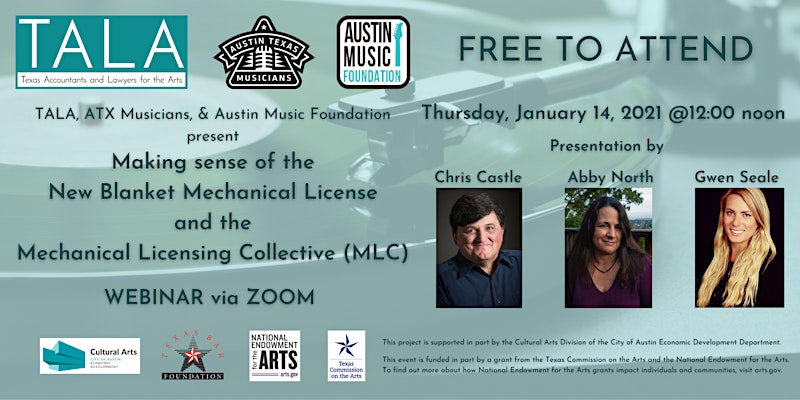
Save the Date! January 14 at Noon CST, Zoom Panel with @musictechpolicy @northmusicgroup @sealeinthedeal for Independent Songwriters

This image has an empty alt attribute; its file name is https%3A%2F%2Fcdn.evbuc.com%2Fimages%2F122288515%2F87998774455%2F1%2Foriginal.20210105-173522

By Chris Castle

I’m grateful to Texas Accountants and Lawyers for the Arts, Austin Texas Musicians and the Austin Music Foundation for hosting an information webinar next week on the impact of the new blanket mechanical license under the Music Modernization Act on independent songwriters. We will also cover the nuts and bolts of dealing with The MLC, Inc. and a unit on the Digital Licensee Coordinator.

I couldn’t be happier to have two great panelists in music publisher and song data solver Abby North and my fellow Austin music lawyer Gwen Seale.

While this panel has an Austin origin, the topics are not Austin-centric and will apply to all songwriters in the world just like the MLC does.

Please RSVP to Eventbrite if you think you might attend at this link and also take a moment to complete the anonymous 10 question MLC Awareness Questionnaire on Survey Monkey at this link. The Zoom code to join will be posted through Eventbrite.

I’ll be posting some other materials, but for those who want the more nitty gritty background, you can read this package of documents at this link.

Please take our Mechanical Licensing Collective Survey

Please take a moment and complete the ArtistRightsWatch new anonymous 10 question survey regarding The MLC at this link. We’re gathering general anonymized information about how songwriters and publishers have heard about The MLC and whether you think an independent advocate (or an “ombudsman”) would be useful to you. This will help us plan future programming and input.

The survey is available to everyone and will be open until January 31, 2021.

Thanks!

Optimism is Contagious, Too: @nivassoc’s #SaveOurStages Included in COVID Stimulus–Update

Guest post by Chris Castle

Thanks to the hard work of the National Independent Venue Association and their allies, it looks like some stimulus relief is finally coming to small venues, theater operators, bars and restaurants. The NIVA effort began with the  Save Our Stages Act that authorizes the Small Business Administration (SBA) to make grants to eligible live venue operators, producers, promoters, or talent representatives to address the economic effects of the pandemic on certain live venues. Save Our Stages will be included in the new COVID stimulus bill. The stimulus bill text was released yesterday (Dec 21) and was voted on last night by both the House of Representatives and the Senate in Washington, DC.

SOS Act authorizes the Small Business Administration to make (1) an initial grant of up to $12 million dollars to an eligible operator, promoter, producer, or talent representative; and (2) a supplemental grant that is equal to 50% of the initial grant. An initial grant must be used for costs incurred between March 1, 2020, and December 31, 2020, but a supplemental grant may be used for expenses incurred through June 30, 2021. I haven’t seen the final language of the COVID stimulus bill, but I would imagine it will be carried over.

Many people pulling together have helped to deliver a miraculous Christmas present for music cities like Austin, Texas and the country. The bi-partisan Save Our Stages Act was carried by two members of the huge Texas Congressional delegation, Senator John Cornyn and Austin Representative Roger Williams alongside their outstanding colleagues Senator Amy Klobuchar and Representative Peter Welch. As we saw in the CLASSICS Act and later in the Music Modernization Act, Senator Cornyn is a strong advocate for the Texas music industry which needs him more than ever.

We also have to thank Governor Greg Abbott and the Governor’s Texas Music Office for their efforts in getting SOS passed and in supporting the local music economy–tireless is an overused word, but the Governor has never forgotten Texas venues in the State’s plans to open in the middle of the 25/8 whole of government response to the pandemic. I’m sure there are many others to thank in many other states and cities, but I know these folks have been white-knuckling the express train for months.

The lobbying effort to pass SOS was a heartening example of our business pulling together with the artist community in the vanguard. That extensive lobbying effort led by NIVA highlighted the importance of live music and music tourism to the local economies of cities across the country. I don’t know if it’s even possible to measure the global economic impact of the lockdown approach on our business, but given the pre-COVID economic impact of the festival business alone, it’s got to be over a $1 trillion loss. As Universal’s Michael Nash said at the University of Georgia Artist Rights Symposium earlier this year, the label was very concerned about keeping live music alive even though labels might not be directly involved. According to MusicAlly, Nash said “The reality is that the health and welfare of our artists is central to everything we do, and so we do have a stake in what’s happening in the broader ecosystem.” That view was reflected in the broad support for SOS from RIAA and other industry groups as well as Universal’s commitment to major investments in live music destination hotels.

It appears that the limitation on liability for businesses like venues that reopen is not going to make it into the stimulus bill. That’s unfortunate because the liability issue is a critical piece, and the situation cries out for a federal solution when there’s a lawyer behind every cough. You may ask why such a crucial aspect of reopening is still a question mark at this late hour? Rep. Stephanie Murphy (D-Fla.), a member of the bipartisan Problem Solvers Caucus, summed it up: “I am frustrated to be part of an institution that is so dysfunctional that it doesn’t even work until the last minute.” Well, frankly, no surprise there. The liability issue will have to be dealt with in the new Congress.

The question has always been if you lock down the venues without protecting that investment, will we have an live music infrastructure to reopen? Austin is an all-too-perfect example. We have no idea what Austin will look like when we get past the pandemic. SOS is too late to save Margin Walker and many others. But with this cash infusion we have a better chance that post-pandemic Austin will bear some resemblance to what it was and can hopefully help get some people back on their feet in Austin and around the country, which is the point. The team is moving in the right direction and will attract others. Universal’s investment in the future is an example of leadership and optimism for the survival of our live music venues and all the wonderful people who run them. Optimism is also contagious, and is more likely to accelerate with Save Our Stages.

The good news is the bad news is wrong–our work is not over, but we live to fight another day–or another 300 days. And that is a Christmas miracle in many households.

Here is the press release from NIVA:

Save Our Stages Act just passed as part of the COVID-19 Relief Bill! 

Thank you for helping to #SaveOurStages! You responded in an overwhelming fashion. NIVA thanks those across the country who sent 2.1 million emails to their elected officials expressing their support for the Save Our Stages Act. All 535 Congresspeople heard from their constituents through SaveOurStages.comWithout your support and continued attention, we could not have accomplished this goal.

Our gratitude also extends to Sen. John Cornyn (R-TX) and Sen.Amy Klobuchar (D-MN) in the Senate, Rep. Peter Welch (D-VT) and Rep. Roger Williams (R-TX) in the House, champion leader Chuck Schumer (D-NY), and 230 bipartisan cosponsors in Congress.

The Save Our Stages Act will provide emergency relief to independent venues and promoters that have been devastated by the pandemic’s shutdown. This legislation will enable these mom-and-pop businesses to hold on until it’s safe to gather, reopen fully, and once again return to serving as the economic engines for their communities. Read NIVA’s full statement and thanks here

The legislation provides critical help to shuttered businesses by providing a grant equal to 45% of gross revenue from 2019, with a cap of $10 million per entity. This grant funding will ensure recipients can stay afloat until reopening by helping with expenses like payroll and benefits, rent and mortgage, utilities, insurance, PPE, and other ordinary and necessary business expenses.

WHAT’S NEXT

NIVA hopes to work with the Small Business Administration to ensure the emergency relief is dispersed as Congress intended, that the instructions and process to apply for grants ensure that the process is implemented accurately, fairly and as expediently as possible.

Since it could take many weeks, even months for the funding to flow, the NIVA Emergency Relief Fund, with The Giving Back Fund as its 501(c)3 fiscal sponsor, continues to raise money to assist the venues at greatest risk of permanently going under as we wait for the grants to be issued. Anyone wishing to donate can do so here.

Guest Post: What is the Intention of Justice? Notice and Stay Down is the Government’s Responsibility

By Chris Castle

ARTHUR

Let’s get back to justice…what is justice? What is the intention of justice? The intention of justice is to see that the guilty people are proven guilty and that the innocent are freed. Simple isn’t it? Only it’s not that simple.

From …And Justice for All, written by Valerie Curtin and Barry Levinson.

Law out of balance is no law at all.  I suggest that the DMCA is just this imbalance and the unbalanced DMCA has created other imbalances that in turn transferred wealth from the many to the few.  One of the biggest dangers to our society currently and in the future is erosion of the third estate (or the “musician’s middle class”) into the concentration of wealth in fewer and fewer hands.  This erosion is accompanied by its inevitable trend toward authoritarianism enforced by the mandarin class of Silicon Valley.  Not to mention the policy laundering operations funded by transferred wealth like the Chan Zuckerberg Initiative (that’s the Chan Zuckerberg who asked Xi Jinping to name her then-unborn child).  

Serfing in the Apocalypse 

This kind of neo-feudal concentration of wealth is most obvious in the tech oligarchy, especially in companies like Facebook, Google and Spotify with their dual class supervoting stock that concentrates the corporate decision making and wealth not in the shareholders but in the hands of Mark Zuckerberg, Sergey Brin, Larry Page, Eric Schmidt, Daniel Ek and Martin Lorentzen.  And then there’s Amazon with the world’s richest man, Jeff Bezos—the future space mogul.  (Bezos’ Blue Origin and Google’s adventures in biometrics and AI in China are examples of the second order knock-on effects of the Internet oligarchy become defense contractors.) 

I also suggest that one of the driving forces that has accelerated this concentration of wealth and power over the last twenty years has been the 1998 Digital Millennium Copyright Act.  Unless substantially reversed, the DMCA will continue to accelerate the wealth transfer from creators to oligarchs.  It must also be said that state actors or near state actors like TikTok either profit from, promote or protect massive online piracy based in DMCA-type alibis.  This topic is another conversation, but anyone who has dealt with the huge pirate sites has felt the cold hand of truly bad guys with top cover.  In addition to the tech oligarchs, Russian oligarchs think the DMCA idea is really pretty groovy.

The DMCA Alibi

You’ve probably heard the expression “notice and takedown” applied to copyright online.  It was the DMCA that created the “notice and takedown” alibi regime for piracy and near-piracy.   These notices have come to be called “DMCA notices” and the Congressional plan that implemented that call and response has unambiguously failed.  You may have also heard the expression “value gap.”   The “value gap” is shorthand for illicit profits made from exploiting the DMCA loophole which itself is a prima facie case of law out of balance.  The “value gap” is the predictable consequence of “notice and takedown.”

Google alone has received nearly five billion DMCA notices just in the current reporting period.  That’s 5,000,000,000.  I’m still waiting to see the conga line of Members of Congress and Senators who say that was exactly what they intended (and many who were involved in drafting the DMCA are still serving).  I’m also waiting to hear lawmakers acknowledge that when something happens 5,000,000,000 times, it’s a feature not a bug just like the Ford Pinto’s exploding gas tank.  No one ever asked them until Senator Thom Tillis began a series of hearings before the Senate Judiciary Committee’s Subcommittee on Intellectual Property earlier this year.

If we’re lucky, in coming days Senator Tillis will be introducing a legislative overhaul of this gaping wound reflecting the many hearings he’s chaired this year to investigate the DMCA imbalance that created one of the biggest wealth transfers in history.  That wealth transfer is not only caused by the perpetual state of piracy or near piracy created by the DMCA, it is also caused by the cost of enforcing copyright that has fallen on all creators in all copyright categories.  Not to mention the sheer scale of the burden imposed by lawmakers on creators.  Hopefully Senator Tillis’s investigation will bear fruit and will right the imbalance.

And as we have exhaustively endured for over 20 years, law out of balance is no law at all.   In the music business, performers—like all creators—have been effectively powerless to stop this latest great imbalance in justice created by the copyright infringement safe harbor disaster and piracy force multiplier.  That value gap has hollowed out the performer community (as well as record companies) after 20 years of wealth transfer to the Big Tech oligarchs from commoditizing the recordings that performers created.  And Big Tech have used their DMCA-driven profits to hire even more lobbyists around the world to create even more loopholes in the human rights of artists in the endless maelstrom of Malthusian decline.  That decline manifests itself in the ennui of learned helplessness of creators around the world as companies like Google seek to impose Google’s version of notice and takedown around the world.

Notice and Staydown

But—there is a new term in our lexicon that hopefully will appear in new legislation from Senator Thom Tillis: Notice and stay down. What does it mean?  It’s a mid point between a pure negligence standard and the intent of the DMCA to provide a responsible alternative dispute resolution system.  Instead of the endless whack a mole iterations of catch me if you can posting and reposting of infringing works, online service providers would be required to actually do the right thing and keep the infringing work off of their service.  It’s really just a properly enforced repeat infringer policy.  It’s hard to believe that adults persist in this whack a mole but they do.  There’s big money in those moles that don’t actually stay whacked.

How in the world did we arrive at the status quo?  A page of history is worth a volume of logic to fully understand this leading edge of the Great Reset.  

The Great Copyright Reset

In the late 1990s, the large ISPs had a legitimate concern about this Internet thing. If ISPs (like Verizon or AT&T) are providing ways for the many to connect with each other over the Internet, they were inevitably empowering essentially anonymous users to send digitized property to each other by means of that same technology.  That property might take the form of an email file attachment (or link to a file) that contained a copy of a sound recording, movie or an image.  ISPs wanted to be protected from responsibility for things like copyright infringement they had nothing to do with.  (This knowledge predicate is where the games begin.)

The ISPs needed a zone in which they could operate, a zone that came to be called the “safe harbor.” The deal essentially was that if you didn’t know or have a reason to know there was bad behavior going on with your users, or didn’t have knowledge waiving like a red flag, then the government would provide a little latitude to reasonable people acting reasonably.

This safe harbor idea was a great privilege conferred upon online service providers and balanced the democratizing nature of the Internet with the need to enforce the law against bad actors.  Lawmakers were caught up with the idea of bringing people together.  What they didn’t realize sufficiently was some of those people previously only met on Death Row.

Artists’ rights to protect themselves were not entirely extinguished by this new safe harbor for big companies but were severely burdened. Record labels and film studios had to devote substantial resources to whack a mole that could have been spent on their core businesses–making records and movies.  If a copyright owner thought there was infringement going on that didn’t qualify for the safe harbor, then the intention was that individual artists shouldn’t have to file a lawsuit, they could just send a simple notice to the service provider. If it turned out that there was a bona fide dispute over the particular use of the work, then the parties could go to court and hash it out if necessary. The notice part of “notice and takedown” was perceived as an inexpensive remedy that would be available to artists who did not want to take on a lawsuit as well as ISPs with litigation budgets.  The Congress did not factor in the charlatans who would come later like Google and Facebook, neither of which existed in 1998.

This is documented in the legislative history from 1998, i.e., both before Google and and Facebook and before the Electronic Frontier Foundation discovered Morpheus or Mrs. Lenz:

This ‘‘notice and takedown’’ procedure is a formalization and refinement of a cooperative process that has been employed to deal efficiently with network-based copyright infringement.

Section 512 does not require use of the notice and take-down procedure. A service provider wishing to benefit from the limitation on liability under subsection (c) must ‘‘take down’’ or disable access to infringing material residing on its system or network of which it has actual knowledge or that meets the ‘‘red flag’’ test, even if the copyright owner or its agent does not notify it of a claimed infringement. 

Sounds very civilized, don’t it? Sounds like something that could be considered to be just. How could something that sounded so right go so wrong so fast?  Notice and takedown has become notice and shakedown after the charlatans arrived.

The Inevitable Notice and Shakedown

The one thing that nobody thought was that it was the intention of Congress that there would be ad networks, multinational corporations and international piracy rings whose business model is in large part built on exploiting the “notice and takedown” loophole in that safe harbor.  

These organizations ignored the DMCA’s knowledge predicate and repeat infringer requirements and adopted what is essentially a “catch me if you can” version that allows them to infringe until they get caught by the copyright owner and then continue to infringe if they are not sued–the exact opposite of what the DMCA intended.  What once was a reasonable exception was almost immediately tainted as a massive loophole that the government has done little to nothing to correct much less enforce.

The “safe harbor” is no longer a loophole, it has graduated to a full blown design defect as indiscriminately harmful as any exploding gas tank.  So now when artists ask that some common sense be applied to this grotesque distortion of the law-supposedly passed in part for the benefit of artists-some would tell artists that it’s not up to government to tell them what the law means. As Kafka-esque as that sounds.

Will You Believe Me or Your Lying Eyes?

Isn’t it obvious that having to send a notice for the same work on the same service hundreds of thousands of times an absurd burden? In other words — is the government actually defending whack a mole with a straight face? Did the government actually intend that 5,000,000,000 take down notices in a year are a new normal?  If they did, evidence of that intent is not in the statute or the legislative history.  Would Congress offer protection to an exploding gas tank after they already knew it was a threat because it was designed that way?

Whack a mole is not automatic-it requires human intervention. As we saw in BMG’s precedent setting and victorious lawsuit against the ISP Cox Communications over Cox’s grotesque failure to enforce its repeat infringer policy, a person has to decide to repost the infringing file even while knowing the file is or is very likely an infringement. Whack a mole actually defies the entire purpose of the safe harbor-whack a mole is not a little latitude for reasonable people acting reasonably.

Whack a mole is a design defect.  Is it just that Congress should protect any design defect?

Let’s get back to justice. Not only does the status quo require creators to tell lawmakers (including courts) what their law means, the U.S. Government has utterly failed artists with the fundamental justification for the Sovereign common to our jurisprudence and political theory. 

Crucially, it must be acknowledged that the government has failed to protect artists.  The government has failed to enforce the laws, essentially overseeing and giving legitimacy to one of the largest wealth transfers of all time from the hands of the many into the overflowing pockets of the few.  All based on an extreme interpretation by Google and its ilk of the government’s laws.  Direct challenges to these interpretations involve costly and protracted litigation — with the inescapable whack a mole continuing all the while.

It would not be unreasonable for artists to think that the whole thing smacks of crony capitalism, particularly when one of the biggest beneficiaries of the loophole is a major lobbying influence like Google. While some ISPs have at least tried to address the issue, the Googles of this world are noticeably absent.

So I would beg pardon here-I do not feel that it should be necessary for artists to tell the Congress what would be acceptable in the way of parameters for “notice and stay down”, at least not initially. I think artists have the undisputed right to ask-actually to demand-of the Congress, what was their intention?

Enter the Foxes

Don’t underestimate the knock-on effects of the DMCA wealth transfer that funds self-preservation for the DMCA beneficiaries.  Who can forget Google’s dominance of the Obama Administration?  It’s clear that like Google learned from Microsoft, Facebook has learned from Google (and both joined forces to try to defeat the European Copyright Directive, so expect more of the same foxes coming for the henhouse when Senator Tillis introduces his bill).  

We note the irony that the ethics czar for the Biden transition team is from Facebook, as is the director of legislative affairs a former Facebook lobbyist.  A former Facebook board member co-chairs the transition team and there is a sprinkling of other former Facebook board members in other roles.  Three transition team members are former Chan Zuckerberg Initiative employees.  And Google’s Eric “Uncle Sugar” Schmidt will have a leading role.  

Once they get into power, you can expect that DMCA reform will get exponentially harder, but the Tech Transparency Project will have even more work to do.

Senator Tillis Could Make Real Progress Toward Reversing the DMCA Cronyism

The safe harbor is the government’s law. They wrote it. They voted for it. They represented voters—including creators—when they did so. They presumably have some idea what it is supposed to mean. Many who voted for it are still in the Congress. The Congress needs to come clean on what they intended. Isn’t that the better place to start? Why should artists have to tell the Congress what the Congress’s intention was?

If it was the intention of the Congress (and President Clinton who signed the law) that the current state of whack a mole was the plan all along, then let them say that — and perhaps more importantly, point to where they told the electorate that was their intention at the time the DMCA was passed in the Congress and signed into law.  If it is not their intention, then it should be reversed with no daylight.

Google alone is on track to receive over five billion take down notices this year alone. If this was the Congressional intention, then let them say that. If their intention was there should be no upper limit on the number of takedown notices any one company could receive in a year, then let them say that. And explain themselves.

And let’s be clear-Google does not appear to view these billions of notices as a design defect, although that would be a perfectly reasonable conclusion. And neither do Facebook or Twitter. One has to believe that if a company the size of Google viewed billions of notices as a problem, they could fix that problem. They haven’t. In fact the number of notices grows exponentially every year. Perhaps they view billions of DMCA notices as a feature set.  Because along with the billions of notices comes a fortune for Google just like Facebook, Twitter and the rest.  Big Tech’s defenders would say of Pirate Bay and Megavideo, they’re just like Google.  Yes, that’s right.  Google is just like them and they are just like Google.  Serfing on the DMCA apocalypse.

What is the intention of justice? That the guilty are proven guilty. But if lawmakers won’t tell us what it means to be guilty much less prosecute the politically connected wrongdoers, then what justice is that?

Notice and stay down is a reasonable reaction to whack a mole, and one that is entirely consistent with the original intent of the DMCA notice and takedown regime that has gone so far wrong. Hopefully Senator Tillis will be leading the charge.

It might actually be that simple.  Notice and stay down.

As Arthur told the jury, “If he’s allowed to go free, then something really wrong is going on here.”

Curiouser and Curiouser: Strange Loose Ends with Apple Music and The MLC

[Guest post by Chris Castle. This post first appeared on MusicTechPolicy. This is interesting because songwriters don’t often see shenanigans from Apple Music but it is probably due to the overpowering litigation magnet of the MMA. Put this in The MLC redesignation file]

Here’s an update on the bizarre saga of Apple Music and The MLC. Remember that HFA sent to its publishers this termination notice from Apple Music on Apple’s lyric and cloud services licenses (and assume for the moment it was also sent to other non-HFA publishers):

Apple Termination

This is remarkable because the Music Modernization Act limits the kind of licenses that the MLC can administer because the blanket license only applies to a limited number of activities (on demand streaming, limited downloads and permanent downloads). It does not apply to lyric licenses or cloud services because the blanket license is not available for those rights. Those rights would still need to be licensed under the very type of agreements that Apple is terminating.

This question came up during a recent MLC webinar moderated by MLC executives Kris Ahrend (CEO) and Serona Elton (Head of Educational Partnerships). These two executives were asked the obvious question, how can The MLC do lyric licensing for Apple. An eagle eyed MTP reader sent this screen capture from the chat:

MLC Apple Answer

So you have to ask, if The MLC can’t license lyrics, why did Apple terminate their lyric licenses and transfer to The MLC?  And what does “separately from us” mean?  The answer is not really responsive to the question.

Separately from us could easily mean that while The MLC is not licensing lyrics, some other entity is. (Presumably the lyrics are from songs that are subject to the blanket license so the MLC would play a role.)   Remember that the termination notice came from HFA.  Could it be that “separately from us” means HFA would be issuing a side by side lyric license on behalf of its publishers?

And remember that the notice from Apple includes this language:

[W]e intend to move our licensing and royalty administration for Apple Music to the MLC starting from January 1, 2021.

Congress did not intend that The MLC offer licensing and royalty administration for DMPs like Apple.  That would mean that The MLC would be paying itself for Apple’s blanket activities.  That is what HFA does through a rather porous ethical wall (and for which they have been at the center of two class actions and numerous copyright infringement lawsuits and are currently a co-defendant with Spotify in another post-MMA lawsuit).

It has long been assumed that somehow some way The MLC intends to offer bundled licensing which is currently prohibited.  Bundled licensing could take the form of performances, ex-US rights, sync, even general licensing.

It seems like that effort is quietly underway.  What is an alternative explanation for Apple terminating a large number of agreements and transferring its licensing and royalty administration functions to The MLC?  Is the plan that The MLC gets the business and HFA does the work that The MLC is prohibited by statute from performing (at least until they move the goalposts again)?

This does help to explain why there is no MLC database and all The MLC’s “data quality initiative” corrections and improvements are being performed on the HFA database (which HFA owns and will use for work not limited to the blanket license).

Curiouser and curiouser.

What is Apple Music Up to with the MLC?

You may have received this notice from HFA Client Services with the subject line “APPLE LEGAL NOTICE OF TERMINATION OF AGREEMENT” which a vigilant reader sent to us:

What is interesting about this is the opening paragraph:Dear Publisher, Reference is hereby made to that certain Subscription, Lyrics, and Cloud Services License Agreement or Subscription and Cloud Services License Agreement (the “Agreement”) between Apple Inc. (“Apple” or “we”) and the publishing entity with which you are affiliated (“Publisher” or “you”)In support of the Orrin G. Hatch-Bob Goodlatte Music Modernization Act and the significant benefits this new legislation is expected to deliver to music publishers and songwriters, we intend to move our licensing and royalty administration for Apple Music to the MLC starting from January 1, 2021.Accordingly, we hereby notify you that Apple has elected, pursuant to the Agreement, to terminate the Agreement, effective December 31, 2020. If you have never entered into such an agreement with Apple you may disregard this notice.

Focus on that “lyrics” and “cloud services” part.  The MMA blanket license does not cover lyrics or cloud services.  That means that Apple is out of contract with the publisher concerned because they terminated the agreement.  They cannot get those rights under the blanket.

Then notice that Apple says, “we intend to move our licensing and royalty administration for Apple Music to the MLC”.  The MLC cannot license outside the blanket to my knowledge.

But also realize that Apple are not stupid, so this must mean something.  We’re looking into it.

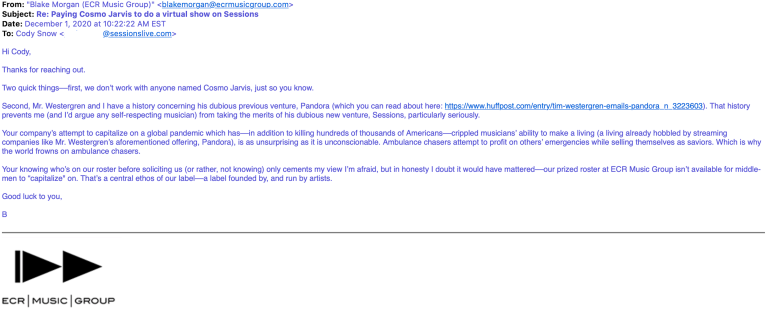
“MILLION A MONTH” TIM IS BACK WITH NEW IMPROVED PROFITEERING–BUT #IRESPECTMUSIC @THEBLAKEMORGAN FIGHTS BACK–AGAIN

[This post first appeared on MusicTechPolicy]

Sessions Cody Snow

You may have received an email from something called “Sessions” like this one above received by our friend Blake Morgan, and Blake wanted us to alert MTP readers. Here’s Blake’s reply:

Sessions Blake Reply copy

Who can forget the epic confrontation between Blake and “Million a Month” Tim Westergren during what Billboard called “World War P”, which shows what can happen when artist relations are grossly mismanaged.

pandora_500_billboard_cover

Why do we say “Million a Month” Tim?  Because that’s what he made from selling Pandora stock while poor mouthing about paying royalties from Pandora’s loss-making revenues.  It may not seem logical, but in Silicon Valley, they care far less about profit than they do about valuation because valuation is, as bank robber Willie Sutton said, where the money is. So “Million a Month” Tim was engaged in the gaslighting of all time.

 I guess Blake hasn’t forgotten.

westergren 5-5-14

Of course in fairness, Daniel Ek and Spotify are running the same play on a much grander scale of international gaslighting as demonstrated by the COVID Misery Index. Big thanks to Blake for calling out another one and speaking truth to power.

COVID Misery Index 12-5-20
Comparison of post-pandemic stock trading of Spotify, Google, Facebook, Amazon, Apple and Live Nation

The DLC Finally Confirms (Sort Of) How Much is in the MMA Black Box–Bigger than a breadbox

By Chris Castle

[This post first appeared on MusicTechPolicy]

We’ve all heard rumors about how much is in the “inception to date” black box at the digital music services. The main reason that nobody knows is another example of the dismal drafting of the Music Modernization Act.

Limitation on Liability

Wouldn’t you think that if the class actions against Spotify gave the insiders the leverage to negotiate the MMA giveaway that they could at least have gotten an immediate accounting from the services for how much of the songwriters’ money they’ve been holding all these years? But no, it’s sleepy time in Washington yet again. From the Land of Frozen Mechanicals they bring you more Brinksmanship 101. The retroactive black box payment is due to be made by the services to the MLC and its data vendor, HFA–remembering that HFA was also the data vendor for at least some of the services that created the black box in the first place.

limitation on liability 2

However, there is some activity at the Copyright Office now about how to get this money paid. It’s at the Copyright Office because while drafting the aircraft carrier revision to the Copyright Act (aka Title I of the Music Modernization Act), the hard parts were never drafted and were left to the Copyright Office to handle through regulations. Musicians–you’ve seen this before. This is the Washington version of “we’ll fix it in the mix.” So you do have feel sympathy for the Copyright Office in the situation when all the smart people leave them twisting in the breeze.

Not that I necessarily believe this number, but for the first time the services have given a bigger than a breadbox idea of how much is in the black box. The DLC’s lawyers filed an “ex parte” letter in which they made that revelation (along with the known universe: Artist Rights Alliance Ex Parte Letter (Nov. 17, 2020)Digital Licensee Coordinator Ex Parte Letter (Nov. 17, 2020)Mechanical Licensing Collective Ex Parte Letter (Nov. 17, 2020)Music Artists Coalition Ex Parte Letter (Nov. 17, 2020)Nashville Songwriters Association International Ex Parte Letter (Nov. 17, 2020)National Music Publishers’ Association Ex Parte Letter (Nov. 17, 2020)Recording Academy & Songwriters of North America Ex Parte Letter (Nov. 17, 2020)Songwriters Guild of America et al. Ex Parte Letter (Nov. 18, 2020).)

The DLC itself is at the mercy of its members in terms of revealing this number but they claim the following in the Digital Licensee Coordinator Ex Parte Letter (Nov. 17, 2020):

DLC also provided a rough estimate of accrued royalties that are available to be transferred to the MLC, based on a limited survey of a subset of DLC members at a particular point in time, and with the crucial caveat that the precise amounts are in flux as digital music providers continue to engage in robust matching efforts. Specifically, DLC estimated that several hundred million dollars were available to be transferred to the MLC as accrued royalties, even after accounting for the derecognition of accruals based on preexisting agreements containing releases to claims for accrued royalties.

DLC also explained that the accruals that were derecognized because copyright owners were paid and provided releases were a fraction of that amount—on the order of tens of millions of dollars.

So now we know at least that much. We know there are “several hundred million” dollars at issue in the black box and we generally know where the money is. We may know that DLC members hold the money. We also know that this money has not been identified, but we at least know enough to get the nose of the camel in the tent.

As COVID Decimates State Revenues Tennessee Franchise Tax Comes for out of State Performers

Most people do not realize this, touring bands end up paying income taxes in multiple states. It tends to be the high population states in the West and Northeast. Think California and New York. This makes sense in some ways as the income tax is based on revenue you make in these states. Big states big revenue. It’s a pain to file multiple state returns but at least there is a reasonable rationale.

A franchise tax is different and is not usually based on a businesses income. It is essentially a flat fee tax on the corporate or LLC entity doing business in that state. The idea is that a business based in that state should pay for the services the state provides. These franchise taxes generally have minimum fees between $150-$800. Bands that use a corporate or LLC structure pay these taxes in their home state because they have a “nexus” in that state. A nexus generally means you have some regular place of business in that state. However some states try to apply the franchise tax even when an out of state business or band has no nexus in that state. However it is exceedingly rare. At least until recently…

Over the last couple months I’ve been hearing anecdotal stories about bands suddenly getting tax bills from the State of Tennessee. Odd. The music state? Aggressively taxing musicians? I didn’t think much of this as, it’s pretty common for bands to not realize they owe sales or income tax in states in which they perform frequently.

But last week I received a surprising notice from the State of Tennessee. A retroactive assessment for 7 years of Tennessee franchise tax. As far as I can tell we have no nexus in that state. I have not heard back from the Tennessee Department of Revenue, but apparently the State of Tennessee considers us to be subject to their franchise tax (now?) because we played a single show in the state in each of these years. Wow. This is ridiculous. Imagine if every state you played in required you to file taxes and pay $150-500 in franchise taxes for the privilege of playing a single show in the state?

Further, this retroactive assessment (including penalties and interest) comes at a time when most states are facing tax revenue shortfalls. When states and local governments face revenue shortfalls they have a bad habit of enacting dubious “revenue enhancement” schemes. Often these amount to badgering businesses and taxpayers into paying taxes and fees they would not normally be assessed. I have no evidence this is what is happening here, but something has changed with way my band is being treated by Tennessee tax authorities. And it is apparently happening to other bands.

WTF? I won’t be rushing back to Tennessee to play shows, record albums or even co-write songs until I have some clarity on the tax situation. I suggest other bands also exercise caution.

One last thought: The federal Music Licensing Collective will come online next year. The MLC is based in Tennessee. Does this mean every songwriter and publisher will now have to pay the Tennessee Franchise Tax? Hardly seems fair but it’s possible.

Black Box Hunting: The Songwriters Guild/Society of Composers & Lyricists/Music Creators North America’s Ex Parte Letter Stands Up for Transparency

[Editor T says: Remember when songwriters were promised that the Music Modernization Act was going to solve all your problems—AND give you a set of steak knives? Remember? Never needs ironing? And doubles on sax? One big feature was digital music services paying up to the Mechanical Licensing Collective for matching the entire black box from “inception” meaning all the money a service ever held that their data vendors couldn’t match and weren’t paid to try very hard, especially Spotify aka “defendant”. Who was that data vendor who couldn’t match? HFA. And who is the MLC’s data vendor? HFA. So the last couple weeks the insiders have been back-tracking behind closed doors at the Copyright Office on how–or if–that black box will be paid to songwriters. The only way you’d ever know this was happening is if you were paying very close attention to the Copyright Office “ex parte” letters. (sign up for email alerts there.) The Songwriters Guild/SCL/MCNA group is the songwriter’s junkyard dog with their teeth sunk in the tuchus of the insiders. We’ll be posting a selection of these recent “ex parte” letters which publicly document private conferences held by the Copyright Office with “stakeholders”. “Everyone’s a winner, bargains galore….the large print giveth and the small print taketh away” as Tom Waits said.]

EX PARTE MEETING SUMMARY WITH

THE UNITED STATES COPYIGHT OFFICE

Docket Number 2020-12

November 18, 2020

Re: Summary of the November 13, 2020 Ex-Parte Meeting Between the United States Copyright Office on behalf of the following independent, US-based music creator organizations: the Songwriters Guild of America, Inc. (SGA), the Society of Composers & Lyricists (SCL), and Music Creators North America, Inc. (MCNA)

On Friday, November 13, 2020, an ex-parte video-conference meeting was conducted by the United States Copyright Office (USCO) with multiple interested parties concerning rulemakings in connection with Doc. No. 2020-12. This summary is submitted on behalf of SGA, SCL and MCNA (together, the “Independent Music Creator Organizations” or “IMCOs”), all of which were represented at the meeting. Attending for SGA were President Rick Carnes, outside counsel Charles Sanders, and outside legislative consultant Marla Grossman of the American Continental Group (ACG). Attending for SCL was President Ashley Irwin. Attending for MCNA was President Eddie Schwartz. The meeting was chaired on behalf of the USCO delegation by its General Counsel, Regan Smith.

Individuals representing the IMCOs began by respectfully stressing, as they had in their ex parte tele-conference with the USCO on September 11, 2020, the bedrock principle that independent music creators speak for themselves on all issues related to their rights and interests, and that no other music community groups have the right or authority to claim otherwise. Specifically, the IMCOs rejected the assertion by some music publisher representatives (backed by at least one of their affiliated songwriter groups) that the USCO’s oversight and rulemaking authority concerning matters related to 2020-12 should be viewed as being narrowly limited.

The IMCOs have stressed on multiple occasions through their USCO Comments a strong belief that Congress, by its very construction of the Music Modernization Act (MMA), intends the Office to have broad and expansive authority to oversee and guide the implementation of the MMA by the Mechanical Licensing Collective (MLC). That is especially so in regard to ensuring transparency, reliability and fairness regarding the safeguarding of music creator rights, the class of persons for whom the MMA was most clearly enacted to protect pursuant to Article I Section 8 of the US Constitution.

The main issue of concern addressed at the November 13, 2020 meeting was the oversight and disposition of accrued, unmatched royalties collected and held by Digital Music Providers and subsequently distributed pursuant to private negotiated agreements with music publishers. It is believed by the IMCOs that as regards those agreements and royalties, some or all of the parties thereto were very likely aware at the time of negotiation and execution, that (i) such confidential agreements and payments concerned royalties accrued from the unauthorized reproduction or distribution of musical works owned by unrelated third parties; (ii) little to no effort had been made to properly identify rightful ownership, and (iii) such accruals might soon be subject to payment rules under the MMA that would require strictly delineated sharing of such “permanently” unmatched royalties with music creators by music publishers (including a minimum floor of 50%) after the conducting by the MLC of bona fide searches for rightful owners.

Further assertions were made by the IMCOs at the meeting that after three years of discussions, still no informed estimate had yet been made by Digital Music Providers of the aggregate amounts of unmatched royalties both still being held and already distributed. Thereafter, one knowledgeable representative of Digital Music Providers estimated that while there remain hundreds of millions of dollars in accrued, unmatched royalties in the possession of the Digital Music Providers, tens of millions of dollars in accrued unmatched royalties were indeed turned over directly to music publishers pursuant to the terms of the confidential, private negotiated agreements.

As was also made clear during the meeting, the IMCOs have no direct information as to the content of such private negotiated agreements, and no direct information as to what became of the unmatched royalties such music publishers received.

Several music publishers have claimed in ex parte letters to the USCO that they indeed shared such unmatched royalties with their affiliated music creators, but no specific information has been provided as to the methodology and details of such sharing, including whether the principles and and guarantees eventually set forth in the MMA as enacted were applied.1 Moreover as the IMCOs reported at the meeting, an informal and ongoing process of canvassing creators currently being conducted by each MCNA member organization have yet to confirm a single instance in which a songwriter or composer received a royalty statement indicating that portions of such accrued, unmatched royalties were included (though they may have been) and on what basis.

As the IMCOs asserted at the meeting, were such unmatched royalties paid to songwriters and composers by music publishers on terms resembling the MMA rules concerning music creator protections (as either drafted or eventually enacted), it seems counter-intuitive that that no line item would appear anywhere in accounting statements indicating the source of such payments, not only as a matter of sound accounting practice, but of earned good will. No other music creator groups present at the meeting challenged or contradicted these ongoing findings or assertions. In any event, as noted, it seems that the burden of demonstrating the details of such payments is more properly placed on the music publishers who claim to have made them, which could be as simple as each publisher disclosing a properly predicated and binding assertion that the payments were made, how many were made, what was the aggregate payment, and how was each songwriter’s share determined.2

Under such circumstances as they currently exist, as SGA President Rick Carnes pointed out at the meeting, asking interested parties to render opinions on the minutiae of proposed rules concerning the disposition of accrued unmatched royalties –with only some parties having an understanding of how the private agreements operated, who got paid, who didn’t, and why– is a difficult position in which to place the IMCOs and other parties with important, related interests.

As Mr. Carnes pointed out, the issues of (i) how to protect the rights of those music creators and copyright owners who did not participate in the privately negotiated agreements by ensuring that there is an opportunity to actually match those already-distributed royalties to their proper owners and to effect the prompt payment of such sums, (ii) how to balance accounts once such proper identifications have been made, while also ensuring that affiliated music creators have been properly paid by their music publishers concerning royalties collected under the private negotiated agreements that otherwise would have flowed through the MLC and been explicitly subject to MMA distribution requirements, (iii) how to address demands of Digital Music Providers that they not be made to pay twice for the same unmatched uses, and (iv) how to ensure that such private negotiated agreements are not utilized in the future in attempts to override the provisions of the MMA, all need to be addressed prior to a proper analysis of how most effectively to move forward.3

Thus, as was stated at the meeting, while the IMCOs agree the MMA makes clear that ALL accrued unmatched royalties for unauthorized reproductions and distributions dating back to inception must be turned over to the MLC by Digital Music Providers, and that the term “generally accepted accounting principles” used in the Act in no way provides an exception to that unambiguous provision, the crucial questions enumerated above also need to be immediately addressed as matters of fairness and transparency mandated by the Act.

As to the very important issue of retroactive effect of the MMA provisions concerning guaranteed music creator participation in the distribution of permanently unmatched royalties at or above the fifty percent level, the IMCOs adamantly believe, as stated at the meeting, that it is wholly illogical for any interested party to argue that Congress intended as it did to require that all accrued, unmatched royalties be rendered to the MLC by Digital Music Providers back to each service’s date of inception, but that the songwriter, composer, transparency and good faith protections guaranteed by the Act would not otherwise be applicable in the event of premature disgorgement of unmatched royalties by Digital Music Providers to music publishers pursuant to prior agreements. This is an issue that certainly requires further attention, and calls for more comprehensive discussion than for which there was time at the meeting.

As was noted several times by various speakers, the Chair of the Senate Judiciary has warned that absent a fair and transparent resolution of these complex issues, the MMA may become a magnet for litigation, the very opposite effect that it was intended to achieve. The IMCOs wholeheartedly agree, and stand ready to assist the USCO in taking all reasonable measures to achieve the transparency, fairness and robust oversight that the legislation demands in order to avoid that undesirable result.

To reiterate in closing, as the IMCOs tried to make clear at the meeting, voluntary disclosure of the specific details of the privately negotiated agreements, redacted to protect legitimate privacy and antitrust concerns, is an important prerequisite to achieving those goals. The IMCOs further repeat their stated beliefs that the USCO has the singular ability if not to compel, at least to facilitate such disclosures in a timely manner, and respectfully urge it to do so.

Further comments of SGA, SCL and MCNA will be forthcoming in regard to the proposed rulemaking by next week’s deadline. As stated at the conclusion of the meeting, however, the IMCOs believe that all parties would benefit by a brief extension for the submissions of such comments until the Monday after the Thanksgiving holiday in order to allow for further discussions among the parties. The IMCOs acknowledge a certain lack of unified support for this suggestion at the meeting, and active opposition by at least one music publisher representative, but continue to believe it to be an advisable accommodation. Those parties wishing to abide by the original deadline would always be free to do so, as was explicitly pointed out.

The IMCOs thank the USCO for scheduling the ex parte discussion, and look forward to continuing this constructive dialog.

Respectfully submitted,

Charles J. Sanders
Outside Counsel
Songwriters Guild of America, Inc.

cc: Regan Smith, General Counsel, The United States Copyright Office
Rick Carnes, SGA President
Ashley Irwin, SCL President
Eddie Schwartz, MCNA President

  1. At least one publisher has indicated an alleged willingness to share details of such payments with any writer who makes inquiry as to his or her own works, an unlikely scenario considering that a huge percentage of writers have no knowledge of the private negotiated agreements in the first place, and –to the knowledge of the IMCOs based on informal canvassing– have not been directly informed about them by their publishers. See, e.g., Ex Parte letter from Sony/ATV dated October 28, 2020: “It has been SATV’s practice to explain to our writers who inquire how these royalties are distributed and reflected on their statements.”

2. Likewise, it seems that the burden of demonstrating how much each Digital Music Provider paid to music publishers is more properly placed on the services who claim to have made the payments, which in turn could be as simple as disclosing a properly predicated and binding assertion that the payments were made, how many were made, what was the aggregate payment, and how was each publisher’s share determined. It is anticipated that such details may be forthcoming from Digital Music Providers in their reporting under the MMA, but that remains uncertain.

3 That is especially so in light of the apparent assertions of one or more Digital Music Providers that they may forego the limited safe harbor provisions provided by the MMA by not turning over to the MLC the full amount of accrued, unmatched royalties dating back to inception of use, probably under the assumption that the potential running of applicable statutes of limitations will provide the same protections as the safe harbor without payment of the royalties due. The IMCO raised this statute of limitations issue at the meeting, and was gratified that at least one Digital Music Provider representative felt that this was an issue worthy of further discussion, hopefully with the important input of the USCO. See also, related comment of DLC that “…a DMP could make the rational choice to forego the payment of accrued royalties entirely, and save that money to use in defending itself against any infringement suits.” Comments Of Digital Licensee Coordinator, Inc. In Response To Notice Of Proposed Rulemaking , Docket 2020-12, Document COLC 2020-0011-0008 (Aug. 17, 2020) at 4.