YouTube’s Value Gap is the Record Industry’s Biggest Problem To Fix, and Here’s Why…

If the record industry is serious about growing streaming revenues (and the digital economy in general) it must address the problems with the exploitative practices of Google’s YouTube. We’ve been lucky to be supplied with Content ID data from the same source as our previous data – so we added that into the mix to see where it would rank.

These numbers are just staggering.

If you combine Content ID to the YouTube Subscription numbers you arrive at a whopping 63% of total streaming market share that only contributes  11% of revenue. Ya’ll taking notes here?

yt_istheproblem


Look at the combined YouTube revenues of Subscriptions and Content ID together at 11% of revenue. That puts the combined earnings at #3 in market share behind Apple Music. However, Apple Music creates more earnings than the two combined YouTube Revenue streams with less than 4% of the consumption. You’ll also notice that YouTube is the only streaming service with three zeros following the decimal point. That means YouTube is paying hundreds of dollars per million streams while the other leading streamers are paying thousands.

Apple Music generates 12% of revenue with less than 4% of streams. YouTube generates 11% of revenue with 63% of streams. Does that sound like a problem to anyone else?

As of this writing we’re not factoring in the direct channel uploads for artists to YouTube or Vevo, however we just can’t imagine that those numbers are much different in terms of plays versus revenues. We hear from a lot of label folks that they are afraid to give up their annual revenue from YouTube sources, but all we can say is that you’d be gaining more much more than you would be giving up.

We’ve heard of at least one executive who met with resistance when faced with the prospect of potentially walking away from millions of dollars a year in YouTube revenues. But, it’s not walking away from millions, it’s giving up 10’s of millions in true revenue.

Let us not forget, that this devalued revenue will prevent the overall growth of streaming as a format. With streaming revenues (largely from Spotify and Apple Music) now accounting for approximately 40% of overall digital music revenues why should YouTube be able to pay 1/10th of the other major players? Oh, that’s right because of user pirated content uploads…

It’s time for the record business to get serious about cleaning up YouTube.


After 16% drop in Per Stream rates, Spotify asks for another 14% Reduction…

We can’t make this up. We’ve stated many times before, as the consumption of streams increase (and those services grow) the per stream rate will drop as revenues level off. This is simply because revenues can not keep up with consumption, and there is no fixed per stream rate.

In our latest look at streaming rates we found that Spotify streaming rates had dropped 16% from 2014 to 2016. Now, Hypebot is reporting that Spotify is asking for another 14% reduction in royalty payments.

Please someone break out a calculator… that would be a 30% reduction in per stream rates in two years! It’s just math. Wow.

Read the full story at Hypebot:

Spotify’s Latest Offer To Labels: A 14% Lower Royalty Rate | Hypebot

Once Again Big Machine/Taylor Swift Lead the Way, This Time on YouTube

Our recent updated “streaming price bible” illustrates the terrible revenues from YouTube to musicians.  Using 2016 payments for a mid sized indie catalogue we estimated that YouTube pays $0.00069 to performer and label per stream.  10,145 spins to generate the revenue created by the sale of one album.

This is well below rates paid by Spotify ($0.00437) and Apple Music ($0.00735).

But the real shocker is this:   YouTube  represents 21.7% of all the catalogue streams but only 3.81% of all revenue.  But this also suggests a strategy.   With revenue at 3.81% who needs these guys right?  If labels and artists managed to pull all their tracks from YouTube the worst that would happen is we would lose a mere 3.81% of revenue.  But in exchange we could drive consumers to better paying services like iTunes an Spotify.   It’s possible this strategy could increase overall revenues.

Now comes this press release from Taylor Swift’s label Big Machine:

Big Machine Label Group will soon launch a proprietary digital video platform that gives fans direct access to content featuring the label’s superstar roster of talent.  Big Machine TV (www.BigMachineTV.com) will offer music videos and behind-the-scenes content when it goes live in February, later hosting exclusive interviews, announcements, contests and more. All of the label’s artists, including superstars Taylor Swift, Tim McGraw, Reba, Florida Georgia Line, Rascal Flatts and Thomas Rhett, will have individual channels on the platform that allow viewers to seamlessly search for desired content for an immersive online fan experience.

Holy shit!  Are Swift and company going after YouTube by creating their own video streaming service?   It’s too soon to know whether or not it will be successful, but this is the kind of in-your-face tactic we need to fight back against YouTube.    YouTube has been ruthless towards musicians.  They have fought fair pay for creators on every front: the courts, the congress and even proposed trade agreements.

It’s time we turn the tables on them.

Class Action by Artists Against Distributor For Accountings Under Direct Deal With SiriusXM

As labels cut more and more deals that bypass SoundExchange expect to see more of these lawsuits.

Music Technology Policy

The string trio Time for Three and S’More Entertainment filed a class action yesterday (Jan 17) in New York federal district court against “Defendants Entertainment One GP LLC and Entertainment One U.S. LP, doing business as E1 Entertainment and/or Koch Entertainment LP” for a variety of claims relating to the defendant’s direct deal with SiriusXM.

The class action complaint describes the suit:

4. In violation of the Class Member Contracts, Defendants entered into secret negotiations and agreements with satellite radio provider Sirius XM Radio (“Sirius XM”), for the exploitation of Plaintiffs’ and the Class Members’ intellectual property. Defendants have systematically failed to account for any revenue, or pay any portion of the revenue generated from the exploitation of the Class Members’ Musical Works on Sirius XM under this agreement.

5. Plaintiffs bring this nationwide class action on behalf of themselves and similarly situated Class Members arising from Defendants’ failure to…

View original post 594 more words

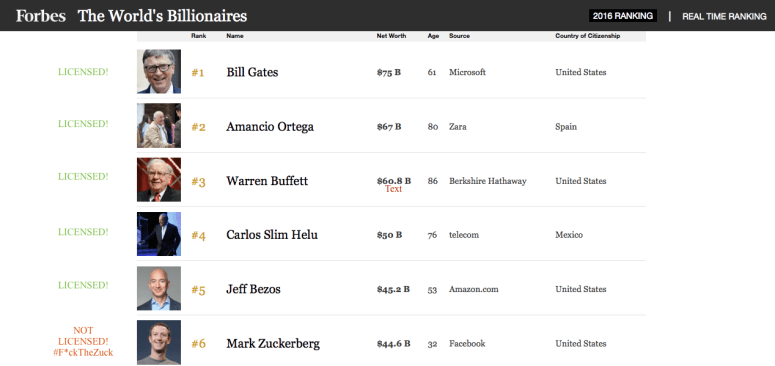
#F*ckTheZuck: It Appears the World’s 6th Richest Man/Company Does Not Pay Songwriters


6-richest-men-in-the-world

Mark Zuckerberg is the 6th richest person on the planet. Facebook is the 6th largest company in the world by market cap.  By any measure Facebook is the world’s largest media company and hosts millions of music video performances a day.   Yet unlike every other media company that regularly hosts and performs music it appears Facebook does not pay any fees to songwriters.  Word on the street is the company knows this is likely illegal yet they are refusing to get licenses.

Over the last few years musicians and songwriters have had a lot to say about paltry royalties (and non payment)  from digital services like YouTube and Pandora. But at least these companies bothered to get licenses and (most of the time) pay songwriters.   Facebook apparently flat out refuses to pay and thinks they don’t need licenses.

Looked at another way, of the 6 richest men in the world only The Zuck is not paying for music licenses at his core business.

#1 Bill Gates:  Microsoft licenses music through it’s Groove and XBox services.

#2 Amancio Ortega:  Main business is the retail clothing giant Zara. The company pays for licenses to perform music in all its stores.

#3 Warren Buffet:  Buffet’s Berkshire Hathaway has extensive media and broadcast holdings that all pay fees to songwriters.

#4 Carlos Slim:  The Mexican billionaire offers licensed music through his core mobile telephone business. In addition he owns various entertainment companies that license music.

#5 Jeff Bezos:  Amazon has extensive licensed music offerings.

#6  Mark Zuckerberg:  Facebook does not pay songwriters for music videos hosted on the site.

Can you say robber baron? #F*ckTheZuck


Artificial Scarcity Makes Itself Scarce

screen-shot-2017-01-08-at-12-27-46-pm

The use of the term “artificial scarcity” by Reddit users has declined dramatically since its peak in 2008. (Source FiveThrityEight.com)  

The use of the term “artificial scarcity” is becoming increasing rare in generalized discussions concerning copyright on the internet.  At least on Reddit as measured by FiveThirtyEight.com   It’s a positive for artists that this pseudo scientific argument appears to be dying.

Artificial scarcity is one of those dubious (and more dubiously applied) concepts from economics that has been used for the last decade to direct moral opprobrium at individuals and companies that hold rights to intellectual property in some form: music, books, films, patents etc. The idea is that the owners of intellectual property control the copying and production of each additional copy by authorizing only certain websites or manufacturers to reproduce a good, thus creating “artificial scarcity.” In the case of copyright, the argument is often made that file sharing and torrenting websites are “naturally” making available a good that has been “artificially” made scarce.

And of course like artificial coloring and artificial sweeteners anything artificial is bad, right?

The problem with this argument should be obvious:  the goods in question are generally not scarce at all. My recordings that are legally licensed to Apple’s iTunes may be infinitely reproduced by the terms of the contract. Like all recording artists I make no restrictions on the number of copies Apple may reproduce. When music distribution was largely confined to the physical reproduction of vinyl it wasn’t scarce either. My independent record label was happy to produce as many copies as the public demanded. Consequently properly licensed and reproduced music is not scarce and never was. This basic fact seems to have gone unnoticed by those who decry the “artificial scarcity” imposed by copyright.

Sure, if a consumer is unwilling to pay for a recording there is a sort of “scarcity.” My recording may be scarce in the user’s music library. But this is a condition the consumer has freely imposed on themselves. Isn’t it? Perhaps the consumer is unable to pay for the song?  The problem then is not that my song is “scarce” the problem is that money is scarce for that consumer. It seems stupid to have to note this but: this is not a condition imposed by copyright!

The dubious concept of “artificial scarcity” as applied to copyright doesn’t even seem to rise to the level of pseudo science. It is not logically coherent. It hardly seems like something worthy of review and discussion by academic economists and law professors. Yet,look at all the papers a Google Scholar search produces for “copyright and artificial scarcity.”

Fortunately the argument seems to be dying.  Good riddance!

++++++++++++++++++++++

Rather than “artificially scarce” a more accurate description of a copyright protected work is a non-rivalrous good that is also excludable.  That is, making a copy of my song does not make less available elsewhere or somehow diminish or degrade preexisting copies.  And since it’s a private good I can exclude others from using or reproducing it.    Sometimes economists call this type of product a “club good.”  Unlike the dubious application of “artificial scarcity” to copyright there are legitimate debates as to whether some forms of club goods are harmful to the greater good.   For example a company creates a life saving medicine but poor people are unable to afford this medicine.   Clearly there is a real human and economic loss if thousands of people needlessly die.  One solution of course is to allow other manufacturers to make very cheap generics of the drug, thus effectively making the good non-excludable.   I believe this is what  happened with life saving drugs used to treat HIV in poor countries in Africa.

The problem comes in when economists (and especially law professors) try to assume a generalized economic loss (“dead weight loss” no pun intended)  for all forms of club goods.  Some critiques of club goods  are well thought out. But in my experience when these arguments are applied to cultural goods they fail.  In it’s most common formulation critics argue that profits above and beyond the fixed and marginal costs of producing club goods are creating a dead weight loss.   The problem is these arguments rarely take into account the cost of the “failures.” Many songs, recordings, books and other works never even make it to market!  I work on at least a dozen song ideas for every one that I finish.  I often spend days  on these before I abandon them. Further for every professional working there are thousands of aspirants producing dozens of songs hoping to one day become at least a semi professional.  Without accounting for this “hidden” effort it is impossible to calculate a dead weight loss.

If such a loss even exists.

Considering the fact the culture business is so aspirational, I suspect if it could be accurately measured copyright incentives would prove to provide a valuable surplus to consumers.


Updated! Streaming Price Bible w/ 2016 Rates : Spotify, Apple Music, YouTube, Tidal, Amazon, Pandora, Etc.

The last time we did this was back in 2014, so we thought it was time for an update. Not a lot of surprises but as we predicted when streaming numbers grow, the per stream rate will drop. This data set is isolated to the calendar year 2016 and represents an indie label with an approximately 150 album catalog generating over 115m streams. That’s a pretty good sample size. All rates are gross before distribution fees.

Spotify was paying .00521 back in 2014, two years later the aggregate net average per play has dropped to .00437 a reduction of 16%.

YouTube now has their licensed, subscription service (formerly YouTube Red?) represented in these numbers as opposed to the Artist Channel and Content ID numbers we used last time. Just looking at the new YouTube subscription service numbers isolated here, they generate over 21% of all licensed audio streams, but less than 4% of revenue! By comparison Apple Music generates 7% of all streams and 13% of revenue.

Speaking of Apple, they sit in the sweet spot generating the second largest amount of streaming revenue with a per stream rate .00735, nearly double what Spotify is paying. But, Spotify has a near monopoly on streaming market share dominating 63% of all streams and 69% of all streaming revenue. The top 10 streamers account for 99% of all streaming revenue.

streamrevenuemkrtshr2016

To put this list in the context of our 2014 numbers we’re adding the chart below with the data sorted by the quantity of streaming plays required to match the revenue of a single song or album download. This is important as we work towards defining and setting a fair per stream rate and also setting an accurate economic equivalent of streams to songs and albums for the purposes of charting.

Billboard currently calculates 1,500 streams to one album for the purposes of charting, which at current streaming rates actually matches an economic equivalent. However, that is most likely a highly excessive numbers of plays to achieve that economic equivalent. But, more on that later…

Keep in mind every streaming service has a key piece of data that would allow artists and labels to set a fair per stream rate. Every on demand streaming service, Apple, Spotify, Tidal, Google Play all know how many times a song is played (per person) on average over time. This is the data that is key to setting fair streaming rates. Who will share this information? Apple, Jimmy Iovine, we’re looking at you.

streamspersong2016

  • HOW WE CALCULATED THE STREAMS PER SONG / ALBUM RATE:
  • As streaming services only pay master royalties (to labels) and not publishing, the publishing has to be deducted from the master share to arrive at the comparable cost per song/album.
  • $.99 Song is $.70 wholesale after 30% fee. Deduct 1 full stat mechanical at $.091 = $.609 per song.
  • Multiply the above by 10x’s and you get the album equivalent of $6.09 per album
[EDITORS NOTE: All of the data above is aggregated. In all cases the total amount of revenue is divided by the total number of the streams per service  (ex: $5,210 / 1,000,000 = .00521 per stream). In cases where there are multiple tiers and pricing structures (like Spotify), these are all summed together and divided to create an averaged, single rate per play.]

[royalties][streaming royalties][music royalties][royalty rates]

.

.

Does Science Fiction Writer and EFF “Special Advisor” Cory Doctorow Profit from Corporate Music Piracy?


Cyber Fiction: Cory Doctorow and the rest of EFF are genuinely fighting for the rights of individuals, not to protect the profits of their corporate Silicon Valley benefactors.  Photo Author and Attribution  Ed Schipul under Creative Commons Share Alike 2.0 License.  

Cory Doctorow the Canadian science fiction writer, Boing Boing editor, and creepy grown up Disneyland enthusiast, is also a special advisor to the Google funded Electronic Frontier Foundation (the world’s first “progressive” anti-civil rights organization).   One of our colleagues recently noticed this product for sale in the Boing Boing store.  For $9.99 Boing Boing sells software it claims can rip ANY YouTube video presumably even illegally uploaded songs and movies from YouTube.  Yeah sure, we know there are plenty of sketchy websites that allow you to do similar things (and also infect your computer with malware).  But generally these sleazy websites don’t add insult to injury by charging a fee and NOT sharing it with the creators of the work.  Since Boing Boing sells this software in its store it is fair to assume that Boing Boing and hence Doctorow eventually get a cut.  Creators of the music or videos being downloaded?  Nada.

There is also the question of whether the software being sold by Boing Boing simply “records” the YouTube streams (an important legal distinction).   Over the last couple of years we have tested many of the so called “YouTube to MP3 converters “and they appear to simply  host the mp3s/mp4s  themselves, making these services indistinguishable from full blown illegal cyberlocker sites like Hotfile or Megaupload  The conversion from YouTube is completely fake, simply a ruse to hide the fact it’s really a cyberlocker.  The YouTube URL is only used to identify the track and seems intended to act as a MacGuffin for journalists. Reports show the Boing Boing software seems to make the conversion fairly quickly. This is pure speculation but I would wager at least even odds that this software sold by Boing Boing hosts or caches the most popular content on a “friendly” or commercially related server.   But why speculate.  I know we have enough tech savvy  readers out there to test this software.   Is a $100 bounty enough?

It’s bad enough that Google/Youtube (the 2nd wealthiest corporation on the planet” has built a music streaming service on illegally uploaded music. But now we have a Google lapdog seemingly profiting from this decidedly non-progressive activity. You’d think it would bother someone like Doctorow who left the UK simply because a Tory was elected.  But then again aren’t all progressives completely full of shit these days? The old cliche was conservatives shilling for big banks and tobacco companies, now it is the modern progressive shilling for technology companies. Anyway what’s the difference?  It’s the same old crony capitalist pay to play racket, they should all be taken down.

The fact that Doctorow continually dresses up his activities as progressive, vaguely revolutionary or for the benefit of “the public” only makes him more contemptible.

Here’s the software that Boing Boing is gleefully pitching

Screen Shot 2017-01-02 at 7.40.30 PM.png

Here is how it’s described on the Boing Boing website:

“YouTube is a massive video and music library, but its only significant flaw is that you need internet access to use it. Well, not anymore. With Softorino YouTube Converter, you can download and import YouTube videos directly into your iTunes, Mac or iPhone. No Wi-Fi? No problem. It’s as easy as copy and download, and all your favorite content will be readily available on your computer or mobile device in no time.

Import files to iTunes as MP3, MP4, or M4A w/o losing quality
Get automatic clipboard monitoring so you don’t have to paste a link–just copy it
Download from Facebook, Vimeo, Instagram, YouTube & more
Skip the ads when you watch offline
Transfer videos & music to your iPhone, iPad or iPod Touch w/ ease
Watch or listen in high quality 4k, 1080p HD video & 192kb/s music”


GhostShip: Mourn the Dead: Fight Like Hell For The Living- Guest Post by Marc Ribot

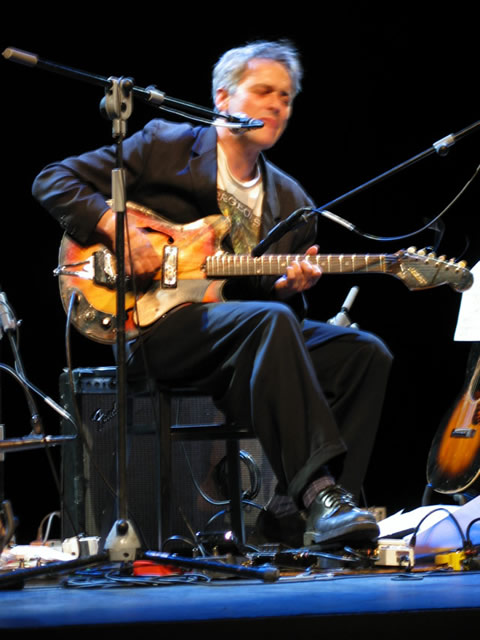
Marc Ribot is an American Musician a member of NYC artists rights group MusiciansACTION http://musiciansaction.org/.   Photo by Webb Traverse at English Wikipedia (Transferred from en.wikipedia to Commons.) [Public domain], via Wikimedia Commons


The initial horror evoked by Oakland’s GhostShip fire is now turning into self questioning and anger at those who placed the victims in harms way.

Yes, there will be individuals —landlords, inspectors, event organizers —held to account.

But the political context of this tragedy is that artists — not only musicians, but graphic artists, photographers and other content creators–have been placed in a condition of risk and precarity by Silicon Valley’s trashing of the copyright laws— a mass expropriation of value which turned what was once an important source of income into an expense for working artists.

Yes, marginal, new, and unsuccessful artists have long been precarious. But Silicon Valley’s implementation of a business model earning itself hundreds of billions via the ad based exploitation of copyright infringing work has marginalized an increasingly large number of working “content creators”, driving many into substandard housing, work spaces, and multiple jobs; and out of health insurance, safe housing, and sleep.

The geographically marginal location of the GhostShip lofts— in Oakland’s industrial zone, far from the nightlife centers of SF, is not only a metaphor, but a sign and

symptom of a wider and deeper phenomenon: the economic marginalization of working artists.

The GhostShip’s Oakland location — right across the Bay from the SV corporations which drove them into fatal precarity — is also more than metaphor. These artists were driven out of less precarious situations by rent increases. San Franscisco real estate has gone through the ceiling as a direct result of the huge wealth of Silicon Valley corporate execs, investors, financiers, and employees.

Rage at this Silicon Valley driven gentrification has been local news for almost a decade. Conflict between local residents and SV employees broke into violence over Google’s usage of public bus stops for their private busses. Leftists may not consider the local residents’ choice of an epithet (“dot.communist”) the ideal metaphor for evil, but it was meant to express the contempt Bay Area residents felt for the tech industry yuppies who drove them out of their homes and work places.

Working artists were by no means the only San Franciscans displaced. But added to the injury of artist displacement was the insulting knowledge that the money enabling their displacers had been generated by their own labor, expropriated via ad based profits on infringing files of their own work, files often posted and used without their consent or remuneration.

Silicon Valley propaganda outlets like the Google funded “Electronic Frontier Foundation” have long taken the position that the 60% collapse of the record industry caused by infringement was only hurting rich major record company exec’s, that somehow you could suck 7 billion a year out of an industry without hurting the working artists — and engineers, and indie label staff, and photographers/graphic artists/designers etc — who worked with them and lived off the sales of their music.

So now the precarity caused by these policies has hurt real people. And the only thing unusual about those hurt or killed in the GhostShip fire was that, unlike the hundreds of thousands of individual, isolated disasters caused by structural precarity, this hurt made national headlines.

Our personal disasters —the broken relationships of those working two jobs, or forced onto the road because that’s all that’s left, the deferment or avoidance of family due to poverty….the dislocations, evictions, foreclosures — will never be on CNN or Fox News. But we all know people, or are people, who have suffered them.

“Precarity” describes the social dimension of supposedly “natural” disasters: the increased risk of death, injury, and misery for those pushed to the social edge. The cause of death may be attributed to natural phenomena: fire, flood, earthquake. But the degree of risk is created

socially: politically, legally, economically. San Fransisco’s “Loma Prieta” earthquake of 1989 registered 6.9 on the richter scale and resulted in 63 deaths. The 2010 Haitian earthquake was a similar magnitude (7.0), but resulted in over 160,000 deaths. The earthquake didn’t kill: substandard housing did. It’s poverty, not nature, that places people in substandard housing. And it’s the lack of political rights and power that condemn populations to poverty.

The precarity pushing ‘content creators” to the social edge is entirely political, caused not by digital technology itself, but by:

1. the special privilege “Safe Harbor” clauses of the Digital Millennium Copyright Act of 1997-98, which prevent artists from seeking damages from online corporations, even those, like YouTube, whose business model is based on the mass infringement of artists rights.

2. The 2ndary boycott provision of the Taft Hartley law which limits the target of “collective economic (ie: union) action” to the immediate direct employer (meaning that almost all corporate profiteering from ‘content’ is off limits to labor action by almost all producers of content).

Many people know that Taylor Swift withdrew her material from Spotify to protest its low rates of pay. Fewer

know that if Ms. Swift had asked other artists to join her, or the public to boycott, she could have been sued for everything she ever made or ever will make. And if a union had made that call on her behalf, they could have seen all their assets, including pension funds, seized, and their officers arrested and placed under gag order.

3. Reagan era court decisions limiting the scope of anti-trust law, even when corporations are clearly using their “monopsony” power to crush producers.

Rip, Mix, Burn

The february 2003 edition of Wired Magazine celebrated the death of the recording industry with a cover (referring to Charles C Mann’s accompanying “The Year The Music Dies” article) consisting of a famous graphic image of the Hindenburg disaster, in which hundreds of passengers were burnt to death in the ill-fated zepellin’s launching.*

This graphic image was accompanied by the text “Rip, Mix, Burn”, a slogan borrowed from an Apple campaign to both advertise their product as a tool for copyright infringement and rationalize the harm done to artists by presenting a for profit corporate campaign as anti-corporate direct action. Apple profited greatly from sales to consumers using their product precisely as suggested.

Wired’s advertisers are often tech corporations reaping similar profits.

The clear implication of Wired’s gleeful use of the Hindenberg disaster photo… is now obscene.

We now know that “the music” didn’t die in 2003. Musicians still make music (using similar technological tools to those in use since the 90’s). People still listen to the music musicians make. Their listening is still mediated by corporations, and still produces (now more than ever) profits for those corporations. Only now those profits aren’t shared by the people who produce them. This isn’t ‘creative destruction’, or ‘technological unemployment’: its exploitation pure and simple.

Thanks to the Safe Harbor clause of the Digital Millennium Copyright Act, and the 2ndary boycott provision of the Taft Hartley Law, content creators have been prevented from fighting this exploitation individually and collectively.

Denied legal means of fighting back, politically swamped by the massive lobbying power and social media manipulation of Silicon Valley corporations, artists have been pushed into economic precarity and risk.

As is so often the case with the violation of rights, violence against the body is the inevitable consequence.

M. Ribot

The author is a member of NYC artists rights group MusiciansACTION http://musiciansaction.org/.

@kayleighqueue: This Austin Nonprofit Is Changing the Way Local Musicians Get Paid — Artist Rights Watch

Austin’s Black Fret, a 501 (c) (3) public charity increasingly has made waves in the Austin music community for how it supports local talent. In just a few short years, Black Fret has given more than $280,000 directly to Austin artists, including rising stars Shakey Graves, Dana Falconberry, and Wild Child. Later this week, at their annual Black Ball, the organization will announce $200,000+ in grants—upwards of $5,000 for minor grants, $10,000 for major ones—that Black Fret will award to more than a dozen local musicians throughout 2017.

via @kayleighqueue: This Austin Nonprofit Is Changing the Way Local Musicians Get Paid — Artist Rights Watch