Meet the New AI Boss, Worse Than the Old Internet Boss

Congress is considering several legislative packages to regulate AI. AI is a system that was launched globally with no safety standards, no threat modeling, and no real oversight. A system that externalized risk onto the public, created enormous security vulnerabilities, and then acted surprised when criminals, hostile states, and bad actors exploited it.

After the damage was done, the same companies that built it told governments not to regulate—because regulation would “stifle innovation.” Instead, they sold us cybersecurity products, compliance frameworks, and risk-management services to fix the problems they created.

Yes, artificial intelligence is a problem. Wait…Oh, no sorry. That’s not AI.

That’s was Internet. And it made the tech bros the richest ruling class in history.

And that’s why some of us are just a little skeptical when the same tech bros are now telling us: “Trust us, this time will be different.” AI will be different, that’s for sure. They’ll get even richer and they’ll rip us off even more this time. Not to mention building small nuclear reactors on government land that we paid for, monopolizing electrical grids that we paid for, and expecting us to fill the landscape with massive power lines that we will pay for.

The topper is that these libertines want no responsibility for anything, and they want to seize control of the levers of government to stop any accountability. But there are some in Congress who are serious about not getting fooled again.

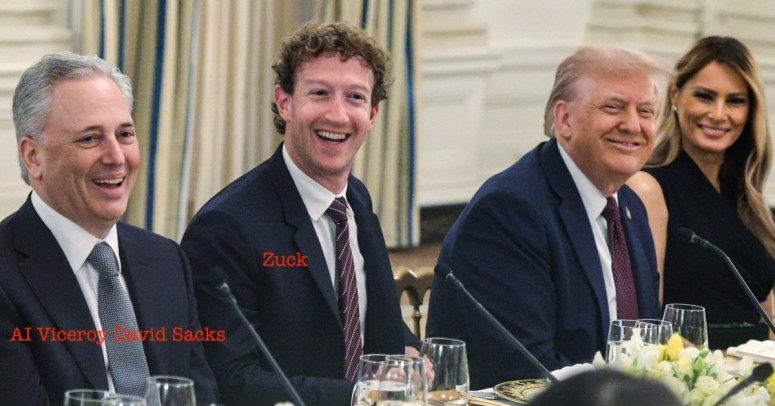
Senator Marsha Blackburn released a summary of legislation she is sponsoring that gives us some cause for hope (read it here courtesy of our friends at the Copyright Alliance). Because her bill might be effective, that means Silicon Valley shills will be all over it to try to water it down and, if at all possible, destroy it. That attack of the shills has already started with Silicon Valley’s AI Viceroy in the Trump White House, a guy you may never have heard of named David Sacks. Know that name. Beware that name.

Senator Blackburn’s bill will do a lot of good things, including for protecting copyright. But the first substantive section of Senator Blackburn’s summary is a game changer. She would establish an obligation on AI platforms to be responsible for known or predictable harm that can befall users of AI products. This is sometimes called a “duty of care.”

Her summary states:

Place a duty of care on AI developers in the design, development, and operation of AI platforms to prevent and mitigate foreseeable harm to users. Additionally, this section requires:

• AI platforms to conduct regular risk assessments of how algorithmic systems, engagement mechanics, and data practices contribute to psychological, physical, financial, and exploitative harms.

• The Federal Trade Commission (FTC) to promulgate rules establishing minimum reasonable safeguards.

At its core, Senator Blackburn’s AI bill tries to force tech companies to play by rules that most other industries have followed for decades: if you design a product that predictably harms people, you have a responsibility to fix it.

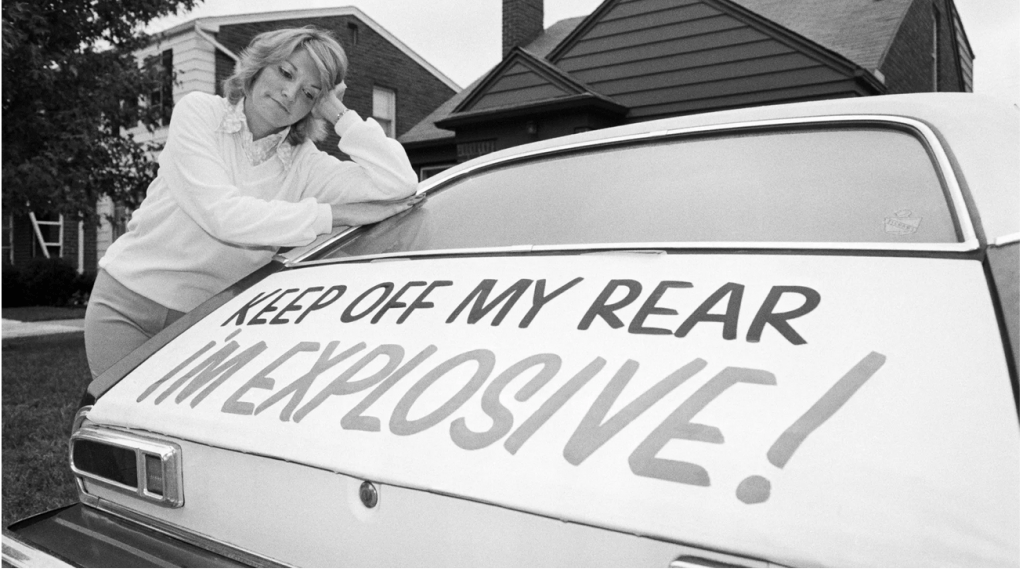
That idea is called “products liability.” Simply put, it means companies can’t sell dangerous products and then shrug it off when people get hurt. Sounds logical, right? Sounds like what you would expect would happen if you did the bad thing? Car makers have to worry about the famous exploding gas tanks. Toy manufacturers have to worry about choking hazards. Drug companies have to test side effects. Tobacco companies….well, you know the rest. The law doesn’t demand perfection—but it does demand reasonable care and imposes a “duty of care” on companies that put dangerous products into the public.

Blackburn’s bill would apply that same logic to AI platforms. Yes, the special people would have to follow the same rules as everyone else with no safe harbors.

Instead of treating AI systems as abstract “speech” or neutral tools, the bill treats them as what they are: products with design choices. Those choices that can foreseeably cause psychological harm, financial scams, physical danger, or exploitation. Recommendation algorithms, engagement mechanics, and data practices aren’t accidents. They’re engineered. At tremendous expense. One thing you can be sure of is that if Google’s algorithms behave a certain way, it’s not because the engineers ran out of development money. The same is true of ChatGPT, Grok, etc. On a certain level of reality, this is very likely not guess work or predictability. It’s “known” rather than “should have known.” These people know exactly what their algorithms do. And they do it for the money.

The bill would impose that duty of care on AI developers and platform operators. A duty of care is a basic legal obligation to act reasonably to prevent foreseeable harm. “Foreseeable” doesn’t mean you can predict the exact victim or moment—it means you can anticipate the type of harm that flows to users you target from how the system is built.

To make that duty real, the bill would require companies to conduct regular risk assessments and make them public. These aren’t PR exercises. They would have to evaluate how their algorithms, engagement loops, and data use contribute to harms like addiction, manipulation, fraud, harassment, and exploitation.

They do this already, believe it. What’s different is that they don’t make it public, anymore than Ford made public the internal research that the Pinto’s gas tank was likely to explode. In other words, platforms would have to look honestly at what their systems actually do in the world—not just what they claim to do.

The bill also directs the Federal Trade Commission (FTC) to write rules establishing minimum reasonable safeguards. That’s important because it turns a vague obligation (“be responsible”) into enforceable standards (“here’s what you must do at a minimum”). Think of it as seatbelts and crash tests for AI systems.

So why do tech companies object? Because many of them argue that their algorithms are protected by the First Amendment—that regulating how recommendations work is regulating speech. Yes, that is a load of crap. It’s not just you, it really is BS.

Imagine Ford arguing that an exploding gas tank was “expressive conduct”—that drivers chose the Pinto to make a statement, and therefore safety regulation would violate Ford’s free speech rights. No court would take that seriously. A gas tank is not an opinion. It’s an engineered component with known risks and risks that were known to the manufacturer.

AI platforms are the same. When harm flows from design decisions—how content is ranked, how users are nudged, how systems optimize for engagement—that’s not speech. That’s product design. You can measure it, test it, audit it, which they do and make it safer which they don’t.

This part of Senator Blackburn’s bill matters because platform design shapes culture, careers, and livelihoods. Algorithms decide what gets seen, what gets buried, and what gets exploited. Blackburn’s bill doesn’t solve every problem, but it takes an important step: it says tech companies can’t hide dangerous products behind free-speech rhetoric anymore.

If you build it, and it predictably hurts people, you’re responsible for fixing it. That’s not censorship. It’s accountability. And people like Marc Andreessen, Sam Altman, Elon Musk and David Sacks will hate it.

United for Artists’ Rights: Amicus Briefs Filed in Vetter v. Resnik Support Global Copyright Termination for Songwriters and Authors: The Authors Guild, Inc., Dramatists Legal Defense Fund, Inc., Novelists, Inc., Romance Writers Of America, Inc., Society Of Composers & Lyricists, Inc. and Songwriters Guild Of America, Inc.

In Vetter v. Resnik, songwriter Cyril Vetter won his trial case in Baton Rouge allowing him to recover worldwide rights in his song “Double Shot of My Baby’s Love” after serving his 35 year termination notice on his former publisher, Resnik Music Group. The publisher appealed. The Fifth Circuit Court of Appeals will hear the case and currently is weighing whether U.S. copyright termination rights include “foreign” territories—a question that strikes at the heart of artists’ ability to reclaim their work worldwide (whatever “foreign” means).

Cyril’s attorney Tim Kappel explains the case if you need an explainer:

An astonishing number of friend of the court briefs were filed by many songwriter groups. We’re going to post them all and today’s brief is by The Authors Guild, Inc., Dramatists Legal Defense Fund, Inc., Novelists, Inc., Romance Writers Of America, Inc., Society Of Composers & Lyricists, Inc. and Songwriters Guild Of America, Inc.

We believe the answer must be yes. Congress gave creators and their heirs the right to regain control of their work after decades, and that promise means little if global rights are excluded. The outcome of this case could either reaffirm that promise—or open the door for multinational publishers to sidestep it entirely.

That’s why we’re sharing friend of the court briefs from across the creative communities. Each one brings a different perspective—but all defend the principle that artists deserve a real, global right to take back what’s theirs, because as Chris said Congress did not give authors a second bite at half the apple.

Read the latest amicus brief below.

The Times They Are A-Changin | Guest Post by Marc Ribot

Guest post by Marc Ribot.

The deceptive premises of the NYTimes Editorial “Keep the Internet Free of Borders” 8/10, begin with the title, which leads one to believe that this ITC case will take something away that actually exists.   In fact, the Internet is not now and has never been,  “free of borders”. Copyright law prohibits unlawful distribution of copyrighted works outside national borders and has strict provisions on import and export of copyrighted works. The Internet has never been free of copyright law, because copyright  is nation-based. That’s why a new treaty was adopted to address the cross-border issue of distribution of works for blind and reading impaired persons- the Marrakesh Treaty adopted in 2012-, and why a global treaty for libraries is now under discussion: to make cross-border distribution legal in certain cases,  precisely because right now it’s restricted.  Even Google knows that the Internet has national borders.  It found a way to respect them for Google Books-  a mechanism to prevent export of copyrighted works to other countries. There are patent rules too.  All universities have policies regarding import and export of patented material. Export control rules and guidelines already cover patented material/trade competition and have NEVER  been restricted to physical goods.

When the editorial extrapolates its argument to the record industry, it goes even further afield.  ” The I.T.C. has long had the power to forbid companies from importing physical goods like electronics, books and mechanical equipment that violate the patents, copyrights and trademarks of American businesses…The commission’s order to ClearCorrect was the first time it had sought to bar the transfer of digital information.”

The Times takes the RIAA to task for supporting the decision: “Groups like the…Recording Industry Association of America are supporting the commission’s view… that, as trade increasingly becomes digital, the definition of “article” should include data.”

Yet when there was actually legislation on the table supporting the alternative remedies to ITC intervention that the editorial now claims to favor,  the NY Times took the exact opposite position ( Beyond SOPA 1/28/12), and supported empowering the ITC:  “By giving the International Trade Commission sole authority to determine infringement, [the OPEN Act] would…[give]  copyright holders powerful new tools to protect themselves [while] protecting legitimate expression on  the Web from overzealous content owners.

Funny how ‘Times’ change.

In any case, the alternate remedies proposed in last weeks editorial simply don’t apply to recording artists works.  “There are far better ways to [protect…patents and copyrights]….Align could sue ClearCorrect and seek damages for patent infringement. Or the company could ask a judge to order ClearCorrect to stop selling products made using the information contained in the files.”

Sounds great: but asking a judge to order an infringing company to stop selling [physical] products made using information contained in infringing files’ isn’t relevant for people whose product is the files themselves.  And  of course, suing companies profiting from infringement is precisely what musicians can’t do, thanks to the Safe Harbor Clause of the DMCA. That clause exempts online businesses from the normal responsibility of companies for violations of the law occurring on their premises.

Is the NY Times now going to support ending Safe Harbor protection for companies whose business models are based on aiding, abetting, and profiting  from infringement?  Such a position would be the only way musicians could have access to its suggested remedy.

We certainly hope so, because while congress has failed to effectively regulate the unfair black market destroying the value of our work, our industry has crashed and our livelihoods are suffering.

Our problem isn’t new technology itself, but the failure of government to regulate new and unfair forms of exploitation. The internet has borders: it is bound internationally by the laws of sovereign nations, and internally by laws which protect the rights of citizens. It also has hugely powerful corporations attempting to violate those borders on a massive scale in order to create consumer ‘facts on the ground’ which render those rights politically un-enforceable.

International borders aren’t the only boundaries threatened by big tech’s drive to profit from infringement: the consequences of the failure of government to stand up to this corporate manipulation won’t stay neatly contained within the music industry.  Nor will the effective nullification of citizens rights stop at those protecting artists.  Its a slippery slope, baby.

– M ribot

Steven Johnson & A Thesis That Isn’t | The Illusion Of More

If we strip away some of the color and simply look at the assertions being made, then the basic structure of the article reveals an important fallacy. First Johnson states that most of the evidence of harm done to creators in the digital age is anecdotal, and this is partly true — although anecdotes from professionals should not be misconstrued as mere random complaining. So, to get beyond the anecdotal, Johnson then cites macroeconomic data, compiled by the Labor Department, most of which suggests a big-picture view that creative people in all media are doing better than they were a decade ago. But, having previously scorned the anecdotal negative, Johnson then cherrypicks bits and pieces of the anecdotal positive — some of which he misrepresents — in order to support his interpretation of the economic data he cites.

READ THE FULL POST AT THE ILLUSION OF MORE:
http://illusionofmore.com/steven-johnson-thesis-isnt/

Music Artists Take On the Business, Calling for Change | New York Times

The New York Times quotes representatives of the artists rights movement including Blake Morgan of the #irespectmusic campaign, Melvin Gibbs of C3Action.Org (Content Creators Coalition), David Lowery of the Trichordist as well as musicians Zoe Keating, David Byrne and others.

“None of these companies that are supposedly in the music business are actually in the music business,” Mr. Gibbs said. “They are in the data-aggregation business. They’re in the ad-selling business. The value of music means nothing to them.”

READ MORE AT THE NEW YORK TIMES:
http://www.nytimes.com/2015/08/01/business/media/music-artists-take-on-the-business-calling-for-change.html

5 Seriously Dumb Myths About Copyright the Media Should Stop Repeating | John Degen @ Medium

Please read John Degen’s 5 Seriously Dumb Myths About Copyright the Media Should Stop Repeating at the link below.

There you have it. I hope this quick list has helped my friends and colleagues in the media who may be hurrying to file a story on World Book and Copyright Day. Here’s a final, simple, rule of thumb for writing about copyright.

If you want to understand how a working artist feels about copyright, talk to an actual working artist.

The last time I checked, ivory-tower legal-theory departments and digital-utopian advocacy groups were not the best places to look for actual working artists.

READ THE FULL POST AT MEDIUM:
https://medium.com/@jkdegen/5-seriously-dumb-myths-about-copyright-the-media-should-stop-repeating-a92e934f12a4

Spotify Desperately Doubles Down on Dumb Bad Math… Free Doesn’t Pay, It’s Just Math.

Bring out your shills… It’s no surprise that Spotify has once again enlisted it’s shills and PR machinery to defend it’s exploitation of artists, bad business model, and horrible royalties. The latest offensive comes as the major labels have announced that the unlimited free tier is not working for them (go figure, free doesn’t pay?).

Last year we wondered out loud, Who will be the First Fired Label Execs over Spotify Fiasco & Cannibalization? In February of this year we found out when Rob Wells exited his post at UMG. Around the same time public comments were made by Lucian Grainge for the need to get more paid subscription revenue. He also noted that the free tiers are not creating the type of performance required for a sustainable ecosystem of recorded music sales. Sony music chief Doug Morris has also come to the party stating, “In general, free is death.

Generally speaking we’re not often fans of major labels (remember they have 18% equity in Spotify) but we’re glad they’ve gotten out the calculators. Right now, the three major labels are currently reviewing their licenses with Spotify which are up for renewal this year. This is the time for the major labels to renegotiate those licenses to be more fair for artists.

We’ve detailed the math here, Music Streaming Math Can It All Add Up? In that post we look at the numbers based only upon paying subscribers. The bottom line is that even at the current rate of $9.99 (per month, per subscriber) it’s going to take a lot more paying subscribers to even get close to the type of revenue earned from transactional sales. Free, ad supported revenue, not even close.

Here’s a couple more things to keep in mind that we’ve detailed:

* Spotify Per Stream Rates Drop as Service Adds More Users…

– and –

* USA Spotify Streaming Rates Reveal 58% of Streams Are Free, Pays Only 16% Of Revenue

But perhaps the worst part of Spotify was outlined by Sharky Laguna’s editorial, “The Real Reason Why The Spotify Model Is Broken.” The well written piece details how the artist you play, may not be the artist who get’s paid due to the fixed revenue pool and market share distribution of revenues.

Now keep in mind we’re not anti-streaming. We completely believe that streaming is the future of music distribution and delivery. None of our arguments here are anti-streaming or anti-technology.

Our arguments are anti-exploitation and anti-bad business models. Technology and economics are different issues. We detailed our thoughts for moving forward with potential solutions in our post Streaming Is The Future, Spotify Is Not, Let’s Talk Solutions. We look at five practices that can make streaming music economics viable for all stakeholders and generate the revenue required for a sustainable ecosystem.

When a Spotify rep says, “We think the model works” keep this in mind as we review the Spotify Time Machine…

* 2010 A Brief History Of Spotify, “How Much Do Artists Make?” @SXSW #SXSW

Back in 2010 during Daniel Ek’s Keynote Speech an audience member who identified themselves as an independent musician asked how much activity it would take on Spotify to earn just one US Dollar. The 27 year old wunderkind and CEO of the company was stumped for an answer… Five years later we have a pretty good idea why.

– and –

* 2012 A Brief History Of Spotify, “It Increases Itunes Sales”… @SXSW #SXSW

Ek strenuously denied that his streaming service cannibalises sales of music through services such as Apple’s iTunes.

“There’s not a shred of data to suggest that. In fact, all the information available points to streaming services helping to drive sales,” he said.

Of course, that was until this past year when Itunes sales are reported to have declined by 13-14% and that is pretty much directly attributed to the cannibalization done by Spotify. Hello…

It is said that one of the definitions of insanity is to keep doing the same thing while expecting different results. Our suggestion to the those in positions of power is simply this, if  you want something different, you have to be willing to do something different.

Sure, Spotify was a grand experiment but after half a decade we now have the data to know if that experiment is working out (or not). In the end, it’s just math and free doesn’t pay…


Streaming Is the Future, Spotify Is Not. Let’s talk Solutions.


Spotify Per Stream Rates Drop as Service Adds More Users…


USA Spotify Streaming Rates Reveal 58% of Streams Are Free, Pays Only 16% Of Revenue

Zoë Keating Publishes Google/YouTube Transcript : Clarity | Zoë Keating Blog

With friends like these…

If i wanted to just let content ID keep doing it’s thing, and it does a great job at and i’m totally happy with it and i don’t want to participate in the music service, is that an option?

That’s unfortunately not an option.

Assuming i don’t want to, then what would occur?

So what would happen is, um, so in the worst case scenario, because we do understand there are cases where our partners don’t want to participate for various reasons, what we basically have to do is because the music terms are essentially like outdated, the content that you directly upload from accounts that you own under the content owner attached to the agreement, we’ll have to block that content. but anything that comes up that we’re able to scan and match through content ID we could just apply a track policy but the commercial terms no longer apply so there’s not going to be any revenue generated.

Wow that’s pretty harsh.

Yeah, it’s harsh and trust me, it is really difficult for me to have this conversation with all of my partners but we’re really, what we’re trying to do is basically create a new revenue stream on top of what exists on the platform today.

PLEASE READ THE ENTIRE POST/TRANSCRIPT AT:
http://zoekeating.tumblr.com/post/109312851929/clarity

Wondering Sound: “David Lowery Has Become Most Important Spokesperson for Artists Rights In Digital Era”

‘In the last three years, David Lowery has become perhaps most the important and ardent spokesperson for artist rights in the digital era. Who is he?’

Balanced, funny and in depth profile of fellow Trichordist writer David Lowery.  Must read.

READ THE FULL STORY AT WONDERING SOUND:
http://www.wonderingsound.com/feature/david-lowery-digital-music-cracker-interview/