Trent Reznor speaks on value of music: “It costs 10 bucks, or go **** yourself. | SPIN

“I know that what we’re doing flies in the face of the Kickstarter Amanda-Palmer-Start-a-Revolution thing, which is fine for her, but I’m not super-comfortable with the idea of Ziggy Stardust shaking his cup for scraps. I’m not saying offering things for free or pay-what-you-can is wrong. I’m saying my personal feeling is that my album’s not a dime. It’s not a buck. I made it as well as I could, and it costs 10 bucks, or go fuck yourself.”

READ THE FULL INTERVIEW AT SPIN:
http://www.spin.com/featured/trent-reznor-upward-spiral-nine-inch-nails-spin-cover-september-2013/

PRE ORDER THE ALBUM ON ITUNES NOW:
https://itunes.apple.com/us/album/hesitation-marks/id655150305

Pandora Prepares to Attack Artists… Again | DMN

Amazing the lengths Tim Westergren and Pandora are willing to go to, to attack artists…

Accordingly, Pandora is taking steps to have well-written, careful responses ready to go within 24 hours in places like Digital Music News.  Most importantly, the response needs to come from a source not affiliated with Pandora (or, so it seems…)

READ THE FULL STORY (AND EMAILS) AT DIGITAL MUSIC NEWS:
http://www.digitalmusicnews.com/permalink/2013/20130715pandora#QFlbW2t7XHEHic_7jx2vSg

Facebook Communities For Artists Rights

The Trichordist links through to FarePlay on Facebook  from the blog and there are also these other communities. Please support all of these pages and let us know if there are more.

CONNECT!

FARE PLAY
https://www.facebook.com/FarePlay

COPY LIKE
https://www.facebook.com/copylike

RE-VALUE MUSIC
https://www.facebook.com/ReValueMusic

FIGHT FOR MUSIC
https://www.facebook.com/freefallfaithfirestor

MUSIC FIRST
https://www.facebook.com/musicFIRSTcoalition

Uncertainty, Copyright and Courage by Paul Williams

On Wednesday, June 5th, ASCAP President and Chairman Paul Williams delivered a powerful keynote to attendees of the CISAC World Creators Summit in DC. He spoke passionately and pointedly about what it means to be a creator in today’s challenging digital environment.

This excerpt of the talk touches on one of many well made points.

Literature, music and art have value to individuals, to businesses and to countries. They open our hearts and minds. They inspire. They teach. They comfort. They drive economic growth and innovation. They define our time; they define our cultures; they bring us together.

So then, why are we now in the position of having to defend ourselves against the insidious erosion of the basic principles of copyright in so many parts of the world?

Intellectual property rights are a cornerstone of democracy. As a citizen, a creator and a consumer, I should have a reasonable expectation that I live in a society where thieves and outlaws are not allowed to run rampant – even when they are operating in cyberspace. But when lawmakers in North America and Europe tried to enact legislation that would help enforce laws against online fraud and theft, the technology sector said it would break the internet. They called it censorship.

Creators are in the business of free expression. Freedom of speech is about political speech, it is not about protecting fraud or theft. They trivialized what free speech means. Forces that want to control and diminish the value of our work for their own economic benefit are systematically attacking the rights of creators. They are methodically attacking the validity of copyright laws. They are building their businesses in a way that makes enforcement of our copyrights next to impossible.

The hope that creative work will pay off for the author, composer, filmmaker or photographer if it becomes successful is no longer a given. Fair payment has become another profound uncertainty in the professional life of every creator. This is true for people at the top of their game, and especially so for those just starting out. This is true globally – not just in the United States, in Canada, in the European Union – all over the world.

PLEASE READ THE FULL KEYNOTE ADDRESS HERE AT ASCAP:
http://www.ascap.com/playback/2013/06/action/uncertainty_copyright_and_courage.aspx

The Constitutional Foundations of Intellectual Property Law

via copyhype:

Randolph May and Seth Cooper of the Free State Foundation look at some of the philosophical underpinnings that drove the inclusion of copyright and patent protection into the United States Constitution. According to May and Cooper, the origin of the right is explicitly Lockean, while the protection of the right is explicitly Madisonian. An engaging and enlightening read.

READ THE FULL REPORT HERE:
The Constitutional Foundations of Intellectual Property Law

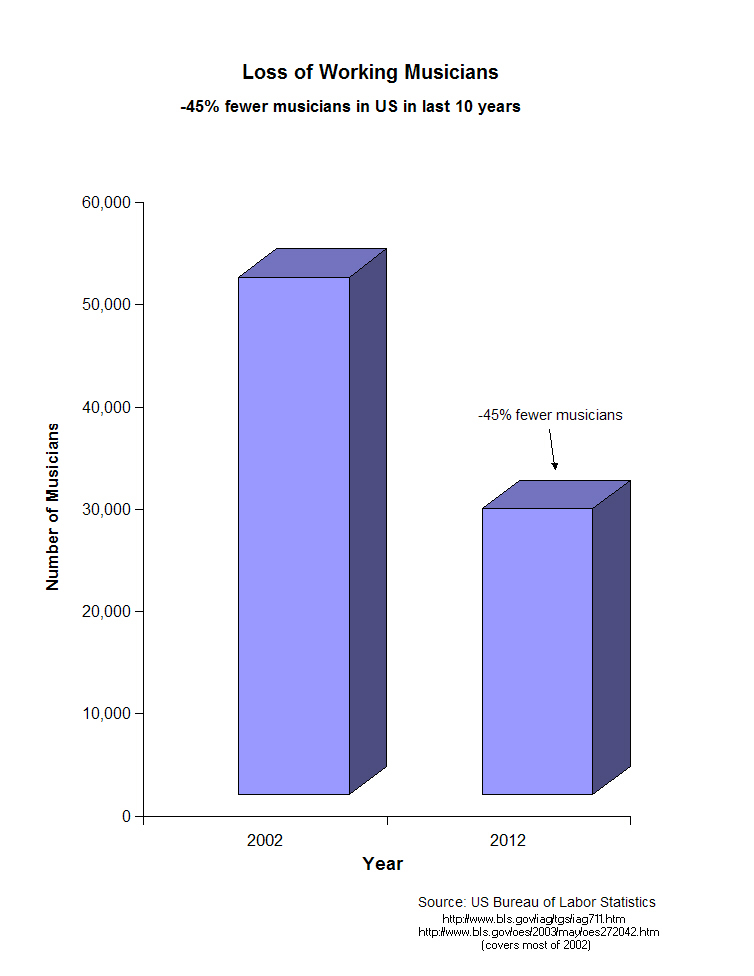
45% Fewer Professional Working Musicians Since 2002

The numbers are simple and staggering. The internet has not empowered musicians, it has exploited them.

-45% fewer working musicians-2

Of course there will always be people to nit pick the numbers, to argue and quibble about the Bureau Of Labor Statistics (BLS) methodology. It may be impossible to estimate the exact effect of unethical internet exploitation, but the trend is definite.

Those who debate the exact numbers are using that to delay action. Their job is similar to the commentators and ‘scientists’ funded by oil companies’ to deny global warming or say it needs “more study.”

The Bureau Of Labor Statistics is an agnostic government agency, not the RIAA.

It is also important to note that these cuts are made from the bottom up, not the top down. It is the struggling and middle class musician that gets hurt first. The difference between “making a living, making music” or not is represented in these numbers.

We should also like to point out that while musicians are making less money, those in Silicon Valley are making more money. Jaron Lanier says that “the internet destroyed the middle class” and we can see for ourselves that through the systematic process of removing the cost of labor from their offerings the elite few, are making more money, while everyone else is doing more of the work.

Artists Rights Watch – Sunday Feb 3, 2013

Grab the coffee!

Recent Posts:
* Over 50 Major Brands Supporting Music Piracy, It’s Big Business!
* @pepsi and @beyonce @superbowl Ads Supporting Pirate Lyrics Site That Exploits Adele and Skyfall
* Derek Khanna is Wrong: Copyleft Mystery Man’s Misleading Memo Creates its Own Myths…
* It’s Not Whack A Mole if You Own the Mole: New York Times Coverage of Brand Sponsored Piracy
* Zero Dark Thirty, Best Picture Academy Award Nominee, Exploited by AT&T, Verizon, MetroPCS, Nissan, H&R Block, British Airways, Progresso, and more…
* #StopArtistExploitation – Tweet Daily for Artists Rights!
* Underreporting and No Accountability: Another Reason Streaming Royalties are So Small
* Internet Pay To Play: Payola’s Revenge – Guest Post by Robert Rial of Bakelite78

From Around The Web

LA WEEKLY:
* YouTube Stars Fight Back

“I woke up today hoping to make a video, but I went into a call with Machinima this evening and they said that my contract is completely enforceable. I can’t get out of it,” Vacas tells the camera. “They said I am with them for the rest of my life — that I am with them forever.

“If I’m locked down to Machinima for the rest of my life and I’ve got no freedom, then I don’t want to make videos anymore,” he says quietly.

The screen fades to black.

NEW YORK TIMES:
* Playing Whac-a-Mole With Piracy Sites
* As Music Streaming Grows, Royalties Slow to a Trickle

Spotify, Pandora and others like them pay fractions of a cent to record companies and publishers each time a song is played, some portion of which goes to performers and songwriters as royalties. Unlike the royalties from a sale, these payments accrue every time a listener clicks on a song, year after year.

The question dogging the music industry is whether these micropayments can add up to anything substantial.

“No artist will be able to survive to be professionals except those who have a significant live business, and that’s very few,” said Hartwig Masuch, chief executive of BMG Rights Management.

ADLAND:
* Online pirating: sponsored by many brands, and now, one government.

BUSINESS INSIDER:
* How Jobs In The Media Industry Got Demolished In The Last 10 Years [Charts]

The Bureau of Labor Statistics has put together a presentation on the recent history and direction of media jobs. It’s not pretty.

THE LEFT ROOM:
* Piracy, Free Books, etc

DIGITAL BOOK WORLD:
* Does Piracy Hurt Digital Content Sales? Yes

BRITISH JOURNAL OF PHOTOGRAPHY:
* Photographers find support in House of Lords in copyright fight

THE HOLLYWOOD REPORTER:
* Ray Charles’ Children Win Lawsuit Over Song Rights Termination

BLABBERMOUTH:
* TOOL Frontman Sounds Off On Illegal Downloading, Music Industry And Digital Distribution

“There’s a disconnect between people not buying music and not understanding why [bands] go away. There are people who are like monkeys in a cage just hitting the coke button. They don’t really get that for [musicians and artists] to do these things, they have to fund them. They have to have something to pay the rent.”

VOX INDIE:
* New Spotlight on Piracy Profitmongers

THE ILLUSION OF MORE:
* Think File Sharing is Sticking it to The Man? Really?
* On Being a Luddite

COPYRIGHT AND TECHNOLOGY:
* Yes, Piracy Does Cause Economic Harm

Decisions about business and policy have to be made based on the best information we have available. After a certain point, simply poking holes in studies — particularly those whose results you don’t happen to like — isn’t sufficient.

It may indeed, as the GAO suggested, be impossible to measure the economic effects of piracy with a large amount of accuracy. But if dozens of researchers have tried, all using different methodologies, then their conclusions in the aggregate are the best we’re going to do. Put another way, it will henceforth be very difficult to dislodge Smith and Telang’s conclusion that piracy does economic harm to content creators.

RAPIDTV NEWS:
* LATAM pay-TV operators unite against piracy

CIOL:
* Kamal Haasan fans help curb Vishwaroopam online piracy

BILLBOARD:
* Worldwide Independent Network Announces ‘Independent Manifesto’
* Blink-182’s Mark Hoppus Talks Piracy, Pros and Cons of Digital at MIDEM

“I believe that artists should be paid for their creativity. There’s no other industry where people can come in and take what you create for free and give it away for free and that’s acceptable.”

MUSIC ALLEY:
* U2 manager Paul McGuinness: ‘I don’t want to engage in Google-bashing, but…’
* Irving Azoff sticks it to Pandora and StubHub
* Midem 2013: How the Music Industry Manages Innovation

“We are the last fortress against this YouTube situation, and we are fighting hard on that,” he said. “The problem is the fair price, getting statements and getting all the business plans… The biggest problem to solve the YouTube deal is they want a non-disclosure deal, and we are not allowed by Germany law to do with any partners a non-disclosure [deal]. We have to do it open.”

DIGITAL MUSIC NEWS:
* Pandora Executives Cash Another $3 Million In January…
* Hey Advertisers: You Might Want to Ask VEVO for a Refund…

HYPEBOT:
* Myspace Allegedly Hosting Unlicensed Indie Music, Merlin Prepares Legal Response
* The Most Honest Interview About the Music Industry Ever, Featuring Jacke Conte of Pomplamoose

“YouTube seemed like a really incredible opportunity, but it’s not repeatable. I don’t know how to make it in the music industry. I don’t think anybody really knows how, and I’m unable to repeat what happened to Pomplamoose.”

PLAGIARISM TODAY:
* 4 New-ish Pro-Copyright Sites To Read

THE FEDERALIST SOCIETY:
* Laws of Creation: An Examination of Intellectual Property Rights

INSTITUTE FOR POLICY INNOVATION:
* Copyright and Innovation? No. Copyright IS innovation.

YAHOO:
* New Order’s Peter Hook: Musicians, Journalists Only People Who Don’t Get Paid for Work

Hook expressed astonishment that in the internet economy, consumers act aggrieved if musicians ask to be compensated for their music or if reporters object to having their stories re-purposed by other news organizations without getting credit or cash.

“If you love and respect music, you should pay for it,” Hook said.

COPYRIGHT ALLIANCE:
* Creators and Consumers Should Cut the Strings

TORRENT FREAK:
* Russia Wants To Fine Websites For Poor Copyright Takedowns
* University of Illinois Disconnects Pirating Students, Staffer Asked To Leave
* Pirate Bay Founder Could Be Prosecuted For Hacking “Within a Month”

VARIETY:
* Music retail giant puts tunes online (Amoeba Archives Project)

THE SCOTSMAN:
* New look at copyright key to digital boom

THE CALGARY HERALD:
* Your content is Freely Shared; their Profit is Closely Held

There’s enormous potential in this ‘Your Content, Their Profit’ crowd-sourcing business model, and it’s turned companies like YouTube, Google and Twitter into multi-billion-dollar corporations.

Whether you realize it not, what you post online (your words, your pictures, your pictures of other people, you name it) becomes someone else’s revenue generating opportunity as soon as you post it.

Top social networking sites build into their user agreements and conditions of use the automatic rights to profit from the content that’s posted (or stored or indexed).

JOHN BOSTOCK @ TED CONVERSATIONS:
* Meet the new Boss, Worse than the Old Boss

THE MAUI NEWS:
* Creators v. Consumers : Restating the Obvious

SAD RED EARTH:
* Aaron Swartz and “Hactivision”

The Copyright Policy Reality Gap

We hear a lot from the free culture movement and the CopyTheft advocates about where they think Copyright and IP Protection should be headed, but it’s important to note what the actual values are for Copyright protection on Capital Hill. Perhaps there’s no place better to start than with the White House itself…
“”What’s more, we’re going to aggressively protect our intellectual property.  Our single greatest asset is the innovation and the ingenuity and creativity of the American people.  It is essential to our prosperity and it will only become more so in this century.  But it’s only a competitive advantage if our companies know that someone else can’t just steal that idea and duplicate it with cheaper inputs and labor. ” – President Barack Obama
“…piracy is theft. Clean and simple. It’s smash and grab. It ain’t no different than smashing a window at Tiffany’s and grabbing [merchandise].” – Vice President Joe Biden
Also, let’s be clear (as is noted below) that at this point there is nothing the least bit controversial about acknowledging the degree of the seriousness that online piracy presents to American jobs and the US economy.
“Let us be clear—online piracy is a real problem that harms the American economy, threatens jobs for significant numbers of middle class workers and hurts some of our nation’s most creative and innovative companies and entrepreneurs.  It harms everyone from struggling artists to production crews, and from startup social media companies to large movie studios. While we are strongly committed to the vigorous enforcement of intellectual property rights, existing tools are not strong enough to root out the worst online pirates beyond our borders. ” – whitehouse.gov

Artists and creators live a different lifestyle with many trade offs from conventional employment often working long odd hours for lower than minimum wage and without benefits. For artists and creators this is balanced out in the rights and protections granted in copyright that allow the artist a sustainable living. As a society we have granted these rights to creators as an incentive to produce a meaningful cultural economy. So effective have these protections been that America has the most profitable and most exported popular culture throughout the world.

“Recently, I’ve had a chance to read letters from award winning writers and artists whose livelihoods have been destroyed by music piracy. One letter that stuck out for me was a guy who said the songwriting royalties he had depended on to ‘be a golden parachute to fund his retirement had turned out to be a lead balloon.’ This just isn’t right.” – US Commerce Secretary Gary Locke

Now is the time to have a serious and meaningful conversation about the future of a fair and ethical internet that does not punish the innovative artists and creators who enrich our lives. Technology may change but principles do not. The internet and digital technology have opened up many new opportunities for artists, but it has also opened up new opportunities for those who wish to exploit those artists for personal or corporate gain.

We call upon the administration and both parties to protect the fundamental rights of artists and creators by adopting a fair and ethical set of principles for internet policy.

Why are Internet Freedom Fighters always fighting against the Internet Freedom of Artists?

We’re always a little amazed when site like Hypebot takes up the fight for internet freedom, as long as that freedom does not include artists rights. Recently the site has confused the difference between a $20 settlement for illegal downloadingversus a $9,250 per song judgement for copyright infringement.

It seems to us, that getting off the hook for $20 per song is a pretty good deal. Should a person downloading also be found to be uploading and distributing (you know, infringing copyright) than they might want to think twice before pushing back too hard or they could end up like Joel Tenenbaum and Jammie Thomas. Both of whom were found guilty of copyright infringement by a Jury of their peers and awarded damages upheld by the courts.

It’s troubling when sites that state they are trying to help musicians are actually making arguments to support the people who exploit artists and rip them off, but not the artists themselves.

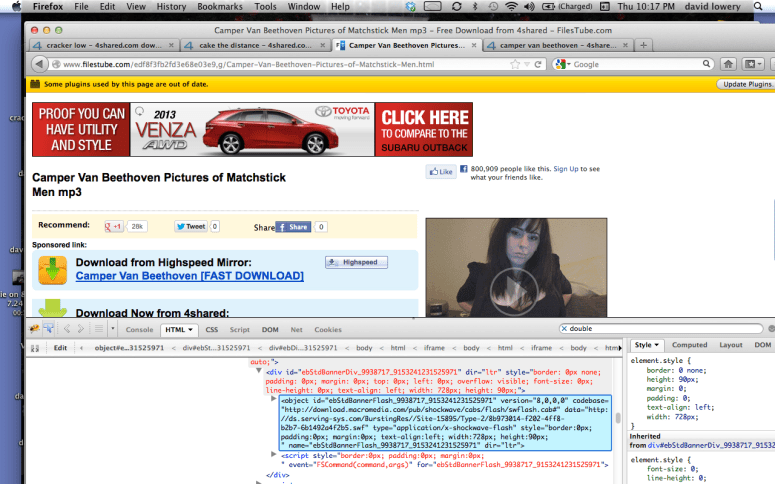
Uh Toyota… didn’t you get the memo? Why are you advertising on unauthorized sites that exploit my music?

We recently ran a story about American Express advertising on Filestube, the site that infringes my copyrights while suggesting porno links next to my brand.  The American Express ad was served by Google’s DoubleClick ad network presumably at the behest of Ogilvy & Mather.

Yesterday a Google spokesperson told us that they had disabled “self serve” advertising for this site.  We weren’t really sure if that meant no more DoubleClick on FilesTube, or if it was some kind of semantic dodge. We’ve had a bunch of those dodging semantics on this issue.  However we monitored FilesTube yesterday and we see no sign of DoubleClick.   We applaud Google for taking this action!

Now not to look a gift horse in the mouth but we’d  love to see Google disable advertising for all those sites that they know are infringing copyright. The ones they mentioned in this handy press release. See it seems a little disingenuous to lower these sites rankings but at the same time to continue doing advertising business with them?  (And yes we are already monitoring advertising on these sites!!)

American Express is another matter. We have not heard back from American Express.  We’d love to hear what American Express has to say about their company helping to finance copyright infringement–not just mine, but all of the artists. We’d love to know how that happened and if they intend to continue advertising on these sites. Cause it doesn’t seem like a very good idea for an iconic American Brand.

Now  I’ve lost my handy pocket version of the RICO statute. People are always borrowing it!  But I’m almost certain that it says something about making plans to profit from copyright infringement as a RICO “predicate”.  I’m no lawyer but if I were a big company like American Express I wouldn’t want to get anywhere near a website  that even had the potential to get wrapped up in a RICO investigation.  Especially one based in Moldova.

Today FilesTube looks like a wasteland of QuiBid ads, MacKeeper popups and click shoot ads.  Pretty low grade.  Seems like it’s not just American Express which got the memo.

Toyota however did not get the memo!   So now it’s Toyota’s turn to answer the question?  Why  are you  advertising on this site?