
2027 Mechanical Royalty Rate Rises to 13.6 Cents: Inflation Protection Works

The numbers are in. Thanks to the inflation adjustment that labels and songwriters negotiated for the Phonorecords IV rate period to defeat the frozen mechanical, the statutory mechanical royalty rate for physical phonorecords and permanent downloads will increase to 13.6 cents per song in 2027, based on my calculation using the Consumer Price Index released this morning by the Bureau of Labor Statistics.

That is up from 13.1 cents in 2026 and represents the final annual cost-of-living adjustment under the current Phonorecords IV rate period, which runs from 2023 through 2027. The alternative per-minute rate will increase from 2.52 cents to 2.62 cents per minute or fraction thereof, whichever calculation produces the greater royalty. These are calculated rates under the applicable regulation. The Copyright Royalty Judges must still publish their official 2027 adjustment in the Federal Register but I feel pretty confident that they’ll announce a 13.6 rate as we previously estimated based on inflation trends.

The November 10 CPI-U Release

This morning, the Bureau of Labor Statistics announced that the Consumer Price Index for All Urban Consumers (CPI-U) increased 0.4% in October on a seasonally adjusted basis. But the number that is most relevant for mechanical royalties is not the monthly inflation percentage. It is the unadjusted CPI-U index, which BLS reported at 337.511 for October 2026. That number is the essential ingredient in calculating the 2027 mechanical royalty rate under 37 CFR § 385.11.

The regulation established a base rate of 12 cents per song and 2.31 cents per minute for 2023, adjusted annually according to cumulative changes in the CPI-U. The base index is 298.012, the October 2022 CPI-U published in November 2022.

Applying the formula:

12¢ × (337.511 ÷ 298.012) = 13.5905¢. Rounded to the nearest tenth of a cent per the regulation, the 2027 per-song rate becomes 13.6¢.

2.31¢ × (337.511 ÷ 298.012) = 2.6162¢. Rounded to the nearest hundredth of a cent, the per-minute rate becomes 2.62¢.

The cumulative increase in the CPI-U between the base index and October 2026 is approximately 13.25%. The royalty formulas preserve that cumulative inflation adjustment, subject to their prescribed rounding rules.

Why October’s CPI Determines the Rate for All of 2027

There is a timing issue here that deserves particular attention. Why does the October 2026 CPI-U determine the royalty rate for 2027, rather than November or December inflation data? The answer is found in the regulation itself. Section 385.11(a)(2) directs the Copyright Royalty Judges to calculate the annual adjustment using the most recent CPI-U published before December 1 of the preceding year.

For the 2027 rate, that means December 1, 2026, is the cutoff. The Bureau of Labor Statistics publishes inflation statistics after the month being measured has ended. Consequently, the October 2026 CPI-U, released on November 10, is the final monthly CPI-U available before the CRB’s cutoff of December 1. (The next CPI report, covering November 2026, is scheduled for December 10. By then, the cutoff will have passed. That means the October CPI-U is effectively locked in as the controlling index for the entire 2027 royalty year.)

The timing is deliberate. The Copyright Royalty Judges must publish notice of the adjusted rates in the Federal Register at least 25 days before January 1, giving copyright owners, record companies, and other licensees advance notice before the new rates take effect. This also explains an important distinction in the calculation: the regulation measures cumulative inflation from the CPI-U published in November 2022 to the CPI-U published in November 2026. Because of BLS’s publication schedule, those are the October 2022 and October 2026 index values, respectively.

The royalty adjustment is not based simply on inflation during the last month or even the last calendar year.

The 2027 Rates

Rate2026Calculated 2027
Per musical work13.1¢13.6¢
Per minute or fraction2.52¢2.62¢

The applicable royalty for each musical work is whichever calculation produces the greater amount. For a ten-song album with songs short enough for the per-work minimum to control, the minimum mechanical royalty increases from $1.31 to $1.36 per album. That five-cent increase may seem modest when considered one album at a time. But across substantial numbers of physical records and permanent downloads, and across an entire catalog, the cumulative effect is significant.

More importantly, the COLA adjustment is automatic. Songwriters do not have to return to the Copyright Royalty Board every year to negotiate protection against inflation. That’s why the government has COLAs. They are both fair and efficient.

Why This is Relevant for Phonorecords V

The 2027 adjustment arrives as the industry prepares for the next mechanical royalty rate period, Phonorecords V, covering 2028 through 2032. The experience under Phonorecords IV illustrates an important principle: a statutory penny rate accompanied by a meaningful annual cost-of-living adjustment provides an objective, predictable measure of inflation protection for songwriters.

It gives songwriters and music publishers a transparent rate that does not depend on opaque royalty pools, fluctuating service revenues, or accounting decisions made by digital platforms. The penny-rate approach also provides an independently ascertainable and predictable obligation for each licensed use. The royalty is determined by the number of musical works reproduced or distributed, not by the copyright owner’s share of a revenue pool controlled by the licensee. As we noted in the Artist Rights Institute’s comment on Music Streaming Fraud, the lack of a penny rate and the lack of a COLA both fail to create an economic incentive for services to police their networks.

A CPI-U adjustment cannot solve every problem with statutory mechanical royalty rates. It does not automatically account for changes in the value of music or compensate for past periods when rates failed to keep pace with inflation. But it does prevent an agreed statutory rate from steadily losing purchasing power simply because the consumer price level rises. That is a substantial improvement over a frozen penny rate. It’s unfair to ask songwriters and the Copyright Royalty Judges to have to anticipate what the cost of “Food at Home” will be five years from now.

Keep the Penny Rate. Keep the COLA.

The lesson of the 2027 adjustment and Phonorecords IV is straightforward. The statutory mechanical rate for physical records and permanent downloads will have risen from 12 cents in 2023 to a calculated 13.6 cents in 2027, without requiring songwriters to undertake a new rate proceeding each year. (Thus also conferring on DSPs the substantial benefit of a locked-in, albeit unfair, rate for five years at a whack.)

The COLA mechanism is public, understandable, and independently verifiable. Anyone with the regulation and the relevant BLS figures can reproduce the calculation. That transparency is worth preserving. As the parties approach Phonorecords V, the objective should be to build on the successful elements of the existing structure: an appropriate statutory penny rate, a meaningful inflation adjustment, and a royalty obligation that can be calculated without relying on a service-controlled revenue pool.

The 2027 adjustment demonstrates that inflation protection works. The next challenge is ensuring that the underlying penny rate adequately values the songwriter’s contribution in the first place.
Selected Phonorecords V Objections: The Society of Composers & Lyricists

As part of our series highlighting selected objections to the NMPA-backed Phonorecords V Subpart B settlement, we turn to the filing of the Society of Composers & Lyricists (SCL), representing approximately 4,000 composers, lyricists, songwriters, and music copyright owners. SCL asks the Copyright Royalty Judges to reject the proposed settlement, arguing that it locks in an artificially low mechanical royalty base rather than genuinely preserving creators’ purchasing power. 

SCL focuses particularly on what it calls the missing inflation of 2021 and 2022. Its objection argues that carrying forward the 12¢ benchmark fails to restore those unusually inflationary years and could perpetuate the resulting shortfall through every subsequent COLA adjustment. SCL objects that the NMPA settlement carries the Phonorecords IV formula into Phonorecords V in a way that effectively creates a new frozen mechanical. Rather than carrying forward the actual inflation-adjusted 2027 penny rate (for example), the settlement retains 12¢ as the benchmark, perpetuating the very rate-freeze problem Phonorecords IV’s COLA was intended to prevent.

SCL proposes instead a physical and permanent-download rate of approximately 15.6¢ beginning in 2028, followed by annual CPI adjustments which would take into account the 2021 and 2022 rates that the PR IV rates did not take into account in coming up with the 12¢ rate. 

The filing also returns to a familiar issue from Phonorecords IV: vertical integration among the parties negotiating the settlement. SCL invokes the Judges’ own earlier warning that relationships linking major publishers and record labels can create inherent conflicts requiring scrutiny before a private agreement is transformed into rates binding the entire industry. 

SCL also challenges the continued 24¢ ringtone rate, raises concerns about bundling, and disputes the proposition that agreement among major industry organizations necessarily represents a consensus of the individual creators whose statutory royalties will be determined. 

Perhaps the filing’s central point is the simplest: an annual inflation adjustment cannot repair an incorrectly low starting point. SCL asks the Judges to reject the settlement and encourage a new negotiation that includes the views of independent creator organizations before rates are fixed for 2028–2032.

Selected Phonorecords V Comments: The Missing Record: Independent Songwriters Ask What the Phonorecords V Settlement Doesn’t Tell Us

Continuing our series highlighting objections to the proposed Phonorecords V settlement for mechanical royalties on physical and permanent downloads, our friends Helienne Lindvall, David Lowery, and Blake Morgan focus on a deceptively simple question: What is the record that allows the Copyright Royalty Judges to conclude this settlement is reasonable? Our friends do not argue that settlement is improper—or even necessarily that this settlement is unreasonable. Instead, they argue that Congress assigned the Judges, not the negotiating parties, responsibility for determining whether a private agreement provides a reasonable basis for rates imposed industry-wide. There’s just no record other than the NMPA’s settlement itself.

The comment also questions carrying the 12¢ Phonorecords IV benchmark forward through another five-year rate period simply because it remains indexed for inflation. CPI preserves the real value of the existing benchmark; it does not establish that the benchmark remains reasonable for 2028–2032. With vertically integrated companies operating on both sides of the “settlement”, the commenters argue that the missing economic record matters even more.

Songwriters Are Being Asked to Accept Something We’ve Never Seen Before

The freeze is back.  

The first settlement in the Phonorecords V mechanical royalty proceeding is now on file (see below). A settlement is supposed to result from a “voluntary negotiation,” so the document raises a simple question: when exactly did the negotiation happen?

The parties describe “conversations” with other participants. Maybe there were conversations. But conversations are not the same thing as negotiation. A proposal presented as essentially a finished product, with little or no opportunity to influence its terms, is notification—not negotiation.

The Parties have had settlement conversations regarding the so-called Subpart B rates and terms with the other copyright owner Participants in the Proceeding (Songwriters Guild of America, World Collections, Inc., Eight Mile Music Companies, and George Johnson), who declined to join this settlement.

That distinction is crucial because this settlement would establish the statutory mechanical royalty rate for physical records and permanent downloads starting in 2028 through 2032.  Those rates affect every songwriter, including those ex-US songwriters whose songs are exploited in the US.  According to sources overseas, ex-US songwriter groups were not consulted, although it is customary for NMPA and NSAI to not engage with them even though they are a significant group (other than major mostly English language songwriters who are represented in the US by major publishers).

This means that it is likely that an alternative proposal or several alternative proposals will come to the Copyright Royalty Board in coming days from those who were not included in the NMPA’s settlement.  As the settlement itself anticipates, whatever deal the Judges end up adopting will be published as a tentative ruling allowing public comment, but that’s down the line.  Watch this space or the CRB website for Phonorecords V for more on deadlines, etc., if you want to comment.

To our knowledge, this is also the first time we’ve seen multiple competing settlements in a CRB phonorecords proceeding. Multiple settlements are common in webcasting and other CRB cases because different categories of music users—commercial broadcasters, NPR, college radio, religious broadcasters, and others—often negotiate different deals tailored to their own services. Mechanical royalty proceedings have traditionally been different. Everyone is negotiating one statutory rate that applies across the board divided into two broad categories by music user: labels (who pay for physical and downloads), and digital services like Spotify, Apple, Google, Amazon, and Meta (who pay for streaming mechanicals and control the global streaming market and some of which largely control AI models so lead the charge on AI theft for training).

The settlement itself also leaves some obvious questions unanswered.

Artificial intelligence is rapidly changing every aspect of music licensing, yet AI is not mentioned at all in the settlement. If downloads or streaming services increasingly contain AI-generated tracks that may not even qualify for copyright protection, should those recordings receive statutory licenses or royalties at all? The Copyright Office has repeatedly stated that works lacking sufficient human authorship cannot be registered for copyright to enjoy the protections of the Copyright Act, and the statutory license is part of the Copyright Act. If that principle eventually affects downloads or streaming (which we think it does right now), it is difficult to imagine that it will never influence the economics of physical or download mechanical royalties as well. That issue received no attention in the NMPA’s settlement.

Then there is another provision that deserves far more discussion.

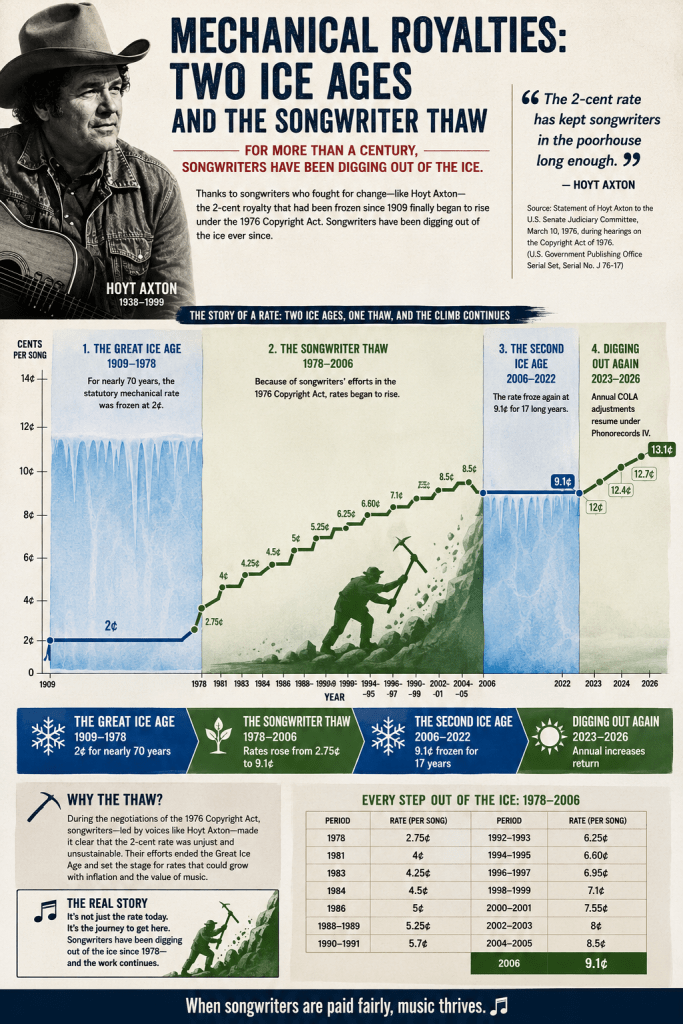
The settlement continues the existing CPI adjustment mechanism that songwriter’s fought for in the last rate setting that increased the mechanical rate from the frozen 9.1¢ proposed by the NMPA and major labels to 12¢ plus a “Cost of Living Adjustment” (or “COLA”) thanks to the Judges rejection of the extended freeze. In other words, they did the opposite of what we recently suggested in Don’t Freeze Mechanicals Again.

Adopting a 12¢ base rate makes no sense—that’s the same rate as the Judges took as the base rate for the first year of the five year rate period starting in 2023 and then applied the COLA to that rate in subsequent years.  Of course, that 12¢ rate has been eroded by inflation every year and is now worth about 10¢ without the COLA, but songwriters negotiated and received that COLA which sustained the value of the rate. That’s how we got from 12¢ in 2023 to the current 13.1¢ rate in 2026 that will probably increase again for 2027 (our guess is somewhere in the 13.4¢ to 13.6¢ range).  Why wouldn’t you just take that highest rate achieved during the last year of the Phonorecords IV period (2027) and start applying the COLA to that in the first year of the Phonorecords V period (2028)?  Rather than go back to the arbitrary 12¢ reference rate? Huh?

On its first glance, adopting a COLA for the new rates sounds reasonable because it protects songwriters against inflation. But the formula contains no floor preventing the statutory rate from declining if cumulative CPI were ever to fall.

Deflation may be unlikely. That’s not the concern.  But the COLA could still cause rates to decline. All that has to happen is that inflation doesn’t rise at the same rate or greater from one year to the next and then the COLA-adjusted statutory rate will decline.

The point is that, for what may be the first time in the history of the statutory rate and certainly since the modern Copyright Act took effect in 1978, songwriters are being asked to accept a statutory mechanical royalty structure under which the minimum statutory rate could actually move backward, and very likely will decline.

A simple solution exists. The regulation could easily provide that each year’s rate is the greater of (1) the COLA-adjusted calculation or (2) the prior year’s rate. That would preserve the existing inflation formula while ensuring the statutory royalty never declines.

Why wasn’t that included?  Or better yet, why wasn’t an actual value based increase included since we are still digging out of two prior freezes of the statutory rate one from 1909-1978 when the rate froze at 2¢ and the other from 2006-2022 when the rate froze at 9.1¢.

That’s a fair question.

So is another one.

If we’re going to lock in the statutory mechanical royalty through 2032, shouldn’t there have been a meaningful discussion—not just among the settling parties, but across the songwriting community—about AI, future valuation, whether there should be a statutory minimum for streaming and whether the statutory minimum itself should ever be permitted to decrease?

Those conversations are coming. The only question is whether they should have happened before the settlement was filed instead of afterward.  We had hoped for a longer table with more voices.  Whether that happens remains to be seen.