David Lowery: Silicon Valley must be stopped, or creativity will be destroyed | SALON

Below is just one excerpt from the interview with the always insightful David Lowery in Salon.

Silicon Valley’s making money off the work of others. David Lowery is on a crusade for copyright, fairness and art

SALON : People sometimes use the Industrial Revolution metaphor. They talk about how factories replaced the artisan and the farmer, and it took decades for things like child labor, dangerous working conditions, and pollution and all the stuff that industry brought to Britain and the U.S. to be eradicated, or made humane and sustainable.

LOWERY: But whenever anybody — I mean, you’ve just brought up David Allen, and we’ve just posted this idea on my Trichordist blog that we should have an ethical, fair-trade Internet, but you’ve got people like David Allen saying you can’t have that. That would be like in the Industrial Revolution saying, “You can’t have a non-polluting factory; you can’t have a factory that doesn’t have child labor; you can’t have a factory that’s safe to work in.” Of course you can!

We’re the ****ing masters of our own destiny, we pass the laws for this country, we create this country, we decide what kind of a society we’re going to have — not the Internet. And, besides, the Internet is coded by humans. We can make the Internet do what it needs to do. I’m a technologist. I program computers. This is what I did before I played in bands.

There is nothing deterministic about the Internet. Basically, what these people are saying is that this is the first technology whereby we must change our principles to match the technology — that’s what these people are saying. Do you want to live in a world like that, with these people running it?

READ THE FULL STORY HERE AT SALON:
http://www.salon.com/2013/12/04/david_lowery_silicon_valley_must_be_stopped_or_creativity_will_be_destroyed/

Rap Genius Says It Will Seek Licenses for Lyrics | NYT

It’s been an interesting week in the battle over unlicensed lyric websites. These lyric sites, likes music piracy sites earn revenue from advertising but don’t “share” any of that revenue with artists and songwriters. The New York Times reports.

Rap Genius, a website that was accused by music publishers on Monday of reprinting thousands of song lyrics without permission, revealed that it had a major licensing deal all along — and also indicated that the site was likely to pursue more such deals in the future rather than fight with publishers over copyright.

“We want to spend our time building an interesting product and community instead of building a legal case, even though we’re sure it would be interesting,” he said. “We chose to partner up with the music publishers and license the lyrics so we could get on with our work and establish closer ties to songwriters and artists.”

David Israelite, the president of the publishers’ trade association, said of Rap Genius’s deal with Sony/ATV, “I think it proves that what Rap Genius is doing is not fair use, and I am hopeful it is a first step toward becoming a fully licensed site.”

READ THE FULL STORY AT THE NEW YORK TIMES:
http://www.nytimes.com/2013/11/15/business/media/rap-genius-says-it-will-seek-licenses-for-lyrics.html

In Music Piracy Battles, Lyrics Demand Respect Too | NYT

David Israelite, the president of the trade group, said that his organization was filing take-down notices against what it called the 50 “worst offenders” based on a web search conducted by David Lowery, a researcher at the University of Georgia. Mr. Lowery, best known as the lead singer of the alternative rock bands Camper Van Beethoven and Cracker, has become an outspoken advocate for artists’ rights in the digital age, which has often put him at odds with technology companies large and small.

“These lyric sites have ignored the law and profited off the songwriters’ creative works, and N.M.P.A. will not allow this to continue,” Mr. Israelite said in a statement, referring to his organization. “This is not a campaign against personal blogs, fan sites or the many websites that provide lyrics legally. N.M.P.A. is targeting 50 sites that engage in blatant illegal behavior, which significantly impacts songwriters’ ability to make a living.”

READ THE FULL STORY AT THE NEW YORK TIMES:
http://www.nytimes.com/2013/11/12/business/media/in-music-piracy-battles-lyrics-demand-respect-too.html

Lessons from the Music Industry: Should We Put Our Faith in Technology Companies? | TSK

The new landscape is instead dominated by technology companies who see all creative content as mere fodder for fueling their own business models (selling ads or devices for example) and they offer no support, no insulation:

The new bosses further cement their position by “waging a cynical PR campaign that equates the unauthorized use of other people’s property (artist’s songs) with freedom.” Through an army of “quasi-religious” surrogates (“freehadists”), the industry pushes for a “Cyber-Bolshevik campaign of mass collectivization,” where creative output is devalued. He sees it as particularly cynical because there’s one exception to this devaluation, one type of IP that is seen as sacrosanct — and that exception is software patents.

Lowery states that suggestions that artists simply need to find a new business model are a clear indication of awareness that artists are getting a raw deal. The new business model is already here, it’s been in place for over 10 years, and it’s making an enormous amount of money. But very little of that money goes to the creator.

At some point, one has to question whether it is still possible to earn a living as a musician, or any type of creator.

READ THE FULL STORY AT THE SCHOLARLY KITCHEN:
http://scholarlykitchen.sspnet.org/2012/06/05/lessons-from-the-music-industry-should-we-put-our-faith-in-technology-companies/

David Lowery in The New York Times | Defining and Demanding a Musician’s Fair Shake in the Internet Age

The New York Times business reporter Ben Sisario profiles David Lowery on the artists rights in the Copyfight. Maybe advocacy is the new radio?

The issue has become hot as technology companies like Pandora and Google have replaced major record labels as the villains of choice for industry critics. Recently, Thom Yorke of Radiohead caused a stir by removing some of his music from Spotify and saying that the service would hurt new artists.

To his detractors, Mr. Lowery is a divisive ranter who pines for a lost, pre-Internet economy. But his knowledge of legal and technological minutiae — he is a lecturer at the University of Georgia’s music business program — make his arguments hard to dismiss.

“He’s telling his personal story and standing up to the big corporations who claim to support songwriters, even as they work to undermine our rights behind the scenes,” said Paul Williams, the songwriter and president of Ascap. “He hasn’t flinched, and I think that’s given courage to other artists.”

READ THE FULL STORY HERE AT THE NEW YORK TIMES:
http://www.nytimes.com/2013/10/01/business/media/defining-and-demanding-a-musicians-fair-shake-in-the-internet-age.html?_r=0

Third Nyan Cat Award For Web Based Idiocy: Cathy Caverly of Creative Commons.

Nyan Cat awards are given for outstanding achievement in disinformation, web myths and general web based idiocy.

I just read with some amusement this article in the UK Guardian whereby author Phillip Pullman rightly calls piracy “Moral Squalor”. But that’s not the part that’s funny. It’s the quote that they use for “balance” from Creative Commons Chief Cathy Caverly.

“By default, copyright closes the door on countless ways that people can share, build upon, and remix each other’s work, possibilities that were unimaginable when those laws were established.”

NO IT DOESN”T. IT JUST MEANS THAT YOU HAVE TO ASK PERMISSION OF THE AUTHOR OF THE WORK IF YOU USE IT PUBLICLY AND/OR COMMERCIALLY EXPLOIT IT. HOW CAN ANY DECENT HUMAN BEING BE AGAINST THAT?

Permission is the foundation of civilization or have you forgotten that Ms Caverly?

But it shouldn’t surprise anyone that the Chief of Creative Commons would utter such idiocy. For they claim they offer a license “that lets creators take copyright into their own hands”. WTF? It actually does the opposite. Isn’t this a false statement? False advertising? Fraud? Reading that statement I can’t imagine there are NOT artists out there that unwittingly put their now valuable work into Creative Commons thinking they were gaining more control over their work when in actuality they were doing the opposite. I’m not a lawyer but isn’t there a problem misleading people in this manner?

Plain old normal copyright IS creators right to their works in their own hands.

Creative Commons licenses are a permanent surrendering of some or all of your copyrights as an artist. To use the same analogy these CC licenses take creators’ works from their hands.

Now some people see Creative Commons as a elaborate put up for a particular large Internet corporation that would like nothing better than to monetize every book, film, photograph and song without ever having to ask permission of the author. They often point to Sergey Brin’s (Google) financial support of the organization and the fact that his mother-in-law is the vice chair. Or they point out that their board is completely dominated by people with ties to technology companies and opponents of Copyright. I don’t agree with this. The pseudo-intellectual Creative Commons movement was afoot long before Google existed. Still one can certainly argue that Creative Commons are “useful idiots” and I won’t object.

But here is the question that no one is asking:

“Why are Creative Commons licenses even necessary?”.

For you can do everything you do with Creative Commons that you can do with old-fashioned-non-googly copyright! For instance I allow the non-commercial sharing of recordings of my bands live shows on the non-profit Internet Music Archive. There are thousands of our recordings on the internet music archive. All I had to do was state on our website that we allow this. Voila. Thousands of recordings appeared.

Neither do we object to fans posting ukele cover versions of “Take the Skinheads Bowling” on their facebook pages. And may I remind you that the Grateful Dead enacted their famous taping policy without a Creative Commons license?

Photographers who wish to freely share their photos in any manner commercial or non commercial may state so on their websites without using a Creative Commons license. Plus they have the added advantage of being able to change their minds later. Something that is not possible with a Creative Commons License.

Why is it left to me rather than a real journalist to point out that there is no point to Creative Commons licenses? Where are the grown-ups?

Well perhaps I’m too hasty. There may be ONE point to these Creative Common licenses:

They serve to confuse the public as to the true nature of copyright. And that looks suspiciously like propaganda to me. “Useful idiots” indeed!

Therefore we hereby present our 3rd Nyan Cat Award to Cathy Caverly of Creative Commons. Enjoy.

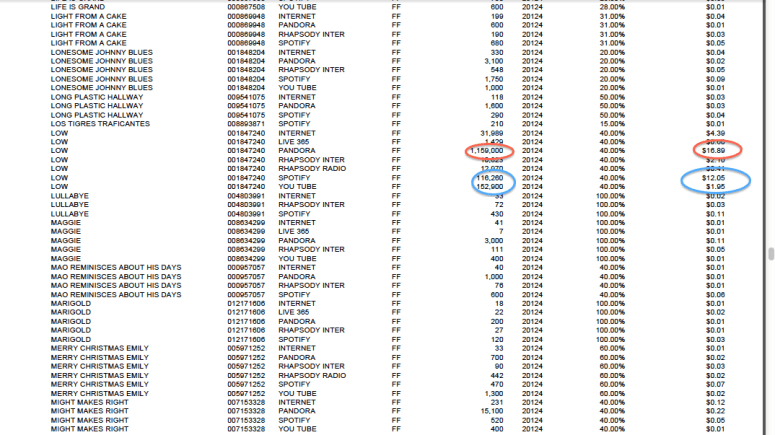
My Song Got Played On Pandora 1 Million Times and All I Got Was $16.89, Less Than What I Make From a Single T-Shirt Sale!

Pandora less than t-shirt sale

As a songwriter Pandora paid me $16.89* for 1,159,000 play of “Low” last quarter.  Less than I make from a single T-shirt sale.  Okay that’s a slight  exaggeration.  That’s only the premium multi-color long sleeve shirts and that’s only at venues that don’t take commission.  But still.

Soon you will be hearing from Pandora how they need Congress to change the way royalties are calculated so that they can pay much much less to songwriters and performers. For you civilians webcasting rates are “compulsory” rates. They are set by the government (crazy, right?). Further since they are compulsory royalties, artists can not “opt out” of a service like Pandora even if they think Pandora doesn’t pay them enough. The majority of songwriters have their rates set by the government, too, in the form of the ASCAP and BMI rate courts–a single judge gets to decide the fate of songwriters (technically not a “compulsory” but may as well be).  This is already a government mandated subsidy from songwriters and artists to Silicon Valley.  Pandora wants to make it even worse.  (Yet another reason the government needs to get out of the business of setting webcasting rates and let the market sort it out.)

Here’s an idea. Why doesn’t Pandora get off the couch and get an actual business model instead of asking for a handout from congress and artists? For instance: Right now Pandora plays one minute of commercials an hour on their free service. Here’s an idea!  Play two minutes of commercials and double your revenue! (Sirius XM often plays 13 minutes and charges a subscription).

I urge all songwriters to post their royalty statements and show the world  just how terrible webcasting rates are for songwriters.

The revolution will not be webcast.

* I only own 40% of the song, the rest of the band owns the other 60% so actually amount paid to songwriters multiply by 2.5 or $42.25)

**  I am also paid a seperate royalty for being the performer of the song.   It’s higher but also what I would regard as unsustainable.   I’ll post that later this week.

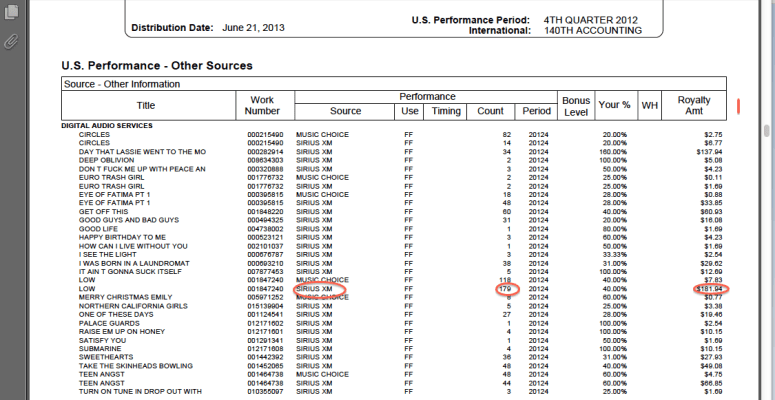
For frame of reference  compare Sirius XM paid me $181.00

sirius royalties

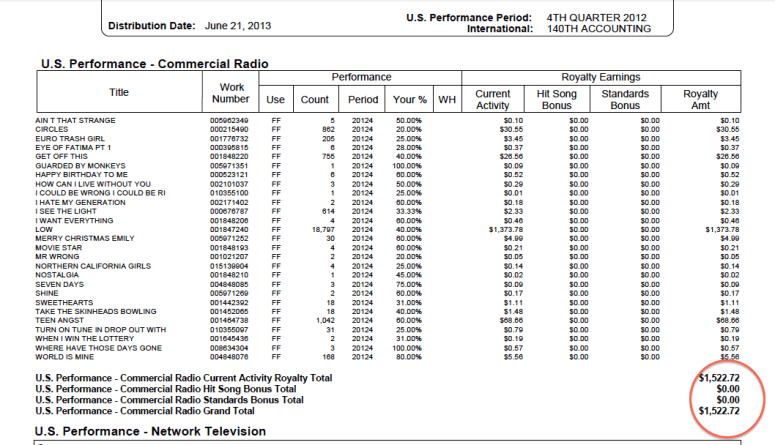
Terrestrial (FM/AM) radio US paid me $1,522.00

Terrestrial Radio royalties Low

Time For Silicon Valley To Grow Up And Take Responsibility For Their Online Advertising Business Model.

Time For Silicon Valley To Grow Up And Take Responsibility For Their Online Advertising Business Model.

Whitelist vs Blacklist Advertising.

Last week much of the world was horrified to learn that Facebook was serving ads from major brands on pages devoted to what the Huffington post described as:

horrific rape-oriented Facebook pages… (including) graphic images of gore and horror, beaten children, naked children, women bound and gagged, or thrown down stairs.

The public outcry against the brands and Facebook was overwhelming. Facebook and many brands were forced to apologize and revise policies (let’s see how long this lasts!).  Dove may have suffered long term damage to their brand.

WAM (Women Action Media), feminist Soraya Chemaly and Everyday Sexism should be commended for bringing this issue to light and achieving real change (and the stunning coordination of their campaign should be a lesson to artists advocates).

What we find interesting here at The Trichordist  is that many of our brands were the usual ad-supported piracy suspects.  In particular  Nationwide and American Express.  We have repeatedly called out these companies for advertising on cyberlocker sites that exploit artists and others.  And as we have noted over and over again this is not just about music.  Generally these sites  include links to bestiality, rape, illegal pornography videos as well as music (Urban Outfitters and Lexus advertising against beastiality links.)  We’ve both publicly and privately reached out to many of these advertisers to no avail. www.adland.tv  actually ran an article entitled “American Express Thinks You Might Like Piracy and Child Pornography” after reviewing my research.

Just as Facebook was long aware of these horrific pages, American Express and many other companies have long known their advertising was ending up on these pages. This latest brouhaha shows (as we have noted) they have yet to take effective action.

And we know why.  Total obfuscation by the online advertising ecosystem: in house ad buyer, Madison Avenue advertising agency, online ad network, ad exchanges and possibly complicity by the brands themselves.

We have seen and documented the following responses from the online advertising ecosystem (In fact I just got a refresher course May 28th at Westminster College in London as I participated in a panel discussion  “Follow The Money: Can The Business Of Ad-Funded Piracy Be Throttled?):

Lame Excuse #1.   We can’t control where these ads end up.

Response:  Then why on earth would anyone pay for your product?  Are you  admitting that your product is faulty? Cause I can think of a couple of lucrative class action lawsuits.   We think you can control where the ads end up. You just want the money.

Lame Excuse #2:  We are not the internet’s policeman (most recently by Google at Westminster College London).

Response: This is a “straw man” argument.  No one is asking YOU to be the web’s policeman. We are simply asking you to run your  company ethically and responsibly. Please stop obfuscating.  Sure the police arrest the thieves, but just like pawnshops, Google and the rest of the online advertising ecosystem have a ethical, moral and LEGAL obligation to make sure they are not selling stolen pageviews.  If a pawnshop used this excuse to sell stolen goods they would be shut down and the owners would go to jail.

Lame Excuse #3:  We don’t know who the bad guys are.

Response:   Really? Then who get’s the money for the CPMs  and/or Clicks?  Are you just leaving suitcases of cash in lockers at greyhound stations?  And if you are doesn’t that seem a tad suspicious? Who pays the taxes on these transactions?   If you don’t know you are probably in violation of many tax laws in many countries. And that’s how they put Al Capone in jail. Don’t mess with the tax man.

Lame Excuse #4:  Apple and Coca Cola don’t end up on these sites because they use “White Lists”.   This was the response from Alexandra Scott the UK Public Policy Executive for Internet Advertising Bureau.  This as always was delivered with an undertone of dismissiveness. As if Apple and Coca Cola just “don’t get it!” and should be advertising on shitty file infringing sites next to trojan downloads and Russian bride ads.

Response: Exactly. Whitelists.  They actually vet the websites on which they are advertising. They check to see if these sites are legitimate sites.  Using the pawn shop analogy.  They actually check to see if the goods-in this case pageviews- are stolen.

And this brings us to the fundamental problem with the internet advertising ecosystem.  It’s not the obligation of artists, feminists, anti-human trafficking activists and animal rights groups to tell you where you should not be advertising. It’s your job. Grow up. Quit trying to force us to do your job for you.

Blacklist systems too often put the burden on the victims or advocates for the victims while enabling brand advertising and Madison Ave/Silicon Valley profits at the expenses of others.

Whitelist systems put the burden on those reaping the benefits:  Brands, Madison Ave. Silicon Valley and Publishers.   This is the ethical model.

Note:  whitelists and blacklists are not created by the government.  These lists are designed for a narrow purpose–brands should be able to spend their advertising dollars in a predictable way that results in the brand being able to control the brand’s own speech.  These lists are not designed to block anyone’s speech.

There’s another way to look at this from the brand’s point of view, which may be better than developing “lists” that are either/or lists that put a site in or out or operation.  It is entirely consistent with the brand’s ability to control the integrity of their products and their right to not be defrauded out of advertising money for the brand to put together lists of sites that they want to avoid, or “undesirable” sites as Google’s Theo Bertand said on our panel in London.

Time for the internet advertising ecosystem and their Silicon Valley enablers to learn to act ethically and responsibly.  Companies like Starbucks and Costco have figured it out.  Companies like Walmart that came under criticism for various unethical practices mostly addressed these problems.  What is Silicon Valley’s response?  “Censorship” and “You silly people don’t understand the internet.”

I call bullshit on this argument.  And we “silly people” understand you better than you think.

Silicon Valley is the new wall street.  Sure they have green buildings and make the occasional charitable donations.   But mob bosses were notorious for making donations to the local orphanages and policemen benevolence societies.

Silicon valley doesn’t give a damn how it makes money. It will do anything to make money.  No matter what the moral implications.   It has a fake censorship argument that it uses to mask it’s fundamental amorality and greed.   Entire PR campaigns (including fake paid bloggers and fake public interests groups) are devoted to promoting a techno Nihilism: If you can do it on the internet-no matter how horrific that act may be-stopping someone from doing it is “censorship” and  infringes someone’s “freedom”.

This is the kind of argument a 13 year old wouldn’t even make.  And it’s amazing that the mainstream press never calls them out on this.  Again why is it left to a 50 year old  moderately successful indie rocker to call them out on this bullshit?

Look it’s very simple.

Grown up style freedom:

“My right to swing my fist ends at the tip of the other man’s nose.”

Silicon Valley petulant 13 year old style freedom:

“My right to swing my fist is absolute.  And you’re not the boss of me!”

Silicon Vallley and the rest of the online advertising ecosystem needs to grow up.

YOU MAY ALSO ENJOY READING:

Google, Advertising, Money and Piracy. A History of Wrongdoing Exposed.

ADWEEK : “Ad Industry Takes Major Step to Fight Online Piracy”… Again…

Over 50 Major Brands Supporting Music Piracy, It’s Big Business!

Look who’s Pirating now! University Of Georgia Music Business Program’s Preliminary Study Of Advertising On Copyright Infringing Sites.


David Lowery Debates Google on Ad Sponsored Piracy in London

A full transcript of the debate is available at Music Ally. Here’s the set up…

The topic of ad-funded piracy has been increasingly prominent in recent months, with musician David Lowery, Beggars Group founder Martin Mills, music industry body the BPI and the University of Southern California’s Annenberg Innovation Lab (among others) questioning why so many big brands’ ads appear on sites that are engaged in piracy.

Google agrees with David that Music Piracy is a for profit business…

Google’s Theo Bertram gave his company’s view, suggesting that he agreed with most of what Lowery had said. “It does seem to me to be an entirely sensible way to tackle piracy… most people doing piracy are not some guy in his bedroom altruistically sharing music with his friends. It’s people making money out of piracy, and it’s big business: some of these sites have 2m visitors regularly, and they’re not doing a bad business from advertising.”

READ THE FULL TRANSCRIPT AT MUSIC ALLY:
http://musically.com/2013/05/28/live-google-david-lowery-and-the-bpi-talk-ad-funded-piracy/

ADWEEK : “Ad Industry Takes Major Step to Fight Online Piracy”… Again…

Stop me, oh uh, stop me, if you think you’ve heard this one before…

The advertising industry took a major step Thursday in fighting rogue websites that steal copyrighted material and sell counterfeit goods. To cut off the financial support that keeps rogue sites alive, the nation’s two major ad industry associations recommended agencies and marketers take steps to keep brands’ ads off those sites.

While the debate remains contentious, there has been universal agreement that the key to shutting down rogue websites was to cut off the money that keeps them alive.

Recognizing advertising was the first line of attack, GroupM last year became the first ad shop to adopt a comprehensive anti-piracy policy, compiling last summer an updatable black list of some 2,000 websites that are cut off from ads from blue-chip clients like Ford, AT&T, Unilever and Dell.

READ THE ABOVE FULL ARTICLE HERE AT ADWEEK:
http://www.adweek.com/news/technology/ad-industry-takes-major-step-fight-online-piracy-140014

So the above is from May 3, 2013… and here’s an insightful article below from the advertising trade publication CLICKZ.COM on April 18, 2011… Yes, 2011…

What is the purpose of me bringing this up? To raise awareness and perhaps ask publicly that those involved in this industry become better corporate citizens. If you are running one of those exchanges or networks and feel that it’s only a “transparency” issue, please consider that you are funding not only these websites but organized criminal organizations that run them.

This is not a victimless crime, but instead one that is affecting musicians, programmers, artists, designers – and businesses of all sizes.

As an industry, here are some suggestions of what we can do:

1. Ensure every network that you work with has a no-warez/piracy/torrent policy. Ask around about the networks that do support this. Even if they claim that your ads aren’t going on there, be aware that many of these networks aren’t honest.

2. Put pressure on exchanges that you work with to ensure no network that has this type of inventory is on that exchange. If a few agencies call the exchanges and make it clear they won’t buy media until they are assured these sites are completely off the exchange, then maybe those in charge will consider it a serious issue.

3. Refuse to pay networks that you discover violate this policy and show your advertisements on those sites. Make it clear that you find this behavior not only illegal, but unacceptable for your agency, network, or product.

YOU CAN READ THE FULL ARTICLE HERE (FROM 2011) AT CLICKZ:
http://www.clickz.com/clickz/column/2041366/advertising-networks-supporting-piracy

Accountability?
Responsibility?
Transparency?
Anyone?
Hello?