What Does Hotfile’s Closure Mean to You? | Plagiarism Today

With the closure of Hotfile, questions are raised about what this means for content creators and the cyberlocker industry. Here are a few likely outcomes.

The judge in the case also ordered Hotfile that, if it wishes to remain open, it has to use “digital fingerprinting” to filter out infringing works. However, Hotfile, either unable or unwilling to comply with that request, has decided to shut down its site, effective immediately.

Hotfile’s closure is easily the biggest case of a cyberlocker being forced offline through legal action since Megaupload in January 2012. However, with nearly two years passed since Megaupload’s shuttering, the Web, especially for illegal downloads, is already a very different place.

READ THE FULL STORY AT PLAGIARISM TODAY:
http://www.plagiarismtoday.com/2013/12/04/hotfiles-closure-mean/

Police crackdown on pirate site ads | BBC

“Operation Creative is being run… to really get to grips with a criminal industry that is making substantial profits by providing and actively promoting access to illegally obtained and copyrighted material,” said Supt Bob Wishart.

The scheme encourages offenders to change their behaviour so that they are operating within the law, he added.

“However, if they refuse to comply we now have the means to persuade businesses to move their advertising to different platforms and, if offending continues, for registrars to suspend the websites,” he said.

READ THE FULL STORY AT THE BBC:
http://www.bbc.co.uk/news/technology-25299593

Tashaki Miyaki Asks People to Please Stop Pirating Music

It’s not just mainstream artists like Tom Yorke and Beck who are speaking up about the challenges facing the new generation of musicians. We’re seeing more artists are speaking up as they face the financial reality that music piracy is having on their careers. We applaud Tashaki Miyaki for taking a public stand in an effort to educate and inform their fans about the challenges musicians are facing today.

the large number of people who are okay with uploading music which one does not own, is truly unfortunate. many musicians have multiple jobs in order to be able to tour and make recordings without becoming homeless. aside from it being copyright infringement, which is an illegal act, uploading tracks onto these torrent sites is robbing the artist of money which would otherwise allow him or her to continue to work. it doesn’t matter the level of the artist. more successful artists support more people, and often successful acts support their label, which then allows the label to take a chance on signing smaller, unknown artists.

please stop pirating music.

Support the band and read the full post here on their Facebook Page:
https://www.facebook.com/tashakimiyaki/posts/744509558897013

Congresswoman Judy Chu: Too Many Americans Think Piracy is OK | THE WRAP

The American public doesn’t understand the consequences to piracy. There are large segments of it that even think it’s okay.

We need to have a greater understanding of [piracy] by the American public. Piracy affects one of the main American exports. It’s a huge industry for the United States, and Americans have to understand it is not right to pirate information.

The MPAA just did a study on how people get pirated content. 74 percent said they first were introduced to infringing content through search engines.

We need to develop a better system for fighting piracy than a whack-a- mole project.

READ THE FULL STORY AT THE WRAP:
http://www.thewrap.com/congresswoman-judy-chu-many-americans-think-piracy-okay/

Eminem Makes Public Service Announcement Against Music Piracy | AHH

Eminem sent out a public service announcement to address online piracy in the wake of his latest album The Marshall Mathers LP 2.

The album leaked online earlier this week and the Shady Records machine quickly went to work to suppress the leak. Eminem and his management even went as far as making Rap Genius remove the lyrics to the songs.

READ THE FULL STORY AT ALL HIP HOP:
http://allhiphop.com/2013/11/01/eminem-makes-public-service-announcement-against-music-piracy/

The Recording Industry: Fiddling while Rome burns. | AdLand

Here come the YouTube Music Awards. YouTube pays artists less per play than Spotify and YouTube get an awards show with artists support. We get what we deserve?

In terms of artists getting their royalties fucked so royally, no one beats Big Tech. The money that should be distributed to musicians is going to google or to ad-supported pirate sites rather than the content creators themselves.

Yet Big Tech is doing what the recording industry can’t. In terms of innovation, the recording industry’s been asleep as the wheel since Napster first rolled out.

READ THE FULL POST AT ADLAND:
http://adland.tv/node/156185#qmSjKtWGAhJ3HzaA.99

RELATED:
YouTube Shares Ad Revenue With Musicians, But Does It Add Up? | NPR

Help for New Musicians Chasing Cash | BBC UK

With digital downloads, falling album sales and rampant piracy, what’s it like trying to establish yourself as a new performer in today’s troubled music industry?

Well, in the words of one UK music business professional: “It’s like trying to create a hurricane by running around a field in circles.”

Artists can no longer depend on labels to finance their projects and invest in building their careers. Long demonized, it appears the true value of investment capital, expertise and contracts are coming into focus for today’s new artists.

In her guide – entitled Easy Money? – Ms Harris identifies six main sources of money for music projects:

  • grants
  • friends and family
  • crowdfunding
  • sponsorship
  • debt
  • investment

She says that during her 15 years in the music industry, it has “moved from an internal funding model to having to go to external sources” for cash to kick-start projects.

Normally, she says, musicians are looking for about £5,000 to £10,000 to fund a specific project, such as a record or live appearances.

READ THE FULL STORY HERE AT THE BBC UK:
http://www.bbc.co.uk/news/business-24249918

Breaking Bad Creator : “Piracy Is A Problem… We All Need To Eat and Get Paid”

In a recent BBC interview Breaking Bad’s creator Vince Gilligan has been quoted talking about the effect of internet piracy on the show.

Piracy is “ultimately a problem and will continue to be a problem going forward,” Gilligan said. “Because we all need to eat. We all need to get paid.”

It’s been reported that the show’s final episode was illegally downloaded over 500,000 times in 12 hours of the first pirated copy turning up on piracy and torrent sites. Many have seized on Gilligan’s remark that piracy helped the popularity of the show.  That’s highly unlikely as those seeking the illegal copies, were seeking them as demand for the show grew from conventional marketing. These people were opposed to paying for the show from the many outlets where the episodes were legally available like Netflix and Itunes. Gilligan clearly understand the impact…

“The downside is a lot of folks who worked on the show would have made more money, myself included, if all those downloads had been legal.”

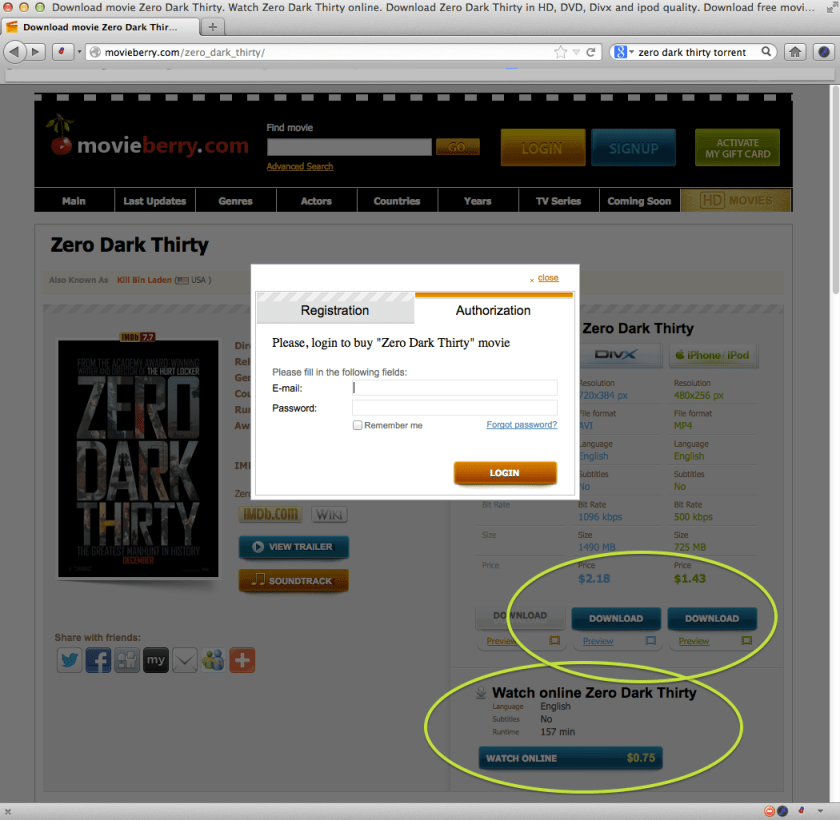
Many piracy apologists and proponents are quick to suggest (incorrectly) that not every illegal download represent a lost sale, but we disagree and here’s why. Looking at the links below you can quickly see that the piracy sites are monetizing the access and availability of the illegal downloads with advertising. Additionally some sites even charge greatly discounted transactional fees via dubious payment processors.

Simply put, piracy is about infringement as a business model. Every illegal download generates revenue for the pirate sites and ad tech companies, none of which is “shared” with the creators.

Zero Dark Thirty, Best Picture Academy Award Nominee, Exploited by AT&T, Verizon, MetroPCS, Nissan, H&R Block, British Airways, Progresso, and more…

BitTorrent 99% Infringing, 100% Disinformation… now with Ads.

We’ve reported before on BitTorrent’s claim that they are “not designed for piracy” despite multiple studies and research finding over 99% infringing content being distributed using it.

The latest comes to us from AdLand.tv who are offering commentary on BitTorrent’s recent move into outdoor advertising that first appeared in Gizmodo.

The opening of Gizmodo’s article reads thusly:

“Torrenting” is kind of a dirty word. It makes you think piracy, doesn’t it? Well it shouldn’t. Torrenting isn’t illegal. It’s not even morally ambiguous. It’s just a way to send data, and it’s awesome.

Yes. That’s right. Keep telling yourself that. Guns don’t kill people. People do. It’s not the syringe, it’s the heroin. It’s not the file sharing platform enabling copyright infringement; its the millions of users using the site to infringe.

Baa, baa, baa, Sheeple.

As usual the folks at AdLand have a wonderful way of exploring the ad campaign by BitTorrent.

“The internet should be regulated people-powered.”

What other industry do you know that has near zero regulation except Big Tech? We have Alcohol, Tobacco and Firearms (ATF) the Environmental Protection Agency, the Food And Drug Administration, and the Occupational Safety and Health Administration (OSHA) to name a few of the regulators. Big Tech doesn’t even police itself because if it did, it would be losing money by the truck load. This isn’t even up for debate.

People-powered, my ass. In the immortal words of our dear president, we didn’t build that. Someone else did. They built the internet, the websites, the software. The search engines. The email programs. Just as someone else created the content you’re helping yourself to for free. Don’t fall for this “people-powered” bullshit at all. The artists and musicians (you know– the people) do not make money off torrent sites from the ‘exposure.’ This has been reported on ad nauseam. The only people who have the power are the Big Tech companies getting rich off of content they don’t own.

READ THE FULL POST AT ADLAND.TV:
http://adland.tv/node/156095#sJh2zH6EcHXqaxFB.99

David Byrne: ‘The internet will suck all creative content out of the world’ | The Guardian UK

In future, if artists have to rely almost exclusively on the income from these services, they’ll be out of work within a year. Some of us have other sources of income, such as live concerts, and some of us have reached the point where we can play to decent numbers of people because a record label believed in us at some point in the past.

I can’t deny that label-support gave me a leg up – though not every successful artist needs it. So, yes, I could conceivably survive, as I don’t rely on the pittance that comes my way from music streaming, as could Yorke and some of the others.

But up-and-coming artists don’t have that advantage – some haven’t got to the point where they can make a living on live performances and licensing, so what do they think of these services?

We were also very happy to see this plug for the Content Creators Coalition. Be sure to read the full interview at The Guardian, the link is below.

The major labels are happy, the consumer is happy and the CEOs of the web services are happy. All good, except no one is left to speak for those who actually make the stuff. In response to this lack of representation, some artists – of all types, not just musicians – are forming an organisation called the Content Creators Coalition, an entity that speaks out on artists’ behalf.

READ THE FULL STORY AT THE GUARDIAN UK:
http://www.theguardian.com/music/2013/oct/11/david-byrne-internet-content-world
