Kristin Robinson makes another important contribution to the artist rights conversation with her interview of Graham Davies, the new head of the Digital Media Association. Graham comes to DiMA from a background in the artist rights movement at our friends the Ivors Academy in the UK. We have high hopes for Graham who brings his intellect to clean up a long, long line of mediocrity at the DiMA leadership who are from Washington and here to help.
Kristin’s interview highlights DiMA’s recent filings in The Reup–the redesignation of the MLC by the Copyright Office that we’ve highlighted on Trichordist. He also has some well thought out analysis on how the MLC is not HFA, however similar the two may seem in practice.
Do you think a re-designation every five years is not enough on its own?
I think it’ll be interesting to see what the re-designation process brings forward from the Copyright Office. Maybe the Copyright Office leans in on governance and says, “We’ve heard enough, and we can come forward with ideas.” But the re-designation process is a different thing than a governance review, which would bring in a special team to actually dig into governance-related issues and bring forward recommendations and proposals that could then be implemented. It would be something more specific and something the MLC could just do. You wouldn’t need the Copyright Office to sponsor it, though they could if they wanted to.
It is absolutely accurate that the streaming services are pushing for abysmal rates and terms in Phono IV. Some services like Amazon, Pandora and Spotify actually advocate to a return of the rates and terms from prior rate setting “wars” in Phono I (2006) and II (2011). Others, like Apple, suggest applying the rates and terms that are determined by the CRB in Phono III – which, mind you, covers 2018-22, and is being litigated simultaneously despite 2022 commencing in two months – because what an awesome system is this Copyright Royalty Board! Nevertheless, there is something that has been conveniently omitted from each of these media articles: “the why.” Why are the services proposing the “lowest rates in history?” What justification do the services provide for their positions? Unfortunately, the answer is not as simple as the streaming services playing the role of “the villains” in the “war” for songwriters’ livelihoods.
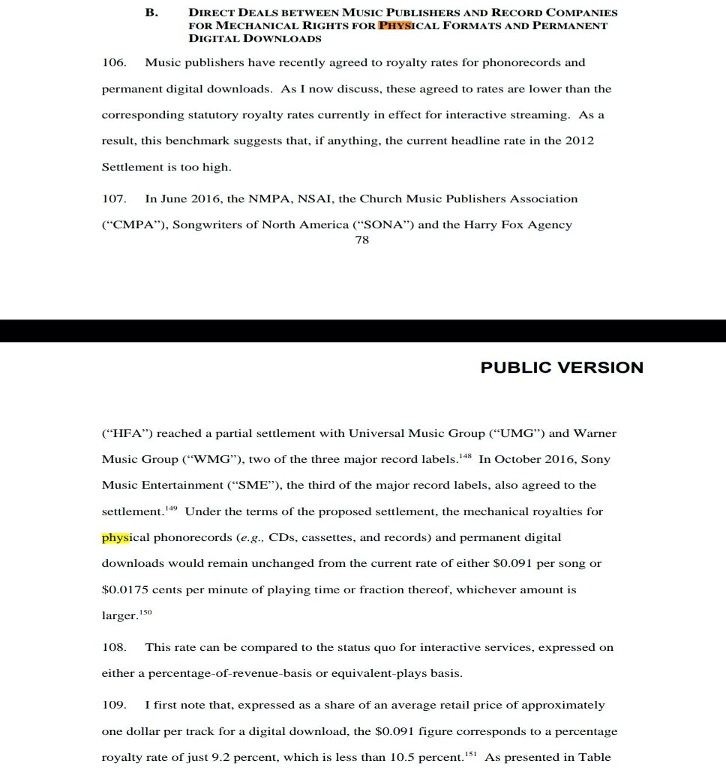
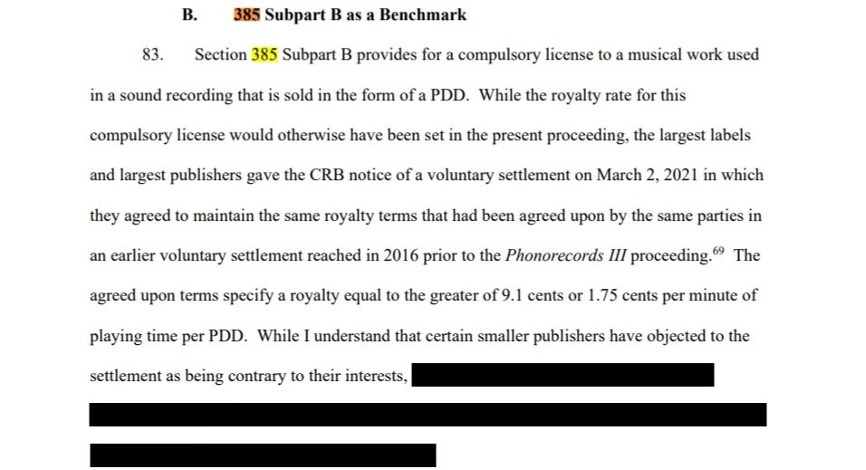
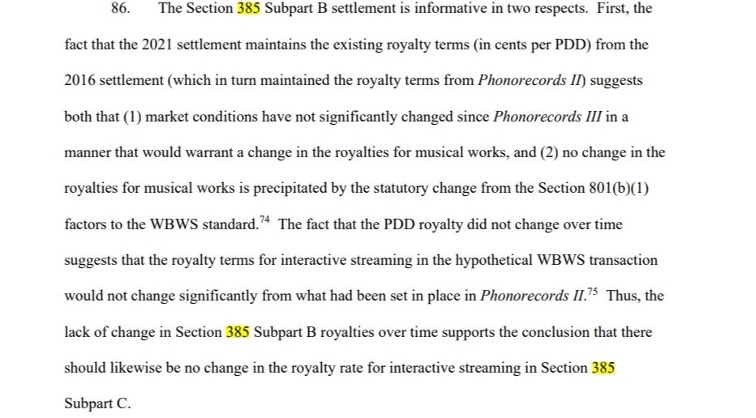
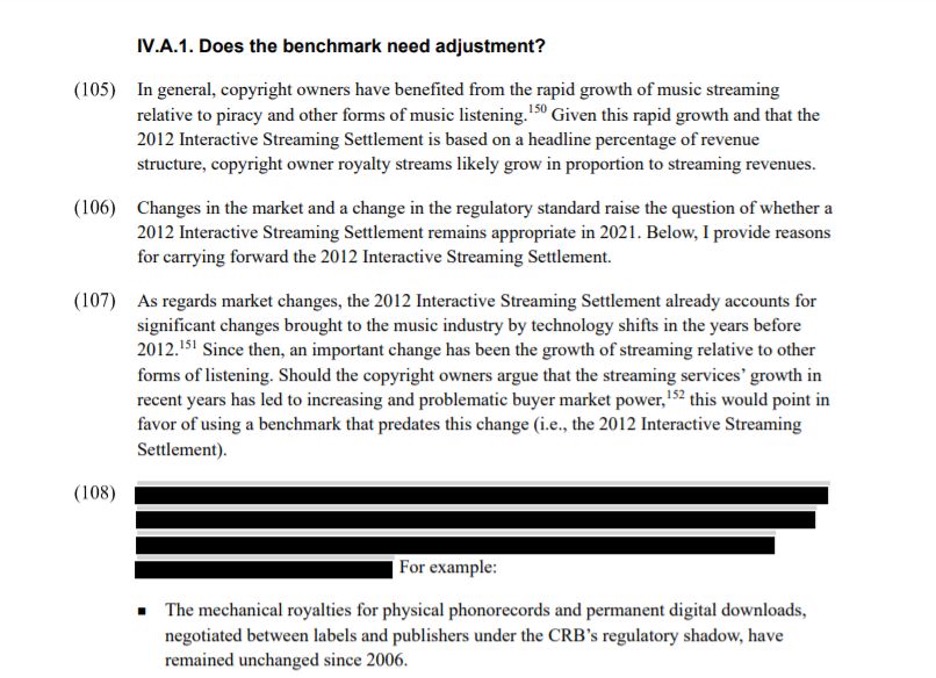
When you download the hundreds of pages of the services’ written direct testimony from the CRB, and wade through the arguments in the mire of heavily redacted passages, there is a surprising common theme used to bolster every last one of their positions: the proposed settlement by the NMPA, NSAI and the three major labels to freeze rates for physical product like vinyl and permanent downloads (the Subpart B configurations) (see here: https://app.crb.gov/document/download/25288).
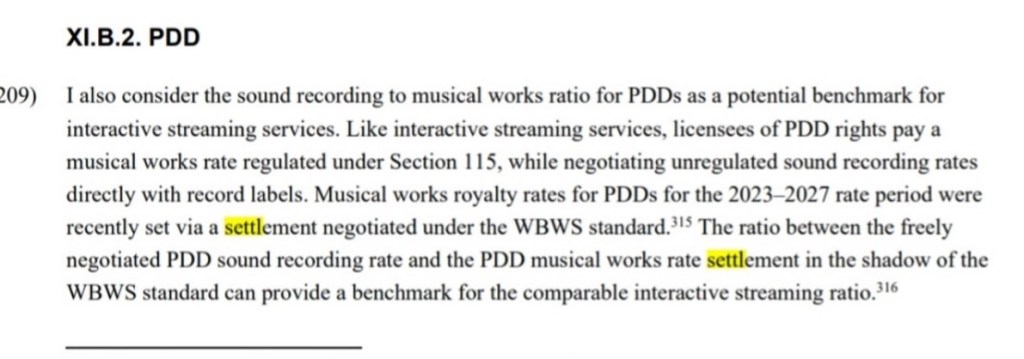
Simply put, every service used the NMPA and NSAI proposed settlement for physical as a benchmark to support their abysmal rates on streaming. Surprised? Me, too. But for reference I’ve included some excerpts from the services’ filings at the end of this post.
For those in need of catching up to this point, TheTrichordist has chronicled this proposed settlement and the reactions thereto (i.e. “the Frozen Mechanicals Crisis” see here: https://thetrichordist.com/category/frozen-mechanicals/ ). Songwriters, music publishers, and songwriter advocates penned articles for The Trichordist and some wrote comments to the CRB objecting strongly to the NMPA and NSAI settlement. Some also wrote their representatives in Congress, expressing their dismay over this important revenue stream being frozen yet again for another five years due to a private settlement between “willing buyers” and “willing sellers” who are one and the same person at the corporate level. What’s more, Texas Congressman Lloyd Doggett submitted a letter to the Librarian of Congress and the Register of Copyrights inquiring about the matter (see here: https://thetrichordist.com/2021/07/18/letter-from-congressman-lloyd-doggett-about-frozen-mechanicals-to-librarian-of-congress-and-register-of-copyrights/).
Now that it is crystal clear the proposed settlement is being seized upon by the services as a way to benchmark and justify their lower-than-ever rate proposals (also called “hoist with your own petard”), it is time for the highly paid representatives of the copyright owners in this proceeding to truly rethink their strategies. This result was predictable – as I mentioned in my last post here: https://thetrichordist.com/2021/06/25/guest-post-by-sealeinthedeal-a-foreseeable-result-of-the-phonorecords-iv-private-settlement-opening-pandoras-box/ , “[i]t did not take a soothsayer to foresee this result; the private settlement opened Pandora’s box – begetting misery for every songwriter.”
More disturbing, they should have seen this coming a long way off because they got called out for doing essentially the same thing in Phonorecords III. For context, when there was a lull in the pace of Phono IV, I began delving through the filings in the Phono III remand. Much to my unsurprise, an expert witness for Pandora in that proceeding, Professor Michael Katz, foreshadowed the current debacle. Not only did he use the physical settlement to make the case that the streaming mechanicals rate in the 2012 settlement was a ’good benchmark,’ but also, even more disastrously, used this argument to rationalize the 2012 rate being too high in testimony filed on April 4, 2021. Chris Castle referred to this issue as the “Streaming Royalty Backfire:
“If you want to argue that there is an inherent value in songs as I do, I don’t think freezing any rates for 20 years gets you there. [Physical mechanical rates were first frozen at 9.1¢ in 2006.] Because there is no logical explanation for why the industry negotiators freeze the rates at 9.1¢ for another five years, the entire process for setting streaming mechanical rates starts to look transactional. In the transactional model, increased streaming mechanicals is ultimately justified by who is paying. When the labels are paying, they want the rate frozen, so why wouldn’t the services use the same argument on the streaming rates, gooses and ganders being what they are? If a song has inherent value—which I firmly believe—it has that value for everyone. Given the billions that are being made from music, songwriters deserve a bigger piece of that cash and an equal say about how it is divided.”
Chris Castle
The proposed settlement did not just open Pandora’s Box, it also opened Spotify’s, Google’s, Amazon’s and Apple’s boxes (don’t mind me, I’m Greek and enjoy every opportunity to make mythology references). So, when posed with the question, “why advocate for this settlement to freeze,” even following the filings of the services, the NMPA’s David Israelite provides the following commentary (heard most recently during last Wednesday’s Town Hall via zoom):
(1) he refers to folks who articulate this concern as professional critics who like to blog from their couches, and that there’s a lot of misinformation going around;
(2) the NMPA has previously (as far back as Phono I) tried to press for an increase to no avail after spending millions of dollars; and
(3) the NMPA wishes to focus efforts on the streaming services as they do not wish to fight multiple fights at once and potentially risk the labels proposing an even lower than 9.1 cent rate.
To respond to this commentary — first, it is difficult to believe the major labels would propose a lower than 9.1¢ rate if the publisher negotiators did not cave if for no other reason that the willing buyer and the willing seller standard ought to work the other way, too. However, if anyone has evidence to support this “labels will screw us” rationale, please reach out to me and I will immediately withdraw that premise. Notwithstanding, even in the hypothetical event that the labels counter with a lower than 9.1 cent rate, is it not the job of the prime representative of the “copyright owners” at the NMPA and NSAI to firmly state that this rate has been frozen for nearly 20 years and no longer will “we” (including their sister publishers) stand by this? In response to the other two points, I understand that I have spent no money in these proceedings and that I do not have the resources to do much more than write about this from the couch in my apartment in Austin, Texas. But, for what it is worth, I believe that an important part of advocacy is being open to critique, listening and learning – even if it is something that you do not wish to hear.
Speaking of, the buried lede is that the CRB has reopened the public comments on the proposed settlement to freeze physical mechanicals – the CRJs are at least willing to listen and learn. Maybe they don’t think we’re couch commenters.
Now, I do not believe in presenting a laundry-list of problems without proffering potential solutions, and luckily, there is a solution that is entirely within the control of the parties that settled: withdraw the proposed settlement to freeze the mechanical rates for Subpart B configurations. Go to the labels and negotiate a voluntary increase. Submit that increase proposal to the CRB. This act will not only bring the entire songwriter and music publisher communities together, but it will also serve to extinguish one of the services’ key benchmarks in their testimony.
While we’re on the topic of strategies, I want to end on one note. Now is not the time to pit what artists are earning from digital radio in relation to what songwriters are earning ( see here: https://variety.com/2021/digital/opinion/digital-radio-guest-column-david-israelite-nmpa-1235092330/ ). One of the great things about working with songwriters in Texas happens to be that many are also recording and performing songwriter/artists. Thus, they value the rates from digital radio that are applied to recording artists, and they welcome the victory achieved by SoundExchange in Web V (which resulted in a rate increase plus index of rates in accordance with inflation — which seems wiser by the day and winter is coming).
Instead, it is time for the focus to be on achieving the best possible results in Phono IV by expanding the revenue stream, not taking money from others which only benefits the services.
THE RECEIPTS: Petard-Hoisting Excerpts from the Services’ Testimony
(Note: PDD = “permanent digital downloads,” and WBWS = the “willing buyer willing seller” standard which the Copyright Royalty Judges (CRJs) are to use as the basis for determining rates in this proceeding, pursuant to the Music Modernization Act.)
We’ve been reviewing the comments posted on the Copyright Office website regarding the accounting regulations for Section 115. We are humbled that so many of you used our post as a guideline for your own comments, and we learned a lot from all of you. Thank you. Thank you for your thoughts and thank you for helping to take ownership of our future.
We thought you might be interested in reading comments from Lisa Thomas Music Services (publisher for independent songwriter/recording artists such as Don Henley and Glenn Frey of the Eagles, Randy Newman, Janet Jackson, Walter Becker of Steely Dan, Ray D. Parker, Jr., Mary Chapin Carpenter and Bonnie Raitt, among others), songwriters Danny O’Keefe , Michelle Shocked, Don Coyer, and Bob Regan as well as David’s comment. All of these songwriter’s thoughtful comments are part of the public record now and are up on the Copyright Office site, but we’ll reproduce David’s comment here:
December 10, 2012
Tanya M. Sandros
Deputy General Counsel
U.S. Copyright Office
101 Independence Ave. S.E.
Washington, D.C. 20559-6000
Re: In the Matter of the Mechanical and Digital Phonorecord Delivery Compulsory License, Proposed Regulations for Reporting Monthly and Annual Statements of Account for the making and distribution of phonorecords, Docket No. 2012-7
Dear Ms. Sandros:
I am David Lowery and I founded the bands Cracker and Camper Van Beethovan. I am also an instructor in the Music Business Program at the University of Georgia at Athens. I am writing to you regarding the proposed regulations for statutory licenses for mechanical royalties. These views are my own and should not be attributed to anyone else.
Other comments will address each of the proposed regulations, but I wanted to give you some general thoughts based on my experiences as a songwriter and music publisher. I want to emphasize that I am all for making music licensing easier, but am concerned that the Copyright Office get a clear picture of what it’s like for songwriters, especially independent songwriters, to live with the laws you make.
1. No Audit: As a songwriter, I have no idea whether I am being paid correctly by any digital service and I am not allowed to audit them. As far as I know, no digital service complies with the rules anyway, so it almost doesn’t matter whether the Copyright Office keeps them the same or changes the rules. This is untenable. When I gave a mechanical license to my record company, I could always audit the label’s mechanical royalty accountings if I chose to do so. Let’s be clear—the new boss is way worse than the old boss. If statements from digital services could be at least as bad as record company accountings, it would be a major step forward.
Respectfully, I would suggest that the Copyright Office should be working especially hard to provide songwriters with a good analog for a royalty audit.
2. Bait and Switch: I routinely receive a “notice of intention to use” my work that is always late. This violates the basic rule of statutory licensing. The “NOI” I receive often comes with a letter asking me to log into a website to see if I am owed money by the digital service or how much I am owed. When I go to the website I am asked to “sign” a click through agreement that makes significant changes to the few statutory rights I have. This is the worst kind of trickery and is worse than the worst direct mail campaigns because I can always throw away the junk mail. This trickery involves my life’s work and I’d rather not throw it away.
I respectfully suggest that the Copyright Office should expressly prohibit anyone who uses the statutory license from further burdening songwriters by trying to trick them into a click through agreement that makes them give up the rights the songwriter is entitled to under the Copyright Act.
3. Minimum Amount for Payment: Digital services sometimes issue a check for one penny along with the bait and switch trick license—yes, $0.01. I have no idea why they send a penny check, but I assume it has something to do with proving they paid for the rights they get in their click agreement. I also understand from songwriter friends that it is pretty common to get penny checks. So if these services can send a penny check when it benefits them, then why do I have to wait to earn $50 before I get paid? And what about the bait and switch technique is supposed to give me confidence that these services will ever pay my $50 and how would I ever know what my earnings were if I can’t audit?
I would respectfully point out to the Copyright Office that these services chose to get into the music business and they have known for over a decade what their obligations are. They save a bunch of money by using the statutory license instead of direct licensing, and I do not understand why they cannot simply pay what they owe when they owe it like everyone else is supposed to do.
4. Black Box: If I am lucky enough to get a certified statement from a CPA, I have no way of knowing if the CPA ever looked at my earnings or if there are any “black box” earnings that I’m entitled to. Given that I get no certifications and no audits, there’s no telling how much money should have been paid that wasn’t.
I respectfully suggest that the Copyright Office work with CPA associations to find clear guidelines for CPAs to follow that make the services pay out 100% of the money owed to songwriters or give it to the State unclaimed property agencies like an unclaimed utility deposit.
5. Don’t Protect Scofflaws: I am not convinced that these services have gotten all these mistakes done without a plan. Some may be innocent mistakes, but some seem very calculated. Respectfully, the Copyright Office should not allow services who have never complied with the law to get protection of the laws they have evaded.
Thank you for this opportunity to hear from me and other songwriters on this important issue.
The Copyright Office public comment period for statements of account on mechanical royalties closes tonight, so there’s still time for songwriters to post comments about the proposed regulations.
The new regulations apply to the license that some services like Spotify rely on for on-demand streaming as well as the new categories of statutory licenses that the Copyright Royalty Judges are expected to approve any day now. It’s probably hundreds of millions of dollars–and we have no idea whether it ever gets paid or paid right.
Seem like a big number? Not really when you consider that services like Spotify launch with millions of tracks and those require millions of mechanical licenses for on demand streaming. They could go to the publishers and songwriters for a direct license, but they prefer to “carpet bomb” notices to songwriters. If you ask a big publisher they will tell you that they receive hundreds of thousands of these notices every year–and 95% of them are filed late and should be terminated.
One thing the regulations required is that online services have to send songwriters a monthly statement of account certified by an officer of the retailer company as correct. As far as we can tell, this has never happened. Why? Because a “certification” means that the officer of the company is taking responsibility for the accurateness of the statement. Personal responsibility. This is exactly the reason why the law requires the certification and exactly the reason why no one has done it as far as we can tell.
The law also requires that a CPA certify the statements on an annual basis. This has been done once that we know of.
Bear in mind–these licenses have been in place for 10 years. No certifications in 10 years. And now the retailers are asking for yet another break through the Digital Media Association (you’ll remember them from IRFA and trying to screw ASCAP songwriters).
Oh, and by the way–you are prohibited from auditing any service that uses the statutory license and the best you can rely on are these certifications and the CPA auditing the retailer’s financials.
We here at the Trichordist think that there are certain aspects of the way that big tech companies have handled the mechanical royalty process that is absolutely horrendous, particularly for indie writers, but truly for everyone.
We want to encourage you to write your own comment. It can be a letter, you don’t have to be a lawyer or hire one. If you want to read what other people are saying, you can read the first round of comments at this link: Initial Comments on Statements of Account.
In particulary, you might want to read comments from Bob Segar’s publisher, Gear Music or Austin attorney Chris Castle.
Here’s a few reasons why that you might consider in writing to the Copyright Office:
1. No Audit: As a songwriter, I have no idea whether I am being paid correctly by any digital service and I am not allowed to audit them. This is untenable.
2. Publishers Clearing House: I routinely receive a “notice of intention to use” my work that is always late. This violates the basic rule of statutory licensing. The “NOI” I receive comes with a letter asking me to log into a website to see if I am owed money or how much I am owed. When I go to the website I am asked to sign a click through agreement that makes significant changes to the few statutory rights I have. This is the worst kind of trickery and is worse than the worst direct mail campaigns because I can always throw away the junk mail. This trickery involves my life’s work!
3. Black Box: If I am lucky enough to get a certified statement from a CPA, I have no way of knowing if the CPA ever looked at my earnings or if there are any “black box” earnings that I’m entitled to. Given that I get no certifications and no audits, there’s no telling how much money should have been paid that wasn’t.
4. Don’t Protect Scofflaws: You cannot allow services who have never complied with the law to get protection of the laws they have evaded.



 The Trichordist
You must be logged in to post a comment.