Loser Generated Content – The Exploitation Economy Explained

Essential reading by Soren Mork Petersen, “Loser Generated Content: From Participation to Exploitation.”

Abstract
In this article [1] some of the critical aspects of Web 2.0 are mapped in relation to labor and the production of user generated content. For many years the Internet was considered an apt technology for subversion of capitalism by the Italian post–Marxists.

What we have witnessed, however, is that the Internet functions as a double–edged sword; the infrastructure does foster democracy, participation, joy, creativity and sometimes creates zones of piracy. But, at the same time, it has become evident how this same infrastructure also enables companies easily to piggyback on user generated content.

Different historical and contemporary examples are provided to map how the architecture of participation sometimes turns into an architecture of exploitation.

READ THE FULL PAPER HERE:
http://journals.uic.edu/ojs/index.php/fm/article/view/2141/1948

So Much For Innovation, YouTuber’s Meet The New Boss…

The persistent myth that artists and creators neither want or need partners in the self empowered digital age seems to have hit a wall. The LA Weekly recently reported on a number of high profile YouTube Artists who have found themselves on the bad end of bad deals with YouTube Producers. Get that. Artists have found themselves on the bad end of deals with business people exploiting them.

Ben Vacas, the creator of Braindeadly posted a video on his YouTube channel explaining the situation to his fans and audience,

“I woke up today hoping to make a video, but I went into a call with Machinima this evening and they said that my contract is completely enforceable. I can’t get out of it,” Vacas tells the camera. “They said I am with them for the rest of my life — that I am with them forever.

How could this happen in this digital age when no one should ever need any help or support from anyone else? So many in the tech blogosphere are constantly on the bullhorn bemouning the evils of record labels and movie studios, so the hypocrisy and irony of this new generation of creators falling prey to the same old types of exploitation is telling.

What’s worse is these artists appear to have entered into the types of agreements that the traditional record and film businesses have long since left behind as those industries matured and the rights of artists have been won in long hard fought battles.

As Chris Castle of Music Tech Policy commented in his post, It’s Called A Union, Numbnuts he sadly points out the obvious that the more things change the more they stay the same. Artists and creators are still prey for those seeking opportunistic exploitation of the creative class.

Well kids, welcome to the new boss. There is a reason why talent and craft unions exist and it’s not to “stifle innovation” of filmmakers any more than copyright exists to “stifle innovation” of musicians, artists, photographers, writers, authors, filmmakers and other creators.

But perhaps it is this more recent story that is more revealing. All Things D wrote this in “YouTube’s Show-Me-The-Money Problem“,

“It’s hard, given YouTube’s low [revenue-sharing] numbers and lack of marketing infrastructure to make the unit economics for premium programming work,” says Steve Raymond, who runs Big Frame, a YouTube network/programmer that says it has generated 3.2 billion views.

So let’s do the math on this. YouTube, which is the great white hope of, and often cited embodiment of the independent new digital culture for creators has bred an environment of draconian contracts for individual creators and at the same time it can not generate enough revenue for it’s most successful producers to maintain a sustainable business model.

How is this “innovation and progress”? Answer, it’s not. Of course readers of this blog will be familiar with David Lowery’s insightful and accurate analysis of the music business “Meet The New Boss, Worse Than The Old Boss” and now we can see that the same forces are also shaping the new reality for more artists and creators than just musicians.

For all of the hype, it’s really funny what happens when you actually just look at the math. What’s more funny is when some tech blogs make statements like, “First of all, YouTube revenue is incremental revenue on top of other revenue.” Well apparently they haven’t spoken to Big Frame about that, unless of course they are suggesting that Big Frame’s primary business (and the creators that work for them) should have day jobs to supplement their revenue from YouTube. You know, jobs like selling t-shirts and touring…

Artists Rights Watch – Monday Feb 11, 2013

A Weekly Recap of Artists Rights, Copyright and Technology News for Creators from Around The Web

THE WALL STREET JOURNAL:
* Reappearing on YouTube: Illegal Movie Uploads

The recent problematic uploads may have undercut the rental effort. Movies produced by Disney’s Touchstone Pictures, such as “I Am Number Four” and “Shanghai Noon” are available free on YouTube, even though the studio struck a rental deal through the site.

HYPEBOT:
* Spotify Listener Data Used To Predict Grammy Winners

THE GUARDIAN UK:
* Pirate sites are raking in advertising money from some multinationals

Sites such as Pirate Bay often portray themselves as altruistic, non-profit “freedom fighters”, when the truth is they’re nothing of the sort – their exploitation of artists for their own monetary gain is far worse than the most unscrupulous labels ever were, as they pocket large sums of ad revenue without having to invest it into developing the content they flog.

MUSIC TECH POLICY:
* Pirate Site Isohunt Selling Dead Kennedys Tickets

JAPAN DAILY PRESS:
* Japan’s ‘Operation Decoy File’ to help deter online piracy

THE DEANS LIST:
* Music, Copyright and New Technology in the News From a Creator’s Perspective 02/05/2013

COPYHYPE:
* Friday’s Endnotes – 02/08/13
* Bringing Reality Back to Copyright Debates

Smith and Telang found that of the papers based on empirical data (as opposed to theoretical models), 25 found economic harm from piracy, while only 4 found little or no harm. And for those who are skeptical of non-academic papers: Smith found that 12 peer-reviewed papers published in academic journals found a negative impact from piracy while only 2 did not (and there are legitimate questions concerning the methodology of those 2 outlier papers, some of which are explored in Stan Liebowitz’s 2005 article Economists’ Topsy-Turvy View of Piracy).

Evidence like this, of course, does not tell us where to go from here. But it is amazing how many who join with skeptics of copyright either don’t know about the scholarly record on piracy or don’t care.

DIGITAL MUSIC NEWS:
* The Average TuneCore Artist Now Makes $120 a Year…
* Spotify Executive: “We’re Totally Transparent, and We Definitely Live by That Principle.”
* In Just 3 Years, P2P Usage Has Dropped 35% In France…

FORBES:
* We Need Strong Copyright Laws Now More Than Ever

So why does CEA attack songwriters in this way? Flawed logic. They reason that member companies can make more money if they pay songwriters and other creators less. The truth is that music creators and technology companies need each other. Many innovative and wonderful music-related products are made by CEA members. But many of these products have no purpose without music. The copyright and associated costs—often pennies on the dollar—are deemed harmful. Make no mistake, the companies of the CEA believe in intellectual property. Just ask them about their own intellectual property, such as their patents or trademarks.

Mr. Shapiro’s conclusion is that copyright laws are hurting America. Nothing could be further from the truth.

CNET:
* Next-gen Xbox will require constant net connection

THE HOLLYWOOD REPORTER:
* Recording Academy Chief on the Grammys, Pandora and Getting Artists Paid (Q&A)

The problem is, in the transition of all this, we have to remember that it all comes back to the men and women who are creating this wonderful music, and do they have a real ability to make that a full-time vocation as opposed to a part-time hobby?

USWITCH:
* Fines to replace disconnections for internet pirates?

SMART COMPANY:
* Why Telstra plans to slow you down to fight online piracy

Telstra will soon conduct a “limited trial of a range of technical options for better managing broadband internet performance for our customers during peak periods”. One of those options is to “shape”, as the industry euphemism puts it, customers’ access to peer-to-peer (P2P) file distribution networks such as BitTorrent.

PC PRO:
* Anti-piracy letter plans face delay over costs

COMPLEX:
* The 25 Most Important Civil Rights Moments in Music History

BILLBOARD:
* Business Matters: MP3 Stores Harder to Find as Google Search Removal Requests Accumulate

Legitimate MP3 links are becoming harder to find even as the RIAA has sent more than 3,400 removal requests to Google relating to approximately 10 million specific URLs from its search results. Legal stores like Amazon and Myxer, as well as legal streaming sites like YouTube and legal streams and downloads at music blogs, are buried under more illegal MP3 links than when Billboard.biz examined 30 artists in November.

Now, using the same 30 artists as before, it took an average of 11.06 search results to find the first legal search result of any kind and 26.84 search results to find the first legal MP3 store. In November, the results were 7.9 and 11.75, respectively. (Each search was conducted by typing in “MP3” and then the name of the artist. Two spellings were used for Ke$ha and P!nk.)

SONIC SCOOP:
* Input\Output Podcast: David Lowery and the Future of Artists’ Rights

SPIN:
* Music Piracy’s Search Problem: Recording Industry Bringing the Fight to Google

THE DUQUESNE DUKE:
* Pirating or advancing; Debating illegal music downloads – Stealing intellectual property is still a crime

The debate against music piracy has also decreased in popularity. Illegal downloading has become a socially accepted practice and as friends talk about what music they recently downloaded, they forget that they are discussing a crime.

Because of piracy, the music industry is in a downward spiral. And when the time comes for our favorite musicians to pack up their instruments and cancel their tours, we will look at each other, dumbfounded, wondering what could have caused such misfortune to manifest. We will blame the labels. We will blame iTunes. We will demonize Justin Bieber and denounce greed.

But what is really holding the industry back isn’t the greed of the structure. It’s the greed of the people who believe they have the right to all the music they want without paying for it. For the love of music, buy the album and appreciate it for what it is worth.

RAPID TV NEWS:
* Legal content downloading up in France, video and TV series stir piracy

CNN:
* What happens if the price of music falls to zero?

THE HUFFINGTON POST:
* The Internet Is Not Free by Lowell Peterson Executive Director, Writers Guild of America, East

So far, the brightest minds in the business have not figured out how to replicate the revenue streams currently generated by television advertising, theater tickets, and DVD sales, so the market for programs created directly for digital distribution has been pretty thin. Thus, if traditional television and cinema are displaced by the Internet, there will not be enough high-quality content for the ISPs to distribute unless we can figure out how to generate more money to pay people to create it.

TERRIBLE MINDS:
* 25 Thoughts On Book Piracy

MUSIC ALLY:
* Pandora’s active listeners dropped by 1.5m in January

HARPERS:
* Google’s Media Barons

As a journalist and board member of the Authors Guild, I’ve watched in dismay as writers, living and dead, have suffered steep drops in income and copyright control thanks to Google’s — and its smaller rivals’ — logistical support for pirating and repackaging everything that we writers, editors, and publishers hold dear. From the humblest newspaper reporter to the most erudite essayist, we do the work, we invest the money and time, some of us risk our lives — and Google, broadly speaking, reaps the benefits without spending a dime.

FROM THE TRICHORDIST:
* What You Can Do Today to Stop Brand Sponsored Piracy Through Touring Contracts or Sponsor Deals: Artists Helping Artists
* Yes, Piracy Does Cause Economic Harm
* Streaming Services Ranked By “Artist Friendliness”
* Wolves in Sheeps Clothing Criminalizing All Who Oppose Them But for He Who Brings the $unlight: The Troubled, $trange, Fearful, Frightened World of Gary $hapiro, the Diogenese of Anti-Copyright Lobbyists
* Google, Advertising, Money and Piracy. A History of Wrongdoing Exposed.
* Google’s Dehumanized “Safe” Advertising Practices in Gmail: More Laughs From the Leviathan of Mountain View
* Music Streaming Math, Can It All Add Up?
* One Bad Apple: The Complete Checklist on Google’s “Non Anti-Piracy” Anti-Piracy Policies

Music Streaming Math, Can It All Add Up?

Music streaming is clearly a challenge for the recording industry and even more so for the new generation of artists hoping to build professional careers in music like Zoë Keating. This new report from the New York Times, “As Music Streaming Grows, Royalties Slow to a Trickle” is the latest to reignite controversies about music streaming royalties.

We’ve leveled our own criticism of streaming sites in the past perhaps focusing unfairly on Spotify. But as we reported in the, Music Streaming Price Index : Pay Rates as of 12/31/11 our complaint is more with the revenue models and royalty payments than with the services themselves.

To be clear, we like Spotify and the people we’ve met that work there. We’d just like to see better royalty rates and the kind of transparency requested by Zoë Keating, and/or the kind we get from Apple’s Itunes.

We also like that Spotify and other music streaming services are legal and licensed. Spotify (Rhapsody, Zune and Napster) are far more ethical businesses than YouTube and Grooveshark. There are no unauthorized copies of an artists material on Spotify and no massive DMCA issues. We’d love to see more brands spending their money with legitimate services than the shady ad networks that feed advertising to pirate sites.

It’s now clear that the brands themselves are a big part of the problem by supporting piracy when they could be supporting the legally licensed sites. Brands, advertising networks and payment processors are driving the race to the bottom in the “optional payment” and “Illegally free” world of exploiting musicians through online piracy.

In a recent interview for Hypebot, music and technology veteran Ted Cohen sums it up well,

Do you still favor subscription over advertising-based music services?

Yes, I do. I don’t think that the advertising model so far has proved to be sustainable. I think that we have undervalued subscription. I am paying $150 a month for cable. I watch 20 or 30 hours of TV a week. I probably listen to 50 to 60 hours of music a week. I’d argue with you that music is worth more than $10 a month subscription service.

The labels were so concerned about (piracy)—and I was there at the time—that we had to come up with a price that was just a little bit more than free to convince people that they should pay. So far, we have not been able to raise the price. I think that music is worth at least $20 or $25 a month.

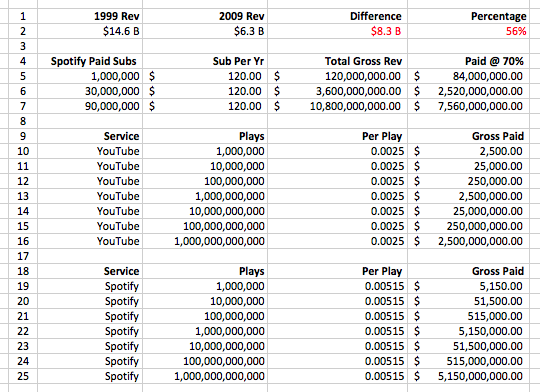
In the chart below calculations are created in tables to illustrate the simple math required to determine the revenue opportunities in different streaming models. For example, lines 5, 6, and 7 detail how much revenue Spotify can generate to artists, songwriters and rights holders paying out 70% of their gross at 1m, 30m and 90m paid subscribers.

If Spotify can capture what most believe is an optimistic amount of paid subscribers in the USA (30m) that would only generate $2.5b in revenue for rights holders. Line 2 represents the revenues of the record industry in the USA between 1999 when it was $14.6b through 2009 when it had plummeted to $6.3b leaving a loss of $8.3b annually since that time.

Maybe we’re missing something. If streaming is the future how does $2.5b in revenue from a massively successful Spotify replace the loss of $8.3b in annual earnings?

streamingmath

So in 2012 when Spotify has claimed 1 million paid subscribers in the US, that’s a payout to artists and rights holders of only about $84m. In simple math, this is about 12m albums at $7 wholesale each (what iTunes pays on a $9.99 album).

Additional food for thought is that Spotify is currently valued at 3 billion dollars. That’s just a little less then half of the entire earnings of the entire US record industry in 2012 at an estimated 7 billion dollars. This means that if the same valuation method is used for both Spotify as a single company, and the domestic record industry as a whole, than either Spotify is overvalued or the record industry is undervalued.

But there are larger problems here than Spotify. As you can see in the chart above YouTube also represents a challenge for artists and rights holders. The site was born of infringement as a business model, and despite policy changes at Google (YouTube’s parent company) the situation is still completely unacceptable for artists as East Bay Ray of The Dead Kennedy’s explains to NPR.

YouTube really deserves it’s own post, and there will be several forthcoming.  In the new “exploitation economy” artists seem to be willing to trip over transactional dollars attempting to pick up streaming pennies. Again, one of the most important distinctions between Spotify and YouTube is that Spotify does not have a massive DMCA and rights management issues that cheats artists of their due. Additionally, YouTube is paying a fraction of what Spotify is, so if this is the future, everyone is really in trouble.

Streaming Services Ranked By “Artist Friendliness”

There is a lot of debate concerning the amounts paid to artists by streaming services.  It’s often very confusing because what an artist sees in royalties on their statements is highly dependent on a number of factors including whether they have a record deal, publishing deal or whether they are a solo performer or a band.  From an artists perspective royalties may accumulate from multiple sources. The other problem is that in general royalties are based on a percentage of the streaming services revenue.  So the amount may vary month to month and year to year.

Still one good  way to compare services is to look at statements for a moderately sized catalogue and calculate the revenue per stream they pay to “the rightsholders” (label/publisher/performer/songwriter) over a period of months.   This would also be the same amount that a completely independent artist that owns 100% if their own recordings and songwriting receives.

But this is not the only way to look at these streaming services from an “artist friendly” viewpoint.   We also need to look at whether these services respect artists rights. That is, whether these services respect the Artists right to choose how to monetize their music.   When you look at it in those terms the picture is a little different.  Here I’ve ranked the 7 most common services.

1. Rhapsody (Napster/Zune).  These three “on demand” services allow you access to virtually any song at any time. From an artist’s perspective they are identical.   These all work on a paid subscription model.  Like Spotify these services pay a percentage of revenue to rights holders.   But because they do not offer an ad based free service they have more revenue and pay more per stream to each artist than Spotify.  All these services  (like Spotify) operate under a private license.  They do not rely on a government imposed compulsory licenses or rates.  This also means rightsholders can theoretically “opt out” of this service if they think it doesn’t pay well enough. Or better yet negotiate a better deal.

I’m not opposed to compulsory licenses and rates in certain situations. But as  an artist I have to note that these rates are set by political appointees.  Broadcasters generally have a lot more money than artists and are thus better positioned  to influence the political process.  This is not some sort of tin foil hat paranoia.   If you were paying attention this fall you will note  that this is exactly  what happened  with the Orwellian-named Internet Radio Fairness Act.  Pandora fronting for Clear Channel,  Sirius XM and various Silicon Valley firms tried to use their lobbying money and influence to force the government to reduce those compulsory license rates!  Artists could have got an 85% pay cut!  So in general private blanket licensing is better for the artist.  Compulsory federal government imposed rates benefit the politically connected.

As previously noted have access to the streaming royalty payments for a moderately sized catalogue. Here are the average per stream rates paid by these three services Jul-Dec 2011.

Zune 2.8 cents

Napster  1.6 cents

Rhapsody 1.3 cents

These are close to being a sustainable* rate for artists.  (See footnote at end for an explanation.)

As a consumer I enjoy Rhapsody’s  256k mp3s.  As a consumer I prefer Spotify’s interface. I’ve never tried Zune or Napster.

2. Spotify.  #2 ?!! This surprises many of you.  Right? Let me explain.

Currently Spotify appears to be paying rightsholders about .5 -.7  cents a stream.  Considerably lower than the three services above.     While my colleagues here believe this is not a sustainable rate and that it may never become a sustainable rate we can’t know for sure.   It  is unclear how much streaming services  “cannibalize” or displace traditional sales. If streaming services  displace 20% of sales Spotify’s per stream rate could be sustainable.  If they displaces 80% of sales? Probably not.

Spotify  relies heavily on it’s free streaming service that is ad supported.  Spotify pays 70% of revenue to rightsholders.  If Spotify manages to convert more users to it’s premium subscription services revenues will rise.  As a result  rightsholder’s revenues rise.  If the ratio of paying subscribers to free subscribers rises substantially the per stream rate rises to something  sustainable.

What we  like about Spotify:  It operates (mostly?**) under  private licenses which means that rightsholders can withdraw from the service if they wish.  More importantly Spotify  has quietly allowed individual artists to “window” their releases and limit which singles or albums are available in the free service.  This is very important. For instance my band Cracker which has had four top ten rock tracks might find it’s revenues from Spotify acceptable.  But a niche artist like Zoe Keating might find she is losing sales to streaming services. She might chose to have only some or none of her catalogue available.  Choice is the foundation of free markets. Allowing artists to experiment with how to use streaming services, and how to monetize their songs is good for everyone. It will eventually be clear the best way to balance revenue and access.

I also should note that Spotify is being unfairly blamed for the knock on effects of disintermediation.  Disintermediation creates winner-take-all markets, and in an industry that was already winner take almost all, the small and middle class artists have gotten clobbered.  On a positive note, in these kind of markets there are usually countervailing market forces at work that nudge us towards  risk and revenue sharing. Or in Layman’s terms: It usually gets better.    The explanation is kind of complex so I’ll skip it for now.  Suffice it to say that right now it’s not so much Spotify taking artists’ royalties but the superstars taking everyone else’s royalties.

Finally Spotify has gone out of it’s way to engage artists, even critics like myself.  The fact that they were willing to sit down with me and discuss my issues with  their service is encouraging.

#3 Pandora.   Oh how the mighty have fallen.    Once they were our favorite.  Look at early Trichordist blogs and note our enthusiastic tone whenever we speak of Pandora!

For those of you that don’t know Pandora is NOT an on-demand streaming service.  I call it a “virtually on demand streaming service.”  If I type in a song title and artist name, I dont’ get that song.  But I usually get a song by that artist.  Pandora is a music discovery service.  It’s not a replacement for owning an album.  As a result Pandora gets and should get a lower rate than on demand services.

What we don’t like about Pandora:

They operate under a compulsory license so artists can not opt out of the service if they do not like the rates!! But what is worse is they have adopted the tactics of Silicon Valley’s hardball monopolists.  Proudly on display are  lobbyists, fake bloggers, planted stories, paid mouthpieces  and all the usual Kabuki Theatre bullshit we’ve come to expect from the “innovators” of Wall Street- er I mean Silicon Valley.  As I mentioned previously  Pandora fronted for the Internet Radio Fairness Coalition and pushed the Orwellian-named Internet Radio Fairness Act. The bill had nothing to do with Internet radio or fairness and everything to do with screwing artists out of 85% of their royalties.

Curiously the Internet Radio Fairness Coalition which supports the bill  has a lot of traditional broadcasters like Clear Channel and Sirius XM. Kind of odd for an organization with the publicized  purpose of leveling the playing field between Internet broadcasters and traditional broadcasters. The CCIA and CEA are also  inexplicably members of the IRFC.  Well maybe not inexplicably.  Just as the Four Horsemen herald the Apocalypse,   The CCIA  and CEA seem to always herald  La Chingada of someone, somewhere by Google.

So for participating in this rapacious anti-artist skullduggery we move Pandora from the top of the list  to #3.   We would put it at the bottom of the list but the other two lower ranking  services in my humble opinion are not even completely legal.

#4.   YouTube/Google.   YouTube is the biggest on demand streaming service. I know people think of it as a video service but it turns out that it’s the most popular music streaming service.  The main problem is that a lot of the music is uploaded and monetized by people that have no right to the music in the first place.  For example here is one of my recordings:  All Her Favorite Fruit. The problem is I didn’t authorize this person to upload this song, nor did I authorize YouTube to sell advertising or sponsored videos against this song.  It’s possible that the record label did but as I am also the songwriter and legally I should have been consulted.  Worse, the person who uploaded the static image can receive advertising revenues  since they “own” the video.  This is no different than Kim Dotcomm/MegaUpload paying people to upload the most popular movies and songs.  Further I have no idea where the money goes since you can’t audit YouTube without signing an agreement with them that basically says you can’t audit them!  YouTube is like the exploitative 1950’s music business but even worse, as  the artist does not receive the occasional Cadillac in lieu of royalties.

Now consider this:  This track is competing with legitimate authorized  streams of my track on other services.  These services generate some revenue for me.  So say I find it in my financial interests  to take this down?  I have to file what’s called a  DMCA notice.  When I do this Google can place my DMCA notice  on this website to try to publicly shame me into not doing this anymore.  I don’t file DMCA notices with YouTube/Google because I don’t want some deranged Freehadists showing up at my  home or office. This is not a far fetched idea, many of us in the vanguard arguing for artists rights and the preservation of copyright receive constant threats from seriously deranged free culture nutbags.  So the result is I don’t file a notice and I let YouTube/Google get away with this. This website is a tool of intimidation. It is my belief that this is exactly what Google intended when it launched this site.

If Google and UC Berkeley (which hosts the site and lends it intellectual legitimacy) had any common decency they would stop this practice cause someone is gonna get hurt one day. Now while  I don’t hold out hope for Google developing any common sense anytime soon (they are still allowing advertising for no prescription Oxycontin despite a half a billion dollar fine and threat of jail time)  maybe the Chancellor of UC Berkeley will recognize how screwed up this is.  You should ask Chancellor Birgeneau yourself: “Why is UC Berkeley supporting Googles intimidation scheme?”  chancellor AT berkeley.edu.

My friend East Bay Ray of The Dead Kennedys  told me he recently got an “offer” from YouTube/Google to let him claim  his own songs and start receiving royalties.(“Really you’re letting me have control over my own songs? Gee thanks how nice!”).  All he had to do was sign away most of his rights and in return the band would get about .1 cents a view.   Considering your typical banner ad on a shitty pirate website gets 1.5 cents an impression,  this is not even a joke.  It’s an insult.   Honestly I can’t understand how artists can complain about Spotify when YouTube/Google is so much worse and certifiably evil.  As I’ve said before “Don’t be Evil” is not their corporate slogan, It’s their widely ignored corporate reminder. 

#5 Grooveshark.   Many young people I run across seem to think this is a legitimate streaming service. It’s not.  My entire catalogue is on this service. No license, no permission and not a dime ever from these guys.   The sooner these guys go to jail the better.  I’m tempted to have a conversation with Ted Nugent. You think he’s mad about Obama raising his taxes and restricting his gun rights?  Wait till he finds out that Grooveshark is not paying him royalties.

* “Sustainable Rate” is my attempt to figure out a streaming rate that compensates artists well enough to continue to write (and especially) record albums.   I’ve examined a lot of iTunes libraries and “most played” lists.   A typical 20 year old college student seems to play a track they have purchased around 25-30 times before they seem to tire of the track.   So if on demand streaming replaces all album sales a stream should pay about 2.3-2.8 cents to be the equivalent of the 69 cents net received from iTunes on a 99cent download.  But if on-demand streaming only replaces 50% of album sales it could be half that rate.  You see?

But a  word of caution.  First this assumes that 99 cents a track is the right price for all songs.  Not necessarily true.   This is a price that iTunes essentially imposed on the record business, against a backdrop of mass piracy.  You can make an argument that this artificially lowered the price of music.

Second the music business has always worked on a revenue sharing model that assumes the “winners” subsidize the “losers” through record companies, publishing companies and their advances.   If you have total disintermediation in the streaming market even with high per stream rates  niche artists like Zoe Keating and Camper Van Beethoven would never generate enough revenue to record albums.  Music sales exhibit a “wild” variation and with total disintermediation almost all the revenue goes to the winners.   So this “sustainable rate” is not necessarily sustainable at all.  It is only one piece in the puzzle.  Eventually the revenue and risk sharing roles once assumed by record labels will need to be assumed by the record labels again, or other mechanisms need to be developed.

Other’s have suggested non market based  mechanisms which  include “crowd funding” government subsidies and corporate patronage.  I am uncomfortable with all of these.   Government and Corporate funding allow powerful elites to decide what music is made.   Crowd funding works for the most extroverted and popular personalities.   While crowdfunding comes closest to market based incentivizing  I don’t believe crowd funding would have ever given us  important artists  like Jimmy Hendrix, Captain Beefheart, Frank Zappa,  NWA,  Black Flag or Nirvana.   Can you imagine Kurt Cobain or Jimmy Hendrix offering a premium support package that includes the artist coming to your house and cooking dinner for you and 4 of your friends? No crowdfunding works for people like me who already have a career or extremely extroverted self promoting personalities like Amanda Palmer (no offense intended). 

One day I hope that all my musician and digital utopists friends wake up and see that the West’s private market based system for creating culture  has produced some extraordinarily profound and non-mainstream work.   No other system can match it. Why are some so  hell bent on throwing it away?  

** My understanding is that there is a compulsory on demand rate for songwriters (song in abstract) not performers.  It’s not clear to me whether Spotify uses this rate.   And I can’t two experts that agree.  But certainly the bulk (if not all) the revenues Spotify pays our are under the private license not compulsory license.

Two Simple Facts about Technology and Piracy : iTunes Vs. YouTube

Fact number one.

Unlike Google’s YouTube, Apple’s Itunes Store does not have a piracy problem, nor does it have an unmanageable issue with DMCA notices. This is often explained that this is because Apple does not allow user generated content from just anyone, therefore there is a barrier to entry that prevents such issues. But this is simply just not true, anyone can upload an album of music to Itunes using any one of the third party aggregation services such as Tunecore or CDbaby. And yet, there are not (as far as we know) hundreds or thousands of DMCA notices and content take downs on Itunes per day, as there are on YouTube. So why is this? In a word, intent.

If Apple, Spotify, Amazon and virtually every other legal and licensed distributor of digital music can put into place, the checks and balances that are capable of managing these rights effectively why is it so hard for Google to do the same YouTube? Think about it.

Fact number two.

YouTube can effectively filter content if it wants to. Since day one, we have never, ever seen any live porn on YouTube. Not a single live link to porn, ever. In debates in various online forums we have often proposed the challenge to anyone to present an active live link to full fledged porn on YouTube. It has NEVER happened. No one has EVER been able to present a live link to an active porn video on YouTube in the six plus years we and our friends have presented the challenge. Talk about a crowd sourcing FAIL.

What these two facts reveal is that rights management online, the protection of copyrights and the enforcement of Intellectual Property require nothing more than the intent and will to do so. But don’t take our word for it, listen to Google’s own Chief Economist Hal A Varian from his book “Information Rules” where he describes “Bitlegging.”

“Bitlegging” can’t be ignored: there’s no doubt that it can be a significant drag on profits.

Bitleggers have the same problem that any other sellers of contraband material have: they have to pet potential customers know how to find them. But if they advertise their location to potential customers, they also advertise their location to law enforcement authorities. In the contraband business it pays to advertise… but not too much.

This puts a natural limit on the size of for-profit illegal activities: the bigger they get, the more likely they are to get caught. Digital piracy can’t be eliminated, any more than any other kind of illegal activity, but it can be kept under control. All that is required is the political will to enforce intellectual property rights.

So Apple, Amazon, Spotify (and hundreds of others) can effectively manage digital distribution without triggering millions of DMCA notices. YouTube can effectively filter porn, and yet the internet is not broken as best as we can tell.

Maybe, just maybe this isn’t so complicated after all. That is unless one has a specific intent and motive from which they perhaps profit from the mass scale aiding of commercial level infringement.

The Trichordist Random Reader Weekly News & Links Sun Aug 5

Grab the coffee!

Recent Posts:
* Kim Dotcom Parody Video Appears on YouTube
* Why Does YouTube Apologize to People who have Uploaded Illegally?
* A Kim Dotcom For All Seasons

Advocacy or Astroturf? Fortune reports on how Google and Facebook channel money to the EFF…
http://tech.fortune.cnn.com/2012/07/30/google-and-facebooks-new-tactic-in-the-tech-wars/

Essential reading, How Online Ad Networks support online piracy. This is business, Big Business. Music Tech Policy reports:
http://musictechpolicy.wordpress.com/2012/08/04/how-the-brands-and-ad-agencies-are-in-on-advertising-supported-piracy/

History repeats itself, Copyhype reports on James Frederick Willetts one of the OG content pirates, prosecuted in 1904:
http://www.copyhype.com/2012/08/enter-the-pirate-king/

Interesting, Demonoid under attack of DDOS strikes and domain redirection to virus software and malware, Torrent Freak reports:
http://torrentfreak.com/demonoid-starts-redirecting-to-ads-and-malware-120802/

Don’t believe the Hype, Facebook reports 83 million “Fake” users, and your band still can’t get 100,000 likes… Digital Music News reports:
http://www.digitalmusicnews.com/permalink/2012/120802facebook#2DUqPK9yMgrhd-3pomt14A

We’ve been disappointed by the delays of the “Six Strikes” ISP anti-piracy notification system going into effect, but the fact that it’s still upsetting to pirates warms our hearts. Torrent Freak reports:
http://torrentfreak.com/isp-six-strikes-anti-piracy-scheme-120803/

Spotify subscriber stats were released this week, but the question remains, will it scale? Digital Music News reports:
http://www.digitalmusicnews.com/permalink/2012/120731spotify#6orxX825bqy7BuKYOEPlpA

Ugh. The state of California bet almost 2% of it’s budget on the Facebook IPO hoping for easy money to help the states budget crisis. Guess what? Now it’s worse… Bloomberg reports:
http://mobile.bloomberg.com/news/2012-08-02/california-says-tax-revenue-at-risk-from-facebook-drop.html

The Trichordist Random Reader News and Links Sun Apr 22

Grab the Coffee!

Here’s some interesting stories and links we discovered or were sent during the week. These may not be stories OF the week, as we share them as we find them.

German Court Rules Against YouTube in Copyright Case:
http://news.yahoo.com/german-court-rules-against-youtube-copyright-suit-115708414–sector.html

Supporting Copyright Is Not The Same as Opposing Free Speech:
http://www.guardian.co.uk/music/musicblog/2012/apr/19/copyright-freedom-speech

Rapidshare Writes Four Page Anti-Piracy Manifesto:
http://www.theregister.co.uk/2012/04/20/rapidshare_stop_piracy/

Interesting interview Between Ben Watt of Everything But The Girl and Journalist/Author Robert Levine:
http://www.buzzinfly.com/index-robert-levine-interviewed-by-ben-watt.html

Musician / Composer Mark Isham Launches ibuymymusic.org
http://ibuymymusic.org/I_Buy_My_Music_Dot_Org/Home.html

TechDirt Goes on the Defensive after Gearslutz thread asks, “Why does TechDirt hate musicians”:
http://www.techdirt.com/articles/20120415/02354118491/difference-between-nuanced-discussion-evil-underbelly-internet-is-apparently-fine-line-indeed.shtml
http://www.gearslutz.com/board/music-business/719114-why-does-techdirt-hate-musicians.html

The Chicago Reader Picked up On David Lowery’s “New Boss, Worse Than Old Boss” as posted at TheTrichordist.
http://www.chicagoreader.com/Bleader/archives/2012/04/17/the-good-old-bad-old-days

Another shout out to TheTrichordist, this time from The Cynical Musician:
http://thecynicalmusician.com/2012/04/recommended-reading-the-trichordist/