Future Of Music Coalition Calls For Boycott Of Camper Van Beethoven Because I Pointed Out Embarassing Fact.

Screen Shot 2013-05-24 at 9.49.23 PM

Casey Rae the Deputy Director is of The Google Funded Future Of Music Coalition has called for a boycott of my band Camper Van Beethoven because I posted a blog which explained why I had been banned from speaking at SF Music Tech.  It indirectly involved his organization. Or so I was told.

According to Brian Zisk FOMC co-Founder and director of SF Music Tech it was because I tweeted a picture showing that Google sponsors Future Of Music Coalition.   My ire was actually directed at SF Music Tech.

Nevertheless Casey Rae Deputy Director of the FOMC responded on my facebook page-in full view of friends, family and my children I might add -with a completely uncalled for personal attack.  A diatribe fof  name calling and profanities. He then topped it off with a call to boycott my band.

So now not only am I being censored by these Google backed techno thugs.  They are now literally trying to take away my livelyhood?   Fuck that. What did CVB guitarist Greg Lisher and Violinist Jonathan Segel do to you?  You gonna take food out of their mouths also?  Fuck you on their behalf. They don’t have rich silicon valley sponsors paying their bills. You’re the asshole.

And me paranoid?! I’m not paranoid if I’m right.  You are out to get me!  You’ve just demonstrated that your opaque undemocratic  501C  group funded by a 1/2 a trillion dollar  corporation is trying to get people to boycott my band because I posted an inconvenient truth about an organization that is -as you claimed – only tangentially related to your organization.  Whisky, Tango, Foxtrot!

Unfortunately what this really demonstrates is that most of the musicians working for these Google front organizations are unhinged wackos.  I rest my case.

RELATED:
Two Sincere Questions for The Future Of Music Coalition

Why I Was Banned From Speaking At San Francisco Music Tech #SFMUSICTECH

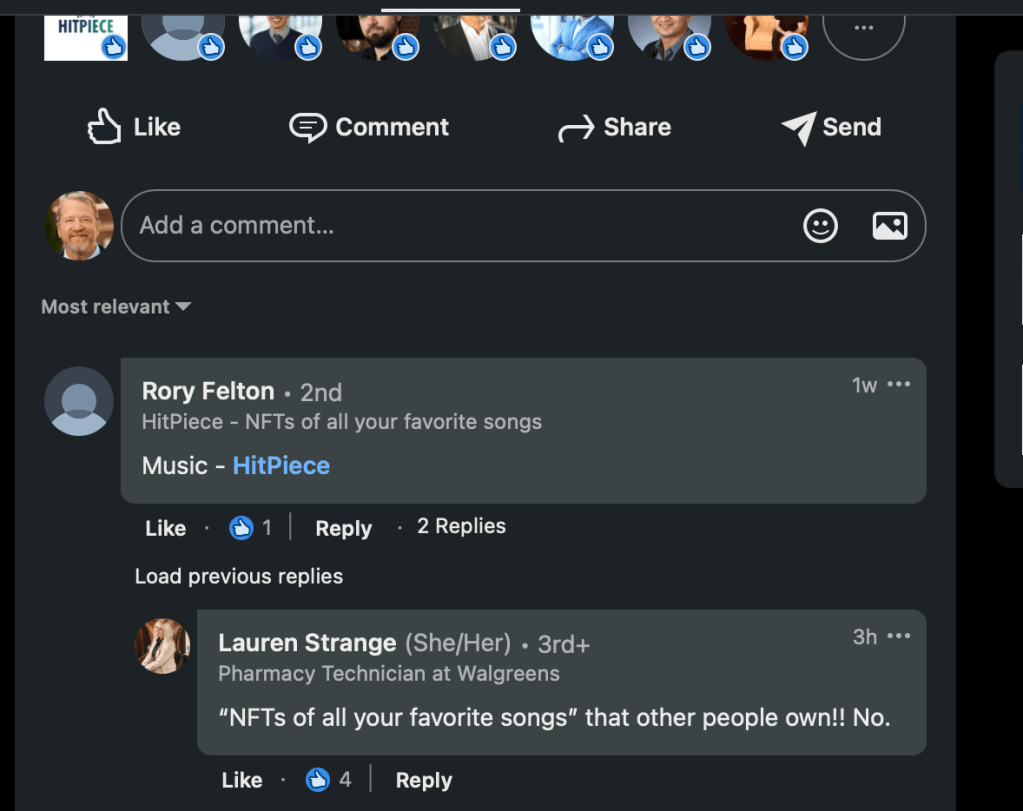
this photo says it all

“This says It all”

I was supposed to speak at the SF Music Tech Summit Feb 19th 2013.   A few days before my scheduled appearance I received a call from  SF Music Tech and Fututre of Music Coalition co-founder Brian Zisk explaining that I would not be allowed to speak because I tweeted/blogged the above picture with the following caption “this says it all.”   Further he noted that “certain sponsors” would not “appreciate” me speaking at this event.

I love the hypocrisy of the Silicon Valley. They are all for free speech until they aren’t.

The fundamental American right is Free Speech. SF Music Tech (and Silicon Valley in general) do not really respect this right. Especially when it begins to interfere with their bottom line.

So what do you say we just end the charade? SF Music Tech Summit is biased against creators/musicians and their rights. It’s a pro-tech industry event.  It’s held in the Kabuki Hotel in San Francisco.  Because it is a giant Kabuki.

Three times a year  you find Tech Industry “entrepreneurs” who’ve never turned a profit “debate” un-elected artists rights advocates who as it turns out work for opaque 501C  foundations and organizations  that are funded by technology companies like Google.

If it’s not clear I’m talking about you, Future of Music Coalition and Cash Music.  Sorry guys/gals you had your chance to do the right thing and  speak out publicly against me being banned and you didn’t.  That makes you at best quislings and at worst shills.

SF Music Tech and Brian Zisk have every right to do whatever they want with their #SFMUSICTECH summit but I just ask them to stop pretending it reperesents anything other than the technologists that wish to exploit artists.

Have a good SF Music Tech.  I’ll be off touring the UK.

Look who’s Pirating now! University Of Georgia Music Business Program’s Preliminary Study Of Advertising On Copyright Infringing Sites.

Jonathan Taplin at  USC’s  Annenberg Center has spent the last few month studying which parts of the online advertising ecosystem are delivering advertising (and hence revenue) to unlicensed music sharing and streaming sites.   His study has caused quite a stir in the advertising and entertainment industry.  Jonathan recently asked me to corroborate some of his findings regarding which brands are advertising on these websites. These are  the results of my preliminary survey.

Over two weeks in April  I had a group of students at UGA note which “brands” were advertising on a small set of sites that stream and distribute my own music without permission or compensation.  I chose sites that featured my own music for a very specific reason:  I could be 100% certain that they were exploiting my material without permission and were hence illegitimate sites.  Third party sources agree with my assessment. For instance The Google Transparency Report has all but 1 of these sites  in the top 200 recipients of DMCA takedown notices.

The purpose of the preliminary study  is not to identify how these advertisements end up on these infringing sites, but simply which brands are appearing on these sites.  We realize that brands often do not realize that their ads are appearing on these sites.   We hope this information is useful to advertisers, advertising agencies and the entertainment industry.  We believe along with artists the brands are also victimized by this practice because they are not geting the quality advertising for which they’ve contracted. And often their ads  appear next to unseemly videos and ads for adult and fetish sites thus damaging the image and reputation of the brands.  We encourage the listed brands to conduct audits of those responsible for placing these ads.  If it’s not possible for those responsible  to comply with an audit demand you should be aware that it is then highly likely that your ads will continue appearing on these sites!

Below I’ve listed the brands in two orders.  The first lists the brands by frequency, adjusted by a “breadth” coefficient. I will explain this breadth coefficient in subsequent post, but because of the way advertisers “track” web users,  the sheer number of a brand’s ads on a website can be somewhat misleading.   For instance ads for the apartment complex “River One” seemed to follow a single student the entire two weeks, but none of the other students recorded an ad from this company. This does not mean that “River One” isn’t in fact funding sites that exploit artists without compensation, it’s just a number of factors could be distorting their overall rankings.  Hence the breadth adjustment to dampen some of these effects.

In the following days  I’ll publish my rather simple  methodology and links to raw data.  Items that expose students identity will be redacted.

University Of Georgia Music Business Program Top 40 Brands Advertising On File Infringing Sites- Preliminary Survey (Breadth Adjustment):

Based on sample of 1,851 pageviews.

April 10-26 2013

rank Top Advertisers instances % “breadth” frequency adj for breadth
1 Country Financial 157 8.5% 100.00% 8.48%
2 Become.com 89 4.8% 100.00% 4.81%
3 AT&T 60 3.2% 100.00% 3.24%
4 Champion roofing 51 2.8% 100.00% 2.76%
5 State Farm 47 2.5% 75.00% 1.90%
6 Target 39 2.1% 87.50% 1.84%
7 Georgia Natural Gas 31 1.7% 100.00% 1.67%
8 AAA 29 1.6% 87.50% 1.37%
9 Rooms To Go 33 1.8% 62.50% 1.11%
10 Allstate 20 1.1% 100.00% 1.08%
11 Transunion 24 24 1.3% 75.00% 0.97%
12 H&R Block 18 1.0% 75.00% 0.73%
13 Pirate storm 26 1.4% 50.00% 0.70%
14 Quibids.com 13 0.7% 100.00% 0.70%
15 Coca-Cola/American Idol 16 0.9% 75.00% 0.65%
16 The New York Times 16 0.9% 75.00% 0.65%
17 One River Place (Atlanta GA) 94 5.1% 12.50% 0.63%
18 Progressive insurance 22 1.2% 50.00% 0.59%
19 Xfinity 15 0.8% 62.50% 0.51%
20 Nationwide 15 0.8% 50.00% 0.41%
21 Suntrust 14 0.8% 50.00% 0.38%
22 The Gold Coast Casino 11 0.6% 62.50% 0.37%
23 Norton 9 0.5% 62.50% 0.30%
24 Just fab boots 14 0.8% 37.50% 0.28%
25 Wartune 10 0.5% 50.00% 0.27%
26 Bing 5 0.3% 100.00% 0.27%
27 Dominos 15 0.8% 25.00% 0.20%
28 Karaolke Pink 28 1.5% 12.50% 0.19%
29 Charter 7 0.4% 50.00% 0.19%
30 Google chrome 12 0.6% 25.00% 0.16%
31 Sea World Busch Gardens 6 0.3% 50.00% 0.16%
32 Victoria’s Secret 11 0.6% 25.00% 0.15%
33 Royal Carribean 11 0.6% 25.00% 0.15%
34 Publix 7 0.4% 37.50% 0.14%
35 Dodge dart 20 1.1% 12.50% 0.14%
36 Bodies The Exhibtion 10 0.5% 25.00% 0.14%
37 The Heist 16 0.9% 12.50% 0.11%
38 HTC 5 0.3% 37.50% 0.10%
39 Pull-ups 5 0.3% 37.50% 0.10%
40 Spirit Airlines 5 0.3% 37.50% 0.10%

Unadjusted for “breadth.”

rank Top Advertisers instances % “breadth” frequency adj for breadth
1 Country Financial 157 8.5% 100.00% 8.48%
2 One River Place (Atlanta GA) 94 5.1% 12.50% 0.63%
3 Become.com 89 4.8% 100.00% 4.81%
4 AT&T 60 3.2% 100.00% 3.24%
5 Champion roofing 51 2.8% 100.00% 2.76%
6 State Farm 47 2.5% 75.00% 1.90%
7 Target 39 2.1% 87.50% 1.84%
8 Rooms To Go 33 1.8% 62.50% 1.11%
9 Georgia Natural Gas 31 1.7% 100.00% 1.67%
10 AAA 29 1.6% 87.50% 1.37%
11 Karaolke Pink 28 1.5% 12.50% 0.19%
12 Pirate storm 26 1.4% 50.00% 0.70%
13 Transunion 24 24 1.3% 75.00% 0.97%
14 Progressive insurance 22 1.2% 50.00% 0.59%
15 Allstate 20 1.1% 100.00% 1.08%
16 Dodge dart 20 1.1% 12.50% 0.14%
17 H&R Block 18 1.0% 75.00% 0.73%
18 Coca-Cola/American Idol 16 0.9% 75.00% 0.65%
19 The New York Times 16 0.9% 75.00% 0.65%
20 The Heist 16 0.9% 12.50% 0.11%
21 Xfinity 15 0.8% 62.50% 0.51%
22 Nationwide 15 0.8% 50.00% 0.41%
23 Dominos 15 0.8% 25.00% 0.20%
24 Suntrust 14 0.8% 50.00% 0.38%
25 Just fab boots 14 0.8% 37.50% 0.28%
26 Quibids.com 13 0.7% 100.00% 0.70%
27 Google chrome 12 0.6% 25.00% 0.16%
28 lowermybills.com 12 0.6% 12.50% 0.08%
29 The Gold Coast Casino 11 0.6% 62.50% 0.37%
30 Victoria’s Secret 11 0.6% 25.00% 0.15%
31 Royal Carribean 11 0.6% 25.00% 0.15%
32 Wartune 10 0.5% 50.00% 0.27%
33 Bodies The Exhibtion 10 0.5% 25.00% 0.14%
34 Norton 9 0.5% 62.50% 0.30%
35 Colorado tech 8 0.4% 12.50% 0.05%
36 Charter 7 0.4% 50.00% 0.19%
37 Publix 7 0.4% 37.50% 0.14%
38 Bruno Mars 7 0.4% 12.50% 0.05%
39 Sea World Busch Gardens 6 0.3% 50.00% 0.16%
40 Alzhiemer association 6 0.3% 25.00% 0.08%

The Underpants Gnomes. Pandora and the Return of the Internet Radio Fairness Act.

Gnomes_plan

(image courtesy Southpark)

In 1998 Southpark presciently lampooned the entire Dot Bomb bubble in an episode  called The Gnomes.  Essentially the Gnomes had a business plan:

Step One: Collect Underpants.

Step Two: ?

Step Three: Profit.

The excellent Seeking Alpha writer Stephen Faulkner last year  pointed out the similarities between Pandora’s business strategy and the Underpants Gnome’s business model.

However Pandora did eventually come up with a step 2.  It’s called the Internet Radio Fairness Act.   Basically this bill would ask the government to step in and mandate lower royalties to artists.   Essentially a bill that would largely benefit  ONE publicly traded company: Pandora  (although curiously Pandora terrestrial radio competitor Clear Channel is signed onto the bill along with Google,  what’s that about?,  Here is a wild guess. Pandora is for sale.)

So basically this is the Pandora Underpants Business Model:

Step 1 Collect Users

Step 2  Ask Congress to pass a bill that benefits a single private company , by mandating lower royalties to artists for Pandora.   Or perhaps more accurately Artists are forced by government  to subsidize Pandoras bad business model.

Step 3 Profit.   ( Stockholders cash out in sale to Clear Channel or Google?).

++++++++++++++++++++++++++++++

But here’s the thing.  The so called Internet Radio Fairness Act was shot down in Congress, largely due to grassroots efforts by artists.   But the rumour is the bill is coming back.   And I’m gonna make a fairly educated guess as to what changes are gonna be in the bill.

While at a social event in Washington DC a rather transparent aparatchik of the telecommunications industry suggested a couple changes to the bill that might possibly meet the approval of the artists.   Essentially it was this:

Why not lower Pandora’s royalties but give a larger percentage to the artists and less to the record labels.

Okay, so yeah I fucking fell off the turnip truck yesterday and that sounds like a really good deal! Sign me up!!

1).  If IRFA passed, royalties from Pandora could be cut 85%.  Even if artists got 100% of the royalties  and record labels got zero we’d still take a whopping paycut of 70%.

2) Like most artists nowadays I own my own “masters” .  That is,  essentially I am the record company.   Most independent artists are their own record labels.  Therefore for the vast majority of artists this is exactly the same paycut and  amounts to the  Internet Radio Fairness Coalition saying “Artists are stupid and they’ll never catch on”.

(Ladies/Guys: after surviving in the music business for 30 years it should be a assumed that I have a finely tuned bullshit detector.)

So I’m gonna take a wild guess here:

The Internet Radio Fairness Act comes back next month with exactly this change.  They think they are gonna be able to divide us from record labels. Not realizing that most artists are the record labels. A divide and conquer strategy. Let’s hope I’m not right. But just in case.  Be ready.

Once Again Techdirt Has Nothing Intelligent To Say So They Just Resort To Mocking Musicians for Being from “Crappy Town” in Southwest Virginia.

Why does anyone take Techdirt seriously? How are  Techdirt writers any different than your typical cyberbullies and trolls on some abusive reddit thread?   Editor Mike Masnick has repeatedly made the  claim (unsupported by the objective facts) that he is on the side of musicians, especially those independent musicians that are trying to make it outside of the major label system.  Yet when a group of independent musicians working outside the major label system from a relatively poor but culturally rich region of Southwest Virginia take a position that he doesn’t like?   His blog (which is based in the  wealthy elitist  cultural wasteland of Silicon Valley) resorts to mocking these artists for being from some “crappy” part of America.  I quote the subtitle of the article:

“from the we-gotta-go-to-the-crappy-town-where-i’m-a-hero! dept”

Unfortunately this is the way that Techdirt and Masnick ALWAYS operate.  The idea is that through mocking and name calling they will intimidate into silence  these particular musicians – and any others  thinking of  joining them. That’s what he did to Lily Allen. That’s what he has repeatedly tried to do to me (to the point it’s beginning to resemble cyberstalking).

Ultimately Masnick et al are not really for freedom of speech. They are anti-democratic and elitist at heart. Over and over again we’ve watched he and his writers stir up and allow a frenzy of name calling and ugly threats in the comment section at Techdirt. He rarely seem to  moderate offensive, slanderous or threatening comments.  It’s a hatefest by design. Intimidate and silence.  It’s like lord of the flies over there. Few people understand that this seems to be the point of Techdirt. Not the poorly written articles but the manipulation of an ignorant and hateful mob in the comments section.  These are the freehadist foot soldiers that spread this hatred elsewhere on the web.

Now Masnick and Techdirt aren’t always trying to stifle all speech. Just speech they don’t like.  For instance when it comes to criminal conspiracies started by “Keep Sweden Swedish” rich extremist xenophobes who exploit artists without compensation (The Pirate Bay)  Masnick et al are quick to find common cause with them on some far fetched “freedom of speech” or “censorship”  grounds. But ordinary US citizens from the Southwestern Virginia Songwriters Association get a very different treatment.  These songwriters apparently had the gall to say something that might-barely-possibly-slightly threaten the power,influence and profits of Masnick’s powerful Silicon Valley sponsors.  So right on cue Techdirt resorts to name calling and  attempts to create viral mockery. Because usually this silences artists.  IMHO the silicon valley demagogues that make up the writing staff of Techdirt are just the cowardly cyber versions of the fascists of old who used  mobs to intimidate dissidents into silence (or worse). Make no mistake that’s what they are methodically attempting to do here: silencing critics.  Sure the mob is virtual  but it’s still a mob.

And I for one do  not use the term fascist lightly.  But sadly in this case the comparison applies. Check it out. Techdirt is the place where these pathetic little Gollums go to feel important and “part of a group” by treating others cruelly.  To feel superior than those ignorant “others.”  Those people from “crappy towns.” Those “bad” people who are threatening “our”  internet way of life.   Masnick has created a safe place for these writers to dehumanize and deligitimize others by insinuating they are not “real” and therefore much easier to treat disgracefully. I quote from the story:

“members of the Southwest Virginia Songwriters Association Seriously? That’s a thing?”

“So congratulations, Songwriters Association of Wherever.”

There can’t possibly be songwriters in Southwestern Virginia!  These people aren’t real, therefore treat them as non-humans.

You don’t even have to read between the lines to conclude this. Just read the comments, Masnick’s Vulgus technoridicae do it for you.

You got to wonder what is wrong with this particular writer that chose  to join team Masnick.  Did he dream his whole life of working for a blog that methodically mocked the weak and powerless on behalf of the rich and powerful? Was that his goal in life?

And what about the trillion dollar internet industry that is so chicken-shit afraid of a handful of musicians petitioning their elected representative  that they seemingly fund people like Masnick to specifically  go after ordinary citizens expressing opinions that they find inconvenient.  See the Google vs Oracle Amended Shill List.

But here is the funny part.  Despite suffering from high self esteem Masnick and his writers are completely inept and  spectacularly ignorant. They’ve probably caused more problems for their cause/paymasters than they have prevented.  Follow along:

The subtext of the Techdirt piece is this:

Bad musicians from  some backwoods part of America that unlike the technology industry doesn’t deserve to be represented in the corridors of power in washington DC.

IGNORANT:

1)The music of  Southwestern Virginia and the Southern Appalachians is the root of much of modern American music.  Bands selling out Red Rocks, The Fillmore, Madison Square Garden this summer are playing songs that originate in this region. And it’s not just obvious mountain, folk and country blues music that originate from this region. Acts like  Sparklehorse, and  Those Darlins have roots here.  Masnick and his staff are totally ignorant  of this easily googled fact.

2) This region is home to some of the most popular and longest running music festivals in the US.  Everything from The Floydfest to The Galax Fiddler Convention. Each summer hundreds of thousands of people trek here from all over the world for the dozens of music festivals.  Again google it.  Look at those links.  You might be surprised if you think music festivals in this region are  just mountain fiddling and enormously popular country stars.

One would assume Goodlatte and his staff have pride in the musical heritage of Southwestern Virginia.

INEPT

3) The Congressman, Bob Goodlatte, the head of the Judiciary Committee represents many of the “crappy towns” in Southwest Virginia right?  During hearings earlier this year Rep Goodlatte asked Maria Pallante  from the Copyright Office “Why is the debate over copyright so polarized?”  This is why the debate is so polarized! Blogs like Techdirt that  refer to his district as a “crappy town” and the only place he could possibly “be a hero!”

This is how it reads in the district of the very powerful  House Judiciary Chairman:

Elitist  Northern Californian Liberals making fun of Southwestern Virginia as an unimport region of “crappy towns” and unintelligent people.

If Google or the CCIA are still paying Masnick, they really are not getting their money’s worth.  Or maybe they are, who knows.