Latest Draft of the Music Modernization Act

FYI everyone. Latest draft of the Music Modernization Act is available here.

Music Technology Policy

The 2nd Draft of Music Modernization Act 3/22/18 was released publicly today.  We are reviewing and will post comments in the coming days.

The first thing I noticed is that the tragic demonstration of the raw lobbying power of Big Tech: The litigation reach back safe harbor seems to still be in there which is designed to deny due process and other Constitutional protections to songwriters whose works are infringed prior to the enactment of the Music Modernization Act.

Plus the one-sided board of directors is still the inverse of the publisher/songwriter control in other countries, 70% publishers and 30% songwriters.

View original post

Can Blocking Ads Help Artists? Should Artists Encourage Fans to Block Ads?

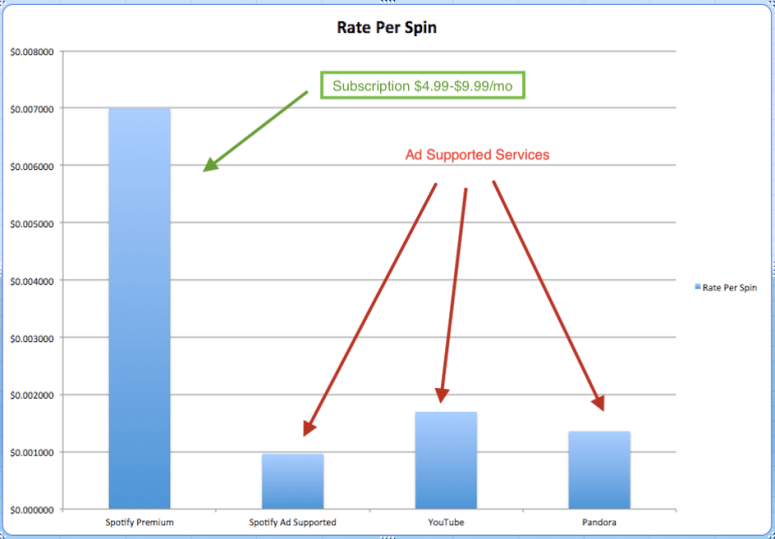
I posted this article in 2015. But it is perhaps more relevant today. Ad supported streaming services rely on packaging and selling user’s personal information. Ad supported streaming underpays artists. Artists and consumers interests are completely aligned.

Subscription services pay artists better and don’t need to compromise consumer privacy. #DeleteTheFreeTier

The Trichordist

Screen Shot 2015-09-20 at 8.43.52 PM

Rates are “all in” at source.  Calculations based on royalty statements from a catalogue of 1500 titles 2014.  Exception is Pandora which was calculated from 2nd quarter 2015 statements (higher than 2014).  

In the fight for fair pay artists are not at war with the Internet or really even the streaming services, we are at war with the online advertising industry.   As we have demonstrated time and time again, subscription (paid) music streaming services pay at least 7 times the rate that the free services pay.   When you see artists (like myself) post absurdly low royalty payments it’s usually from one of the services that is predominately ad supported. Above is a chart that illustrates this nicely.

So for artists the solution seems easy:  get rid of ad-supported free tiers.  The problem is that in order to do away with these ad-supported tiers we have to fight not…

View original post 1,839 more words

Video: Who You Gonna Call? Artists’ Rights And Law Enforcement Panel UGA Artists Rights Symposium Jan 23

Who you Gonna Call? Law Enforcement and Artists’ Rights


Amanda Williams, Songwriter, Songwriter Advocate
Detective Superintendent Peter Ratcliffe, Police IP Crime Unit City of London Police
Carlos Linares, VP Anti-Piracy Legal Affairs RIAA
Ellen Seidler, Filmmaker, Writer, Producer, Digital Citizens Alliance
Kevin Phelan,  Senior Supervisory Agent, FBI Palo Alto CA

1:15- 2:15 PM

Chris Castle of MusicTech Policy once remarked, “If someone is stealing your musical gear, it’s clear you call the police. If someone is stealing your musical catalogue, who do you call?” Most of the time the answer is “call a lawyer and file a federal copyright infringement lawsuit.” However, this presents several problems. An artist would have to track down the culprit, not an easy task when operators of website may be located in foreign countries or ownership masked by shell registrations. Second, a plaintiff must have hundreds of thousands of dollars to proceed in federal court. This is not a practical solution for most independent songwriters and musicians.

There are however other actions that artists may initiate. The federal government has several units that deal with criminal intellectual property theft that can often help. In addition, it’s entirely possible that these websites may be committing other crimes such as fraud, tax evasion and/or money laundering. Other federal units may be activated to investigate these suspicions. Similarly, these crimes may also violate state laws. Many states also have their own copyright laws, rights of publicity, false advertising and consumer protection statutes that may come into play. Some of the most surprising and effective anti-piracy law enforcement operations in recent years have come from the City of London’s Police Intellectual Property Crime Unit. Is it possible an artist in the US could one day call the local police?

Video: Grassroots Advocacy Panel at University of Georgia Terry College Artists Rights Symposium Jan 23 2018


The UGA Terry College Music Business Certificate Program hosted an Artists’ Rights Symposium Jan 22-23 2018.  Over 250 people attended the symposium. Above is the video of the Grassroots Artists Advocacy Panel.

An Overview of the State of Grassroots Artists’ Rights Advocacy

Mala Sharma, Georgia Music Partners
Blake Morgan, Performer, #IRespectMusic
Miranda Mullholland, Performer, Advocate, Roaring Girl Records
Doria Roberts, Performer, Activist
Rick Carnes, Songwriter, Songwriters Guild
2:30-3:30 PM

In addition to the organization of the grass roots advocacy groups, the panelists discuss; messaging; effective use of social media; consumer education; constructively interacting with federal, state and local government representatives; lobbying for legislation; and discouraging companies from doing business with royalty deadbeats.  Panelists also discuss lessons learned from these successful campaigns and map them onto current problems.

Barf. Just Barf.

David Israelite of the NMPA and Mitch Glazier of the RIAA  have penned an op-ed for Variety Magazine, in which they extoll the virtues of various copyright reform proposals before congress.  While I agree with them on the Classics Act (fixes pre-1972 loophole) and AMP Act (helps producers/engineers receive royalties from digital royalty streams) every day I find myself liking the MMA less and less.

Perhaps it’s because the folks pushing it come out with idiotic statements like this:

“Streaming services have been sued multiple times by music creators who have not been paid properly, preventing them from fully investing in the potential of their platforms”-Israelite/Glazier

That’s right litigious songwriters have prevented streaming platforms like Spotify from investing in their platform.  Yup, in 2011 Spotify et al talked to a magic future-predicting genie who told them they should save their money because starting in 2016 they would be sued by songwriters.  Makes sense.

I guess that’s why upon launch in 2011 they didn’t build any sort of system to license and pay royalties to independent songwriters. And thats why they paid obscenely low royalties right from the start. Conserving money! Our future lawsuits made them pay shitty and infringe in the past!  Whoah!  It’s all quantum mechanics and shit!

We independent songwriters can relate.  While we were not being paid royalties we were also unable to “invest in our platforms.”  You know housing, food, transportation, childcare, healthcare etc.   Must have been really tough on Spotify, and they have to  cover that 30 million dollar a year lease on their offices in the World Trade Center.

And now here come the NMPA and RIAA to save the day.  While we appreciate their attention to matters, songwriters should ask themselves a couple questions:

What were the NMPA, RIAA (and their lapdogs AIMP, and AI2M) doing 2011-2016 while streaming services were failing to pay large numbers of member/songwriters?

Absolutely nothing.  Jack shit.  Diddly squat.  Nada. Nothing.  Nishto. Zilch. Nani mo.  Méiyǒu.

Why are streaming services now willing to sit down and bargain on songwriter pay?

Cause we sued the fuck out them.

RIPE is the FIFA of the Internet and it Enables Europe’s Internet Crime

This is a guest post  (translated from German) by Volker Rieck.  Mr. Rieck has spent considerable time investigating Private Layer a web hosting company that seems to be favored by many copyright infringing sites. Unfortunately Rieck’s investigation has been stonewalled by the quasi governmental organization RIPE.   

According to Wikipedia: “RIPE or The Réseaux IP Européens Network Coordination Centre (RIPE NCC) is the Regional Internet Registry (RIR) for Europe, the Middle East, and parts of Central Asia. It is headquartered in Amsterdam.”

Ostensibly RIPE gets its authority from ICANN which in turn used to get its authority from The US Department of Commerce via NTIA. That changed at the end of the Obama administration.  ICANN is more less independent now but is supposed to consult closely with government.  Since ICANN has (swank) offices in Los Angeles, we would hope that “closely consulting with government” would include US government.  Including the US Trade Representative. 

Alas, like so many poorly governed international organizations ICANN/RIPE is quickly showing signs of  arrogance and unaccountability.  After reading Rieck’s report I would argue that RIPE is corrupt. They are clearly  transmitting fraudulent information to the public. When the error was pointed out they did not correct it. Thus they are complicit. So it is fair to ask, is RIPE the FIFA of the Internet?  Who knows. We will never know unless someone with authority looks into it. There is no way that rights holders can force RIPE to properly follow their own rules.

However the United States Trade Representative could surely ask the US Department of Commerce/NTIA to look into it.  Aren’t they across the hall? If that doesn’t work why not The Justice Department? Certainly the following questions need to be asked by federal authorities: What part of the RIPE charter allows you to keep in good standing members that provide false public information?  What kind of public interest organization thinks it’s their “duty to provide the public with fake registration data?  What part of your charter mandates you protect members clearly involved in mass copyright infringement? You guys are either total idiots or criminal enabling scumbags: which is it? 

Tweet this at staff of US Trade representatives and Department of Commerce and/or NTIA. Rights holders should exercise their 1st amendment rights and loudly protest this blatant failure of governance. You are the victim. Don’t let them get away with it. 

-David Lowery

++++++++++++++++++++++++++++++++++++++++++

Internet self-government á la RIPE: A paradise for criminals

By Volker Rieck

Every year in January, the office of the United States Trade Representive (USTR) publishes a list of the worst offenders on the Internet for the past year. This concerns both haptic goods, i. e. counterfeits, replicas, etc. and infringements of intellectual property rights in the form of the non-regulated distribution of films, books, music, software, apps, etc.

The list includes names like the Chinese e-commerce giants Alibaba and Taobao, but also websites like Movie4k, Libgen, The Pirate Bay or Openload.

Contributors to the list include associations such as the Motion Picture Association of America (MPAA) on behalf of the US film industry or the Recording Industry Association of America (RIAA) on behalf of the US music industry.

The role of the RIPE NCC Internet self-administration system will be highlighted here.

Groundhog day

The name of one particular host provider has appeared on the USTR list year after year: Private Layer from Panama or Switzerland. In this respect, the report is not all that clear.

This company provides server space and bandwidth to other “companies”.

According to the USTR report, Private Layer’s “customers” in 2017 included sites such as 1337x. to or primewire.ag. Other sites using the services of Private Layer include youwatch.org, firedrive.com or sockshare.com. All of these are sites that violate the rights of third parties.

The USTR report contains a note about Private Layer to the effect that the operators act more or less anonymously and do not react to information about rights infringements, and that Private Layer’s customers act in the same way.

A closer look at the company therefore appears worthwhile.

Private Layer is a member of RIPE NCC (Réseaux IP Européens), one of five organisations worldwide that are primarily responsible for the allocation of IP addresses and so-called Autonomous System Numbers (ASN). Without such autonomous systems and IP addresses, accessing the Internet and individual websites would be impossible.

The area in which RIPE NCC effectively acts as an arm of the Internet self-government ICANN includes Europe and parts of Asia.

It does not include Central and South America, which fall under the aegis of its sister organization, LACNIC.

Nevertheless, a company such as Private Layer from Panama can become a member of RIPE NCC, receive an Autonomous System Number (ASN) and assign IP number ranges that it has previously received from RIPE NCC.

A question to RIPE NCC as to why a Central American company can do business in Europe so easily with the help of RIPE NCC was answered after several e-mails: if a company has activities in Europe, it can also become a member of RIPE NCC.

So far, so logical. But to think that the Panamanian company is running a data center in Switzerland would be to set oneself up for a disappointment: while the address in the RIPE NCC database indicates a location in Zurich, this is merely the address of a letter distribution center. In German law, a PO box cannot be the registered office of a company. And by any understanding, a post box is most certainly not a data center.
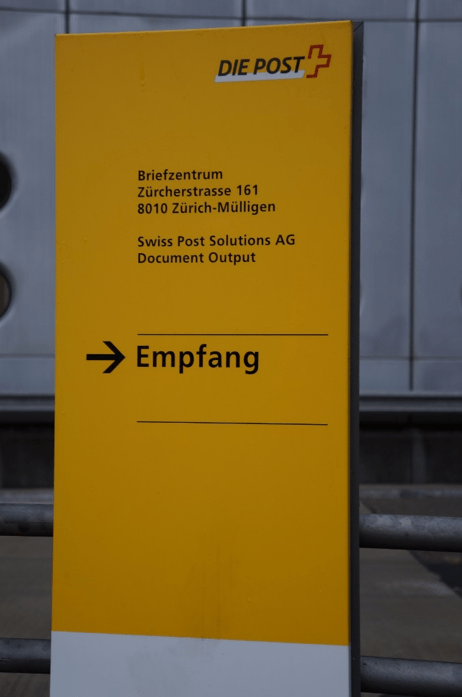
Photo: Company location of Private Layer regarding the RIPE NCC Database
© Christian Buetighofer

A visit to Panama

If the company has no registered office in Switzerland, then the company should be located at the Panama address RIPE has recorded.

But even here it cannot be found. A personal visit to Panama in 2015 at the address given by RIPE NCC led to an office building, but no Private Layer Inc. company could be located there. There was no Private Layer office on the 17th floor, no mailbox and no Private Layer bell button.
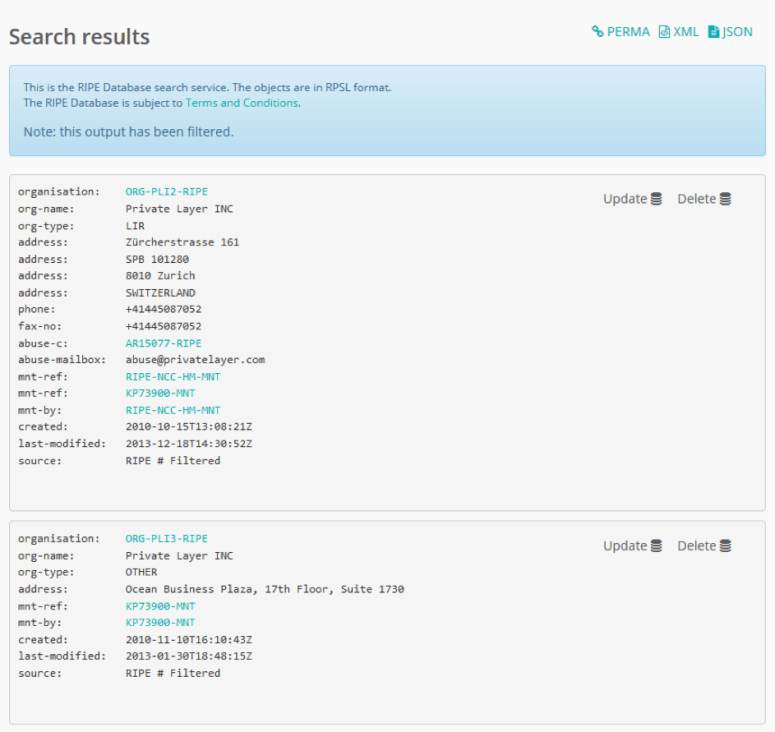

Screenshot: Official company information of Private Layer at RIPE NCC in 2015

The way to Zurich

RIPE NCC does not operate a so-called GEO IP database. But other services like Maxmind from the USA do. Such a database can be used to determine where the data center assigned to a specific IP is located.

In the case of Private Layer, this is actually Zurich, but not the PO box mentioned above, but one of the Zurich branch offices of the US company Equinix Inc. where Private Layer has either rented servers or space for its own hardware in Equinix’s data center.

So Private Layer uses the infrastructure of Equinix.

The role of Equinix will not be discussed further in this context.

Everything has a price

Let’s have a look at the price list of Private Layer. The smallest server there costs 89 US dollars per month. The servers on offer are not exactly up to date from a technical point of view. They have a processor that Intel introduced to the market in 2010, and it is therefore difficult to compare the server rental price with those of competitors: finding vendors with such outdated hardware is not easy.

Screenshot: Website of Private Layer with server offers in February 2018

In Germany servers with about 4–6 times the performance (better processors, more memory etc.) can be rented for less than half the price. So it is not the ruinously expensive price point that explains why Private Layer has been able to remain operating in the market for so long.

Private Layer’s selling point is, rather, explained by the USTR report: Private Layer offers a so-called hidden feature. The company’s own operators are anonymous, and Private Layer guarantees the same anonymity and uncontactability to its “customers”.

Private Layer’s customers shy away from the public eye. Nearly all of the WhoIs entries (showing who runs the domain) of the sites hosted at Private Layer have been obscured by special WhoIs services. Attempts to reach the site operators in cases of rights infringements only ever lead to a contact form, never to the operator or even to any company at all.

But the route via the renter of the servers, Private Layer, is also a dead end. As described above, the company’s registered office is either a PO box in Switzerland or a non-existent address in Panama. Documents cannot be served with return confirmation of receipt, and nobody can be reached.

So Private Layer is an attractive proposition for those willing to pay far above the market rate for a weak server in exchange for being able to carry out their business undisturbed and without having to worry about unpleasant investigations.

All fake – we don’t give a damn

How can a non-existent company with a PO box in Zurich become a member of an organization (RIPE NCC) that is responsible for the smooth operation of the Internet?

A company whose business purpose is to provide infrastructure and protection for those who violate rights?

This is exactly the question we put to RIPE NCC. The answer we received is astonishing.

Of course RIPE NCC attaches great importance to accurate data. However, a distinction is made between the member data (i. e. internal and highly private data) and the contact data shown externally.

Accordingly, the internal data is checked by comparison with official company documents.

For external data, the RIPE NCC member only has to observe one thing: an address and an e-mail address must be given. Neither are verified, and RIPE NCC emphasizes that it is not possible to ensure that members also respond.
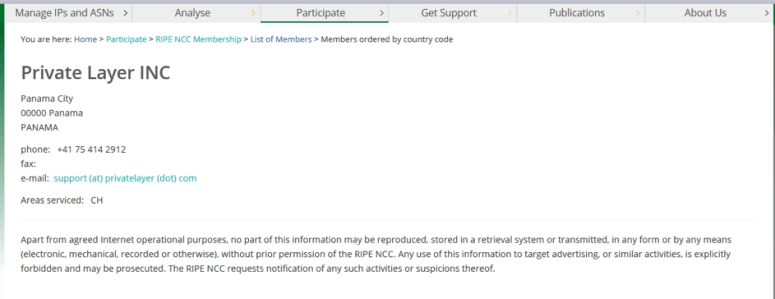
Screenshot: Fake data of Private Layer at RIPE NCC at the 7th of February 2018
Telephone calls useless – no response, e-mails were ignored, the postal address is a joke

In cases of obviously false data, RIPE “can” contact a member for clarification – with the emphasis on “can”.

Only if a member does not reply or if data proves to be incorrect “can” RIPE NCC exclude it according to its statutes – again with the emphasis on “can”. According to its own statements, RIPE does not see itself in a punitive role: it only wants to provide data. It doesn’t really matter what the quality of the data is. On request, it was emphasized that a person reporting abuse has no entitlement to be informed about the further progress of the case.

Nor do law enforcement agencies fare much better in their quest for information. In a separate section on the website, RIPE NCC explains that only public information is shared in response to enquiries from LEA (Law Enforcement Agencies), because the privacy of members is important. As is clear from the example of Private Layer, this information is fake and therefore worthless, quite apart from the fact that these fakes can be viewed in the RIPE NCC database at any time.

Further information would not be released without a court order or another official order. According to Dutch law, of course. As stated on the RIPE NCC website:

“In such cases, the RIPE NCC strives to protect the interests of its members and will not provide any confidential or private information to LEAs without a court order or other legally enforceable order or request under Dutch law.”

In the case of EWEKA, a court in Northern Holland has ruled that RIPE NCC would also be obliged under Dutch law to surrender the owner’s information in the event of copyright infringements without a court order.

It is plain that the diffusion of responsibility prevails at every level from top to bottom.

The victims are the rights holders whose rights are infringed on a daily basis and who have little chance of defending themselves against this, because deception and trickery are rife at every level.

Conclusion

The time has come to look more critically at the role of Internet self-government and at self-regulation through ICANN/RIPE NCC. The way in which this is managed creates almost lawless spaces that are a dream for every criminal. The example of Private Layer proves this conclusively and is unfortunately not an isolated example.
(In 2016, RIPE received 374 Abuse Reports in total (p. 19 RIPE NCC Annual Report). These have apparently had no consequences; most of them are still under investigation.)

Instead of doctoring the symptoms of undesirable developments on the Internet, their root causes should be analyzed and clearly regulated. Just as in the analogue world, where even a small market stall at a weekly market needs to have a clearly identifiable proprietor.

Imagine a situation involving the sale of contaminated food in which the market owner refused to release the data of the seller citing his own rules and the privacy of the seller.

On February the 13th 2018,7 days after the announcement at RIPE NCC, completely wrong data about Private Layer will continue to be published there.

The legislature should ask itself why it allows the most basic rules of the Internet to be determined by a network of non-democratically legitimized institutions that go so far as to cooperate actively in facilitating violations of the law.

Volker Rieck is Managing Director of the content protection service provider FDS File Defense Service. His expertise in the area of Internet piracy is widely recognized. FDS regularly works on studies relating to issues around piracy. It also supports law enforcement authorities with its data.

How Artists Can Fight Internet Monopolies: UGA Terry College Artists Rights Symposium Keynote By Jon Taplin

Readers of this blog know that that Terry College of Business at University of Georgia hosted the inaugural Artists Rights Symposium Jan 23 2018.   All the panel videos are now available on the Terry College of Business YouTube Channel. 

Here is Jonathan Taplin’s Keynote.  It’s fantastic.  Funny, concise and likely to make your blood boil.  Watch it.


Fight For The Future May Have Illegally Used Corporate Donations For Electioneering

UPDATED
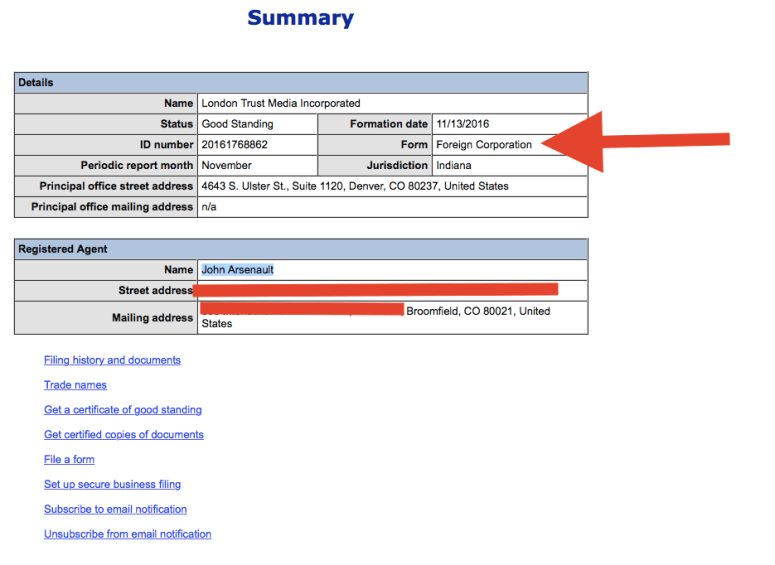
John Arsenault called and we spoke about the registration of Corporations in Colorado.  Mr Arsenault says this simply indicates the corporation is from another state but now doing business in Colorado.  We are not experts on Colorado corporate registrations and we defer to Mr Arsenault and appreciate the clarification on this matter for us.  As a result we have updated the blog to focus only on the implications for US Non-profits and electioneering.  We leave screenshots above to simply illustrate what we are correcting. 

Anybody who has been in the fight for Artists Rights knows that one of our biggest enemies is the astroturf group Fight for the Future.   We’ve been following them for some time and have covered FFTF funding from the mysterious London Trust Media.  What we didn’t realize until yesterday is that that London Trust Media is apparently registered as a foreign corporation.  

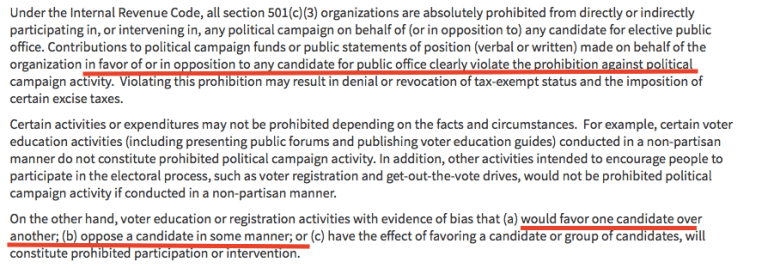
Here is the paragraph from the IRS concerning Non-profits

I am not an attorney but this would seem to make many of the activities Fight For the Future has been involved in illegal under FEC IRS regulations.  In particular a communication urging a vote against a particular candidate is off limits.  Here is just one example:

 Lets be clear here, Fight For The Future opposed TPP NOT because they were worried about American jobs or environmental regulations.  They opposed TPP because it did not force our trading partners to weaken copyright protections for artists!!!!  Regardless, this sort of position against specific candidates would seem to violate paragraphs  IRS rules on non-profits.  This could also would seem to put their Massachusetts non-profit status in doubt. (FACT:  in an email dated  May 26th 2016 I pointed out the apparent non-profit violation to Fight For The Future’s accountant  and FFTF board members, yet, Fight For The Future continues to claim they are a compliant non-profit. See addendum for correspondence.)

If you’d like to help take the bad guys down I suggest you:

  1. Write the FEC and complain about activities of this foreign corporation funding activity that urged voters not to vote for  specific candidates.  Ask them to investigate. They are the experts! Warning the Federal Elections Commision does not make it easy to complain about this activity. Imagine that! Refer them to this blog.  This is the best I can do https://www.fec.gov/legal-resources/enforcement/complaints-process/  Updated: Don’t do this it is not FEC but matter but IRS matter. As Mr Arsenault notes LTM is within it’s rights to donate to FFTF.
  2. Complain to the Massachusetts Secretary of the Commonwealth. Again they don’t make it easy.   What you want to do is make sure they realize you are complaining about Center For Rights in Action (This is the real name of Fight For The Future). The issue is electioneering and opposing candidates. Main Number:Toll Free: 1-800-392-6090 (within Massachusetts only)Telephone: 617-727-7030 TTY: 617-878-3889 Fax: 617-742-4528 E-mail: cis@sec.state.ma.us


+++++++++++++++++++++++++++++++++++++++++

Here is the correspondence with their CPA indicating that on May 26 2016 I made them aware of the violations.

Mr Alario:

I hope this finds you well.  I have some questions about Fight For The Future Education Fund.  As a public charity they have certain obligations and responsibilities under the law. 

First:

I’m looking at the FFTF Education Fund website  right now and the financials link redirects to link for Center For Media Rights 990 IRS form. 
Although I’m sure this was just a mistake as the two organizations have intertwined management and web resources,  it is a legal requirement that you make available to the public the 990 IRS form for FFTFEF, including the Schedule B.  Please send me a copy or kindly tell me where I can find it on the web?
Second:
I’m concerned that FFTF Education Fund appears to have violated some IRS rules for public charities.
Political Campaign Intervention
“Contributions to political campaign funds or public statements of position made on behalf of the organization in favor of or in opposition to any candidate for public office clearly violate the prohibition against political campaign activity. Violation of this prohibition may result in revocation of tax-exempt status and/or imposition of certain excise taxes.”
IRS Compliance Guide
for 501(c)(3) Public Charities
Lobbying Activity
“A public charity is not permitted to engage in substantial legislative activity (commonly referred to as lobbying). An organization will be regarded as attempting to influence legislation if it contacts, or urges the public to contact, members or employees of a legislative body for purposes of proposing, supporting or opposing legislation, or advocates the adoption or rejection of legislation.-
IRS Compliance Guide
for 501(c)(3) Public Charities
FFTF urged the public to contact members of congress and their employees proposing, supporting and opposing TPP legislation.  Including statements urging voters to vote against specific candidates;  organized a likely illegal “comment bombing” of the Copyright Office public consultation on section 512 of The Copyright Act.
++++++++++++++++++++++
MORE INFO
FFTF claims to be a Non-Profit
Oh but read the fine print.  They clearly know what they are up to:


TorrentFreak Owner/Editor Lennart Renkema PhD Received Funding From Google & Bittorrent Friendly VPN

Google funded Lennart Renkema’s last paper. 

Let’s just get right to the point shall we?   TorrentFreak is not a semi-biased news source that reports sympathetically on piracy. If you accept the framework of academic policy washing laid out in Merchants of Doubt, TorrentFreak operates as a public policy arm of Google and other commercial interests that profit from piracy. Multiple sources report that Ernesto Van Der Zar is Lennart Renkema PhD.  Renkema is also the co-author of “Copy Culture in U.S. and Germany.”   It was funded with a grant from Google.

But that’s nothing.  It gets much uglier if you dig deeper.  Shall we?

More disturbing is Renkema’s links to London Trust Media.  LTM operates a VPN under the brand name Private Internet Access. Private Internet Access is a VPN that touts itself as bittorrent friendly. In other words instead of paying musicians for their work you just pay Private Internet Access and they hide your identity.  In this way LTM/PIA profits from piracy while sharing nothing with the artist. Ernesto/Renkema admits PIA is Torrentfreak’s main sponsor. Ernesto/Renkema clearly financially benefits from this sponsorship. Torrentfreak also writes glowing reviews of PIAs  service.  A deep search of the web shows no other employment for Renkema. Rick Falkvinge is also a writer at Torrentfreak. Until we exposed it Rick Falkvinge (yes the guy who suggested child pornography be legalized) was listed as the Chief Privacy Officer at Private Internet Access. As a result one could plausibly argue that Torrentfreak is really just an arm of Private Internet Access/London Trust Media.

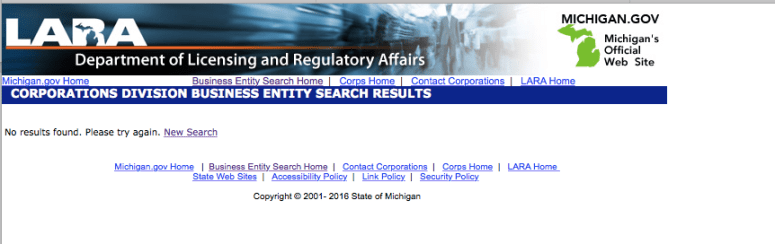
So let’s take a closer look at Private Internet Access/London Trust Media.  Official 2014 tax documents show an address in a mini industrial park in Michigan. Yet in 2016 Michigan Department of Licensing and Regulatory Affairs had no such company registered in the state of Michigan.  This would seem to be a violation of state law.  Back in 2016 we did some research on other companies listed as doing business at that address:

World Fertility Experts an offshore fertility clinic.

Flip it Friday a $50 dollar a month online course on how to flip houses.

My Diploma:  Sure.  Seems perfectly legit.

GS Media Looks to be a penny stock promoter. Again no business records in Michigan state database.  They come up in this interesting article here

http://www.goodetrades.com/2012/06/global-gaming-network-gbgm-is-the-pump-and-dump-du-jour/

KlearGear: Then of course there is KlearGear. You got to read this one.

http://www.mlive.com/business/west-michigan/index.ssf/2013/11/kleargear_grandville.html

The Daily Scam which reports daily on internet scams reports on a business located at this address.

http://www.thedailyscam.com/december-30-2015/


So think about it folks. Is Torrentfreak really what it claims to be?  Is Lennart Renkema simply a reporter? Or is he part of a bigger profit oriented endeavor?


The Bipartisan Classics Act Is Ready For Prime Time: Time to fix Pre 1972 Loophole

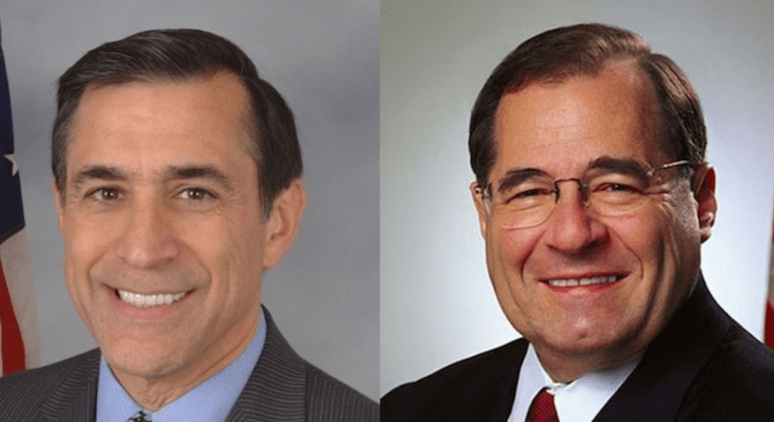
Issa (R-CA) and Nadler (D-NY) sponsored the Classics Act in the house. 

Artists that had the misfortune to record before 1972 do not get royalties for the public performance of their recordings on satellite and non-interactive streaming services.  This so-called loophole is simply a creation of federal courts (Ninth & Second) and apparent collusion by digital services (DOJ antitrust: Agreeing to fix a price at $0 is still price fixing).

The Classics Act is designed to fix this loophole.  This fix has long been championed by Rep Nadler (D-NY) and Rep Issa (R-CA).  It’s a simple matter of fairness and equal treatment under the law.  There is no way in hell that the legislators who enacted The Digital Performance Right in Sound Recordings Act of 1995 (DPRA) intended to leave out pre-1972 performers.  Why has this persisted so long?

Artists owe a debt of gratitude to Nadler and Issa for relentlessly pushing this bill forward.  Also  Pandora, SoundExchange and other groups like Music First, the Internet Association, the GRAMMYs,  Screen Actors Guild‐American Federation of Television and Radio Artists, American Federation of Musicians, the Content Creators Coalition, the Future of Music Coalition, Fare Play, the Rhythm and Blues Foundation, and the Living Legends Foundation deserve their fair share of the credit.