@ALA Libraries (Again) Enable Apparent Corporate Lawfare Conspiracy Against Authors, Artists and Songwriters

Does ALA counsel Jonathan Band really have libraries best interests at heart.  Or is he more interested in helping Silicon Valley in its war on the individual rights of authors. 

If you haven’t heard the “used” digital file platform ReDigi case is back.   The case rests on the question of whether consumers have the right to sell a digital copy of a file, as long as they delete the old one.    ReDigi supporters argue that it’s no different from selling a used paperback book or CD.  And in the  tl/dr world of digital punditry that probably sounds pretty compelling.  Just add the American Library Association support to your argument and you’ve got a rancid pseudo-intellectual veneer of legitimacy.  Enough so that say that  law professors at insular institutions like Harvard or Stanford can claim there is some legitimate question of the law here.

There isn’t.

Read David Newhoff’s excellent analysis of the case here and here.

ReDigi’s arguments were soundly rejected by Judge Sullivan:

At base, ReDigi seeks judicial amendment of the Copyright Act to reach its desired policy outcome. However, “[s]ound policy, as well as history, supports [the Court’s] consistent deference to Congress when major technological innovations alter the market for copyrighted materials. Congress has the constitutional authority and the institutional ability to accommodate fully the varied permutations of competing interests that are inevitably implicated by such new technology.” Sony, 464 U.S. at 431, 104 S.Ct. 774. Such defence often counsels for a limited interpretation of copyright protection. However, here, the Court cannot of its own accord condone the wholesale application of the first sale defense to the digital sphere, particularly when Congress itself has declined to take that step. Accordingly, and for the reasons stated above, the Court GRANTS Capitol’s motion for summary judgment on its claims for ReDigi’s direct, 661*661contributory, and vicarious infringement of its distribution and reproduction rights. The Court also DENIES ReDigi’s motion in its entirety.

So why is this case proceeding? I mean digital downloads are dying and being rapidly replaced with music streaming.  This firm does not have a viable business model going forward.  And surely the backers of this company know it.  What is the point of appealing?

I believe there is only one reason this case is being reasserted:   This is simply more lawfare by Silicon Valley aligned groups against the individual rights of creators*.   It only makes sense as a strategic move to weaken creators rights organizations and associated trade groups by forcing us to deploy our limited resources fighting this absurd case.

The ALA has no compelling interest in this case despite what the ALA’s  DC gollums may argue. In fact it is a strategic mistake.

First, purely on a PR level it undermines libraries broad support by authors.  I don’t understand why in this age of shrinking budgets and growing irrelevance of libraries that the ALA continues to wage war on authors and other creators? (I count more than a dozen amicus briefs in which ALA or the related LCA  has sided with Silicon Valley interests against creators). I can’t imagine libraries have many allies anymore.

Second, it casts libraries’ lot in with the shyster capitalists of Silicon Valley.  By tying the exemptions granted for libraries under the copyright act (happily granted by authors I might add),  to imagined loopholes viscously  exploited by tech firms,  it begs the question:  Why should libraries be treated any differently than say Google?

Librarians should remember this.  Unlike the rest of the industrialized world, US libraries do not pay a public “lending royalty” to authors.  This is a profound “give” to public and academic libraries by authors.  IMHO if libraries continue to play “hardball” and  support the rapacious behavior of tech firms and VCs,  we should do the same and withdraw our support for the exemptions that libraries take advantage of and demand they pay lending royalties to authors.

So rank and file librarians should ask their public policy apparatchiks “what is the game plan is here?”

When NPR cast their lot with corporate giants like Google and ClearChannel and joined the Mic-Coaliton.org in an effort to reduce royalties to performers and songwriters the backlash was huge.    We crushed them (with tactics like this) and they had to eventually withdraw from the alliance.     It’s a little weird that say UVA pays it top librarian $325,000 a year, but UVA public policy  seems happy to see authors and songwriters stiffed.   Just saying…

*We would like to point out for the 157th time, that groups do not have rights.  Under our constitution rights are vested in the individual.  The ALA and it’s allies is arguing that “consumers” a group have rights, that can violate the constitutional rights of individuals.

 

Here it Comes: Another Safe Harbor For Digital Services

Think of the damage that Google has been able to do to artists’ income with the DMCA safe harbor and YouTube.   The DMCA safe harbor means that artists have to play an endless game of  Whac-A-Mole with the second largest corporation on the planet,  or take the shitty music licensing deal they offer.  A textbook case of market failure.

And really the other streaming services should object to  YouTube’s abuse of the DMCA takedown process because it makes it near impossible for them to fairly compete.  Why pay for Spotify premium when you can get  all the  same music for free on YouTube? Again another market failure.  I’m positive the authors of the 1998 copyright legislation did not intend for companies like Google to build an interactive music streaming service on the safe harbor protections.

So after 2 decades of living with the DMCA safe harbors, every rightsholder, performer or songwriter will tell you the same thing.  The DMCA safe harbor needs to be fixed.  Anyone that knows anything about music licensing would NOT propose another safe harbor.

Yet this looks like it’s being seriously floated. The video above is from a Technology Policy Institute panel at NYU.  Starting at 10:15 Professor Lawrence  White proposes a new safe harbor for streaming services.   It’s important to note that White is sitting between two of the four horsemen of the songpocalypse (Sirius and Jim Griffin).  This is clearly a harbinger.  The idea is that if a streaming service makes a “good faith effort” to find a song and they can’t find the owner they don’t have to pay. In the world this professor lives in (not ours) the new safe harbor thus “incentivizes” songwriters to build a global all-encompassing database in order to get paid.

Neat, except…what the professor (and to be fair most music licensing lawyers and policy wonks) don’t understand is there is no incentive to register precisely because the royalty is too low!   Would you spend 20 minutes registering something in some wonky database if it meant you’d get $1.08 check 2 years from now? There is an entire generation of musicians that have given up on registering music or collecting royalties because it’s not worth the hassle.  Second no database would ever be fully up to date anyway.   New songs are written every day.  Songs and catalogues change ownership.  This perfect database will never exist.   The services will just legally keep all the “unmatched” royalties.  They will have a financial incentive to NOT find the owners.

Curiously White has an interesting paper on creating more competition in music licensing.  But after watching this, if he’s pro-competitive, as he claims, it’s a funny kind of pro-competitive.  Competition requires regulatory “space” not further narrowing of the songwriters ability to negotiate. Adding new federal safe harbors or expanding compulsory licenses for the use of music further reduces competition.

Rarely noted is that we have exactly the same problem on the other end of the compulsory license. By federal statute all streaming services have access to exactly the same composition repertoire. Federal regulations force them all to function in much the same manner.  They all have the same royalty expense structure. They charge the same subscription rates etc.

How do they distinguish themselves?

They don’t. And once one music service becomes dominant all competition will fade away.  There is no way for a competitor to innovate and displace the dominant service. So why bother?

I guess I’m not NYU-educated enough to understand how adding more mandates to the swamp of federal music licensing regulations “drains the swamp” and creates competition.  To me this looks like another handout to Silicon Valley billionaires and the VCs that back these services.


Five Lies In YouTube’s Spin on Content ID

This was from June of last year. But it’s as accurate as ever considering YouTube’s latest smokescreen!

Music Technology Policy

youtube-logo-parody-1

An increasing number of artists are stepping forward to condemn YouTube’s sleazy business practices ranging from YouTube’s improbable royalty payments to Google’s legacy DMCA notice and shakedown business practices.  YouTube has struck back with the usual squid ink trying to obfuscate Google’s absurdly ineffective Content ID and Content Management System (“CMS”), most recently to the New York Times.

YouTube’s theory according to the NYT is that independent artists (such as five time Grammy-winner Maria Schneider who graced our pages with her groundbreaking essay on YouTube’s sleaze) are not harmed by YouTube’s “catch me if you can” DMCA shakedown because Content ID–the principal tool that some artists and copyright owners use to block or monetize both UGC and official video assets on YouTube–is widely available.  The implication being if those pesky artists would just use the tools YouTube provides, there would be peace in the valley with sunshine and puppy dog tails…

View original post 1,812 more words

Google Fingerprints on John Oliver’s GoFCCYourself Website? Why? Also Why Are Cyber-Libertarians Bankrolling the Whole Thing?

What’s wrong with this picture?

GoFCCYourself.com is the website that John Oliver used to flood the FCC Net Neutrality consultation page  with comments.  Purportedly his action brought  the FCC website down.   Sound familiar?

I’ve registered a lot of domain names. I’ve registered many with Google domains.  I’ve never seen this.  A new website registered at exactly zero zulu time?  Right down to the second!  I went through a bunch of other domains that were listed as registered by Google Domains they appeared to reflect actual times registered to the second.

For instance  the registry for the domain http://www.GoogleDomains.com shows

Updated Date: 2017-04-10T04:00:33-0700
Creation Date: 2003-08-09T14:36:38-0700

The registry for Alphabet.xyz shows
Updated Date: 2016-02-10T09:59:37.0Z
Creation Date: 2014-12-02T14:02:50.0Z

I find this odd. This website URL thus appears to have been registered differently by Google Domains than any other registration I can find. How and why was this registered differently than other domains? Did Google help John Oliver with this?  Did they automate the timing of the registration?  Is Google involved in yet another assault on the FCC?  Is this payback for the failed “unlock the box”proposal? The enemy of my enemy?

Net Neutrality is a complex issue. Reasonable people disagree on how best to implement it.  But before we move on, let me ask you this.  Given the news coverage…  Is the FCC proposing ending net neutrality?  yes or no?   Quick! don’t think about it!

I bet you said yes.

You would be wrong.

You are purposely being misled by fake progressive astroturf groups.  This is the SOPA playbook.

In actuality the FCC is not proposing ending net neutrality but instead transferring authority over net neutrality back to the FTC, where it lived for many years.  I don’t remember my internet being broken then.  Do you?

But more importantly there are a number of complex reasons why I think that this is not necessarily a bad thing for copyright holders.  The most important reason is that the FCC has extraordinary powers and under the last FCC chairman they demonstrated their intention to essentially force compulsory licenses onto copyright holders.  Haven’t we artists, songwriters especially suffered enough under compulsory licenses?  For you civilians you’ve probably read stories about songwriters getting checks for ridiculously small amounts like  17 cents from a streaming service.  Compulsory licenses and rate setting by the federal government are the cause of that particular outrage.     No thanks, no more compulsories.

Further, you know, it’s possible to be pro-net neutrality and also be against granting the FCC extraordinary power to regulate the internet.  Right?  They are not mutually exclusive.

Now will it be better for artists if we were are not under the FCC? I can’t say for sure.

But what I CAN tell you is that a lot of people who have been on the wrong side of copyright and artists rights issues for a very, very long time are pulling out all the stops trying to keep Net Neutrality under the FCC.  For this reason alone artists and copyright holders need to be very careful here.  These assholes are up to something.

Take for instance our old friends Fight For The Future.  We have written extensively about them.  Best we can tell they are pure astroturf for silicon valley corps. And readers of this column will remember this company well,  These were the folks that “comment bombed”the Copyright office  consultation page on DMCA takedown reform.   They illegally posted 86,000 identical comments to the Copyright Office using an automated tool from a third party website.  Or in layman’s terms they attacked a government website with “a bot.”   We caught them. Nobody in the last administration had the balls to do anything about it.    See our coverage here, here, here and here.   Since that time we learned that this “progressive net rights group is heavily funded by a mysterious cyber libertarian bitcoin promoter named Andrew Lee.   Lee was also somehow  involved in Mt Gox the famous bitcoin exchange that lost hundreds of millions of dollars worth of bitcoin and then collapsed resulting in criminal charges and arrests.    Why is a “progressive” grassroots group taking money from people like this?   What is really going on here?

I doubt this is really about net neutrality and empowering the individual.  I think this is a battle between corporate proxies, and one set of mega corps wants to keep the Net Neutrality under the FCC.  Poor John Oliver and fans. They’ve been duped into being human shields for silicon valley interests.


What’s the Deal with the Tech Dirt T-shirt? Protecting the 1st Amendment!


I feel that I didn’t make this clear enough at the beginning, so let me be absolutely clear.

I am wearing this Tech Dirt T-shirt on stage as much as possible because I sincerely believe that Tech Dirt and Mike Masnick are being unfairly sued.  As a blogger I’ve been on the receiving end of letters threatening legal action for simply exercising my free speech.  It without a doubt chilled my speech.  I can’t imagine what it would be like to actually be sued for millions of dollars.   I understand that it is almost comic that I am defending Tech Dirt and Masnick.  We couldn’t be more opposite on so many issues.  However this is deadly serious.  If Tech Dirt is shut down because of this lawsuit no blogger, including this blogger is safe from this sort of intimidation.  We are in 100% agreement here.

As Masnick stated in a post shortly after the suit was filed:

“So, in our view, this is not a fight about who invented email. This is a fight about whether or not our legal system will silence independent publications for publishing opinions that public figures do not like.”

You can read Mike’s detailed explanation here:

https://www.techdirt.com/articles/20170111/11440836465/techdirts-first-amendment-fight-life.shtml

How to help:

https://isupportjournalism.com


Are Moves By FCC Chief Ajit Pai on Net Neutrality Good for Copyright Holders?

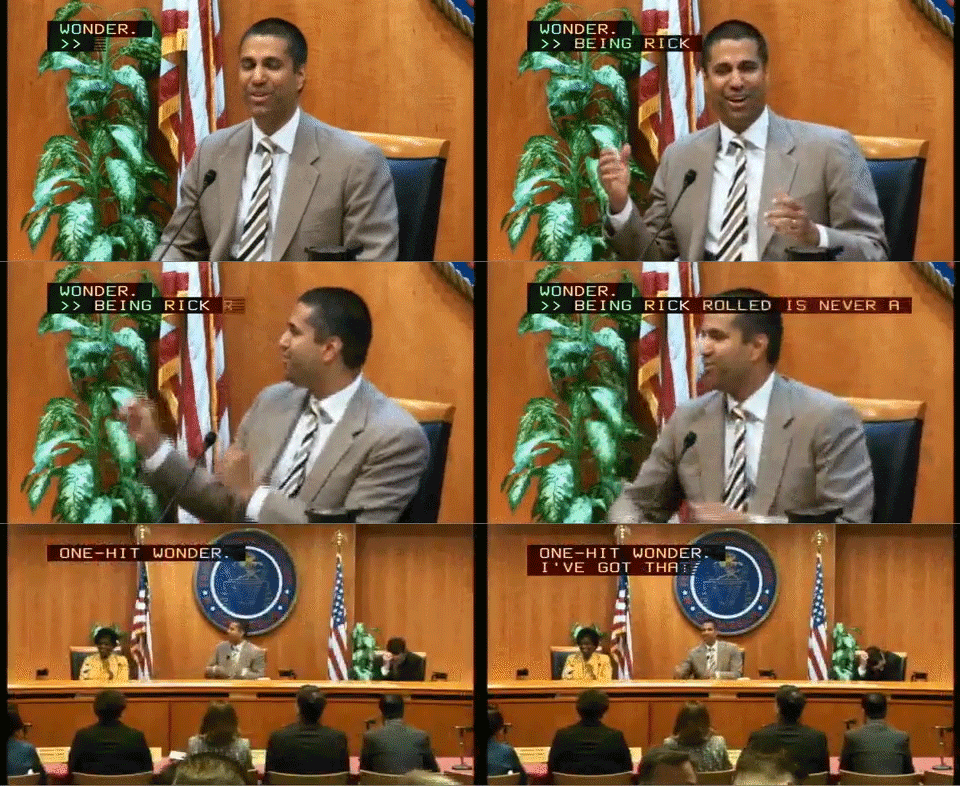
FCC Chairman Ajit Pai proposes rick rolling back FCC regulation, and this may be good for copyright holders.

A few years ago I was one of a number of artists that signed onto a petition to strengthen net neutrality. You have to understand why an independent musician, songwriter and label owner like myself might see this as important. There is a long history of “paid prioritization” in the music business. Radio payola being the most obvious. But back in the 80’s and 90’s there were all sorts of payola type fees. Even independent record stores (think High Fidelity) demanded fees and free goods for in store play and end racking. It was all a shakedown that favored the incumbent players and discriminated against startup labels.

So to my indie musician brain, net neutrality seemed akin to earlier anti-payola and anti-bribery prohibitions. Sure, in the end it was probably unenforceable but at least it was a gesture towards fairness. And looked at in another way, how was this any different then the public exchanges for equities? Aren’t public exchanges designed to treat each trade the same? Not prioritize some over others? Didn’t this guarantee a flat and fair “market” for each packet of music?

At the time a couple of friends warned me that I would come to regret this. That somehow net neutrality was simply a trojan horse for the FCC to not just regulate the ISPs but also the content creators and copyright holders. As it turned out I should have listened to my friends.

Ironically the true dimensions and implications of the net neutrality debate have been manifested in the hypocritical protestations of the defenders of Title ll in response to FCC Chairman Pai’s proposal to reverse Title ll’s application to net neutrality. First you have to understand that despite all the hyperventilating (and RickRolling) by groups like freepress.net, the FCC is not rolling back net neutrality. Instead it is handing back authority to the FTC. We DID have net neutrality before it was regulated by the FCC. Going back to the FTC does not mean it’s going away. It’s just the FCCs rather extraordinary power will not be hanging like Damocles sword over copyright holders as they negotiate with companies like Google and Amazon.  As songwriters will tell you repeated intervention in music licensing by the DOJ (through the outdated 70 year old consent decrees) has radically depressed songwriter public performance royalties.  Do we really want the FCC intervening in film, tv and cable in the same way?  Songwriters are the last in line to get paid, and we always seem to suffer the most when there is agency capture.

Moreover, it has become increasingly clear that Title ll net neutrality is primarily a fight between corporate giants trying to secure negotiating leverage about who has to pay for what, with over the top providers (Google/Amazon) trying to decrease the costs for reaching their users.

More fundamentally, Title ll net neutrality is a form of internet exceptionalism under which the internet would operate under non-market rules. But why does this make sense? The internet may have started as a vehicle for the sharing of ideas, but today it is also the backbone of the global economy. Property rights encourage investment. We risk undermining the vitality of the global economy if we introduce (or in some cases, maintain) significant encroachments into the operation of market economies. The FTC can, and should, guard against anti-competitive practices by internet giants, whether they are ISP’s, or edge providers (Google, Facebook, Amazon etc). But we should not take actions based on some perception that the internet has upended the reason for encouraging market, rules-based, commerce.

We have already been down this path with the FCC with respect to set-top boxes. In 2016 the FCC under the guise of “opening up” set top box competition came up with its AllVid proposal for cable TV. The problem was that it wasn’t really about “unlocking the set top box” it was really about unlocking copyright holders content and giving Google, Amazon and other technology companies access to the content without having to go through the hassle of getting licenses. Maria Pallante then the US Register of Copyrights warned the new rules “could interfere with copyright owners’ right to license their works … and restrict their ability to impose reasonable conditions on the use of those works.”

Luckily, FCC Chairman Pai has scuttled this proposal, but given the near miss that copyright holders had with the FCC on the AllVid proposal, it probably a good thing for all copyright holders that he has proposed to eliminate Title ll net neutrality in favor of restoring authority to the FTC to address anti-competitive practices. To my fellow musicians and songwriters, I know some of you feel differently, and are drawn to the idea of limiting the capacity of perceived gatekeepers to skew fair and open access. I share that concern. But Title ll is the wrong remedy. There are a broad range of potential gatekeepers, but there is one company that undoubtedly has the greatest influence on what is relevant and irrelevant on the internet, and they support Title ll.  That would be Google.  Doesn’t this tell you something? At a minimum, it is not the David v. Goliath battle that Title ll defenders would have you believe.

I’m sure that some of you will disagree.  Flame and troll away.  I am on tour in Spain and will be off the grid for a while, don’t get your feelings hurt if I don’t respond.


The Politics of Librarians

Castle makes an excellent point here. The entire Google/Soros funded anti-copyright astroturf industrial complex is dead. Did they overplay their hand? Sure, the orchestrated attacks on the Register of Copyrights by groups like Public Knowledge and FreePress.net followed by her apparent unlawful constructive termination by the newly appointed Librarian of Congress (herself a former Open Society Foundation board member) would suggest they did overplay a bit. But ultimately I think Castle is right. The main reason that they lost is that there is a sea change on Capitol Hill: No one is afraid of Google and their pathetic astroturf groups anymore.

Music Technology Policy

The lopsided vote this week on HR 1695 (the Register of Copyrights Selection and Accountability Act) this week invites an explanation (378-48).  Some people were surprised by just how few votes the opposition got but the spread in our office pool was at least 300 voting “yes”.  Why?

You hear different explanations for this such as Republicans like property rights so they want strong copyright laws and the Democrats like Hollywood, so naturally they’d all support an independent Register of Copyrights.  Neither stereotype is universally true, obviously–House Minority Leader Pelosi voted against the bill.  The more interesting stereotype is the one about Republicans.

While it may be a transitive aspiration (“Republicans like strong property rights so they ought to like copyright”), it is simply not true that all Republicans like strong copyrights no matter how they feel about property rights in general, particularly the Republicans who work at think tanks…

View original post 524 more words

Content Creators Coalition Responds To Rep. Zoe Lofgren’s Attack on Goodlatte and Conyers

This may seem down in the weeds, but it’s worth the read. Basically Rep Zoe Lofgren the congresswoman from Silicon Valley, tried to suggest that race/gender is playing a role in efforts to split the Copyright Office from the Library of Congress. Dr Carla Hayden the Librarian is black.

However this has prompted a sharp response from the Content Creators Coalition to the Congressional Black Caucus:

“As artists of color, we find it deeply offensive that opponents of this bill have attempted to recast their anti-creators’ rights goals into a smear campaign against its sponsors and supporters, insinuating that the legislation is about the race and gender of the current Librarian of Congress. ”

Read more below.

Music Technology Policy

[Cross posted from Artist Rights Watch]

I want to call your attention to a letter by members of the Content Creators Coalition regarding the Copyright Office.  First, a little context.

In case you missed it, Rep. Zoe Lofgren (D-Google) has been on a tear to oppose a bill in the House of Representatives (HR 1695) to both widen the pool of potential candidates to head the Copyright Office (called the “Register of Copyrights” for historical reasons) and elevate the office to a presidential appointment like the head of the Patent & Trademark Office.  (By the way, support HR 1695 by signing the CreativeFuture petition if you haven’t already.)

The bipartisan bill, authored by Chairman Bob Goodlatte and Ranking Member John Conyers and passed by the House Judiciary Committee 27-1 by its very nature increases the level of transparency in the appointment of the Register of Copyrights and maintains…

View original post 2,912 more words

#irespectmusic and #savesoho Join Forces in London, Tuesday, April 18!

This is fantastic. Blake Morgan #IRespectMusic and Tim Arnold Founder of #SaveSoho join forces in Soho (London) for panel hosted by BBC 6’s Matt Everitt.

Music Technology Policy

IRM London

BBC 6 Music’s Matt Everitt hosts this very special event.

The Save Soho pop-up venue returns to The Union Club for a special meeting bewteen two artists, both well known for their activism in the music sector. Blake Morgan, from New York – founder of #IRespectMusic and Tim Arnold from London – founder of Save Soho.

This will be a chance to hear both artists perform as well as hear each of them discuss their passion for protecting the rights and freedoms of the creative communities in the UK and the U.S with their campaigns.

The Reservation continues the Soho tradition to support emerging artists.. For this event we are delighted to welcome singer Sara Strudwick in her debut London show.

Make your reservation now….

http://www.seetickets.com/event/save-soho-the-reservation/the-union-club/1064413

View original post

What Would Asset Bubble Theorist Hyman Minsky Say About Spotify’s Unique IPO Plans?


The Wall Street Journal is reporting that Spotify is taking a unique approach towards a potential IPO:

“Spotify is seriously considering a direct listing, in which the company would simply register its shares on a public exchange and let them trade freely, according to people familiar with the matter. The company wouldn’t raise any new money or use underwriters to place new blocks of stock.

That would mark a departure from the typical IPO, in which new investors buy shares from the company or its early investors, or both, the night before they start trading. The initial price is set by underwriters following extensive meetings with potential new investors.”

While this will save the company underwriting fees and on the surface it appears “cooler” and more innovative matching the young company’s style,  it also raises some serious questions.

First and foremost the article states clearly “In direct listings, early investors would be subject to less stringent lockups governing the sale of insiders’ shares.”  In typical IPOs most insiders can’t sell their shares for 90 days or more.   This prevents unscrupulous companies from dumping their shares to unsophisticated investors before problems with the company become apparent to outsiders.

Second, while the underwriting system may often give an unfair advantage to institutional investors,  it also helps everyday investors by vetting the company (at least in theory).   Banks and other financial experts examine the financials of the company before they agree to buy large blocks of shares.  This is something retail investors can’t do.  For instance, analysts working for institutional investors might evaluate: the effect that the convertible debt (a fairly nasty way of borrowing money) has on the long term price of the shares; risks associated with contingent liabilities (lawsuits, patent infringement claims or tax penalties);  content licensing agreements with the large multinational labels; tax penalties; and the EXACT number of paid subscribers and how those subscribers are counted.

What happens with these rare direct listings is that the financials of  a company and associated risk are not likely to be evaluated by third parties, or if they are, not with the same level of scrutiny.  Sure Spotify will have to disclose all financials as well as financial risks, but it’s unlikely that ordinary retail investor will read these disclosures.  So it seems fair to say that some significant portion of the public buying the stock will be unsophisticated investors.  This is likely to exacerbate  “information asymmetry” between retail investors and insiders.   It’s a recipe for trouble.

So what does this have to do with the late Washington University economist Hyman Minsky? Minsky is known for his theories about the unavoidable tendency for markets to develop bubbles (specifically debt bubbles) and become unstable.   Indeed the collapse of debt markets and subsequent collapse of asset bubbles is sometimes referred to as a “Minsky Moment.”  The question as to whether financial bubbles can be predicted has long vexed economists and been a serious topic of debate for decades.  Minksy made a stab at identifying irrationally priced debt supporting asset bubbles before they collapsed.  His theories are unique in that instead of looking at the underlying assets themselves he looked at the participants in the market and the market structure.  For instance in the case of debt he identified three kinds of borrowers. When those three kinds of borrows are present and active in the market you may have a bubble.  From wikipedia:

Minsky argued that a key mechanism that pushes an economy towards a crisis is the accumulation of debt by the non-government sector. He identified three types of borrowers that contribute to the accumulation of insolvent debt: hedge borrowers, speculative borrowers, and Ponzi borrowers.

This is all very technical and it requires complex explanation to directly apply this theory to the Spotify non-IPO situation, and ponder the true value of Spotify stock.   Fortunately professional traders have provided us with a much simpler (and vulgar) heuristic, informally known as “The 3 I s”  Innovators, Imitators and Idiots.    The idea is that a stock is first favored by the innovators;  then sophisticated imitators follow them into the trade, and then finally unsophisticated investors who have no business investing in risky stocks pile into the trade.   Proponents of this heuristic argue that as soon as the third set of investors (idiots) start buying you should start selling, because the stock is overpriced.  It’s really the same idea that Minsky put forward. It’s just applied directly to the stock rather than the underlying debt. 

Honestly, I bet a lot of people don’t buy the explanation for the “non-IPO” that has been put forward by the unidentified sources in the WSJ.   I certainly don’t think it makes sense.  Something else is going on here.
Regardless, insiders and current shareholders (including major labels) should be asking themselves “is this really just a not-so-clever way to sell shares to the idiots?”  Dark thoughts yes, but you can never be too careful.   I mean what happens if this whole thing blows up?  Is someone with a badge gonna come around asking “what did you know and when?”