Is Pandora Really a Non-Interactive Service? Does It Really Qualify for Compulsory Licenses and Lower Rates?

What Is interactive radio?  And why isn’t Pandora considered interactive radio?

Although Pandora has always regarded themselves as a “non-interactive” Internet radio service  from what I can tell this assumption has never really been properly tested. The question is important because if Pandora is  “interactive” -not non-interactive -it could no longer rely on compulsory licenses.  Instead it would have to negotiate with rights holders to use sound recordings.  Further it would no longer be able to engage in its patented direct licensing shenanigans and “create evidence” for the copyright royalty board.  All of this would be a net plus for rights holders as Pandora has been relentless in trying to lower royalties paid to songwriters and performers.  And besides a little good faith negotiation never hurt anyone.

I will say that I have always felt that Pandora oversteps the bounds of what should be considered a non-interactive webcasting service.  Mostly because it’s… well it’s interactive!  It allows me to build my very own personal radio station based on a particular artist, even a particular song.  I can skip tracks, I can give a track a thumbs up, or give a track a thumbs down and I won’t ever hear that track again!  It’s very interactive.

But more importantly, if I build my personal station using just the artist (and not specific song) the first song played is almost always a song by the artist I requested.  If I specify a particular song and artist, I always get a track by that artist within the first five songs.  If I don’t want to wait for the first few songs to play,  I can “skip” the first four tracks to get to a song by the specified artist.  So for all practical purposes I can almost immediately make the service play a track by the artist I want to hear.

This intuitively seems to make Pandora an interactive internet radio service.

What does the law say?

I realize  using my own intuition for what is interactive and non-interactive is not law. So what does the law say?   I dug out the relevant paragraph that currently applies (H.R. Rep. No. 105-796 at 88):

Subsection 114(j)(7)—‘‘interactive service.’’ The definition of ‘‘interactive service’’ is amended in several respects. First, personal- ized tranmissions—those that are specially created for a particular individual—are to be considered interactive. The recipient of the transmission need not select the particular recordings in the program for it to be considered personalized, for example, the recipient might identify certain artists that become the basis of the personal program. 

This seems very clear.   Indisputable even.  Further the fact the cited paragraph is a clarification of the definition of interactive service it would seem to carry extra weight.  The previous definition had been criticized for being too vague, so this paragraph is intended to be more precise, more literal, and less open to interpretation than the previous language. Congress really meant it when they modified the  description.

From this we can objectively conclude that congress  clearly intended to include this specific kind of “personalization” as interactive. To argue otherwise is absurd. Otherwise why give it as an example?

Again let’s look at that last line:

“the  recipient might identify certain artists that become the basis of the personal program.”

If I can start my own personal radio station based on an artist and it immediately plays a song by the artist it is clearly giving me the artist “on demand.”  Clearly Pandora is interactive.  I think most reasonable people would come to the same conclusion.  But here is the problem.   Pandora (and other “non-interactive” services) take the position that they are no different than the now-defunct LAUNCHcast  And because  the Second Circuit Court of Appeals ruled that LAUNCHcast was non-interactive it follows that Pandora is also non-interactive.

Does this truly follow?  I don’t think it does.

The Second Circuit and Launch Media. 

Once upon a time there was a internet music service called LAUNCHcast.  And if you or I examined this service we might reasonably conclude that the service was “interactive” and hence could not avail itself of the compulsory licenses.   This is in fact what BMG/Arista argued in 2001 and subsequently took LAUNCHcast to court.  But the Second Circuit disagreed and allowed LAUNCHcast to be classified as non-interactive.   This decision was upheld by the Second Circuit Court of Appeals in 2009.

Many broadcast attorneys were surprised by the original decision and the result of the appeal. Even those that generally welcomed the expanded flexibility it granted internet broadcasters seemed to think it was maybe a little too good to be true.   As one IP litigator noted at the time:

In my opinion, the LAUNCHcast decision is quite persuasive. The court’s research into the legislative history is exhaustive, and its understanding of the relevant technology is impressive. But, if you read just the text of the definition of interactive service, it’s a pretty counter-intuitive result. – See more at: http://ipbreakdown.com/blog/pandora-almost-wasnt-the-definition-of-interactive-part-11-of-our-online-music-services-series/#sthash.pAxwQ8Gn.dpuf

There was even a sort of “fix” proposed, gradations of interactivity to create a sort of  “pseudo interactive streaming” service, since in the view of many the court should have kept LAUNCHcast in the interactive service but simply applied different rates.

Now I’m not trying to re-litigate the Launch media decision,  the real question is whether Pandora is interactive not LAUNCHcast.   However let me at least outline my  general criticism of the LAUNCHcast decision.  For if my reasoning is legally sound (due diligence if you are not aware I have no legal training) I believe it is very significant.

While the decision on LAUNCHcast is admirable in its craftsmanship (some would say admirable in a Rube Goldberg sort of way) it ultimately rests on some assumptions that I don’t think one can necessarily assume.  Further if I diagram the argument (I won’t do that here as it is a beast), it seems to rely on some false inductive reasoning at key points.  ( I will admit it’s possible that I don’t really understand the argument).   But these criticisms are ultimately unimportant, for IMHO there is a much bigger flaw.

The real problem with the decision requires one to  “zoom out” and look at the decision as a forest and not trees. From that “zoomed out” perspective you can see an enormous and troubling contradiction.

Specifically the Second Circuit’s interpretation of the law eliminates the need for an entire class of interactive services set up by the very same law.   How is the Second Circuit’s interpretation of the law possibly consistent with what congress intended?  Clearly congress didn’t intend to set up a class of interactive services that were unnecessary because they were actually non-interactive services.  But that is the consequence of the decision.

Two Classes of Interactive Services

 The DMCA not only distinguishes between non-interactive and interactive services, it further subdivides the interactive services in to two categories:

An “interactive service” is one that enables a member of the public to receive a transmission of a program specially created for the recipient, or on request, a transmission of a particular sound recording, whether or not as part of a program, which is selected by or on behalf of the recipient.  (17 U.S.C. § 114(j)(7))

or as described by Mary Ann Lane in the Alabama Law Review:

The DMCA provides two models of interactive services: (1) a program that is specially created for the recipient and (2) a program that allows an individual to request a particular sound recording.

As many commentators have observed the court explicitly accepted this distinction and only attempted to clarify whether LAUNCHcast was interactive under the first model.  Again quoting Lane in the Alabama Law Review:

The Second Circuit’s opinion began with a focus on the type of interactive service in which a program is “specially created” for the recipient. Because a LAUNCHcast user cannot request a particular song on demand, the court did not consider the other model of an interactive service—a program that allows a user to request a particular sound recording.

While the court focused on what was meant by “specially created” the court does not seem to address the fact that this decision effectively moves all services that congress intended to classify as interactive under model (1) to non-interactive.    It virtually depopulates the entire category.   This clearly is not what congress intended when it created (and then further clarified) this category of interactive services.

Are there any services in the US that are classified as interactive under model (1)? This is a serious question. I really don’t know.  Are there any services that are not on-demand that negotiate for sound recording licenses?  I’ve asked around but no one is quite sure.   I’m sure there must be a few but I can’t seem to find any.   iTunes radio and Spotify radio all appear to be classified as non-interactive.   Certainly if there are any services they must represent such an insignificant portion of the market that we can reasonably call this  category empty.    And this fact appears to be the direct consequence of this decision.

Reductio ad Absurdum

So now let’s go back to my earlier questions.   Pandora considers itself a non-interactive service presumably based on the LAUNCHcast decision.  The idea is LAUNCHcast was ruled non-interactive so Pandora is similar and therefore it follows non-interactive.  So does it truly follow? Is that truly the correct logical conclusion to make?   And if indeed it does follow that Pandora is non-interactive what does that say about the Second Circuit’s decision?

I say that no matter which logical fork you take, eventually you undermine the argument that Pandora is a non-interactive service.

1.  Assume the LAUNCHcast decision also classifies Pandora as non-interactive. But clearly Pandora allows  “the recipient to identify certain artists that become the basis of the personal program.” This is clearly interactive as this is one of the examples listed in the DMCA.  Therefore  a) the LAUNCHcast decision is  wrong or b) the decision is improperly applied to Pandora.

Either way Pandora does not get the benefit of the LAUNCHcast decision.

2. Assume Pandora does not have the benefit of the LAUNCHcast decision.  Then again, on its own merits and as noted above it passes the test for interactive and thus fails the test for non-interactive.

Either way Pandora is interactive.

Why are they even before the CRB as a Non-Interactive Service?   To quote Walter in The Big Lebowski  “Smokey, this isn’t ‘Nam, there are rules.”


How To Translate an Article on Spotify Finances into Non Magic Unicorn Math

Screen Shot 2015-04-10 at 7.23.25 PM

The Wall Street Journal is reporting that Spotify is close to finishing a new round of funding that values the money losing streaming service at approximately $8.4 Billion dollars.

Spotify nears deal to raise $400 million in a funding round valuing the company at $8.4 billion 

Now many of you that work for normal companies outside of Silicon Valley’s bubble-and-bullshit based economy are a little confused by the financial reporting on Spotify.   You see in the music tech industry they use a special kind of financial analysis generally referred to as Magic Unicorn Math (MUM).  It works very differently than the kind of financial analysis (non-MUM) used by businesses that are non-exploitative, make profits, and actually add value to our nation’s GDP.   Here let me give you an example:

Since Spotify is a a music tech company the Wall Street Journal correctly  uses MUM financial standards to report on it’s finances:

The money-losing company needs the cash to support its costly business model of paying nearly 70% of its revenue to rights holders as royalties. Spotify said in January that it had about 45 million free users and 15 million who pay $9.99 a month for an ad-free version.

If you break down this statement you can clearly see the differences between a “Magical Unicorn Math” financial analysis and Non-MUM financial analysis.  For instance if you were doing a financial analysis of a grocery store chain, you would use NON-MUM analysis and would never report as remarkable that a grocery store pays out 70% of it’s revenues for groceries. After all groceries are it’s primary product. Of course they pay a substantial portion of their revenues for this product!

However when you use MUM financial analysis,  paying for your primary product is not just unusual, it’s outside the pseudo-scientific quasi-religious postulates of Magic Unicorn Math financial analysis.  In MUM financial analysis your product or  “content” is expected to magically appear on your platform or network. Without ever having to pay for it!

Well I shouldn’t say “magically” because there is a real honest to goodness religious theory behind the magic.  The theory relies on something called “unicorn drag.”   Unicorn drag was first postulated by Dr. Blake Morgan.  As described by Dr Morgan “unicorn drag is a kind of ‘dark matter’ that is shed by unicorns as they invisibly zip about the board rooms of venture capital firms.”

In MUM financial analysis simply by building a platform or network, “unicorn drag” invisibly compels rights holders to freely give up their works at below market rates (or even for free!) so that venture capitalists can profit handsomely through an IPO or  “liquidity event”.   Liquidity events are sometimes more informally referred to as “bilking pension funds and little old ladies out of their life savings.”   Now this is a little confusing because our normal “civilized” ethics would discourage people from profiting in this manner and those that did profit in this manner would normally be shunned or even imprisoned.

However the Old Norse/Silicon Valley/Venture Capital religion on which MUM is based celebrates the “liquidity event.”   According to this particular mythology, the greater the abject immorality of your liquidity event the greater your reward in the afterlife.  Legend has it that those who profit the most shamelessly get to sit and drink from the skulls of their victims at the table of the great crypto-fascist-liBRATarian God Peter Thiel.   Skol!!

++++++++++++++++++++++++++

I think I’ve made my point.  Let’s look at that WSJ statement again:

The money-losing company needs the cash to support its costly business model of paying nearly 70% of its revenue to rights holders as royalties. Spotify said in January that it had about 45 million free users and 15 million who pay $9.99 a month for an ad-free version.

For all of you that live in the real world, here’s how that WSJ paragraph should have been written using Non-MUM financial analysis:

The money-losing company needs the cash to buttress meager revenues from the advertising supported free tier of their service.   Spotify said in January that it had about 45 million free users and 15 million who pay $9.99 a month for an ad-free version.

(ED NOTE: We believe that the 15 million paying $9.99 a month is probably not correct, from our reading it looks like WSJ is counting users paying $4.99 a month in that $9.99 a month tier.)

Anti-Competitive Behavior: Billboard/Nielsen Hot 100 Chart Favors Spotify and other Incumbents

Screen Shot 2015-04-09 at 2.45.06 PM

Back in November Billboard announced it would change how it’s top 200 album chart was calculated.  It reasonably added a streaming component to the calculation.  What we did not like at the time it was announced is that it essentially overweighted the streams and disfavored albums not released to the streaming services.   We were also suspicious that this was yet another subtle partisan move by Billboard to bolster incumbent streaming services like Spotify, Pandora and YouTube. Why? Well it seemed suspicious to us that Billboard’s change came  right after Taylor Swift refused to release her album on free streaming services.

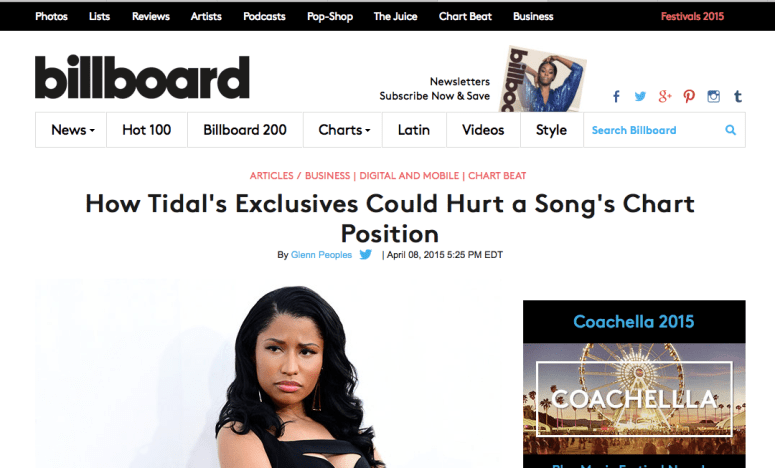
Today, in a very odd article, Glenn Peoples and Billboard warned artists that releasing content exclusively with the artist owned Tidal would hurt their showing on the Billboard/Neilson Hot 100 chart.   Peoples helpfully estimates just how much lower certain artists would rank on the Billboard Hot 100.  For instance he specifically calls out Beyonce on this point noting that her single “7/11” would fall 8 places from #44 to #52.   Given that Tidal’s relaunch was the brainchild of her husband Jay Z, this seems a little like throwing down the gauntlet.   Since when is Billboard in the artist warning business?  And why start warning artists in the run up to The Billboard Music Awards?  It all seems odd.

Unless of course Billboard and Nielsen somehow have a dog in the fight.  I mean shouldn’t Billboard charts be service neutral?  Why should the charts favor (as Billboard readily admits) one streaming service over another?  Why would “The Bible of the Music Business” make it harder for upstarts that want to challenge the incumbent and dominant market players in the streaming business? Why would Billboard use it’s bully pulpit to seemingly discourage use of a particular streaming service?

We’ve noticed a very strong tilt in Billboards reporting in the last few years away from artists and towards the streaming services.  It has gotten so bad that when this blog exposed Tim Westergren’s (Pandora) donations to an anti-gay politician that Billboard immediately performed damage control for Westergren.  But this is even more disturbing.  Billboard seems to be putting a thumb on the scale here, favoring Spotify and the incumbents over Tidal.

Now I’m just speculating here,  but is there some other reason that Billboard has come out so strongly in support of certain streaming services?  Is it possible that Billboard has developed financial relationships with these companies? And if they have, wouldn’t this make them complicit in anti-competitive behavior by the incumbent streaming services?  Seems to me that someone should look into this.

But what do I know? I’m just a dumb artist.


Apparently Billboard Doesn’t Want Jay Z at Billboard Music Awards, Pimps for Spotify! @S_C_

Why on earth is Glenn Peoples and Billboard warning artists not to go exclusive with Jay Z’s Tidal?   Is Billboard pimping for Spotify?    We’ve long suspected this. Glad it’s almost out in the open.

Screen Shot 2015-04-09 at 2.45.06 PM


The ‘Zero Effect’: Do New Consumption Charts Penalize Compilation Records and Artists Who Window?


New Math $.00666 : Billboard’s New “Consumption” Chart, Free Streams and the End Of Meaningful Metrics?


Copyright Royalty Board Filing Suggests that Pandora/Chris Harrison “Created Evidence” for Rate Court Proceedings

Sadly no one in the music business press seems to be paying attention to the Copyright Royalty Board filings. But we all should be watching this closely.   A couple days ago SoundExchange filed a letter with this bombshell in it:

“SoundExchange requested a specific email sent by Pandora executive Chris Harrison in December of 2013 in which Mr. Harrison highlighted the success of a strategy he implemented for DMX that involved entering into direct licenses in order to create evidence for a rate court proceeding. Evidence of a strategic motive underlying Pandora’s direct licensing would undermine the direct licenses Pandora has proffered as benchmarks. But Pandora has refused to produce the requested email and any other documents except for two. In light of their clear probative value to the key benchmarks Pandora has put at issue here, Pandora should produce all documents that constitute, comprise, memorialize, or analyze Mr. Harrison’s efforts on DMX’s behalf.”

full document here:

2015-04-07 Reply re Pandora [PUBLIC]

Created evidence?   That sounds a lot like “manufacturing evidence” to me.   If this is true,  Pandora at the behest of counsel Chris Harrison specifically cut this direct deal with MERLIN (the independent label consortium)  to “create evidence” for the rate court then this should be seriously investigated.  I’m not an expert but when I say investigate I mean law enforcement, The Judiciary Committee or at very least some bar association ethics panel.   If Harrison and Pandora are allowed to get away with this, it doesn’t just harm songwriters and artists, it harms the entire legal process.

(Also some of the labels represented by MERLIN need to start asking:  what it is that MERLIN/MERLIN executives got out of the Pandora deal? Who was banging on MERLIN’s door asking for a direct deal with Pandora?)

Meanwhile the DOJ (despite reports to the contrary) still have the anti-trust consent decrees pointed at songwriters rather than Pandora and Broadcasters.    What a world we live in.

Another Indie Label Sells Out Artists: This Time It’s My Own Euro Label Cooking Vinyl

It is with great sadness that I see Martin Goldschmidt of Cooking Vinyl resort to demagoguery in the debate about Spotify. Defending Spotify n the Wall Street Journal he says

““A lot of artists think the world owes them a living,” says Mr. Goldschmidt. “And it doesn’t.”

Sometimes all caps is necessary.

NO ARTIST IS DEMANDING A LIVING. THEY JUST WANT A FAIR DEAL FROM SPOTIFY AND STREAMING SERVICES. OR THE RIGHT TO OPT OUT. UNLIKE THE MEMBERS OF THE MERLIN INDIE LABEL ALLIANCE WE DIDN”T GET EQUITY IN SPOTIFY.

FURTHER SPOTIFY ISN”T ENTITLED TO A PROFIT. ESPECIALLY WHEN IT REQUIRES THE INVOLUNTARY EXPLOITATION OF ARTISTS SONGS.

http://www.wsj.com/articles/selling-songs-for-a-song-scrutinizing-the-streaming-model-1427468267?mod=WSJ_hp_RightTopStories

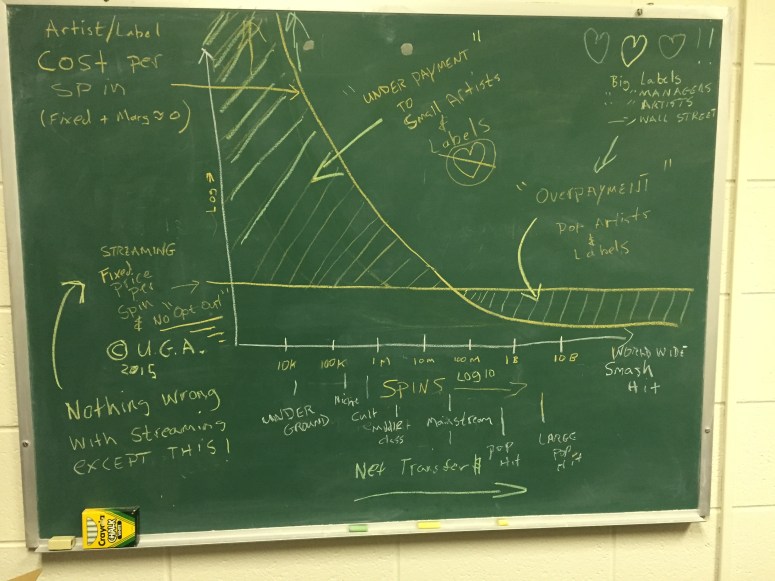
This Chart Explains What Is Wrong With Current Streaming Model (Sorry Generation tl;dr)

IMG_0361

(Sharky Laguna’s recent post on the problem with streaming got me thinking about the issue again. I decided to probe a little deeper into the matter at UGA this week.   This is still a work in progress but I think this goes a long way to explaining the internal conflict within the music business over streaming.)

Apologies in advance to “generation tl;dr”  there is not a simple explanation here.   This is the best I can do: In a free market specialty or niche products generally cost more than mass market products.  So for instance a semi-ironic american flag tank top from walmart can be sold for $9 and the manufacturer still makes money.  This is in part because the fixed costs can be spread over a large number of buyers.  Compare that to a  Rockmount Ranch Wear hand stitched western shirt.   It’s impossible for this maker to sell this shirt at $9 and stay in business.  Now if through a combination of government mandates and cartel price fixing all shirt makers were required to sell each of their shirts for $9 the Walmart american flag tank top would stay in business.  Rockmount Ranch Wear would go out of business.

I’m simplifying here but, on-demand streaming pays a more or less fixed rate to rightsholders per spin. For Spotify it’s around  $0.0049.  For YouTube (Content ID)  it’s on average less than $0.001 ( YouTube is a much bigger problem for artists than Spotify!!).   This fixed price per spin was the result of a combination of government mandates and cartel price fixing.

So what has happened?  I’m generalizing here, but niche market artists (and their labels), even middle class artists  have a difficult time recouping fixed costs of recording and are generally unhappy with this sort of deal (not all).    Meanwhile pop stars, their labels and managers are generally happy with this deal because it’s easier for them to recoup their fixed costs (but again not all).   Both groups of artists/labels and managers are acting rationally from their own perspectives.

But if you really look at my chart you see that something much more troubling is going on. Niche products should be more expensive, while mass produced products should be less expensive.   But here the reverse is true.  Because of the fixed price per spin, the most popular artists look like they are being overpaid.  While the the niche and middle class artists look like they are being underpaid.    So in effect this is a transfer of wealth from the niche and middle class artists/labels  to the biggest pop stars and their labels.

++++++ tl;dr stop reading here+++++++++++++++

Assumptions:

My curve is   Y= Average Fixed Cost Per Song ÷X

Y = fixed cost per spin.

How do I know what the average fixed cost per song is?   I don’t.  I was trained in abstract mathematics -and I realize this is gonna drive the applied math and engineers folks crazy- but you don’t really need to know that.

It doesn’t matter whether the average fixed cost per song is $500 or $50,000 dollars you are still gonna get the same shape in the curve.   You will still have the biggest artists being overpaid and the niche artists being underpaid.

Further because spins of songs appear to exhibit  non-guassian variation the “break even” point is still gonna be up towards the top tier of artists whether fixed costs are $500 or $50,000.   My “break even” point for this version of the chart was just subjectively chosen. Its where I thought the “pain” seemed to be kicking in.  Artists in the below 10 million spins seem to be complaining.  Artists above 100 million spins, not so much.


UPDATE 1

One side of the scale (X axis) is log scale compressed, because spins/sales exhibit wild variation and I couldn’t properly  draw the curve on the chalkboard.  Unless the chalk board was several miles (?) long.   This misrepresents the size of “overpayment” region.    But the “underpayment” region isn’t really represented properly either.   My intent is not to have you compare the “area” of these regions. Just that there is an aggregate underpayment to smaller artists and an aggregate overpayment to very popular artists.  If you look very very closely it says “log?” on the Y axis.  The Y axis is not supposed to be Log compressed, though i did make that note.  I’m not really sure it would make much difference either way since I’m asking the reader to NOT compare size of regions.  Not compressing the Y axis helps make the curve more “readable” but distorts the size of regions.   But I am open to suggestion on this.


UPDATE 2

Finally remember I am talking about the hypothetical average song and the average artist.  There clearly will be individual exceptions. Of particular importance is that many small artists some new, some  semi-professional, others hobbyists (no negative connotation implied) will happily offer their music for free, and the low per spin rate is not a problem.   New artists especially, have always given away their music for free. It’s a competitive advantage and a key part of any new artist marketing strategy.  I’m sure you can find any number of small artists that don’t feel underpaid and instead feel that streaming services offer them an opportunity to reach a mass market.  The odds are long for these artists as the consumer is faced with a tyranny of choice, but it is still a rational choice for many artists.  And I am all for artists choice.   What concerns me the most is that this streaming model seems to underpay the vast middle class of working artists that are really the backbone of the music industry.

Is the video below a glimpse of what the future looks like without this middle class of artists 🙂 ?

I welcome sensible and polite comments. I hope this provokes a conversation that leads to a better and more accurate model of this phenomenon  and eventually that leads to sensible solutions.

MERLIN Wizardry: Caldas Position on Free Streaming Makes Major Labels Look Benevolent

Look MERLIN the industry consortium that represents nominally “independent” labels is often held up as a spokesperson for the independent labels and artists.  You see this in the press all the time. First a comment from a major label spokesperson then a representative from MERLIN to give the “indie” viewpoint.   At the Trichordist we’ve long held the view that in  actuality MERLIN represents the interests of a tiny minority of “independents” that have some of the largest artists in the world. They DO NOT represent the interests of what most people would think of as “independent” labels.   The economics for those that produce mass market products (like pop hits)   is totally different than those that produce niche products (like progressive metal or indie rock). Yet time and time again we have seen MERLIN advocate for models and ideas that only work for the biggest players. Not independents.

Our suspicions were confirmed earlier this year when we saw MERLIN cut a payola- oops I mean “steering” deal with the famously anti-artist Pandora.   The history of payola clearly shows that it is a tool by which the entrenched players with substantial resources and market share keep the upstart independent players off of major media platforms.  We don’t see how this “steering” deal ends any differently.

Further MERLIN was so (there really is no other word to report the facts correctly) STUPID that they fell for a trick that Pandora’s Chris Harrison had previously used at DMX.   That trick was widely reported at the time. It’s jaw dropping that MERLIN was not aware it was being played. And exactly as we predicted Harrison took this “steering”deal a to the Copyright Royalty Board in an attempt to lower royalties for ALL labels.   Just as he did with the DMX deal. The pure incompetence of MERLIN regarding this deal should make independent labels reconsider their membership in MERLIN.

But this weekend at the  “Spotify House” at SXSW Caldas and MERLIN went further and made it abundantly clear where their loyalties lie.  Their loyalties lie with Spotify.   Caldas accused the major labels of having a “Napster moment” in regards to the free platform of Spotify.  While we are happy to see Caldas compare Spotify “free” to the original unlicensed Napster (because like the original Napster it pays jack shit to artists)  it seems a very very odd position for Caldas and MERLIN to take.  Why the hell does Caldas care that the major labels want to move away from the free tier and move it’s product to the premium tier?  Who the fuck is he working for?

If Caldas is right and the free tier is better for indie artists and the indie labels that he represents,  won’t the fact the major label product is behind a paywall help MERLIN labels?   Let them go dude!  Bigger audience for MERLIN labels.  But Caldas wants them to stay on the free platform?  Caldas position makes no sense. The only way this makes sense is if Caldas and MERLIN have some vested interest in Spotify.  Emotional, religious, ideological or otherwise, that is at odds with the interests of independent labels.   (BTW can’t wait for that Spotify IPO.  I bet there will be some artist attorneys interested in the who got stock.  Hell might even get an Eliot Spitzer type investigation.)

What’s really freaking bizarre about this whole episode, is within a few months we suddenly have the major labels taking a position against free streaming and letting artists opt out of the platform (despite their ownership stake in Spotify),meanwhile the leader of the consortium of independent labels angrily takes the opposite position.   What the hell is going on?

Tomorrow:  The math on why the current streaming model is a net transfer of wealth from small and middle class artists/labels to the big artists and labels.   


Charles Caldas (MERLIN) Praises Napster, Piracy and Promises to Reform His 1990s Rap Metal Band

Ha Ha. Okay Charles Caldas was never in a Rap Metal band.  As far as we know of anyway. So maybe this was all a joke. Maybe the Spotify house party was actually a 1999 theme party. It’s entirely possible he could have been in character and we got this out of context.   But we think not.  We didn’t see many folks dressed in black cargo shorts nor was their a tribute to Limp Bizkit on stage.

For all you independent labels who are “represented” by MERLIN  and don’t know what I’m talking about?  At the Spotify house party at SXSW Caldas  helpfully compared free Spotify to the original Napster.  He said:

“The major labels screwed Napster and screwed the market by killing what was potentially the biggest opportunity the industry could imagine in getting into the digital space early. If they follow through with this (moving Spotify from free to paid subscription), they are going to do it again”.

Yeah that’s right Chuck,  Napster which paid zero revenues to artists and songwriters was such a great “opportunity.”  Well that’s not fair, it was a great opportunity for the Multi-Billionaire Sean Parker.   Not so much for the little people.

Who’s side is MERLIN on?  Shouldn’t we independent artists and  labels be represented by someone who isn’t so obviously a fawning sycophant for Spotify?