Call to Action: Songwriters Submit Comments to the DOJ on the Consent Decrees Now.

The DOJ is reviewing the WWII era consent decrees that force songwriters under federal court supervision for supposed anti-competitive practices.  Yes the awesome power of the federal government is being used to protect multi-billion dollar companies like Clear Channel, Sirius, Pandora, YouTube/Google, Amazon and Spotify from hippy freak songwriters. Considering that many of these companies are effective monopolies it’s a stunning abuse of federal power on behalf of a few politically connected corporations.

The consent decree forces songwriters to allow these services to use our songs while a single appointed for life judge (song czar) sets our rate of compensation.   You may remember that I posted that my million spins on Pandora earned me less than $17?   I can’t even opt out of this service, how is that even fair?  That’s how this kind of outrage occurs.  This amounts to an government mandated subsidy from songwriters to some of the largest companies in the world.

If you are a songwriter, please submit comments.  The DOJ specifically would like to hear from you.  If you don’t’ understand the legalese just make a simple statement about how you feel about the compensation from these digital services that results from these consent decrees. Be passionate but polite.  Here are the instructions:

http://www.justice.gov/atr/cases/ascap-bmi-decree-review.html

Here are my comments. I took a constitutional approach. You don’t have to be as esoteric or as detailed. Simple heartfelt comments are just as important.


The Consent Decrees Violate Individual Rights.


I am an American songwriter, a member of BMI and a member of the bands Cracker and Camper van Beethoven. I’m submitting this comment on my own behalf in opposition to the ASCAP and BMI consent decrees. I believe these government actions essentially are a compulsory license outside of the Congress and take away songwriters’ rights to due process of law.


Just to be clear, I am not saying that Justice Department consent decrees in general are oppressive. I am saying that the way these particular consent decrees operate is oppressive to songwriters. That operation is oppressive because of the extremely long period of time they have been in effect, because they take away our valuable property rights to negotiate our own licenses, and they essentially force songwriters into being judged guilty before we’ve even expressed ourselves.


Why Songwriters Matter


Most discussions surrounding the consent decrees start with a striking fiction: The consent decrees only apply to BMI and ASCAP but not to individual songwriters. From a songwriter’s perspective, this is extraordinary sophistry.


As a practical matter, all American professional songwriters have to join one of ASCAP, BMI or SESAC in order to earn a living from their chosen craft. Sure, it’s possible that SESAC (which is not yet under one of the government’s consent decrees) might invite someone like me to join. But they are known to be more difficult to join than ASCAP or BMI.


The only certain choice for all songwriters is joining one of ASCAP or BMI. And that means that the vast majority of songwriters are subject to the consent decree from the time they write their first song. Unless something is done about it, they will remain subject to the rate court until they write their last song and even beyond the grave.

The DOJ has essentially created a single exchange within the federal courts that requires songwriters to join a regulated PRO in order to participate in the market.


So in practice as soon as an individual decides to take the tiniest steps towards being a professional songwriter they immediately fall under one of the two consent decrees and the jurisdiction of one judge in one court. Let’s dispense with the fiction that the consent decrees do not apply to songwriters and hence dispense with the fiction that it does not limit the rights of individuals—living, dead and yet to be born.


The Single Exchange Takes My Right to Negotiate


The government limits my ability to participate in a free market; it takes my property rights without due process or just compensation; it even limits my kind of speech (public performance of my songs) as I must participate in this process or effectively forgo compensation when I perform my songs in the public square.  I know that there’s always the theoretical possibility of a direct license outside of the consent decrees, but as a practical matter, I can tell you that is very rare because it is rarely offered.


I am not a lawyer or a constitutional scholar but I believe the consent decrees violate the American social contract for many reasons, not the least of which is that in practice songwriters are singled out for the government’s scrutiny before they have done anything except engage in speech and create songs. When you are on the receiving end, this feels like a kind of writ of attainder. Allow me to explain.


A) Typically when we limit the rights of individuals in the manner prescribed by the consent decrees one of three things must occur:


1) Legislative action by elected officials.

2) Judicial proceedings finding a particular individual (not a class of individuals similar to that individual) guilty of something.

3) The individual must consent to have his/her rights limited (usually to avoid judicial proceedings or because they participated in an election).


As an individual songwriter the consent decrees effectively compel me to submit to this process. At least the compulsory license in the Copyright Act is a legislative action by elected representatives and if I don’t like that rule I can work to get someone unelected. Under the consent decrees, generations of songwriters are powerless to stop the government from taking our rights without that legitimacy—for decades. I do not understand how the Department of Justice has the authority to force us to submit to this process.


B) As soon as an ASCAP writer creates their first song, the writer is forced into a court proceeding that was opened in 1941, seventy three years ago.   The BMI consent decree is from 1964, fifty years ago. Many songwriters who are subject to the consent decrees weren’t even born when the Department of Justice opened the cases.


Even if I accept the premise that I am guilty until I can prove to the government that I am not, and that my licensing decisions require review by a federal judge at great social expense, what possible justification can there be for my decisions today being subject to a case opened so long ago? This seems like some arbitrary federal assignment of “original sin” to a class of Americans. Does the federal government have a crystal ball? Can they see into the future? Can they read my thoughts? How do they know that every single member of this class is doing something wrong? How is that possibly Constitutional?


C) How many of the government’s court cases are “open” for 73 years or even 50 years? How is that not a violation of due process? Why am I and all future songwriters required to pay for whatever misdeeds that occurred decades ago?


D) I can’t emphasize enough that from my point of view as a songwriter, the consent decrees act as a kind of compulsory license by government edict. The government compels songwriters to allow music services to use our songs whether we like it or not. And unlike the Copyright Act, I can’t complain directly to rate court except at great expense. There is nobody to get unelected if we don’t like the rate court’s decision except very indirectly.


As Ari Emmanuel once said, “Fair is where we end up.” He would be wrong in the case of these consent decrees. In practice the consent decrees effectively substitute the opinion of a federal judge for that of a fair negotiation to set the rates at which those services compensate my fellow songwriters and me. After 73 years this has effectively become an unlegislated compulsory license. The consent decrees walk and talk like a compulsory license and after decades of practice they effectively are a compulsory license. At least with a compulsory mechanical license we know where we will end up on the rate.


E) Essentially the consent decrees take valuable rights to negotiate the exploitation of property from over 500,000 Americans simply because they write songs. And there is no end in sight. (Not to mention the foreign songwriters whose works get swept up and who can’t afford to complain to the WTO.)


F) If we must live under consent decrees, why must all the cases be heard before the same judge in New York City? Not only do the consent decrees unfairly impose the government on songwriters, they also force music services to make their case before a single judge in New York City—twice, once for ASCAP and again for BMI. This is a very expensive process that only the most well-heeled services can afford.


Why shouldn’t a service be able to bring their rate case in San Francisco, Los Angeles, Nashville, Austin, Athens—or any federal court?   Respectfully, are two federal judges in New York the only federal judges in the entire country capable of trying PRO cases? Surely that can’t be true.


I believe that the decrees have become a crutch on which those well-funded music services that can afford the litigation have come to depend. Instead of actually innovating and improving their revenues they use the rate courts as a perceived competitive advantage at great expense to their own shareholders, songwriters and, of course, the taxpayer.


There’s also a question of how many new entrants don’t come into the market at all because they are scared off by the expense of the rate court process and the uncertainty of litigation.


So not only have the operation of these consent decrees created a single market inside a federal court, I suggest that the consent decrees actually limit access to that market to the number of potential buyers who can afford the millions in legal fees required to participate. I think most songwriters would say that they want to license their works to innovators, and yet access to the rate court market is limited to the rich innovators as a practical matter.


Yes—in practice the consent decrees may well be anticompetitive.


Are the ASCAP and BMI Consent Decrees Unconstitutional?


I pose this question not because I’m a learned lawyer or constitutional scholar. I pose it because I can tell you that living under these consent decrees feels oppressive and I have found that when the government acts oppressively it is often acting outside of the Constitution.


This is not to say that the government should not pursue claims against songwriters if we actually do violate the antitrust laws. I’m not asking for a free pass. We should get the same treatment as Google, Microsoft or anyone else.   It’s also not to say that there wasn’t some justification for the consent decrees long ago.


But from this songwriter’s perspective, that time has passed. As James Madison wrote in Federalist 44, “[government] interference is but the first link of a long chain of repetitions, every subsequent interference being naturally produced by the effects of the preceding.” Respectfully, I suggest that Madison could have been describing the Kafka-esque rate courts.


David Lowery

Aug 1st 2014

Athens Georgia
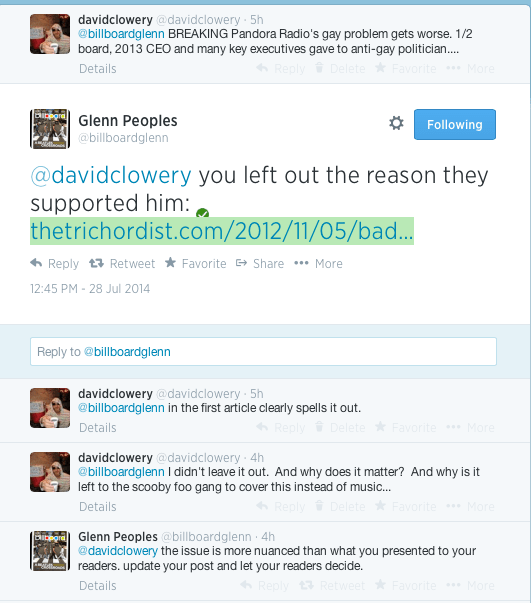


Why is Billboard Writer Defending Pandora Radio On Anti-Gay Politician Contributions?

glenn peoples billboard


You can see the whole conversation here. 

Why is Billboard writer defending Pandora Radio on Founder, CEO, 1/2 the Board and other top executives giving money to anti-gay politician Jason Chaffetz.  You know the guy that tried to nullify a bunch of same sex marriages in Washington DC?  I really don’t’ understand why the writer is “helping” me or Pandora Radio on this one.  The Billboard writer could easily go on record and explain the “nuances” of why Pandora apparently chose a well known anti-gay demagogue to sponsor their Orwellian named  Internet Radio Fairness Act. How does this soomehow this makes the $13,000 dollars they gave this politician ok.   And why is Billboard demanding that I soften this story?

Just saying…

UPDATE Pandora Radio’s Gay Marriage Problem Just Got Worse: CEO and 1/2 Board of directors also supported radical anti-gay politician


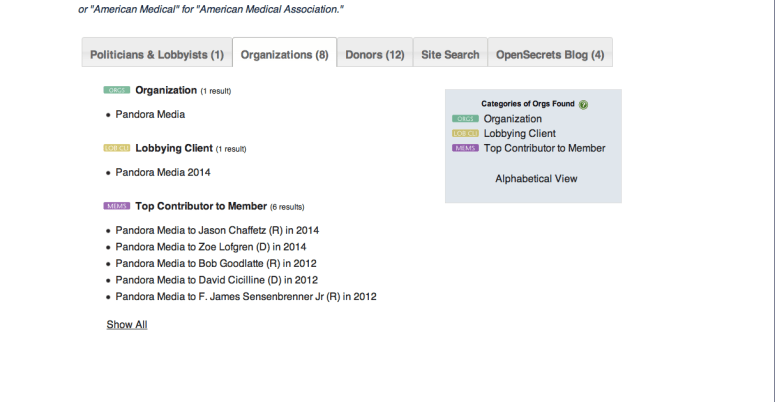
Looks like Pandora’s anti-gay marriage problem just got  much much bigger.  This is no longer just a Tim Westergren problem.  Looks like it’s a company wide problem. Pandora’s Founder, 2013 CEO and HALF the board of directors donated money to a radical anti-gay congressman from Utah,  Jason Chaffetz.

This looks bigger than the Mozilla scandal. Not just a single executive, this is five key executives and directors.


Screen Shot 2014-07-27 at 3.14.12 AM

These guys can’t claim they didn’t know this politician’s views as Chaffetz is quite famous for grand standing on this issue.  Among other things Chaffetz is the guy that sought to have the federal government step in and nullify the votes of citizens of Washington DC and have gay marriages banned in the city.  Essentially he wanted to un-marry same sex married couples in Washington DC.

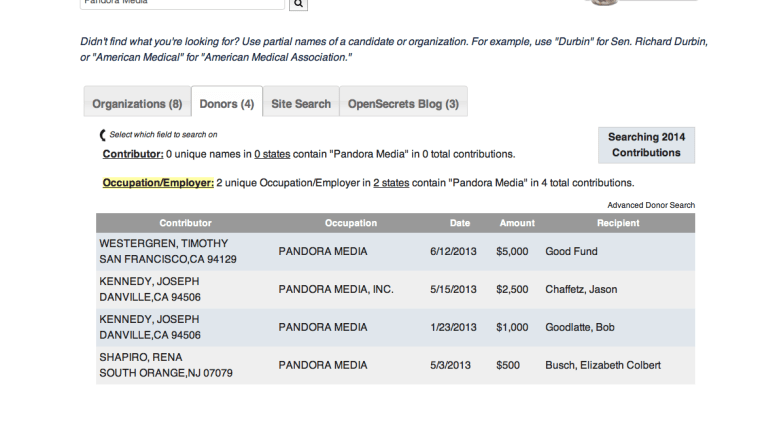
In 2013 CEO Joseph Kennedy donated money to Chaffetz (Kennedy has since stepped down).   Pandora board members Peter Gotcher, David Sze and Westergren also donated money to this demagogue. And tellingly Rena Shapiro Pandora’s political ad director donated to the anti-gay Chaffetz. I think with this many high level Pandora insiders donating money to this candidate it’s a reasonable question to ask whether the company has an anti-gay bias.

And this revelation could not come at a worse time for Pandora.   For Pandora has recently and very publicly embraced Rev Jesse Jacksons PUSH campaign to increase diversity in Silicon Valley. And diversity includes sexual orientation.  Silicon Valley’s brogrammers  are well known for their misogyny and homophobia.   The fact that McAndrews embraced Rev Jackson’s campaign so quickly and readily brings Hamlet  to mind.  The lady doth protest too much, methinks.  

As SF Bay View reported:

 CEO Brian McAndrews of Pandora said in his letter to Rev. Jackson, “Thank you for reaching out. We were excited to hear from you because we have been discussing our own path towards transparency and amplifying our efforts around building a more diverse workforce….. We hear your urge for data transparency . . .There is no doubt that knowledge leads to awareness, and to actions.”

Well Mr McAndrews? Here is my contribution to your quest for “transparency.”  The upper management of your company apparently supports a radical anti-gay politician.  What does that say about your attitude towards diversity?

Gentlemen we’d love to hear from you.  So would many of your listeners.

kennedy

Screen Shot 2014-07-27 at 3.22.20 AM


Screen Shot 2014-07-27 at 2.59.33 AM

Westergren Chaffetz

Pandora’s Tim Westergren Supports Radical Anti-Gay Politician Jason Chaffetz UT.

Tim Westergren David Shankbone 2010 NYC.jpg
Tim Westergren David Shankbone 2010 NYC” by David ShankboneOwn work. Licensed under CC BY 3.0 via Wikimedia Commons.

Forget Mozilla’s anti-gay CEO.  We have confirmed that Pandora’s Tim Westergren contributed  funds to radical anti-gay politician Jason Chaffetz  for his 2014 race.   This is the guy that among other things tried to legislate away Washington DC’s same sex marriages.

Wow.  I guess Pandora not only has no R E S P E C T for Aretha Franklin,  they must not think much of their gay subscribers and employees either!

You’d think that in the wake of the Mozilla scandal companies like Pandora would know better.

But first a little backstory cause this is not just simple homophobia or ignorance .  It’s a very nasty story of anti-gay demagoguery, political corruption, corporate skullduggery and pay-to-play politics.

Last year Pandora pushed the Orewellian-named Internet Radio Fairness Act.  The way that Pandora presented the bill was that it would level the playing field for internet broadcasters against those “bad” terrestrial broadcasters.  The problem with this characterization is that the bill did no such thing. It was a sharks belly stew of gifts for the broadcast industry.  Internet and Terrestrial. Why else would Clear Channel support a bill that would help internet radio “compete with it’s 840 terrestrial stations?  The real reason the internet radio AND terrestrial  broadcast industry supported this bill is that it would have used the awesome power of the federal government to mandate lower performer royalties by 80 percent!

Wow. I wish I could go to congress and have them mandate that my suppliers  charge me 80% less for everything they sell me.  But I digress.

Those of us outside Washington have come to expect this sort of pay-to-play nonsense from Washington, and so it’s not really a surprise that these politically connected firms could get this into a bill and then get it seriously considered by congress.

What was surprising is that Pandora was pushing a bill  sponsored by a well known anti-gay demagogue, Utah politician Jason Chaffetz.

Now we didn’t’ make a big deal about it before because it could have just as easily been the National Association of Broadcasters, Clear Channel any of the other ethics impaired corporations that had a relationship with this politician.  Surely the “progressive” leaders of an internet radio station based in Oakland a city that Rev. Jesse Jackson recently called the “rainbow city”  would never support an anti-gay politician!

Think again.

Below is a screenshot from opensecrets.org clearly indicating that Tim Westergren founder and spokesperson for Pandora personally gave money to this anti-gay demagogue. Apparently a thank you for sponsoring the bill Westergren pushed so strongly.  That is Westergren personally supports this anti-gay demagogue.


Westergren Chaffetz


Now remember this  is for this upcoming 2014 election.This is not a long time ago. This is long after Chaffetz’s  various anti-gay outbursts were known.  This is after Chaffetz famously sought to overturn the will of the voters in Washington DC, essentially nullify their votes and institute a federally mandated ban on gay marriage in Washington DC.   That’s right Chaffetz wanted to impose his religious (?) views on 650 thousand citizens of a city 2000 miles from his home district in Utah. Imagine if you were a same sex couple in DC, and you had your marriage nullified because a Utah politician wanted to grandstand for voters back home?

Tim Westergren had to know what this guy stood for and yet he personally donated money to him.

This revelation could not come at a worse time for Pandora.   For Pandora has recently and very publicly embraced Rev Jesse Jacksons PUSH campaign to increase diversity in Silicon Valley. Diversity includes sexual orientation as well fellas.   Silicon Valley’s embarrassingly misogynistic and homophobic brogrammers have started to become a liability for these companies. Notably Pandora embraced the effort so quickly and readily that Hamlet comes to mind.  The lady doth protest too much, methinks. 

As SF Bay View reported:

 CEO Brian McAndrews of Pandora said in his letter to Rev. Jackson, “Thank you for reaching out. We were excited to hear from you because we have been discussing our own path towards transparency and amplifying our efforts around building a more diverse workforce….. We hear your urge for data transparency . . .There is no doubt that knowledge leads to awareness, and to actions.”

Well Mr McAndrews, here is my contribution to your quest for “transparency.”  Your companies founder apparently supports radical anti-gay politicians.  What does that say about your attitude towards diversity?


Chris Harrison: Please Explain Why Pandora Has No Respect For Aretha Franklin?

christopher-harrison

Songwriter Enemy #1 is also Performer Enemy #1?


Hello Chris:

Now I’m not 100% positive that you were the person at Pandora that made the decision not to pay royalties on pre-1972 master recordings, but given your history of screwing songwriters (multiple lawsuits, ASCAP, BMI, DMX legal trickery etc etc) it seems like the requisite set of skills required to repeatedly screw songwriters is the same set of skills required to screw performers.  So it seems likely it was you. But if in fact you weren’t in charge of this moral outrage I’m sure you were at the meeting. After all looks like you are in charge of Pandora’s legal team that will be defending this decision. And who better to explain this to the public. You seem eloquent.  You wrote this persuasive article for The Hill where you nearly had lawmakers and investors convinced you had actually purchased a terrestrial radio station (minus the actual broadcast license oops!).

So give it a shot.  What could possibly be Pandora’s moral and ethical rationale for not paying these performers while other internet radio stations and streaming services appear to pay these performers?  Please explain it to us. Why doesn’t Pandora R E S P E C T Aretha Franklin?

I Can Prove Songwriters Abused by Unscrupulous Webcasters. So Why Are Songwriters under DOJ Supervision?

We’ve heard a lot of misleading rhetoric by blowhard broadcasting/webcasting lobbyists on Capitol Hill.  Songwriters are somehow a threat to these multi-billion dollar corporations and so songwriters must be kept in the yoke of the DOJ consent decree.

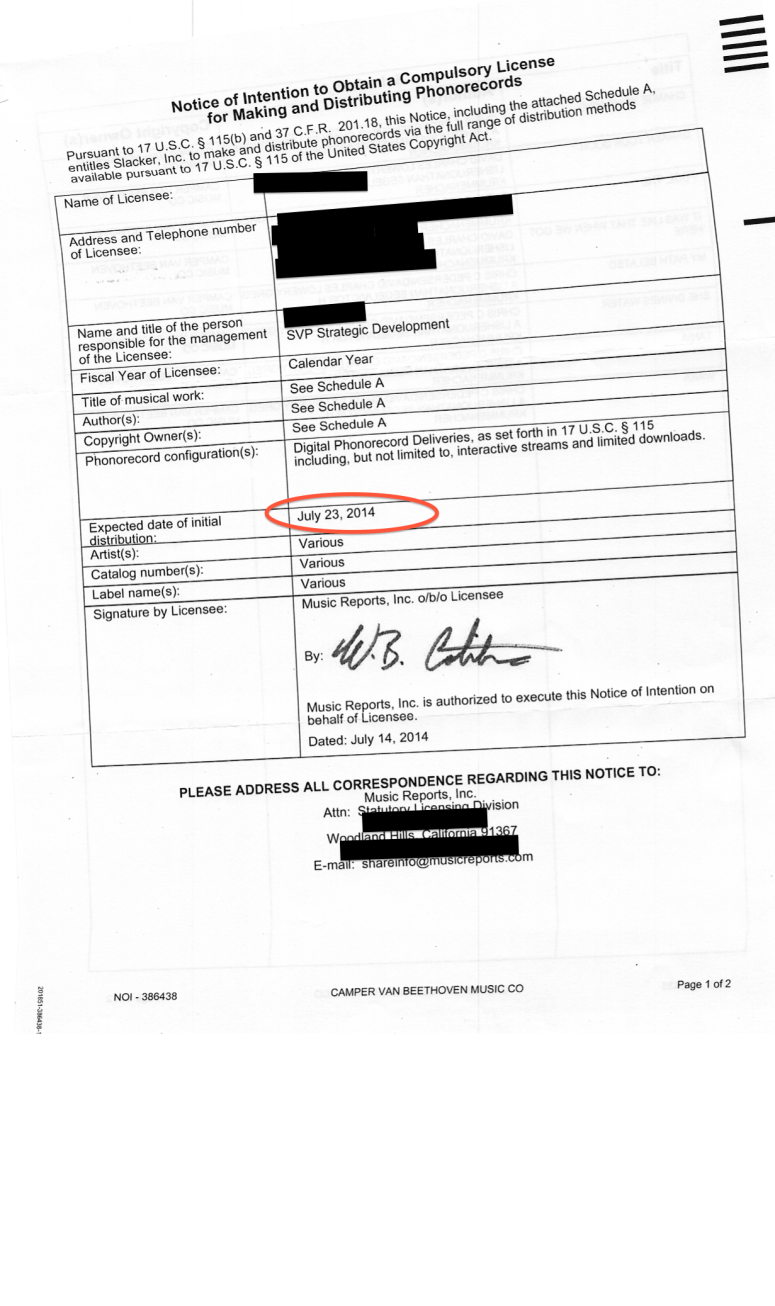
Now let me give you some cold hard facts. Below is an actual example of the webcasters violating the terms under which they may receive a compulsory license.   This is a  “Notice of Intention” that they are legally required to file before playing one of my songs. It is outrageously deficient. Therefore they are illegally playing my music.

But this is not just an isolated example.  I have dozens of these NOI’s and  90% of them appear deficient as they are notices of intent to distribute songs that have been made available for years. I have spoken to many other music publishers and songwriters. All of them agree that the majority of the NOI’s they receive are deficient.  Usually because they are sent after the music service uses the songs.  This appears to be mass copyright infringement.  Mass copyright infringement is a RICO predicate. So why the hell am I the one under DOJ supervision?

Virtually all the digital media companies (except Apple) do it this way. I’m telling you, these people make Morris Levy look downright honest.

So why am I forced by the DOJ to let these mass infringers use my songs?  Why does the federal government force me into a contract but then does not allow me to audit these companies. That’s right the federally proscribed compulsory license does not allow for an audit.  I’m supposed to take these companies at their word. Companies that I can demonstrate are lying?

Yet industry groups representing these abusive web casters held a semi-secret “hearing” on Capitol Hill to urge Congress and the DOJ to not only keep songwriters under the consent decree but expand it!!  This is essentially the bad guys running a protection racket with the DOJ as their muscle.

That’s why I protested this panel and gave the actual shirts off the backs of three songwriters to these lying and theft-enabling lobbyists.

https://thetrichordist.com/2014/07/21/why-i-gave-the-national-association-of-broadcasters-dima-and-ccia-the-shirt-off-my-back-during-congressional-panel/

This is songwriters “I’m as mad as hell and I’m not gonna take it anymore” moment.  Let the DOJ know that you aren’t gonna take it anymore.   They’ve asked for comments.   Click here for instructions.


++++++++++++++++++++++++++++++++++++++++++++++++++++++++

Let me explain specifically how this notice is deficient and therefore invalid. I also intend to send a more detailed report to DOJ.

First this notice was mailed on July 14th.  So I received this notice before the listed date of distribution (July 23rd).   So on  July 22nd I checked to see if these songs were available on this service.  They were.  I even played the two newest.   The other songs were released in the late 1980s. These songs were from a major label album that has long been available on this service.  Yet they are only now getting around to sending the “Notice of Intention” to distribute these songs?

Finally since the service is exercising the compulsory license they are required to send me accounting statements monthly.  Where are my statements?  That’s another violation of the law!

Again it’s the webcasters that need DOJ supervision not Songwriters.  I have dozens of these notices.

MRI bad NOI  redacted 2


MRI bad NOI  redacted 1


The Revolution Will Be Webcast But Gil Scott Heron’s Estate Will Not Be Paid for Use of Recording.

Pandora has stopped paying performers who recorded before 1972. A bizarre interpretation of copyright law by Pandora, Sirius and Clear Channel has led these companies to seemingly collude and simultaneously stop paying artists on all pre-1972 sound recordings.  We suspect this is likely the work of Artist Enemy #1 Chris Harrison of Pandora.  That means the Estate  of Gil Scott Heron will not be paid  performer royalties for Pandora’s commercial exploitation of this song. It should be noted that as much as we criticize Spotify they at least ask permission and then pay for the right to use this song. Pandora does neither.


Contact Pandora and ask them why they have stopped paying artists like Gil Scot Heron on Pre-1972 recordings.

You can find their main office phone number and other contact info on this page:

http://www.pandora.com/contact


Did Pandora’s Chris Harrison Intentionally Mislead Congress and Investors When He Claimed Pandora Purchased Radio Station?

christopher-harrison

Pandora’s Publicity Stunt: Pandora bought  South Dakota terrestrial radio station minus the broadcast license.

Back in June of 2013 Pandoras Associate Chief Counsel Chris Harrison (Songwriter Enemy #1) wrote an article for The Hill that implied that Pandora had purchased a radio station in South Dakota. The idea was that they were somehow now equivalent to Clear Channel and deserved the same percentage of revenue deal for sound recordings that Clear Channel receives.  Never mind that much of Clear Channel’s content IS NOT MUSIC and terrestrial broadcast has enormous capital costs so percentages of revenues are not comparable.  THE REAL PROBLEM and why this is misleading is that Pandora did not own the broadcast license of this station.   Transfer of this license requires FCC approval and as far as we can tell it appears Pandora had not even filed for transfer of this license at the time of this announcement (we could be wrong but we can’t find evidence, glad to correct if we are wrong).  Do you really own a radio station without a broadcast license? It’s not really clear what it is that Pandora actually purchased.

A year later this broadcast license is not in the hands of Pandora. And indeed the foxes in the henhouse over at the  FCC (much to our surprise) rejected Pandora’s license.  There is a rule that a company must demonstrate it has less than 25% foreign ownership to own a radio station broadcast license and Pandora could not demonstrate this. However silly this rule may be, it’s still a rule, and Chris Harrison as an attorney with long experience in radio surely knew this.  Right?  So shouldn’t Congress and the SEC ask Pandora and Harrison if they intentionally misled Congress and investors?

Maybe they didn’t mislead investors and they really didn’t understand the requirements for purchasing a broadcast license.  But this implies that the top legal staff of Pandora is incompetent.  What does that say to investors?


Why I gave the National Association of Broadcasters, DiMA and CCIA the Shirt off my Back during Congressional Panel

Screen Shot 2014-07-21 at 5.51.41 PM

Screen Shot 2014-07-20 at 3.23.11 PM

Diverse group of Washington DC lobbyists.


The major webcasters and broadcasters decided to convene a nearly secret last minute congressional panel to urge Congress and the DOJ to keep in place the 73 year old “temporary” consent decree that forces songwriters to let companies like Clear Channel, YouTube, Sirius, Pandora, Amazon and Spotify use our songs without any negotiation whatsoever.  The consent decree also empowers a single appointed-for-life federal judge to arbitrarily decide what a “reasonable” rate  is for songwriters.   In effect we have been forced by federal courts to provide  subsidy to corporations that have a combined market cap of more than a trillion dollars.

As I demonstrated in this an earlier post  as a songwriter I received less than $17 dollars from Pandora for over a million spins of my song Low. 

https://thetrichordist.com/2013/06/24/my-song-got-played-on-pandora-1-million-times-and-all-i-got-was-16-89-less-than-what-i-make-from-a-single-t-shirt-sale/

How is this a “Reasonable” rate?

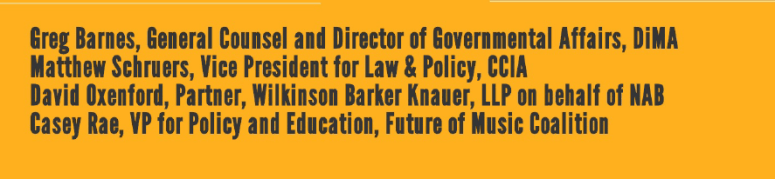
The panel was hosted by Greg Barnes of DiMA.  Other panelists included David Oxenford National Association of Broadcasters and  Mathew Schruers from the  CCIA.   The companies represented by these lobbying outfits (Amazon, Clear Channel, YouTube/Google, Spotify, Pandora, Microsoft, Yahoo have a combined market cap of over a trillion dollars.  YET THERE WAS NOT A SINGLE REPRESENTATIVE OF SONGWRITERS ON THE PANEL.   This is particularly appalling considering that songwriters are the ones living and working under the consent decree.

I had prepared a short set of comments detailing my experience as a songwriter, especially the financial  effects of the consent decree on my digital royalties.    I parked myself in the second row and waited for the moderator Greg Barnes to start taking questions from the audience.  Mine was the first hand up and Barnes indicated that he would call on me but first he wanted one more comment from Oxenford.  It was during Oxenford’s comment that I noticed the lobbyist (?) seated directly in front of me pulled out her smartphone and started frantically texting something.  Curious I leaned forward and could clearly read my name and then the  phrase “watch out”.   Funny stuff.  I wanted to say “Hey dumbass, I’m sitting right behind you.” But I resisted.

Curiously it was immediately after this that Barnes suddenly announced that they would only be taking comments from “Staff” members and I would have to wait “til the vey end and time permitting only.”  He then proceeded to call upon a college student from GW.

SERIOUSLY? The Digital Media Association is in the business of selling songwriters music but their chief DC lobbyist is afraid of having a songwriter speak.  Spineless coward.  If that’s not clear, Yes, Greg Barnes, I am calling you a spineless coward. And I’m standing by it.

When the college student finished his comments I raised my hand again.  Once again Barnes told me that they were only taking questions from staffers despite the fact he had just demonstrated that they were in fact taking questions from anyone.

This went on for a while and I realize that Barnes clearly intended to not let me ask a question.  For amusement I started to stare down the not-quite-slimey representative of the National Association of Broadcasters.  He suddenly found something in his lap extremely interesting and wouldn’t look up.  If I was absolutely certain that he was not suddenly transfixed by the unexpected appearance of  a colony of miniature unicorns dancing on his lap I’d call him a spineless coward as well.  But as I actually couldn’t see his lap, I can’t rule out the possibility of miniature unicorns, and so for now I’ll give him a pass.

The night before this event I had been warned that it was likely that I would be blocked from asking any questions or making any comments.  Considering the fact I was gonna have to get up at 5:45 am to make it to the panel I wasn’t really in the mood to go to all this effort for nothing.  I had to have a plan B.

A few days before a songwriter friend remarked that the current licensing system for songs and digital services was so fucked up that songwriters really had nothing left to lose except “the shirts off our backs.”    I remembered this.  I went across the street to the local grocery store bought some gift bags and wrapping paper and proceeded to gift wrap  three shirts that had been worn by me and my bandmates  as “gifts” for the  NAB, CCIA and DiMA.  I figured that at the very least I could present them with the shirts off our backs and eke out a photo op.

Of course it didn’t go that way.   Clearly Barnes was terrified of having an actual songwriter air a viewpoint that was contrary to the party line.   When he asked for questions again,  I asked that as the only person in the room forced against their will to live and work under the consent decree I be allowed to speak.  He refused.

So shit, I did what I had to do. I marched up to the panelists and presented each of them with a gift wrapped “shirt off of a songwriters back”.    They looked like they were gonna pee their pants.  It was priceless.

“I got less than $17 dollars for a million spins on Pandora, that’s your consent decree at work.”   I told the room and walked out.

The whole thing was so fucking stupid on the broadcasters/webcasters’ part.  If they’d just let me speak they could have spent the final 15 minutes to counter my questions and statements with measured doses of non-sensical legalese and mock concern for the plight of the independent songwriters.    But by acting like spineless cowards they totally screwed themselves.  Just goes to show that if you  put on a “Show trial?” you very well may end up with a show you didn’t expect.

Welcome to Washington gentlemen.

For those of you keeping score it’s now

Scooby Doo Gang 2

Broadcasters 0


Why Some Mangers and Agents Love Streaming and Piracy.

Seems like every six months or so I have friends  forward me an article or interview with a manager or agent extolling the virtues of streaming (and sometimes even piracy.)  Usually this comes with some note that reads something like this “Agent/Manager  X thinks streaming/piracy is a good thing, Why don’t you?”  I am always  perplexed by this.   Of course some managers and agents love streaming and piracy! Less revenue from recorded music means their artists must play more and more live shows to make up the difference.  I thought everyone knew this.

You see managers and agents make virtually all their money from an artist’s live performance not from the artist’s recorded music.    However screwed up it might seem from an artist’s perspective it makes perfect financial sense (at least in the short term) for managers and agents to turn a blind eye to piracy and low payouts for streaming. Precisely because  it seems to result in more touring.  You can’t really blame them for this can you?

I teach a class on the finance and economics of the music business at the  University of Georgia.  I usually spend at least one lecture on the differing financial incentives for artists, managers and agents, and in particular how managers and agents are often incentivized to work against the artists long term interest.  Let me try to summarize that lecture here.  Especially how it relates to streaming and piracy.

First , have artists resorted to playing more shows to make up for declining revenues from their recordings?   In my case? Yes, absolutely. So have virtually all my friends.   There are plenty of  anecdotal stories of artists touring into their old age because recorded music royalties have dropped off.  Levon Helm of The Band is one tragic case and here’s Robert Hunter from The Grateful Dead spelling it out clearly.    But you don’t have to rely on anecdotal data as it is clearly reflected in the records kept by companies like Pollstar.  It depends on how you interpret the data but even the most conservative reading suggests there has been a 200%  rise in the number of shows since the advent of Napster.  Now this would all be great news except that average attendance has fallen and any gains in revenue appear to have gone to the top 1% of acts.

So why is this good news for managers and agents but not artists?   You have to consider the order in which people are compensated.   Managers and agents are paid first and off the top before expenses.  Artists are paid last and after expenses. Let me explain.

Agents.

An agent’s only source of revenue is commissions on live performance.  So if artists play more shows this is generally good for agents.  But dig a little deeper. Specifically agents usually receive 10% of gross.   Not net, but gross.  You get what that means, right?  Whether the artist makes a profit or loss on the show the agents commission comes off the top.  The agent always gets paid.

Example: a baby band gets a $500 club show but it costs them $465 dollars, in hotels, gas, rental vehicle, meals etc.   The agent still get’s his/her 50 bucks.   Off the top. Before expenses.  So the band would actually lose $15 dollars on that show.

A more subtle example is to examine what happens when a  band that normally plays 75 shows a year  suddenly starts playing 150 shows a year to make up for lost recording revenue. My wife is a concert promoter and books hundreds of shows every  year.  We see this situation all the time.  We are very familiar with what happens.    In order to accomplish this an artist may needs to play smaller rooms;  go into smaller markets and overplay and hence saturate some major markets.  The artists annual gross for live shows will not double as the result of playing twice as many shows. If the band is lucky they will see a rise in revenue of around 50%.   But unfortunately for the band, expenses may come close to doubling! As a result the artist usually only sees a small increase in their income since they get paid after expenses.  In some cases I’ve seen artists actually earn less by doing more shows!  I think this was the case for my band  in 2007! Regardless the 50% rise in gross revenues never turns into 50% rise in income to the artist.  But the agent DOES see a 50% increase in income.   As a result the agent has a much bigger financial incentive to see an artist play more shows even if the artists doesn’t see a substantial increase in income.

Managers.

Unlike agents, a manager typically does make money from recorded music revenue.  So you would think a manager might be more concerned about piracy and low payouts from streaming services.   But as it turns out managers make such a small percentage from recorded music revenues when compared to live revenues their financial incentives are no different than agents.   Also it turns out that certain managers are investors in Spotify. Again let me lay it out for you.

Like agents, managers are paid a gross percentage on their artists live revenues.  Typically a manager will get between 15%-20% of gross from concerts.  But it is customary that a manager take their cut of all other income after all expenses have been deducted,  i.e. they get paid when the artist (finally) gets paid.

So for instance if a band receives a recording advance of $70,000 and the band spends $50,000 recording the album, the manager only gets 20% of $20,000 not $70,000!

Similarly an artist is typically compensated for recorded music with an “Artist Royalty” of 10-20% of the wholesale price of a download, “stream”  or CD.  So a manager’s 15-20% of that means a manager only  nets 1.5%-4% of recorded music revenue.  And these royalties are only payable  after the artist has recouped it’s recording and promotion costs.  So in practice a manager receives very little money from these sources.

Finally a time-tested way for a manager to generate additional revenue is to get the label to pay for “tour support” and send the artist out on an otherwise unprofitable tour.  Stick with me  on this one cause this is brilliant scam.

Let’s say band X is planning a  tour and they have gross guarantees of $50,000 dollars but they have $60,000 in expenses.   The band would normally cancel this tour and the manager would get nothing.  Instead the manager requests 10k in tour support from the record label.   The record label hoping to generate sales agrees. The band then goes out on a break even tour but the manager still  pockets 20% of $50,000 which is $10,000.   Now where does that $10,000 in tour support really come from?  Does it really come from the label?  No.   It’s almost always configured as an advance against the artist’s royalties.   So in effect the manager has traded  20% cut of $10,000 in future artist royalties for 20% cut of $50,000 in live revenues.   The manager turned $2,000 potential commission into $10,000 actual bird-in-the-hand commission.

There are a zillion of these clever tricks that managers have dreamed up over the years, but that’s not really the point of this post.  The point is that managers and agents don’t really make anything off of recorded music revenues at least when you compare it to the amount they make off of live concerts.  Managers and agents have never really cared about revenue from recorded music and they have even less incentive to care about it now that streaming has obliterated what little revenue there was.

So managers and agents are free to say whatever they want about streaming and piracy.  But just remember  what’s good for managers and agents is not necessarily what is good for artists.  Keep that in mind next time you see an agent or manager extoll the “virtues” of streaming or piracy.   Heck some managers even own pieces of these low paying streaming services or worse unlicensed services that pay nothing to artists. No wonder they love  streaming and piracy.