Updated! Streaming Price Bible w/ 2016 Rates : Spotify, Apple Music, YouTube, Tidal, Amazon, Pandora, Etc.

The last time we did this was back in 2014, so we thought it was time for an update. Not a lot of surprises but as we predicted when streaming numbers grow, the per stream rate will drop. This data set is isolated to the calendar year 2016 and represents an indie label with an approximately 150 album catalog generating over 115m streams. That’s a pretty good sample size. All rates are gross before distribution fees.

Spotify was paying .00521 back in 2014, two years later the aggregate net average per play has dropped to .00437 a reduction of 16%.

YouTube now has their licensed, subscription service (formerly YouTube Red?) represented in these numbers as opposed to the Artist Channel and Content ID numbers we used last time. Just looking at the new YouTube subscription service numbers isolated here, they generate over 21% of all licensed audio streams, but less than 4% of revenue! By comparison Apple Music generates 7% of all streams and 13% of revenue.

Speaking of Apple, they sit in the sweet spot generating the second largest amount of streaming revenue with a per stream rate .00735, nearly double what Spotify is paying. But, Spotify has a near monopoly on streaming market share dominating 63% of all streams and 69% of all streaming revenue. The top 10 streamers account for 99% of all streaming revenue.

streamrevenuemkrtshr2016

To put this list in the context of our 2014 numbers we’re adding the chart below with the data sorted by the quantity of streaming plays required to match the revenue of a single song or album download. This is important as we work towards defining and setting a fair per stream rate and also setting an accurate economic equivalent of streams to songs and albums for the purposes of charting.

Billboard currently calculates 1,500 streams to one album for the purposes of charting, which at current streaming rates actually matches an economic equivalent. However, that is most likely a highly excessive numbers of plays to achieve that economic equivalent. But, more on that later…

Keep in mind every streaming service has a key piece of data that would allow artists and labels to set a fair per stream rate. Every on demand streaming service, Apple, Spotify, Tidal, Google Play all know how many times a song is played (per person) on average over time. This is the data that is key to setting fair streaming rates. Who will share this information? Apple, Jimmy Iovine, we’re looking at you.

streamspersong2016

  • HOW WE CALCULATED THE STREAMS PER SONG / ALBUM RATE:
  • As streaming services only pay master royalties (to labels) and not publishing, the publishing has to be deducted from the master share to arrive at the comparable cost per song/album.
  • $.99 Song is $.70 wholesale after 30% fee. Deduct 1 full stat mechanical at $.091 = $.609 per song.
  • Multiply the above by 10x’s and you get the album equivalent of $6.09 per album
[EDITORS NOTE: All of the data above is aggregated. In all cases the total amount of revenue is divided by the total number of the streams per service  (ex: $5,210 / 1,000,000 = .00521 per stream). In cases where there are multiple tiers and pricing structures (like Spotify), these are all summed together and divided to create an averaged, single rate per play.]

[royalties][streaming royalties][music royalties][royalty rates]

.

.

Windowing Works! 9 of the Top 13 UK Albums NOT on Spotify…

Windowing isn’t just for Adele and Taylor Swift anymore, Music Business Worldwide reports the following:

Four of the Top 5 current UK midweek albums aren’t on Spotify – and are, streaming wise, particularly fragmented.

A quick scan down the rankings, sent to labels today, shows that the same fact applies to five of the Top 6, six of the Top 10 and nine of the Top 13.

We started suggesting that windowing was one of several viable solutions to combat the negatives effects of streaming music ubiquity as early as 2013 when we stated “Why Spotify Is Not Netflix, But Maybe It Should Be“.

We were told we were “out of touch”, “luddites” and we “didn’t understand the new digital economy.” But we persisted on this point with additional writing in 2014, “How To Fix Music Streaming In One Word, Windows“.

Again, many resisted what is just common sense. The record industry always had utilized windows (or windowing as some prefer), but it just looked a little different than the way the film business did it. But it was there, and it always had been there.

In a December 2015 post we got more specific, suggesting that record labels experiment with more disruption and innovation following Taylor Swift and Adele successfully windowing off of Spotify during the initial release window of their latest releases. We wrote, “Three Simple Steps To Fix The Record Business in 2016… Windows, Windows, Windows…“.

In that post we included this:

This is not a philosophical discussion. This is financial reality. Respected stock analyst Robert Tullo who is the Director Of Research at Albert Fried & Company says this:

Longer term IP Radio and Spotify are good annuity revenue streams and great promotional tools. However, we believe the system works better for everyone when artists have the right to distribute their Intellectual property how they see fit.

Ultimately we think windows for content will form around titles that look much like the Movie Windows and that will be great for investors and the industry as soon as all these so called experts get out of the way and spot trading fashionable digital dimes for real growth and earnings.

So here we are in the spring of 2016. As simple math and economic reality effects more artists, managers and labels first hand the truth becomes self evident.

YouTube is the next windowing battle to a restoring a healthy economic ecosystem for artists. You can’t window if you can’t keep your work off of YouTube. That’s not YouTube, that’s YouLose…

Guest Post by @schneidermaria: Open Letter to YouTube, “Pushers” of Piracy

A must read. YouTube from an independent artist’s perspective.

Music Technology Policy

[We’re pleased to post this open letter to YouTube written by Maria Schneider, a five-time GRAMMY-winning composer and bandleader, a board member of the Council of Music Creators, and an active supporter of MusicAnswers.org.]

Open Letter to YouTube, “Pushers” of Piracy

by Maria Schneider 

Hank Green’s recent open letter in support of YouTube (that was in response to Irving Azoff’s open and scathing letter against YouTube) deserves a strong response from musicians and other creators.   I appreciate YouTube’s illegal business model might yield a few anecdotal success stories like Mr. Green’s and his videos of opening beer bottles with antlers, but for the vast majority of the artistic community, including me, and every musician I know (and I know thousands), YouTube is a resounding disaster.

MariaSchneider_GregHelgeson Maria Schneider in rehearsal

There’s no use in beating around the bush, so I’m going to cut to the chase…

View original post 3,429 more words

Fight For The Future Of Corporate Astroturf Ripping Off Creators!

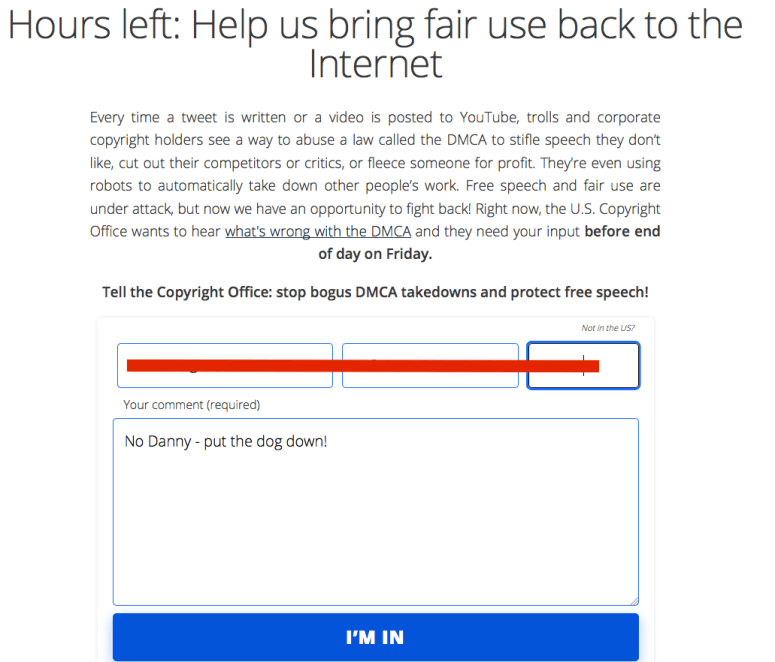
Musicians, know who your friends are and are not. Here is another example of big tech money, corporate astroturf, attempting to remove your rights. In the last hours of the submissions to the Copyright Office for comments on the DMCA a webform was introduced.

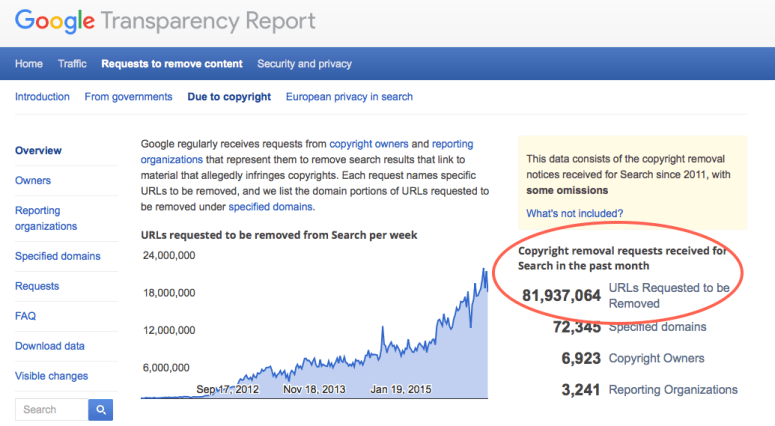
Note the fear-inducing reference to “robots”–“robots” must refer to the tools that Google itself gives to big companies to automate sending DMCA notices to Google for infringing links.  So by definition, “corporations” use Google’s own “robots” at Google’s request.  80 million infringing links this month alone!  (And remember, the Google “transparency report” does not include DMCA notices sent to YouTube, Blogger or any other Google property, it just covers Google search.)  EEP! ROBOTS!  DON’T BREAK THE INTERNET!

Google DMCA 3-31-16

This letter is exceptionally misleading because Google doesn’t allow independent artists to use these tools.  That means even the handful of artists who can monitor Google search 24/7 have to send manual notices.  So what the astroturf group is really complaining about is that EVERYONE should have to send notices manually which would increase the amount of time that Google has to profit from links to infringing content by data profiling or advertising sold on pirate sites.

This webform did not even verify if those sending the automated letter to the US Copyright Office were actually US Residents or machines…or made an intelligible comment on the questions the Copyright Office asked for public comment.  So, we had some fun with it, see bel0w.

David Newhoff at The Illusion Of More has an excellent piece looking much deeper at how these corporations and their funded organizations are working aggressively to take away the protections granted to individual creators in copyright.

Read it here, at the link below.

Astroturf Organizations Typically Hysterical on DMCA | The Illusion Of More


fightforthefuture....png

The Truth About Vinyl And Streaming – And It Is Not Pretty…

More talk about vinyl and streaming, here’s more clarity…

The Trichordist

vinylcu

There’s a romanticism about vinyl, and we share that enthusiasm of the format for obvious reasons. However it should be noted that the romanticism that surrounds vinyl, is largely that- romanticism. Below we’ve assembled a number of recent editorials and reports about the state of vinyl production to shed some light and much needed perspective on this subject.

There several important take-a-ways from our friends who are on the front lines of vinyl production that are also noted in the reports below.

1) Vinyl revenues are grossing more than free streaming receivables. This sounds impressive at first but said another way it means that free streaming is just not generating a lot of revenue in the aggregate of the total business (not a surprise, free streaming is a big problem).

Second, and more sadly is the fact that vinyl production is very expensive and miscalculations on selecting a title or…

View original post 904 more words

If Streaming Is The Solution To Piracy, Why Is Piracy Still Increasing?

Music Business Worldwide is reporting that “GLOBAL MUSIC PIRACY DOWNLOADS GREW BY ALMOST A FIFTH IN 2015″.

The amount of music downloaded on illegal piracy sites grew by 16.5% in the second half of 2015 compared to the year’s opening six months.

That’s according to leading content protection and market analytics company MUSO, which tracked web activity on 576 sites which were ‘wholly dedicated to music piracy or contained significant music content’.

Across these sites, MUSO analysed over 2 billion visitor traffic hits globally.

READ THE FULL STORY AT MUSIC BUSINESS WORLDWIDE:
http://www.musicbusinessworldwide.com/global-music-piracy-downloads-grew-by-almost-a-fifth-in-2015/

Netflix Is The Model for Spotify, Watch And Learn…

Ahem… we were making these observations in 2013 when we wrote, “Why Spotify is not Netflix (But Maybe It Should Be)“. In that piece we detailed the practical and philosophical divide between the record business and the film/TV businesses online.

Nowhere is that divide in logic, reason, investment and profit more profound than the differences between Spotify and Netflix. It’s time for the record business to recognize and understand there is a mature digital business model that exists in digital distrbution, and it includes both streaming and capital investment for the development of new works.

Music Business Worldwide Reports:

Netflix is doing a lot of things that Spotify isn’t.

This year, across licensed content and its own original shows, the company will spend $5bn on programming.

It’s just launched in 109 countries, including India, where Daniel Ek is yet to tread.

It boasts around 75m paying subscribers – three times that of  Spotify.

Oh, and it’s turning a profit.

And you know what else, Netflix has NO FREE TIER and rotates inventory MONTHLY.

Watch and learn people. Seriously, it’s not that hard.

READ THE FULL STORY AT MUSIC BUSINESS WORLDWIDE:
http://www.musicbusinessworldwide.com/netflix-is-putting-all-sides-of-the-music-business-to-shame/


Why Spotify is not Netflix (But Maybe It Should Be)

Consumer Spending On Digital Music Actually Fell In 2014 (Yes You Read That Right) | Music Industry Blog

The Problem With Streaming, Is The Problem With Streaming… Mark Mulligan Reports.

down

“Though the drop was small – 1% – it was still nonetheless a drop at a period when digital spending should be booming.  In some key markets the consumer spending decline was significantly larger, such as a 3% fall in the UK.”

It’s just math. Better late than never… and here’s another newsflash from the way back machine that folks might want to start looking at again, Music Streaming Math, Can It All Add Up? That was 2013…

“The end goal has changed: Just under a third of free streamers go onto buy the music of artists they discover on these service while 37% simply stream newly discovered artists more. Both use cases will coexist for some time, but with with music purchasing fading phenomenon, the latter will dominate.”

The problem is at the top of the waterfall. This means the downstream economics are not going to get better than what’s going on at the top. This is the truth, no matter what nonsense they come up with over at CALinnovates, it’s the musicians are are right to demand better economics and transparency from the streaming companies.

READ THE FULL BLOG AT MUSIC INDUSTRY BLOG:
https://musicindustryblog.wordpress.com/2015/12/04/consumer-spending-on-digital-music-actually-fell-in-2014-yes-you-read-that-right/