Petition to Stop Advertising on Pirate Sites

Please sign the letter in the link below to the CEOs of brands that appear on multiple occasions on infringing sites. Ask them to take a pledge to keep their ads off of illegal sites. Keep in mind that this list is not a comprehensive list of brands that appear on pirate sites.

Click Here : Please Sign The Petition to Stop Advertising on Pirate Sites

An Open Letter to the CEOs of Brands Advertising on Infringing Sites:

We, the undersigned, are just a few of the millions of artists and creators living, working, and creating across the United States. It has come to our attention that your companies are advertising on websites that illegally host or distribute creative content. We want to make you aware of the harm your companies do to independent artists and small businesses when you advertise on these sites.

Advertising on these sites encourages others to exploit our work for economic gain without a return to us. It deprives us of the opportunity to build communities with fans when they visit illegal sites to obtain our work, rather than our sites. It also gives consumers a false sense of security by lending an air of legitimacy to these sites. And, it rewards activities that are illegal.

Advertising on these sites also damages your own brands by association.

We understand that it can be difficult to know where your companies’ ads might end up because of the complexity of online advertising. However, difficult does not mean impossible. It appears that other companies make ad buys in ways that don’t result in their brands being tarnished and our work being exploited.

We ask you to encourage your companies to do the same.

You are in the best position to employ high-quality control standards and to demand the same from the ad networks you use. We encourage your companies to uphold high ethical standards for advertising placement, just as you do in other areas of business.

Please ask your online advertising purchasers to adopt practices like those detailed in the Statement of Best Practices to Address Online Piracy and Counterfeiting, released last year by the Association of National Advertisers, the American Association of Advertising Agencies (4A’s), and the Interactive Advertising Bureau. The practices outlined here, if adopted by major companies like yours, would go a long way towards ensuring a free and fair online marketplace for artists and creators to thrive. A report released by the University of Southern California’s Annenberg Innovation Lab on February 14, 2013, under the direction of Jonathan Taplin, has identified the top ten Ad Networks placing ads on infringing sites. And, according to research and documentation by artists working in tandem with this project, your companies have been identified as brands that repeatedly advertise on infringing websites.

Now that this issue has been brought to your attention, we hope that you will take affirmative steps to address this problem.

Artists Rights Watch – Monday Feb 25, 2013

A Weekly Review of Artists Rights, Copyright and Technology News for Creators from Around The Web.

THE NEW YORK TIMES:
* For Music Industry, a Story of Two Googles

…as long as the search side of Google causes friction with the music industry, its other side — the one that is trying to compete with Apple, Amazon and every other digital music service out there — will face some rough patches.

SF GATE:
* New tune at SF MusicTech Summit

The freewheeling era of file sharing, it appears, is slowly coming to a close as artists begin to assert their rights and tech companies consider business alliances with the creators they once flagrantly ignored.

“Here we are, stuck with all these people who want music for free,” said Dave Allen, founding member of Gang of Four and interactive strategist at the branding agency North. “We have to find a way for musicians to make a living.”

SF WEEKLY:
* SF MusicTech: Dead Kennedys’ East Bay Ray Lashes Out at Internet “Pimps”

“There’s opportunists on the Internet that have taken advantage of the artists,” he said, at one point calling them “pimps.” The slim royalties from streaming services, coupled with the proliferation of free MP3s online, meant the music industry was “selling a free ride on a carnival horse, but they’re starving the carnival horse.”

SOLVEIG
* Recap SF Music Tech Summit XII 2013

REUTERS:
* Content economics, part 1: advertising

TV is still the monster, the elephant: for all the talk of cord-cutting, Americans have clearly voted that, given the choice, they’d much rather have cable TV than broadband internet.

And for web-based publishers, the situation is much, much worse even than this chart makes it look.

SEATTLE WEEKLY:
* The Misplaced Zeal of Aaron Swartz

The late activist’s efforts helped put power and public sympathy into the hands of corporations at the expense of artists, musicians, and the people.

Past and present facilitators of digital piracy like Napster, Audiogalaxy, Grokster, Megaupload, and The Pirate Bay are not misunderstood beacons of freedom of speech. They are digital black-market distributors who never asked artists’ permission to feature their works or paid creators a penny, and whose owners took money for themselves via venture-capital funding, subscription fees, or advertising revenue.

DIGITAL MUSIC NEWS:
* The Pirate Bay Is Actually Suing Someone for Trademark Infringement…
* I’m East Bay Ray. And I Think YouTube Has Forced 12,000 Musicians Out of Work…
* Spotify, Pandora & Google Have a New Problem: The New York Times…

MUSIC ALLY:
* Writing or speaking about streaming music screwing artists? Read these articles first
* Harlem Shake tops Billboard Hot 100 chart thanks to YouTube streams

ALL THINGS D:
* Big Music Says Google Isn’t Cracking Down on Pirate Sites, After All

“We have found no evidence that Google’s policy has had a demonstrable impact on demoting sites with large amounts of piracy.”

THE VERGE:
* Spotify pushing labels to lower costs, open up free service to phones

Spotify, the popular music subscription service, is due to meet in the coming weeks with its major counterparts in the record industry to renew their licensing agreements. The Verge has learned that managers at Spotify are expected to ask for substantial price breaks from the music labels as well as the rights to extend its free pricing tier to mobile devices.

VOX INDIE:
* Smokey the Bear Fuels Piracy’s Fire?
* Google Wants to Pass the Buck on Piracy, but Keep Theirs?

Any progress in severing piracy’s blood supply is a certainly a good thing BUT for Google to claim the company is working to “block funding” of pirate sites–while simultaneously profiting from them–seems more than a tad disingenuous. What about blocking access to funding via their AdSense accounts on YouTube and Blogger? Why focus on Visa and Mastercard when one’s own house is in such disarray?

COPYRIGHT ALLIANCE:
* The vine should suffer, not the artist.

THE CYNICAL MUSICIAN:
* The Limits of Copyright
* Copyright Maximalism

The misapplication tends to be especially apparent in the comments section of TCM, where the strangest things are brought up as examples of what would happen if we let up the good fight against copyright. The fact that they strangely failed to materialise over the 300 years or so that copyright had been in existence prior to 2000 (when it tended to be enforced a good deal better) doesn’t throw those who would put forward such theories.

FORBES:
* Congressman Says He’ll Propose Ban On 3D-Printable Gun Magazines

THE TELEGRAPH UK:
* Google looks to Cut Funds to Illegal Sites
* Google’s Copyright War Rages On

In private, the creative industries argue that Google’s supposed favoured status began in Number 10.

David Cameron’s former director of strategy, Steve Hilton, is married to Rachel Whetstone, head of communications at Google. It handed Ms Whetstone a “hotline” to Number 10, opponents argue. Although the couple now live in California, that hotline is “still hot”, says one source. “But it doesn’t matter anyway, because the damage is done.”

The close relationship between Number 10 and the top brass at Google’s Mountain View headquarters has become the framework for all subsequent discussion, critics say. It was emblematic when, nearly a year ago, Downing Street was apparently so in tune with Google’s thinking that the company’s chairman, Eric Schmidt, and the Chancellor, George Osborne, published a joint leader in The Financial Times.

COMPUTER WORLD:
* A Declaration of the Interdependence of Cyberspace

You allege that government has had no role in the Internet, and for this reason it has no claim to the Internet today, but this accusation is founded on nothing more than ignorance and superstition. Government labs and government-funded research programs gave birth to the Internet’s essential technologies, and government policies continue to guide the development of important Internet innovations today.

SALON:
* Stop pretending cyberspace exists – Treating the Internet as a mythical country makes us dumber

If you’re not convinced by now that the very notion of cyberspace is silly, try substituting “fax” or “telephone” or “telegraph” for “cyber” in words and sentences. The results will be comical. “Activists denounced government criminal surveillance policies for colonizing Fax Space.” “Should Telephone Space be commercialized?” Again, the point is not that telecommunications should not be structured and governed in the public interest, but rather that the debate about the public interest is not well served by the Land of Oz metaphor.

SPIEGEL.DE:
* ‘Liquid Democrazy’: Pirate Party Sinks amid Chaos and Bickering

The Pirate Party has been too busy tearing itself apart, with members fighting leaders, who are bickering among themselves and antagonizing the members too. In just the last two days, party leaders for the states of Baden-Württemberg and Brandenburg have stepped down, citing the negative climate. “The atmosphere is so poisonous, there’s hardly any constructive work taking place anymore,” says Udo Vetter

TORRENT FREAK:
* Former File-Sharing Site Admin Fined 6.4 Million Euros
* Google Refuses to Index Huge Streaming Movie Portal Homepage

THE VOICE OF RUSSIA:
* US to crack down on intellectual property theft

The 141-page document refers to China at least 188 times. Russia is mentioned 45 times, and India is also mentioned.Those cases cited mostly involved employees stealing trade secrets on the job rather than cyber-attacks. US corporate victims of the theft included General Motors, Ford, DuPont, Dow Chemical, Motorola, Boeing and Cargill.

TOP COPYRIGHT BLAWGS

Artists Rights Watch – Monday Feb 11, 2013

A Weekly Recap of Artists Rights, Copyright and Technology News for Creators from Around The Web

THE WALL STREET JOURNAL:
* Reappearing on YouTube: Illegal Movie Uploads

The recent problematic uploads may have undercut the rental effort. Movies produced by Disney’s Touchstone Pictures, such as “I Am Number Four” and “Shanghai Noon” are available free on YouTube, even though the studio struck a rental deal through the site.

HYPEBOT:
* Spotify Listener Data Used To Predict Grammy Winners

THE GUARDIAN UK:
* Pirate sites are raking in advertising money from some multinationals

Sites such as Pirate Bay often portray themselves as altruistic, non-profit “freedom fighters”, when the truth is they’re nothing of the sort – their exploitation of artists for their own monetary gain is far worse than the most unscrupulous labels ever were, as they pocket large sums of ad revenue without having to invest it into developing the content they flog.

MUSIC TECH POLICY:
* Pirate Site Isohunt Selling Dead Kennedys Tickets

JAPAN DAILY PRESS:
* Japan’s ‘Operation Decoy File’ to help deter online piracy

THE DEANS LIST:
* Music, Copyright and New Technology in the News From a Creator’s Perspective 02/05/2013

COPYHYPE:
* Friday’s Endnotes – 02/08/13
* Bringing Reality Back to Copyright Debates

Smith and Telang found that of the papers based on empirical data (as opposed to theoretical models), 25 found economic harm from piracy, while only 4 found little or no harm. And for those who are skeptical of non-academic papers: Smith found that 12 peer-reviewed papers published in academic journals found a negative impact from piracy while only 2 did not (and there are legitimate questions concerning the methodology of those 2 outlier papers, some of which are explored in Stan Liebowitz’s 2005 article Economists’ Topsy-Turvy View of Piracy).

Evidence like this, of course, does not tell us where to go from here. But it is amazing how many who join with skeptics of copyright either don’t know about the scholarly record on piracy or don’t care.

DIGITAL MUSIC NEWS:
* The Average TuneCore Artist Now Makes $120 a Year…
* Spotify Executive: “We’re Totally Transparent, and We Definitely Live by That Principle.”
* In Just 3 Years, P2P Usage Has Dropped 35% In France…

FORBES:
* We Need Strong Copyright Laws Now More Than Ever

So why does CEA attack songwriters in this way? Flawed logic. They reason that member companies can make more money if they pay songwriters and other creators less. The truth is that music creators and technology companies need each other. Many innovative and wonderful music-related products are made by CEA members. But many of these products have no purpose without music. The copyright and associated costs—often pennies on the dollar—are deemed harmful. Make no mistake, the companies of the CEA believe in intellectual property. Just ask them about their own intellectual property, such as their patents or trademarks.

Mr. Shapiro’s conclusion is that copyright laws are hurting America. Nothing could be further from the truth.

CNET:
* Next-gen Xbox will require constant net connection

THE HOLLYWOOD REPORTER:
* Recording Academy Chief on the Grammys, Pandora and Getting Artists Paid (Q&A)

The problem is, in the transition of all this, we have to remember that it all comes back to the men and women who are creating this wonderful music, and do they have a real ability to make that a full-time vocation as opposed to a part-time hobby?

USWITCH:
* Fines to replace disconnections for internet pirates?

SMART COMPANY:
* Why Telstra plans to slow you down to fight online piracy

Telstra will soon conduct a “limited trial of a range of technical options for better managing broadband internet performance for our customers during peak periods”. One of those options is to “shape”, as the industry euphemism puts it, customers’ access to peer-to-peer (P2P) file distribution networks such as BitTorrent.

PC PRO:
* Anti-piracy letter plans face delay over costs

COMPLEX:
* The 25 Most Important Civil Rights Moments in Music History

BILLBOARD:
* Business Matters: MP3 Stores Harder to Find as Google Search Removal Requests Accumulate

Legitimate MP3 links are becoming harder to find even as the RIAA has sent more than 3,400 removal requests to Google relating to approximately 10 million specific URLs from its search results. Legal stores like Amazon and Myxer, as well as legal streaming sites like YouTube and legal streams and downloads at music blogs, are buried under more illegal MP3 links than when Billboard.biz examined 30 artists in November.

Now, using the same 30 artists as before, it took an average of 11.06 search results to find the first legal search result of any kind and 26.84 search results to find the first legal MP3 store. In November, the results were 7.9 and 11.75, respectively. (Each search was conducted by typing in “MP3” and then the name of the artist. Two spellings were used for Ke$ha and P!nk.)

SONIC SCOOP:
* Input\Output Podcast: David Lowery and the Future of Artists’ Rights

SPIN:
* Music Piracy’s Search Problem: Recording Industry Bringing the Fight to Google

THE DUQUESNE DUKE:
* Pirating or advancing; Debating illegal music downloads – Stealing intellectual property is still a crime

The debate against music piracy has also decreased in popularity. Illegal downloading has become a socially accepted practice and as friends talk about what music they recently downloaded, they forget that they are discussing a crime.

Because of piracy, the music industry is in a downward spiral. And when the time comes for our favorite musicians to pack up their instruments and cancel their tours, we will look at each other, dumbfounded, wondering what could have caused such misfortune to manifest. We will blame the labels. We will blame iTunes. We will demonize Justin Bieber and denounce greed.

But what is really holding the industry back isn’t the greed of the structure. It’s the greed of the people who believe they have the right to all the music they want without paying for it. For the love of music, buy the album and appreciate it for what it is worth.

RAPID TV NEWS:
* Legal content downloading up in France, video and TV series stir piracy

CNN:
* What happens if the price of music falls to zero?

THE HUFFINGTON POST:
* The Internet Is Not Free by Lowell Peterson Executive Director, Writers Guild of America, East

So far, the brightest minds in the business have not figured out how to replicate the revenue streams currently generated by television advertising, theater tickets, and DVD sales, so the market for programs created directly for digital distribution has been pretty thin. Thus, if traditional television and cinema are displaced by the Internet, there will not be enough high-quality content for the ISPs to distribute unless we can figure out how to generate more money to pay people to create it.

TERRIBLE MINDS:
* 25 Thoughts On Book Piracy

MUSIC ALLY:
* Pandora’s active listeners dropped by 1.5m in January

HARPERS:
* Google’s Media Barons

As a journalist and board member of the Authors Guild, I’ve watched in dismay as writers, living and dead, have suffered steep drops in income and copyright control thanks to Google’s — and its smaller rivals’ — logistical support for pirating and repackaging everything that we writers, editors, and publishers hold dear. From the humblest newspaper reporter to the most erudite essayist, we do the work, we invest the money and time, some of us risk our lives — and Google, broadly speaking, reaps the benefits without spending a dime.

FROM THE TRICHORDIST:
* What You Can Do Today to Stop Brand Sponsored Piracy Through Touring Contracts or Sponsor Deals: Artists Helping Artists
* Yes, Piracy Does Cause Economic Harm
* Streaming Services Ranked By “Artist Friendliness”
* Wolves in Sheeps Clothing Criminalizing All Who Oppose Them But for He Who Brings the $unlight: The Troubled, $trange, Fearful, Frightened World of Gary $hapiro, the Diogenese of Anti-Copyright Lobbyists
* Google, Advertising, Money and Piracy. A History of Wrongdoing Exposed.
* Google’s Dehumanized “Safe” Advertising Practices in Gmail: More Laughs From the Leviathan of Mountain View
* Music Streaming Math, Can It All Add Up?
* One Bad Apple: The Complete Checklist on Google’s “Non Anti-Piracy” Anti-Piracy Policies

We love Google. We really do. However it’s these kinds of practices that harm artists and creators that are very, very disappointing.

Music Technology Policy

Written by Chris Castle

[Editor Charlie sez: It was recently reported that Google has now received notices for over 10 million infringing links in search results–actually a low number given that Google receives 3 million notices a week for search alone–i.e., not counting Blogger or YouTube.  Before the anti-copyright crowd goes spinning into the ether that the volume of notices is somehow evidence of the orphan cause of action “copyright misuse”–Google acknowledges that 97% of these notices are properly sent.  “One Bad Apple” was first posted on 9/2/2011 after the COICA legislation caught Google’s attention and the company announced it was taking steps to protect the interests of artists because they really do care.  It was reposted on January 13, 2012–no change.  And as we all know–purity is a prophylactic against scrutiny.  Let’s see how much–if anything–has changed since January 13, 2012.  The answer?  Nothing.]

This post is a compilation…

View original post 6,191 more words

Music Streaming Math, Can It All Add Up?

Music streaming is clearly a challenge for the recording industry and even more so for the new generation of artists hoping to build professional careers in music like Zoë Keating. This new report from the New York Times, “As Music Streaming Grows, Royalties Slow to a Trickle” is the latest to reignite controversies about music streaming royalties.

We’ve leveled our own criticism of streaming sites in the past perhaps focusing unfairly on Spotify. But as we reported in the, Music Streaming Price Index : Pay Rates as of 12/31/11 our complaint is more with the revenue models and royalty payments than with the services themselves.

To be clear, we like Spotify and the people we’ve met that work there. We’d just like to see better royalty rates and the kind of transparency requested by Zoë Keating, and/or the kind we get from Apple’s Itunes.

We also like that Spotify and other music streaming services are legal and licensed. Spotify (Rhapsody, Zune and Napster) are far more ethical businesses than YouTube and Grooveshark. There are no unauthorized copies of an artists material on Spotify and no massive DMCA issues. We’d love to see more brands spending their money with legitimate services than the shady ad networks that feed advertising to pirate sites.

It’s now clear that the brands themselves are a big part of the problem by supporting piracy when they could be supporting the legally licensed sites. Brands, advertising networks and payment processors are driving the race to the bottom in the “optional payment” and “Illegally free” world of exploiting musicians through online piracy.

In a recent interview for Hypebot, music and technology veteran Ted Cohen sums it up well,

Do you still favor subscription over advertising-based music services?

Yes, I do. I don’t think that the advertising model so far has proved to be sustainable. I think that we have undervalued subscription. I am paying $150 a month for cable. I watch 20 or 30 hours of TV a week. I probably listen to 50 to 60 hours of music a week. I’d argue with you that music is worth more than $10 a month subscription service.

The labels were so concerned about (piracy)—and I was there at the time—that we had to come up with a price that was just a little bit more than free to convince people that they should pay. So far, we have not been able to raise the price. I think that music is worth at least $20 or $25 a month.

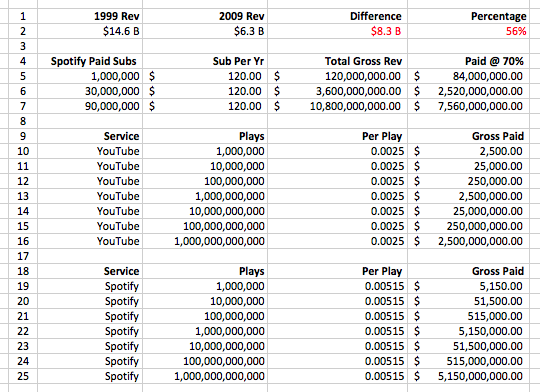
In the chart below calculations are created in tables to illustrate the simple math required to determine the revenue opportunities in different streaming models. For example, lines 5, 6, and 7 detail how much revenue Spotify can generate to artists, songwriters and rights holders paying out 70% of their gross at 1m, 30m and 90m paid subscribers.

If Spotify can capture what most believe is an optimistic amount of paid subscribers in the USA (30m) that would only generate $2.5b in revenue for rights holders. Line 2 represents the revenues of the record industry in the USA between 1999 when it was $14.6b through 2009 when it had plummeted to $6.3b leaving a loss of $8.3b annually since that time.

Maybe we’re missing something. If streaming is the future how does $2.5b in revenue from a massively successful Spotify replace the loss of $8.3b in annual earnings?

streamingmath

So in 2012 when Spotify has claimed 1 million paid subscribers in the US, that’s a payout to artists and rights holders of only about $84m. In simple math, this is about 12m albums at $7 wholesale each (what iTunes pays on a $9.99 album).

Additional food for thought is that Spotify is currently valued at 3 billion dollars. That’s just a little less then half of the entire earnings of the entire US record industry in 2012 at an estimated 7 billion dollars. This means that if the same valuation method is used for both Spotify as a single company, and the domestic record industry as a whole, than either Spotify is overvalued or the record industry is undervalued.

But there are larger problems here than Spotify. As you can see in the chart above YouTube also represents a challenge for artists and rights holders. The site was born of infringement as a business model, and despite policy changes at Google (YouTube’s parent company) the situation is still completely unacceptable for artists as East Bay Ray of The Dead Kennedy’s explains to NPR.

YouTube really deserves it’s own post, and there will be several forthcoming.  In the new “exploitation economy” artists seem to be willing to trip over transactional dollars attempting to pick up streaming pennies. Again, one of the most important distinctions between Spotify and YouTube is that Spotify does not have a massive DMCA and rights management issues that cheats artists of their due. Additionally, YouTube is paying a fraction of what Spotify is, so if this is the future, everyone is really in trouble.

…it will henceforth be very difficult to dislodge Smith and Telang’s conclusion that piracy does economic harm to content creators…

Copyright and Technology

Back in 2010, the Government Accountability Office (GAO) published a meta-study of the economic effects of intellectual property infringement (including counterfeit goods as well as copyrighted works).  The GAO concluded that IP infringement is a problem for the economy, but it’s not possible to quantify the extent of the damage — and may never be.  It looked at many existing studies and found bias or methodological problems in every one.

More recently, Michael Smith and Rahul Telang, two professors at Carnegie-Mellon University, published another meta-study that serves as a sort of rejoinder to the GAO study.  This was the subject of Prof. Smith’s talk at the recent Digital Book World (DBW) conference in NYC.

Assessing the Academic Literature Regarding the Impact of Media Piracy on Sales summarizes what has been a growing body of studies on the economic effects of so-called media piracy.  Their conclusion is that piracy does have…

View original post 391 more words

Artists Rights Watch – Sunday Feb 3, 2013

Grab the coffee!

Recent Posts:
* Over 50 Major Brands Supporting Music Piracy, It’s Big Business!
* @pepsi and @beyonce @superbowl Ads Supporting Pirate Lyrics Site That Exploits Adele and Skyfall
* Derek Khanna is Wrong: Copyleft Mystery Man’s Misleading Memo Creates its Own Myths…
* It’s Not Whack A Mole if You Own the Mole: New York Times Coverage of Brand Sponsored Piracy
* Zero Dark Thirty, Best Picture Academy Award Nominee, Exploited by AT&T, Verizon, MetroPCS, Nissan, H&R Block, British Airways, Progresso, and more…
* #StopArtistExploitation – Tweet Daily for Artists Rights!
* Underreporting and No Accountability: Another Reason Streaming Royalties are So Small
* Internet Pay To Play: Payola’s Revenge – Guest Post by Robert Rial of Bakelite78

From Around The Web

LA WEEKLY:
* YouTube Stars Fight Back

“I woke up today hoping to make a video, but I went into a call with Machinima this evening and they said that my contract is completely enforceable. I can’t get out of it,” Vacas tells the camera. “They said I am with them for the rest of my life — that I am with them forever.

“If I’m locked down to Machinima for the rest of my life and I’ve got no freedom, then I don’t want to make videos anymore,” he says quietly.

The screen fades to black.

NEW YORK TIMES:
* Playing Whac-a-Mole With Piracy Sites
* As Music Streaming Grows, Royalties Slow to a Trickle

Spotify, Pandora and others like them pay fractions of a cent to record companies and publishers each time a song is played, some portion of which goes to performers and songwriters as royalties. Unlike the royalties from a sale, these payments accrue every time a listener clicks on a song, year after year.

The question dogging the music industry is whether these micropayments can add up to anything substantial.

“No artist will be able to survive to be professionals except those who have a significant live business, and that’s very few,” said Hartwig Masuch, chief executive of BMG Rights Management.

ADLAND:
* Online pirating: sponsored by many brands, and now, one government.

BUSINESS INSIDER:
* How Jobs In The Media Industry Got Demolished In The Last 10 Years [Charts]

The Bureau of Labor Statistics has put together a presentation on the recent history and direction of media jobs. It’s not pretty.

THE LEFT ROOM:
* Piracy, Free Books, etc

DIGITAL BOOK WORLD:
* Does Piracy Hurt Digital Content Sales? Yes

BRITISH JOURNAL OF PHOTOGRAPHY:
* Photographers find support in House of Lords in copyright fight

THE HOLLYWOOD REPORTER:
* Ray Charles’ Children Win Lawsuit Over Song Rights Termination

BLABBERMOUTH:
* TOOL Frontman Sounds Off On Illegal Downloading, Music Industry And Digital Distribution

“There’s a disconnect between people not buying music and not understanding why [bands] go away. There are people who are like monkeys in a cage just hitting the coke button. They don’t really get that for [musicians and artists] to do these things, they have to fund them. They have to have something to pay the rent.”

VOX INDIE:
* New Spotlight on Piracy Profitmongers

THE ILLUSION OF MORE:
* Think File Sharing is Sticking it to The Man? Really?
* On Being a Luddite

COPYRIGHT AND TECHNOLOGY:
* Yes, Piracy Does Cause Economic Harm

Decisions about business and policy have to be made based on the best information we have available. After a certain point, simply poking holes in studies — particularly those whose results you don’t happen to like — isn’t sufficient.

It may indeed, as the GAO suggested, be impossible to measure the economic effects of piracy with a large amount of accuracy. But if dozens of researchers have tried, all using different methodologies, then their conclusions in the aggregate are the best we’re going to do. Put another way, it will henceforth be very difficult to dislodge Smith and Telang’s conclusion that piracy does economic harm to content creators.

RAPIDTV NEWS:
* LATAM pay-TV operators unite against piracy

CIOL:
* Kamal Haasan fans help curb Vishwaroopam online piracy

BILLBOARD:
* Worldwide Independent Network Announces ‘Independent Manifesto’
* Blink-182’s Mark Hoppus Talks Piracy, Pros and Cons of Digital at MIDEM

“I believe that artists should be paid for their creativity. There’s no other industry where people can come in and take what you create for free and give it away for free and that’s acceptable.”

MUSIC ALLEY:
* U2 manager Paul McGuinness: ‘I don’t want to engage in Google-bashing, but…’
* Irving Azoff sticks it to Pandora and StubHub
* Midem 2013: How the Music Industry Manages Innovation

“We are the last fortress against this YouTube situation, and we are fighting hard on that,” he said. “The problem is the fair price, getting statements and getting all the business plans… The biggest problem to solve the YouTube deal is they want a non-disclosure deal, and we are not allowed by Germany law to do with any partners a non-disclosure [deal]. We have to do it open.”

DIGITAL MUSIC NEWS:
* Pandora Executives Cash Another $3 Million In January…
* Hey Advertisers: You Might Want to Ask VEVO for a Refund…

HYPEBOT:
* Myspace Allegedly Hosting Unlicensed Indie Music, Merlin Prepares Legal Response
* The Most Honest Interview About the Music Industry Ever, Featuring Jacke Conte of Pomplamoose

“YouTube seemed like a really incredible opportunity, but it’s not repeatable. I don’t know how to make it in the music industry. I don’t think anybody really knows how, and I’m unable to repeat what happened to Pomplamoose.”

PLAGIARISM TODAY:
* 4 New-ish Pro-Copyright Sites To Read

THE FEDERALIST SOCIETY:
* Laws of Creation: An Examination of Intellectual Property Rights

INSTITUTE FOR POLICY INNOVATION:
* Copyright and Innovation? No. Copyright IS innovation.

YAHOO:
* New Order’s Peter Hook: Musicians, Journalists Only People Who Don’t Get Paid for Work

Hook expressed astonishment that in the internet economy, consumers act aggrieved if musicians ask to be compensated for their music or if reporters object to having their stories re-purposed by other news organizations without getting credit or cash.

“If you love and respect music, you should pay for it,” Hook said.

COPYRIGHT ALLIANCE:
* Creators and Consumers Should Cut the Strings

TORRENT FREAK:
* Russia Wants To Fine Websites For Poor Copyright Takedowns
* University of Illinois Disconnects Pirating Students, Staffer Asked To Leave
* Pirate Bay Founder Could Be Prosecuted For Hacking “Within a Month”

VARIETY:
* Music retail giant puts tunes online (Amoeba Archives Project)

THE SCOTSMAN:
* New look at copyright key to digital boom

THE CALGARY HERALD:
* Your content is Freely Shared; their Profit is Closely Held

There’s enormous potential in this ‘Your Content, Their Profit’ crowd-sourcing business model, and it’s turned companies like YouTube, Google and Twitter into multi-billion-dollar corporations.

Whether you realize it not, what you post online (your words, your pictures, your pictures of other people, you name it) becomes someone else’s revenue generating opportunity as soon as you post it.

Top social networking sites build into their user agreements and conditions of use the automatic rights to profit from the content that’s posted (or stored or indexed).

JOHN BOSTOCK @ TED CONVERSATIONS:
* Meet the new Boss, Worse than the Old Boss

THE MAUI NEWS:
* Creators v. Consumers : Restating the Obvious

SAD RED EARTH:
* Aaron Swartz and “Hactivision”

DiCola Study : Read the paper before getting caught up with the pretty pictures, people.

Guest Post by Sebastian Förström, you can check out his website [here]. Copyright in the Author.

Please read the 77 page paper before getting caught up with the pretty pictures, people.

The graphs show “the average musician”, the one guy that doesn’t exist.

The survey includes a lot of different musicians, many of which don’t have any recordings (41.5% answered N/A on the “sound recordings” question and 56.2% answered N/A on the “money from songwriting/composition question”).

It’s heavily skewed towards classical and jazz musicians (50.9%) and those two genres together make up about 4% of the record business. It’s also made in 2011, after music sales have dropped by 50%. It would be interesting to compare it to some kind of similar survey from pre-Napster times, but there probably hasn’t been any made using the same criteria.

That said, it seemed pretty balanced to me and worth a read if someone is interested.

I’ll point out that for those calling themselves “composers” copyright-related income on average was around 45%.

For those musicians who made the most money, copyright-related income was a larger part of the pie than for the average musician. Just goes to show that it’s as everybody has always said, the real money in the music business is in writing songs.
( As long as people buy the records 🙂 )

I’ll copy-paste some bits for those who don’t want to read the whole paper:

34/77
“There are subgroups of musicians who make a much more substantial portion of their revenue from compositions, especially, and also recordings. These relatively copyright­‐reliant subgroups include composers and musicians in the highest brackets for music­‐related income, as described below.”

35/77
“This suggests that sound recordings have greater relative importance for lower-income, part-time, and younger musicians. Selling recordings might be a way to get started in the industry. But for higher-income musicians accumulating revenue streams, composition royalties have a much larger role in earning revenue..”

41/77
“Figure 8 also shows how some of the negative trends in the industry are affecting musicians’ revenue. Twice as many respondents who compose reported a decrease in mechanical royalties as reported an increase: 50 percent to 24 percent. Unsurprisingly, sales of recordings in traditional retail stores showed a distinctly negative trend, with 50 percent of respondents who record music reporting a decrease. Financial support from record labels is also in decline; 41 percent of those recording artists with record­‐label contracts reported a decrease in financial support against only 9 percent who reported an increase. This accords with my colleagues’ findings in the separate, qualitative­‐interview phase of the larger project.”

46/77
“But merchandising, branding, and licensing of one’s persona make up only a tiny fraction of musicians’ revenue, despite the increased prevalence of social networking. Merchandising revenue is a tiny sliver of musicians’ revenue “pie.””

48/77
“In sum, some musicians are more dependent on revenue streams that are directly related to copyright than others. The variation in musicians’ sources of revenue is important; it shows that musicians have a wider range of roles and revenue sources that go beyond composing and recording. Musical creativity takes a number of forms, not just the kinds that copyright law protects. This broader perspective should not, however, obscure the reliance on copyright for many musicians in particular subgroups. To return to a key example, those who focus their activity on composing rely on composition revenue and are much more vulnerable to harm from copyright infringement. The same goes for recording artists who rely on sales of sound recordings.”

Pretty much, yeah.

[EDITORS NOTE: It is the Dicola study that had made headlines declaring only 6% of musicians benefit from Copyright]

#StopArtistExploitation – Tweet Daily for Artists Rights!

As we suggested on our post, Over 50 Major Brands Supporting Music Piracy, It’s Big Business! the best way to start to effect positive change is to simply encourage like minded people to send a daily tweet to one of the brands on the list. A tweet a day to just one of these brands will create enough awareness to bring this issue to the attention of the brands themselves. There are over 50 brands, so that’s nearly two months of tweets just by doing one simple tweet a day.

By using the hashtag #StopArtistExploitation we can also easily help others find out about this problem and build support for artists rights online.

Thanks to everyone who participates, you really can make a difference. We’re also tweeting a brand a day, so feel free to retweet us if you like – which is even easier.

Here’s a directory of the brands on Twitter. Please feel free to copy/paste this simple suggested tweet to them:

@Brand Stop Supporting Online Music Piracy #StopArtistExploitation http://wp.me/p2hvgt-1xH

@Adobe – https://twitter.com/Adobe

@ADTstaysafe – https://twitter.com/ADTstaysafe

@AlaskaAir – https://twitter.com/AlaskaAir

@amazon – https://twitter.com/amazon

@AmericanExpress – https://twitter.com/AmericanExpress

@ATT – https://twitter.com/ATT

@Audi – https://twitter.com/Audi

@BMWUSA  – https://twitter.com/BMWUSA

@bostonmarket – https://twitter.com/bostonmarket

@boyscouts – https://twitter.com/boyscouts

@British_Airways – https://twitter.com/British_Airways

@CENTURY21 – https://twitter.com/CENTURY21

@CharterCom – https://twitter.com/CharterCom

@Citibank – https://twitter.com/Citibank

@MINIUSA – https://twitter.com/MINIUSA

@CoxComm – https://twitter.com/CoxComm

@CrateandBarrel – https://twitter.com/CrateandBarrel

@DirecttTv – https://twitter.com/DirecttTv

@DishSatellite  – https://twitter.com/DishSatellite

@eBay – https://twitter.com/eBay

@EA – https://twitter.com/EA

@Air_Emirates – https://twitter.com/Air_Emirates

@FergusonShowrms – https://twitter.com/FergusonShowrms

@Ford – https://twitter.com/Ford

@GoPro – https://twitter.com/GoPro

@googlechrome – https://twitter.com/googlechrome

@HertzCWB – https://twitter.com/HertzCWB

@HP – https://twitter.com/HP

@HiltonHotels – https://twitter.com/HiltonHotels

@HyattPR – https://twitter.com/HyattPR

@Hyundai – https://twitter.com/Hyundai

@JetBlueAirlines – https://twitter.com/JetBlueAirlines

@KAYAK – https://twitter.com/KAYAK

@Kohler – https://twitter.com/Kohler

@LegalZoom – https://twitter.com/LegalZoom

@LGUS – https://twitter.com/LGUS

@MyMMscom – https://twitter.com/MyMMscom

@Macys – https://twitter.com/Macys

@_MarvelAvengers – https://twitter.com/_MarvelAvengers

@MazdaUSA – https://twitter.com/MazdaUSA

@musiciansfriend – https://twitter.com/musiciansfriend

@Nationwide – https://twitter.com/Nationwide

@neimanmarcus – https://twitter.com/neimanmarcus

@netflix – https://twitter.com/netflix

@NissanUSA – https://twitter.com/NissanUSA

@priceline – https://twitter.com/priceline

@PrincessCruises – https://twitter.com/PrincessCruises

@Register_com – https://twitter.com/Register_com

@RejuvenationInc – https://twitter.com/RejuvenationInc

@Sheraton_Hotels – https://twitter.com/Sheraton_Hotels

@Skype – https://twitter.com/Skype

@sprint – https://twitter.com/sprint

@StateFarm – https://twitter.com/StateFarm

@SweetwaterSound – https://twitter.com/SweetwaterSound

@Target – https://twitter.com/Target

@TuneCore – https://twitter.com/TuneCore

@UNITED_AlRLINES – https://twitter.com/UNITED_AlRLINES

@UrbanOutfitters – https://twitter.com/UrbanOutfitters

@VirginAtlantic – https://twitter.com/VirginAtlantic

@Visa – https://twitter.com/Visa

@VW – https://twitter.com/VW

@WHotels – https://twitter.com/WHotels

@WeightWatchers – https://twitter.com/WeightWatchers

@Wendys- https://twitter.com/Wendys

@Westin – https://twitter.com/Westin

@WilliamsSonoma – https://twitter.com/WilliamsSonoma

@Yahoo – https://twitter.com/Yahoo

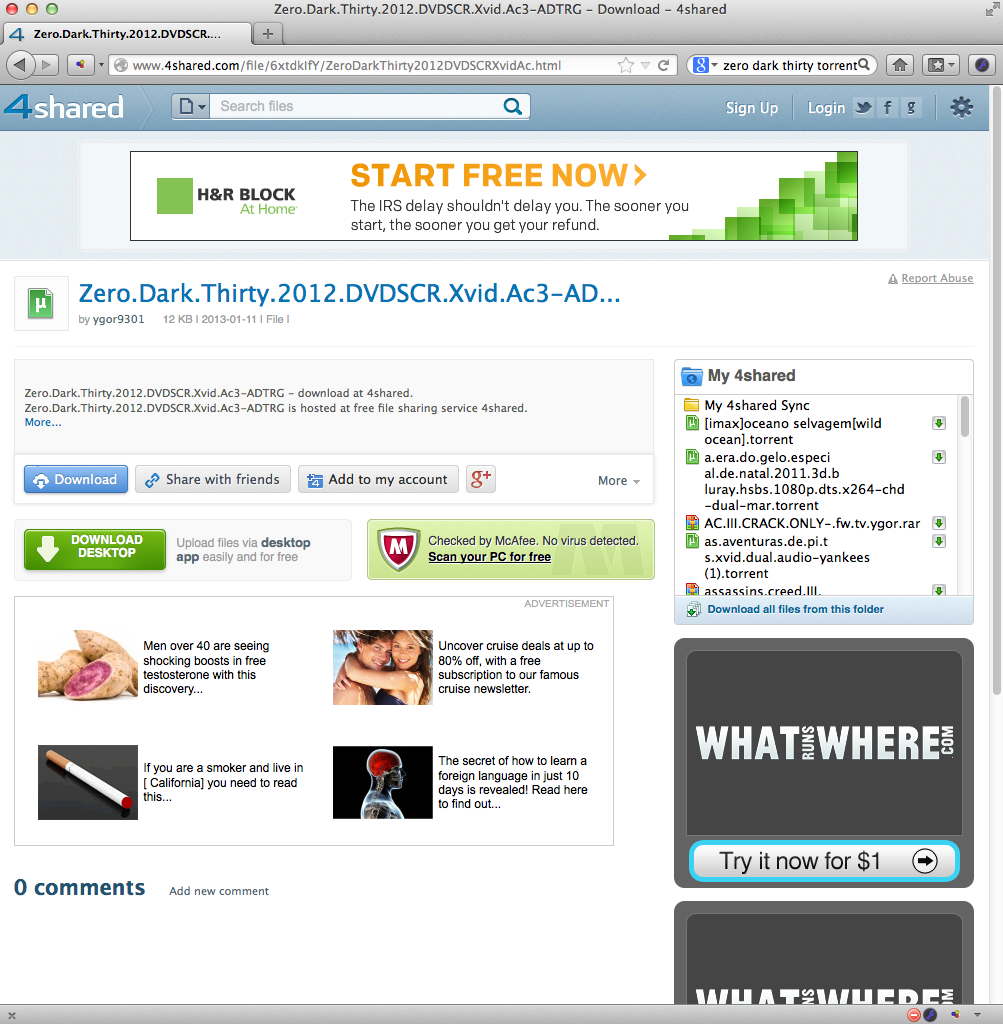
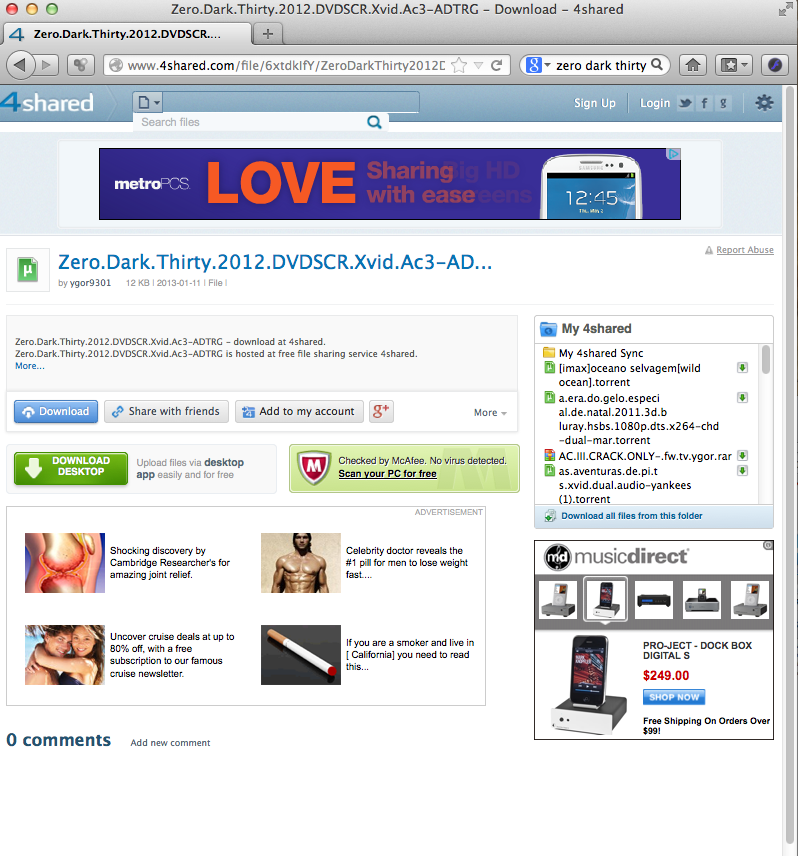
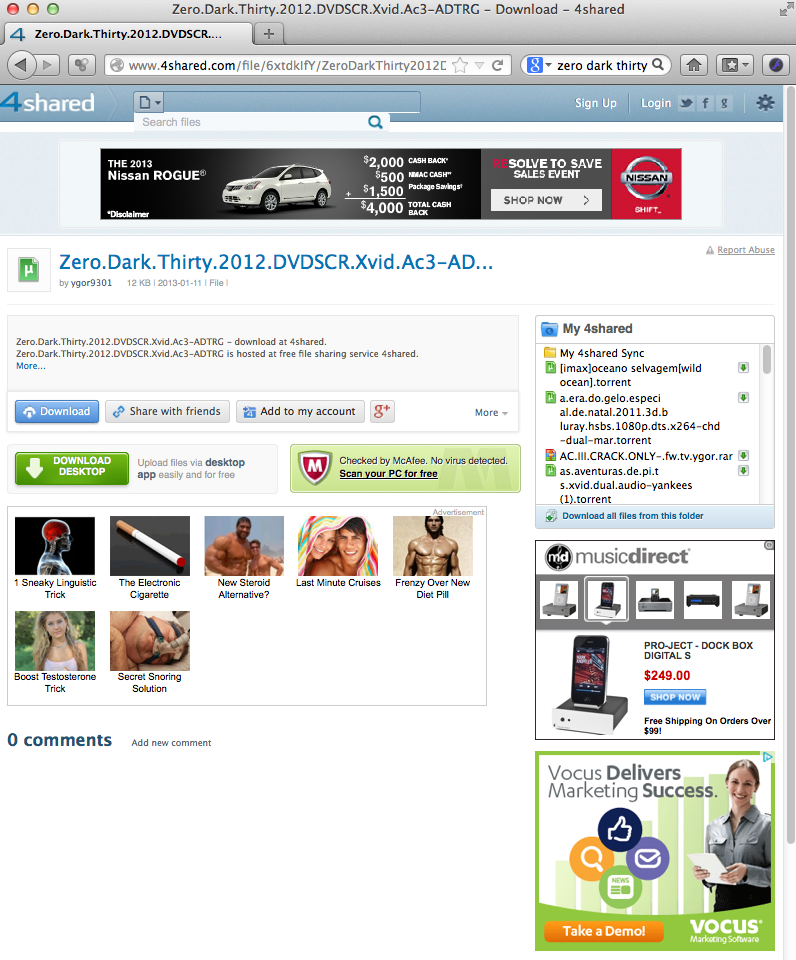
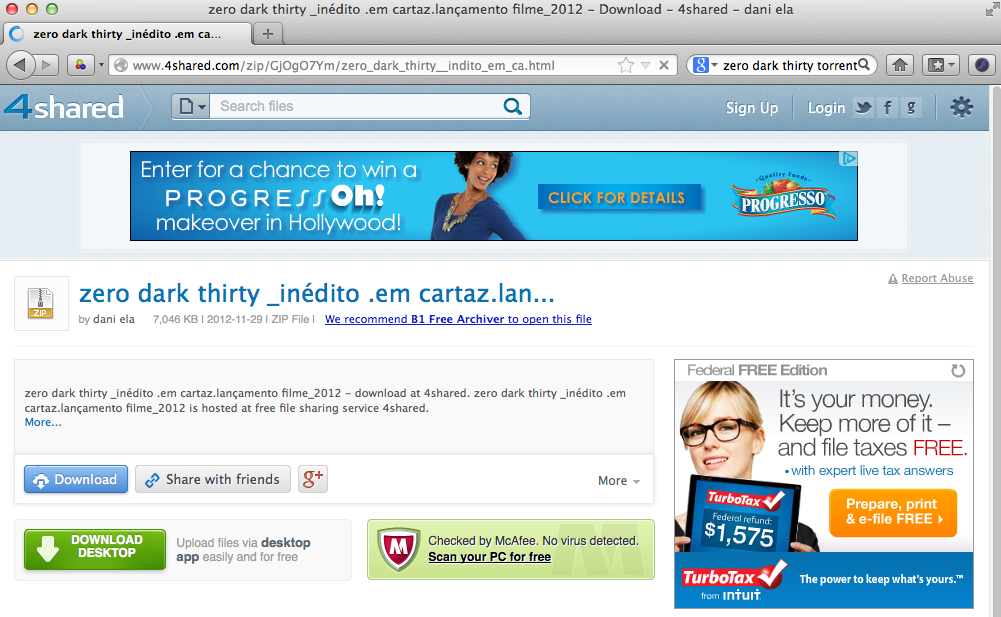
Zero Dark Thirty, Best Picture Academy Award Nominee, Exploited by AT&T, Verizon, MetroPCS, Nissan, H&R Block, British Airways, Progresso, and more…

We spend most of our time here focused on artists rights as it applies to music and musicians. But we wanted to see if the film industry was having the same challenges as music. We believe in the rights of all creators to consent and compensation for their work (ethical internet principles numbers two and four, respectively).

With the upcoming Academy Awards we wondered if it would be possible to find pirated versions of Zero Dark Thirty. It is  the most talked about film of the year which is nominated for five Academy Awards including Best Picture. But it could easily be any of the other nominated films, in any of the categories as well. We just picked Zero Dark Thirty. It’s also been widely reported that most of the nominated films have already been pirated and are online.

We were also curious what major brands might be supporting that piracy, and if any of those same brands might have advertising that appears on the broadcast of  The Academy Awards show itself. We would hope the Academy Of Motion Picture Arts and Sciences would be able to educate the various brands, advertising agencies and online ad networks about the damage they are doing to the creative community.

What makes this even more frustrating in the case of Zero Dark Thirty is that the film is not even out of theaters yet. At least with music, it is usually (usually…) commercially available before it is pirated.

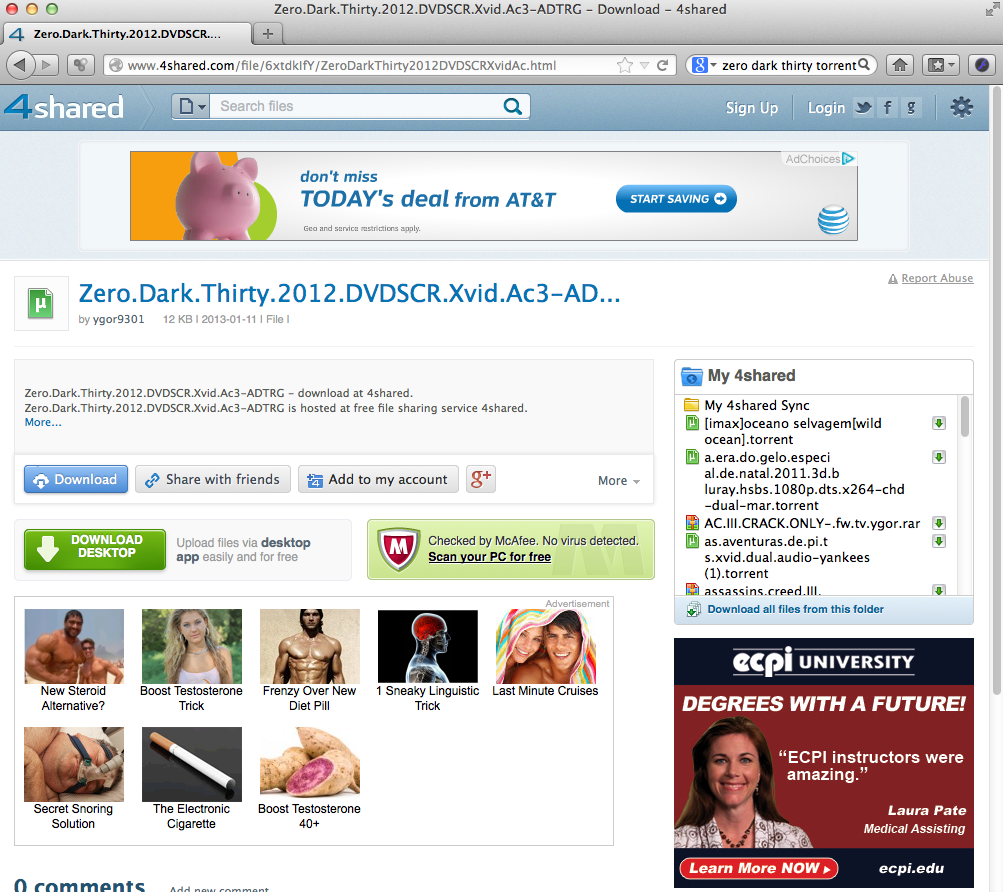
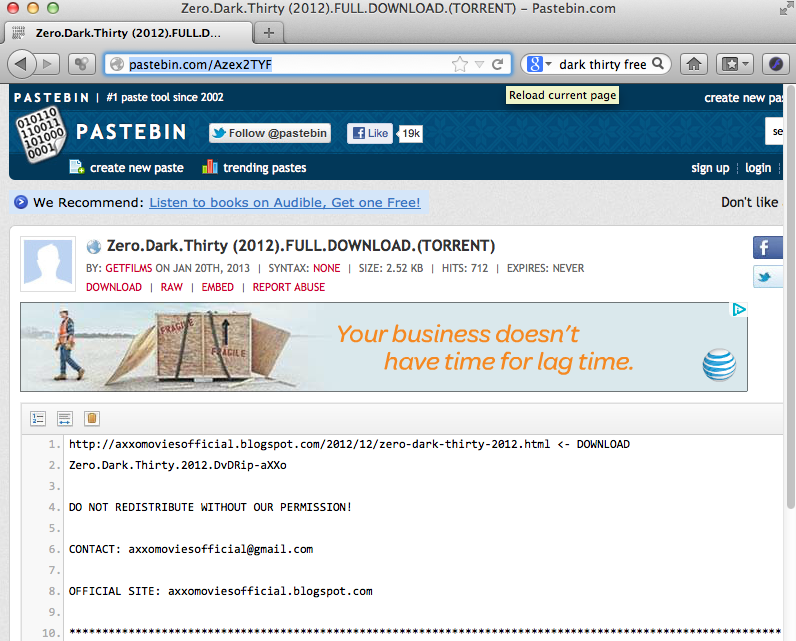
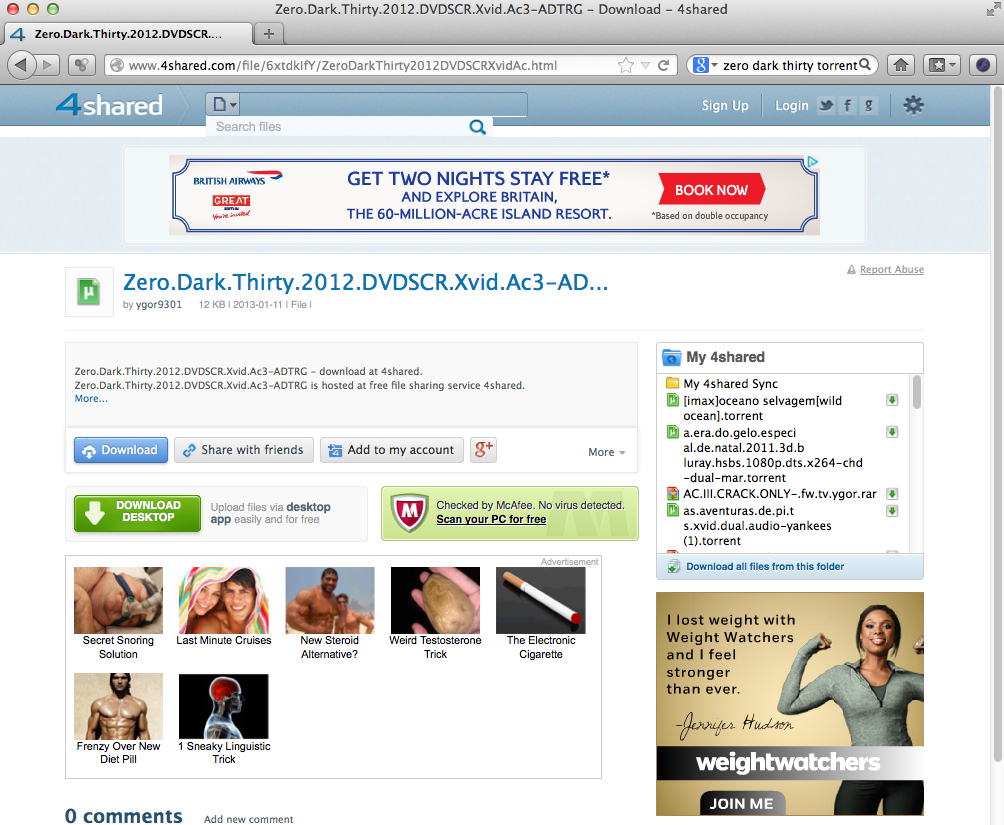
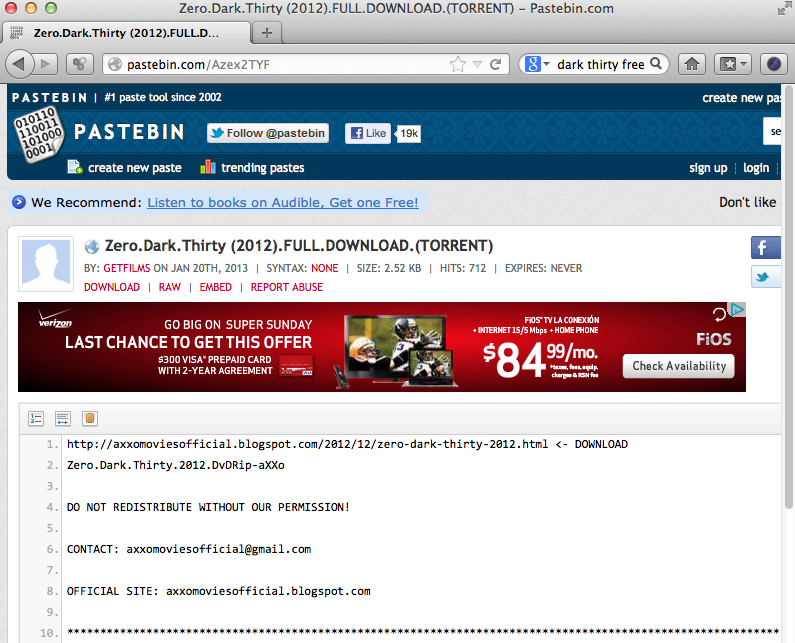
Here’s what we found within a few minutes, on just two sites…

* AT&T on 4Shared
* AT&T on Pastebin
* British Airways on 4Shared
* H&R Block on 4Shared
* MetroPCS on 4Shared
* Nissan on 4Shared
* Progresso on 4Shared
* Turbo Tax on 4Shared
* Verizon on Pastebin

ZDT_ATTT

ZDT_Pastebin

ZDT_BAZDT_H&RBlockZDT_metroPCSZDT_NIssanZDT_ProgressoTTZDT_Verizon

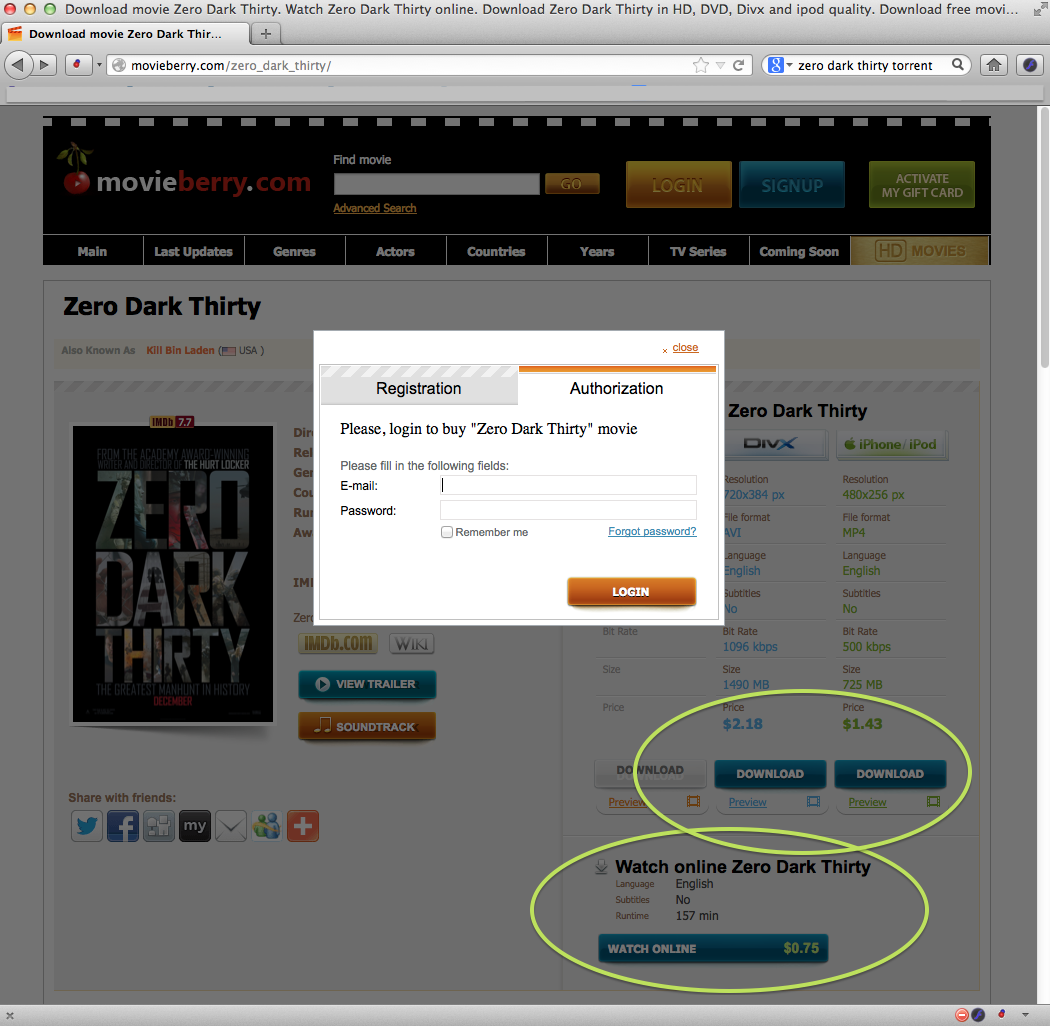
That’s just a couple sites to download the movie for free. What’s more common amongst film piracy are the faux subscription services that charge annual membership fee’s to stream all of their pirated movies (so much for information wants to be free, but movie want to be paid for…).

Here’s just one example where you can pay on a transactional basis of $.75 to stream the film or between $1.43 or $2.18 to download the film of varying quality.

ZDT_movieberry

So much for “Free Culture.” As it turns out there’s probably very little online piracy happening without money changing hands somewhere in the value chain. The money may be in advertising, or it may be in transactional or subscription fees, but one thing is for sure, people are getting paid and not paying the creators.

In the case of the above, and as we also asked did MegaVideo Charge for Streaming Movies the problem here is to address those processing payments such as American Express, Visa, Master Card and the various other banks such as Citi Bank and Wells Fargo (whom have also been seen advertising on pirate sites). At least PayPal is taking responsibility and denying service to pirate sites. That thanks largely to the good work being done by StopFileLockers.

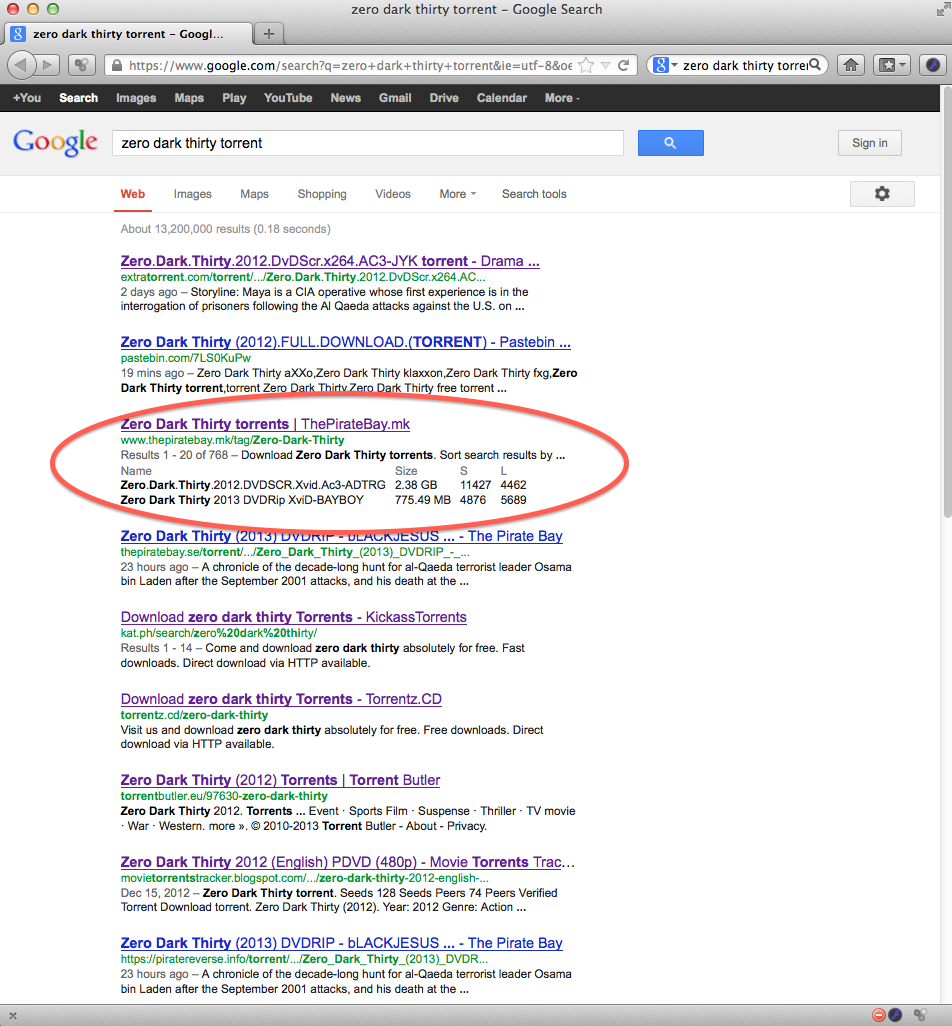
We found a couple of things of interest as well regarding Google’s search. Despite there being (we’re guessing conservatively) literally thousands of DMCA notices to remove the film from search, The Pirate Bay still ranks #3 on the first page of search results! Surely Google as well as everyone else in the world knows the site was found guilty and it’s founders sent to jail. Yet Google has not delisted the site from search in it’s entirety which would be the right thing to do, knowing that the judgement against The Pirate Bay was upheld even by the Supreme Court of Sweden.

ZDT_GoogleSearch

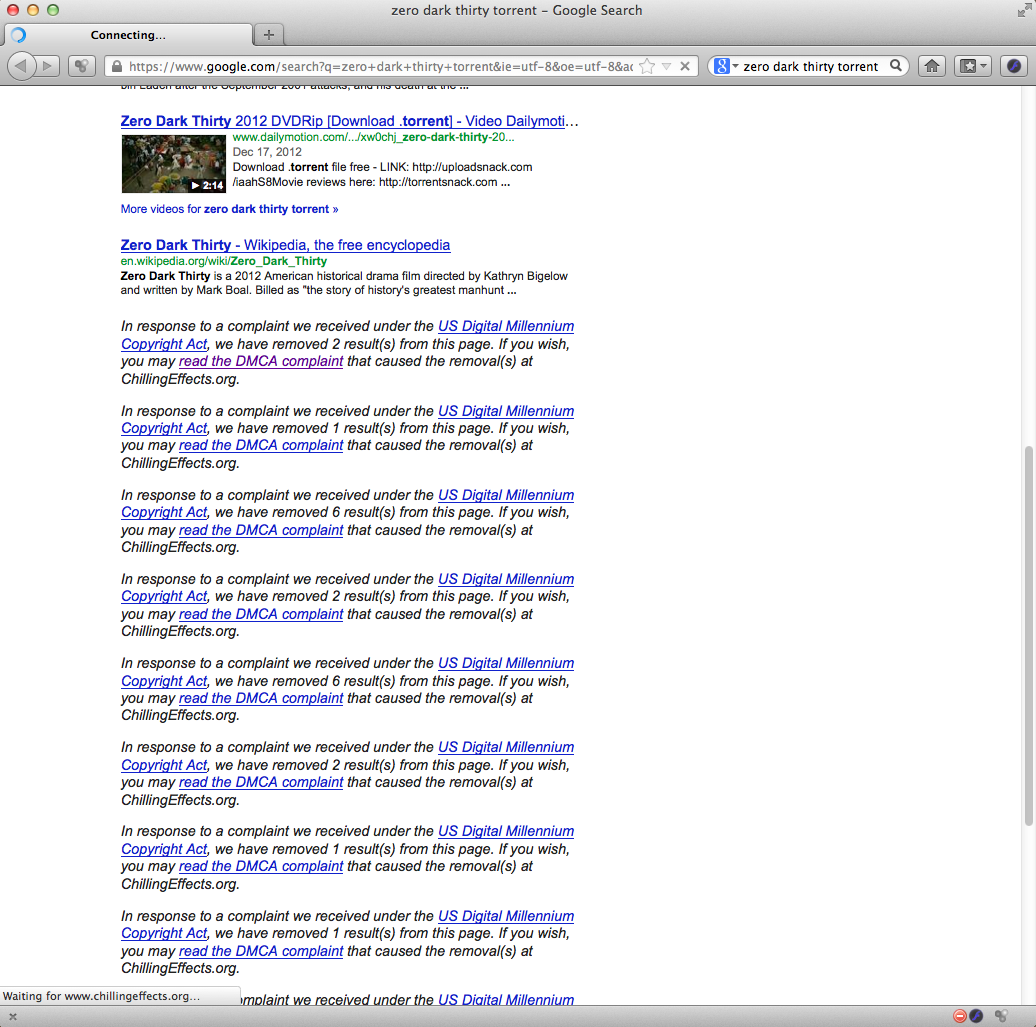
Of course a quick scroll down the page and the delisted link removal notices start to appear as follows:

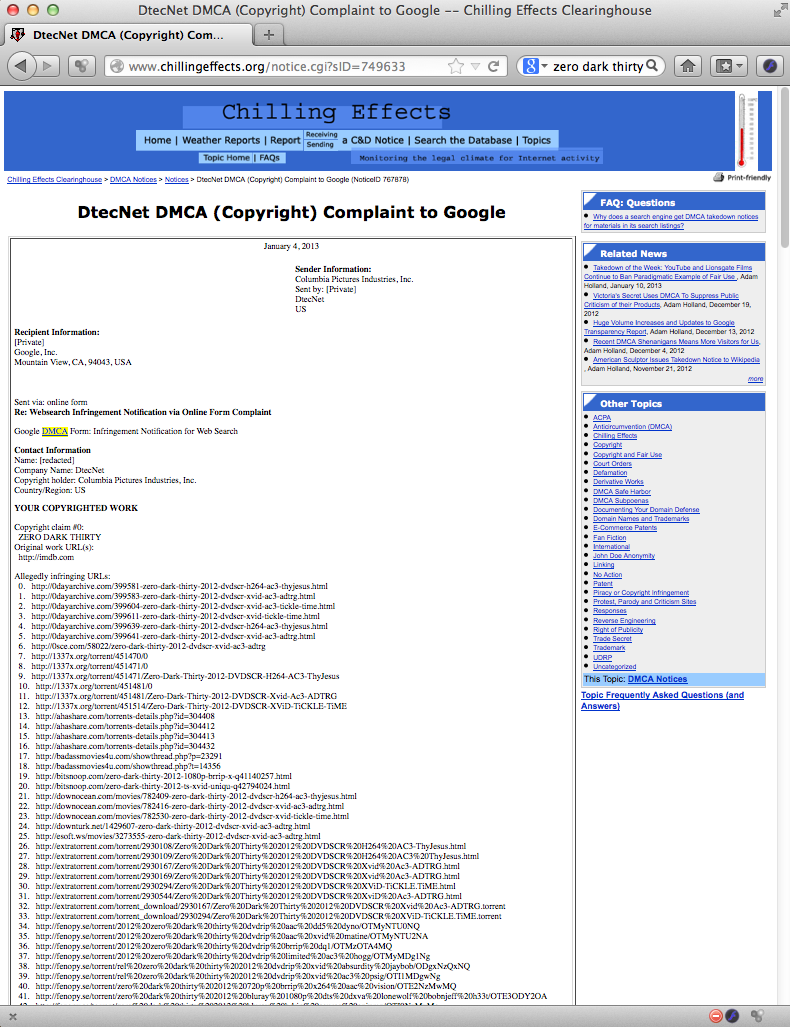
In response to a complaint we received under the US Digital Millennium Copyright Act, we have removed 1 result(s) from this page. If you wish, you may read the DMCA complaint that caused the removal(s) at ChillingEffects.org.

ZDT_DMCA_GoogleCjill

Now why exactly is there a need, once a link has been delisted to post a notice to a site that then shows that very same link that had been lawfully delisted from Google search by the DMCA? In the screen shot below are shown just the first forty delisted links, but on that one notice alone there are over three hundred delisted links to pirated copies of Zero Dark Thirty in one way or another.

ZDT_CEpg1

Make no mistake about it, every one of those previously delisted links is still active on the servers where it originated and it can simply be copied and pasted back into any web browser.

Further more, these links have been delisted due to the fact that most if not all of these infringing sites are not based in the United States and do not conform to United States law and therefore do not comply with the DMCA itself.

Is this all just a cat and mouse game for Google to profit from piracy? Draw your own conclusions.