World Watch:  Canadian Government Closes Big Tech’s Back Door Loophole

Music Technology Policy

Canadian Prime Minister Stephen Harper’s government has announced that Canada will expand the current 50 year copyright term for sound recordings in Canada to 70 years. This brings Canada into the 21st Century and in line with its global trading partners. Expect handwringing from Big Tech and the magisterium of the professoriate, some of which has already begun, complete with at least some manufactured evidence worthy of Pandora.

Harper Government Acts to Protect Canadians from the Copyright Term Shell Game

The way you play the copyright term game internationally is to sell knockoff CDs or vinyl versions of classic recordings at super-budget prices in the country with the shortest term as those records flow into the public domain. Fans are confused by these records being sold side by side with value added versions (such as digitally remastered, 5.1 mixes, etc.). There’s also a good chance that the same game…

View original post 2,867 more words

Twilight in the Garden of Good and Evil and Hubris: Google Will Face at Least Two Antitrust Investigations in Europe

Music Technology Policy

Good things come to those who wait
So just relax and wait for fate…

from Love You Madly by Duke Ellington and Billy Strayhorn

______________________________________________________

According to the Wall Street Journal (EU files formal charges against Google):

European Union regulators formally accused GoogleInc. of violating the bloc’s antitrust laws by abusing its dominance of online search, escalating a long-running case that had stalled for years despite three separate attempts at a settlement.

Wednesday’s move is the first time that any regulator has filed formal antitrust charges against the California search giant, putting the EU in the vanguard of a global debate over the regulation of giant Internet platforms.

In a statement, EU regulators said they had reached the preliminary conclusion that Google “systematically positions and prominently displays its comparison shopping service in its general search results pages, irrespective of its merits.” That conduct started in 2008, the…

View original post 573 more words

#irespectmusic The New Improved Performance Rights Act: Because You Believed

Music Technology Policy

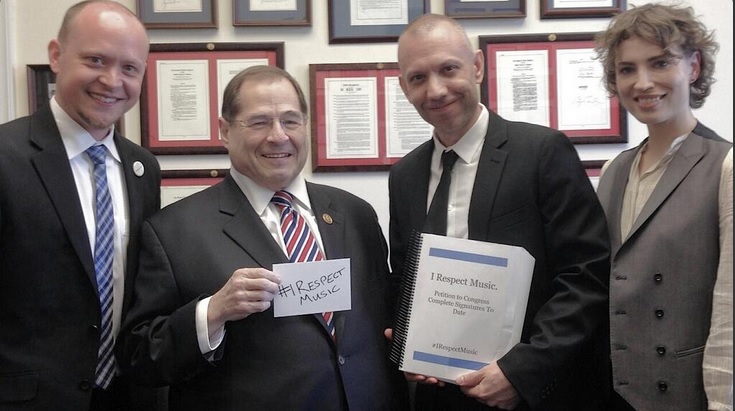
Congressman Jerry Nadler and Marsha Blackburn, John Conyers and Ted Deutch will introduce legislation on Monday that responds to all of you who supported artist pay for radio play.  The thousands and thousands of you who signed the #irespectmusic petition, the hundreds of you who attended #irespectmusic events, the hundreds of you who responded to the Copyright Office’s request for comments on the Music Licensing Study and the “NABtweets” campaign on Grammy night, and who supported the Turtles fight against Pandora and SiriusXM.  All the bands who have hosted #irespectmusic shows around the country, all the fans who wore the “#irespectmusic AND I VOTE!” button at election time.

marsha blackburn

Janita, Rep. Marsha Blackburn, Blake Morgan and Tommy Merrill

nadler

Tommy Merrill, Rep. Jerry Nadler, Blake Morgan and Janita

deutch 2

 Janita, Rep. Ted Deutch, Blake Morgan and Tommy Merrill

Some of you joined this movement recently, some of you were around for the last…

View original post 656 more words

The Great Disappointment: Tidal Highlights YouTube’s Moral Hazard for All the World to See

Escape from the Great Streaming Cult….

Music Technology Policy

Part of Tidal’s business model relies on artists being able to grant exclusives.  The concept of an exclusive requires property rights that are respected by other platforms in the channel.

Imagine if Showtime began showing rips of Game of Thrones day and date with its HBO release.  Forget that HBO would sue them and win.  The actors, screenwriters, producers and the vast below the line personnel would think twice about working for Showtime in the future.

And that’s exactly what should happen to YouTube.

Beyonce released “Die With You” on Tidal as an exclusive.  Everyone at YouTube knows that it was intended to be an exclusive just like everyone at YouTube knows that YouTube could keep the track from being uploaded to YouTube if YouTube wanted to do that.

YouTube has worked hard at getting the world to accept the concept of “user generated content” as some kind of great…

View original post 590 more words

#howgooglegateworks: Will @senmikelee Investigate Washington Insider Beth Wilkinson for Her Role in the FTC’s Noninvestigation of Google?

The FTC can regulate songwriters but not Google?

Music Technology Policy

The Googlegate Mascot

One of the historical facts that may (or ought to) come up in Senator Mike Lee’s corruption investigation of Google and the Federal Trade Commission is the FTC’s hiring of Washington insider Beth Wilkinson.  Ms. Wilkinson was hired to oversee the FTC’s Google investigation on April 26, 2012, four months before the internal FTC report recommending prosecution as reported by Brody Mullins at the Wall Street Journal.  Beth Wilkinson has several dots that connect her to various players in the Googlegate corruption probe.

Why Was Ms. Wilkinson Hired?  The threshold question is why did the FTC need to bring in an outside lawyer to manage the Google investigation?  Has the FTC done this before?  (Not that I can find.)  Why did they do it this time?  Why did they hire Ms. Wilkinson and who else did they consider for the post (if anyone)?  How…

View original post 1,460 more words

@senmikelee Investigating White House Influence in FTC Decision Not to Prosecute Google

Maybe Senator Lee could look at Google’s scorched earth attack on Zoë Keating?

Music Technology Policy

According to the National Journal (“Senate to Investigate White House Role in Google’s Antitrust Victory“):

A Senate panel plans to investigate whether the White House inappropriately derailed a federal investigation into accusations that Google was stifling online competition.

Sen. Mike Lee, the chairman of the Senate Judiciary’s Antitrust Subcommittee, plans to contact the Federal Trade Commission, Google, and other online companies to discuss the issue, Emily Long, a spokeswoman for the Utah Republican, said Monday. The subcommittee has no plans yet to hold a hearing on the issue, she said….

“In short, we are interested in how the FTC allowed a confidential report to be disclosed, and second, what conversations, if any, the FTC or Google had with the White House about the pending investigation,” Long said in an emailed statement. “We are not likely at this time to re-examine the underlying merits of the investigation, which was…

View original post 874 more words

The Queen of Denial: Be Careful or Rachel Whetstone Will Clap You in Irons

Music Technology Policy

The demagogue is one who preaches doctrines he knows to be untrue to men he knows to be idiots.

H.L. Mencken

You may have read one of many, many recent news articles about an internal Federal Trade Commission report about the Google antitrust investigation released by the FTC under a Freedom of Information Act request by the Wall Street Journal.   That report conclusively demonstrates that at least some of the lawyers at the Federal Trade Commission wanted to bring an action against Google for a variety of violations of the U.S. antitrust laws.

That report was overruled by the political appointees who run the FTC.

The Journal followed up their reporting with an analysis of how many times Google met with Obama Administration officials at the White House both before and after the FTC voted not to pursue an action against Google.  When coupled with the number of Google executives…

View original post 1,222 more words

Must Read Op-Ed by AFM President Ray Hair Lays it Down on the Shadowy Naxos Deal with Pandora

As we posted, there are very few details about the recent direct deal between Naxos Records and Pandora.  The two big points that aren’t getting discussed is the Pandora special “steering payola” that Naxos and Pandora refused to discuss with the RAIN Newsletter.

The big issue that Naxos and Pandora also refused to discuss is direct payment to artists, musicians and vocalists through SoundExchange which was a big part of the Merlin direct deal with Pandora.

The musicians union president Ray Hair (American Federation of Musicians) stepped up and called out Naxos and Pandora on this issue in Billboard in a must-read op-ed:

We are alarmed by the agreement recently reached between Pandora and Naxos, the world’s leading classical music label, on a multi-year US license for the entire Naxos catalog. We were concerned when their joint announcement was notably silent on any mention of fair and direct payment of royalties to artists. As AFM members who record classical music are keenly aware, professional musicians receive royalties directly and immediately when Pandora uses the statutory license. Pandora has repeatedly and publicly boasted about the supposed benefit it provides to artists, including in their sworn testimony to the House Judiciary Subcommittee, just a few months ago. They praised the statutory licensing process as an efficient, transparent solution that “must be preserved,” and specifically applauded the fact that the statutory license ensures that artists and musicians “actually receive their fair share of the hundreds of millions of dollars in royalties that services like Pandora pay each year.”

Indeed, direct pay to artists and musicians was supposedly a significant part of Pandora’s agreement with Merlin, an independent consortium of record labels — there was an entire paragraph in the Billboard article on the agreement about the fact that artists would still be paid directly, even if they were on a label subject to that agreement. But nothing in the Naxos announcement mentions anything about SoundExchange administering payment to the artists.

Read the whole thing here in Billboard.

We are 100% in Ray’s corner on this and commend him for taking a leadership role in calling out both Naxos and Pandora to disclose the terms of the deal and pay creators fairly.

We also are 100% in sync with the AFM members calling for the AFL-CIO union pension funds to divest of any shares of Pandora or Google stock they hold, and of course any shares of the members of the “Free Radio Alliance” who oppose artist pay for radio play.  It’s time to get serious.

Big thanks to Ray for all he does for musicians.

Again with the Bad Napster Analogies

As David pointed out, Merlin’s Charles Caldas has gotten himself sideways again over Spotify.  Well he’s nothing if not consistent.  Will someone just give this guy a CBE, please?  Maybe that will calm him down.

This time Caldas is reacting to statements by Lucian Grainge and Doug Morris that they’re taking a relook at their deals with Spotify on ad supported streaming.  Sidebar: Let’s not forget something–Grainge and Morris ARE REALLY LATE TO THE PARTY on questioning the value of the ad supported model.  So the fact that it took Taylor Swift to get these guys focused is the real story.

But Caldas wades steps right into it by giving a quote to the tech press:

“Treating consumers like children and telling them that everything they’ve enjoyed about these streaming services is going to be taken away because the biggest record companies don’t like it, that’s another Napster moment,” Charles Caldas, the CEO of Merlin Network, the global licensing agency for independent music labels, tells Quartz. “The major labels screwed Napster and screwed the market by killing what was potentially the biggest opportunity the industry could imagine in getting into the digital space early. If they follow through with this, they are going to do it again”.

So here’s a fact check–Napster may have had a license from AIM labels, but Napster did not have enough licenses to launch a commercial version of the Napster platform.  It also takes two to tango, so if there was any screwing of Napster, Napster was the one that got themselves in that position, so to speak.

Despite Daniel Ek’s connection to Bit Torrent, Spotify is nothing like Napster so Caldas is really reaching to jam Spotify into that box.  Almost all the labels and a bevy of independent artists have licensed Spotify as have songwriters.  Again, nothing like Napster.  If you have a license with a music service, that deal eventually comes to an end and then you get to decide if you like the deal and want to renew.  You also get to decide if you want to renew on the same terms or different terms.  And guess what?  The service gets to decide if they want to take your renewal terms.  If they don’t, you’re done.  The service has to get along without you.

We’ve long complained of Spotify’s absurdly low royalty rates.  Here’s how it works.  The major labels–and possibly Merlin–got extra goodies that they may or may not share with their artists like equity, breakage (unrecouped advances that don’t roll over) “technology fees” and other nonrecoupable payments.  And a royalty rate that is artificially low because all those goodies are not included in the value of the royalty rate.

When independent artists or labels (presumably that are not part of Merlin) license to Spotify, we don’t get those goodies, but we get the shit royalty.  So if Caldas wants to talk about “screwing the market”, we think this little structure qualifies.  And as far as we can tell Merlin went right along with it and still is.  To Merlin’s credit, many of the Merlin member labels have adopted the “Fair Digital Deals Declaration” to promote sharing of the “goodies” with artists.  There will be a time to discuss how the majors treat the pass through of the goodies, but that time is not today.  Everyone should be very clear that is a discussion that will be had the easy way or the hard way.

But make no mistake–they’re sharing because they got the goodies in the first place.  Just like the majors.  And we’re still taking the shit royalty because of it.

Here’s the larger point.  License deals eventually expire and according to Billboard and others, it looks like Universal’s and Sony’s  Spotify licenses are coming up for renewal.

Stop picture for a second–when Daniel Ek got into a public argument with Taylor Swift in October, he had to know with 100% certainty that he was publicly dissing the most successful artist on his biggest label partner over what was sure to be the biggest selling record of the year.  All because she didn’t like his deal.  How was that supposed to help him renegotiate with Universal on terms favorable to Spotify’s stockholders?

NOT!!

What Ek should have been telling his team was that Spotify needed to be in business with Taylor Swift PERIOD.  END OF DISCUSSION.  MAKE IT HAPPEN.  SCREW THE PRECEDENT.  But no, his strong move was to insult her publicly.  He should be summarily fired for this reason alone.  Which makes you ask, who’s in charge over there?

But back to the Universal and Sony licenses that Ek knew were coming up for renewal.  Here’s the issue:  Ek sold everyone on the idea that he could convert ad supported users to subscribers.  He has tried, but if you ask us, he hasn’t tried very hard.  You may disagree, and if you do, you leave your music on Spotify.  If you don’t, you pull it down.

Or you reach some compromise in the middle.  There’s no reason for people to get in a huff over this.  It’s nothing personal, it’s just business.

Here’s the interesting part.  When we look at the calendar and the history, it’s possible and maybe even likely that the major label deals are up before the Merlin deals.  If the majors get the terms they want–and they almost surely will, one way or another–Merlin labels may find themselves suffering under the old terms for quite a while.  We can’t know that for sure, but that might be motivating the invective.

What is hopeful about the Universal and Sony position on Spotify is that they are focused on the shit royalty.  Having raised that point, it’s probably not going to get lost with some under the table payment.  And far from “screwing the market” that could have the affect of boosting the market and boosting the actual royalty rate paid to all artists.

For the first time we’re hearing the majors talk about the royalty rates and not the “industry” payments.  Spotify is fond of touting the total royalty it pays out to labels and publishers, independent artists and songwriters.  For the individual artist, that “total” is a largely unpersuasive number, practically irrelevant.  What matters to us is what we get in our stocking.  Spotify is fond of trying to push the blame for low royalty rates onto labels, but we know better because we know what the independent artists get who receive the label’s share of the ad supported service.

And guess what–it’s still shite.

If there’s any screwing of the market going on, we know where it’s really coming from.

We said it before and we’ll say it again:  Lars was first and Lars was right.  So spare us the Napster analogies, Mr. Caldas.

What Happens When NPR Reporter @sydell Starts asking Big Radio about Payola?

FCC Payola 1

As David said in his post FCC Payola Lanes: Big Broadcasters ask FCC for Payola Waiver, Clear Channel and other NAB radio gigantamo chains have asked the FCC for a “waiver” on the FCC’s payola rules.  What’s interesting about this is the filing date, November 26, 2014.

What else happened on November 26?  One thing is that NPR reporter Laura Sydell posted “Pandora’s New Deal: Different Pay, Different Play“.  Laura Sydell quoted David alongside Georgetown professor Jim Burger and Pandora CEO Brian McAndrews all on the subject of whether Pandora’s “steering” deal with Merlin labels is payola and whether the FCC’s payola rules apply to Pandora.  This would be based on Pandora being the only pureplay webcaster to at least try to become an FCC licensed broadcaster.  (We’re not really sure where that application is at, but if you do, please comment with a reference.)

Was Sydell’s post the first time the payola issue has come up in the context of steering or promotion in direct deals between broadcasters and labels?  Of course not, it’s come up repeatedly.  But it was the first time that we know of that it came up in the context of Pandora and especially in the context of Pandora’s “Chris Harrison special” that they are trying to run in the current rate court as Sydell reports (and as was later confirmed in Billboard’s (admittedly skeptical) reporting about the similarities between the Pandora and DMX licensing strategies.  Harrison worked at DMX before Pandora–see DMX’s chest-beating press release trumpeting its defeat of songwriters).

Not to get too tin foil hat about it all, but it is very coincidental that an NPR reporter starts asking about payola and then the NAB quietly asks the FCC to give them a waiver.

If the FCC rules in the broadcaster’s favor, that could also apply to Pandora’s purchase of South Dakota radio station KXMZ-FM.

And maybe to Pandora itself.