Music Technology Policy

A Picture Speaks 1000 Words

The Los Angeles Times published yesterday a story about the USC-Annenberg Innovation Lab first monthly report on brand sponsored piracy–the purchase by major brands of advertising inventory located on pirate websites.  This is one of the ways, for example, that Megavideo became such a megamoney enterprise.  Page 8 paragraph 18 of the Megavideo indictment tells us:  “Originally, the Mega Conspiracy had contracted with companies such as AdBrite, Inc., Google AdSense, and PartyGaming plc for advertising. Currently, the Conspiracy’s own advertising website, Megaclick.com, is used to set up advertising campaigns on all the Mega Sites.”

The study highlights the fundamental problem with the brand sponsored piracy–if you follow the money, big brands buy advertising that is served to users of pirate sites by a variety of means.  How the ad comes to be there is important, but following the money in this case is a lot easier than some…

View original post 1,584 more words

First USC-Annenberg Brand Supported Piracy Report and Google Response

Professor Jonathan Taplin of the USC-Annenberg Innovation Lab released the first monthly report on brand supported piracy that demonstrates how major brands make pirates rich (not to mention the ad networks that take a cut–or some might say a vigorish–along the way.

[The USC Annenberg Lab Advertising Transparency Report details] the Online Ad Networks support of the major pirate movie and music sites around the world. The top ten ad networks placing the most ads to Pirate sites are:

  1. Openx
  2. Google (including Double Click)
  3. Exoclick
  4. Sumotorrent
  5. Propellerads
  6. Yahoo (including Right Media)
  7. Quantcast
  8. Media Shakers
  9. Yesads
  10. Infolinks

The list of top infringing sites was compiled using the Google Transparency Report (http://www.google.com/transparencyreport/removals/copyright/domains/?r=last-month) of domains with the most DMCA Takedown requests.

The Los Angeles Times reported that Levi’s is one brand that responded immediately:

Jeans maker Levi’s took swift action when Taplin presented evidence that the clothing company’s ads had appeared on file-sharing sites.

“When our ads were running unbeknownst to us on these pirate sites, we had a serious problem with that,” said Gareth Hornberger, senior manager of global digital marketing for Levi’s. “We reached out to our global ad agency of record, OMD, and immediately had them remove them…. We made a point, moving forward, that we really need to take steps to avoid having these problems again.”

Google, of course, had a carefully parsed response to the Times:

“To the extent [the study] suggests that Google ads are a major source of funds for major pirate sites, we believe it is mistaken,” a Google spokesperson said. “Over the past several years, we’ve taken a leadership role in this fight. The complexity of online advertising has led some to conclude, incorrectly, that the mere presence of any Google code on a site means financial support from Google.” (emphasis added)

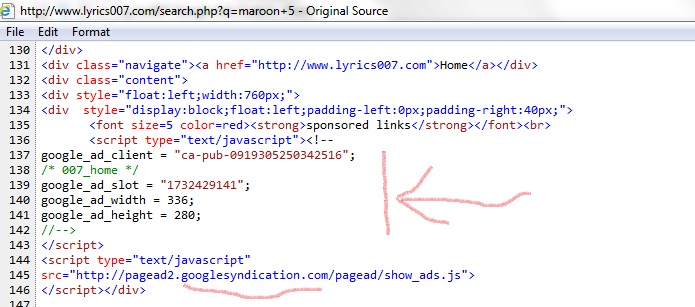
Right.  Of course, this may well be a true statement–except the issue isn’t only about “Google ads”, that is, ads for Google products like this ad for Google Play on a pirate lyric site.

google ads sponsored links 2

And even if they meant any ad served by Google for any product, what if Google ads are a minor source of funds for major pirate sites?  Or are a major source of funds for minor pirate sites?

And what if the “mere presence of Google code” includes the Google ad publisher account number for the pirate?  Does that still count as “mere”?

Isn’t this called a nondenial denial?

Lyrics007 Google Ads Code 1

The Return of Orphan Works: Trojan Horse: Orphan Works and the War on Authors by Brad Holland, Part 3

The Fair Use/Orphan Works Connection: A Lesson from the UK

We would all do well to observe the intellectual property meltdown occuring in the UK largely as the result of the so-called “Google Review” commissioned by the UK government (officially titles the “Hargreaves Review”).   This is particularly acute given the concurrent “agency capture” of the UK’s Intellectual Property Office (roughly equivalent to a combined version of our Patent & Trademark Office and Copyright Office).

We should expect to see Google and its allies (CCIA, CES, various library associations) go for something similar in the Congress that starts this week in the US.

The Register’s Andrew Orlowski sums it up well:

The threat to the sovereignty of the individual now comes from academics and bureaucrats. Parliamentarians spent much of the year studying the radical, activist department of Whitehall called the IPO, the Intellectual Property Office – formerly the Patent Office, which has been behind a succession of moves to strip the individual of his or her rights. The MPs and Lords stopped short of calling for the IPO to be disbanded, but reminded the bureaucrats that copyright is a property right – not a regulatory impediment to some imaginary digital Utopia.

The IPO responded by placing a permanent extension of its powers onto the Coalition’s Business and Enterprise Regulatory Reform Bill (BERR) and seeking, in effect, to “do a Zuckerberg” by statute. Millions of unidentified works, without metadata, would be swept into schemes where they could be commercially exploited without the knowledge of their owner. It’s the only scheme in the world which proposes to allow third parties to rip off the creator for profit. The UK faces a “firestorm” of litigation from overseas, US creators have warned. And expect to see some real fireworks as the Bill moves into report stage.

(Note that China is beefing up its IP – the winner of the new economic wars will be the nation that can best protect and exploit its inventiveness).

Why has Britain been blessed with such a barmy bureaucratic class? They’re undoubtedly sincere in thinking the public would benefit from removing rights from creators. But we could abolish copyright entirely overnight and have an orgy of consumption – only to wake up from the Remixing Party with a headache, discover the creative industries have upped sticks and moved abroad (easier to do than you might think), at a huge cost to future growth and economic opportunities.

Politicians don’t really understand the potential damage, and won’t really appreciate the dangers, until UK businesses decide they need to move outside the UK to protect their work.

The UK government has been mislead by Google into thinking that somehow “fair use” was a cornerstone to the company’s success–naturally, “fair use” as defined by Google has found its way into the Google Review.

Alison Wenham, OBE, chair and chief executive of the Association of Independent Music, confronted Hargreaves at one of the few (if not the only) public meetings to receive comments about the Google Review before the report was issued.  She said:

“’I don’t believe IP is the problem,’ said Alison Wenham, representing independent music companies. ‘One of reasons Google did not start here is nothing to do with IP, it was to do with funding. The US has a rich culture of high risk investment and unfortunately our banking system does not value this, we have a criminal lack of funding for high risk ventures’….‘There’s no lack of business models, there’s a lack of market traction, because we’re all competing with free,’ she said. ‘What safe harbour and fair use has given US copyright owners is zero. Professor Hargreaves, you must be very careful what you wish for.’ Wenham wondered why Google promoted pirate sites so heavily, and why government agencies advertised the pirate sites.”

To which Hargreaves replied [disregarding the fact that the leader of AIM might actually know something about what’s happening in her own industry]: ’I don’t think the current system (of copyright) is serving you well.’  He added, ‘It is clear that in all sorts of ways that the market place for digital content in the UK is a troubled place in all sorts of ways. The Government having a Review will not be able to calm all of those waters. But what we are looking for are ideas to edge forward the ease with which markets with rights work.’”

Like excluding the enforcement of those rights by means of vauge and expansive “fair use” safe harbors.  A close cousin to the “fair use” safe harbor is “orphan works”.

We take a dim view of the “orphan works” theory–it seems to be yet another way of undermining copyright through a back-door safe harbor. If the last effort at “orphan works” legislation was any guide, it will another excuse for copyright infringement–if the infringer doesn’t quite qualify for a “fair use” defense, then they will say that their use of the infringed work is an “orphan” because they tried really, really hard to find the copyright owner, but couldn’t quite seem to find them. We think that “orphan works” puts the fox squarely in the henhouse, and is another clear example of the law creating another moral hazard to the detriment of artists.

We are expecting another push at so-called “orphan works” legislation in the U.S. Congress during the upcoming legislative session because the U.S. Copyright Office is soliciting comments in a Notice of Inquiry proceeding that closes February 4, 2013 (in a few weeks).

We have a lot of readers in the music business, and people in the music business often think that “orphan works” don’t affect them–we have all these databases after all. That places an awful lot of trust in the infringer. Remember–Google specifically asked the Copyright Office to consider users of “millions” of orphan works and the outside counsel for Google seems to be parking the orphanworks.com domain on the EFF’s servers. Still want to be so trusting? What about Google getting 3 million DMCA notices a week for search alone suggests that artists should trust the system?

We are pleased to be able to serialize an excellent article about the history of the “orphan works” movement in the U.S. written by the distinguished illustrator, Brad Holland. We encourage readers to make common cause with the illustrators and photographers who will likely be most harmed by this specious legislation backed by Google the last two times it appeared in the Congress. The article first appeared in the Journal of Biocommunication in 2010 and is used by permission of the author.

If you missed Part 1 of this important article, you can read it here along with Brad’s bio.  You can read Part 2 here.

Keep this thought in mind as you read the article: If orphan works represent a market failure, how can you have a market failure without a market, and how can you have a market without enforceable property rights?

Part 3: Trojan Horse: Orphan Works and the War on Authors, by Brad Holland

A One Day Symposium

If the Glushko-Samuelson Law Clinic conceived the “legislative blueprint” before the Copyright Office commenced its study, what kind of research did the Law Clinic undertake to inform its proposals? Here, in their own words, is how the authors of the plan described it:

“Since 2001, the Glushko-Samuelson Intellectual Property Law Clinic…has provided student attorneys with the opportunity…to work on important public policy projects related to important issues in the field. Clearly, the problem of ‘orphan works’ is one such issue.

“On April 11, 2003, the Clinic held a symposium with scholars, academics and other interested parties to discuss this issue. Since then, the work of CCI has focused its efforts on devising the blueprint for a legislative solution to the ‘orphan works’ problem (hereafter the CCI proposal) and has been in close contact with various non-profit organizations, intellectual practitioners and academics…”23

A footnote on page 2 identifies the eight “clinic students” who allegedly conceived this plan. It also names three organizations whose “representatives…made significant contributions to the proposal.” 24 These include two of the groups we’ve already encountered: Public Knowledge, whose president later praised the Copyright Office for proposing the plan; and the College Art Association, which two years later asked its members to flood the Copyright Office with anecdotes about orphan works “difficulties.” Of course, we shouldn’t be surprised that groups which helped draft the amendment would fully support it. But how plausibly can they argue that the “framework” they helped write between 2003 and 2005 was actually conceived by the Copyright Office only in response to a study the Copyright Office didn’t launch until 2005?

There’s nothing in the Glushko-Samuelson proposal that explains how eight law students had gained any knowledge of the dynamic $187 billion dollar licensing markets their recommendations would affect. Nor does it explain how a one day symposium attended by “non-profit organizations, intellectual practitioners and academics” could shed any serious light on the matter.  Yet the Glushko-Samuelson proposal was adopted by the Copyright Office and passed on to Congress with only slight modifications: where the law students had proposed capping infringement fees at $100, the Copyright Office report changed that to the ambiguous and undefined “reasonable fee.”

Based on this evidence it appears that the Orphan Works bill was cobbled together by marrying the “limitation on remedies” proposed by the Glushko-Samuelson Clinic to the Creative Commons proposal that compulsory registration be imposed on rightsholders in such a way as to appear voluntary. As Creative Commons predicted, this would “move works [probably in the millions of works] into the public domain.”

These works would act effectively as start-up capital to benefit two classes of opportunists: Internet businesses, which could harvest newly-created orphans as their own property to license to others; and entrepreneurs who wish to start new commercial rights-clearance registries, clearing the rights to copyrights that have been registered with them and certifying unregistered works as orphans available for legally-sanctioned infringement. Both types of business would operate essentially as stock houses do now, channeling client contact away from creators and into their own hands.

The Myth of Market Failure

Officially, the goal of forcing copyright holders to rely on private registries was expressed benignly on page 106 of the Copyright Office Report:

“[W]e believe that registries are critically important, if not indispensable, to addressing the orphan works problem, as we explain above. It is our view that such registries are better developed in the private sector…” (Italics added.) 25

But subsequently, in defending their proposal from unexpected opposition, the Report’s principal author began stating the case for registration in more coercive terms. Speaking at “Orphan Works: A Search for Solutions,” hosted by the Progress and Freedom Foundation, March 31, 2006, Jule Sigall, the Copyright Office’s Associate Register for Policy & International Affairs, explained why they had proposed stripping artists of the automatic protection afforded under current copyright law. He said it was necessary to “push” us into handing our work over to the private registries the bill would create. Artists, he said, are like cats who can’t be herded, and:

“You can’t herd cats, but you can move their food…It’s really what kind of incentives, what kind of pressure and how you put on the right pressure.” (Italics added.)26

He justified such coercive measures by blaming visual artists for having failed to create such registries themselves:

“I use this line a lot, photographers and illustrators like to say, ‘We haven’t collectivized.’ This is a problem, generally, for their marketplace. It’s hard to have a marketplace where buyers can’t find sellers.” (Italics added.)27

Nothing expresses the looking glass logic of the Copyright Office proposals better than this apparent belief by the bill’s principal author that an amendment legalizing the infringement of millions of commercial copyrights is necessary so that art directors can find artists. Even a quick glance at a newsstand should dispose of that argument. There are thousands of magazines and daily newspapers filled from cover to cover with photographs and art. There are billions of images published in trade publications, medical journals, ads, annual reports, posters, brochures, catalogues, postcards, greeting cards, surface and fabric designs. How can anyone be surrounded by this sea of pictures and seriously argue that the trade in images is being impeded because clients can’t find artists who have failed to collectivize?

Artists were not the only ones to notice that the Copyright Office lacked any substantial supporting evidence for its Orphan Works recommendations. The Association of Independent Music Publishers and the California Copyright Conference made the same observation in a joint paper published July 15, 2008.

“The Copyright Office,” they wrote, “requested orphan works legislation without having conducted a needs assessment study, an independent audit of its registration and copyright history records, an economic impact analysis, or an evaluation of how the public, society and authors would be affected by reduced quantity and quality of art, film, television, music, video games and other copyrighted works in the future.” 28

The Runaway Scope of the Orphan Works Bill

The assertion of market failure, though entirely unsupported by evidence, took on the authority of fact when presented to Congress with the imprimatur of the Copyright Office. By the time Howard Berman, Chairman of the House Judiciary Subcommittee on Courts, the Internet and Intellectual Property, opened his single hearing on the Orphan Works Act of 2008, he simply cited the premise to decree an end to an author’s exclusive right to control the uses of his or her own intellectual property.

“[W]e should correct a misnomer” [he began]. “The works we’re talking about are not orphans…The more accurate description… is probably an unlocatable copyright owner…this situation better describes the orphan works construct, which is to correct the market failure when a potential user can’t find the copyright owner. But for the sake of ease we’ll keep talking about them as if they’re orphans.” (Italics added.) 29

With this breezy introduction, the Chairman casually brushed aside Article 9.2 of the Berne International Copyright Convention, which states that “[m]ember [countries] shall confine limitations and exceptions to [an author’s] exclusive rights to certain special cases which do not conflict with a normal exploitation of the work and do not unreasonably prejudice the legitimate interests of the rightsholder.” (Emphasis added.) 30

Clearly, by redefining an “abandoned” work as any work by any author that anybody finds sufficiently hard to find, the Orphan Works bill would not limit exceptions to “certain special cases.” Since everybody can be hard for somebody to find, this definition would void every rightsholder’s exclusive right to his or her own property. It would create the public’s right to use private property as a new default position – and creating a new default position for copyright was exactly the deceptive strategy proposed by Creative Commons for “moving works into the public domain.”

The Subcommittee’s hearing lasted less than an hour and a half. No one asked why a bill that was not about orphaned work should be called an Orphan Works bill, even “for the sake of ease.” There were no further hearings on the Orphan Works Act of 2008. The terms of the bill had been decided over the previous two years during closed-door negotiations with special interest groups; and so, with almost casual indifference to facts (or the lack of them), the Orphan Works Act was introduced in March 2008 and placed on the “Rocket Docket” for swift passage by early summer. Despite its “paucity of data,” lawmakers had accepted the Copyright Office report as “a detailed study” of a crisis in commercial markets. The Trojan Horse had done its job.

Deconstructing Authorship

Peter Jaszi is a distinguished legal scholar at the Washington College of Law at American University. Along with Professor Lawrence Lessig, founder of Creative Commons, Jaszi is one of the most influential of a zealous group of legal scholars who believe that laws respecting intellectual property are based on “outdated” concepts of individualism and should be radically changed to favor common “sharing” by the public. As Director of the Glushko-Samuelson Law Clinic, Professor Jaszi could plausibly be characterized as the true Godfather of the Orphan Works bill.

In 1994, the professor co-edited The Construction of Authorship, a book of essays by various contributors subtitled Textual Appropriation in Law and Literature, in which “Appropriation” is clearly intended to mean unauthorized use. In his introduction, Jaszi spelled out his belief that in the new “information environment” created by the Internet, authors, artists and others “may require some kind of legal security [for the work they create] as an incentive to participate [in the creative process, but] they may not need the long, intense protection afforded by conventional copyright — no matter how much they would like to have it.” (Italics added.)31 The punitive tone of the comment is striking.

Copyright, Jaszi argued, is rooted in outdated concepts of “possessive individualism.” 32 He dismisses authorship as a “Romantic paradigm,” 33 a vestige of the 18th and 19th centuries “in which entrepreneurial publishers…[and] entrepreneurial writers…played out their shared conviction that the ‘individual [is] essentially the proprietor of his own person or capacities’ — and thus of whatever can be made of them.” 34 Most writing today,” he argues, “in business, government, industry, the law, the sciences and social sciences — is collaborative.” Therefore he objects to the fact that authorship is still being taught and treated by the law “as if it were a solitary, originary [sic] activity.”35

The professor has criticized the US for joining the international Berne Copyright Convention, calling it “an international agreement grounded in thoroughly Romantic assumptions about creativity.” 36

“The first Act of this preeminent ‘authors’ rights’ treaty in 1886 represented the culmination of a process which got underway in the mid-nineteenth-century with Victor Hugo’s vigorous campaign for the rights of European writers and artists. Other famous ‘authors’ rallied to the cause: Gerhard Joseph suggests that the manic energy with which Charles Dickens championed international copyright stemmed from the novelist’s private insecurities about his own ‘originality.’”37

Note the disparaging quotes around “authors” and “originality.” Professor Jaszi appears to subscribe to the postmodern cliché that all creativity derives from the “transformative” uses of the work of others, and therefore such concepts as authorship and originality are merely covers for one writer’s “vigor” or another’s “insecurities.” There may or may not be any merit to such an argument, but if you’re a working author you might simply guess that Dickens and Hugo campaigned for copyright laws because they wanted to protect the books they wrote.

In The Construction of Authorship Professor Jaszi cites the “critique of authorship” by postmodern literary critics and complains that their theories have “gone unheard by intellectual property lawyers.”

“However enthusiastically legal scholars may have thrown themselves into “deconstructing” other bodies of legal doctrine, copyright has remained untouched by the implications of the Derridean proposition that the inherent instability of meaning derives not from authorial subjectivity but from intertextuality. Above all, the questions posed by Michel Foucault in ‘What Is an Author?’ about the causes and consequences of the persistent, over-determined power of the author construct — with their immediate significance for law — have gone largely unattended by theorists of copyright law, to say nothing of practitioners or, most critically, judges and legislators.” (Emphasis added.)38

Or to put it into plain English, why hasn’t Congress written some debatable literary theories into US statute law? In a Content Agenda interview entitled “10 Pushy Questions,” the professor offered his own answer to that question:

“This is a society built around protection of private property and they’ve [the content industry] been very effective in persuading people that all property is the same. And if you take someone else’s property, that’s theft.  But all property is not the same; there are differences.” (Emphasis added.)39

These differences, of course, refer to intellectual property, and the concept that theft of intellectual property may not be theft can indeed be traced to the French literary critics Professor Jaszi cites as his source of revealed wisdom. In What is an Author? Michel Foucault asserts that authorship is a false concept of ownership arising from a “privileged moment of individualism,”40 a by-product of nineteenth century capitalism. He objectifies creative works as mere “texts,” a pseudo-scientific classification that can include anything from Shakespeare’s plays to “a laundry list;” 41 then he challenges the right of any legal system to treat these texts as “objects of appropriation” by anyone, including the author. 42 Citing the “disappearance of the author function,”43 he predicts a future in which “[a]ll discourses…would then develop in the anonymity of a murmur,” 44 and the questions one would ask about any creative work would not be “whose property is it?” but

“What are the modes of existence of this discourse? Where has it been used, how can it circulate, and who can appropriate it for himself?” (Emphasis added.) 45

Foucault asserts that authors are no longer any more important to the “texts” they create than are their readers, and less important than the enlightened critic who deconstructs the text by means of post-Marxian analysis. In an interview published in L’Express July 6-12, 1984, just before his death, Foucault explained what he had tried to accomplish in his work:

“What did Marx do when in his analysis of capital he came across the problem of the workers’ misery? He refused the customary explanation, which regarded this misery as the effect of a naturally rare cause of a concerted theft. And he said substantially: given what capitalist production is, in its fundamental laws, it cannot help but cause misery.  Capitalism’s raison d’etre is not to starve the workers but it cannot develop without starving them. Marx replaced the denunciation of theft by the analysis of production. Other things being equal, that is approximately what I wanted to say.” (Emphasis added.)46

Jacques Derrida, whose “propositions” Professor Jaszi also suggested should be used to inform US statute law, likewise derived his inspiration from Marx. In his book Specters of Marx, he argued that with the falling-away of state-sponsored Marxism, it’s the duty of modern intellectuals to create a “New [stateless] International” 47 to translate Marxist thought into political action:

“Upon rereading the Manifesto and a few other great works of Marx, I said to myself that I know of few texts in the philosophical tradition, perhaps none, whose lesson seemed more urgent todayIt will always be a fault not to…go beyond scholarly ‘reading’ or ‘discussion.’ It will be more and more a fault, a failing of theoretical, philosophical political responsibility. When the dogma machine and the ‘Marxist’ ideological apparatuses (States, parties, cells, unions, and other places of doctrinal production) are in the process of disappearing, we no longer have any excuse, only alibis, for turning away from this responsibility. There will be no future without this. Not without Marx, no future without Marx, of his genius, of at least one of his spirits.” (Italics in the original, underlines added.)48

Since we now know that the legislative blueprint for the Orphan Works bill was drafted before, not after, the Copyright Office study; and since we know it was drafted by (or under the direction of) Professor Jaszi; and since there’s no reason to doubt the professor’s sincerity in his belief that the laws governing intellectual property should be altered to reflect the opinions of Derrida and Foucault, is there any reason to doubt that the legislative” blueprint” his Law Clinic drafted between 2003 and 2005 reflects this ideological agenda rather than the underwhelming “evidence” of 215 letters submitted in 2005 to the Copyright Office study?

To be continued…

23.  Glushko-Samuelson Intellectual Property Law Clinic, Response to Notice of Inquiry on the Issue of “Orphan Works,” Submitted to the United States Copyright Office, Library of Congress March 24, 2005, Page 2  http://www.copyright.gov/orphan/comments/OW0595-Glushko-Samuelson.pdf

24.  ibid

25.  Report on Orphan Works, A Report of the Register of Copyrights, January 2006 United States Copyright Office, Page 106 http://www.copyright.gov/orphan/orphan-report.pdf

26.  Jule L. Sigall, “Orphan Works: A Search for Solutions,” hosted by the Progress and Freedom Foundation, March 31, 2006. http://www.archive.org/details/PffSeminar-OrphanWorksASearchForSolutions

27.  ibid

28.  Association of Independent Music Publishers (AIMP) and California Copyright Conference (CCC) Joint Position Paper on Orphan Works Legislation, July 15, 2008, Page 2 http://www.brandaideblog.com/pdf/Position_Statement.pdf

29.  Rep. Howard Berman (D-CA), Chairman, Subcommittee on Courts, the Internet, and Intellectual Property; Committee on the Judiciary; United States House of Representatives, Opening Statement: “Orphan Works Problem and Proposed Legislation,” March 13, 2008 http://www.copyright.gov/docs/regstat031308.html Video Testimony of Chairman Berman’s opening comments (requires RealAudio plug-in):
http://www.copyright.gov/video/testimony-3-13-08.html

30.  Article 9.2 Berne Convention for the Protection of Literary and Artistic Works http://www.law.cornell.edu/treaties/berne/9.html

31.  Peter Jaszi, The Construction of Authorship: Textual Appropriation in Law and Literature, Page 12, Edited by Martha Woodmansee and Peter Jaszi, Duke University Press, 1994 http://books.google.com/books?id=dpRKltgJYYwC&printsec=frontcover&dq=Peter+Jaszi,+The+ Construction+of+authorship&hl=en&ei=1UXsS6aJFsH68AaF4NzBCA&sa=X&oi=book_result &ct=result&resnum=1&ved=0CCwQ6AEwAA#v=onepage&q&f=false

32.  Peter Jaszi, The Construction of Authorship: Textual Appropriation in Law and Literature, Page 6 Edited by Martha Woodmansee and Peter Jaszi, Duke University Press, 1994

33.  Peter Jaszi, The Construction of Authorship: Textual Appropriation in Law and Literature, Page 9 Edited by Martha Woodmansee and Peter Jaszi, Duke University Press, 1994

34.  Peter Jaszi, The Construction of Authorship: Textual Appropriation in Law and Literature, Page 6 Edited by Martha Woodmansee and Peter Jaszi, Duke University Press, 1994

35.  Peter Jaszi, The Construction of Authorship: Textual Appropriation in Law and Literature, Page 9 Edited by Martha Woodmansee and Peter Jaszi, Duke University Press, 1994

36.  Peter Jaszi, The Construction of Authorship: Textual Appropriation in Law and Literature, Page 10 Edited by Martha Woodmansee and Peter Jaszi, Duke University Press, 1994

37.  Peter Jaszi, The Construction of Authorship: Textual Appropriation in Law and Literature, Page 9-10 Edited by Martha Woodmansee and Peter Jaszi, Duke University Press, 1994

38.  Peter Jaszi, The Construction of Authorship: Textual Appropriation in Law and Literature, Page 8-9 Edited by Martha Woodmansee and Peter Jaszi, Duke University Press, 1994

39.  Peter Jaszi, “10 Pushy Questions for Peter Jaszi and Patricia Aufderheide” This interview is no longer online, but was once available at http://www.contentagenda.com/info/CA6434467.html (This URL no longer exists)

40.  Michel Foucault, What is an Author? Text of a lecture presented to the Societé Francais de philosophie, February 22, 1969 Translation by Josue V. Harar, Page 1, http://www.scribd.com/doc/11397906/What-is-an-AuthorFoucault

41.  Michel Foucault, What is an Author? Page 3

42.  Michel Foucault, What is an Author? Page 6

43.  Michel Foucault, What is an Author? Page 14

44.  ibid

45.  ibid

46.  Michel Foucault, Interview by Pierre Boncenne, Page 113, Politics, philosophy, culture: interviews and other writings, 1977-1984 by Michel Foucault, Lawrence D. Kritzman, Alan Sheridan, Routledge, Chapman & Hall, Inc. 1988 http://books.google.it/books?id=HfWNHGCw55EC&pg=PA113&lpg=PA113 &dq=michel+foucault+%22+What+did+Marx+do+when+in+his+analysis+of+capital+he+came+across+the+problem +of+the+workers’+misery&source=bl&ots=mQRxyxhm3s&sig=Tnlz6of6aN-V_ak1vosmlpwH-MQ&hl=it&ei= dj_XS8qBE82PsAa84OScAw&sa=X&oi=book_result&ct=result&resnum=1&ved=0CAYQ6AEwAA#v=onepage&q&f=false

47.  Jacques Derrida, Specters of Marx: the State of the Debt, the Work of Mourning, & the New International, Translated by Peggy Kamuf, Routledge 1994, Page 13 http://books.google.it/books?id=sEENbAP5FZsC&dq=derrida++specters+of+marx&printsec=frontcover &source=bn&hl=it&ei=ncXYS6z1OoXdsAbur92FAw&sa=X&oi=book_result&ct=result&resnum=4&ved= 0CBsQ6AEwAw#v=onepage&q&f=false

48.  ibid

The Return of Orphan Works: Trojan Horse: Orphan Works and the War on Authors by Brad Holland, Part 2

Artists have taken note of the recent legislative activity in the European Union regarding “orphan works”.  The European Union defines these works as “works like books, newspaper and magazine articles and films that are still protected by copyright but whose authors or other rightholders are not known or cannot be located or contacted to obtain copyright permissions. Orphan works are part of the collections held by European libraries that might remain untouched without common rules to make their digitisation and online display legally possible.”

Of course, these libraries–the real ones, like the British Museum, not the Google Books Project–have a legitimate interest in digitizing their holdings and making them available online.  However, just as we saw with the Google Books project, Big Tech uses orphan works as a dodge (note that the lobbyist for the “Library Copyright Alliance” also is the lobbyist for the Computer & Communication Industry Association and the Net Coalition–and has been going around the country bashing collecting societies who want payments from his clients.  What’s common to all these things?  Google.

We are expecting another push at so-called “orphan works” legislation in the U.S. Congress during the upcoming legislative session because the U.S. Copyright Office is soliciting comments in a Notice of Inquiry proceeding that closes February 4, 2013 (in a few weeks).

We take a dim view of the “orphan works” theory–it seems to be yet another way of undermining copyright through a back-door safe harbor. If the last effort at “orphan works” legislation was any guide, it will another excuse for copyright infringement–if the infringer doesn’t quite qualify for a “fair use” defense, then they will say that their use of the infringed work is an “orphan” because they tried really, really hard to find the copyright owner, but couldn’t quite seem to find them. We think that “orphan works” puts the fox squarely in the henhouse, and is another clear example of the law creating another moral hazard to the detriment of artists.

We have a lot of readers in the music business, and people in the music business often think that “orphan works” don’t affect them–we have all these databases after all. That places an awful lot of trust in the infringer. Remember–Google specifically asked the Copyright Office to consider users of “millions” of orphan works and the outside counsel for Google seems to be parking the orphanworks.com domain on the EFF’s servers. Still want to be so trusting? What about Google getting 3 million DMCA notices a week for search alone suggests that artists should trust the system? Keep this thought in mind as you read the article: If orphan works represent a market failure, how can you have a market failure without a market, and how can you have a market without enforceable property rights?

We are pleased to be able to serialize an excellent article about the history of the “orphan works” movement in the U.S. written by the distinguished illustrator, Brad Holland. We encourage readers to make common cause with the illustrators and photographers who will likely be most harmed by this specious legislation backed by Google the last two times it appeared in the Congress. The article first appeared in the Journal of Biocommunication in 2010 and is used by permission of the author.

If you missed Part 1 of this important article, you can read it here along with Brad’s bio.

Part 2: Trojan Horse: Orphan Works and the War on Authors, by Brad Holland

Claims Without Evidence

While academics, college professors, and students may have submitted anecdotes to the Copyright Office study, the weightiest contributions appear to have come from big Internet concerns whose business models depend on providing free or cheap access to other people’s intellectual property. These groups invariably submitted statements claiming that creative works once published have virtually no commercial value. A typical example is the joint statement submitted by NetCoalition.com, whose members “include Bloomberg, CNET, Google and Yahoo, as well as a number of smaller state and local ISP associations.” The coalition congratulated the Copyright Office for identifying “a significant issue that requires expeditious resolution.” Then it stated:

“The vast majority of copyrighted works have little or no economic value soon after their creation or publication.”9

This blatant assertion was offered with no evidence of any kind, nor was it even propped up by argument. Indeed, the letter went further (again without evidence) to state that “[a]uthors of such works typically are willing to permit others to reproduce, distribute, perform, or display their works at no charge because the authors still benefit in tangible and intangible ways from their uses.” (Italics added. ) 10

It should be self-evident that such unsupported conclusions are self-serving. Many Internet content providers are dependent on business practices that have invited major lawsuits for infringement. In March 2007, for example, Google filed a mandatory 10-Q Filing with the US Securities and Exchange Commission in which it acknowledged “copyright claims filed against us [by copyright owners] alleging that features of certain of our products and services, including Google Web Search, Google News, Google Video, Google Image Search, Google Book Search and YouTube, infringe their rights.” Google admitted that “[a]dverse results in these lawsuits may include awards of substantial monetary damages, costly royalty or licensing agreements or orders preventing us from offering certain functionalities, and may also result in a change in our business practices, which could result in a loss of revenue for us or otherwise harm our business.” [Italics added.] 11

Having acknowledged their exposure to costly infringement litigation, one can easily understand why such companies might seek to denigrate the value of the work they’ve been charged with infringing. What’s not clear, however, is why the US Copyright Office should urge Congress to undermine the intellectual property rights of citizens based on such claims.

Google Sees Value in Orphan Works

Despite having joined its NetCoalition partners in asserting that orphaned works “have little or no economic value,” Google sang a different tune at the Orphan Works Roundtables on July 26, 2005 in Washington. There, the company’s attorney, Alexander MacGillivray, made it clear that his firm actually believed the work under consideration was worthless only when it still belonged to the people who created it:

“The thing that I would encourage the Copyright Office to consider is not just the very, very small scale – the one user who wants to make use of the [orphaned] work – but also the very, very large scale – and talking in the millions of works.” 12

“Google strongly believes that these orphan works are both worthwhile, useful, and extremely valuable. In fact, I think that’s why most of us are here. We do think there is a lot of value in these works.” 13

“[W]e expect that [Google’s] use of these orphan works will likely be in the 1 million works range…we know that many of them will be in the public domain, that most of their authors won’t care. But there are a few that really will care and they will come forward [to ask for payment] and it will be extremely inefficient for us [to have to pay them].” (All italics added.)14

Four months later, in November 2005, at the same time as the Copyright Office was concluding its Orphan Works study and preparing its final report to Congress, Google made a surprising $3 million contribution to the Library of Congress for its “World Digital Library” project. The Library of Congress oversees Copyright Office activities. While the Library of Congress acknowledged that the World Digital Library project would be supported by public and private partnerships, it appears that Google was the project’s first, largest, and perhaps only private sector contributor. 15

Turning a Legal Fiction into Reality

It’s not a compelling argument for a large global corporation to say it should be allowed to infringe your intellectual property based on its own assurance that your property is worthless. But while Internet powerhouses such as Google can only make such assertions, a more devious strategy has emerged from the small but dedicated core of copyright “reform” attorneys smitten by the romance of mass digitization. Their idea was not simply to claim that small rightsholders’ work is worthless, but to propose a legal metamorphosis that would make it so.

Of particular interest is the 106 page paper “Reform(alizing) Copyright” submitted to the Copyright Office by the advocacy group Creative Commons. In it, attorney Christopher Sprigman proposed a scheme that would effectively roll back the 1976 Copyright Act by requiring artists, writers and others to mark and register every single work they create or find the work deemed (page 491) “commercially valueless”: 16

“[T]his Article proposes a system of formalities that, although nominally voluntary, are de facto mandatory for any rightsholder whose work may have commercial value. Non-compliance with the newstyle formalities would subject works to a perpetual and irrevocable ‘default license’ with royalties set at a very low level, thus effectively moving works into the public domain.” (Emphasis added.) (Pages 490-491)17

The logic behind this proposal is as cynical as it is clearly stated. Since authors, particularly visual artists, would lack the time and resources to mark and register every drawing, painting, photograph or sketch they create, then track and renew these tens of thousands of registrations over a period of decades, billions of copyrighted works by working authors would inevitably fall through the cracks and into the public domain. This would happen not because the authors have actually abandoned their works (which would be the legal presumption), but merely because the law had swamped them with paperwork. In effect, this proposal would turn a legal fiction – that “most copyrighted work has little or no value soon after its creation or publication” – into reality.

The problem with this proposal is that any government that required rightsholders to register their work as a condition of its protection would violate international copyright law. Article 5.2 of the Berne Convention is explicit: “The enjoyment and the exercise of these rights shall not be subject to any formality.”18

So, the question for advocates of registration became how to skirt the letter of the law in pursuit of its violation. The answer turned out to be simple: amend existing copyright law to “limit” the remedies for infringement wherever an infringer can successfully assert an orphan works defense; then promise rights holders that they can sill protect their exposed work, but only by registering it with for-profit databases to be created in the private sector. Then let the marketplace take care of the rest. Once infringers came to rely on these databases as one-stop shopping centers for rights clearance, any work not available from the databases would become a de facto orphan. This would avoid an explicit violation of international copyright law because it would not legally require you to register your work. It would merely redefine your work as an orphan if you didn’t.

According to the official account, this proposal was the result of the Copyright Office’s year-long study. The facts, however, don’t bear this out.

“The Legislative Blueprint”

The essential language of the Orphan Works legislation was written at least a year before the release of the 2006 Copyright Office Report. It was drafted, ostensibly by law students, as a classroom project at the Glushko-Samuelson Intellectual Property Law Clinic under the guidance of its Director, Peter Jaszi and was submitted to the Copyright Office March 24, 2005. In a few simple words, the Glushko-Samuelson Copyright Clearance Initiative (CCI) spelled out the operative feature of the Copyright Office recommendations that were released nearly one year later. From the CCI, Section III (page 5):

“Remedies and Liability “Under no circumstances will Sec. 504 statutory damages, attorneys fees, damages based on the user’s profits or injunctive relief relating to the challenged use be available against a qualified user.

•  If infringement by a qualified user is proved, damages would be limited to the lesser of •  Actual damages or •  An award of $100 per work used, up to a maximum of $500 for any group of works claimed by a single owner and subject to a single use.”19

This “limitation on remedies” was rationalized (page 6) as necessary to guarantee “certainty” to good faith infringers. Supposedly this would protect the “innocent” infringer from ruinous fees or penalties in the event the owner of an infringed orphan “came forward.” It was said this would encourage worthy users to make older works of cultural or historical significance available to the public. If so, it was never explained why the bill would throw the doors wide open to infringement by commercial users. Since the emasculation of penalties would apply throughout the entire world of publishing, it would create a haystack of “legal” infringements in which bad faith infringers could hide like needles.

To pass such a law would pull the only teeth that current copyright law possesses. There’s no other mechanism for copyright enforcement; no Copyright Bureau of Investigation, no Copyright Office Police Force. All copyright owners are responsible for policing their own copyrights, and the existing penalties for infringement are the only mechanism the law gives us to do it with. Provide infringers with certainty and you create massive uncertainty in commercial markets as well as in the lives of all small copyright owners.

This was one of the key objections to the Glushko-Samuelson proposal that medical illustrator Cynthia Turner and I raised on May 9, 2005, when we submitted a critique of the Glushko-Samuelson proposal to the Copyright Office study. 20We faulted it for granting benefits to scholars, consumers, the public – and infringers – at the expense of authors’ rights:

“The Glushko-Samuelson plan proposes a ‘minimalist approach’ to amending Title 17 USC. But what it actually portends is an expansion of fair use by weakening authors’ rights. It would empower users to annul copyrights based on the user’s own definition of due diligence.

“Glushko-Samuelson defines an orphan work (p. 3) ‘as a work for which the copyright owner cannot be reasonably located.’ But it allows the would-be user to define what constitutes a reasonable effort, then it defines ‘reasonable effort’ as ‘a flexible definition that applies to a variety of situations . . .’ It adds: ‘In the rare instances where there is disagreement about whether a search was adequate, the courts are open to make the required determination.”21

“But while sending authors to court to seek relief from abuses,” we concluded (page 5) that the plan “would restrict an author’s ability to seek redress.” In effect this would undermine copyright protections for all but large corporations, which in most cases would have the resources to staff up and register work, then hire sophisticated search technology to police and protect the copyrights they acquire. 22

The full text of our critique can be read on the Copyright Office website, where it’s been sitting [since 2005]. These excerpts should be enough to demonstrate that it reads like an analysis of the final Orphan Works bill; yet we wrote it 10 months before the Copyright Office report was released and more than a year before the House Judiciary Subcommittee unveiled its first legislative draft. Clearly we could not have condemned the Orphan Works plan a year before it was written if the plan itself had not been written sometime before we condemned it.

To be continued..

10.  ibid

11.  United States Securities and Exchange Commission Form 10-Q/A, Amendment No. 1, Quarterly Report Pursuant to Section 13 or 15(d) of the Securities Exchange Act of 1934 For the quarterly period ended March 31, 2007, Page 36  http://investor.google.com/documents/20070331_10-Q.html

12.  United States Copyright Office Transcript of Orphan Works Roundtable, July 26, 2005, Page 21   http://www.copyright.gov/orphan/transcript/0726LOC.PDF

15.  United States Copyright Office Transcript of Orphan Works Roundtable, July 26, 2005, Page 119 http://www.copyright.gov/orphan/transcript/0726LOC.PDF

13. United States Copyright Office Transcript of Orphan Works Roundtable, July 26, 2005, Page 166 http://www.copyright.gov/orphan/transcript/0726LOC.PDF

14. “Library of Congress Launches Effort to Create World Digital Library,” News From the Library of Congress, November 22, 2005 http://www.loc.gov/today/pr/2005/05-250.html

15. Christopher Sprigman, “Reform(alizing) Copyright,” Stanford Law Review Vol. 57: 485 November 2004, Comment to Copyright Office Orphan Works Study, Page 491 http://www.copyright.gov/orphan/comments/OW0643-STM-CreativeCommons.pdf

16. Christopher Sprigman, “Reform(alizing) Copyright,” Stanford Law Review Vol. 57: 485 November 2004, Pages 490-491, Comment to Copyright Office Orphan Works Study http://www.copyright.gov/orphan/comments/OW0643-STM-CreativeCommons.pdf

17. Article 5.2 Berne Convention for the Protection of Literary and Artistic Works http://www.law.cornell.edu/treaties/berne/5.html

18. Glushko-Samuelson Intellectual Property Law Clinic Response to Notice of Inquiry on the Issue of “Orphan Works,” Submitted to the United States Copyright Office, Library of Congress March 24, 2005, Page 5 http://www.copyright.gov/orphan/comments/OW0595-Glushko-Samuelson.pdf

19. Brad Holland and Cynthia Turner, Reply Comment to Copyright Office Orphan Works Study (70FR3739) May 9, 2005 http://www.copyright.gov/orphan/comments/reply/OWR0139-IPA.pdf

20. Brad Holland and Cynthia Turner, Reply Comment to Copyright Office Orphan Works Study (70FR3739) May 9, 2005, Page 3http://www.copyright.gov/orphan/comments/reply/OWR0139-IPA.pdf

21. Brad Holland and Cynthia Turner, Reply Comment to Copyright Office Orphan Works Study (70FR3739) May 9, 2005, Page 5 http://www.copyright.gov/orphan/comments/reply/OWR0139-IPA.pdf

The Return of Orphan Works: Trojan Horse: Orphan Works and the War on Authors by Brad Holland

We at the Trichordist are expecting another push at so-called “orphan works” legislation in the U.S. Congress during the upcoming legislative session.  We take a dim view of the “orphan works” theory–it seems to be yet another way of undermining copyright through a back-door safe harbor.  If the last effort at “orphan works” legislation was any guide, it will another excuse for copyright infringement–if the infringer doesn’t quite qualify for a “fair use” defense, then they will say that their use of the infringed work is an “orphan” because they tried really, really hard to find the copyright owner, but couldn’t quite seem to find them.  We think that “orphan works” puts the fox squarely in the henhouse, and is another clear example of the law creating another moral hazard to the detriment of artists.

We have a lot of readers in the music business, and people in the music business often think that “orphan works” don’t affect them–we have all these databases after all.  That places an awful lot of trust in the infringer.  Remember–Google specifically asked the Copyright Office to consider users of “millions” of orphan works and the outside counsel for Google seems to be parking the orphanworks.com domain on the EFF’s servers.  Still want to be so trusting?  What about Google getting 3 million DMCA notices a week for search alone suggests that artists should trust the system?  Keep this thought in mind as you read the article:  If orphan works represent a market failure, how can you have a market failure without a market, and how can you have a market without enforceable property rights?

We are pleased to be able to serialize an excellent article about the history of the “orphan works” movement in the U.S. written by the distinguished illustrator, Brad Holland.  We encourage readers to make common cause with the illustrators and photographers who will likely be most harmed by this specious legislation backed by Google the last two times it appeared in the Congress.  The article first appeared in the Journal of Biocommunication in 2010.

Part 1: Trojan Horse: Orphan Works and the War on Authors, by Brad Holland

About the Author

Brad Holland is a self taught artist and writer whose work has appeared in Time, Vanity Fair, The New Yorker, Playboy, Rolling Stone, the New York Times and many other national and international publications. His paintings have been exhibited in museums around the world, including one-man exhibitions at the Musée des Beaux-Arts, Clermont-Ferrand, France; the Museum of American Illustration, New York City and the Torino Atrium, Turin, Italy. His satire of the art business, “Express Yourself, It’s Later Than You Think,” first published in The Atlantic Monthly, has been widely republished, both in print and on the Internet. In 2005 he was elected to the Society of Illustrators Hall of Fame.

“During a career that has stretched over three decades,” wrote Steven Heller in Print Magazine, October 2002, “Brad Holland has changed the way illustration is perceived and practiced. By the late ’60s he had helped transform a profession of renderers into one of conceivers, challenging editors and art directors to let him create images that complemented rather than mimicked texts.” In 2000, the editors of the artists’ directory RSVP voted Holland “the one artist, who in our opinion, has had the single greatest impact on the illustration field during the last twenty five years.” Holland has won more awards presented by the New York Society of Illustrators than any other artist in its long history. The American illustrator Mark English has called him “the most important illustrator in America today.”

In the last decade, Holland has become an outspoken advocate for artists’ rights and is a founder of the Illustrators’ Partnership of America. In 2005, he represented artists at the Orphan Works Roundtables held by the US Copyright Office; in 2006, he testified before the Intellectual Property Subcommittees of both the US House and Senate, and in 2008 he and medical illustrator Cynthia Turner led the opposition to the Orphan Works Act of 2008. It was through their lobbying efforts that the US Small Business Administration acted to conduct its own Orphan Works Roundtable at the Salmagundi Club in New York City, August 8, 2008.

Holland is featured in the documentary, “Citizen 3.0 Copyright, Creativity and Contemporary Culture,” available at www.kinobserver.com and his article, “First Things About Secondary Rights,” published by The Columbia Journal of Law and the Arts is available at weblog.ipcentral.info/holland_ColumbiaLaw.pdf

Holland’s blog, Poor Bradford’s Almanac, can be accessed at http://www.drawger.com/holland/?article_id=9022

Introduction

In 2004, lawyers at the US Copyright Office adopted a premise of the anti-copyright lobby that the public is being harmed because some people lack sufficient access to other people’s copyrighted works. In 2006 they released the results of a year-long study, announcing that they had documented evidence of a “market failure” so serious that Congress should amend existing copyright law to spare the world the loss of valuable cultural works.

The changes they proposed would effectively redefine each and every creative work as a potential “orphan,” unless the author takes steps to register it with new commercial registries yet to be created in the private sector. This would reverse the automatic protection currently guaranteed by the 1976 Copyright Act. Yet this radical change to a law protecting private property was to be enacted not by a transparent Congressional debate over new legislation, but through the Trojan Horse of an Orphan Works Amendment that would serve to emasculate the penalties for infringement whenever an infringer believed that he or she had made a “reasonably diligent” but unsuccessful effort to find the rightsholder.

Twice (in 2006 and 2008) the bill’s sponsors have tried to ram this legislation through the US Congress. The last time they nearly succeeded by means of backroom deals. Both times the legislation was stopped by an aggressive opposition campaign led by artists and photographers. Although the legislation’s stated purpose has been to let libraries and museums digitize their archives of old work, the bill would actually permit the widespread commercial infringement of work created by contemporary artists and ordinary citizens. While supporters say the bill would help users find artists so that artists can be paid, the provisions would undermine every artist’s exclusive rights, devalue works in derivative markets, breach contracts past and present, and expose every citizen’s intellectual property to unwanted changes and uses.

When spelled out like this, it’s hard to see why anyone would want such legislation. But if we go to the heart of the matter, we’ll see why some special interest groups have invested so much time and money in the effort.

Harvesting Orphans

The Internet has made it possible for entrepreneurs to create financial empires by supplying the public with access to copyrighted material. The problem for these enterprises is how to cheaply acquire the legal right to license other people’s intellectual property. By redefining millions of copyrighted works as orphans on the premise that some might be, this legislation would allow Internet content providers to profit by harvesting the works this law would orphan, providing their online databases with marketable content they could never afford to create themselves nor license from authors.

To justify this mass transfer of intellectual property from individuals to corporations, scholars of the anti-copyright lobby have whitewashed it as a long-overdue public service. Taking a page from postmodern literary criticism, they argue that individual authorship is a “romantic myth,” suggesting that all creativity comes from the masses and that a change in the law is therefore necessary to give the masses access to their communal property. In this theory then, big Internet corporations would merely be sharing the property of ordinary citizens with other citizens for the greater good of the public.

The idea of a left-wing literary theory employed in the service of a potential corporate rights grab may strike some as incongruous. Yet the fight over this bill is merely one battle in a gathering war on authors that has united opportunists of the right and left. Surprisingly, this effort was launched by a government agency long thought by many to be author-friendly. So to understand the symbiotic relationship that has made left-wing theorists the Remoras of big business, we need to look closely at the document that’s routinely used to justify the amendment: the US Copyright Office’s 2006 Report on Orphan Works.

The Myth of the Big Chill

Public Knowledge is a Washington-based “advocacy group” with a Six Point Plan to “reform” copyright law.1On May 29, 2008, its President and co-founder Gigi Sohn, addressed the 8th Annual Intellectual Property Symposium at the Center for Intellectual Property at the University of Maryland University College. In her speech she presented the official account of how the Orphan Works bill had risen out of the foamy sea of copyright chaos.

“At the urging of libraries, museums, academics like American University Law Professor Peter Jaszi, and advocacy groups like Public Knowledge, the Copyright Office sought public input on the orphan works problem and suggestions for how to deal with it. After receiving some 850 comments from a wide variety of stakeholders, the Copyright Office in 2006 issued a detailed report that showed that there was ample evidence that users were chilled from using works under copyright when they could not find the holder, and that as a result, millions of works were not being used. The Copyright Office proposed a framework for solving this problem that has, for the most part, become the basis of the current legislation.” (Italics added.)2

This official line has become the standard talking point supplied by the Copyright Office to Congressional lawmakers and by lawmakers to their constituents. If you’re one of the tens of thousands of copyright holders who’ve already written Congress to protest this bill, you’ve probably received a version of the talking point in your Congressman’s reply: Congress will do what’s best for all parties and rely for guidance on the detailed Orphan Works Study conducted by the Copyright Office.

But what if this “detailed study,” with its inference of millions of “chilled” copyright users, was based on no more “evidence” than 215 anecdotal letters? What if its legislative “framework” was written not after the year-long study, but before it? Here are the facts. In 2005 the Copyright Office published a Notice of Inquiry3 requesting comments from interested parties on the specific subject of orphaned work. It did not inquire about the workings of commercial markets, and there is no evidence in its subsequent report that business clients have any substantial difficulty finding the authors they wish to work with. While it may seem heretical to suggest that the Copyright Office report contains no evidence to justify its sweeping recommendations, the fact is it doesn’t. How it came to be accepted as an important study requiring the overturning of existing copyright law is quite a story.

A “Paucity of Data”

In its 2006 Report on Orphan Works, the Copyright Office reported “an overwhelming response” to its “year-long study.” The Register of Copyrights testified to Congress that it “documents the nature of the orphan works problem, as synthesized from the more than 850 written comments we received.” 4In a nation of more than 300 million people, 850 letters might not seem like an “overwhelming response.” Yet read the Report itself, and we learn that at least 600 of those letters had to be discounted as irrelevant. Here’s how the Copyright Office itself characterized the results:

Page 17: “The [Copyright] Office received an overwhelming response (by comparison to past studies), receiving 721 initial comments, and 146 reply comments [for a total of 867].”

Page 21: “A large portion of the comments (about 40%) did not identify a specific instance where a copyright owner could not be identified or located.

“Another portion (10%) presented enough specific information for us to conclude that the problem presented was not in fact an orphan works situation.

“Still, approximately 50% of comments did contain information that could fairly be construed as presenting an orphan works situation, and a significant number of those comments (about 45%, or about 24% of all comments) provided enough information about a specific situation for us to conclude that it presented an orphan works situation.” (Italics added.) 5

Twenty four percent of 867 letters equals 215. This means that even by counting “reply comments,” there were no more than 215 letters to the Orphan Works study that could even “be construed” as relevant to the subject. While the President of Public Knowledge has said these comments came from “a wide variety of stakeholders,” it appears they overlooked the stakeholders with the greatest stake of all: authors. Instead, most of the comments appear to have been generated by appeals such as this one, from the College Art Association to its members:

“As you may already know, the U.S. Copyright Office is soliciting formal comments from the public on the problem of ‘orphan’ works… If successful, this initiative could significantly help artists, scholars, and others who use copyrighted images and texts in their creations and writings… In order to make a strong case to the Copyright Office, we need anecdotes – as many as you can think of – about specific instances where scholars or artists have had difficulty using copyrighted materials because the copyright holder cannot be located.” (Emphasis added) 6

By telling artists, scholars, and others that they would “significantly help” creators by flooding the Copyright Office with such anecdotes, what artist, scholar, etc. would not want to help by responding? One wonders though, how accurate is the implication that a scholar’s “inability to locate a copyright holder” could lead to legal peril. In fact, it appears to be at odds with the truth. As the drafters of the 1976 US Copyright Act made clear:

“[I]t is important to realize that the [1976] bill would not restrain scholars from using any work as source material or from making “fair use” of it; the restrictions would extend only to the unauthorized reproduction or distribution of copies of the work, its public performance, or some other use that would actually infringe the copyright owner’s exclusive rights.” (Emphasis added.) U.S. Code, House Historical and Revision Notes Report No. 94-1476, at 136 (1976) 7

We can’t know how many of the 215 “relevant” letters were generated by appeals from such groups as the College Art Association, or how many were based on misinformation regarding the latitude of “fair use” available to copyright users. Yet even if every single letter of the 215 represented a legitimate “orphan works situation,” it would hardly qualify as “ample evidence” that “millions” of potential users are being “chilled from using works under copyright.” In fact, as David Rhodes, President of New York’s School of Visual Arts has observed:

“[I]n its report the Copyright Office provides little or no evidence that there is in fact a problem. There is no systematic review of the various markets to see if they are in fact dysfunctional. All of the supposed examples of the harm caused by orphan works are clearly anecdotal and in a country of 300,000,000 fall far short of the threshold for serious consideration. The Copyright Office’s own paucity of data should lead one to conclude that ‘Orphan Works’ are not a problem at all.” 8

Of course, that’s not what the Copyright Office concluded.

To Be Continued….

Footnotes

  1. Gigi B. Sohn: “The Orphan Works Act of 2008: Copyright Reform Takes Its First Steps,” Presented to the Center for Intellectual Property 8th Annual Intellectual Property Symposium, University of Maryland University College May 29, 2008 http://www.publicknowledge.org/node/1594
  2. ibid
  3. United States Copyright Office, Library of Congress, Notice of Inquiry on Orphan Works, [Federal Register: January 26, 2005 (Volume 70, Number 16)] [Notices] [Page 3739-3743] http://www.copyright.gov/fedreg/2005/70fr3739.html
  4. Register’s testimony on the “Orphan Works Problem and Proposed Legislation” before the Subcommittee on Courts, the Internet, and Intellectual Property; Committee on the Judiciary; United States House of Representatives March 13, 2008 http://www.copyright.gov/video/testimony-3-13-08.html
  5. Report on Orphan Works, A Report of the Register of Copyrights, January 2006 United States Copyright Office    http://www.copyright.gov/orphan/orphan-report.pdf   (Note: download is 133 pages.)
  6. College Art Association. This website appeal is available at: http://web.archive.org/web/20050319091445/www.collegeart.org/orphan-works/
    and the emailed appeal to members can be accessed as a re-post at:
    http://h-net.msu.edu/cgi-bin/logbrowse.pl?trx=vx&list=H-New-Jersey&month=0503&week=a&msg=+ByJSt4DOW0FQI+t+wMbZg&user=&pw
  7. U.S. Code, House Historical and Revision Notes Report No. 94-1476, at 136 (1976) http://www.law.cornell.edu/uscode/html/uscode17/usc_sec_17_00000302—-000-notes.html
  8. David Rhodes, President, School of Visual Arts, U.S. Small Business Administration Roundtable on Orphan Works Legislation, August 8, 2008

Music Technology Policy

The Seattle Weekly’s Chris Kornelis has a thoughtful article today asking why artists came together to oppose the so-called Internet Radio Fairness Act but haven’t consistently been a united front against the unprecedented levels of online theft we’re all too familiar with (read “It’s Time for Artists to Fight Piracy as Vigorously as They’ve Challenged Pandora“).   This is actually a very insightful point because the alliterative piracy and Pandora are more connected than one might think.

Catching Up to the Google Propaganda Machine

Kornelis mentions David Lowery’s “Letter to Emily” which was almost universally received as a balanced and courteous discussion of the underpinnings of piracy as a culture and pointed out how successfully Big Tech has attempted to commoditize music and movies in order to sell hardware and Internet access.  Nowhere is this more prevalent than Google, which has built an entire litigation and lobbying…

View original post 1,177 more words

Happening now…Google is using crony capitalism to dodge another threat to its monopoly.

Music Technology Policy

According to MLex, the Federal Trade Commission is preparing to allow Google to submit a non-binding letter that will describe a few things Google is willing to do to get out of the pesky FTC investigation into its business.  Bowing and scraping to Google…well, maybe not scraping…the FTC is taking an unprecedentedly lax approach that reeks of political favoritism and crony capitalism.

The letter makes no mention of the most serious complaint against Google, which alleged the company deliberately biased its search results to favor its own products….Under the normal settlement procedures, FTC staff draft a consent order with legally binding commitments by which a company must abide….[T]he public can submit comments on the settlement before it is finalized….In the absence of a consent order, companies opposed to the resolution of the Google probe likely won’t have the opportunity to provide formal public comments….Independent observers said privately that they…

View original post 48 more words

Congressional Research Service Memo on Constitutionality of IRFA Section 5

Senator Ron Wyden and his staff director Jayme White were kind enough to ask the Congressional Research Service to conduct a legal analysis of the concerns regarding Section 5 of the so-called “Internet Radio Fairness Act” that we have raised on Trichordist and that David Lowery raised directly with Senator Wyden at the Future of Music Coalition Policy Summit in Washington on November 13.

You can read the entire memo here, but the part that interests us the most is this section:

David Lowery, writing for the Thetrichordist.com, has argued that “Section 5 of IRFA is perhaps the most pernicious part of the bill, for it would make it illegal for anyone to criticize digital sound recording licensees. If IRFA becomes law, artists and artist organizations will need to watch what they say in public in opposition to [certain licensees’]direct licensing efforts.”  It seems that Lowery takes issue with the use of the words”any action” that would”prohibit, interfere with, or impede”negotiations.

He argues that these terms are too broad and could apply even to those who would criticize licensees for attempting to negotiate direct licenses with copyright owners. Another concern cited by Lowery in opposition toSection 5 is the ambiguity inherent in the language “any copyright owners acting jointly.”

This language does not necessarily seem to be limited to large member-based royalty collection organizations like SoundExchange. It may be broad enough to encompass, for example,the members of an individual band, who might be considered to be individual copyright owners, acting jointly. Under this broadreading of the language, an argument could be made that a band, posting its criticisms of direct licensing negotiations between a licenseeand a copyright owner, would betaking an action that would interfere with a direct licensing negotiation, therebyviolating Section 5.

Though this hypothetical presents a broad interpretation of the language of Section 5, it is not an implausible one. It is possible that the language may be broad enough to cover a blog post by a band expressing their opinion regarding contract negotiations between a licensee and a copyright owner. Nonetheless, it seems unlikely that, in practice, Section 5 would impinge upon First Amendment rights….

But it’s not “implausible.”