For the past 20 months or so the Trichordist has been almost exclusively focused on artists rights in the digital age. In particular we have zeroed in on two main issues and suggested solutions.
#1 Government Mandated Digital Uses and Pricing of Songs and Recordings Should be Ended
The Government and institutional mechanisms that limit artists’ choice over how to monetize their recordings and involuntarily collectivize their songs and recordings for the benefit of wealthy technology firms should be ended.
The compulsory licenses and antiquated DOJ consent decrees have become massive subsidies from songwriters (especially) and performers to webcasters and on demand streaming services. Spotify and Pandora have market caps well in excess of $4 billion! (EMI was recently sold for $2.1 billion.) Apple and Google recently started webcasting services and are the largest tech companies in the world. Why do these companies need help from the US Government?
While many songwriters find it personally insulting that they are often paid micropennies per digital spin the truth is that no one can really tell you the fair rate per spin for any particular song. Songwriters and artists can’t. Spotify can’t. Pandora can’t. Neither can BMG, Sony nor the US Congress. This is because there is not really a free market in songs and recordings in the US to set those fair prices. This is easily solved: Create one.
That is why we are simply asking our government to dismantle the regulations that prevent a free market in songs and recordings from developing. We are asking our government to dismantle the biggest impediment to a free market: The rate courts and consent decrees that keep a free market from developing for songwriters. At a minimum, our government could at least allow an “opt out” for artists and songwriters so that compulsory rates become a “floor” rather than a “ceiling”.
It should be noted that contrary to what some in the technology press have been saying, we are not asking for special treatment, handouts or subsidies for artists and songwriters. We aren’t asking for special legislation to protect prices for our industry. We are not asking to be protected from the disruptions caused by technological innovations. To the contrary, it’s the webcasters, broadcaster and Silicon Valley giants that have lobbied Congress for royalty fixing legislation to prevent “disruption” of their business models.
#2 Ad Supported Piracy. Payment Processor Supported Piracy.
The second thing we have focused on is ad and payment processor supported piracy. Virtually every major music piracy website seems to sell their inventory for some kind of advertising . Some sites proudly display advertising from Fortune 500 companies. Others sites charge premium subscriptions for faster downloads with the complicity of companies like Paypal, Mastercard, Amex and Visa.
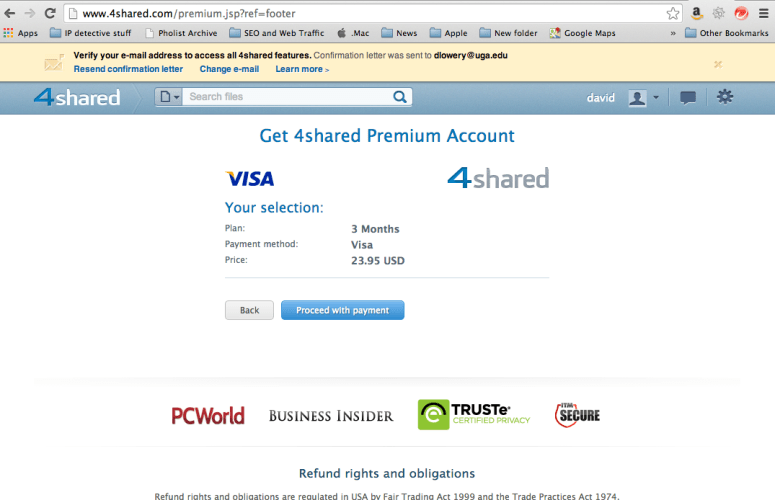
This is ridiculous–massive banks and credit card companies (that got a huge taxpayer bailout which we’ve never asked for or gotten) profit from massive theft. It is very easy to find out which sites are likely involved high levels of infringement–just ask creators if they ever licensed the site. Credit card companies do all kinds of checking on creditworthiness, why don’t they check on dishonesty?
If asking doesn’t “scale,” Google helpfully provides The Google Transparency Report on number of DMCA takedown notices (copyright infringement notices) associated with each site–notices that Google has acknowledged are over 90% accurate. An advertiser or payment processor need only look at this link.
I am not a lawyer but I understand that mass copyright infringement is a predicate for federal prosecutors to bring a case under the Racketeer Influenced and Corrupt Organizations Act or “RICO”–which is the law that the government used to take down white collar criminals like Michael Milken (a Gordon Gekko figure who may have done a lot of things but who wasn’t engaged in global advertising fraud). I believe that at the very least the federal government should be investigating the online advertising industry and the payment processors to see if they are knowingly involved in any criminal conspiracies associated with these sites. (Processing payments? Paying ad revenue to pirates? How could they not be? Don’t the accountants and bankers who “move” money for the mob usually go to jail? Orange Is The New Black?)
But this is unlikely to happen. The Federal Government, in particular the Department of Justice and the Federal Trade Commission seem unwilling to give even slaps on the wrists to the companies involved in these practices. In particular frequent White House dinner guest Eric Schmidt and his company Google.
While this may seem like a wild accusation to some, it seems to be supported by objective facts. If the federal government will fine Google a measly $25,000 dollars in the NSA-like Google Maps “WiSpy” data vacuuming scandal why would they bother with a silly thing like RICO criminal acts? $25,000 dollars? Think about it. This is a $370 billion company. They make $25,000 in seconds.
Well that’s just one isolated case right? Google doesn’t get special treatment. Right.
Sadly it looks like they do.
Ever heard of the Google drugs case? This was a CRIMINAL international drug trafficking case brought against Google by the Rhode Island US Attorney’s office. Google paid a $500,000,000 dollar fine in that case to avoid CRIMINAL prosecution.
Well that sounds better. They didn’t get away with that!
Really? Since when do people pay fines instead of going to jail for being key part of promoting organized international drug operations? Since when does the DOJ purportedly offer an apology for prosecution, as the Wall Street Journal reports?
This Is What Corruption Looks Like
So after 20 months of arguing for artists rights in the digital age I’ve come to the conclusion that this goes way beyond a few thousands artists losing 2/3 their revenue to shady websites with the complicity of multi billion dollar corporations. This is much worse.
We have monopolistic companies doing bad things on a scale we haven’t seen since the days of the Robber Barons. And getting away with it. The most positive spin I can put on it? We have the same old “Pay to Play Democracy” except this time instead of picking our pockets they are only picking our data. We should call it what it is:
Corruption.
We need a new Teddy Roosevelt to “Bust these Internet Trusts”.
Our love affair with the internet has left us blinded to the enormous power that these companies hold over our government and our daily lives. It has blinded us to the massive invasions of privacy and and attempts to collectivize our private data, personal information and even our photos with no protection from our federal government.
Why are we letting these giant monopolies develop? Has anyone considered that a single search engine controls nearly 70% of all web searches in the US. Recently Google “demoted” both JC Penny and Rap Genius in search results for using “black hat” search engine optimization techniques. These are not laws that were broken. This is a private company’s arbitrary rules (they “black hat” their own properties like YouTube) What’s to stop them “demoting” one political candidate and “promoting” another one? How would you ever know if they have already done it?
What’s to stop them from sharing their vast store of data on us with government spy agencies or the political candidates they favor. How do we know they haven’t already done this, too?
My Songs = Your Instagram Photos.
Remember the Instagram Terms of Service changes? They get to use your photos for advertising? Without your permission? The Internets went crazy. That’s exactly the same thing these Silicon Valley companies (that are essentially just big advertising agencies) have been doing with my songs and lyrics for years. They slather advertising on sites that don’t ask my permission to use my songs or lyrics. I don’t get any of the revenue and no one will stop them because they are too politically powerful.
If they can do this with my songs they WILL do it with your Instagram photos. Your FaceBook profile, your Google+photos. (Heard of “shared endorsements”?) It’s just a matter of time!
Oh, wait–they’ve already done it. Facebook sponsored stories. And Google plus shared endorsements. These “services” probably weren’t part of the deal when you first signed up for these “convenient” and “free” services. Right? Facebook and Google just changed their terms of service. And then helped themselves to your identity and photos. “Permissionless Innovation” is what the suits in Silicon Valley call it (as if that’s a good thing).
Here’s The Washington Post succinctly on the subject:
“But critics say tactics that further exploit the data people leave online amount to a bait-and-switch. People signed up for Google’s services because they were free and convenient. They probably never thought their words and identities would be put in front of strangers to sell a product.”
New Statement Of Purpose.
Well I’ve oversold this a little. There isn’t really a new statement of purpose. Just simply we are expanding the blog to cover more than just artists rights.
Why?
Your average Internet user is being exploited in exactly same way that the artists are. You are being exploited by exactly the same companies. Ad supported piracy? What’s the difference from “shared endorsements”? They take something that belongs to you without your permission. They then sell advertising against it and keep all the money without letting you set the price–much less paying you a share of the revenue.
It’s time that the average Internet user understands that the web is something we collectively created. And when it doesn’t work the way we want it to? We can change it. We can make it better. We can upgrade it. The web doesn’t belong to these multibillion dollar internet behemoths. It belongs to all of us. And these companies need to play by the same set of rules that the rest of us play by.





You must be logged in to post a comment.