The Absurd CRB Rates: Wage Stagnation Exposed Kafka Style

“The nine most terrifying words in the English language are, ‘I’m from the government and I’m here to help.'”

Ronald Reagan

This week we all got a glimpse of what the government thinks we’re all worth compared to Silicon Valley:  Not much.  Run along little artists and be glad that Washington allows you to keep any of the value of your work.

How do we know this?  The Copyright Royalty Board handed down its decision on what music is worth for a variety of the compulsory license rates that benefit Pandora, Clear Channel (iHeart), the National Association of Broadcasters, and other multinational corporate members of the trillion dollar lobbying group known as the MIC Coalition.  The rates  only apply to services that are not “interactive” like Pandora and iHeart most prominently.

The rates were set in some relationship to Pandora’s direct deal with Merlin and iHeart’s deal with Warner Music–that’s the main reason the 2016 rates are so low.  Of course Merlin and Warner Music got other goodies like steering payola that nobody else gets (in fact, we’d be very surprised if any Merlin or Warner artist has any idea what the royalty rate is under either of these deals).

That must be why the CRB asked the Register of Copyright if the CRB could set two different rates, one for the indies that were part of Merlin and who got the non-cash goodies and steering payola and the other for everyone else.  It would be entirely logical that the Merlin and Warner rates would be lower and maybe a lot lower than the rate the CRB set for everyone else (because Merlin and Warner artists will still get paid under the direct steering payola deals but using those rates as a benchmark dragged down everyone else in the world).

Since the Register of Copyrights ruled that two rates are not permitted the CRB had a choice–refer the direct deals with Pandora and iHeart to the FCC for a ruling on whether steering payola is illegal, ignore the direct deals with Merlin and iHeart (which may be illegal contracts based on the steering payola pending a determination by the FCC in the payola waiver petition filed by members of the MIC Coalition) because the rates are not good benchmarks and set their own rates, or pretend that the steering payola rates should be applied to everyone else.  (Note that A2IM, AFM and SAG-AFTRA had a heart attack objecting to indie rates compared to other label rates, with at least A2IM probably knowing all along that this would drag everyone down toward the Merlin rates to which many of their members were parties.)

This is what’s become known as the “Chris Harrison special” (named for the former lawyer for DMX and Pandora, now at SiriusXM, who makes a career out of screwing artists and songwriters).  The trick is that the company does a deal for a low royalty rate plus non-cash goodies with big companies and then shoves the low royalty with NO non-cash goodies on everyone else.  We know he did this.  Billboard reported that he did this and that the same dance could happen with Web IV.  With all the brain power at Merlin and Warner, don’t you think that they could have seen this coming?  They got theirs and left us to fight over the scraps.

It’s actually pretty fair to say that these two deals totally screwed the entire music business.  Thanks Merlin and Warner.  Merry fucking dumbass Christmas to you, too.

We’ll have more to say about this, but let’s talk about the other bunch of fools, the Copyright Royalty Board.  Not only did they buy into the Chris Harrison bullshit, they also added some of their own–they indexed the royalty rate so that it only increases based on what is essentially increases in the rate of inflation applied to the Chris Harrison-era 2016 rate.

FOR FIVE YEARS!

Think about that–what that means is that the 2016 rate essentially stays the same for the full five years of the CRB decision.  This is called “wage stagnation”–a classic case of it in fact.  It’s one thing when wage stagnation happens in the market place.  This isn’t that.  This is government mandated wage stagnation for the benefit of Pandora, Clear Channel/iHeart, Google and the rest of the MIC Coalition.

Maybe the bully boys from Washington thought we should be happy that inflation doesn’t eat into our measly royalty rate?  Did they think there would be dancing in the streets that the government only put their boot on our necks and didn’t cut our guts out, too?

Or maybe they thought we’d be too dumb to notice that they are giving us a flat rate for five years regardless of the value of music.  It’s not implausible to believe that it was their intention to devalue music–at least if you’re not getting the non-cash goodies given to Merlin and Warner.

Here’s the language that applies to royalty rates after 2016 using the CPI (which doesn’t stand for “Create Pandora Income” but you wouldn’t know it):

(c) Annual royalty fee adjustment. The Copyright Royalty Judges shall adjust the royalty fees each year to reflect any changes occurring in the cost of living as determined by the most recent Consumer Price Index (for all consumers and for all items) (CPI-U) published by the Secretary of Labor before December 1 of the preceding year. The adjusted rate shall be rounded to the nearest fourth decimal place. The Judges shall publish notice of the adjusted fees in the Federal Register at least 25 days before January 1. The adjusted fees shall be effective on January 1.

This is just ridiculous.  Let’s leave aside whether the CPI arithmetic mean formula (the “Laspeyres formula”) used by the Bureau of Labor Statistics even makes sense applied to music, let’s leave aside the fact that the entire federal government starting with the Federal Reserve is doing everything humanly possible to keep inflation as low as possible for largely political reasons, and let’s leave aside the fact that the Federal Reserve (and other central banks) has been in lala land with quantitative easing and other indirect forms of printing money to keep the 99% economy from collapsing since 2008.

Let’s also leave aside that the “CPI-U” rate that the CRB chose for us is for urban consumers only and never has included an “expenditure category” for music, entertainment or even “leisure” activities.  (Neither has the producer price index.)  The only connection between CPI-U and artists is what it costs everyone in the economy to live, not to produce music–and will necessarily underweight certain costs to artists like oh, say, GASOLINE.  Everyone uses gasoline, but artists probably use a lot more of it because we have to tour because record sales are in the toilet right next to webcasting rates thanks to the little intellectual elite in a far-away Eastern city.  We use gasoline to produce a product–music–not to drive to work like judges at the CRB.

Out of touch and mean-spirited.

And by the way–indexing everyone’s royalty rate to the CPI-U means that artists who live outside the U.S. will have their U.S. royalty rates pegged to U.S. inflation.  Can we expect to get the same treatment for royalties earned by U.S. artists overseas that SoundExchange collects?

This whole indexing idea is just stupid and it’s insulting.  Not only does it freeze our royalty rates for five years, it also guarantees that any increase in the value of music through the government licenses goes 100% to the services.  It is not shared by the services with featured artists, labels, musicians and vocalists.  The CRB just rewarded what economists call “rent seeking behavior” and what we call being a scumbag.

The geniuses in Washington just told us that they’re going to freeze our royalties and that they think we’re too stupid to know the difference.

Remember–the federal government froze the mechanical royalty rate paid to songwriters at two cents from 1909-1977.  Sixty eight years baby.
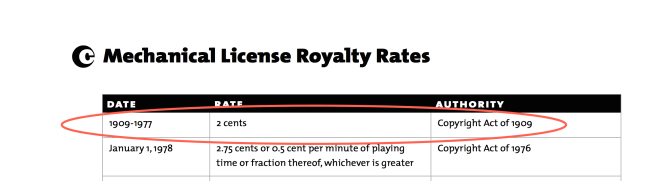
Mechanical Rate 1909
Copyright Office Historical Mechanical Rates

If you adjusted for inflation that two cents would be worth over 50¢ today–but it still would have the same buying power as two cents in 1909.  If they did it to the songwriters, they’ll do it to the artists, too.

If we don’t stop the runaway CRB, we may have to live with the consequences for a long time to come.  If you think this is wrong, let the Copyright Office know.  You can write to the Register of Copyrights directly at their public communication page:

http://copyright.gov/help/index.html

half cent
Will Pandora Bring Back the Half Cent Coin?


What Does BMG v. Cox mean for the Copyright Alert System

Music Technology Policy

A Virginia jury today handed down a $25 million judgement in favor of BMG for willful contributory copyright infringement by Cox Communications following what was apparently a very brief deliberation.  There will be much written about the case, but let’s think for a moment about what it means for the Copyright Alert System.

The judge in the case ruled earlier in pre-trial motions that Cox had failed to maintain an effective repeat infringer policy and procedure.  What seems to have been most compelling to the judge was that Cox didn’t do enough in terminating repeat infringers although the company did temporarily suspend access to a users Internet connection.

That is interesting because the Copyright Alert System (which involves the largest US ISPs) is essentially a system of notices and alerts that never results in what seemed to be important to the court in Cox–termination.  Which is actually just…

View original post 109 more words

Jury Rules For BMG on Cox Media P2P Piracy

Details are still slim, but it looks like a victory for artists and rightsholders.  Court agrees ISPs are supposed to have real policy for disconnecting repeat infringers.  Cox basically had a “fake” cutoff  policy and lost DMCA protections. Fox is now liable for user’s infringement.

Law360, Washington (December 17, 2015, 12:38 PM ET) — Internet service provider Cox Communications must pay music publisher BMG Rights Management $25 million for turning a blind eye to illegal music downloads by its subscribers, a Virginia federal jury found in a verdict Thursday, holding the ISP guilty of willful contributory copyright infringement.

http://www.law360.com/topnews/articles/739353/breaking-cox-must-pay-bmg-25m-for-user-piracy-jury-finds

Opt Out of Pandora’s Purchase of Rdio

Remember that Pandora is buying some assets from the Rdio bankruptcy with the intention to expand its webcasting service into a windowing service like Spotify?  How can they do that you may ask?  Don’t the licenses for those recordings and songs terminate in a bankruptcy?

Check your email–you may have received this notice from Pandora with the misleading subject line (with our emphasis):

We’re writing in regard to Pandora’s recent announcement that it plans to acquire certain assets from Rdio.  We’re currently working to finalize the transaction and are extremely excited about the opportunities this acquisition will bring not only to Pandora, but to the music industry as a whole.  With that in mind, we wanted to reach out regarding your company’s musical compositions embodied in sound recordings (the “Content”) stored on Rdio’s servers. As part of our acquisition of Rdio’s assets, we would like to retain the Content contained on these servers for possible inclusion in expanded Pandora service offerings in the future.

To be clear, Pandora will not launch expanded service offerings without acquiring the appropriate licenses. In addition, we will access the Content for possible ingestion into our Music Genome Project. We believe that retaining this Content is the surest way for Pandora to include your compositions upon the launch of any expanded service.  However, if you would prefer that your musical compositions not be included at this time, please follow the link below and indicate your intent to opt-out.

Pandora Media, Inc.
2101 Webster St., Suite 1650
Oakland, CA 94610

ConsentInquiries@pandora.com

Please click the following link if you wish to opt out:
https://www.musicreports.com%5Bredacted%5D

Why are they sending this email around?  If Pandora wants to launch an on-demand service, they’re very likely going to need negotiated licenses or licenses like the ones Rdio already holds.  This is all new to Pandora–Pandora executives are to hiding behind the federal government to protect their business and guarantee them a multimillion dollar payday for that 14 bathroom vacation house they’ve always wanted.

If Rdio has a license from you for your songs, Pandora may recognize that those licenses cannot be transferred from Rdio to Pandora in the Rdio bankruptcy.  Why else would they be asking you to opt in to a new license in this misleading email?  But wait…they never say they’re asking you to opt in, they’re offering you a chance to opt out.

And wait and see–if you don’t respond, they will say that they offered you a chance to opt out, so by not opting out they will deem you to have opted in.  Pretty scummy, right?  And how do we know this?  Because it’s what a scumbag would do.  Then naturally its what Pandora would do.  Very predictable.

The problem is that you have no idea what the business model will be of whatever new service it is that Pandora may launch, so why in the world would anyone ever agree to a license for a business before you even know what the business is?  How would you ever know what’s fair?

It seems like the only smart thing to do if you’ve gotten this email is to opt out immediately.  If you decide to opt out, it would probably be a good idea to follow up with a letter telling Pandora that you want no part of it.

Here’s an interesting side note.  Check out this sentence:

In addition, we will access the Content for possible ingestion into our Music Genome Project.

That sounds like Music Genome rights would be included in whatever license Pandora wants, and if you opt out, Pandora would not have the rights to “ingest” (lovely) your songs.  It sounds like Pandora might think they need a license to map your song into Pandora’s “Music Genome”.  That’s interesting because we do, too.

We’ve thought for a long time that Pandora needed a license for each song in the Music Genome and that the use of an artist’s name to create channels also needed a separate license for the use of the artist’s name.

Unless you’re in the habit of buying pigs in pokes, you could do worse than to opt out of any license you ever granted to Rdio and tell your publisher to do the same.  Once Pandora can tell you exactly what they want to do with your song, you can always change your mind.

After what they’ve done to artists and songwriters, who would ever trust these corrupt guys if the government didn’t force you to?

Pandora’s Shell Game with Royalty and Revenue

Here’s why Pandora should not get lower rates!

Music Technology Policy

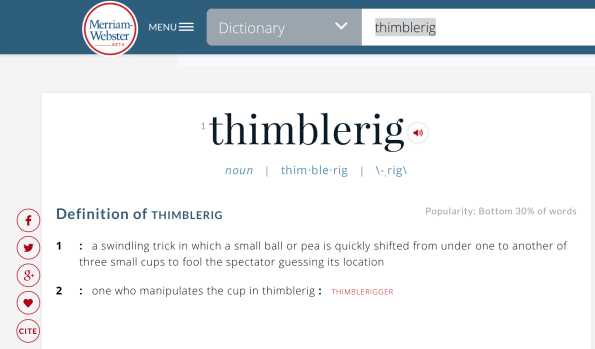
thimblerig definition

Remember when Pandora used to complain about how royalty costs were over half their revenue?  Let’s take a look at their income statement for the last 12 months (“trailing twelve months” or “ttm”) from Yahoo! Finance:

Pandora Income Statement

“Total Revenue” of $1,100,000,000.  Because as Sean Parker will tell you, you know what’s really cool?  A billion dollars.

“Total Cash” of $363,600,000.

And at least at the moment, zero debt.

So stop right there–what do you think the response would be if you walked into any business school in the world (and not just the good ones) and asked the first MBA you met this question: How would you like a case study of a public company that has a $2.69 billion market cap, and that has government mandated vendors (that’s the artists and songwriters) whose selling price (aka royalties) is set below market by the government, and that has a billion…

View original post 592 more words

Music Director at WJCU Breaks with National Association of Broadcasters in Letter to Congress Supporting Artist Pay for Radio Play

Music Technology Policy

[Editor Charlie sez: It’s the end of 2015 and it’s time to look over the good news that came during the year.  For those MTP readers who missed the interview with Karoline Kramer-Gould, the heroic Music Director at tastemaker college radio station WJCU, here’s the reprint from Chris’s blog on Huffington Post.  If you already saw it, it’s well worth a re-read to remind you that we do have friends–a lot of friends–in radio who support treating artists fairly and who have devoted their lives to music every bit as much as artists and musicians have.  What makes Karoline so special is that she was willing to stand up for what she believes in and speak truth to the MIC Coalition.]

The United States is the only democracy in the world that does not pay recording artists for radio airplay. Artists and record labels have been fighting a legislative battle…

View original post 2,521 more words

An Open Response to Peter Sunde | David Newhoff @ TIOM

The Pirate Bay’s Peter Sunde has recently stated he’s given up. His interview can be read here. David Newhoff at the Illusion Of More responds to Sunde in a brilliant open letter that is required reading.

This is what comes of evangelizing the idea that it’s okay to exploit other people’s investment of real labor and real capital in goods and services that would otherwise have regenerative value. And exploiting these types of investments is precisely what you and your colleagues did with The Pirate Bay.

At least part of the Internet you don’t like is what comes of preaching to a whole generation that they can have whatever they want, free of charge, as long as it’s just a mouse click away.  And indeed, we are lately seeing the wheels come off that naive (and frankly predatory) idea. As the leaders of Pandora and Spotify begin to see that “freemium” isn’t a business model; as Facebook’s video service “freeboots” the promised ad-share value out of the pockets of YouTube creators; and as the global network of pirate sites is revealed to be a malware-infested and sophisticated black market that preys on individual consumers, you seem to have missed the point, Peter. The “fight” you lost is not with the MPAA and the principles of real capitalism—but with the unfettered greed you helped foster on the Internet you asked for.

READ THE ENTIRE POST AT THE ILLUSION OF MORE:
http://illusionofmore.com/an-open-response-to-peter-sunde/

Three Simple Steps To Fix The Record Business in 2016… Windows, Windows, Windows…

windows

This time last year we correctly predicted the restructuring of at least one major label group when we asked the question, “Who will be the First Fired Label Execs over Spotify Fiasco & Cannibalization?“. It didn’t take long for us to find out, “It’s Just Math : Digital Music Execs Exit, But will the Pivot to Paid Subs Be Enough To Save The Record Biz?” We’re still not sure that even paid subscription streaming actually works in the long term, but we know for sure that unlimited free streaming does not!

What a difference a year makes. What a difference Taylor Swift makes. What a difference Adele makes.

Going into the next year our prediction is that the power of windows can not be overstated as the leading solution to the problems faced by the record industry. Effective windowing has always been a part of the economic life cycle of every album release. The physical singles sales business (ya’ll remember 45 prm records, right?) – well, that was largely a loss leader to boost singles chart positioning that combined retail and radio reports.

In every record store there was the “hit wall” of discounted new releases to encourage higher volume sales. Every store stocked a robust variety of titles across different genres and price points comprised of front line titles, mid-line titles, budget line titles, and at the end there was the cut-out bin. Also, let us not forget the “11 records for a penny” record clubs advertised in magazines.

Those, my friends, are windows. Those who are advocating against windows are probably too young to know better or have been lead around by the nose by some digital snake oil salesman protecting their own interests.

This is not a philosophical discussion. This is financial reality. Respected stock analyst Robert Tullo who is the Director Of Research at Albert Fried & Company says this:

Longer term IP Radio and Spotify are good annuity revenue streams and great promotional tools. However, we believe the system works better for everyone when artists have the right to distribute their Intellectual property how they see fit.

Ultimately we think windows for content will form around titles that look much like the Movie Windows and that will be great for investors and the industry as soon as all these so called experts get out of the way and spot trading fashionable digital dimes for real growth and earnings.

Mr. Tullo is correct. Not only will artist (and rights holders) do better when they have the freedom of choice but so will the partner platforms. This is how it works in the film business. Every month the “virtual inventory” on Netflix is rotated. New titles come in, old titles go out. If you really, really, really want to see something right now, you have to rent it or buy it via a transactional stream or download. The record business will benefit from the same models and strategies. Windowing works. Period.

See here’s the thing… If these new digital platforms are so great for artists, why wouldn’t artists want to participate on them?  The benefits would be self evident? If the product that Spotify, Pandora, YouTube (and others) are offering is so good for artists, why are these companies so afraid of artists and rights holders opting out? Maybe, just maybe these platforms are not offering the type of value that their suppliers find meaningful?

It really speaks volumes when a business model is so bad that one of  the essential features for survival of the company is to deny its suppliers the option to fairly negotiate their participation or have the ability to opt out. In the old neighborhoods that was known as a protection racket, or extortion.

Silicon Valley didn’t invent the freemium, they’re just doing it wrong. Really wrong. Horribly wrong.

Let those who want to give away their work freely do so, but also allow those who would rather opt out the ability to do so. If artists find value in the freemium tier, and they may well as they always have, then let them chose how to best utilize that option. Musicians pioneered the freemium model often using street teams to canvas concerts by giving away cassettes to fans of similar music.

If digital platforms allowed artists to use their technologies creatively, everyone might be pleasantly surprised how much better (and more profitable) things would work out.

Watching Pandora lose $5 billion in value in a year becomes a punch line when they believe they are better suited to dictate to artists how to best communicate with their own fans. It is indeed interesting to see Pandora admit what we’ve been saying for years, unlimited, ad-supported free streaming unsustainable. No Kidding. Here it is from Brian Andrews, CEO of Pandora:

“This gray market is unsustainable. If consumers can legally listen to free on-demand music permanently without converting to paying models, the value of music will continue to spiral downward to the benefit of no one.”

Of course what makes this comment most interesting is that Pandora is entering the crowded field of on demand streaming with it’s purchase of the failed Rdio. Pandora now has to compete with Spotify’s very large free tier of unpaid and entrenched users. Migrating those users to a new on-demand streaming platform will be a challenge (ask Apple and Tidal), and even more so as artists and labels grow tired of subsidizing these horribly flawed business models.

Here’s three uses of freemium streaming most artists (and rights holders) would probably embrace if given the choice.

1: The Hit Single

– Using the freemium platform to launch a single to gain ubiquitous awareness of a new album release. This is what both Taylor Swift and Adele did and the results speak for themselves. More artists would probably embrace releasing one or two songs or singles from an album on freemium tiers. With the artists support this becomes far more valuable than extorting the them into releasing their entire album on a platform they feel devalues their work.

BONUS: What if Adele made an official playlist of her favorite songs, leading with her new single? How much added value does an artist of this caliber bring to a platform when they feel they are being respected and valued? Answer, ALOT.

2: The Focus Track

– Not everyone has a hit single, but most artists have a focus track from their album. Like the hit single, these artists would embrace the opportunity to be discoverable and to build an audience of new fans. Developing artists are the most eager to try new opportunities because the have the most to gain. If digital streaming platforms worked with artists in a meaningful and respectful way, the mutual benefits could be huge for everyone.

3: Rotating Inventory Management

– By adopting a Netflix like inventory management of monthly rotating titles on the freemium (or even paid subscription) tier more artists might feel compelled to be more engaged. Rotating inventory management is a smart way to keep users and fans engaged as old titles rotate out and new ones in. This simple trick restores a great deal of the consumer engagement that is a part of discovery, and promotion.

Of course, the goal of every freemium model is to lead to more paid revenues in higher value products. Working together with artists and rights holders the future of streaming distribution could be very bright. But to get there we need to let go of Stockholm Syndrome. the old neighborhood protection rackets, bullying extortion threats and just plain bad business models.

There is a lot that can be done in the world of streaming. Streaming is not bad, it’s just a technology. Free streaming and subscription streaming both have their place in the ecosystem. What is bad are the exploitative business models, lack of transparency and devaluation of the artists work. These are fixable issues that have nothing to do with technology, just a lack of common and business sense.

“Rumor Has It” That Spotify May Stop Censoring and Start Segmenting

Music Technology Policy

The Wall Street Journal reports that Spotify is considering allowing the market to work so that artists can decide window their music between the Spotify free music service and Spotify’s subscription service.  Naturally, this decision to liberate artists from the bureaucrats in the Spotify Ministry of Culture will be welcome news although it may be limited to superstar artists.

The Journal reports:

In private talks, Spotify has told music executives that it is considering allowing some artists to start releasing albums only to its 20 million-plus subscribers, who pay $10 a month, while withholding the music temporarily from the company’s 80 million free users.

Spotify, initially, will try the new approach as a test, according to a person familiar with the matter. It wants to investigate how such a “windowed” approach might affect usage and subscription sign-ups. It also hasn’t decided which artist will get to withhold music from the…

View original post 599 more words

Coldplay Says #irespectmusic and Rejects Freemium: Mr. Ek, The Market Calling on Line One

Music Technology Policy

When the market shifts, it hardly ever happens all at once.  That’s because on a microeconomic level, a bunch of decision makers are making small decisions.  Successful entrepreneurs spot these small decisions before they become a trend, and react in a profit-centered way.  Observers notice that change.

It should surprise no one that Coldplay has rejected freemium on their new “Headful of Dreams” album release and Spotify’s pig headed response should also surprise no one, either.

Complete Music Update asks the question of why Spotify is painting itself into a corner:

Which brings us back to that old question: why doesn’t Spotify allow premiere league artists to window their new releases so that they become available to the service’s paying premium users first, subsequently arriving on freemium several weeks or months down the line? Because ‘A Head Full Of Dreams’, which is already available on premium-only streaming platforms like Apple…

View original post 546 more words