Weekly Recap & News Sunday Dec 2, 2012

Grab the coffee!

Recent Posts:
* Lars Was First And Lars Was Right
* Zoë Keating’s Request for Internet Transparency met w/ usual Hypocrisy
* The Most Important Fact Academics and The Copyleft Neglect to Mention: Copyright is Optional.
* Giving Thanks for Creators Rights and Copyright
* Congressional Research Service Memo on Constitutionality of IRFA Section 5
* Other Than That Mr Westergren, How Was The Play? IRFA Gets An Ass Whupping
* Or Pandora Could Add Another Minute Of Advertising And Raise Their Revenue 50%
* Video of the “Radio Active” panel at The Future of Music Summit 2012.
* The Internet Radio Fairness Act’s Attack on Free Speech
* This photo says it all
* Google’s Serial Obfuscation: Music Canada,BPI, Billboard Question Whether Google Has Really Lowered Pirate Sites Search Rankings
* IRFA is the Broadcast Industry’s SOPA. Censors Free Speech
* IRFA and the Future of Music Policy Summit: Why Would FOMC Miss An Opportunity to Defend Artist Rights?

IRFA-APLOOZA:

Seeking Alpha :
* The Internet Radio Fairness Act Will Fail

Ars Technica :
* Pandora’s Internet radio bill hits a wall of opposition in Congress

CNET :
* Pandora’s Web radio bill is doomed — well, for now

House Judiciary Committee – Video of the Hearing:
* Music Licensing Part One: Legislation in the 112th Congress

WELL, THIS IS EMBARRASSING – OOOPSIES! THE RSC’s FICTIONAL LOOK AT COPYRIGHT IS RECALLED IN LESS THAN 24 HRS:

Techdirt:
* House Republicans: Copyright Law Destroys Markets; It’s Time For Real Reform
* That Was Fast: Hollywood Already Browbeat The Republicans Into Retracting Report On Copyright Reform

Precursor Blog:
* The Copyright Education of Mr. Khanna — Part 2 Defending First Principles Series

Copyhype:
* Republican Study Committee Policy Brief on Copyright: Part 1
* Republican Study Committee Policy Brief on Copyright: Part 2

Music Tech Policy:
* Critiquing The “Free Culture” Book Report or “The Copyright Education of Mr. Khanna”

FROM AROUND THE WEB:

Mercury News:
* German lawmakers call Google campaign ‘cheap propaganda’

“The campaign initiated by Google is cheap propaganda,” said conservative lawmakers Guenter Krings and Ansgar Heveling.

“Under the guise of a supposed project for the freedom of the internet, an attempt is being made to coopt its users for its own lobbying,” the two said in a statement.

Stereogum:
* Deconstructing: Pandora, Spotify, Piracy, And Getting Artists Paid

Pitchfork:
* Making Cents – Damon Krukowski of Galaxie 500 and Damon & Naomi breaks down the meager royalties currently being paid out to bands by streaming services and explains what the music business’ headlong quest for capital means for artists today.

The Cynical Musician:
* Reco’nize: The Original Cynical Musician (Lars Ulrich)

Billboard:
* Songwriters Are Left Out of Pandora’s Royalty Plan: Guest Post by Downtown Music’s Justin Kalifowitz

The National Review Online:
* Myths and Facts about Copyright

VoxIndie:
* How Are Google’s Anti-Piracy Search Policies Working?

Digital Music News:
* We’ve Written Some of the Biggest Songs In History. And This Is What Pandora Pays Us…
* If You Stream a Song Once a Day, When Does It Pay the Same As a Download?
* My Song Was Played 3.1 Million Times on Pandora. My Check Was $39…
* Finally: A Solution for Pandora’s Financial Problems…

Torrent Freak:
* IMAGiNE BitTorrent Piracy Group “Sysop” Jailed 40 months
* BitTorrent Site Owners Fear European Domain Name Seizures
* Canada Set For Mass BitTorrent Lawsuits, Anti-Piracy Company Warns

Music Tech Policy:
* The Artists, United, Can Never Be Defeated
* Too Big to Fix Part 1: YouTube’s Thimblerig, or What’s Inside Your Black Box Today Mr. Schmidt?

Copyhype:
* Friday’s Endnotes – 11/30/12
* A Brief History of Webcaster Royalties
* The Purposes of Copyright Law and “Anti-Copyright” Arguments

Worth an encore, Lars Ulrich predicts the demise of Artists Rights to Internet Robber Barrons in 2000 on The Charlie Rose Show.

The Most Important Fact Academics and The Copyleft Neglect to Mention: Copyright is Optional.

This started as a quick response to a piece that Paul Resnikoff ran on his excellent Digital Music News blog.   I realized later that I really had a more general point to address.  There is a large contingent of people in the Copyleft (especially academics) that don’t seem to realize that eliminating copyright actually reduces choices and empowers rich and powerful corporations. 

++++++++++++++++++++++++++++++++++++++

A few years ago I had the pleasure of seeing comedian Patton Oswalt at my wife’s venerable DIY/indie music venue The 40 Watt club.

Patton opened with an apology to the largely liberal academic and college students in audience.

“I want to sincerely apologize for my opposition to gay marriage, I realize I may have offended many of you. But no one told me  gay marriage wasn’t mandatory”.

This is what is so incredibly stupid about the copyright debate. The tech lobby has created an army of ignorant academics, tech public policy apparatchiks and paid bloggers that seem to not understand that copyright is not mandatory.  Anyone is free to enter into a creative commons like licensing agreement or even just give away their music by fiat if they chose.  The hybrid/sharing economy is here and it’s thriving.

In fact that is what I do with some of my repertoire.  Cracker and Camper Van Beethoven have had a Grateful Dead inspired taping/sharing policy since our inception in the the early 1980’s.  We have thousands of live tracks on the internet music archives I unequivocally support an artist’s right to monetize his/her songs however they see fit. Or not to monetize those songs.

Eliminating Copyright protections does not increase choice by artists but limits them.  It does the opposite. We would no longer be able to choose how we monetize songs.  We could not chose with whom we do business. Eliminating copyright is mandatory collectivization, it’s closer to something that totalitarian regimes impose than the kind of free choice we provide in our democratic societies.

If this had been the public policy in the 1950’s and 1960’s the mafia connected Morris Levy wouldn’t have even had to buy those R&B singers the occasional Cadillac. He could have paid them nothing.  Most of the digital shysters arguing that they they want to “help” artists by “promoting” their music and paying them nothing are making the exact same arguments that Morris Levy made to artists in the 1950s and 1960’s when artists came to him asking for money.

Those calling for the abolition of copyright protections would simply be allowing multinational corporations like Universal Music, Google, Apple and BitTorrent  to exploit artists without little or no compensation.   It would make the most exploitative practices of the old music business look like childs play.

While it may seem revolutionary to many academics and bloggers to sit behind a computer and post invectives against copyright and the major record labels it’s not. It’s actually a regressive pro-corporate activity.  The truth is the rights of millions of individual artists (not record labels) would be destroyed in the process.  While mostly large multinational corporations would benefit.

The ideals of western civilization are ultimately designed to protect the rights of the weak, poor and powerless against the strong rich and powerful.  It may seem stupid in this age of cynicism and greed to measure policies against the fundamental principles of western civilization.  But it is not.  Especially if you believe in leaving behind a better and fairer world. If academics and intellectuals have time and energy for “fair trade” coffee isn’t it hypocritical that they don’t want to ensure that artists (the vast majority of which are in the developing world) are also fairly compensated and not exploited?

In an age when we are obsessed with advancing the rights of formerly persecuted minorities  and generally making the world a kinder place.  It is startling to see so many people arguing to make the world less fair and less civilized place for the milions of individual artists on the planet.  I can’t help but wondering if these generally progressive academics and intellectuals have really thought through their opposition to copyright.

Giving Thanks for Creators Rights and Copyright

It’s been said that the only thing more sacred than a human being sharing their love, is their labor. We agree. Copyright is the institution to protect the innovative artists, musicians, filmmakers, photographers, writers, illustrators and creators of all types. We are thankful for Copyright.

One of the enduring myths that we constantly hear from those who would deny individuals these fundamental protections of their labor is that copyright is an instrument of corporations to exploit artists and creative innovators. Fortunately this myth is not true. It is in fact very much a lie that copyright is for corporations. Copyright is the instrument that protects the individual from exploitation by and from the tyranny of exploitation by corporations.

Copyright is what grants the individual liberty as expressed in the freedom of choice as to who (if anyone) and how the creator allows their work, labor and love to be exploited. Exploitation in this sense is not a bad word, in so far as the creator has the right to determine who, where and how their work is exploited. Without copyright the individual is powerless from such unwanted exploitation, without consent or compensation. This is why copyright, in it’s essence, very much an issue of human and labor rights.

We are thankful for copyright and to all of our representatives and government officials who do so much good work on our behalf to protect the integrity of the individual spirit as expressed in our art.

Those who are against copyright are also fundamentally against personal liberty and aggressively against the pursuit of the freedom of choice. These are the people who wish to exploit artists for their own personal or corporate gain and like to suggest that artists would be better off without copyright. This is simply not true.

There are those who point to democratized services available to musicians such as TuneCore and CDBaby which allow any musician to access distribution such as Itunes, Spotify and others without the need for a record label. We wholehearted support these services as pro-choice for the power of the individual to make the decisions that are important to them.

These services that provide more choices to artist to determine how they choose to exploit their own work are only viable because the individual artist has the choice to use these services and not sign to a traditional record label. Without copyright, the artists ability to make these choices does not exist. The choices would be made for the artist without any ability determine the uses or the compensation for those uses. This would mean more predatory exploitation of artists, not less.

Copyright is Pro-Choice. Anti-Copyright is Anti-Choice, or Pro-Exploitation.

We think few artists would be in support of losing these rights for all the reasons detailed thus far. Opposition to copyright is opposition to individual rights and supports the unchecked corporate exploitation of artists which we have unfortunately witnessed for the past decade plus online.

We hear from many who are outraged by the wrong doings of record labels, and justifiably so. So let us be clear, any wrong doing should be unacceptable be it by record labels, or those exploiting artists online such as the many illegally operating and infringing business such as the pirate bay and others who literally pay artists nothing, not one penny. The logical disconnect that somehow record labels are bad and the illegally and infringing online businesses are good defies any reasonable justification. Unless of course the motivation is not actually the empowerment of artists, but rather the profits of these tech companies.

So lets get the facts straight. Artists have been given the choice of whom they wish to be in business with. Does anyone really think that artists will be better off with less protection of their work? There is no basis in reality for this assertion and as of this writing, over a decade into the digital economy no new robust middle class of professional musicians has been established in the one place where this theory is being tested. The exploitation economy has failed miserably to create a new sustainable professional middle class of musicians.

For those with an axe to grind with major labels and the RIAA please take note of this, without copyright, the record labels who are more powerful than the individual could just as easily take the artists work without compensation. Surely those who advocate for weaker copyright are not suggesting the records labels should be given more power over the artist? The same would be true of television producers and film studios. If these massive corporations were granted weaker copyright, than artists and creators would be subject to unrelenting exploitation. You can not weaken copyright in one area and not others. The true fallacy of the argument for weaker copyright is that in the areas where copyright is well enforced, creators are compensated greater than where copyright is weaker. This is just common sense.

Weakening copyright would not be isolated to just how rights are granted on the internet, but rather, the individual would be catastrophically disenfranchised. Those with power would exploit those with less power, be it by record labels, film studios, television producers or internet technology companies (as we’ve seen). We need to look no farther to the internet to see this already happening where copyright law is hopelessly out of date for the protection of individual freedom and where artists are so hopelessly disenfranchised and under compensated for their work.

Perhaps it is Metallica’s Lars Ulrich who first (and correctly) noted that “If the record labels are not going to get the money, the internet companies are – and if the internet companies are not going to pay artists that is profiting illegally.”

Copyright provides the foundation for each artist to make individual choices about how to leverage their work. So the truth is that every artists who has signed to a record contract has done so of their own free will, and negotiated contracts which have been reviewed lawyers. As a result of this protection of copyright the record labels must compensate the artists in exchange for a grant of rights. On the much of the internet however, there is no grant of rights, no consent and no compensation. This is categorically unacceptable.

In closing we are thankful for copyright in giving us, the innovative artists, writers, authors, photographers, filmmakers and creators the ability to chose a course of individual freedom and liberty that is fundamental to the ideals of good, fair and honest people everywhere.

Bad News, Good News, Bad News. Internet Radio “Fairness” Act Sponsor and Conservative UT Congressman Chaffetz Taunts Musicians; Admits to Belief in Evolution; Urges Government Interference In Markets.

Rep Jason Chaffetz R-UT “conservative” Republican from Utah and sponsor of the ironically named “Internet Radio Fairness Act” shocked his constituents by accidentally admitting to his belief in dinosaurs and evolution while attempting to taunt musicians and urging government interference in markets.  In response to musicians opposition to his bill he told The New York Times.

“The old-school dinosaurs are trying to help, but they’re stuck in the tar,” he said. “They can go talk to the pterodactyls.”

Never mind the taunt doesn’t make any sense. It brings up some intriguing questions:

Old school dinosaurs?  Are there new school dinosaurs? Who are the dinosaurs trying to help?  Musicians? Or Pandora? Or are the Musicians the dinosaurs?  Wouldn’t the pterodactyls be flying around and not stuck in the tar pits?  And who’s supposed to talk to the pterodactyls ? the other dinosaurs? Or the musicians? Do the pterodactyls represent internet radio? Are pterodactyls the implied “new school” dinosaurs? And I’m not trying to be purposely obtuse but I’ve been to the LaBrea tar pits and it was mammals like mastodons and sabre toothed tigers that got stuck in the tar pits.  Not dinosaurs.  Is this part of the metaphor I don’t understand? Is this a zen koan? Is the Congressman operating on a higher level of consciousness?

All kidding aside, should we really be surprised that Chaffetz could be so ideologically flexible? And to be clear there is nothing wrong with being ideologically flexible to a certain extent.  According to Wikipedia the anti-gay marriage conservative Utah legislator  is half brother of actor John Dukakis the adopted son of Governor Dukakis.  Chaffetz was originally a democrat.  Indeed he was the chair of the Dukakis For President campaign in Utah. Later in life he switched party affiliations to the Republican party.   With strong support for gay rights and democratic policies coming from his father and extended family thanksgiving dinners must be pretty complicated affairs at the Chaffetz house!

So it should be no surprise that this supposed free market advocate could be “ideologically flexible”  enough to sponsor a bill that asks the government to set prices; to pick winners and losers; and force musicians through government mandate to bail out a private company that continues to stick with a bad business model (one minute of ads an hour). Oh and this private company happens to be a campaign donor.

What happened to the free market ideals?  I guess that’s for dinosaurs.

Madison Avenue and Media Piracy, Are Online Ad Networks the Birth of SkyNet?

In the mythology of the Terminator Sci-Fi movies it is a military defense computer system (SkyNet) that achieves consciousness through artificial intelligence and declares war on human beings. In reality, it appears the first computer networks to declare war on us may be advertising networks, ad bots, and online AI advertising auctions.

If one is to believe the various people responsible for the millions (er, uhm billions) of dollars flowing through online advertising networks (Google alone is estimated to be $30b annually) you could easily believe the machines have already achieved consciousness as no human being we speak to seems to have an actual understanding of how online advertising networks function.

It all appears to be a mystery as to how the money changes hands down stream, and how to determine who is getting paid from what specific ad placements and on what specific sites.  We had one ad network executive tell us privately “we can not control where the ads end up”.

Really?  So the online ad networks are Skynet?

This would seem to an alarming problem for buyers of advertising including such respected brands as Wendy’s, Yahoo, BMW, Adobe, Cadillac, LG, Target, Westin Hotels, Priceline, Hyatt Hotels, Weight Watchers, VISA, State Farm, Mini Cooper, ADT Security and even Presidential Candidate Mitt Romney.

It would probably be pretty embarrassing for a multinational electronics company like LG and a Presidential Candidate to both be advertising on two of the Top 20 most infringing sites in the world, wouldn’t it? Uh oh, don’t look now…

If the machines are already in control we should probably be worried, but we do think it’s odd they would be so focused on a capacity that only seems to transfer wealth from artists, musicians, filmmakers, authors and other creators to internet millionaires running ad networks and pirate sites.

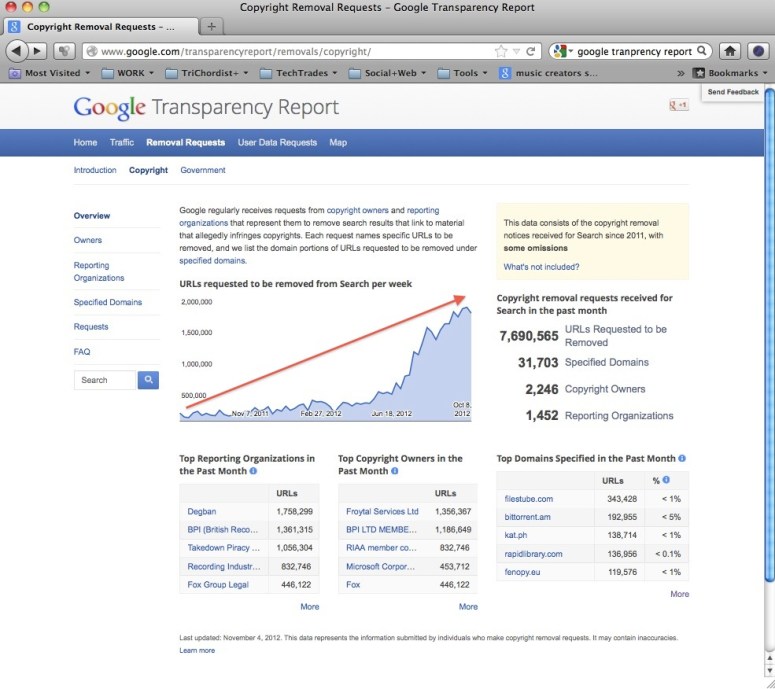
Certainly if Google and the other ad networks had knowledge of the top infringing sites say through a publicly accessible transparency report based on DMCA notices, they would not be serving ads to those businesses operating far beyond the intention of the law? Certainly if they knew that just the Top 20 infringing sites had over 2.3 Million claims in just one month, than Google and the other advertising networks would clearly make a best practices “no fly zone” for advertising on those sites, wouldn’t they?

We’d much rather see this advertising revenue directed towards legally operating and legitimate media outlets such as television, newspapers and magazines who no doubt are also in need of revenue in an ever competitive marketplace. Why finance the pirates who are illegally exploiting others in the creative industries? How much money is being lost from legitimate media outlets to media pirates?

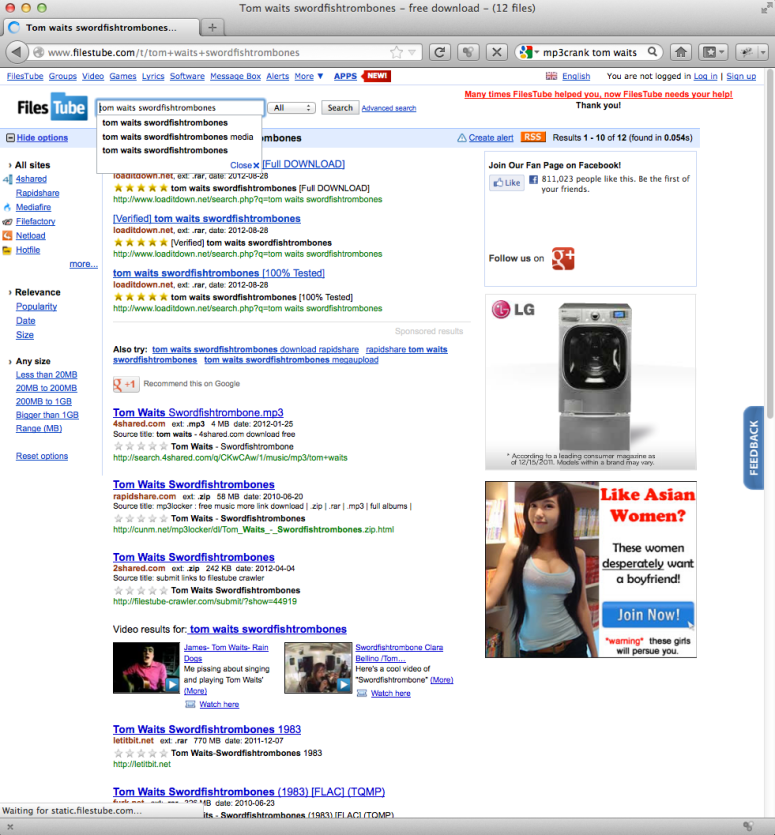
Below is a random sampling of artists exploited by these Madison Avenue Brands and the sites hosting the advertising. We wonder who is serving these ads, and paying these sites because everyone we talk to denies advertising on these sites and seems to know nothing about it.

TOM WAITS Exploited By Wendy’s, Yahoo, BMW, Mitt Romney, Adobe, Cadillac, LG, Target, Westin Hotels, Priceline, Hyatt Hotels, Weight Watchers, VISA, State Farm, Mini Cooper, ADT Security

* BMW on Kick Ass Torrents
* Mitt Romney, ADT Security on 4Shared
* Adobe, Mini Cooper on FilesTube
* Cadillac on FilesTube
* LG on FilesTube
* Target on Mp3Crank
* VISA, State Farm on Mp3 Crank
* Wendy’s on Kick Ass Torrents
* Westin on Kick Ass Torrents
* Priceline, Weight Watchers on 4Shared
* Hyatt on 4Shared
* Weight Watchers, Hilton on 4Shared
* Yahoo on Dilandau
* Urban Outfitters on FilesTube

U2 Exploited by United Airlines, Jet Blue, HP, State Farm, Westin, Urban Outfitters, Sprint, AT&T, Amazon, Disney Resorts, Crate and Barrel

* United Airlines x2 on h33t
* United Airlines on mp3 bear
* United Airlines on FilesTube
* Jet Blue and Kayak on h33t
* Hewlett Packard and State Farm on mp3skull
* Westin Hotels on 4shared
* Westin Hotels on mp3raid
* Urban Outfitters on mp3skull
* Sheraton Hotels on mp3skull
* Century 21 on 4shared
* Alaska Airlines on torrent reactor
* State Farm on torrent reactor
* Sprint on torrrent reactor
* Sheraton Hotels on 4shared
* Hewlett Packard x2 on filestube
* Hewlett Packard and State Farm on mp3skull
* Hewlett Packard on h33t
* Rejuvenation on filestube
* Disney Resorts on torrent reactor
* Crate & Barrel on Files Tube
* Charter Cable on mp3 raid
* AT&T on mp3skull
* Amazon on 4shared

These two examples above are just the tip of the iceberg, and it’s not just the most well known and respected mainstream artists who are effected. Perhaps even more so it is the smaller artists who have been the most hard hit by this diversion of revenue without compensation Aimee Mann, Neko Case, Talib Kweli, Death Cab For Cutie and Jared Leto to name a few.

It would also appear that Google makes plenty of money serving ads on sites that it knows are infringing. Here is Google’s Doubleclick serving an ad for Jeep on http://www.dilandau.eu   This is a site that Google’s own transparency report ranks as the 24th most copyright infringing site in the world.  Isn’t knowingly providing money to an illegal enterprise a RICO predicate?

One would think with this kind of information there would be a move to improve the situation for rights holders, but looking at this graph it appears to be getting worse, much worse.

The bottom line is, we wonder how such mass scale, enterprise level and generally sketchy businesses can continue to go unchecked without any reporting from the mainstream media (who also depend on ad dollars that are now going to competing businesses engaged in media piracy and mass scale copyright infringement).

Once upon a time no one thought twice about “accounting irregularities” at Enron and we all know how that story ended. So who’s gonna ask the hard questions and get some real answers? Operators are standing by…

Weekly Recap Sunday October 21, 2012 aka Pandorathon, On and On…

Grab the Coffee!

Recent Posts, aka The Pandorathon:
* Sign the @musiciansunion (AFM) Letter: Friends don’t let friends get IRFA’d!
* If Pandora wants Terrestial Radio Royalty Rates, Act Like It – Problem Solved!
* Tim Westergren’s Sophomore Slump. New Bill Sucks, Old Radio Fairness Bill Was Way Better.
* Screw You Too, Pandora. Part I. Pandora The Union Buster! Jail time for Collective Bargaining?
* Four Simple Reasons Why the Pandora Radio Act Screws Musicians (EZ Reader)
* Screw You Too, Pandora. Part II: Did Pandora Lie During Their IPO? Or are they just plain old greedy.
* IRFA Analysis: Section 2
* Screw you too, Pandora™ PT III. Kangaroo Court: Pandora Bill Requires Firing of Copyright Judges and Replacement with Fake Judges.
* Screw You Too Pandora! Pt IV. Why Conservatives and Libertarians Should Be Appalled By The IRFA Bill.
* Radio Fairness? Sirius/XM Paid My Band $2,213 Pandora Paid $91

And, in case you missed it:
* Amex must really like advertising on #1 copyright infringing and illegal porn linking site Filestube
* Mythbusting : Music Is Too Expensive!?
* Remembering Steve Jobs

From Around The Web.

C|NET:
* Breaking Bad’s Bryan Cranston on Piracy and TV’s golden age

SPIN:
* Downloaders Beware: Copyright Alert System Arises as Torrent Sites Enter the Cloud

COPYHYPE:
* Friday’s End Notes Oct 19, 2012

VOXINDIE:
* Blogspot.com, a Bridge to Piracy?
* Why Doesn’t YouTube Address the Real Content ID Fail?

ETHICAL FAN:
* Calling All Lawyers! uTorrent Increases “Privacy” and Counters Mass-Monitoring of Downloads

COPYLIKE via MEMEGENERATOR:
* Scumbag Steve – Downloads Music for free Buys $300 headphones
* Join Copylike on Facebook

THE CYNICAL MUSICIAN:
* If a Tree Falls in the Forest and Nobody Hears It…

TORRENTFREAK:
* Microsoft Will Ban Halo 4 Pirates from XBOX Live
* Maybe he should have thought twice? Pirate Bay Founder in Jail.

DIGITAL MUSIC NEWS:
* Trent Reznor returns to Major Label System

HYPEBOT:
* SXSW announces first 40 Panels for 2013

MUSIC TECH POLICY
* Betting the Company: The Internet Radio Fairness Act has little to do with the Internet, Radio or Fairness
* An Overlooked Brookings Institute Study on Fighting Piracy at the Corporate Level

AFM:
* Check out the American Federation of Musicians on Facebook

CREATIVE AMERICA:
* Petition for an Internet The Works for Everyone

Mythbusting : Music Is Too Expensive!?

Music has never been less expensive to own, legally. We often hear that if music were cheaper, artists would sell more, but this is simply not true. Myth busted, read on.

Digital Music News – Worse Than Worst Ever? Tommy Boy Starts Number-Crunching Again…

“The first Beatles album in America came out in 1964 at $4.98 list,” Tommy Boy continued. “In today’s dollars that would be $35 for a 28 minute, monophonic 8-song album.”

In other words, using today’s pricing of $9.99 for an Itunes album would have only cost $1.35 in 1964… Even if you wanted to entertain a $20 CD (are there any $20 CDs these days?), the same would have only cost $2.70 in 1964. That’s nearly half of what it actually cost then.

So in the very worst case scenario, music is STILL 45% less expensive today than it was in 1964! And that’s calculated on a $20 CD! If you calculate the difference for an Itunes download, and full album today costs 86% LESS than it did in 1964…

Inflation Calculator: Bureau of Labor Statistics

Today’s $8.00 hr Min Wage equates into only $1.08 in 1964. But, the Federal minimum wage in 1964 was actually $1.25… so today’s minimum wage, adjusted for inflation actually has MORE buying power than it did in the 60s.

This is the weakest argument ever for the decline in music sales… the weakest… And, low ticket items (like 99 cent songs) or the most resilient in a bad economy. It’s durable goods like cars and washing machines that take the big hit.

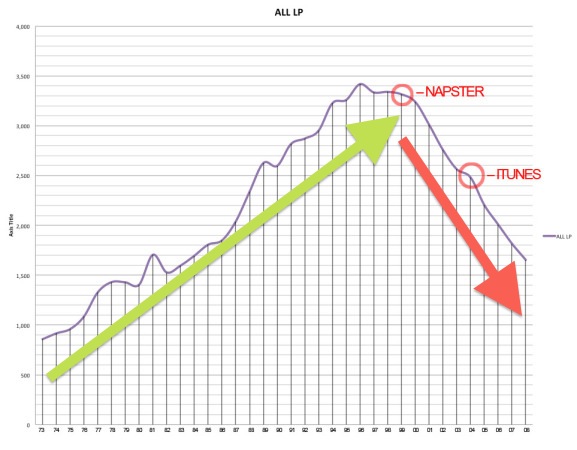
Let’s look at 35 years of historical data 1973 – 2008 (Source IFPI). *

73-08salesnapsteritunesSo it looks like the economy and consumer competition really isn’t that big of a factor after all, again, looking at 35 years of data… the late 90’s may have been the peak, but that’s only because of the onset of illegal exploitation of content without compensation that began at the turn of the century.

Let’s also remember that each decade saw it’s own added consumer competition.

The 70s saw the initial release of VCRs and Video Cassettes as well as video game consoles and cartridges.

The 80s saw home video boom as VHS matured, cable tv boomed, new types of youth sports took hold.

The 90s saw the introduction of DVDs, home computers became household items, people started paying for internet service, and cell phones began to be common place… each offering competition to music sales, but not free music itself.

Yet through each one of those decades (without rampant online piracy) sales grew steadily until p2p sharing and broadband reaches ubiquity at the turn of the century…and then, the sales plummet.

It’s also important to note that sales of recorded music (in all formats combined) started dropping with the onset of Napster and affordable broadband. Many assign the decline of recorded music sales to the introduction of ala carte song sales and Itunes. However, Itunes didn’t launch until the end of 2003 and this introduction of legal ala carte song sales did not accelerate the decline of paid sales (nor did it slow it).

* Chart includes all formats including Track Equivalent Albums whereby every 10 songs = 1 logical album unit.

Weekly Recap & Links Sunday Sep 30, 2012

Grab the Coffee!

Trichordist Recently Posted:
Why are Internet Freedom Fighters always fighting against the Internet Freedom of Artists?
Is The New Internet Association Really Just A Pro-Corporate Version Of The Pirate Party? No It’s a Transparent Ploy by Google To Curry Favor With Congressional Republicans.
Artists Utilize Power of Internet to Get Paid 
Ad Sponsored Piracy Gains Attention and Awareness in Europe
Is it The Pirate Party, or The Pirate Lobby?
Mythbusters, Why Internet Pirates Will Not Win (and should just get over it)
Class Act: Amanda Palmer.
Pandora, Please Stop discrimination against Musicians!
So much for Post-Scarcity, unless Electricity is free?
Google Pro-Artist Policy Changes Challenge Allegations of “Net Censorship”

From Around the Web:

FastCompany:
* Samsung Muscles In On New Territory – Providing Digital Content

VoxIndie via NPR:
* via NPR-How Much do Artists Make on Youtube?
* YouTube Shares Ad Revenue With Musicians, But Does It Add Up?

CopyHype:
* Friday’s Endnotes 09/28/12

Digital Music News:
* Spotify Is Almost Profitable in Europe?
* Deadmou5 witholding latest album from Spotify
* Gee, That’s Funny: Grooveshark Has the Entire deadmau5 Album…

Torrent Freak:
* Canadian Government Learns about the rogue nature of Ad Networks
* Six Strikes Cooperative ISP/Content Initiative coming soon?
* More pirate convictions, this time Jail and 1.1m Euros Fine

Ethical Fan:
* Comcast May Owe Content Owners $1.6B A Year Or More

Music-Tech-Policy:
* Not So Stoopid After All: Firedoglake Reports that Google Pulls Utoopi App
* Updated: A New Twist on Artist Consent Provisions: Protect Your Right to Say No to @mcdonalds ads on pirate sites
* The Wall of Shame Diaspora Jumps the Pond: UK Authors Speak Out on Brand-Supported Piracy

Copyright Alliance:
* Internet Freedom and Protection of Authorship: A Winning Ticket

Is it The Pirate Party, or The Pirate Lobby?

It’s endlessly fascinating to witness the double standard of the internet companies and pirate communities. The conversation is, was and will always be about money. So much so, that the tech industry has created yet another lobby to prop up it’s interests to exploit artists and creators in the aptly named, Internet Association. This in addition to the record breaking lobby spends by just Google. At least this time the shills are out in the open. Author Scott Cleland posts, The Top False Claims of the New Internet Association to add some balance (and transparency) to the conversation.

Let’s be clear about this, the conversation is not, nor has it ever been about free speech as IP scholar Adam Mosoff writes in The Statesman,

“The right to free speech is the right to express one’s thoughts without censorship by the government. Copyright does not prohibit anyone from creating their own original novels, songs or artworks. Importantly, copyright does not stop people from thinking, talking or writing about copyrighted works.”