Pay the Band | Memphis Flyer

Brice S Newman of Memphis details why support for the Fair Play, Fair Pay bill is essential for all musicians and creators to support.

There are four parts to the initiative, which includes a comprehensive bill that gives music creators pay parity. First, legislation would establish a process for setting fair-market royalty rates, not some pathetic low royalty rate that is decades old.

Second, the legislation would create a performance right for artists on terrestrial radio in the U.S., so that artists can get paid when their performances are on the radio. This is how it’s done in much of the rest of the world.

Third, this legislation would close a 1972 loophole and would guarantee that veteran performers receive royalties.

Fourth, the legislation would codify royalty payments to producers — the people behind the songs. If we can make all this happen, I am sure we will be paid back many times over in good music that’s been created by musicians who deserve to make a living.

READ THE FULL STORY AT THE MEMPHIS FLYER:
http://www.memphisflyer.com/memphis/pay-the-band/Content?oid=4073778

Michael Price: Composer for Sherlock blames Google and YouTube for suppressing rewards songwriters receive | Independent UK

More artists, performers, songwriters and composers are getting it.

“YouTube are effectively paying incredibly low rates and are not a willing partner to negotiate licences and that pulls down the rates from someone like Spotify, which has to compete in their free service with YouTube,” he told The Independent on Sunday.

“The value from the music we create is being sucked out into the companies that aggregate it, [but] YouTube … are not happy to set adequate streaming rates. There is a huge shift of value from artists to tech companies.”

READ THE WHOLE STORY AT THE INDEPENDENT UK:
http://www.independent.co.uk/news/media/michael-price-composer-for-sherlock-blames-google-and-youtube-for-suppressing-rewards-songwriters-receive-10447054.html

DMN Says It’s Unlikely Spotify Pays More to Rights Holders Than Apple Does

In the dust up surrounding the Apple Music Launch and the leaked agreement that lead to speculation that Apple was paying indies less than the often heard 70% to rights holders an interesting thing happened.

Industry executives and commenters at Digital Music News reported that Spotify was also paying indies less than 70% and closer to the 58%, or less than Apple.

Update to June 15th, and Apple is not only stating that they are paying 70%, but a more aggressive 71.5% to 73% of revenues depending on territory.

But what makes this that much more interesting is that Spotify has now been outed as NOT paying the commonly accepted 70% of revenues and also has NOT responded to the claims being made at Digital Music News…

So how much is Spotify actually paying? So much for openness and transparency…

RutOh...

Digital Media Association (DiMA) Always Against Musicians

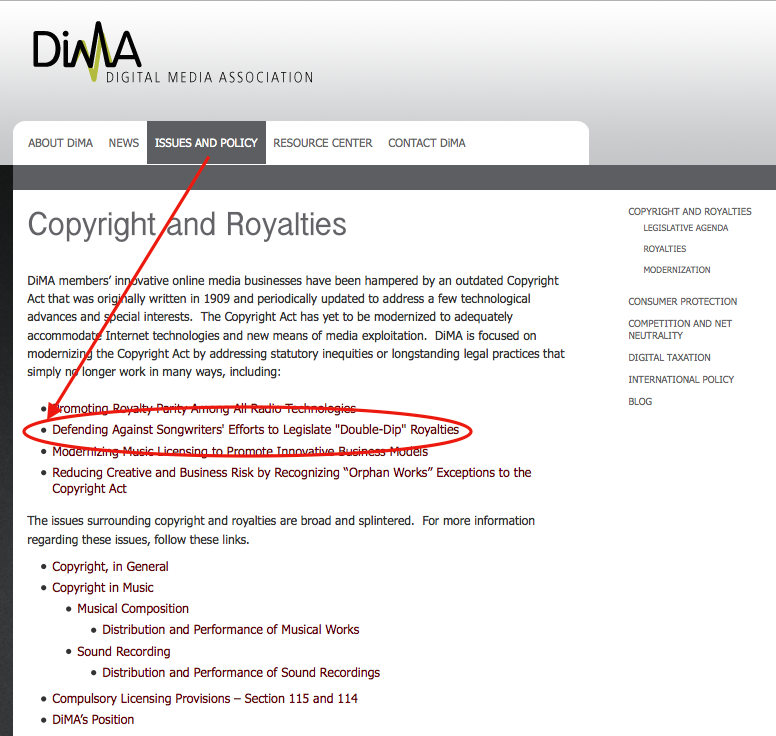
Who is DiMA? Glad you asked, the Digital Media Association. Why do we care? Well, because they are actively working against artists rights. How do we know? Three words… “Defending Against Songwriters”. Yes, DiMA is dedicated to “Defending Against Songwriters” because, you know songwriters are a force that businesses need to defend themselves against.

Wow, really? Seriously? Ok, check it out…

DimaDoubleDipSongwriters

But lets take a look below where current DiMA policy positions are directly in opposition to artists and songwriters rights.

DiMA supports Pandora buying a terrestrial radio station in an effort to lower the royalties Pandora will pay to songwriters.

DiMA is opposed to the Fair Play, Fair Pay Act that would pay performers a terrestrial radio broadcast royalty.

DiMA is opposed to The Songwriter Equity act that would allow songwriters the ability to negotiate fair market rates for their work.

DimaPOlicyAgainstArtists

Who would work with DiMA that wasn’t forced to via statutory rates and rate courts?


* MUST READ * YouTube’s Heartbreaking Extortion Of Musicians Begins… | Zoë Keating Explains New Rules

Below is the opener, after that – it gets worse…

“My Google Youtube rep contacted me the other day. They were nice and took time to explain everything clearly to me, but the message was firm: I have to decide. I need to sign on to the new Youtube music services agreement or I will have my Youtube channel blocked.
This new music service agreement covers my Content ID account and it includes mandatory participation in Youtube’s new subscription streaming service, called Music Key, along with all that participation entails. Here are some of the terms I have problems with:

1) All of my catalog must be included in both the free and premium music service. Even if I don’t deliver all my music, because I’m a music partner, anything that a 3rd party uploads with my info in the description will be automatically included in the music service too.

2) All songs will be set to “montetize”, meaning there will be ads on them.

3) I will be required to release new music on Youtube at the same time I release it anywhere else. So no more releasing to my core fans first on Bandcamp and then on iTunes.

4) All my catalog must be uploaded at high resolution, according to Google’s standard which is currently 320 kbps.

5) The contract lasts for 5 years.”

Seriously the whole post is an absolute must read, in full, probably at least two or three times to have it all sink in.

READ THE FULL POST ON ZOE KEATING’S BLOG:
http://zoekeating.tumblr.com/post/108898194009/what-should-i-do-about-youtube

Spotify Must “Adapt Or Die” : Pricing For Sustainability

The single biggest problem with Spotify (and other services like it) is that they have completely removed the relationship between the artists and the fan. The labels have leveraged their catalogs as an asset in exchange for equity shares in a tech start up that is subsidized by the artists. And to be clear, that is equity that the labels are not “sharing” with the artists who are making the equity possible. We’re not even sure how this could be legal, but we’ll leave that to the lawyers to figure out.

The second problem is that the money the consumer pays, does not pay the artists the consumer is supporting. The model for Spotify and others is to divide the total pool of revenue by the total number of streams and pay out the revenue on a per stream basis. But that is not the same as a directing each consumers payments only to the artists that consumer is streaming.

So in two very important ways the relationship between the fan and the artist has been broken by completely disconnecting compensation from consumption.

There’s a very simple fix, per stream retail pricing. We are NOT supporting the notion that 150 streams should equal one song download. However for the purposes of this writing that’s where we’re going to start. We feel that Billboard has grossly undervalued the cost of a stream, but we’ll get to that later.

We’re starting with this metric specifically in the context of the new Billboard “consumption” chart whereby every 150 streams = 1 song. At retail, that means each stream is worth $.00666 (we still love the irony there).

$.00666 x 150 = $.99

Here’s what the breakdown looks like PER STREAM:

$.00666 Gross Retail (Paid by Consumer to Spotify)

$.00666 x .70 = $.00467 Paid to Artist/Rights Holder (70% of Gross)

$.00666 x .10 = $.000666 Paid to Songwriters / Publishers from 70% Above

So let’s recap… in context of 150 streams to ONE SONG:

$.00666 x 150 = $.99 (One Song)

$.00467  x 150 = $.70 (70% of Gross) To Artist/Label

$.000666 x 150 = $.09 (Full Stat Mechanical, One Song) To Songwriter/Publisher

$.70 – $.09 = $.61 Net to Artist/Label

These are the exact same mechanics paid on a single song download.

Another way to express this would be to say that the consumer spending $10 a month on Spotify can play 1,500 streams. Every stream the consumer plays then pays out 70% of gross, just like iTunes. In other words, every 150 streams equals the same economics as ONE Itunes Song Download in the distribution of revenue.

A consumer pays $10 for every 1,500 streams they consume at $.00666 retail pricing. If they consume more, they pay more. If they consume, less they pay less.  Compensation is now directly reconnected to consumption!

Simple. Easy. Fair.

We can argue about what the price of a stream should be, but reconnecting the artist fan relationship through compensation for consumption is essential.

Steve Jobs was a genius. He reversed engineered the margins and mechanics of physical retail distribution for Itunes. Jobs made it easy for labels to make sense of digital revenues, accounting, operations and royalties reporting. There is no logical reason why streaming services can not operate the same way.

There is also no logical reason why per stream retail pricing can not exist. That is unless of course the goal is to NOT have a simple, easy and fair ecosystem that is sustainable and supports artists.

We tend to think that the retail price per stream should probably more like two to five cents per stream (maybe more), as we’ve heard Beats may be paying. Whatever the retail price per stream to consumers there should be flexibility in the model for variable pricing bu artists and labels.  Variable pricing exists in digital stores such as iTunes as it also does in physical distribution.

Retail per stream pricing restores the relationship between the fan and the artist whereby compensation is directly connected to consumption. This model works and does not change the margins paid by Spotify (and others). The streaming service still retain 30% of the gross revenue, except now we have the opportunity of moving closer to a fair cost of goods.

No Music = No Business.

Add to the above experiments with new release windowing, value propositions based on bundled tiers, etc, and we can start to see a smart and sustainable streaming business emerging for all stakeholders.

Spotify can chose to “adapt or die.” It’s just math.



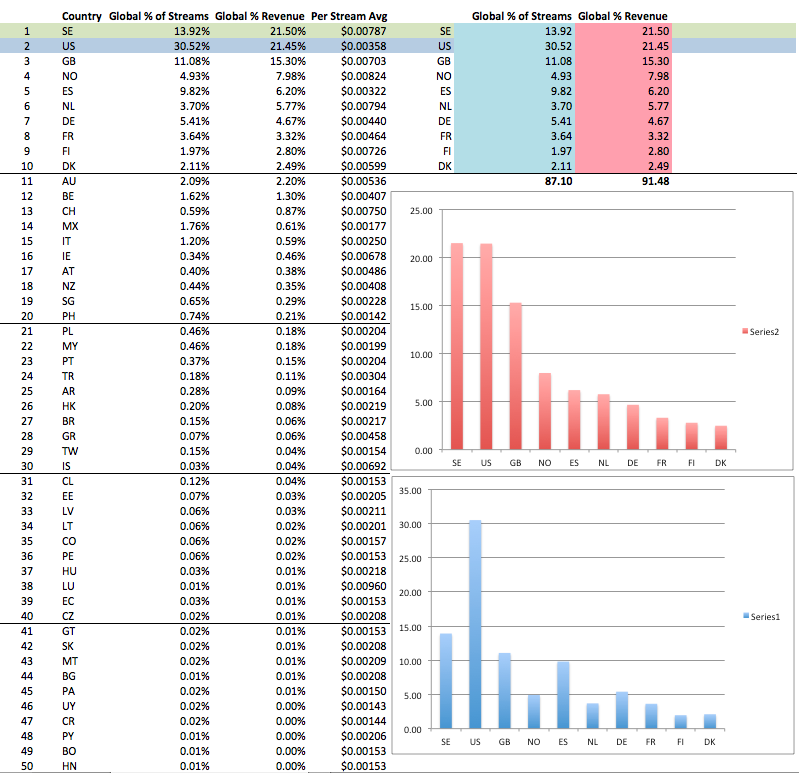
Spotify Top 10 Territories : Global Revenue Marketshare & Streaming Percentages

The Top 10 territories account for 87.10% of all streams and 91.48% of all revenue. So all revenue outside of the Top 10 is less than 9% of global revenues. So if you’re streaming your music outside of the Top 10 territories, you are more or less giving your music away.

SpotifyGLOBALMarketshareRevStreams

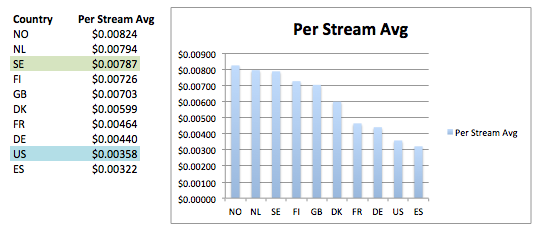
Here’s the summed, net averaged per play rate for the top ten territories.

SpotifyT10CountriesStreamingRates

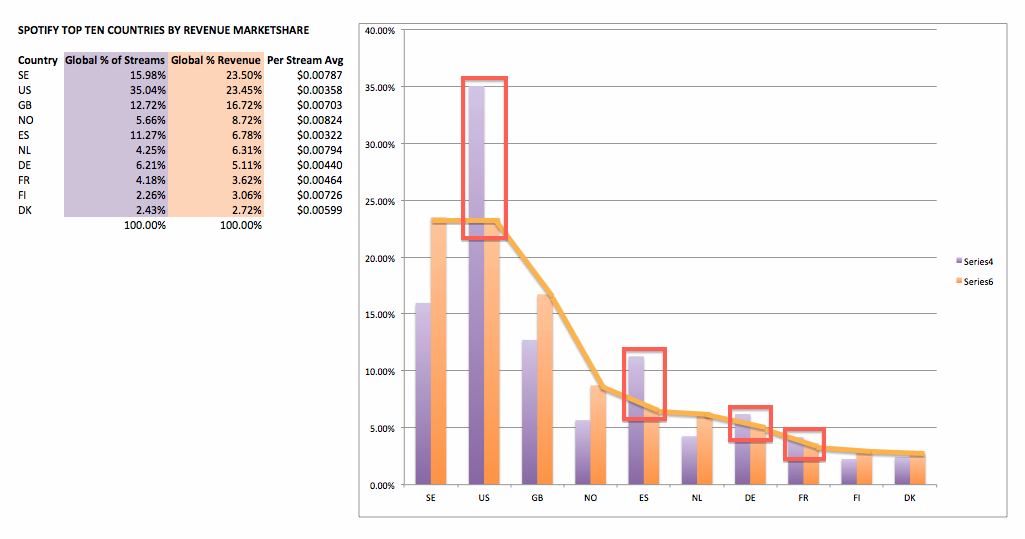
Below the top ten territories are isolated (and the market share recalculated).

The data would seem to suggest that savvy artists and labels avoid the territories where the number of streams far exceeds the percentage of revenue (the red boxes).

SpotifyNOFLYTerritories

Data set provided by US based indie label with 800 songs. Data is summed from sales and reports dated Sept 2011 – Aug 2014. This is what Spotify really looks like to most artists and indie labels.

Pandora’s New Deal: Different Pay, Different Play | NPR

The new payola?

Performers get paid a small royalty each time one of their songs is played on Internet radio, at a rate set by a Royalty Court at the Library of Congress. But Internet radio and labels can strike individual deals, as Pandora did with Merlin. The Internet service will recommend Merlin artists over those not affiliated with the consortium in exchange for paying Merlin’s musicians a lower royalty rate.

Merlin artists get more spins, and Pandora winds up paying less in royalties than it would if were giving those same spins to non-Merlin artists. Plus, consortium labels will get to suggest favorite tracks.

READ OR LISTEN TO THE FULL STORY AT NPR:
http://www.npr.org/2014/11/26/366339553/pandoras-new-deal-different-pay-different-play

Dead Kennedys’ East Bay Ray Explains How YouTube Is Stealing From Musicians | New York Observer

Taylor Swift recently brought these “robber baron” business tactics into the mainstream. When she removed her catalog from Spotify, they were trying to force a bad deal on her. Dead Kennedys had Spotify figured out early on, we pulled most but not all of our tracks off of Spotify back at the start of 2013. Musicians are not against streaming, but we are against “plantation/sharecropping” business practices. It doesn’t have to be this way.

Educate yourself about what’s really going on and the reality is shocking. Don’t buy the lies and memes, educate people, share this article, stand up. The Internet is not like the weather, it was created by humans and can be changed by humans. It’s not about regulating the Internet, it’s about regulating businesses. (They’ll try to confuse that, too.)

This Weekend in NYC : Benefit for Content Creators Coalition (c3): Defend Artists’ Rights: Economic Justice in the Digital Domain! w/ Marc Ribot, John Zorn, and friends

A Benefit Concert for c3

Featuring John Zorn, Eric Slick (Dr Dog), Steve Coleman, Marc RibotHenry Grimes, Marina RosenfeldTrevor Dunn, Brandon SeabrookSatomi Matsuzaki (Deerhoof), Amir ElSaffar, and more!

The event will also feature a short screening of highlights from Michael Count Eldridge’s upcoming documentary film “Unsound”.

General Admission: $20 pre-sale (ends at noon on 10/18) $25 at Doors

Special Artist Rights Supporter tickets include reserved balcony seating and access to a one hour meet and greet prior to the show // Doors at 7pm

TICKETS :
https://web.ovationtix.com/trs/pe/9950804

MORE INFORMATION:
http://roulette.org/events/benefit-content-creators-coalition-c3-defend-artists-rights-economic-justice-digital-domain-w-marc-ribot-john-zorn-friends/