The Digital Ad Business Is Broken, Says Former Forbes.com CEO | Venture Beat

No surprises here, right?

“The onion is slowly and surely getting peeled back.”

…

Last year, Google reported that 56.1 percent of all ads served were not measured viewable by humans.

Last December, the Association of National Advertisers and security firm WhiteOps estimated that up to a quarter of video ad views were fraudulent and resulting from software bots. It also said that as much as half of publisher traffic is from bots. This represents a projected $6 billion-plus in wasted ad spend this year.

Spanfeller sees the current system as a big part of the problem.

No kidding.

READ MORE AT VENTURE BEAT:
http://venturebeat.com/2015/08/08/the-digital-ad-business-is-broken-says-former-forbes-com-ceo/


Over 50 Major Brands Funding Music Piracy, It’s Big Business!

“User Pirated Content” Is Core Internet Advertising Model


Fun with Digital Royalties | The Cynical Musician

The excellent blog “The Cynical Musician” has accepted our challenge to debunk the  latest Berklee College of Music/Rethink Music set of flow charts on digital music royalty flow.  Really excellent work by Faza. It’s devastating to Berklee.  Check it out. While this whole exercise has been fun for us,  it has to be embarrassing for a $60k a year academic institution that offers a degree in the “music business” to demonstrate that they fundamentally do not understand how digital royalties work.  

The Trichordist posted a challenge to disassemble Rethink Music’s royalty chart today and I do so love a challenge. I won’t be pasting the whole of it – just the juicy bits – so make sure you read their post.

Let’s start with the breakdown of internet radio royalties:

Read the Full Post :  Fun with Digital Royalties | The Cynical Musician.

$100 Dollar Prize! Be First To Illustrate all the Flaws in this @BerkleeCollege of Music Chart


Screen Shot 2015-08-07 at 11.52.32 PM

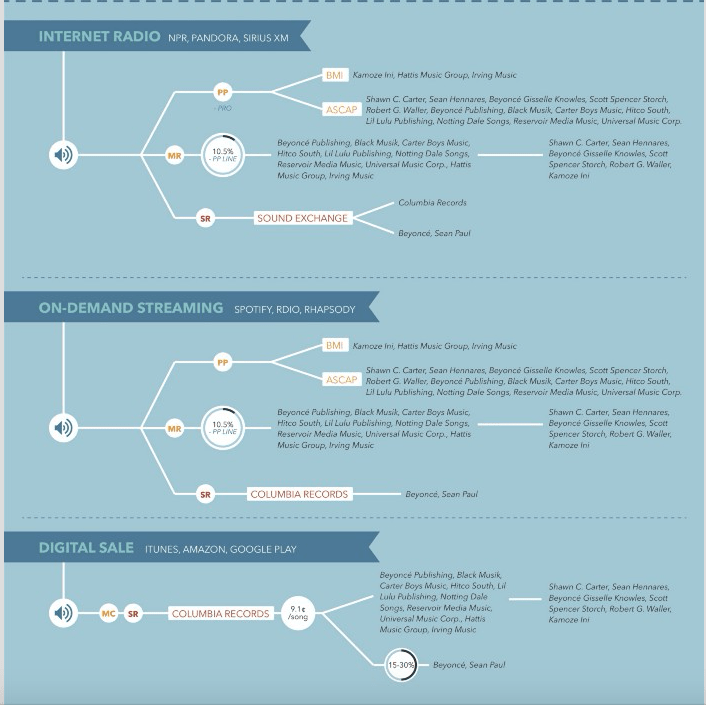
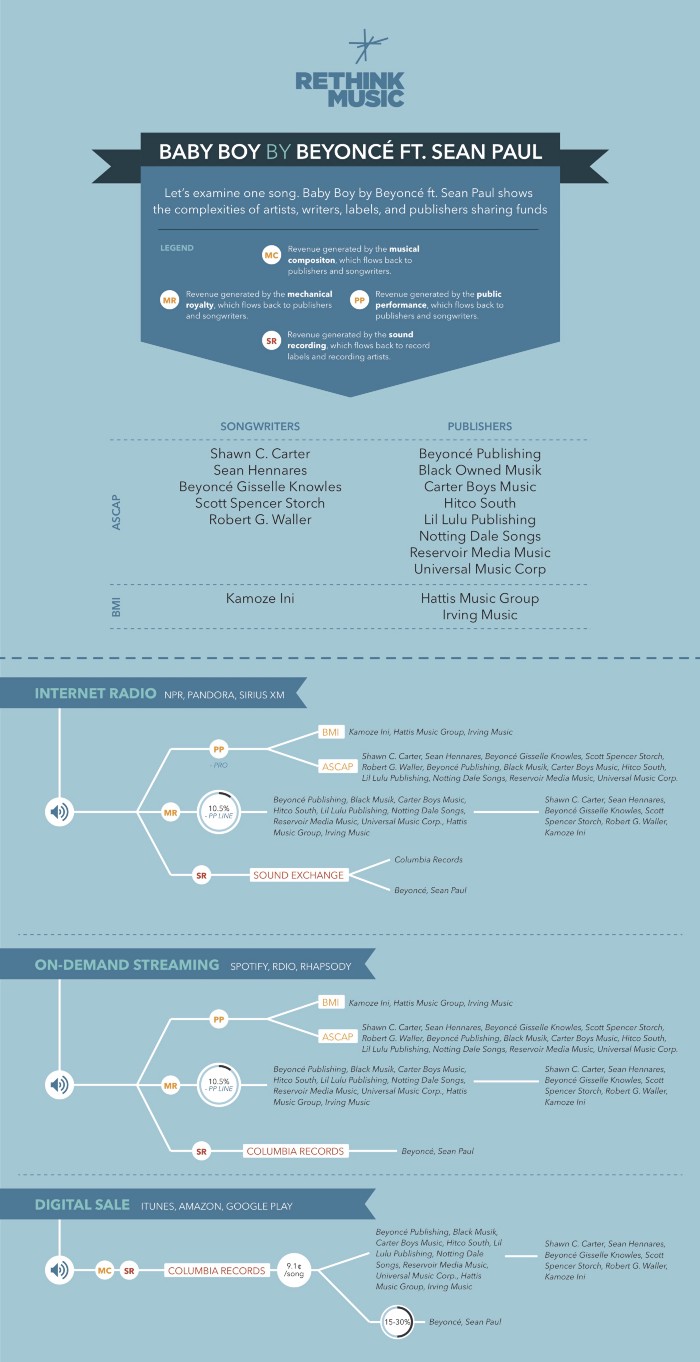
MC = musical composition, SR = sound recording, PP = public performance, MR = Mechanical Royalty (by which they really mean the so called “streaming mechanical” ).

Berklee College of Music/Rethink Music just issued a rather defensive follow up  in response to our criticism of their original Kobalt Music/Google Ventures funded report on fair pay and transparency in the music business.

Well we must confess we’ve been laughing our asses off all day at these guys. Why? Because while Allan Bargfrede and Panos Panay have been busy taking the low road by suggesting we are luddites and comparing us to “birthers” (WTF right?), they’ve also been distributing digital royalty flow charts that are completely wrong . Guess they thought we stupid and ignorant artists wouldn’t notice.

There are at least two major errors in the flow charts above, maybe more depending on what the authors were trying to illustrate (it’s actually not clear).   I teach a music publishing and digital royalties class at UGA.    I teach undergraduates but I guarantee you that after week ten 90% of them will be able to spot the errors in these charts. I will be using these faulty charts on my tests in the fall!

So look I don’t want to come out and explain what’s wrong here. Let’s have a little fun here.  First person to most accurately describe the flaws in this chart and submit a hand drawn “markup”, chalk, paper or whiteboard illustration of the errors gets $100 “professor whiteboard” prize!  We will publish winning submission here.

Here is a link to a higher res copy.

flawed rethink music followup

http://web.archive.org/web/20150808043822/https://medium.com/@allenbargfrede/music-paid-fairly-5df29f2b3924


How to ignore YouTube completely: One Direction’s radical gamble | Music Business Worldwide

Good luck Sony, let’s see how this goes with the “User Pirated Content” at YouTube…

Search YouTube for 1D’s new comeback single Drag Me Down, and you’ll discover Harry, Niall, Louis and Liam are nowhere to be found.

Sony won’t confirm it, but the major appears to have a taskforce stamping out any attempt to upload the track onto the platform.

Why? Because One Direction are using their colossal social media presence (Twitter: 24.5m; Facebook 37m; Instagram: 9.7m) to actively push fans towards iTunes and Spotify instead.

READ THE FULL STORY AT MUSIC BUSINESS WORLDWIDE:
http://www.musicbusinessworldwide.com/how-to-ignore-youtube-completely-one-directions-radical-gamble/


YouTube’s Content ID : $375.00 Per Million Views… aka “Block In All Countries”…


What YouTube Really Pays… Makes Spotify Look Good! #sxsw


@BerkleeCollege Shows They Aren’t Serious, Responds to Our Criticism with Straw Man Argument

Professor Whiteboard Trichordist vs Berklee item 1

Berklee College of Music has still not addressed our fundamental criticism of their report. 

A few days ago I had an email conversation with Panos Panay who may or may not have authored the flawed Berklee College of Music report on transparency and fair pay in the music business.   In our conversation he indicated that he thought our list of omissions were valid criticisms of their report.  I encouraged him to issue a follow-up report or letter.

Yesterday Berklee did indeed issue a follow-up.  But it was less of an actual correction or update and more of a defensive “fuck you.”  Yes, they squandered their opportunity to have a real discussion, by following up with a bullshit straw man argument, that completely misrepresents our criticism of the report.  These guys are not interested in a real and honest discussion.  Therefore don’t expect an honest discussion at their conference either. In other words don’t waste your money.

Here’s what they say about our criticism in their follow up:
“Some have questioned the role of digital services in this debate. It is important to remember that most online music services pay 70% of their revenue to rights holders (except YouTube, who should be encouraged to pay more than their current 50%), and we believe that this technology for distribution is a good thing. It is impossible to put the “Internet genie back in the bottle” — let’s not forget that the main source of industry woes 5 years ago was piracy — and at least a business model has evolved that has people paying for music again” 

Classic straw man argument.

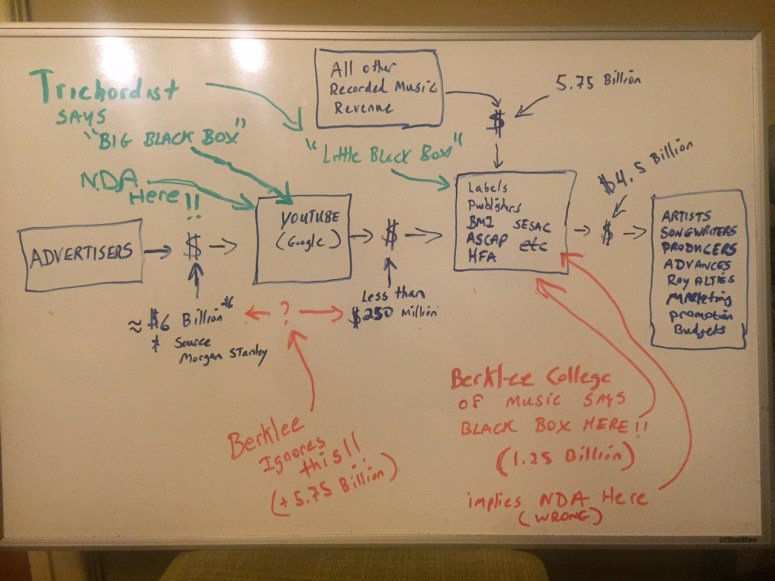
We don’t think “the technology” is a bad thing, and we are not trying to put the “internet genie back in the bottle.”  If you want to put it in terms of “internet genies” we are asking the internet genies to drop their NDAs and to exhibit more transparency on advertising revenues and expenses.   This is clearly illustrated in the whiteboard photo above.  Further the email record clearly  indicates that Panay understands our criticisms.  The only conclusion is that Berklee knowingly misrepresented our criticisms of their report.

This is classic demagoguing.  Trying to neutralize your critics by dishonestly claiming they are saying something they are not.  Berklee implies we are “trying to put the internet genie back in the bottle”  or somehow we are against streaming technology because they wish to portray us as hopeless luddites that are completely out of touch with the modern world. Yet facts are facts, our criticism illustrates a deeper understanding of the revenue flow in the digital world than their sloppy and biased report.

I don’t understand how someone at an academic institution can engage in this sort of demagoguing and still have a job.   My academic institution would really have a problem with me issuing an official statement in the name of the institution that engaged in this level of dishonesty.

At the very least from a public relations stand point Berklee needs to learn to stop “poking the bear.”  Especially this bear.  They just gave us at least five new posts on why rights holders and artists should NOT go to their “Rethink”  conference.


BUT SPOTIFY IS PAYING 70% OF GROSS TO ARTISTS, ISN’T THAT FAIR? NO, AND HERE’S WHY…


Why Digital Exec’s ARPU is Bad Math and also Bad Philosophy for Artists.


Music Artists Take On the Business, Calling for Change | New York Times

The New York Times quotes representatives of the artists rights movement including Blake Morgan of the #irespectmusic campaign, Melvin Gibbs of C3Action.Org (Content Creators Coalition), David Lowery of the Trichordist as well as musicians Zoe Keating, David Byrne and others.

“None of these companies that are supposedly in the music business are actually in the music business,” Mr. Gibbs said. “They are in the data-aggregation business. They’re in the ad-selling business. The value of music means nothing to them.”

READ MORE AT THE NEW YORK TIMES:
http://www.nytimes.com/2015/08/01/business/media/music-artists-take-on-the-business-calling-for-change.html

“Professor Whiteboard” Explains What’s Wrong With @BerkleeCollege Of Music Report

Professor Whiteboard Trichordist vs Berklee item 1

All figures approximate, but based on numbers provided by Morgan Stanley and IFPI.

1. Berklee College of Music/Rethink Music report on fair pay and transparency in music business primarily focuses on “black box” at traditional music industry players like labels, PROs and publishers. Ignores black box at the digital services.

2.  The Berklee College of Music/Rethink Music report derides the NDA (non-disclosure agreement) culture that pervades the digital music business, but implies that this is a problem with the labels, publishers and PROs.  But it is a well known fact that it is the digital services that demand the non-disclosure agreements.

3. The Berklee College of Music/Rethink Music report was funded by Kobalt Music which is a Google Ventures company. And Google owns YouTube.  Rethink Music was started by The Berkman Center.  The Berkman Center is an “academic” institution that has close ties to Google.  For this reason we believe this report to be a damaging piece of propaganda that distracts artists from the bigger problem: Low pay and no accountability from the digital services like YouTube.  At best Berklee College of Music is “fighting the last war” and in effect protecting those who exploit their students.


“User Pirated Content” Is Core Internet Advertising Model (Which is Why Streaming Rates Can’t Increase Until Piracy is Decreased)

Google’s YouTube is a business built on infringement as a model. So called “User Generated Content” is really just code for what the majority of the high value media on YouTube really is, “User PIRATED Content“.

In other words there’s nothing internet advertising loves more than illegally monetizing the work of professional creators, and thus driving down the true fair market rates for those works (keep this in mind when thinking about Spotify and streaming services!).

Below are excerpts from emails discovered during the Viacom Vs. YouTube lawsuit and published  by DailyFinance:

• A July 29 email conversation about competing video sites laid out the importance to YouTube of continuing to use the copyrighted material. “Steal it!” Chen said , and got a reply from Hurley, “hmmm, steal the movies?” Chen’s answer: “we have to keep in mind that we need to attract traffic. how much traffic will we get from personal videos? remember, the only reason our traffic surged was due to a video of this type.”

And this is not the only smoking gun, here’s a quote from DailyTech regarding Google’s Ad Sales and the site EasyDownloadCenter: 

In fact, Google’s ad teams even made suggestions designed to optimize conversion rates by using keywords targeted to pirated content – such as suggesting downloading films still in theatrical release, that obviously were not available yet in any authorized format for home viewing.

According to PCWorld this added up to some decent money…

EasyDownloadCenter.com and TheDownloadPlace.com generated US$1.1 million in revenue between 2003 and 2005, and Google received $809,000 for advertising, the Journal reported.

Both YouTube and Google Search function similarly by monetizing infringing “User Pirated Content” with advertising. On YouTube users upload infringing music and videos of all varieties which attract the consumers to the globally dominant and monopolistic video streaming site.

Remember the email above where the YouTube founders admit “how much traffic will we get from personal videos? remember, the only reason our traffic surged was due to a video of this type”. And by “this type” they mean professionally produced and created media by artists, musicians, filmmakers and other creative professionals that are of high value in attracting an audience – an audience that can then be monetized with advertising.

Google Search operates in very similar way (no coincidence) by monetizing (mostly with advertising) millions infringing URLs on sites primarily dedicated to distribution of copyrighted works via p2p networks and bittorrent.

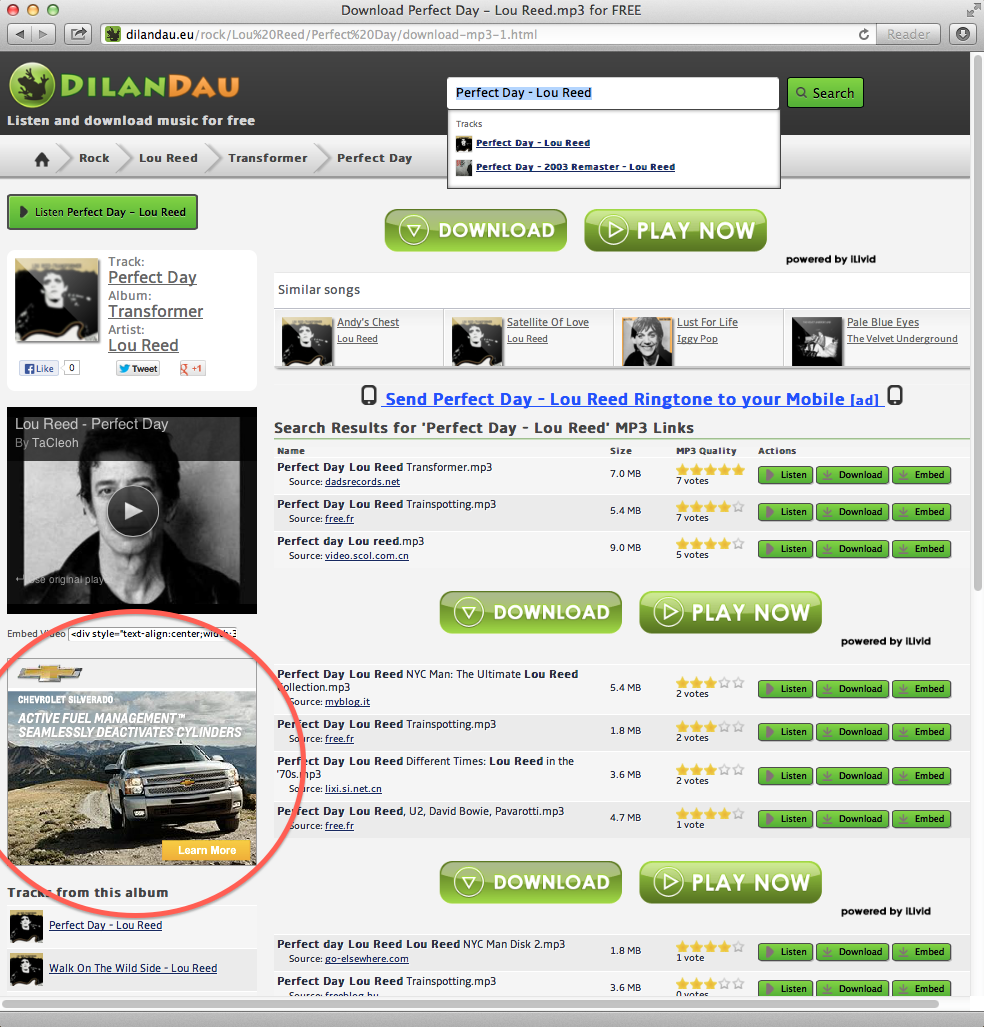
Over 50 Major Brands Funding Music Piracy, It’s Big Business!

LouReedCHEVY

But don’t take our word for it, here’s a report from DigiDay (owned by The Economist):

According to AppNexus CEO Brian O’Kelley, it’s an easy problem to fix, but ad companies are attracted by the revenue torrent sites can generate for them. Kelley said his company refuses to serve ads to torrent sites and other sites facilitating the distribution of pirated content. It’s easy to do technically, he said, but others refuse to do it.

“We want everyone to technically stop their customers from advertising on these sites, but there’s a financial incentive to keep doing so,” he said. “Companies that aren’t taking a stand against this are making a lot of money.”

What about the removing infringing material with a DMCA notice you ask? Well, we’re glad you did… here’s how it “works”…

https://vimeo.com/94514834


DMCA “Takedown” Notices: Why “Takedown” Should Become “Take Down and Stay Down” and Why It’s Good for Everyone | Nova Edu


Safe Harbor Not Loophole: Five Things We Could Do Right Now to Make the DMCA Notice and Takedown Work Better


Power Transition, Lawfare and the Spotify/Google Interlocking Directorate

Long read but worth it for insight into the Google/Spotify alliance against Apple!

Music Technology Policy

Though this be madness, yet there is method in it.

Hamlet, by William Shakespeare

Power Transition in Business

When a relatively unequal competitor is about to overtake a dominant competitor, lawfare is most likely to break out when the less dominant competitor perceives their opportunity to replace that hegemon.  At this point in the power relationship, the less dominant competitor may seek interlocking relationships with other less dominant competitors in the relevant market in order to attack the hegemon by reducing competition with each other and coordinating lawfare operations against the hegemon.

These interlocking boards or corporate relationships may work well when there is something in it for the allied less dominant competitors that helps each of them in ways that do not harm each of them.  For example, in an alliance of two less dominant competitors G and S against hegemon A, this will be particularly true if company…

View original post 3,472 more words

Creative Commons: Please Share Your Money To Figure Out How Sharing Makes Money

Guest Post By Alan Graham  (Twitter @agraham999 )
A former music major, I’ve worked in technology for over 20 years. I’ve always been a proponent of technology and in the past have supported many of the principles of the EFF and Creative Commons, but as time has gone by I’ve found myself more and more on the side of the creative class. I’ve watched many friends of mine who work in the music industry start to experience what I’ve personally experienced as a writer in the past 15 years.
Years ago, during the bursting of the first tech bubble, I took a career detour as a paid writer, actually making a living by earning around $1 per word for my work. My last book earned me an advance of $8k, and the total cost to print it, get to market and on actual shelves was somewhere around $50k. I eventually stopped writing professionally, but I happened to see many of my friends later scraping by on the equivalent of $.01 a word, with bonuses of a couple hundred bucks if they could out perform their peers in traffic. I’ve watched the decimation of the creative class due to the “sharing economy” from the inside out, and with ad blocking, it looks like things might just get worse. Is that even possible? Yes it is.
Today I ran across a Kickstarter from the Creative Commons, trying to raise $50k to create an e-book about how you can use the Creative Commons to make a living, and I about lost my fucking mind.
Let’s just begin with a quote from their intro video for the project.
“How do you make money to sustain what you do when you are letting the world reuse your content? We think this is one of the most important questions of the digital age. And we don’t have answers. It’s still too early for simple formulas or plug and play business models built on sharing.”
Holy shit.
It is 2015 and the Creative Commons was founded in 2001. Why are you just now getting around to asking this question? I agree, it is one of the most important questions of the digital age and one I think might have been good to ask 14 FUCKING YEARS AGO.
Must…reduce…rage.
The Creative Commons has had very close ties to the tech industry, accepting millions in grants from companies who benefit from the erosion of copyright under the guise of a public service. Last time I checked (correct me if I’m wrong about this), actual copyright has allowed you to make a living off creative works for quite some time. Now, 14 years after its founding, the CC is finally going to get around to explaining (after they discover the answer) through an e-book how to make money using the CC. Print is on its last legs, the music industry has been Kill Bill’d in half, and don’t even get me started on photos, all predicated on the simple fact of making sharing without permission, payment, or penalty, business as usual.
Let’s dig further into this project:
“Although it will involve the entire Creative Commons staff and community, this project will be spearheaded by Paul Stacey and Sarah Pearson.”
Is this not super ironic the writers/creators of this project are already paid employees of CC and therefore don’t need to make money off a work of Creative Commons? No, they have no risk at all of whether they start or finish a project such as this one. At the end of the day, successful Kickstarter of not, they get paid. How about the fact that at least one of those in charge of assembling this project makes over $100k a year? What’s the average take home of a writer these days? What’s the average advance on a book? $50K? Not even close!
So if those assembling the book are already paid, where is this money really going?
Let’s keep going:

With the proceeds from this Kickstarter, CC will:

  • Create in-depth profiles of 24 successful CC business/revenue models based on your votes; 
  • Visually depict each business model and extract at least 3 high-level lessons for each one;
  • Distill common strategies and patterns in the various business models and publish 6 long-form articles on Medium;
  • Create a lightweight interactive online tool that helps people design open business models;
  • Publish an ebook (licensed CC BY-SA) that combines all of the profiles, analysis, and recommendations from this project.
Whoa whoa whoa. Since when do you let people pay money to buy votes to nominate which “successful” businesses appear in what is in essence a study on the power and validity of the Creative Commons? But that’s not all, if you pledge a minimum of $250, you get an opportunity to co-edit the book. Yes, instead of being paid for your work, you pay them. That’s how writing books works, right? Brilliant! They’ve cracked this whole thing wide open! I’m curious, if I put my credit card down right now and buy some votes AND co-edit the book, can I have my own chapter where I show a real business using regular copyright making money and can I just edit out all the other bullshit? That’s gonna be a short book.
If you pay enough, CC will also personally review your business plan or visit you to help consult on making your business more “open”. This is the same group that has no idea how to actually make money from “open,” but are more than happy to take your money to give advice on that which they don’t currently understand. Actually, that’s not a bad way to make some money, if they were an actual business, but they aren’t. They are a non-profit entity. And speaking of being a non-profit entity, 85% of the donations to the Creative Commons in part go towards Program Services which includes, Culture, Education, International/Affiliates, Legal, Litigation, Science, and Technology. Doesn’t this project fall under education? If you’re going to make the case for how great CC is, shouldn’t you use your existing grant money and donations to make that case?
Not to mention they are releasing some blog entries and a fucking e-book. It doesn’t even have print costs. So outside the costs that should likely be covered by their budget for outreach, why do they need to raise $50k?
Via the Kickstarter:

“Our goal is to begin to answer what we consider one of the most important questions of the digital age: how do creators make money to sustain what they do when they are letting the world reuse their work? 

Again, you don’t already fucking know? I mean it has been almost 15 years. Should you not have this answer already? I get that it has been problematic considering when you say “reuse” you mean give away for free. It is really hard to make money off of stuff when you teach people it has no value other than attribution, hugs, and hi-fives for how open we all are now. Although all that openness does often work in the favor of those who wrap ads around everything.

But in fact, doesn’t this Kickstarter offer proof that your sharing model doesn’t work? You are asking us to fund a study to find the answer to something that I can answer already. I can point you to thousands of businesses and citizens that use regular ol’ copyright and licenses and make money every single day, but I can’t think of a single CC sharing model in the past 15 years that has been a windfall for creators that doesn’t turn them into some exploitable product wrapped around some other sellable product. Boom…where’s my Kickstarter?

We are starting this work by trying out our own open business model here on Kickstarter. We want you to both support us, and help steer this project.”

Right, because what you want from a study is a bunch of backers who give money in order to have influence over the project. Yes, anyone with a credit card gets to put their $.02 in. That’s the American system alright. God I’m so tempted to back this right now…must resist!
Creative Commons is not a business, but a not-for-profit organization, so the idea that they are trying out their own “open business model”, seems contrary to their stated purpose. And since when is Kickstarter a business model? If you are using Kickstarter to make a point of a successful business model, you have already failed, as Kickstarter isn’t designed at all for making a living, but (and watch what I do here very carefully breaking it down) KICK-STARTING a project by which you will then be able to make money off of once it is released. Of course this e-book and project will be offered free and will make no money at all which again tells me your “open business model” is not a business at all. If you are holding this up as an example of how to run a business, then you have already failed.
…which then begs me once again to ask…
Why do you need $50k to assemble a free e-book project? I wrote an e-book a couple years ago in a few months (that’s still sitting on my hard drive) for free. All the tools for assembling it were also free. So what are we talking here, labor? Aren’t you already paid by the CC anyway? Why not simply ask for submissions? Aren’t you all about sharing free content? Won’t people freely share that feedback if you ask them? Creative Commons is entirely built on the premise of sharing, asking, and giving…for free. So, why not simply ask, share, and then just attribute?
“Note: Creative Commons is a 501(c)(3) nonprofit organization. Your contribution is tax-deductible to the extent allowed by law. CC will issue tax receipts for all donations exceeding $250.” 
 
Kickstarter forbids any charitable giving or financial incentives, but they do allow tax deductions. I wanna say that giving money in exchange for a tax deduction qualifies as a financial incentive, but I don’t make Kickstarter’s rules. Sure, you get an e-book and a bunch of blog posts for pledging, BUT SO DOES EVERYONE ELSE…it’s going to be released for free! You aren’t paying for the next great coffee-making doohicky, you are donating money to a cause, which returns to you a tax-deduction, that then gives the final product away.
That isn’t business, that’s charity.  
This organization gets millions in donations and here they are asking us to crowdfund something that should fall under their charter to produce and release as a public service. If you believe so much in your mission, put your millions in grants where your mouth is. In fact, if you read the CC wiki under Affiliate Project Grants, you’ll find the following information on past grants:

Creative Commons is excited to announce the CC Affiliate Project Grants. These grants are part of funding from Google to help strengthen and support the work of CC’s Global Affiliate Network.

The Project Grants are designed to seed affiliate projects that support and forward CC’s mission in your country or region and promote a broad understanding and adoption of open policies and related practices around the world. Depending on the final number of selected projects, proposals submitted by CC affiliates and community members will be selected to receive up to $20,000 USD towards their project(s).

So if Google and CC are so keen to give out money to show how great open policies are, why not grant $50k to an outside objective team to put together these materials without having donations…er…backers buy votes to influence the outcome of the project?
I feel like this is one more fleecing of people who don’t understand what is at stake by supporting this shit. We should call them on their bullshit and this should be pulled down. Creative Commons, you should pay for this out of your own pocket…eat your dog food!
There was as time, many years ago, when I respected what these organizations were trying to accomplish by making the web work better, but I realized through my experiences and those of my peers and friends (who were creators), that these organizations were founded by people sympathetic to tech companies. Technology companies have used tools like Creative Commons to their advantage to fill their platforms full of the creations of others, all the while teaching them that their own creations have no value at all, other than the occasional attribution from those who often don’t bother to even give credit where it is due.
Almost 15 years with the promise that Creative Commons would make everything better. But it isn’t better. We’ve been given anecdotal evidence again and again how great the sharing economy is for the creative class, and to hear from Creative Commons now that through all these years…
“…we don’t have answers. It’s still too early for simple formulas or plug and play business models built on sharing.”
…is infuriating.
Still too early? How much time do you need? The creative class of artists is teetering on the bring of utter collapse, and they want us to fund a study based on something they should have researched years ago. It makes me angry.
And you should be angry too.
Alan Graham is the co-founder (along with legendary songwriter/artist/producer Rupert Hine) of the world’s first micro-licensing/micropayment engine for apps/platforms that builds bridges between rights owners, rights users, and the apps and platforms they love. It helps remove the complications of copyright (no takedowns), delivers always approved pre-cleared content, uses zero DRM, ensures every use of media has a payment associated with it, and every creator gets paid (regardless of what type of media). Called OCL, it is a hybridized solution of centralized and decentralized technologies, utilizing the untapped potential of blockchain/crypto to deliver solutions the world has never seen before.