WE NOW HAVE THE PROOF. STREAMING RATES HAVE PEAKED.
As we noted yesterday The UN is airlifting calculators and behavioral economics textbooks to Hollywood and Silicon valley. So soon we hope some of the executives being paid to do the math on streaming will actually do the math on streaming.
In the meantime we crunched the numbers and it appears that Spotify rates per stream have peaked and are now dropping as they add more users.
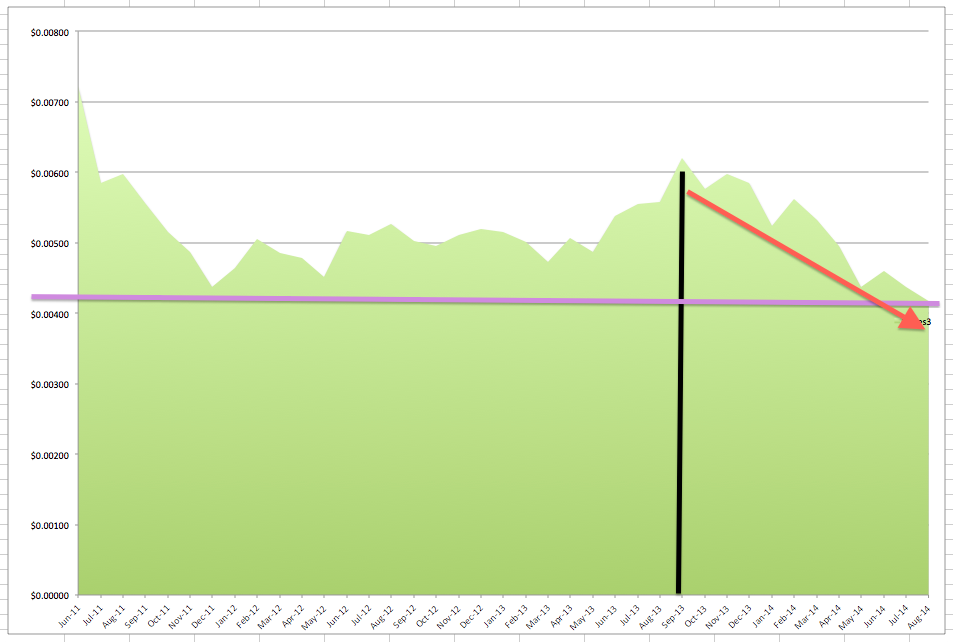
Per stream rates started to decline in Sept 2013 (black vertical line) and continue to drop. Here’s the graph which runs from June 2011 – Aug 2014, from left to right.
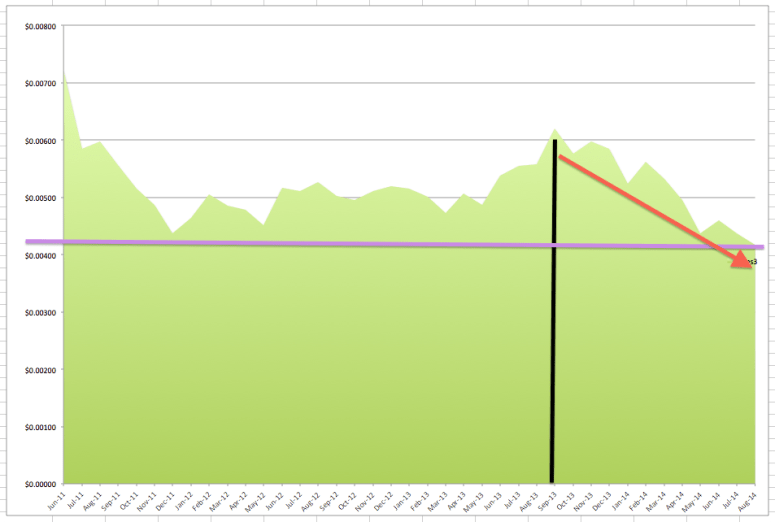
Spotify rates per spin appear to have peaked and are now declining.
Per stream rates are dropping because the amount of revenue is not keeping pace with the number of streams. There are several possible causes:
1) Advertising rates are falling as more “supply” (the number of streams) come on line and the market saturates.
2) The proportion of lower paying “free streams” is growing faster than the proportion of higher paying “paid streams.”
3) All of the above.
This confirms our long held suspicion that as a flat price “freemium” subscription service scales the price per stream will drop. AND as the service reaches “scale” the pool of streaming revenue becomes a fixed amount. The pie can’t get any larger and adding more streams only cuts the pie into smaller pieces! Don’t expect it to be any different for the newly announced YouTube music service.
You can see this more clearly if you remove the US figures from the calculation and use only the more mature ROTW markets. In this calculation the streaming rate decline is even more pronounced. Yikes!
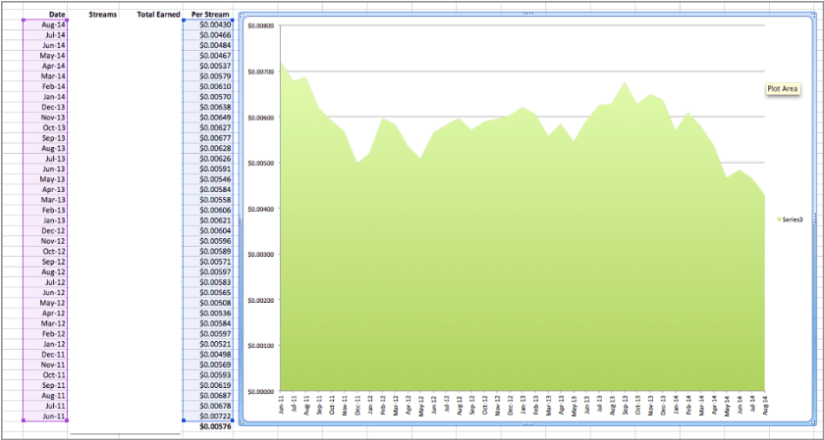
If you exclude the US and look at the more “mature” ROTW Spotify markets the decline is even more pronounced.
And the full data (for the first graph) is below…
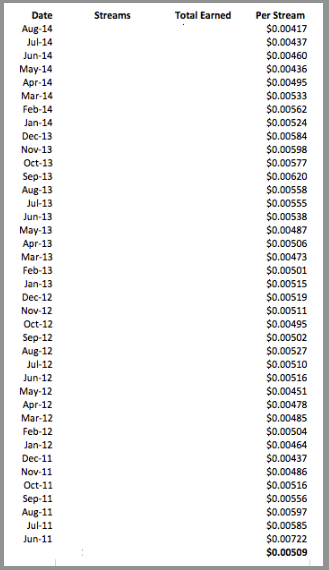
The data above is aggregated. In all cases the total amount of revenue is divided by the total number of the streams per service (ex: $5,210 / 1,000,000 = .00521 per stream). Multiple tiers and pricing structures are all summed together and divided to create an averaged, single rate per play.









 The Trichordist
You must be logged in to post a comment.