
Forget exploitative pay from Spotify! Do you want your music on YouTube Music? Will you be alongside Hate rock songs? Jihadi Recruitment Music Videos? Probably. YouTube is full of this vile stuff. And we let our kids watch YouTube?


Forget exploitative pay from Spotify! Do you want your music on YouTube Music? Will you be alongside Hate rock songs? Jihadi Recruitment Music Videos? Probably. YouTube is full of this vile stuff. And we let our kids watch YouTube?
WE NOW HAVE THE PROOF. STREAMING RATES HAVE PEAKED.
As we noted yesterday The UN is airlifting calculators and behavioral economics textbooks to Hollywood and Silicon valley. So soon we hope some of the executives being paid to do the math on streaming will actually do the math on streaming.
In the meantime we crunched the numbers and it appears that Spotify rates per stream have peaked and are now dropping as they add more users.
Per stream rates started to decline in Sept 2013 (black vertical line) and continue to drop. Here’s the graph which runs from June 2011 – Aug 2014, from left to right.
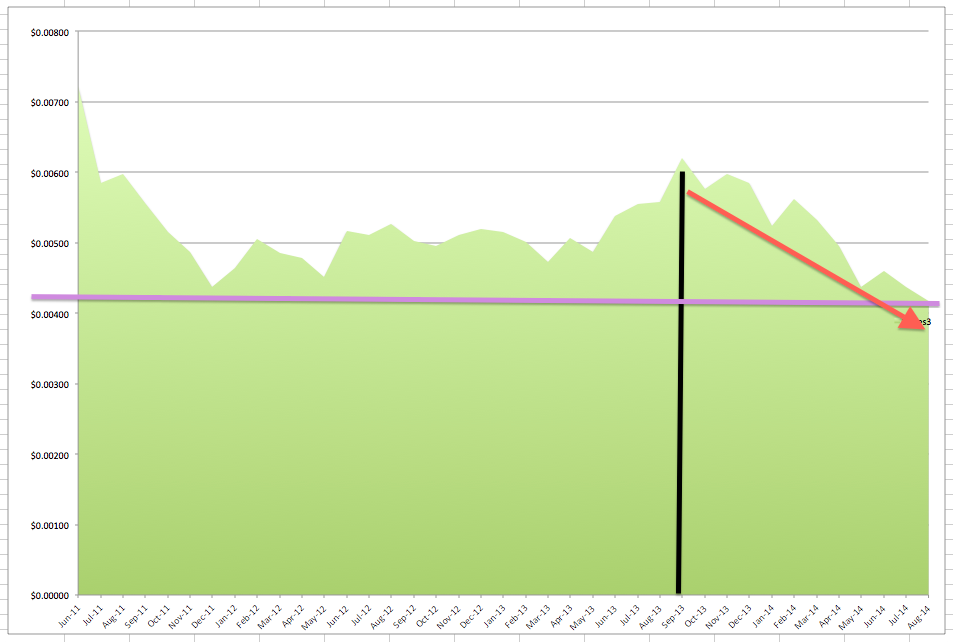
Spotify rates per spin appear to have peaked and are now declining.
Per stream rates are dropping because the amount of revenue is not keeping pace with the number of streams. There are several possible causes:
1) Advertising rates are falling as more “supply” (the number of streams) come on line and the market saturates.
2) The proportion of lower paying “free streams” is growing faster than the proportion of higher paying “paid streams.”
3) All of the above.
This confirms our long held suspicion that as a flat price “freemium” subscription service scales the price per stream will drop. AND as the service reaches “scale” the pool of streaming revenue becomes a fixed amount. The pie can’t get any larger and adding more streams only cuts the pie into smaller pieces! Don’t expect it to be any different for the newly announced YouTube music service.
You can see this more clearly if you remove the US figures from the calculation and use only the more mature ROTW markets. In this calculation the streaming rate decline is even more pronounced. Yikes!
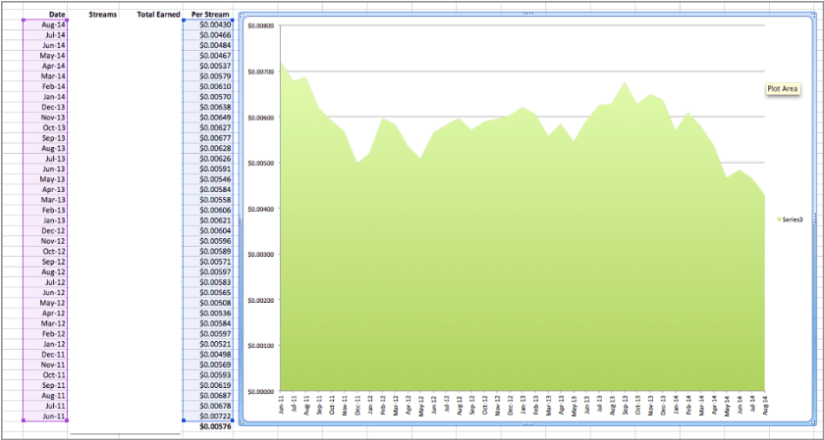
If you exclude the US and look at the more “mature” ROTW Spotify markets the decline is even more pronounced.
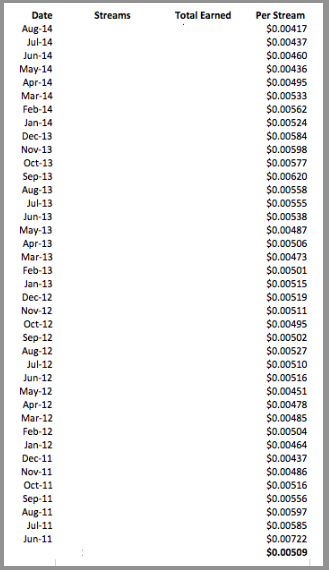
And the full data (for the first graph) is below…

UN prepares to airlift badly needed calculators and behavioral economics textbooks to Hollywood and Silicon Valley. Above a A Norwegian UN peacekeeping soldier reacts to details of YouTube Music Key deal. Photo by Русский: Фото: Михаил Евстафьев English: Photo: Mikhail Evstafiev (Mikhail Evstafiev)
If only this story were true.
Yet again we are witnessing a catastrophic failure of mathematics and logic by the music business and their digital music partners:
1). If you offer something for free don’t expect anyone to pay $7.99 a month for the exact same product. After a healthy debate over the (bad) economics of free streaming courtesy of Taylor Swift, the record labels and YouTube have doubled down on their losing bet on free streaming with the YouTube music service. Full album streaming will be available on the free service as well as the paid service. So again no reason to upgrade to paying service. Well at least we can “opt out” of YouTube. Right? Can’t we?… I think we can…. (ed note- you can pull your tracks off Spotify but YouTube will hide behind the DMCA act and let their users upload it.)
2.) If you let YouTube have all our music at $7.99 a month how do you tell Spotify and all the other services they have to stay at $9.99 a month? You can’t blame Daniel Ek for being pissed off about the YouTube deal, now can you?
3) Let’s assume that people defy basic economic principles and pay for something they already get for free. Let’s assume streaming scales to as many US customers as Netflix. That’s 36 million subscribers. At YouTube’s rate of $7.99 you get 3.4 billion retail. 2.4 billion at wholesale. The current recorded music business is 7.1 Billion.
4) As the Cynical Musician eloquently notes: If flat fee streaming services really are the future of music consumption, at “scale” we end up with a fixed pool of money for ALL recorded music. This means the pie can never grow and the slices get smaller and smaller as you increase spins and add new albums. This looks like a death spiral. The only way out is to allow windowing. Oh but wait! The YouTube deal doesn’t let you do that!
5). Stop saying that $120 a year from each streaming subscriber is greater than the $71 a year per capita music consumption in 1999. PER CAPITA! Do you know what that means? Per capita means we are counting every single resident of the USA. Including infants and your 90 year old great grandparents. Unless you have a plan to get $120 a year from infants and 90 year old great grandparents please STFU.
A must read from David Newhoff for all creators with many points, well made.
Further, if it is true that a copyright-free future could shrink the pool of producers to those already financially secure (as predicted above), this suggests that all of the non-remunerative benefits of copyright might be of even greater value to those authors still willing and able to produce. And in the absence of those rights, we could easily see a reduction not only in the number of producers, but also in the number of works produced by that elite few. In a practical example, imagine the trustafarian artist working in the most altruistic manner, producing wonderful works solely to be experienced; he doesn’t care about money, but he does have to accept that McDonald’s can use his work to sell hamburgers, which betrays everything he is expressing. It is not farfetched to imagine the artist in this example will withhold works from public view, even if he continues to produce for his own pleasure.
READ THE WHOLE POST AT:
http://illusionofmore.com/copyright-critics-dont-get-artists/
Have a Great Weekend!
More to follow, but the Turtles win another one for all pre-72 artists in federal court in New York applying New York state copyright law.
Turtles NY Memorandum and Order Denying Defendant’s Motion for Summary Judgement
Satire – but not by much.
Apple Computer announced today that for it’s Itunes Music Store to remain competitive in the digital distribution marketplace for music they would be changing their retail pricing of album downloads to one dollar and song downloads to 10 cents each. The pricing change will be effective on black Friday for this holiday season. “Since we purchased Beats music and are competing directly with Spotify we recognized the need for more competitive pricing structures based on what consumers may be willing to pay”, an Apple spokesman said. He continued, “Spotify has proven that as long as we’re paying 70% of gross, the retail pricing is irrelevant, irrelevant! We are even contemplating 10 cent albums and one cent songs to further achieve parity with music streaming services!”
Record label executives rejoiced in the move as one source exclaimed,” I don’t know why we didn’t think of reducing the retail price of downloads by 90% years ago. It’s still money, right? It’s so simple that this is really the only way to grow the business to $100b annually while competing with piracy.”

A must read post from The Cynical Musician:
“In a hypothetical future that is nothing but streaming (a depressingly real possibility, given that everything but streaming is going down the drain), the size of the industry is capped at 70% of streaming service revenue. There’s no way to grow the industry, because there’s no new money coming in. The subscription revenue pays for all present and future consumption, it doesn’t matter how many (or few) hot new releases there are. In fact, it doesn’t even matter what music is on the service or how popular it is. The size of the pie is fixed from the start.”
READ THE FULL POST HERE:
http://thecynicalmusician.com/2014/11/new-money/
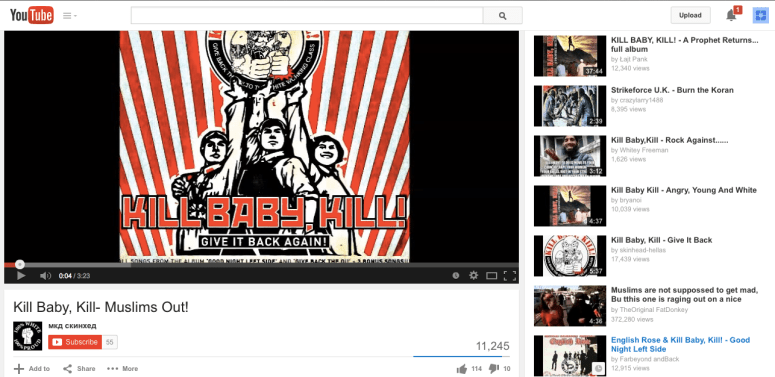
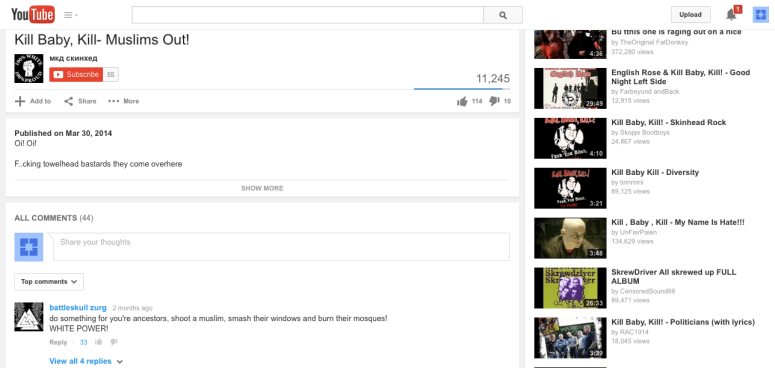
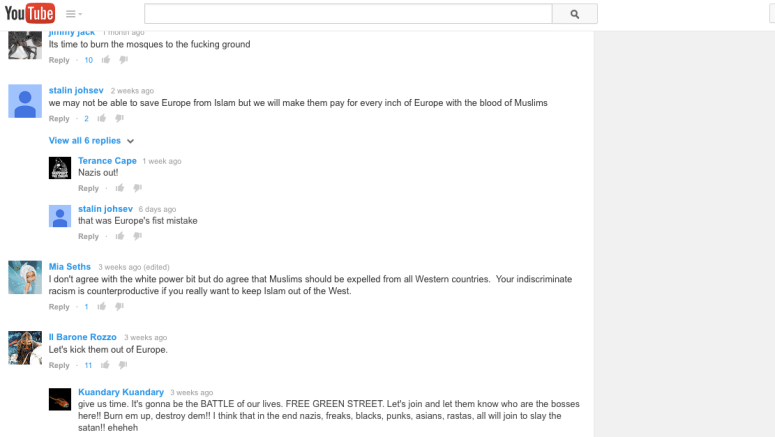
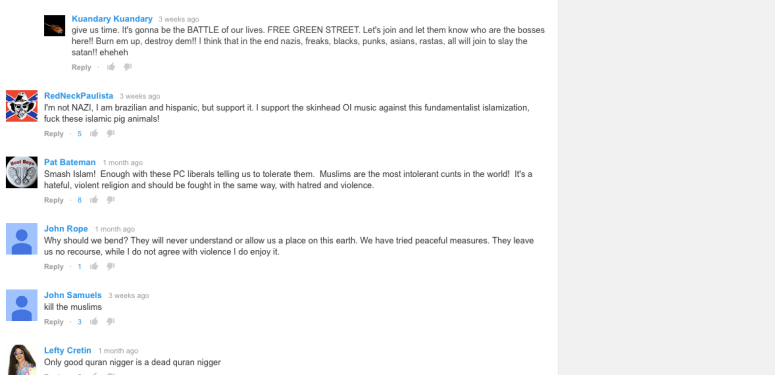
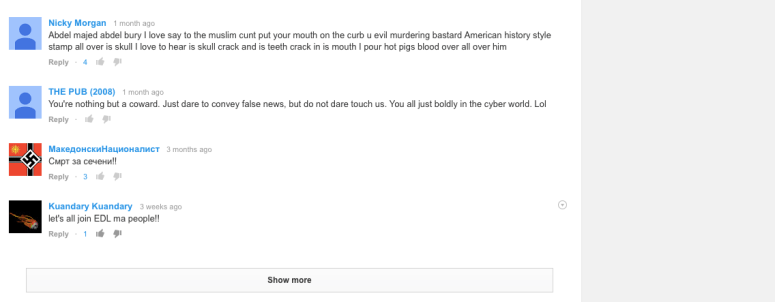
I’m sure all the violent white supremacists the world over are excited about the launch of the new YouTube music service! Will they be able to listen to Kill Baby Kill or Angry Aryans and recruit new followers to our violent Neo-Nazi movement the way they can currently on YouTube?
Violent terrorist skinheads the world over are anxiously holding their breaths!


Several of our posts on streaming pay rates aggregated into one single source. Enjoy…
[UN to Airlift Calculators, Behavioral Economics Textbooks to Digital Music Industry]
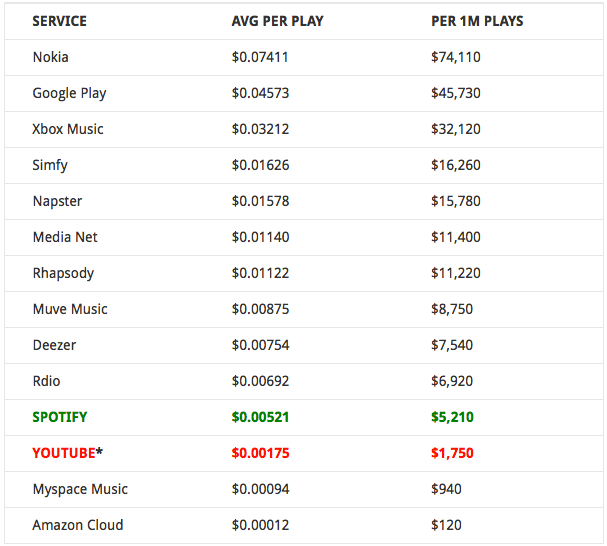
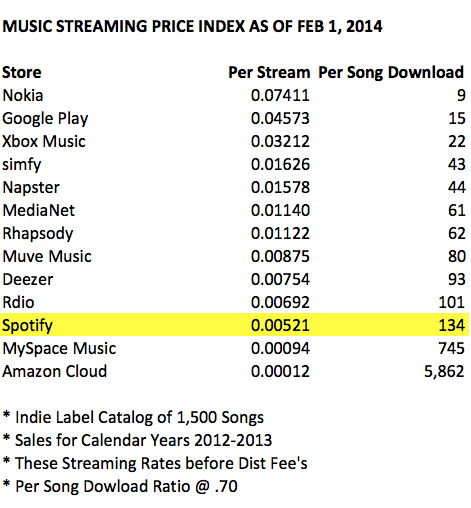 [EDITORS NOTE: All of the data above is aggregated. In all cases the total amount of revenue is divided by the total number of the streams per service (ex: $5,210 / 1,000,000 = .00521 per stream). In cases where there are multiple tiers and pricing structures (like Spotify), these are all summed together and divided to create an averaged, single rate per play.]
If the services at the top of the list like Nokia, Google Play and Xbox Music can pay more per play, why can’t the services at the bottom of the list like Spotify and YouTube?
We’ll give you a hint, the less streams/plays there are the more each play pays. The more plays there are the less each stream/play pays. Tell us again about how these services will scale. Looking at this data it seems pretty clear that the larger the service get’s, the less artists are paid per stream.
So do you think streaming royalty rates are really going to increase as these services “scale”? No, we didn’t either.
We’ve been waiting for someone to send us this kind of data. This info was provided anonymously by an indie label (we were provided screenshots but anonymized this info to a spreadsheet). Through the cooperative and collaborative efforts of artists such as Zoe Keating and The Cynical Musician we hope to build more data sets for musicians to compare real world numbers.
In our on going quest for openness and transparency on what artists are actually getting paid we’d love to hear from our readers if their numbers and experience are consistent with these numbers below. At the very least, these numbers should be the starting point of larger conversations for artists to share their information with each other.
Remember, no music = no business.
 For whatever reason there appear to be a lot of unmonetized views in the aggregate. So let’s just focus on the plays earning 100% of the revenue pool in the blue set. These are videos where the uploader retains 100% of the rights in the video including the music, the publishing and the video content itself.
| Plays | Earnings | Per Play |
| 2,023,295 | $3,611.84 | $0.00179 |
| 1,140,384 | $2,155.69 | $0.00189 |
| 415,341 | $624.54 | $0.00150 |
| 240,499 | $371.47 | $0.00154 |
| 221,078 | $313.47 | $0.00142 |
| TOTALS | TOTALS | AVERAGE |
| 4,040,597 | $7,077.01 | $0.00175 |
So it appears that YouTube is currently paying $1,750 per million plays gross.
We understand that people reading this may report other numbers, and that’s the point. There is no openness or transparency from either Spotify or YouTube on what type of revenue artists can expect to earn and under what specific conditions. So until these services provide openness and transparency to musicians and creators, “sharing” this type of data is going to be the best we’re going to be able to do as East Bay Ray comments in his interview with NPR.
As we’re now in a world where you need you need a million of anything to be meaningful here’s a benchmark of where YouTube ranks against Spotify.
| Service | Plays | Per Play | Total | Notes |
| Spotify To Performers/Master Rights | 1,000,000 | 0.00521 | $5,210.00 | Gross Payable to Master Rights Holder Only |
| Spotify To Songwrtiers / Publishers | This revenue is for the same 1m Plays Above | 0.000521 | $521.00 | Gross Payable to Songwriter/s & Publisher/s (estimated) |
| YouTube Artist Channel | 1,000,000 | 0.00175 | $1,750.00 | Gross Payable for All Rights Video, Master & Publishing |
| YouTube CMS (Adiam / AdRev) ** | 1,000,000 | 0.00032 | $321.00 | Gross Payable to Master Rights Holder Only |
The bottom line here is if we want to see what advertising supported free streaming looks like at scale it’s YouTube. And if these are the numbers artists can hope to earn with a baseline in the millions of plays it speaks volumes to the unsustainability of these models for individual creators and musicians.
Meet the New Boss: YouTube’s Monopoly on Video | MTP
It’s also important to remember that the pie only grows with increased revenue which can only come from advertising revenue (free tier) and subscription fees (paid tier). But once the revenue pool has been set, monthly, than all of the streams are divided by that revenue pool for that month – so the more streams there are, the less each stream is worth.
All adrev, streaming and subscription services work on the same basic models as YouTube (adrev) and Spotify (adrev & subs). If these services are growing plays but not revenue, each play is worth less because the services are paying out a fixed percentage of revenue every month divided by the number of total plays. Adding more subscribers, also adds more plays which means that there is less paid per play as the service scales in size.
This is why building to scale, on the backs of musicians who support these services, is a stab in the back to those very same artists. The service retains it’s margin, while the artists margin is reduced.
Here’s what 1 million streams looks like from different revenue perspectives on the two largest and mainstream streaming services.
| Service | Units | Per Unit | Total | Notes |
| Spotify | 1,000,000 | $0.00521 | $5,210.00 | Gross Payable to Master Rights Holder Only |
| Spotify | same million units as above | $0.00052 | $521.00 | Gross Payable to Songwriter/s & Publisher/s (est) |
| YouTube | 1,000,000 | $0.00175 | $1,750.00 | Gross Payable for All Rights Video, Master & Publishing |
| YouTube CMS Master Recording (Audiam / AdRev) | 1,000,000 | $0.00032 | $321.00 | Gross Payable to Master Rights Holder Only |
| STREAMING TOTALS | 3,000,000 | $7,802.00 | TOTAL REVENUE EARNED FOR 3 MILLION PLAYS ON SPOTIFY AND YOUTUBE | |
| Itunes Album Downloads | 1,125 | $7.00000 | $7,875.00 | Gross payable including Publishing |
Here are some compelling stats on the break down of what percentage of videos on YouTube actually achieve breaking the 1 million play threshold, only 0.33%
CHART OF THE DAY: Half Of YouTube Videos Get Fewer Than 500 Views | Business Insider
Some 53% of YouTube’s videos have fewer than 500 views, says TubeMogul. About 30% have less than 100 views. Meanwhile, just 0.33% have more than 1 million views.
That’s not a huge surprise. But it highlights some of the struggles Google could have selling ads around all those unpopular videos, despite the money it has to spend to store them.
An artist needs to generate THREE MILLION PLAYS on the two largest and most popular streaming platforms to equal just 1,125 album downloads from Itunes. This is an important metric to put in context. In 2013 only 4.8% of new album releases sold 2,000 units or more. So if only 4.8% of artists can sell 2,000 units or more, how many artists can realistically generate over four million streams from the same album of material?
in 2013 there were 66,565 new releases, only 3,237 sold more than 2,000 units = 4.8% of new releases sold over 2,000 units
in 2013 there were 915,482 total releases in print, only 14,856 sold more than 2,000 units = 1.6% of ALL RELEASES in print sold more than 2,000 units.
This is even more important when you start to consider that many artists feel that growing a fan base of just 10,000 fans is enough to sustain a professional career. Note we said solo artists because these economics probably need to be multiplied by each band member added for the revenue distribution to remain sustainable. So a band of four people probably need a sales base of 40,000 fans to sustain a professional career for each member of the band.
Each 10,000 albums sold on iTunes (or 100,000 song downloads) generates $70,000 in revenue for the solo artist or band. To achieve the same revenue per 10,000 fans in streams, the band has to generate 30 million streaming plays (as detailed above) if they are distributing their music across the most common streaming services including Spotify and YouTube.
In 2013 the top 1% of new releases (which happen to be those 620 titles selling 20k units or more) totaled over 77% of the new release market share leaving the remaining 99% of new releases to divide up the remaining 23% of sales.
This appears to confirm our suspicion that the internet has not created a new middle class of empowered, independent and DIY artists but sadly has sentenced them to be hobbyists and non-professionals.
Meanwhile the major artists with substantial label backing dominate greater market share as they are the few who can sustain the attrition of a marketplace where illegally free and consequence free access to music remains the primary source of consumption.
What’s worse is that it is Silicon Valley corporate interests and Fortune 500 companies that are exploiting artists and musicians worse than labels ever did. New boss, worse than the old boss, indeed.
So whose feeling empowered?
RELATED:
Locals in the lovely fishing village of Inverness CA ( I shot half a video there) are up in arms wondering just what Pandora founder Tim Westergren is doing with an old Russian Monastery. Google Street View here.
As The San Jose Mercury News reports.
Judging from the many letters of opposition that have been sent to county planners, most residents are aghast at the size of the 8,297-square-foot project, which would have 14 bathrooms and up to 17 “functional” bedrooms, according to critics, and would be up to four times larger than the median-sized house in this community of remodeled summer homes, weekend cottages, rustic cabins and modest single-family dwellings.
Westergren says his plans call for nine bedrooms total, but the Inverness Association, an 84-year-old organization of property owners and preservationists, concludes that the second unit “functions as a six-bedroom, two bath housing unit with detached two-car garage” and the septic systems have been sized to service 11 bedrooms in the main residence and six bedrooms in the second unit. (read more)
Some are speculating that rather than a house he intends to open a boutique hotel.
We have have another suggestion:
Westergren can use the property to house the songwriters he has made homeless by his relentless war on songwriters and performers.
Tim Westergren making 1 million a month in stock sales
http://musictechpolicy.wordpress.com/2013/05/03/the-return-of-irfa-million-a-month-tim-charges-on/
And look at the other Pandora insiders selling stock like crazy!

 The Trichordist
You must be logged in to post a comment.