#irespectmusic Blake Morgan on Spotify and Artists….
View original post 824 more words
#irespectmusic Blake Morgan on Spotify and Artists….
View original post 824 more words
The music business press has repeatedly criticized artists for not providing a solution for the problems with streaming. Once you get past the amusing fact that it’s not our job nor are we paid to fix streaming services it does become a useful exercise. Here is my response.
I would like to thank the shareholders for appointing me CEO of Spotify. I am honored that you placed such great trust in my ability to navigate us through this difficult time.
I would like to make a few comments on the strategy pursued by my predecessor Daniel Ek. I do this not to criticize my predecessor but to illustrate how my leadership of this company will vary significantly from his.
1. Under my predecessor’s leadership Spotify pursued a scorched earth policy towards artists that criticized our company. This has been going on for some time. In the past Spotify engaged surrogates and proxies to attack artists. This was at best misguided, but the full throated media attack we orchestrated on Taylor Swift was a strategic blunder.
The reality is that Taylor Swift controls her own catalogue and we have given her every reason to NEVER license her songs to the service EVER AGAIN. Swift accounted for more than 20% of all album sales the last two weeks. It’s likely that she would have represented a similar amount of streams. Her songs are now on our competitors services but not ours. Spotify can not afford to repeat this mistake.
After I fire all of Spotify’s astroturf consultants, I intend to issue a full apology to the singer–with no conditions–and hereby renounce all such tactics.
2. My predecessor insisted that all songs be available on the free version of the service. Indeed this is exactly the issue that led Taylor Swift to leave the service. I believe that this also was a strategic blunder.
By taking a hardline, Spotify lost a once-in-a-decade opportunity to increase revenue and move free users to the premium service. I intend to modify this policy to allow premium-only content on the subscription service to move free users towards the subscription service.
Further I intend to transition the free service to a free thirty day trial. I believe that Netflix would have never become so successful by competing with itself with a free version. Nor would it have become successful without offering exclusive premium content.
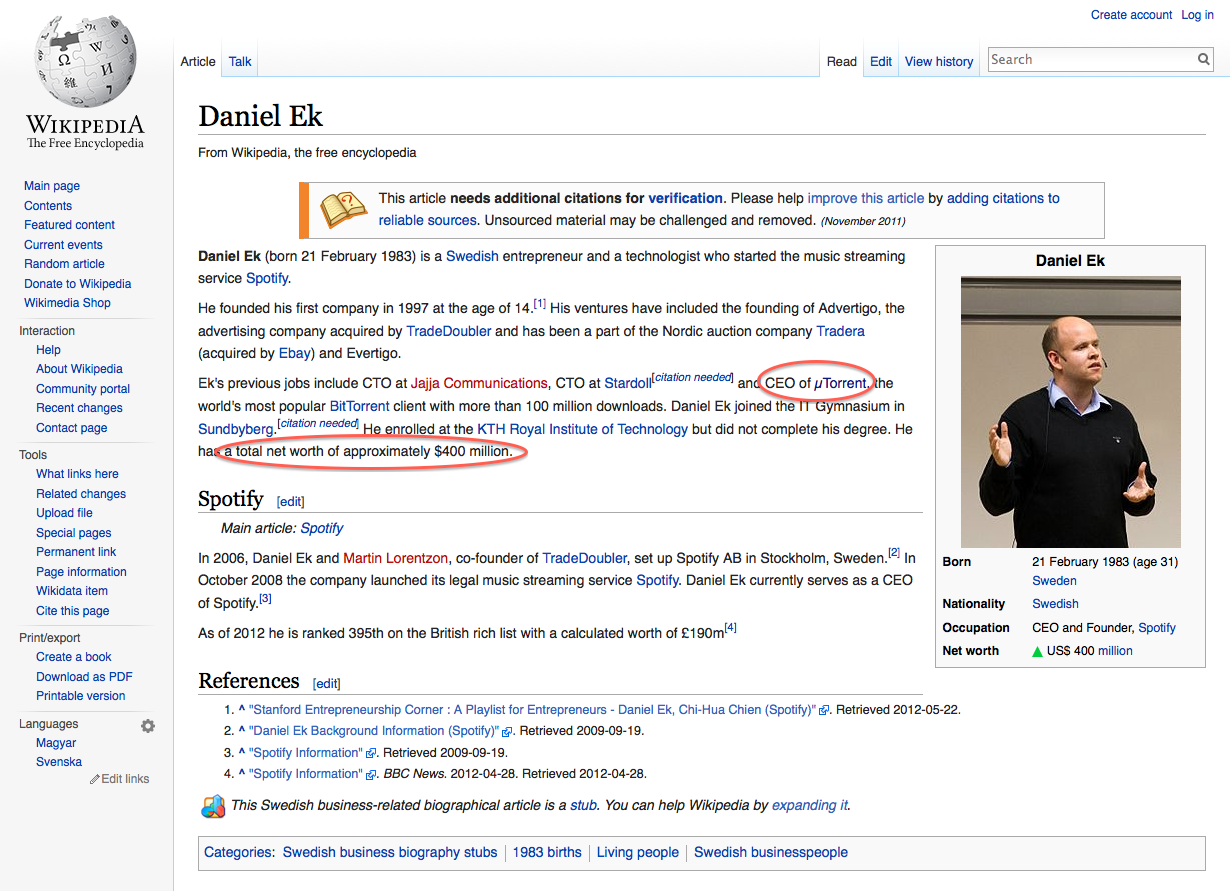
3. My predecessor was once CEO of uTorrent the world most popular bitTorrent client [Editor’s note-“someone” repeatedly edits this out of Mr. Ek’s wikepedia page–ahem–hence we’ve had to rely on static screen captures.] I believe that his immersion in the world of piracy impaired his judgement.
My predecessor failed to understand that piracy is the enemy of Spotify. Unlicensed sites not only hurt artists but compete with Spotify for users and advertisers. Instead of seeing this as an existential threat Spotify has repeatedly used the threat of piracy as a “club” to keep rightsholders and artists on it’s free service.
I hereby renounce the use of this tactic and going forward intend to create alliances with rightsholders and artists to attack the scourge of ad-funded piracy.
4. I must commend my predecessor for recognizing (however belatedly) the strategic threat that YouTube represents to all streaming services. YouTube the video monopoly is also the biggest streaming service. And it is free. But this is because YouTube hides behind the fiction that it can not control what it’s users upload and Google’s litigation muscle and shakedown rackets.
Much as my predecessor used the threat of piracy as a club, YouTube uses its users as a sort of “torches and pitchforks” mob to threaten rightsholders and artists (not to mention its highly litigious culture). I believe that this is an illegal practice and I intend to join with rightsholders to press the US government, the European Commission and any other government who is willing into taking action against YouTube on this issue. Perhaps if all these governments join together, the Google juggernaut can be stopped. Spotify should lead the charge.
Thank you and I look forward to a long a productive term as CEO of Spotify.
RELATED :
We’ve written about this before in two posts, Why Spotify is not Netflix (But Maybe It Should Be) and Streaming Is the Future, Spotify Is Not. Let’s talk Solutions. In Both posts we talk at length about how the problem is not technology or streaming itself, but rather the very restricted business models and poor economics that currently exist. No amount of selective double speak from Daniel Ek will change the bad math that Spotify can not scale at current rates.
Jason Aldean now joins Taylor Swift in removing his music from Spotify which leads us to wonder how many more artists with the ability to do so will remove their new releases and/or catalogs as well. This may also be a good time to revisit those two previous posts mentioned above.
So here is the question, is the record business really utilizing the new digital platforms correctly to address the current market place? Perhaps by looking at the options available to consumers from movie streaming, rental and download businesses we can find more robust and flexible opportunities for artists.
At the very least windowing releases allows artists, their managers and even labels the ability to manage and maximize current revenue streams more effectively. Windowing opens up strategic decisions about tier based pricing relative to the value proposition for both the artist and the consumer. Windowing may not fix all of the problems artists are facing in music streaming but it will be a great first step towards recognizing that the artists should have some direct participation in deciding how their work is consumed.
It’s not that streaming can’t work. It can. It’s that Spotify is a bad business model that has unsustainable economics and exploits artists because it is a wall street financial instrument and not a music company.
Pay Gates may be another solution (which is essentially a window). For example, Spotify premium paid subscribers could access the new Taylor Swift record, but not those using the free version of the service. This also allows artists to determine which songs can be accessed for free for greater promotional value, and which songs are intended to maximize revenue.
Why does Spotify unilaterally get to dictate to artists, managers and labels how to best maximize their relationships and revenues with their own fans?
As Spotify is a destination platform, and not a discovery platform we could see where the current hit singles are only available to paid subscribers while select album tracks could be accessible for free. The tracks on the free tier are monetized only by advertising revenue which pays very little, but there may be a promotional benefit to build awareness on lesser know songs.
Even the old school record business had tier based pricing. There were front-line, mid-line and budget pricing tiers. Front-line titles were often deeply discounted for premium in-store positioning. Mid-line titles were discounted as an incentive to stimulate more sales from recent catalog titles. Budget titles were mostly oldies and very deep back catalog. Primitive as they were, these were windows.
Yes, we know the choir of “or else they’ll steal it” from piracy apologists will claim that anything less the complete devaluation of music as fodder for advertising revenue is pointless. We’ll take our chances with Jason Aldean, Taylor Swift, Adele, Coldplay, Beyonce’, The Black Keys, Thom Yorke and the growing number of artists that are either removing their catalogs from Spotify, or windowing them.
Bring on the windows and pay gates! Let’s see some “innovation” and “disruption” that actually works for artists and not just the new boss. The outcry (from Spotify) of artists removing their songs also proves another very important point – all music is not equal. If some weekend hobbyist does not put their music on Spotify or pulls it off Spotify it doesn’t make headlines. Taylor Swift, Adele, Beyonce, The Black Keys, Thom Yorke, etc – all make headlines because people actually do VALUE professional music. Professional music, has a professional price.
If Spotify is such a good business for artists, why not let each artist decide if Spotify works for them? Why does Spotify publicly shame artists to convince them how good they are? The lady doth protests too much, wethinks…
It’s funny how long it’s taken the record industry to realize that if you keep allowing something to be given away for free there is no incentive to pay. Who knew?

RELATED:

Piracy and Streaming seem to have a lot in common in the (false) arguments presented by tech bloggers…
There’s a post on a tech blog from 2009 following The Pirate Bay guilty verdict titled “Paul McCartney’s Confused About The Pirate Bay” that truly illustrates how many internet consultants and tech blogger’s appear feel about musicians. The comments responding to Sir Paul McCartney speaking about the Pirate Bay verdict show just how much these people don’t seem to understand musicians.
In this one post we see all of the major anti-artists talking points that Silicon Valley interests still use against creators in a disinformation campaign that is over a decade long:
– artists are easily confused about the internet and technology
– artists don’t know what’s best for them (let the “consultant” help you!)
– artists can get paid, but as long as its not via a “government mandated tax” ie, copyright (!?)
– artists shouldn’t be able to live off of one song (royalties)…
View original post 351 more words
Music industry exec and blogger Jay Frank commented on our post BUT SPOTIFY IS PAYING 70% OF GROSS TO ARTISTS, ISN’T THAT FAIR? NO, AND HERE’S WHY…. Jay’s comment is typical of the thinking that has landed the record industry where it is today (losing money and in trouble).
It’s hard to tell from the comment whether Jay actually believes what he’s saying in the same way someone who bought a million dollar house with no money down, on a zero percent, 5 year ARM convinced themselves there was no housing bubble…
If they [Spotify] go from 10m to 100m free users, they’ll be able to charge much larger premium rates, and may even strike deals with some acts. That could easily result in $1b in artist royalties, given some other media models. This now puts Spotify at $3.5b in artist royalties per year. Pretty good.
To your point, though, that’s still half of the $7b number you put out there.
Right, no kidding “that’s still half of the $7b number”. To be fair to Jay, you should read his whole comment in context at the link above.
However, by his own admission he is still coming up short by $3.5b. If you factor that in with the analysis of the projected revenue losses from YouTube’s Music Key that’s another estimated $2.3b in the hole. But the simple truth is much easier to see, revenue keeps dropping as it has for the past 13 years while piracy apologists and digital music snake oil salesmen have yet to show any increase in actual overall net revenue from recorded music sales.
YouTube’s MusicKey Will Cause $2.3 Billion In Music Industry Losses… | Digital Music News
http://www.digitalmusicnews.com/permalink/2014/11/03/youtubes-musickey-will-cause-2-3-billion-music-industry-losses
By Jay’s logic, digital albums would sell for one dollar not ten while digital song downloads would be priced at ten cents and not one dollar. That’s not the case for good reason and illustrates quickly and effectively why Spotify paying 70% of gross is moot. We don’t think labels would agree to getting paid 70% on one dollar album albums and ten cent songs. Of course the labels don’t have 18% equity in Itunes either…
The larger truth and common sense is that Spotify economics don’t work in the same way $1 album downloads and $.10 song downloads don’t work – there’s not enough scale to make the economics sustainable. If Jay truly thinks you can more than double the revenue from transactional downloads by reducing the price by 90% we’ve got a bridge in Brooklyn we’d like to sell him very cheap.
In terms of “highly selective math” Jay continues his comment from above:
To your point, though, that’s still half of the $7b number you put out there. True, but that presumes that Spotify is the only player in town. While they may be a major force, there will also be other internet radio, satellite radio, video streaming, other streaming competitors and probably still physical and digital retail sales. Add to that greater ubiquity in tracking usage with increasing penetration of smart mobile devices combined with declining mobile data cost…and I feel like we’re starting to approach $10b a year.
And that’s just the U.S.
Ok, so let’s see that $10b a year in revenue streams plotted out and lets take a closer look at it. Here’s what subscription based services look like right now. Netflix only has 36m subscribers in the US, no free tier, and massive limitations on available titles of both catalog and new releases. Sirius XM, 26.3m in the US as a non-interactive curated service installed in homes, cars and accessible online. Premium Cable has 56m subscribers in the US paying much more than $10 a month and also with many limitations. Spotify… 3m paid subscribers in the US after four years.
Tell us again about this strategy of “waiting for scale.” Spotify is Three Million Paid… Three… Oh, and that’s just the U.S.
* 3m Spotify Subs Screen Shot
* 26.3m Sirius XM Subs Screen Shot
* 36m Netflix Subs Screen Shot
* 56m Premium Cable Subs Screen Shot
* $7b Music Business Screen Shot
Hey, it’s just math… but in the meantime Jay, you may want to look at this:
Streaming Isn’t Saving the Music Industry After All, Data Shows… | Digital Music News
http://www.digitalmusicnews.com/permalink/2014/06/26/streaming-isnt-saving-music-industry-new-data-showsA Detailed Explanation on Why Streaming Has Failed… | Digital Music News
http://www.digitalmusicnews.com/permalink/2014/10/02/detailed-explanation-streaming-failed
You can email Paul Resnikoff at paul@digitalmusicnews.com
RELATED:
One of our friends created this survey to get some information on how you hear about, listen to and enjoy music. Given that Taylor Swift has focused the world’s attention on this issue, we thought it would be a good time to post this survey. Click here to take the survey on Survey Monkey!
Spotify is not paying sustainable rates for the cost of goods. Look – it’s like this, if something cost you $100 to make, and someone else sells it for $10… it doesn’t matter that you are getting 70% of the gross, you’re still over 90% unrecouped on a per unit basis. This is the problem with Spotify, is that it undervalues the true cost of goods (including R&D, etc).
Artists agreeing to streaming their music on Spotify are essentially agreeing to sell albums for One Dollar and Songs for Ten Cents… Oh Wait, Spotfiy actually pays way less than that… (calculated on a per stream basis).
This is why arguments about marginal percentages miss the point completely. It’s about simple math and simple economics.
The cost of music is not in the distribution of music (which is cheap). The cost of music is in the human labor of the CREATION of music (which is expensive).
The cost of goods is greater than the marginal cost to distribute those goods. Stop confusing the product with the container.
The CREATION of music is also more than the cost of RECORDING music. The cost of music is in the sustainable needs of the human labor for food, shelter, clothing, etc.
Spotify can not scale and work at current economics… One More Time…
SPOTIFY MATH FOR THOSE OF YOU AT HOME WITH CALCULATORS:
Just show us the math where streaming scales, we’ll wait. Spotify has 3m paid in the US at $10 each.
$10 x 12 mos = $120 per year. Pay out 70% that’s a gross of $84 per year per subscriber. Simple Math.
That $84 per sub is in revenue to all artists in rights holders. Times that by 3m and you get a whopping $252m a year in a $7b business.
Multiple that by 10, to get 30m subs @ $10a month and that’s only $2.5b a year… and that’s a big IF Spotify ever gets to 30m paid in the USA… and IF they do, that’s ONLY 2.5b in revenue against the $7b now…
So you effectively cut the revenue to everyone by 1/2 to 2/3rds… how does this math work without raising the price of subscriptions? It doesn’t.
It’s just math.
RELATED:
A few days ago we learned that Taylor Swift had decided to “window”her new album and not release it on Spotify. We also learned that she had removed her back catalogue albums from the Spotify service.
We learned this because Spotify posted this sad little note in which they begged her to come back to their service.
This of course became a national news story with the press largely lecturing Taylor Swift on “depriving” her fans of her music; Mansplaining that she was making a bad business decision; And generally being mean and greedy.
Bad Taylor. Poor Spotify.
And then it all turned out to be total bullshit. Taylor Swift hadn’t pulled her back catalogue from the streaming services. The albums are available on virtually every other subscription service! A fact that only a single major US news outlet has noted! According to Music Ally, Swift wanted her music only on the premium (paid) part of these services. Spotify refused. They demanded Swift put her albums on the free tier. Spotify not Swift played hardball. They didn’t get their way. She left.
Oh that’s a little different isn’t it?
I mean it’s a little like your friend who comes over to sleep on your couch because his girlfriend broke up with him. So sad. They seemed so perfect for each other! You feel bad for him. But the next morning you find out he slept with a flight attendant and tried to make her cat smoke crack.
Oh that’s a little different, isn’t it?
Still that hasn’t stopped Spotify from mounting what now resembles a cyberbully attack on Swift in order to get her to come back to Spotify. Instead of privately negotiating, Spotify decided to go public and mount a full throated PR campaign that even features Elevation Partners Managing Director and U2 lead singer Bono weighing in. Add to that the absolutely unfiltered vitriol that Spotify is allowing in the comments on it’s company blog and it doesn’t look good. It looks like cyberbullying.
Or even a “Swift Boat” attack.
And if Swift’s only public interview since this whole thing exploded is any indication? It doesn’t look like she’s coming back. Here is Swift earlier today on Yahoo:
“All I can say is that music is changing so quickly, and the landscape of the music industry itself is changing so quickly, that everything new, like Spotify, all feels to me a bit like a grand experiment,” Swift told Yahoo. “And I’m not willing to contribute my life’s work to an experiment that I don’t feel fairly compensates the writers, producers, artists, and creators of this music.”
Tough luck guys.
…Of Foxes and Hen Houses…
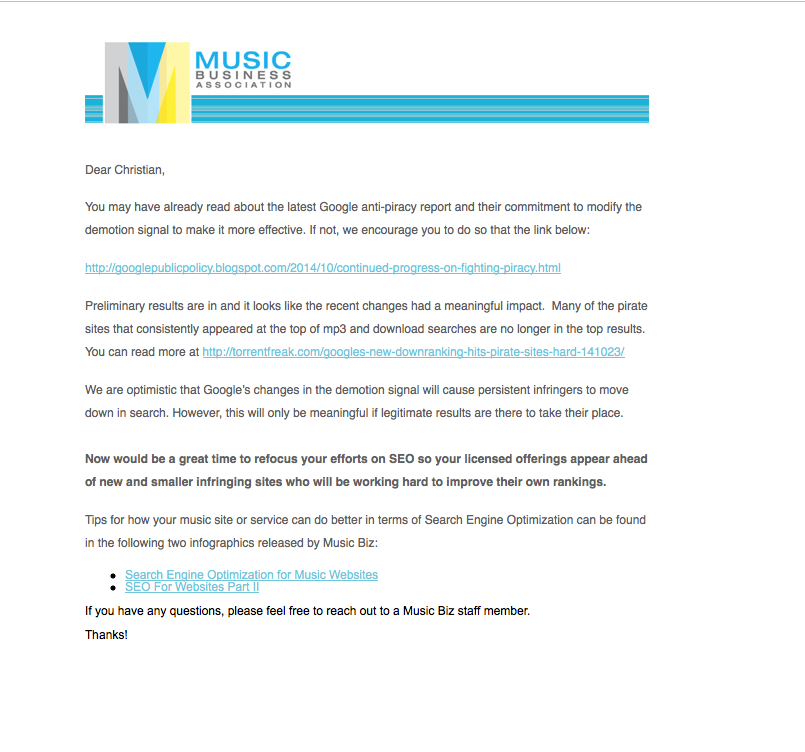
There used to be a great organization called the National Association of Recording Merchandisers or “NARM.” A few years ago, we watched them invaded by “digital retailers”. (Check the board of directors photographs–you can spot them the same way you can pick out talent agents–especially the guys who drove BMWs when they were in the mailroom. You know what I’m talking about.) Now it is called the “Music Business Association.”
So now I get this crap in my email today:
The idea that these people are buying into Google’s bullshit shakedown demotion scheme based on “preliminary results are in” just check Torrentfreak is such obvious shillery that it’s nauseating. The answer to piracy? Search engine optimization.
“Now would be a great time to refocus your efforts on SEO so your licensed offerings appear ahead of new and smaller infringing sites who will be working hard to improve their own rankings.”
View original post 30 more words
I was asked to provide a 250-300 word comment for the New York Times on the subject of Taylor Swift, Spotify and whether streaming music is the future. Apparently my thoughts on the subject were a little too “direct” and consequently they won’t be appearing there. My friends thought they were amusing. Here they are:
Taylor Swift, Streaming and the Future of the Music Business.
To quote Yogi Berra “It’s tough to make predictions, especially about the future.” In 2005 we all thought Myspace was the future. A music industry without MySpace was inconceivable! You think I’m kidding? Go back and read the articles.
You must be logged in to post a comment.