
In just about every other country in the world musicians are paid a performance royalty for terrestrial radio airplay. The United States is one of a few countries that does not, along with China, Iran and North Korea.
Happening now…Google is using crony capitalism to dodge another threat to its monopoly.
According to MLex, the Federal Trade Commission is preparing to allow Google to submit a non-binding letter that will describe a few things Google is willing to do to get out of the pesky FTC investigation into its business. Bowing and scraping to Google…well, maybe not scraping…the FTC is taking an unprecedentedly lax approach that reeks of political favoritism and crony capitalism.
The letter makes no mention of the most serious complaint against Google, which alleged the company deliberately biased its search results to favor its own products….Under the normal settlement procedures, FTC staff draft a consent order with legally binding commitments by which a company must abide….[T]he public can submit comments on the settlement before it is finalized….In the absence of a consent order, companies opposed to the resolution of the Google probe likely won’t have the opportunity to provide formal public comments….Independent observers said privately that they…
View original post 48 more words
Songwriter comments on Section 115 Rulemaking
We’ve been reviewing the comments posted on the Copyright Office website regarding the accounting regulations for Section 115. We are humbled that so many of you used our post as a guideline for your own comments, and we learned a lot from all of you. Thank you. Thank you for your thoughts and thank you for helping to take ownership of our future.
We thought you might be interested in reading comments from Lisa Thomas Music Services (publisher for independent songwriter/recording artists such as Don Henley and Glenn Frey of the Eagles, Randy Newman, Janet Jackson, Walter Becker of Steely Dan, Ray D. Parker, Jr., Mary Chapin Carpenter and Bonnie Raitt, among others), songwriters Danny O’Keefe , Michelle Shocked, Don Coyer, and Bob Regan as well as David’s comment. All of these songwriter’s thoughtful comments are part of the public record now and are up on the Copyright Office site, but we’ll reproduce David’s comment here:
December 10, 2012
Tanya M. Sandros
Deputy General Counsel
U.S. Copyright Office
101 Independence Ave. S.E.
Washington, D.C. 20559-6000
Re: In the Matter of the Mechanical and Digital Phonorecord Delivery Compulsory License, Proposed Regulations for Reporting Monthly and Annual Statements of Account for the making and distribution of phonorecords, Docket No. 2012-7
Dear Ms. Sandros:
I am David Lowery and I founded the bands Cracker and Camper Van Beethovan. I am also an instructor in the Music Business Program at the University of Georgia at Athens. I am writing to you regarding the proposed regulations for statutory licenses for mechanical royalties. These views are my own and should not be attributed to anyone else.
Other comments will address each of the proposed regulations, but I wanted to give you some general thoughts based on my experiences as a songwriter and music publisher. I want to emphasize that I am all for making music licensing easier, but am concerned that the Copyright Office get a clear picture of what it’s like for songwriters, especially independent songwriters, to live with the laws you make.
1. No Audit: As a songwriter, I have no idea whether I am being paid correctly by any digital service and I am not allowed to audit them. As far as I know, no digital service complies with the rules anyway, so it almost doesn’t matter whether the Copyright Office keeps them the same or changes the rules. This is untenable. When I gave a mechanical license to my record company, I could always audit the label’s mechanical royalty accountings if I chose to do so. Let’s be clear—the new boss is way worse than the old boss. If statements from digital services could be at least as bad as record company accountings, it would be a major step forward.
Respectfully, I would suggest that the Copyright Office should be working especially hard to provide songwriters with a good analog for a royalty audit.
2. Bait and Switch: I routinely receive a “notice of intention to use” my work that is always late. This violates the basic rule of statutory licensing. The “NOI” I receive often comes with a letter asking me to log into a website to see if I am owed money by the digital service or how much I am owed. When I go to the website I am asked to “sign” a click through agreement that makes significant changes to the few statutory rights I have. This is the worst kind of trickery and is worse than the worst direct mail campaigns because I can always throw away the junk mail. This trickery involves my life’s work and I’d rather not throw it away.
I respectfully suggest that the Copyright Office should expressly prohibit anyone who uses the statutory license from further burdening songwriters by trying to trick them into a click through agreement that makes them give up the rights the songwriter is entitled to under the Copyright Act.
3. Minimum Amount for Payment: Digital services sometimes issue a check for one penny along with the bait and switch trick license—yes, $0.01. I have no idea why they send a penny check, but I assume it has something to do with proving they paid for the rights they get in their click agreement. I also understand from songwriter friends that it is pretty common to get penny checks. So if these services can send a penny check when it benefits them, then why do I have to wait to earn $50 before I get paid? And what about the bait and switch technique is supposed to give me confidence that these services will ever pay my $50 and how would I ever know what my earnings were if I can’t audit?
I would respectfully point out to the Copyright Office that these services chose to get into the music business and they have known for over a decade what their obligations are. They save a bunch of money by using the statutory license instead of direct licensing, and I do not understand why they cannot simply pay what they owe when they owe it like everyone else is supposed to do.
4. Black Box: If I am lucky enough to get a certified statement from a CPA, I have no way of knowing if the CPA ever looked at my earnings or if there are any “black box” earnings that I’m entitled to. Given that I get no certifications and no audits, there’s no telling how much money should have been paid that wasn’t.
I respectfully suggest that the Copyright Office work with CPA associations to find clear guidelines for CPAs to follow that make the services pay out 100% of the money owed to songwriters or give it to the State unclaimed property agencies like an unclaimed utility deposit.
5. Don’t Protect Scofflaws: I am not convinced that these services have gotten all these mistakes done without a plan. Some may be innocent mistakes, but some seem very calculated. Respectfully, the Copyright Office should not allow services who have never complied with the law to get protection of the laws they have evaded.
Thank you for this opportunity to hear from me and other songwriters on this important issue.
Sincerely,
David C. Lowery
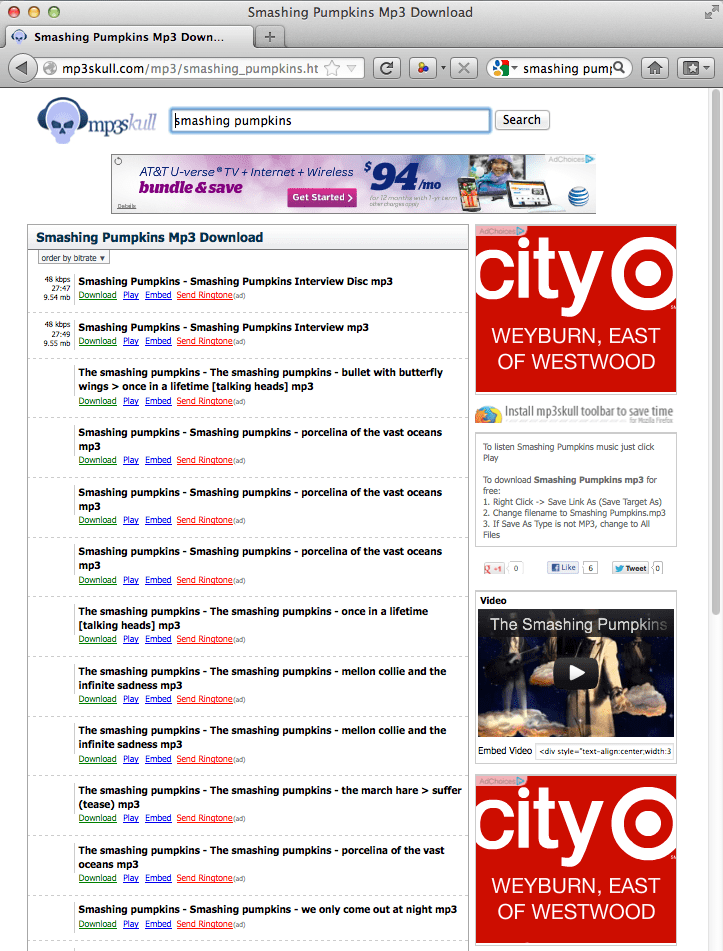
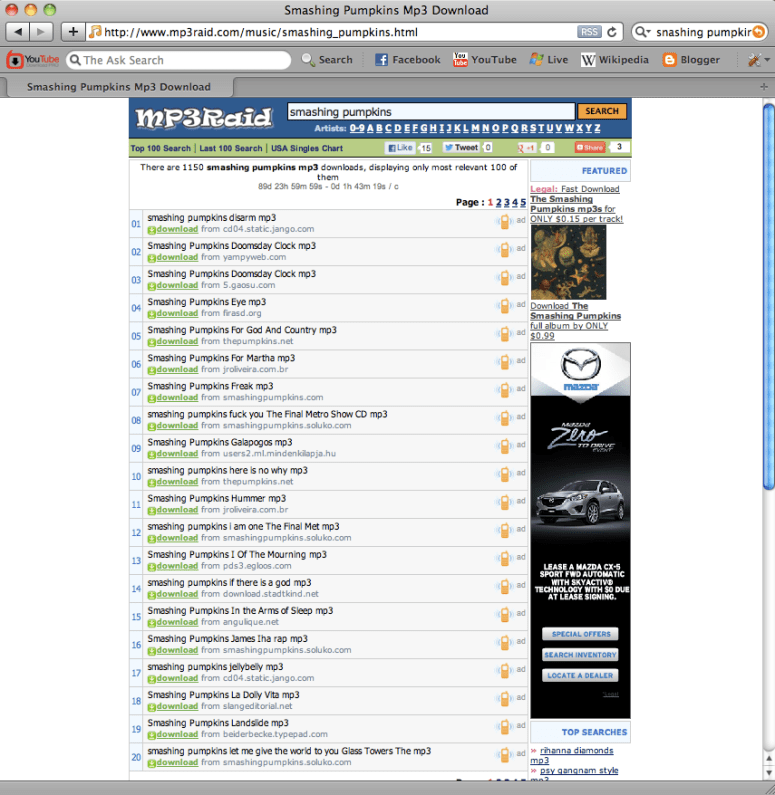
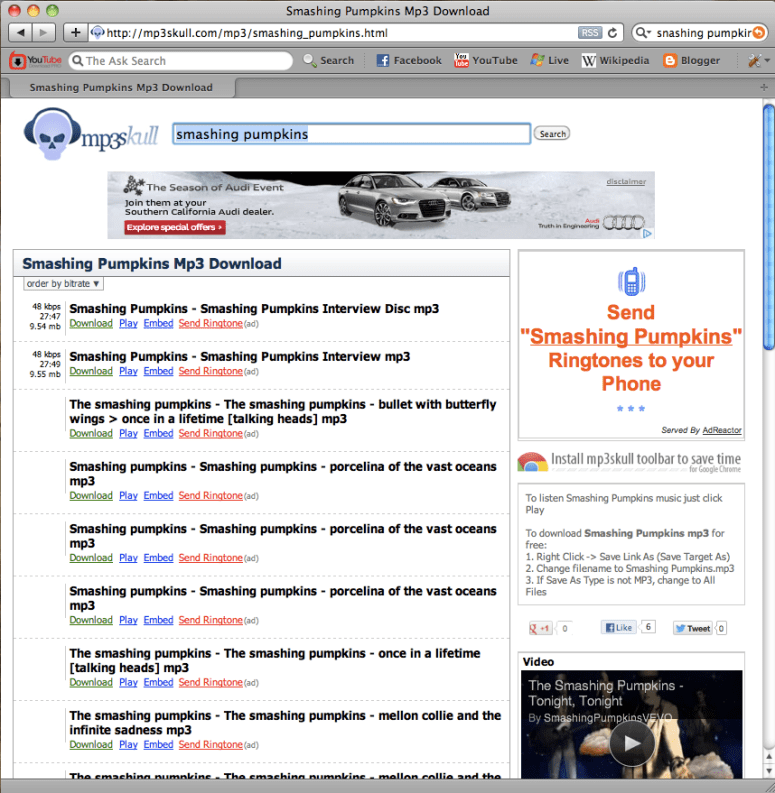
Billy Corgan Exploited By… Citi Bank, AT&T, Target, Virgin Atlantic, Mazda, Neiman Marcus, Musicians Friend, Hertz, BMW, Audi, Boston Market, Urban Outfitters, Williams Sonoma
At SXSW in 2012 Billy Corgan shared his thoughts about the music business from his perspective, including his thoughts that you can’t really make money in the music business anymore. Billy is probably right that musicians can’t really make money in the music business anymore, but it appears there is plenty of money being made by internet sites dedicated to infringement as well as the ad networks and payment processors who allow the sites to profit from the musicians work.
Surely these advertisements are not appearing without being paid for, and there actually is money is being paid to finance and support the operation of major piracy sites (as reported by Google’s own transparency report). What’s worse is that the money financing these major piracy sites ripping off artists and creators are being paid by well know major consumer brands and corporations. See below…
Citi Bank – 4Shared
AT&T – 4Shared
AT&T – Mp3Skull
Target – Mp3Skull
Virgin Atlantic – IsoHunt
Mazda – Mp3Raid
Neiman Marcus – Mp3Skull
Hyundai – Mp3Skull
Musicians Friend – 4Shared
Hertz Rent A Car – 4Shared
BMW – 4Shared
Audi – Mp3Skull
Boston Market – 4Shared
Urban Outfitters – 4Shared
Williams Sonoma – IsoHunt






Ending Decade Old Arguments : How the Promise of the Internet has Failed Artists and Musicians…
As Jaron Lanier tells it, Ted Nelson envisioned his version of the internet (Xanadu) as a single walled garden where everyone could be both a consumer and a producer. Ideas and art could be exchanged in a frictionless environment where a truly free market would emerge. People could make their wares available for free, or charge for them. However, once a price was set, the market would then determine the demand for that information be it a song, poem, movie or software. This truly free and open market would have empowered creators of all kinds access to a marketplace the likes of which we’ve never seen. Ted’s vision would have truly empowered creators and democratized distribution. Unfortunately, Ted’s vision has not come to be.
Much has been written about the record industry in particular failing to “adapt and evolve” to the new online digital economy. Whereas this may have been a valid argument in 2002 it holds little water a decade later in 2012. In the past decade we’ve seen many new offerings to consumers for legal and licensed music services tailored to many different consumer lifestyles. The tip of the iceberg includes such well known offerings as Itunes, Spotify, Pandora, Rhapsody and literally hundreds of others. And yet despite there being over 500 legal music services neither sales nor revenue have begun any significant rebound. The one thing these services still require, that piracy does not, is payment.
Let’s take a look back. In 1999 in the USA there were probably ten thousand retail points of sale for physical music, Tower, Sam Goody, Target, Walmart, etc. At the time they were selling $20 dollar physical discs – much of the overhead due to physical packaging, manufacturing, shipping, stocking fees and the overhead of real human beings being employed in record stores who need to eat, have shelter, etc.
These physical retail locations also had all the problems of supply side inventory management – a band would be on tour, and no stock would be in that market, a song would be played on the radio and the album would quickly be out of stock, etc. An artist could get placed on a TV show or featured in a commercial and suddenly there is demand, but no availability. These supply side inventory issues combined with limited points of sale were a massive problem for the artists and the record industry.
Digital distribution has none of these problems. Today someone can walk from their living room to their computer (or it may be on their lap) to purchase the latest hot song, featured in Gossip Girl. Or not even, they can buy the song/album on their iphone while watching the TV show or in a movie theater or at a club or concert.
So today in 2012 there are an estimated 500 million retail points of sale for prerecorded music via itunes alone. Just stop and think about this for a second. We went from ten thousand points of sale to five hundred million points of sale in less than a decade and removed all of the supply side inventory issues… wow. The promise, size and scale of the internet should have seen sales of pre-recorded music increase, massively.
There is frequent argument made that if music cost less, it would sell more… well, we now have 99 cent songs and $9.99 albums and sales have dropped by half in a decade…
So the recording industry adapted by:
1) removing inventory problems
2) making music instantly available
3) allowing for songs to be sold individually at a price never before possible and…
4) dropped the price of the album by half of the retail list price of a decade ago
All of this should be a net positive, not a net negative except for one very big thing, payment is now optional to everyone, and there are no consequences for not paying… So let’s be clear about what the problem is when talking about potential solutions.
The problem is not a lack of viable new business models, the problem is the proliferation of illegally distributed recordings being monetized by advertising on infringing websites. There is money in the distribution of recordings on the internet, the problem is the majority of that money is being made illegally and not paying the artists a penny.

[Editor Charlie sez: Given that the Google Party in Europe is jamming a new orphan works on steriods bill through the UK and EU Parliaments, this is a good time to repost this history of orphan works from last year. See “UK’s Brazen Copyright Landgrab Sneaked Into Enterprise Bill” and Photography Organisations Raise Objections to EU Orphan Works Law]
In the aftermath of the Google Books debacle, we are starting to hear noises that Google will back a new orphan works bill in this Congress. There are some commentators—truly misguided in my view—who are calling for Congress to bring back the failed legislation from 2008 known as the “Shawn Bentley Orphan Works Act”. (The late Shawn Bentley was a tech industry lobbyist and former Senate Judiciary staff counsel.) Let’s review that legislation in light of what we now know. (For a more detailed account, see Unhand That…
View original post 1,631 more words
What Can Songwriters Do: Copyright Office Comment Period Ends Today for Mechanical Royalty Statements of Account
The Copyright Office public comment period for statements of account on mechanical royalties closes tonight, so there’s still time for songwriters to post comments about the proposed regulations.
The new regulations apply to the license that some services like Spotify rely on for on-demand streaming as well as the new categories of statutory licenses that the Copyright Royalty Judges are expected to approve any day now. It’s probably hundreds of millions of dollars–and we have no idea whether it ever gets paid or paid right.
Seem like a big number? Not really when you consider that services like Spotify launch with millions of tracks and those require millions of mechanical licenses for on demand streaming. They could go to the publishers and songwriters for a direct license, but they prefer to “carpet bomb” notices to songwriters. If you ask a big publisher they will tell you that they receive hundreds of thousands of these notices every year–and 95% of them are filed late and should be terminated.
One thing the regulations required is that online services have to send songwriters a monthly statement of account certified by an officer of the retailer company as correct. As far as we can tell, this has never happened. Why? Because a “certification” means that the officer of the company is taking responsibility for the accurateness of the statement. Personal responsibility. This is exactly the reason why the law requires the certification and exactly the reason why no one has done it as far as we can tell.
The law also requires that a CPA certify the statements on an annual basis. This has been done once that we know of.
Bear in mind–these licenses have been in place for 10 years. No certifications in 10 years. And now the retailers are asking for yet another break through the Digital Media Association (you’ll remember them from IRFA and trying to screw ASCAP songwriters).
Oh, and by the way–you are prohibited from auditing any service that uses the statutory license and the best you can rely on are these certifications and the CPA auditing the retailer’s financials.
We here at the Trichordist think that there are certain aspects of the way that big tech companies have handled the mechanical royalty process that is absolutely horrendous, particularly for indie writers, but truly for everyone.
We want to encourage you to write your own comment. It can be a letter, you don’t have to be a lawyer or hire one. If you want to read what other people are saying, you can read the first round of comments at this link: Initial Comments on Statements of Account.
When you get it written, you can file it at this link: Copyright Office Electronic Filing Page
In particulary, you might want to read comments from Bob Segar’s publisher, Gear Music or Austin attorney Chris Castle.
Here’s a few reasons why that you might consider in writing to the Copyright Office:
1. No Audit: As a songwriter, I have no idea whether I am being paid correctly by any digital service and I am not allowed to audit them. This is untenable.
2. Publishers Clearing House: I routinely receive a “notice of intention to use” my work that is always late. This violates the basic rule of statutory licensing. The “NOI” I receive comes with a letter asking me to log into a website to see if I am owed money or how much I am owed. When I go to the website I am asked to sign a click through agreement that makes significant changes to the few statutory rights I have. This is the worst kind of trickery and is worse than the worst direct mail campaigns because I can always throw away the junk mail. This trickery involves my life’s work!
3. Black Box: If I am lucky enough to get a certified statement from a CPA, I have no way of knowing if the CPA ever looked at my earnings or if there are any “black box” earnings that I’m entitled to. Given that I get no certifications and no audits, there’s no telling how much money should have been paid that wasn’t.
4. Don’t Protect Scofflaws: You cannot allow services who have never complied with the law to get protection of the laws they have evaded.
Weekly Recap News & Links Sunday December 9, 2012
Grab the coffee!
Happy Holidays, it’s been a slow week at The Trichordist following the ongoing IRFA and RSC meltdowns…
FROM AROUND THE WEB:
Background Briefing with Ian Masters:
* Is the Door Closing for Musicians in Digital Age?
AdLand:
* Selling the Canadian government and wives on the same networks : demand accountability now
* Let the social media Cola Wars begin
* Istagram pulls twitter integration, need to puff their own site stats to ‘monetize’ and keep investors happy
Paid Content:
* If you want to hurt pirates, target their ad money says rockstar
Seeking Alpha:
* Pandora, The Underpants Gnomes, And Sirius XM
Vox Indie:
* (Another) Misleading Study (Sort of) Claiming Piracy is Good for the Movie Biz…
* Google Search #FAIL Means More $$$ for Them
Copyhype:
* Does Copyright Involve Scarcity?
Ethical Fan:
* Torrent Freak: US BitTorrent Traffic Grows 40% from 2011 (Sandvine)
Torrent Freak:
* NZBMatrix Shuts Down Citing Piracy Troubles
* Record Labels go to High Court to Force More ISPs to Block Pirate Bay
* Pirate Bay Proxy Loses Domain Name to Anti-Piracy Boss
Digital Music News:
* US Album Sales Down Just 4% On the Year…
* iTunes 11: Be Very Afraid, Spotify…
* Major Labels: We Spend Up to $1.4 Million Developing a New Artist…
The Illusion of More :
* The Opaqueness of Transparency
* Why isn’t the Internet breaking?
* Google Protects IP (its own)
The Washington Post:
* Justice Department meets with firms seeking Google antitrust probe
Business Insider:
* Google Is One Vote Away From Being Slammed With A Massive Anti-Trust Suit By The FTC
I was struck by a continuing theme during the recent hearing on “Music Licensing Part One: Legislation in the 112th Congress” before the House IP Subcommittee (the “IRFA hearing”). Mr. Chaffetz wants to do the right thing but he got some really bad advice. There were flickers of connections between Mr. Chaffetz’ questions and other statements by the usual suspects (and many Google Shill Listers) none of whom really know anything about the music business but all of whom “make stuff up” (to paraphrase the classic words of David Lowery at the Future of Music policy conference).
For example, Mr. Chaffetz asked Jimmy Jam whether Jimmy thought that the allocation of royalties among the sound recording owners, featured artists and nonfeatured artists was “fair.” Now why would he ask that question and why was he surprised that Jimmy did think the allocation was fair? The issue was not part of the bill and to my knowledge…
View original post 742 more words
Weekly Recap & News Sunday Dec 2, 2012
Grab the coffee!
Recent Posts:
* Lars Was First And Lars Was Right
* Zoë Keating’s Request for Internet Transparency met w/ usual Hypocrisy
* The Most Important Fact Academics and The Copyleft Neglect to Mention: Copyright is Optional.
* Giving Thanks for Creators Rights and Copyright
* Congressional Research Service Memo on Constitutionality of IRFA Section 5
* Other Than That Mr Westergren, How Was The Play? IRFA Gets An Ass Whupping
* Or Pandora Could Add Another Minute Of Advertising And Raise Their Revenue 50%
* Video of the “Radio Active” panel at The Future of Music Summit 2012.
* The Internet Radio Fairness Act’s Attack on Free Speech
* This photo says it all
* Google’s Serial Obfuscation: Music Canada,BPI, Billboard Question Whether Google Has Really Lowered Pirate Sites Search Rankings
* IRFA is the Broadcast Industry’s SOPA. Censors Free Speech
* IRFA and the Future of Music Policy Summit: Why Would FOMC Miss An Opportunity to Defend Artist Rights?
IRFA-APLOOZA:
Seeking Alpha :
* The Internet Radio Fairness Act Will Fail
Ars Technica :
* Pandora’s Internet radio bill hits a wall of opposition in Congress
CNET :
* Pandora’s Web radio bill is doomed — well, for now
House Judiciary Committee – Video of the Hearing:
* Music Licensing Part One: Legislation in the 112th Congress
WELL, THIS IS EMBARRASSING – OOOPSIES! THE RSC’s FICTIONAL LOOK AT COPYRIGHT IS RECALLED IN LESS THAN 24 HRS:
Techdirt:
* House Republicans: Copyright Law Destroys Markets; It’s Time For Real Reform
* That Was Fast: Hollywood Already Browbeat The Republicans Into Retracting Report On Copyright Reform
Precursor Blog:
* The Copyright Education of Mr. Khanna — Part 2 Defending First Principles Series
Copyhype:
* Republican Study Committee Policy Brief on Copyright: Part 1
* Republican Study Committee Policy Brief on Copyright: Part 2
Music Tech Policy:
* Critiquing The “Free Culture” Book Report or “The Copyright Education of Mr. Khanna”
FROM AROUND THE WEB:
Mercury News:
* German lawmakers call Google campaign ‘cheap propaganda’
“The campaign initiated by Google is cheap propaganda,” said conservative lawmakers Guenter Krings and Ansgar Heveling.
“Under the guise of a supposed project for the freedom of the internet, an attempt is being made to coopt its users for its own lobbying,” the two said in a statement.
Stereogum:
* Deconstructing: Pandora, Spotify, Piracy, And Getting Artists Paid
The Cynical Musician:
* Reco’nize: The Original Cynical Musician (Lars Ulrich)
Billboard:
* Songwriters Are Left Out of Pandora’s Royalty Plan: Guest Post by Downtown Music’s Justin Kalifowitz
The National Review Online:
* Myths and Facts about Copyright
VoxIndie:
* How Are Google’s Anti-Piracy Search Policies Working?
Digital Music News:
* We’ve Written Some of the Biggest Songs In History. And This Is What Pandora Pays Us…
* If You Stream a Song Once a Day, When Does It Pay the Same As a Download?
* My Song Was Played 3.1 Million Times on Pandora. My Check Was $39…
* Finally: A Solution for Pandora’s Financial Problems…
Torrent Freak:
* IMAGiNE BitTorrent Piracy Group “Sysop” Jailed 40 months
* BitTorrent Site Owners Fear European Domain Name Seizures
* Canada Set For Mass BitTorrent Lawsuits, Anti-Piracy Company Warns
Music Tech Policy:
* The Artists, United, Can Never Be Defeated
* Too Big to Fix Part 1: YouTube’s Thimblerig, or What’s Inside Your Black Box Today Mr. Schmidt?
Copyhype:
* Friday’s Endnotes – 11/30/12
* A Brief History of Webcaster Royalties
* The Purposes of Copyright Law and “Anti-Copyright” Arguments
Worth an encore, Lars Ulrich predicts the demise of Artists Rights to Internet Robber Barrons in 2000 on The Charlie Rose Show.

 The Trichordist
You must be logged in to post a comment.