Google’s Serial Obfuscation: Music Canada,BPI, Billboard Question Whether Google Has Really Lowered Pirate Sites Search Rankings

Back in August Google announce it would push down search rankings for pirate sites.  This was greeted with a lot of hoopla by both opponents and proponents of illegal piracy.  But it now appears that this announcement was just newspeak from the GOOrwell Ministry of Truth.

Graham Henderson at Music Canada has just posted an article that puts Google’s claims into question.   In the article Still Searching for Results in Google’s Wasteland of Illegal Sites and Takedown Notices  Henderson details the emptiness of Google’s claims.  A search for Carly Rae Jespersen’s Call Me Maybe  results in zero legitimate music sites on the first page.  The lone exception is the Google owned YouTube.  It’s not till the second page of results that  the 800lb gorilla of the digital retail, iTunes shows up!   Not only does this illustrate the difficulties facing artists it illustrates how tough it is for the legitimate music tech companies to reach their customers.  It’s odd that the myopic music tech companies like Pandora still seem to think it’s the artists that are the enemy.  They refuse to acknowledge that Google is eating their lunch.

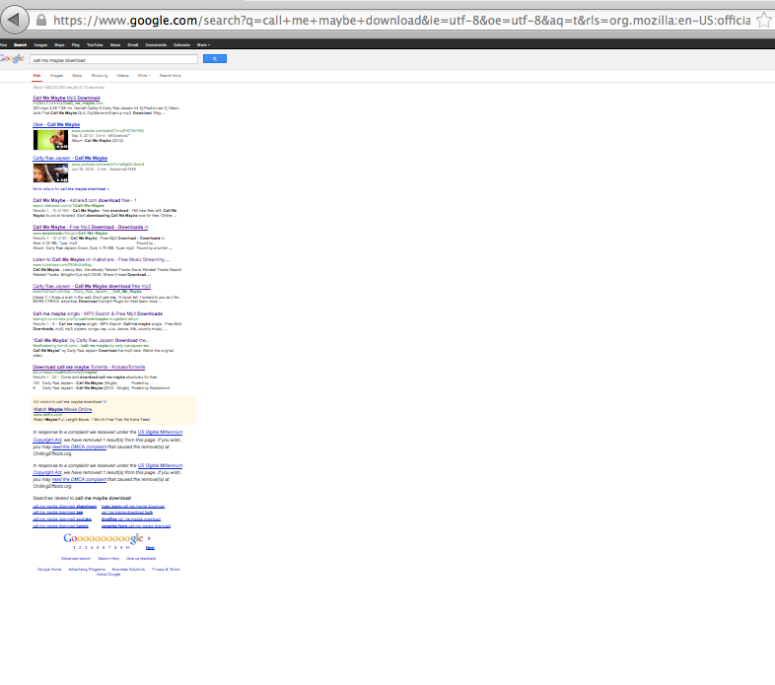
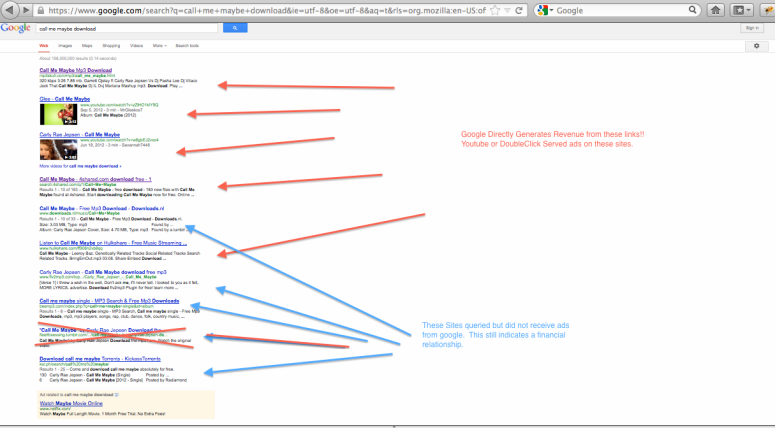
It get’s even worse.  We looked at every single link on the first page of search results for “Call Me Maybe Download”.  Google has no incentive to push these infringing links down.   Every link except one apparently generates revenue for Google!!   How?  either directly through Youtube,  by (illegally?) selling advertising on the site hosting the infringing links, or using one of googles many other tools to generate revenue.   We give you the evidence here:

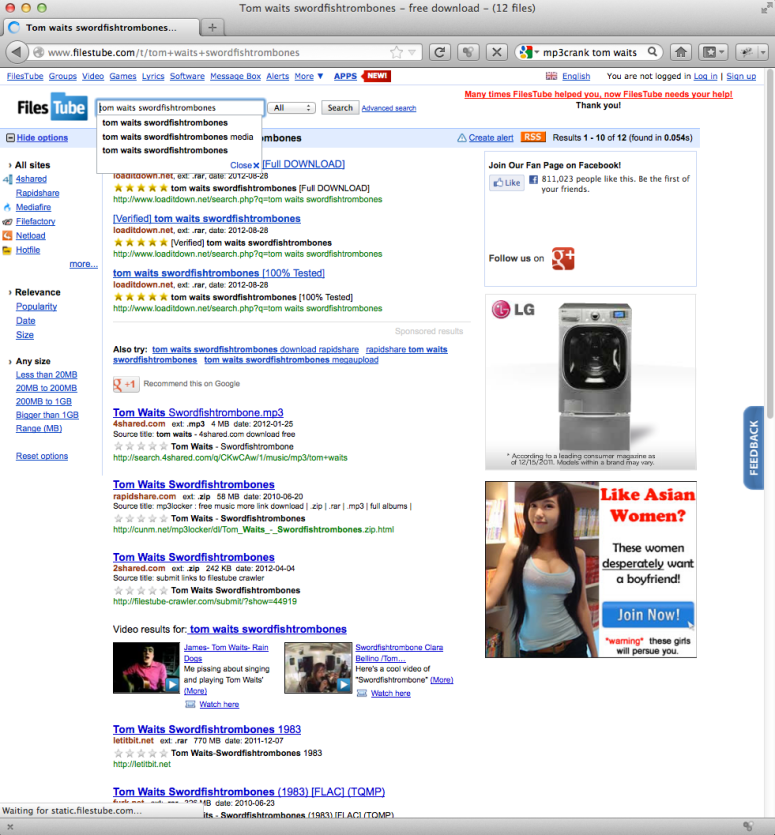
Here is the first page of search results.

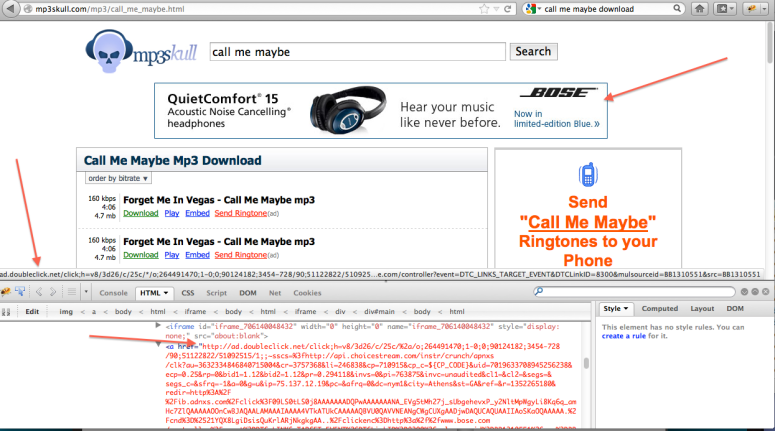
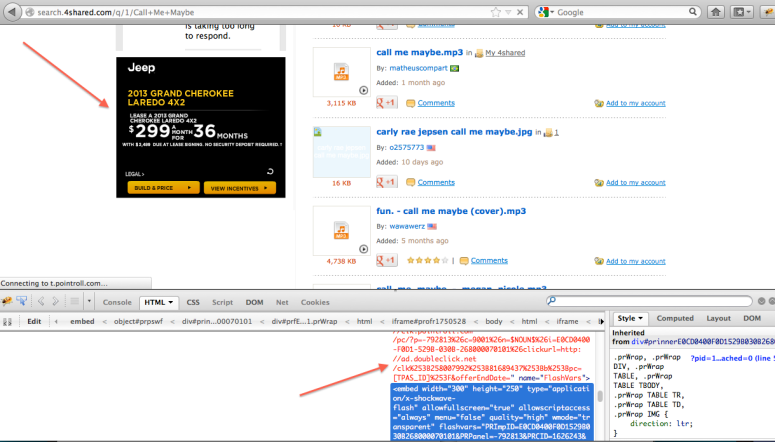
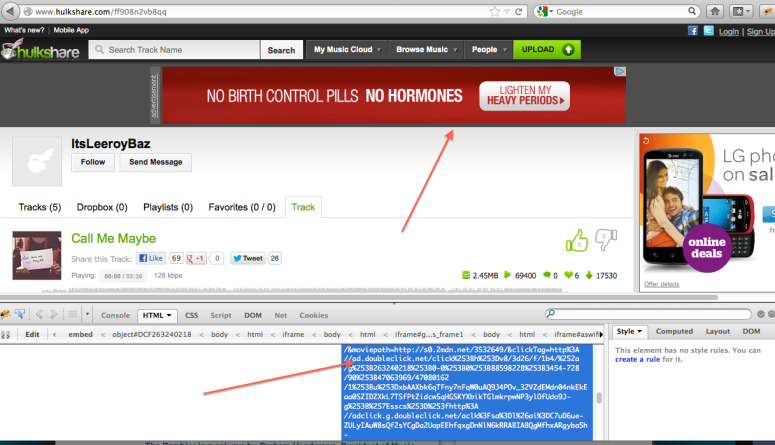
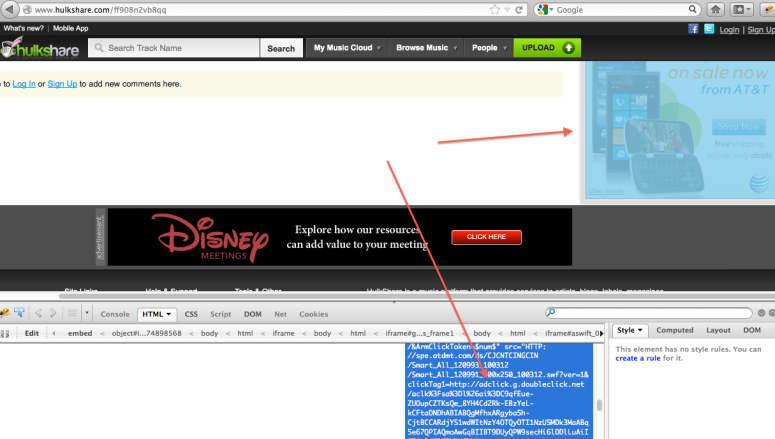
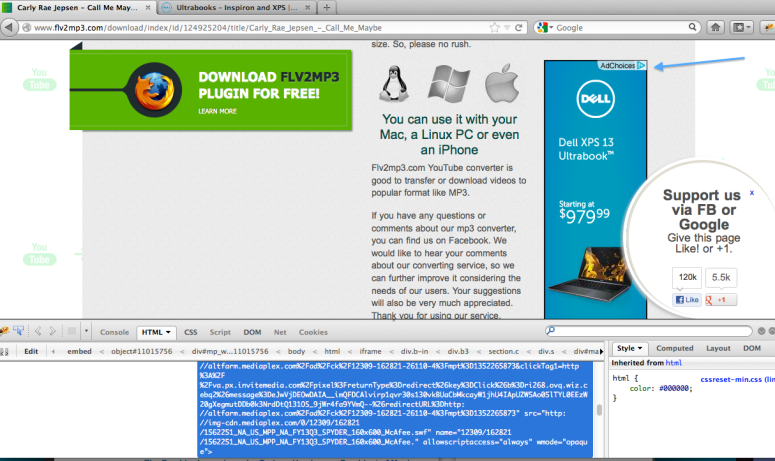
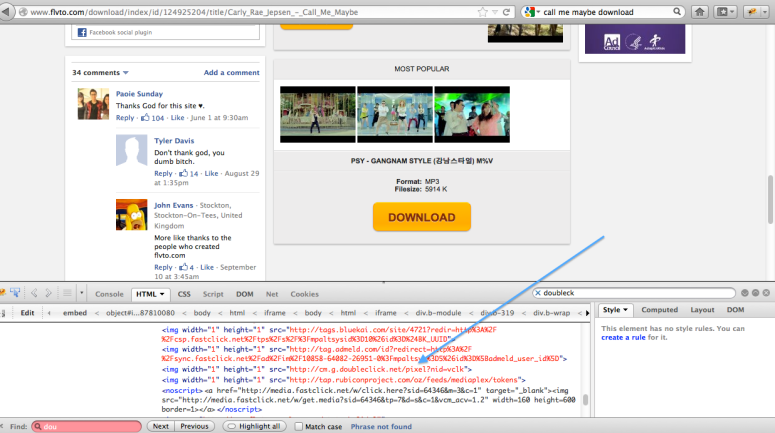
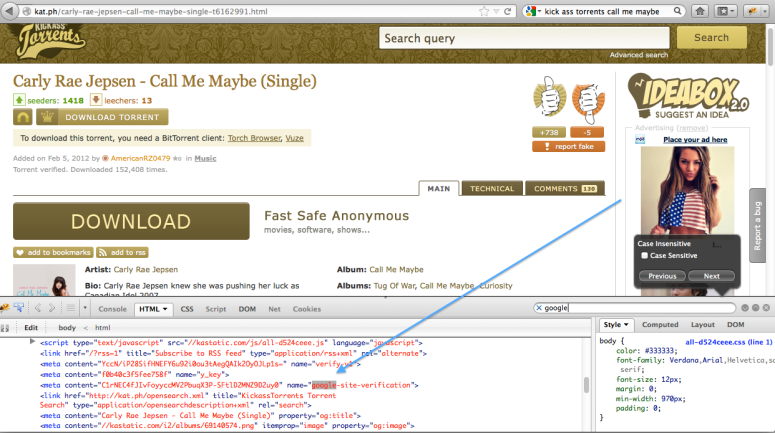
Clicking through to the links reveals Google’s DoubleClick serving advertising directly on each these sites or evidence that they have in the past. 5 of these links definitely generate revenue for Google.  Two other  links resulted in queries to Google for ads  but in this case didn’t directly receive ads.  The last two use other google tools to generate revenue    Just like the online pharmacy case Google is complicit in what appears to be illegal activity.  Maybe now the election is over the Obama administration will pursue this.

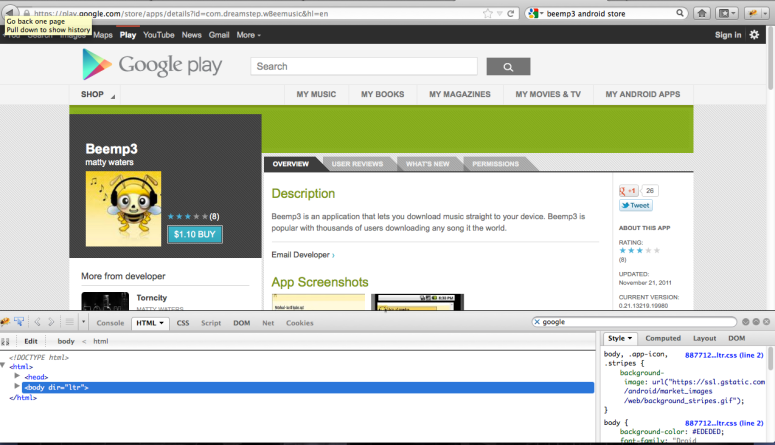
BeeMP3’s ad traffic has been decimated of late, but google is still selling their android app.

Note that David will be speaking on this panel on Tuesday November 13.

12:50 PM – 1:30 PM
Radio-active: Internet Broadcasting and Artist Compensation

Learn more about Artists and Creators Rights:

Music Technology Policy

“People of the same trade seldom meet together, even for merriment or diversion, but the conversation ends in a conspiracy against the public, or in some contrivance to raise prices.”

Adam Smith, An Inquiry Into the Nature and Causes of The Wealth of Nations

The Future of Music Policy Summit will convene for the 12th year on November 13.  The Internet Radio Fairness Act will be front and center–both Pandora Founder Tim Westergren and Senator Ron Wyden have been added in the last few days and they are not there to talk about the weather.  Or stock options.

When FOMC first started, it was viewed as a grass roots organization and the policy summit was a new idea–bring current issues in the music industry before the Washington, DC policy environment.  New faces appeared on the panels as well as familiar ones.  A mix of Members of Congress and bureaucrats showed up as well…

View original post 1,742 more words

Weekly Recap and News Sunday Nov 11, 2012

Grab the coffee!

Recent Posts:
* Madison Avenue and Media Piracy, Are Online Ad Networks the Birth of SkyNet?
* Bad News, Good News, Bad News. Internet Radio “Fairness” Act Sponsor and Conservative UT Congressman Chaffetz Taunts Musicians; Admits to Belief in Evolution; Urges Government Interference In Markets.
* Muzzling Free Speech By Artists: IRFA Section 5 Analysis
* Lobbyist For CCIA Makes All Kinds of Wild Claims About Copyright Management Organizations. BMI ASCAP SOCAN SAMI Included in Charges of Corruption.

From Around The Web:

Copyhype:
Friday’s End Notes 11/09/12 (Essential Weekly Reading)

Dan Ariely
How to Stop Illegal Downloads
“Before it was my book being illegally downloaded, I was more on the “Information wants to be free” end of the spectrum. The sudden, though predictable, shift in my feelings when I found my own work being downloaded for free was a jarring experience.”

Digital Music News
Goldman Sachs Is About to Invest $100 Million In Spotify…
Dear Pandora, You Totally Suck. Signed, Songwriters…
Pandora Is Now Suing ASCAP to Lower Songwriter Royalties…

TechCrunch:
Spotify Is Having A Good 2012: Revenues Could Reach $500M As It Expands The Digital Music Market

Billboard:
Songwriters Are Left Out of Pandora’s Royalty Plan: Guest Post by Downtown Music’s Justin Kalifowitz

The Hill:
NAACP blasts Pandora-backed Internet royalty bill

The New York Times:
A Clash Across Europe Over the Value of a Click

The Precursor Blog:
Google’s Top Ten Anti-Privacy Quotes — Part 3 In Google’s Own Words Series
“We know where you are. We know where you’ve been. We can more or less know what you’re thinking about”Google Chairman Eric Schmidt 10-1-10 per the Atlantic

Torrent Freak:
Supreme Court Rejects Hearing For Pirate Bay’s Peter Sunde
RapidShare Limits Public Download Traffic to Drive Away Pirates
“Six-Strikes” BitTorrent Crackdown May Target Private Trackers

Columbia Journalism Review:
Audit Notes: digital ads, margins of error, freehadists – French publishing’s online revenues make the Americans look good

Music Tech Policy:
IRFA and the Future of Music Policy Summit: Why Would FOMC Miss An Opportunity to Defend Artist Rights?
Stretching the Possibilities of Offensiveness, Pandora Demonstrates How to be Ugly at Scale

The Washington Examiner:
Report: Google and Facebook competing for an Obama cabinet slot

Digital Trends:
Sorry, Internet, SOPA had zero effect on election day results
“Of the 24 House Members up for reelection who co-sponsored or otherwise supported the highly contentious anti-piracy legislation, all but three won reelection on Tuesday. This includes Republican Rep. Lamar Smith, of Texas, SOPA’s author and chief co-sponsor who became the Internet’s Enemy No. 1”

ChinaDaily:
Free Online Music in China Coming to An End?

Lobbyist For CCIA Makes All Kinds of Wild Claims About Copyright Management Organizations. BMI ASCAP SOCAN SAMI Included in Charges of Corruption.

I don’t even know what to say about these statements by Jonathan Band, one of the long-time lobbyists for the Computer & Communications Industry (read Google).   The whole thing just seemed kind of crazy to me.  To be clear I don’t have a dog in this fight.   Just curious where these allegations come from.  Cause I researched a bit and I don’t really see anything to justify most of these charges.

Perhaps our readers can help?

But otherwise he does do a good job of answering a question that has always been of interest to me: Google’s acquisition of Rightsflow.

Listen for yourself.

Memo (2)  Jonathan Band at Michigan State University  Law School.

Muzzling Free Speech By Artists: IRFA Section 5 Analysis

The “Internet Radio Fairness Act” has a lot to concern artists. Today, we’re continuing our section-by-section analysis of the proposed legislation because knowing is half the battle. We’ve been looking at how the bill would affect current law: strikethrough text shows what the bill would remove, while underlined text shows what it would add.

SEC. 5. PROMOTION OF A COMPETITIVE MARKETPLACE.

17 USC § 112 – Limitations on exclusive rights: Ephemeral recordings

(e) Statutory License.—

(2) Notwithstanding any provision of the antitrust laws, any copyright owners of sound recordings and any transmitting organizations entitled to a statutory license under this subsection may negotiate and agree upon royalty rates and license terms and conditions for making phonorecords of such sound recordings under this section and the proportionate division of fees paid among copyright owners, and may designate common agents, on a nonexclusive basis, to negotiate, agree to, pay, or receive such royalty payments. Nothing in this paragraph shall be construed to permit any copyright owners of sound recordings acting jointly, or any common agent or collective representing such copyright owners, to take any action that would prohibit, interfere with, or impede direct licensing by copyright owners of sound recordings in competition with licensing by any common agent or collective, and any such action that affects interstate commerce shall be deemed a contract, combination or conspiracy in restraint of trade in violation of section 1 of the Sherman Act (15 U.S.C. 1).

17 USC § 114 – Scope of exclusive rights in sound recordings

(e) Authority for Negotiations.—

(1) Notwithstanding any provision of the antitrust laws, in negotiating statutory licenses in accordance with subsection (f), any copyright owners of sound recordings and any entities performing sound recordings affected by this section may negotiate and agree upon the royalty rates and license terms and conditions for the performance of such sound recordings and the proportionate division of fees paid among copyright owners, and may designate common agents on a nonexclusive basis to negotiate, agree to, pay, or receive payments.

(2) For licenses granted under section 106 (6), other than statutory licenses, such as for performances by interactive services or performances that exceed the sound recording performance complement—

(A) copyright owners of sound recordings affected by this section may designate common agents to act on their behalf to grant licenses and receive and remit royalty payments: Provided, That each copyright owner shall establish the royalty rates and material license terms and conditions unilaterally, that is, not in agreement, combination, or concert with other copyright owners of sound recordings; and

(B) entities performing sound recordings affected by this section may designate common agents to act on their behalf to obtain licenses and collect and pay royalty fees: Provided, That each entity performing sound recordings shall determine the royalty rates and material license terms and conditions unilaterally, that is, not in agreement, combination, or concert with other entities performing sound recordings.

(3) Nothing in this subsection shall be construed to permit any copyright owners of sound recordings acting jointly, or any common agent or collective representing such copyright owners, to take any action that would prohibit, interfere with, or impede direct licensing by copyright owners of sound recordings in competition with licensing by any common agent or collective, and any such action that affects interstate commerce shall be deemed a contract, combination or conspiracy in restraint of trade in violation of section 1 of the Sherman Act (15 U.S.C. 1).

(4) In order to obtain the benefits of paragraph (1), a common agent or collective representing copyright owners of sound recordings must make available at no charge through publicly accessible computer access through the Internet the most current available list of sound recording copyright owners represented by the organization and the most current list of sound recordings licensed by the organization.

This section is far more troubling than it first appears.

The effect of IRFA as a whole would be to reduce the amount of royalties that companies like Clear Channel, Sirius XM Radio, and Pandora have to pay to recording artists.

For most companies, arrangements between buyers and sellers are negotiated on the open market. But for a number of reasons, the Copyright Act establishes a compulsory license for certain uses of digital sound recordings with the license terms and rates set by the Copyright Royalty Board.

So companies like Sirius XM and Pandora already have an advantage that many businesses don’t have: government-guaranteed access to the content that drives their business at a rate set by law. Compulsory licensing is compulsory: there is no opting in or opting out for artists.

But compulsory licensing doesn’t preclude direct licensing under the current law — that is, without IRFA. Copyright owners are — and always have been — free to negotiate privately with copyright users. Sirius XM has been particularly aggressive in recent years in pursuing such direct licensing, and Clear Channel is right behind Sirius with their own direct deals.

What does this mean for artists? First of all, in practice, this means that the rates set by the Copyright Royalty Board act as a ceiling — no licensee is going to pay more than the compulsory rate. They are guaranteed access to every sound recording on the market at the CRB’s rates.

So why would recording artists or sound recording owners want to accept a deal that gives, say, Sirius XM more rights for less money?  (Bearing in mind that many artists own their sound recordings.)

Here’s one reason. During recent proceedings, Sirius XM Executive VP David Frear testified that “Among other things, [record companies] recognized that by entering into direct licenses with Sirius XM, they gained the potential for enhanced airplay and greater exposure for their recording artists.” Left unsaid was the corollary to this: refusing to enter into a direct license could mean less (or no) airplay.

Direct licensing, in conjunction with a compulsory licensing scheme, thus gives licensees all stick and no carrot. And when you’re terrestrial radio giant Clear Channel, or the only satellite radio provider, or Pandora — which accounts for 37% of all digital sound recording royalties — that’s a pretty big stick. (Pandora and Sirius XM together account for 90%.)

Section 5 of IRFA is perhaps the most pernicious part of the bill, for it would make it illegal for anyone to criticize digital sound recording licensees. If IRFA becomes law, artists and artist organizations will need to watch what they say in public in opposition to Sirius and Clear Channel’s direct licensing efforts.

This is not an exaggeration or hyperbole — it is already happening. The provisions of Section 5 seem to be a direct response to groups like American Association of Independent Music (A2IM), SoundExchange, and major record labels cautioning recording artists about the drawbacks to a push by Sirius XM to license recordings directly following the latest rate-setting proceedings.

In March 2012, Sirius XM filed a lawsuit against SoundExchange and A2IM alleging anti-trust violations for their efforts to resist what SoundExchange and A2IM saw as a raw deal from Sirius XM’s direct licensing push. Now, for starters, it might seem odd that a company with an effective monopoly on satellite radio is complaining that a non-profit nonexclusive collecting agency and a trade association representing hundreds of small companies are violating anti-trust laws.

But the allegations that Sirius made in the lawsuit should concern any artist. Sirius XM essentially argues that various public communications concerning its direct license program amount to anti-competitive behavior — not anti-competitive conduct, just speech.

One such communication identified in Sirius XM’s anti-trust suit includes this August 2011 blog post by A2IM. In its lawsuit, Sirius XM points specifically to a paragraph that states:

In general statutory licenses have been good for the independent music label community as statutory licenses insure that all music label copyrights, whether those of the major labels or those of independent labels or artists, are treated equally and paid the same rate amount for each stream (play) of that music. Under direct licenses there are cases where independents have received less than equitable rates.

And lest you think only industry groups would be caught in the crosshairs, it’s not unlikely that artist advocacy organizations could face legal liability. Sirius XM also refers to a statement made by the Future of Music Coalition, in its November 2011 newsletter:

Here at FMC, we want artists to get the money they’re owed for the use of their music on any platform. The statutory rate for digital performance plus direct payment via SoundExchange is an important piece of the compensation puzzle for creators. Bypassing it might benefit the bottom lines of major corporations in the short run, but it’s a dangerous thing for performing artists.

This is the type of explanatory speech — not conduct — that Sirius XM thinks is illegal and IRFA definitely would outlaw. Again, it would make it a violation of the Sherman Act for “any copyright owners of sound recordings acting jointly, or any common agent or collective representing such copyright owners, to take any action that would prohibit, interfere with, or impede direct licensing.” Whenever two or more artists are gathered, Sirius XM (and Clear Channel, and Google) will be there.

The statements above are already alleged by Sirius XM to violate existing anti-trust laws. To be clear, the allegations are absurd — these statements are clearly not urging an unlawful “boycott” against Sirius XM’s direct licensing, and even if they were, Sirius doesn’t lose out since it already has access to every sound recording on the market under the compulsory license. There’s also a much simpler and way less conspiratorial explanation to the public response that Sirius complains of: maybe the labels who spurned Sirius XM’s proposal just didn’t like the deal. But Section 5 of IRFA would ensure that the law explicitly prohibits any criticism of direct licensing deals.

So if IRFA becomes law, if you don’t like the deal, you better keep it to yourself.

Bad News, Good News, Bad News. Internet Radio “Fairness” Act Sponsor and Conservative UT Congressman Chaffetz Taunts Musicians; Admits to Belief in Evolution; Urges Government Interference In Markets.

Rep Jason Chaffetz R-UT “conservative” Republican from Utah and sponsor of the ironically named “Internet Radio Fairness Act” shocked his constituents by accidentally admitting to his belief in dinosaurs and evolution while attempting to taunt musicians and urging government interference in markets.  In response to musicians opposition to his bill he told The New York Times.

“The old-school dinosaurs are trying to help, but they’re stuck in the tar,” he said. “They can go talk to the pterodactyls.”

Never mind the taunt doesn’t make any sense. It brings up some intriguing questions:

Old school dinosaurs?  Are there new school dinosaurs? Who are the dinosaurs trying to help?  Musicians? Or Pandora? Or are the Musicians the dinosaurs?  Wouldn’t the pterodactyls be flying around and not stuck in the tar pits?  And who’s supposed to talk to the pterodactyls ? the other dinosaurs? Or the musicians? Do the pterodactyls represent internet radio? Are pterodactyls the implied “new school” dinosaurs? And I’m not trying to be purposely obtuse but I’ve been to the LaBrea tar pits and it was mammals like mastodons and sabre toothed tigers that got stuck in the tar pits.  Not dinosaurs.  Is this part of the metaphor I don’t understand? Is this a zen koan? Is the Congressman operating on a higher level of consciousness?

All kidding aside, should we really be surprised that Chaffetz could be so ideologically flexible? And to be clear there is nothing wrong with being ideologically flexible to a certain extent.  According to Wikipedia the anti-gay marriage conservative Utah legislator  is half brother of actor John Dukakis the adopted son of Governor Dukakis.  Chaffetz was originally a democrat.  Indeed he was the chair of the Dukakis For President campaign in Utah. Later in life he switched party affiliations to the Republican party.   With strong support for gay rights and democratic policies coming from his father and extended family thanksgiving dinners must be pretty complicated affairs at the Chaffetz house!

So it should be no surprise that this supposed free market advocate could be “ideologically flexible”  enough to sponsor a bill that asks the government to set prices; to pick winners and losers; and force musicians through government mandate to bail out a private company that continues to stick with a bad business model (one minute of ads an hour). Oh and this private company happens to be a campaign donor.

What happened to the free market ideals?  I guess that’s for dinosaurs.

Madison Avenue and Media Piracy, Are Online Ad Networks the Birth of SkyNet?

In the mythology of the Terminator Sci-Fi movies it is a military defense computer system (SkyNet) that achieves consciousness through artificial intelligence and declares war on human beings. In reality, it appears the first computer networks to declare war on us may be advertising networks, ad bots, and online AI advertising auctions.

If one is to believe the various people responsible for the millions (er, uhm billions) of dollars flowing through online advertising networks (Google alone is estimated to be $30b annually) you could easily believe the machines have already achieved consciousness as no human being we speak to seems to have an actual understanding of how online advertising networks function.

It all appears to be a mystery as to how the money changes hands down stream, and how to determine who is getting paid from what specific ad placements and on what specific sites.  We had one ad network executive tell us privately “we can not control where the ads end up”.

Really?  So the online ad networks are Skynet?

This would seem to an alarming problem for buyers of advertising including such respected brands as Wendy’s, Yahoo, BMW, Adobe, Cadillac, LG, Target, Westin Hotels, Priceline, Hyatt Hotels, Weight Watchers, VISA, State Farm, Mini Cooper, ADT Security and even Presidential Candidate Mitt Romney.

It would probably be pretty embarrassing for a multinational electronics company like LG and a Presidential Candidate to both be advertising on two of the Top 20 most infringing sites in the world, wouldn’t it? Uh oh, don’t look now…

If the machines are already in control we should probably be worried, but we do think it’s odd they would be so focused on a capacity that only seems to transfer wealth from artists, musicians, filmmakers, authors and other creators to internet millionaires running ad networks and pirate sites.

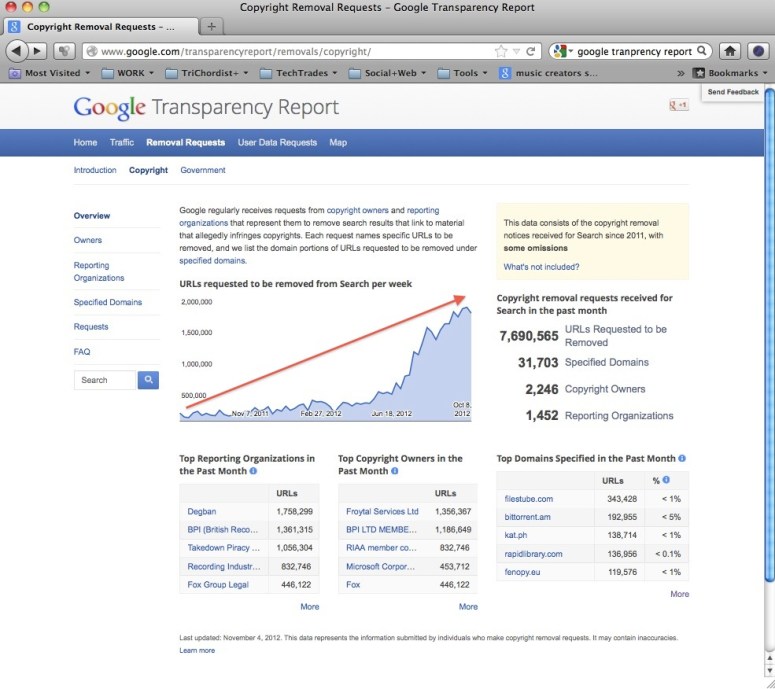
Certainly if Google and the other ad networks had knowledge of the top infringing sites say through a publicly accessible transparency report based on DMCA notices, they would not be serving ads to those businesses operating far beyond the intention of the law? Certainly if they knew that just the Top 20 infringing sites had over 2.3 Million claims in just one month, than Google and the other advertising networks would clearly make a best practices “no fly zone” for advertising on those sites, wouldn’t they?

We’d much rather see this advertising revenue directed towards legally operating and legitimate media outlets such as television, newspapers and magazines who no doubt are also in need of revenue in an ever competitive marketplace. Why finance the pirates who are illegally exploiting others in the creative industries? How much money is being lost from legitimate media outlets to media pirates?

Below is a random sampling of artists exploited by these Madison Avenue Brands and the sites hosting the advertising. We wonder who is serving these ads, and paying these sites because everyone we talk to denies advertising on these sites and seems to know nothing about it.

TOM WAITS Exploited By Wendy’s, Yahoo, BMW, Mitt Romney, Adobe, Cadillac, LG, Target, Westin Hotels, Priceline, Hyatt Hotels, Weight Watchers, VISA, State Farm, Mini Cooper, ADT Security

* BMW on Kick Ass Torrents
* Mitt Romney, ADT Security on 4Shared
* Adobe, Mini Cooper on FilesTube
* Cadillac on FilesTube
* LG on FilesTube
* Target on Mp3Crank
* VISA, State Farm on Mp3 Crank
* Wendy’s on Kick Ass Torrents
* Westin on Kick Ass Torrents
* Priceline, Weight Watchers on 4Shared
* Hyatt on 4Shared
* Weight Watchers, Hilton on 4Shared
* Yahoo on Dilandau
* Urban Outfitters on FilesTube

U2 Exploited by United Airlines, Jet Blue, HP, State Farm, Westin, Urban Outfitters, Sprint, AT&T, Amazon, Disney Resorts, Crate and Barrel

* United Airlines x2 on h33t
* United Airlines on mp3 bear
* United Airlines on FilesTube
* Jet Blue and Kayak on h33t
* Hewlett Packard and State Farm on mp3skull
* Westin Hotels on 4shared
* Westin Hotels on mp3raid
* Urban Outfitters on mp3skull
* Sheraton Hotels on mp3skull
* Century 21 on 4shared
* Alaska Airlines on torrent reactor
* State Farm on torrent reactor
* Sprint on torrrent reactor
* Sheraton Hotels on 4shared
* Hewlett Packard x2 on filestube
* Hewlett Packard and State Farm on mp3skull
* Hewlett Packard on h33t
* Rejuvenation on filestube
* Disney Resorts on torrent reactor
* Crate & Barrel on Files Tube
* Charter Cable on mp3 raid
* AT&T on mp3skull
* Amazon on 4shared

These two examples above are just the tip of the iceberg, and it’s not just the most well known and respected mainstream artists who are effected. Perhaps even more so it is the smaller artists who have been the most hard hit by this diversion of revenue without compensation Aimee Mann, Neko Case, Talib Kweli, Death Cab For Cutie and Jared Leto to name a few.

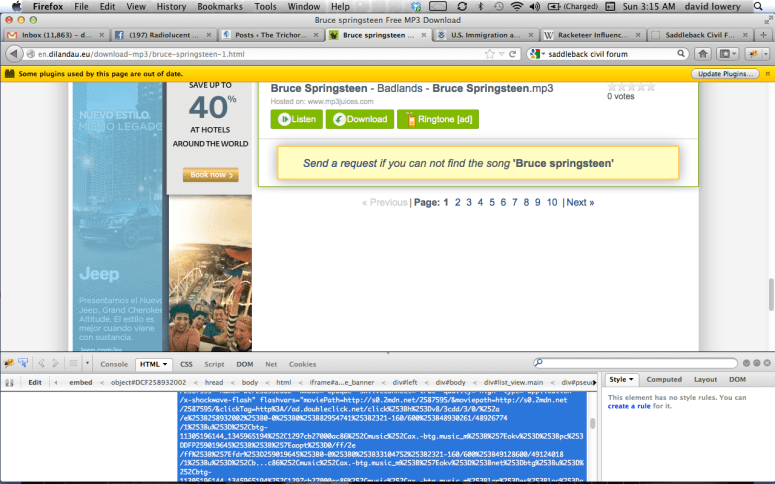
It would also appear that Google makes plenty of money serving ads on sites that it knows are infringing. Here is Google’s Doubleclick serving an ad for Jeep on http://www.dilandau.eu   This is a site that Google’s own transparency report ranks as the 24th most copyright infringing site in the world.  Isn’t knowingly providing money to an illegal enterprise a RICO predicate?

One would think with this kind of information there would be a move to improve the situation for rights holders, but looking at this graph it appears to be getting worse, much worse.

The bottom line is, we wonder how such mass scale, enterprise level and generally sketchy businesses can continue to go unchecked without any reporting from the mainstream media (who also depend on ad dollars that are now going to competing businesses engaged in media piracy and mass scale copyright infringement).

Once upon a time no one thought twice about “accounting irregularities” at Enron and we all know how that story ended. So who’s gonna ask the hard questions and get some real answers? Operators are standing by…

Weekly Recap Sunday Nov 4, 2012

Grab the Coffee!

Recent Posts:
* Techdirt Is A Never Ending “Dumb Off”
* Untruth in Advertising: Pandora’s Misleading Plea To Listeners On Behalf Of The Internet Radio “Fairness” Act.
* Mellencamp Character Assassination. The New Republic Bravely Stands Up For Corporations and Criminal Groups That Exploit Artists.

From Around The Web:

Ars Technica
Artist who sued Twitter over copyright declares victory—via settlement
The Russian underground economy has democratized cybercrime
Google settles Rosetta Stone lawsuit, its last major dispute over AdWords

Copyhype
Friday’s Endnotes – 11/02/12

Music Producer Tunnidge via Facebook
Tunnidge Facebook Post
“I am going to try and be as obvious as possible. Without being able to make money from our music it effects greatly our ability to make the music, more often it stops us.”

Vox Indie
Where’s Our Outrage When Internet “Free Speech” is Really Under Attack?
Blogspot.com, a Bridge to Piracy?

The Illusion Of More
On Letting Foxes Mind Chicken Coops

The Register UK
The Big Debate: OK gloomsters, how can the music biz be FIXED?

Zoe Keating
Towards a manifesto
“We can’t just hope that the interests of music and technology companies will always magically align with ours. We have to participate in the process. Otherwise, we just have to accept that anachronistic legislation, policies and deals will continue to be written without our input. We need public policy that reflects us. We need fair royalty schemes. We need companies to build our interests into their business models.”

Popup Pirates
Theft is not “Free Speech”

Music Tech Policy
Mellencamp Is Right, Brand-Supported Piracy Screws Songwriters AGAIN: Snakes in the Grass, @McDonalds, Google and Other Species of Vermin

Digital Music News
It Gets Worse: Pandora Executives Have Dumped $63 Million In Stock In the Last Year…
13 Extremely Scary Things About the Music Industry Today…

Tape Op
ON SPOTIFY (AND WHY I’M NOT A CONSPIRACY THEORIST AFTER ALL)

Copyright Alliance
AN INVITATION TO FREE INTERNET ADVOCATES TO JOIN US
“Without free speech, copyright protection is meaningless. The two rights are critical to artists and combined have proven to be a powerful force for social justice around the world. That is why we consistently and openly advocate for a fair and open internet that champions free speech as well as respect for authorship.”

Torrent Freak
Piracy Topsite Operators Handed Suspended Jail Sentences
IMAGiNE BitTorrent Piracy Group Members Jailed
BitTorrent Pirate Ordered to Pay $1.5 Million Damages For Sharing 10 Movies
Link ‘Pirate’ Sentenced to Pay $13,000 to NBA, NFL, NHL, WWE and TNA

AdLand
The trouble with Adsense – abusive porn ads on The Star news site [NSFW]

Mellencamp Character Assassination. The New Republic Bravely Stands Up For Corporations and Criminal Groups That Exploit Artists.

I’m sort of delighted by this. I mean I went to a very liberal college and there’s a certain kind elitist and dim knee jerk liberal I really dislike.  Dorm room revolutionaries who end up unwittingly doing the work of the man.  The kind that end up blogging for The New Republic.

Recently John Cougar Mellancamp wrote a piece in which he criticized the music business.  In particular he criticized them and his fellow artists  for not standing up to  large corporations like Google who have monetized illegal file-sharing by selling advertising against illegal download search results and also by providing advertising directly to file infringing sites.

The New Republic-always the class act-decided to respond with a character assassination piece.   They sent the remarkably ignorant Lydia DePillis (on twitter @lydiadepillis)  a 3 year real estate journalism veteran to “School” the 40 year music business veteran John  Mellencamp on the history and future of the music business.  It’s freaking hilarious.  Not only does this “professional” journalist not understand that  the main point is that Mellencamp is criticizing the music business for not protecting artists she wanders completely off topic and makes historical claims that have no basis in fact. Further she incorrectly disputes Mellencamp’s facts.

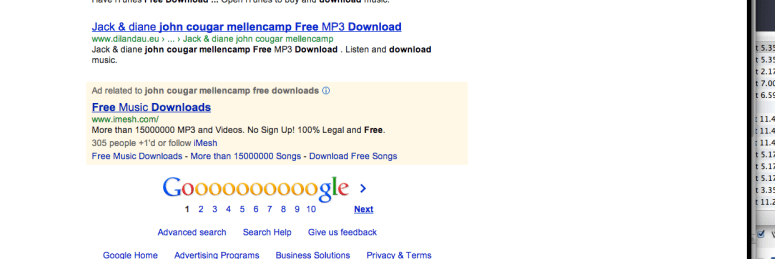
I’m just gonna give you one example.  The 3 year journalism veteran claims that search engines don’t make money off the searches for illegal downloads.   it took exactly 3.2 seconds for me to disprove this…

That is Google advertising against a set of infringing links.

Also she then dismisses and mocks Mellencamp’s correct claim that Google makes plenty of money serving ads on sites that it knows are infringing.

Here is Google’s Doubleclick serving an ad for Jeep on the that same site http://www.dilandau.eu   A site that Google’s own transparency report ranks as the 24th most copyright infringing site in the world.  Isn’t knowingly providing money to an illegal enterprise a RICO predicate?

It is sad but not surprising to see The New Republic standing up for the right of giant corporations and criminal groups to make money by exploiting artists songs.  The New Republic has totally lost it’s way.  They are now for the big corporations and against the little guy.

If The New Republic has any journalistic integrity left it  needs to correct the falsehoods in this article.  Further they should apologize to Mellencamp for the nasty tone of this article.  I’m sure they won’t but it’s worth a try.   Maybe tweeting at the author will work better @lydiadepillis .