DOJ Antitrust Lit Section III Looks Other Way While Digital Services Collude in Sending Fraudulent Backdated NOIs

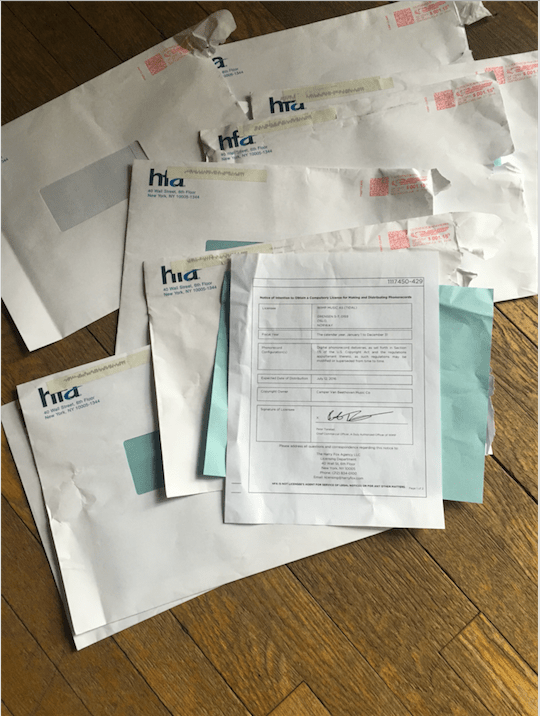
Screen Shot 2016-09-04 at 2.16.02 PM

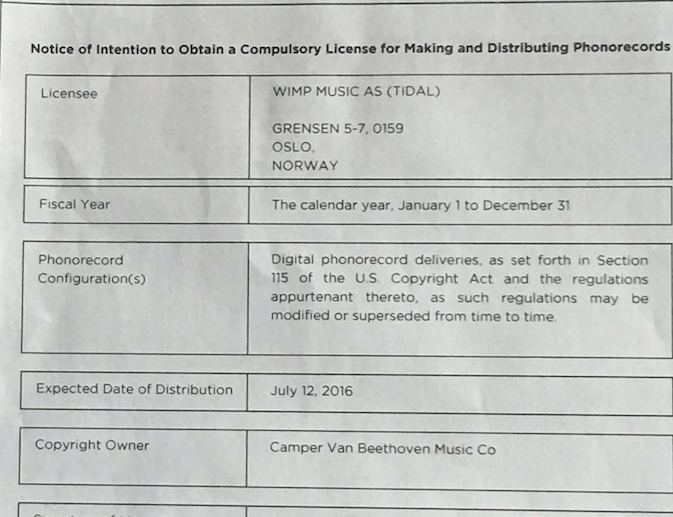
Screen Shot 2016-09-04 at 2.16.16 PM

I get dozens of these a month.   They are almost all deficient.  In effect they purport to being legal “notices of intent” to license a composition, but they are not.  And the services know this.  They send them out anyway.

They appear fraudulent in two ways:

  1. Some are sent (knowingly) after the work is used thus the service does not qualify for a compulsory license.  This is fraud because the unsophisticated songwriter will be fooled into thinking that they no longer have the valuable right to negotiate a direct license from the services.  This is just as fraudulent as tricking pensioners into waiving rights to pension underpayments with an official looking letter.
  2. The remainder are simply backdated.  In other words they purport to be a legitimate and timely NOI from say 2012 or 2014.   They are not.  How do I know?  If they had my address back then, why haven’t I received my monthly accountings as required under the law?  Why are they sending them only now?  It looks like these are simply being manufactured.

Further virtually all of the services are engaged in this fraud.  I have deficient NOIs from virtually all of the digital services.   They appear to all be participating in this fraudulent activity.   How do you suppose that happened?  Just a coincidence?

Meanwhile the DOJ Antitrust Division Litigation Section III which has authority over the entertainment business has spent two years investigating the settled practice of “fractional licensing” by songwriters and found (lo and behold!) the previous 75 years of DOJ antitrust lawyers were wrong, and “fractional licensing” is anticompetitive.  These guys are smarter than the last 75 years of DOJ lawyers combined! Now songwriters and PRO are burdened with the task of unwinding hundreds of thousands of co-writing agreements and new administrative burdens to account to co-writers.

Not to go too far down the rabbit hole, but you should know the end of fractional licensing benefits one company: Google/YouTube.  See here.  And the fractional licensing investigation was led by a former Google lawyer Renata Hesse.    It’s like the 18 fucking 90s when it comes to antitrust enforcement in Washington DC, a period when antitrust laws were used by trusts to protect against competition.

Unfortunately the digital services led by Google/YouTube and Spotify are so tight with the current administration this administration will never investigate them.   There will never be any justice for songwriters from the DOJ.

So it’s virtual torches and pitchfork time. Over the next couple weeks I will demonstrate how to use the new DOJ licensing rules against the services to bring the entire digital licensing system down.  It’s really easy and it follows the DOJ orders to the letters of the law.  What have we got to lose?


P.S.  When I do get a check from these services they look like this.  No accounting now statement no nothing?  Is this a bait check?  Like you cash it and then it’s an “implicit license?”

Screen Shot 2016-09-04 at 5.39.07 PM


Spotify Retaliating Against Apple Music Exclusive Artists, Execs Say… | DMN

Nope… nothing to see here…

The Times dropped the bombshell after digging into the Frank Ocean situation, one that is actively causing the music industry to reinvestigate their practices around exclusives.  “Executives at two major record labels said that in recent weeks Spotify, which has resisted exclusives, had told them that it had instituted a policy that music that had benefited from such deals on other services would not receive the same level of promotion once it arrived on Spotify,” Sisario wrote.  “Such music may not be as prominently featured or included in as many playlists, said these executives…”

READ THE FULL STORY AT DIGITAL MUSIC NEWS:
http://www.digitalmusicnews.com/2016/08/26/apple-music-exclusive-spotify-sabotage/

Spotify might not suppress search, but that doesn’t mean artists with exclusives get treated equally | Tech Crunch

Hmmmm…

However, while Spotify has been clear about rejecting one part of the argument against the company, there is another piece of the story that remains unaddressed. Hidden in the details, the accusations are really twofold, including both the notion that

* Spotify directly suppresses tracks from artists that have previously signed exclusives with Apple Music or Tidal in search results.
* And, Spotify indirectly targets artists who have signed exclusives with Apple Music and Tidal but promoting music differently in playlists and banner ads.

READ THE FULL STORY AT TECHCRUNCH:
https://techcrunch.com/2016/08/26/spotify-might-not-suppress-search-but-that-doesnt-mean-artists-with-exclusives-get-treated-equally/

Spotify’s Apparent Group Boycott of Artists/Apple/Tidal Shows US DOJ Antitrust Division is Corrupt

Screen Shot 2016-08-30 at 10.14.31 PM

I mean you couldn’t ask for a better screenshot.  Who is running DOJ Antitrust Division Litigation Section III?  

How the fuck do they get away with this?

The DOJ Antitrust Division Litigation Section III (entertainment industry antitrust beat) spends two years investigating the practice of fractional licensing by songwriters at the behest of  the Mic-Coalition (Google) and imposes a ridiculous new 100% licensing burden on songwriters.

But fucking Spotify-the dominant player by market share-is apparently organizing a boycott of artists who sign exclusives with Apple, and then urging a group boycott  by record labels of rival streaming services Apple Music and Tidal.  Where is DOJ ATR LIT III?  I’m not an attorney but how the fuck is this not a violation of the Sherman Act? Are we supposed to believe that the Harvard and UC Berkeley educated lawyers in the Antitrust Division don’t recognize blatant anti-competitive behavior like this?  They can’t possibly be that incompetent? Can they?

Why does Spotify get a pass? (Maybe this?)  If you ask me this looks like corruption.  Just look at this timeline,

We have multiple sources reporting that record labels are urging artists, managers and distributed labels to not do exclusives with Apple and Spotify because “it is making Spotify really mad.”   This is a group boycott.

Spotify Burying Artists

http://www.bloomberg.com/news/articles/2016-08-26/spotify-said-to-retaliate-against-artists-with-apple-exclusives

Labels limiting exclusives

https://techcrunch.com/2016/08/26/spotify-might-not-suppress-search-but-that-doesnt-mean-artists-with-exclusives-get-treated-equally/

“That said, a representative of a singer-songwriter told Bloomberg that the artist turned down an appearance on an Apple Music show because of fears they would “lose promotion from Spotify.” This is not about suppressing search results, this is about promoting music differently on the Spotify platform as a direct result of exclusives signed with streaming services like Apple Music.”


@claireatki: Labels Said to be Trading Spotify Even Lower Royalty Rates for Windowing — Artist Rights Watch

I’m with stoopid:

Spotify wants to hand over less than 50 percent of its revenue to the labels, sources say. Right now, it pays them as much as 58 percent of revenue. “There are two things being discussed — windowing and rates. It’s a bit of ‘we’ll compromise if you compromise,’ ” said a source familiar with talks. “They’re tech people and they want to get rich.”

via @claireatki: Labels Said to be Trading Spotify Even Lower Royalty Rates for Windowing — Artist Rights Watch

Texas Governor Greg Abbott Leads the Push Back Against DOJ’s Attack on Songwriters–will others join him?

It may be lost on the elites in Washington, but songwriting is not something that only happens in New York City, Nashville or Hollywood.  Music contributes billions of dollars to local economies in states all across the country and to cities all across those states.

Texas is no different–music contributes over $1 billion a year of economic impact to the City of Austin alone.  Many other states come to mind who are likely similarly situated in addition to California, New York or Tennessee.

A random choice would be  Illinois, Washington, Mississippi, Louisiana, Colorado, Oregon, Georgia, Florida and the District of Columbia in no particular order.  Chicago, Seattle, Clarksdale, New Orleans, Denver, Portland, Atlanta, Miami and DC all have associated themselves with music both culturally and economically.

In fact, one could pretty easily point to some aspect of every state’s economy that gets a significant contribution from music–and great records and great shows rely on great songs.

That’s why the Department of Justice Antitrust Division Litigation III Section’s decision to adopt the cockamamie position on 100% licensing that is so destructive to the music ecosystem is rightly of concern to governors and mayors across the country.  Protecting our songwriters is a bi-partisan issue that everyone can agree on.

That’s also why it is so gratifying and encouraging to see Texas Governor Greg Abbott lead the way for the protection of Texas songwriters against the DOJ’s Kafka-esque overreach by unelected and unconfirmed lawyers on its antitrust mandate.  Governor Abbot has asked U.S. Attorney General Loretta Lynch to reconsider the DOJ’s position in this letter.

We all truly appreciate his leadership at a time when we could all use some good news.

G O V E R N O R  G R E G  A B B O T T

August 29, 2016

The Honorable Loretta E. Lynch
Attorney General
U.S. Department of Justice
950 Pennsylvania Avenue, NW
Washington, D.C. 20530-0001

Dear Attorney General Lynch:

I write to express my disagreement with the U.S. Department of Justice’s (DOJ) recent decision regarding the consent decrees in United States v. Broadcast Music, Inc. 1 and United States v. American Society of Composers, Authors and Publishers. 2 The Texas Music Office is housed within my office and is charged by law with promoting the Texas music industry. As the head of that office, I must object to the DOJ’s position in these cases, which is both legally flawed and threatens to harm the music industry in Texas. I respectfully request that the DOJ reconsider its position.

The DOJ ultimately concluded that the consent decrees require Broadcast Music, Inc. (BMI) and the American Society of Composers, Authors and Publishers (ASCAP) to offer only full-work licenses to their respective music repertoires, including those songs in which BMI or ASCAP only represent a fraction of the ownership rights. However, despite claims to the contrary, BMI and ASCAP have never offered full-work licenses to fractionally owned songs, and the consent decrees have never been interpreted by the DOJ to require that until now. This drastic change in course will have severe consequences for music artists and the music industry as a whole. Specifically, the DOJ’s conclusion will inhibit collaboration between music artists, upend longstanding practices within the music industry and further reduce royalty payments to music artists.3

The DOJ claims that the plain language of the consent decrees does not permit it to reach any other conclusion. That is incorrect. The decree language on which the DOJ bases its conclusion states  that  BMI  and  ASCAP  must  grant  to  users  licenses  to  “perform”  the  songs  in  their

1 64 Civ. 3787,  1994 WL  901652 (S.D.N.Y.  1994).

2 41 Civ. 1395, 2001 WL 1589999 (S.D.N.Y. 2001).

3 These effects, along with many others, are explained in detail in the dozens of public comments the DOJ received during its review of the consent decrees. See https://www.justice.gov/atr/ASCAP-BMI-comments-2015.

The Honorable Loretta E. Lynch August 29, 2016
Page 2

respective repertoires. From the word “perform,” the DOJ  extrapolates  an  obligation  that  was never in the contemplation of the parties to the consent decrees and that  runs  counter  to longstanding industry expectations.  Consent decrees are not  statutes to be construed based  solely  on their text. Instead, consent decrees are to be construed under the ordinary rules of contract interpretation. They should be  interpreted  in the  context  of the  lawsuits  from which  they  arise and in light of the expectations of the parties to those  lawsuits.  See  US. v. ITT  Continental  Baking Co., 420 U.S. 223, 237 (1975) (when interpreting a  consent  decree,  it  is  proper  to  consider “the circumstances surrounding the formation of the consent” decree); US. ex rel. Anti­ Discrimination Ctr. of Metro N Y , Inc. v. Westchester County, 712 F.3d 761, 767 (2d Cir. 2013) (reasoning that a consent decree should be read “in the light of the . . . intention of the parties as manifested” by the decree). There is no indication that these consent decrees were intended to  address the issue of full-work licenses or that full-work licenses were even at  issue  in  the  underlying litigation. The DOJ’ s conclusion is based on a technical construction of the  decrees’  terms rather than a contextual understanding of the  decrees’  role  in  resolving  discrete  legal  claims that had nothing to do with the full-work license issue. It is well-settled law that consent decrees of this nature should be given a narrow construction  See Perez  v. Danbury  Hosp.,  347 F.3d 419, 424 (2d Cir. 2003). The decrees in these cases are  susceptible  to  alternative interpretations, and they should be construed narrowly  to impose  only the obligations anticipated  by the parties to the  decrees.

Even if the plain language of the consent decrees did clearly impose an obligation to grant full­ work licenses, which it does not, the decrees  should  be  amended  to  recognize  and  legitimize BMI’ s and ASCAP’s current practice of fractional  licensing.  The DOJ  has  refused  to  agree  to any such amendment, claiming that it would not be in the public interest. The DOJ claims that permitting BMI and ASCAP to offer fractional licenses  would  impair the  function  of the market for public performance licensing and could  result  in  certain  music  not  being  played  by  users. But as previously noted, fractional licensing represents the status quo, and most music users recognize this fact. It is the  DOJ’ s new  interpretation  of the  consent  decrees that  would  disrupt the market, not fractional licensing. An amendment modifying the consent decrees to expressly permit fractional licensing  is in the public  interest,  and the DOJ  should reconsider  its opposition  to  such an amendment.

Thank you for your thoughtful consideration of these concerns. If you have any questions about this matter, please contact Brendon Anthony, Director of the Texas Music Office, at
(512) 463-6666.

Sincerely,

Greg Abbott
Governor

Spotify Is Burying Musicians for Their Apple Deals | Bloomberg

New boss, worse than the old boss…

Spotify has been retaliating against musicians who introduce new material exclusively on rival Apple Music by making their songs harder to find, according to people familiar with the strategy. Artists who have given Apple exclusive access to new music have been told they won’t be able to get their tracks on featured playlists once the songs become available on Spotify, said the people, who declined to be identified discussing the steps. Those artists have also found their songs buried in the search rankings of Spotify, the world’s largest music-streaming service, the people said. Spotify said it doesn’t alter search rankings.

READ THE FULL STORY AT BLOOMBERG:
http://www.bloomberg.com/news/articles/2016-08-26/spotify-said-to-retaliate-against-artists-with-apple-exclusives

“Progressive” Zephyr Teachout’s Financial Ties to Pirate Party and Bitcoin Promoters

PIA Falkvinge Andrew Lee


Earlier in the summer we reported heavily on the democratic candidate for NY-19 congressional seat Zephyr Teachout.  In particular we were very interested in her role as director of Fight For The Future because they have an extremely regressive anti-artist anti-copyright agenda.  Further under her leadership Fight For the Future organized a mass copyright infringement campaign directed at the MLK estate.  Only in a 90% white upstate New York district could this act be seen as “progressive.”  See more here.  (Fight For the Future has since removed her name from the website, but the candidate has failed to clarify if she is still director).

So what?  Just another fake progressive politician right?  Well we think it goes beyond that.  We dug deep into the funding for the Fight For the Future.  Of particular concern was something called London Trust Media.   They gave more than $200,000 to FFTF when Teachout was director.


Screen Shot 2016-05-02 at 10.02.30 AM


This is the address listed for London Trust Media on FFTF tax documents.  Does this look like a company that normally gives  $200,000k to non-profits?  It is apparently located in an industrial park in Michigan.   As it turns out, London Trust Media is some sort of holding or shell company, that appears designed to hide the true ownership of Private Internet Access.

However we know a lot about Private Internet access. Co-founder is Andrew Lee a long,  a long-time Bitcoin promoter.   He was also founder of Mt. Gox Live, that was subsequently sold to (or merged with) Mt Gox the primary bitcoin exchange.  Mt Gox of course spectacularly collapsed when they “lost” 700,000 bitcoin worth an estimated $460 Million dollars.   Bitcoin is the preferred currency of Anarcho-Capitalists and other fringe opponents of “fiat” currencies, not typically the kind of thing that a progressive typically endorses.  Especially progressives that want to increase regulation of financial markets and banks.  Does anyone else find this odd?

And BTW who is the “other” co-owner of London trust media?

Private Internet Access also lists Rick Falkvinge the founder of the Pirate Party as the “Head of Privacy at Private Internet Access.”  You can’t get more anti-copyright than the Pirate Party.

Teachout needs to come clean on her views on copyright.  Right now she looks like a Trojan horse candidate that will try gut artists revenue and rights when she gets into congress.    Why won’t she clarify her positions?   What is she afraid of?