
Jay Frank’s Magical Mystery Streaming Math… Or, Brotha Can Ya Spare A Calculator?

Music industry exec and blogger Jay Frank commented on our post BUT SPOTIFY IS PAYING 70% OF GROSS TO ARTISTS, ISN’T THAT FAIR? NO, AND HERE’S WHY…. Jay’s comment is typical of the thinking that has landed the record industry where it is today (losing money and in trouble).

It’s hard to tell from the comment whether Jay actually believes what he’s saying in the same way someone who bought a million dollar house with no money down, on a zero percent, 5 year ARM convinced themselves there was no housing bubble…

If they [Spotify] go from 10m to 100m free users, they’ll be able to charge much larger premium rates, and may even strike deals with some acts. That could easily result in $1b in artist royalties, given some other media models. This now puts Spotify at $3.5b in artist royalties per year. Pretty good.

To your point, though, that’s still half of the $7b number you put out there.

Right, no kidding “that’s still half of the $7b number”. To be fair to Jay, you should read his whole comment in context at the link above.

However, by his own admission he is still coming up short by $3.5b. If you factor that in with the analysis of the projected revenue losses from YouTube’s Music Key that’s another estimated $2.3b in the hole. But the simple truth is much easier to see, revenue keeps dropping as it has for the past 13 years while piracy apologists and digital music snake oil salesmen have yet to show any increase in actual overall net revenue from recorded music sales.

YouTube’s MusicKey Will Cause $2.3 Billion In Music Industry Losses… | Digital Music News
http://www.digitalmusicnews.com/permalink/2014/11/03/youtubes-musickey-will-cause-2-3-billion-music-industry-losses

By Jay’s logic, digital albums would sell for one dollar not ten while digital song downloads would be priced at ten cents and not one dollar. That’s not the case for good reason and illustrates quickly and effectively why Spotify paying 70% of gross is moot. We don’t think labels would agree to getting paid 70% on one dollar album albums and ten cent songs. Of course the labels don’t have 18% equity in Itunes either…

The larger truth and common sense is that Spotify economics don’t work in the same way $1 album downloads and $.10 song downloads don’t work – there’s not enough scale to make the economics sustainable. If Jay truly thinks you can more than double the revenue from transactional downloads by reducing the price by 90% we’ve got a bridge in Brooklyn we’d like to sell him very cheap.

In terms of “highly selective math” Jay continues his comment from above:

To your point, though, that’s still half of the $7b number you put out there. True, but that presumes that Spotify is the only player in town. While they may be a major force, there will also be other internet radio, satellite radio, video streaming, other streaming competitors and probably still physical and digital retail sales. Add to that greater ubiquity in tracking usage with increasing penetration of smart mobile devices combined with declining mobile data cost…and I feel like we’re starting to approach $10b a year.

And that’s just the U.S.

Ok, so let’s see that $10b a year in revenue streams plotted out and lets take a closer look at it. Here’s what subscription based services look like right now. Netflix only has 36m subscribers in the US, no free tier, and massive limitations on available titles of both catalog and new releases. Sirius XM, 26.3m in the US as a non-interactive curated service installed in homes, cars and accessible online. Premium Cable has 56m subscribers in the US paying much more than $10 a month and also with many limitations. Spotify… 3m paid subscribers in the US after four years.

Tell us again about this strategy of “waiting for scale.” Spotify is Three Million PaidThree… Oh, and that’s just the U.S.

* 3m Spotify Subs Screen Shot
* 26.3m Sirius XM Subs Screen Shot
* 36m Netflix Subs Screen Shot
* 56m Premium Cable Subs Screen Shot
* $7b Music Business Screen Shot

Hey, it’s just math… but in the meantime Jay, you may want to look at this:

Streaming Isn’t Saving the Music Industry After All, Data Shows… | Digital Music News
http://www.digitalmusicnews.com/permalink/2014/06/26/streaming-isnt-saving-music-industry-new-data-shows

A Detailed Explanation on Why Streaming Has Failed… | Digital Music News
http://www.digitalmusicnews.com/permalink/2014/10/02/detailed-explanation-streaming-failed

You can email Paul Resnikoff at paul@digitalmusicnews.com

calculator


RELATED:

Streaming Is the Future, Spotify Is Not. Let’s talk Solutions.

Music Streaming Math, Can It All Add Up?

Who will be the First Fired Label Execs over Spotify Fiasco & Cannibalization?
 

Five Important Questions For Spotify from Artists and Managers

If artists and managers were to find themselves in a room in the coming weeks with representatives of Spotify there are some questions which should probably be asked and some issues which should probably be raised.

Spotify is working hard to convince musicians that they are not the enemy. We appreciate that the service is legally licensed. We also recognize that the major labels have a different relationship to Spotify than most artists ever will as it has been reported the major labels collectively have at least an 18% equity stake in the company.

What is particularly troubling about these equity positions (same for the Beats sale to Apple) is that we don’t know of any artists who benefit from their work being used as the leverage for the labels equity participation.

So with this in mind here are five questions artists and their managers could ask Spotify…

1) At what scale and price point is Spotify actually sustainable for artists? 

Daniel Ek says it’s 40m paid subscribers, but that math just doesn’t work. 40m Subscribers x’s $84 per year = $3.3b in annual global revenue to artists and rights holders (assuming they really are paying out 70% of gross). Here’s the simple math* : 40,000,000 x’s $84 = $3,360,000,000

* 10 a month per subscriber, x’s 12 months = $120 per year per subscriber. $120 per year per subscriber paying 70% to rights holders is $84 per year per subscriber.

The current domestic record business is bottoming out at about $7b annually.

When confronted with this fact, “Investor and Artist In Residence” D.A. Wallach recently responded publicly that “Itunes has more than 40m users.” Ok, fine. We showed you our math, how about you show us yours. Once that’s out of the way, let’s ask the second question…

2) When do you think Spotify can realistically achieve a sustainable scale for artists?

Given that Netflix only has 36m subscribers in the USA and that there only 56m premium cable subscribers in the USA why does anyone really think Spotify will have more than that anytime soon? Spotify is reporting only 10m paid subscribers, and that’s for the entire world. Sirius XM as a mature business, which is installed in homes, cars and is also accessible via the internet only has 26.3m subscribers across all platforms.

Does anyone really think that Spotify is going to ramp up to over 80m paid subscribers in the USA alone anytime soon? We’ve detailed this math before, it’s not pretty and it’s right here.

3) Why not publicly show the full tables of equity participation’s and the distribution of payments, including the rate of pay to all stakeholders? If Spotify is really paying out 70% of revenues, let’s see where it is really going and who is getting what share.

We already know that majors (and possibly Merlin) are getting preferred rates.  Say what you will about Apple but everyone knows that take a flat 30% across the board. It’s a transparent business. If Spotify wants to talk about transparency and openess, they should lead by fully disclosing this information.

4) Why should artist trust a business created by the same person who profited massively from the illegal distribution of artists work, without compensating them?

According to Wikipedia, Daniel Ek the CEO of Spotify was also “CEO of µTorrent, the world’s most popular BitTorrent client with more than 100 million downloads.” uTorrent makes its money the same way The Pirate Bay does, by monetizing the distribution of infringing works with advertising revenue.

5) Why not publicly and vocally join the fight against Ad Funded Piracy? Why not publicly endorse and support legislation (like SOPA) that would stop illegally operating businesses like uTorrent from destroying the lives of creators?

Well, this should be pretty obvious given that the CEO of uTorrent is now the CEO of Spotify. We all know there is a lot of money being made in the distribution of music online. Unfortunately that money is not being paid to artists in a meaningful and sustainable way. In the case of uTorrent artists don’t see a penny. Spotify paying fractions of a penny to artists per play is functionally of little difference to most artists.

The simple truth is that the fundamental problem with Spotify and other businesses like it, is that the cost of goods is grossly undervalued. In other words, the only way that streaming really works is to increase both the price of subscriptions and the number of paid subscribers. Of course we understand the appeal of having musicians subsidize their business, but in a word that is just unsustainable.

One last point… Stop with the misleading press and stories about Spotify growing the transactional business. It’s not. It’s not going to. Spotify is cannibalizing the transactional business into accelerated decline without replacing the revenue that is being lost. If this trend continues we’re knowingly pursuing a death spiral from a current $7b annual business in the US to a $3b annual business.

It’s not that complicated, it’s just math.

RELATED:

A Tale of Two Pirates? Daniel Ek (uTorrent) and Kim Dotcom (Megaupload)


A Detailed Explanation on Why Streaming Has Failed…


Streaming Isn’t Saving the Music Industry After All, Data Shows…


Sorry, Streaming Isn’t Saving the Music Industry In 2014…

Streaming Services Will Never Become Profitable, Study Finds… | Digital Music News

“The streaming business has to slowly move from a free economy to a paid economy as the sustainability of ad-supported revenue model is a big question mark.”

The grim financial outlook comes as rumors intensify over plans by Spotify to go public.  But just like Pandora, Spotify’s financials remain ugly and are unlikely to improve. “Pandora has never made a profit and we think that the company will never make a profit, unless there is a major change in strategy,” Generator concluded.

READ THE FULL STORY AT DIGITAL MUSIC NEWS:
http://www.digitalmusicnews.com/permalink/2014/02/18/profitless

RELATED:

Music Streaming Math, Can It All Add Up?

No, Streaming is not more profitable than Transactional Sales… Not Today, Maybe Not Ever…

Beck on Spotify: “The Model Doesn’t Work. And the Quality Sucks.” | DMN

Pandora Suit May Upend Century-Old Royalty Plan | NY Times

After federal antitrust investigations, both groups agreed to government supervision in 1941.

This system has hummed along for decades. But with the rise of Internet radio, publishers have complained that the rules are antiquated and unfair. They point to the disparity in the way Pandora compensates the two sides of the music business: Last year, Pandora paid 49 percent of its revenue, or about $313 million, to record companies, but only 4 percent, or about $26 million, to publishers.

“It’s a godawful system that just doesn’t work,” said Martin N. Bandier, the chairman of Sony/ATV, the world’s largest music publisher.

The wider music world has been galvanized by the issue of low royalties from fast-growing streaming companies.

For songwriters, Ascap and BMI have also been among the most reliable institutions in the music industry, and few want to see them go. But Rick Carnes, a Nashville songwriter and president of the Songwriters Guild of America, said that while these organizations had served him and his colleagues well, the Justice Department agreements that govern them were outdated and must be changed.

“This is a horse-and-buggy consent decree in a digital environment,” Mr. Carnes said. “There’s no way that works now.”

READ THE FULL STORY AT THE NEW YORK TIMES:
http://www.nytimes.com/2014/02/14/business/media/pandora-suit-may-upend-century-old-royalty-plan.html?

Musicians POV: Spotify Isn’t Good for You (Part 4 of 5)

This is Part 4 of a 5 part post read Part 1 here, Part 2 here and Part 3 here

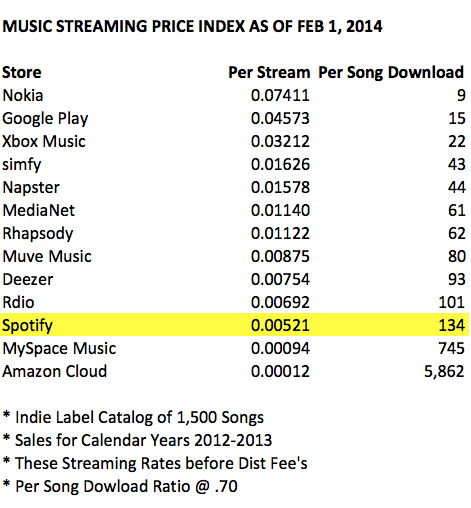
See also “Streaming Price Index: Pay Rates as of 12/31/11″

Fair Play for Artists

Spotify’s business model is actually the kind of extraordinarily short sighted economics that you see from people who don’t understand the business they are in.  Take Walmart for example.  They drive a hard bargain, but they are not trying to leverage themselves off the back of thieves.

Walmart doesn’t say to its suppliers that Walmart is better than the alternative of being robbed blind, but will only make the benefit so incrementally tiny that the supplier will go out of business at that rate.  This is the commoditization rate, or what we call “less than zero” pricing.  This sounds just fine to someone whose salary is guaranteed by venture capitalists, but makes no sense for the artists—and they are leaving Spotify in droves.

Walmart knows that they succeed when their suppliers succeed and the consumer succeeds.  The pricing that Walmart pays to suppliers is based on buying power and a mission of offering consumers low prices, meaning that everyone in the chain takes a little less and truly does make it up on volume.  That method is not for everyone, which is why you don’t see just every brand in Walmart.

Spotify’s valuation is based on a business model that is inherently unfair to artists, producers and songwriters.  This accounts for its low conversion ratio—it’s a couple points away from a pure pirate service and has failed miserably in the one thing it had to do to justify its existence: convert free to paid customers.

And even if it did succeed, that would be the worst possible world for artists, because there is little difference in the functionality of a top tier Spotify service and buying a download from iTunes–aside from the price paid to the artists, producers and songwriters, of course.  There is even some evidence that suggests that fans who were buying downloads are shifting to Spotify’s free service and substituting away from paying for downloads legally to a free legal service–the exact opposite of how Spotify has sold its service to artists as the “piracy buster”.

Next: Part 5

See Part 1 here, Part 2 here and Part 3 here