A friend is someone whom you trust to do the right thing. Sometimes you’ll hear people say that a friend did something uncharacteristic. If they are really your friend, you will be the one to stand with them in those moments and say that just can’t be right. Give them another chance to prove themselves.
So it is with National Public Radio’s short-lived membership in the MIC Coalition, the massive lobbying group organized by…someone…to oppose the Fair Play Fair Pay Act guaranteeing artist pay for radio play. By the looks of it, those organizers were the usual suspects at the National Association of Broadcasters and Google.
As I mentioned in my presentation last week at the Copyright Society of the USA in Austin, the MIC Coalition members are companies and trade associations with a combined…
We are not really sure if these two events have anything to do with each other. But we’d like to think they are related. It serves as warning to other companies that decide to rely on government lobbying and mandates instead of old fashioned hard work and innovation to create a profitable company.
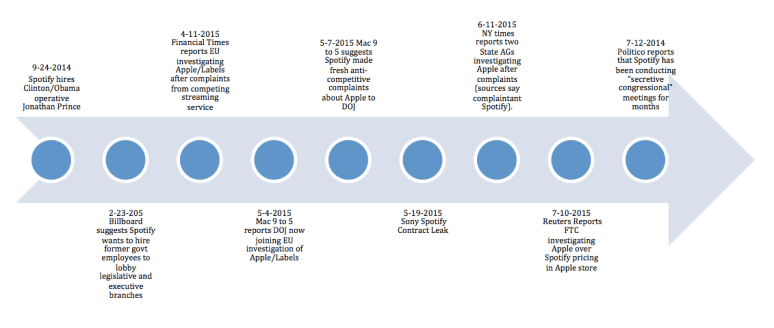
A Timeline of Spotify hardball lobbying efforts with EU, State AGs, Executive branch, DOJ, FTC and Congress since hiring former Obama/Clinton administration official.
We have been tempted to stay out of the debate over Apple Music and let the three big music tech companies Apple, Spotify and Google/YouTube rip each other apart. After all, real market competition from these companies for our recordings and songs could eventually lead to better pay for artists.
If you zoom out and look at Spotify’s lobbying activity in sum total they appear to have three goals:
1) Protect their free tier (which pays artists 1/7 of what the premium subscription service pays) but makes them more valuable at IPO or as a takeover target to an advertising-driven company like Google.
2) Get Apple under some kind of anti-competitive regulation in EU, US and state AGs.
3) Get rights holders of sound recordings (Artists and Record Labels) under some sort of anti-competitive regulation in EU, US and US states so they are obligated to license sound recordings to Spotify outside of the free market (like the ASCAP and BMI rate courts).
Yes, we were disappointed with Apple’s initial attempt to not pay artists during it’s 90 day free trial (they’ve since changed their tune), the fact is Apple is still better than Spotify for artists:
1) Apple free trial pays about $0.002 a spin while the last time we checked Spotify pays about $0.0009 per spin on their ad supported free tier (Online advertising rates have experienced a secular decline since then).
2) Apple free trial is 3 months. Spotify free tier is forever. After 3 months Apple free trial ends and subscribers move up to subscription tier. We expect Apple’s subscription tier to pay more than Spotify subscription so this means a significant increase in revenue per spin to artists. Plus–we don’t have to go through the absurd revenue share calculation of the advertising peddlers.
3) Spotify is actively trying to get users to unsubscribe from its premium service offered through the Apple App Store, which will likely mean an overall net reduction in revenue to artists due to inserting inconvenience into the transaction. Apple is actively trying to encourage subscription uptake which will mean an overall net gain in revenue to artists.
Omid Kordestani, who has just temporarily replaced Nikesh Arora as chief business officer of Google, is joining the board of Spotify, according to people with knowledge of the situation.
In addition, sources said, one of the search giant’s former execs, Shishir Mehrotra, will become a special adviser to CEO Daniel Ek and the company’s management.
The move is a fascinating one, especially since sources inside Google said that new YouTube head Susan Wojcicki has expressed interest in acquiring the popular online music service if it were for sale.
YouTube and Spotify share a board member! (DOJ: where is that anti-trust investigation?) Every quarter when artists get their royalty statements they have tangible evidence of the damage created by this duopoly.
Here is the kicker, we should welcome investigations by the European Commission, State AGs, Congress and DOJ into anti-competitive behavior and collusion in the digital music licensing marketplace for sound recordings. But it must include ALL players! Broaden it to include Spotify, Google/YouTube, Pandora, Amazon, IHeartRadio, NPR, MERLIN (indie label licensing authority) and the major labels. (The feds already have songwriters and their PROs under DOJ supervision).
Fair is fair. Democracies don’t function when certain politically connected companies and individuals get different treatment under the law. Further the government needs to get out of the business of licensing music. (See my argument in detail here.) We are wasting vast amounts of federal manpower and taxpayer dollars when our nation(s) faces other more important challenges. Seriously we’re worried about streaming services profit margins when we face very real threats from Greek bankruptcy? A resurgent and expansionist Russia? Chinese hackers?Federal cyber breaches, and ISIS inspired terrorism?
Let me remind you once again: Artists are not asking for a handout from the federal government. In this debate it is the multi-billion dollar streaming services asking for the handout. Spotify is asking for protection from competition. Artists welcome competition. Artists are simply asking the federal government to do less and stop regulating the market, let our songs and sound recordings be priced in the free market.
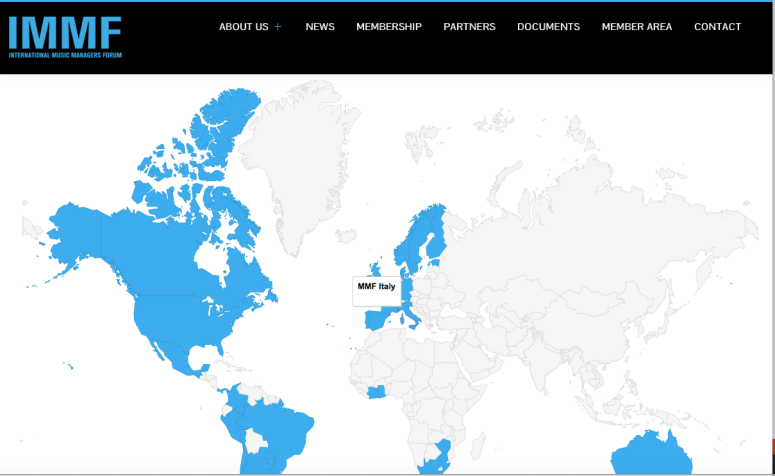
The International Music Managers Forum is the parent organization which nominally oversees the Music Manager Forum affiliates in various countries around the world. Last week we broke a story that a whistleblower indicated the Music Managers Forum in the UK along with its sister organization Featured Artist Coalition are taking money from Google and Spotify. We have since had a second source corroborate this.
This is important because MMF and FAC have been strong advocates for Spotify and its low paying ad supported free tier. Further many artists feel betrayed that MMF/FAC hosted a series of “informational” meetings with Spotify while apparently taking money from Spotify. It’s not a good look for the (formerly) well respected institutions.
Naturally in the wake of this revelation we received communications indicating that certain members of the IMMF were not happy with this news, and seemed to want to distance themselves from the MMF.
Fair enough. So we looked into the IMMF to see what they are about. What we found is just as ugly:
1) The IMMF is a member of Copyright 4 Creativity. Other members include the artist-hostile-anti-copyright-Google-funded EFF as well as the CCIA and CDT.
3) The IMMF is a signatory to the Copyright 4 Creativity manifesto which contains this clause:
“Ensure Monopoly Rights are Regulated in the Online Environment: Limitations and exceptions act to counter-balance the lack of competition that is created by the granting of monopoly rights in copyright law. In order to protect creativity and innovation we must ensure that these monopoly rights are also regulated in the online environment.”
Sounds okay right? No one likes big monopoly corporations!
Uh… except that’s not the kind of monopoly they are talking about. They are talking about YOUR individual rights as a monopoly!! Specifically your copyright “monopoly” over your songs and sound recordings, which is the same kind of “monopoly” you have over your guitar, your car, your house or your body, not an anti-competitive monopoly. “Regulating” means taking away your right to decide how your sound recordings and songs are exploited in the online environment and at what price. Implicit is the government would somehow set the rates and uses.
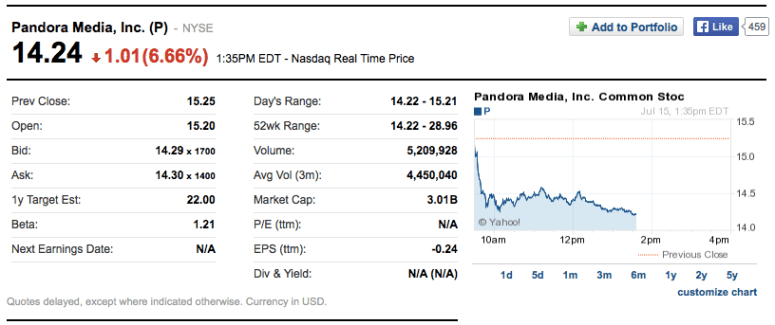
What could possibly go wrong? The big internet companies would never out lobby and out spend us in Washington and force us to take rates we’d never agree to in a free market! That would never happen! Right? (See Pandora Media.)
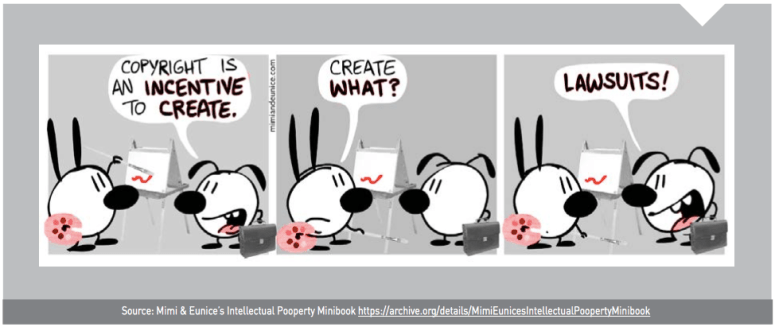
4) The Copyright 4 Creativity Manifesto which is endorsed by the IMMF contains cute little graphics like this cartoon:
This is some real intelligent thoughtful stuff here. Next manifesto maybe they should try using only decade old internet memes. And BTW the last frame to be accurate should read:
“Lawsuits! When the artist figures out the manager stole his copyrights”
Not cool at all. But it’s really no surprise. Sleazy managers ripping off artists? Again?
You’ll remember that The Verge ran the leak of Spotify’s agreement with Sony Music. Now The Verge is running a story about subscriptions to the Spotify app from Apple’s App Store:
Spotify is trying to raise awareness around the fact that it’s cheaper to subscribe on the web instead of through Apple’s App Store. The leading subscription music service plans to email iPhone customers the below note encouraging them, if they haven’t already, to start paying at Spotify.com and save a few dollars. “In case you didn’t know, the normal Premium price is only $9.99, but Apple charges 30 percent on all payments made through iTunes,” the email blast reads. “You can get the exact same Spotify for only $9.99/month, and it’s super simple.”
Here’s the actual emails:
Quick–based on what you just read, who sets the price for the Spotify subscription through the App Store? Apple or Spotify?
David Lowery’s recent post on the Trichordist reveals the disclosure by an apparent whistleblower that the Music Managers Forum and to some extent the Feature Artist Coalition have each been taking undisclosed money from Google and Spotify. (Given the context, I assume the whistleblower is referring to the MMF chapter in the UK.) Why is this important? Because when confronted with the artist rights grass roots movement that Lowery personifies, we can expect Google to do what they always do–try to co-opt it one way or another.
Want evidence? If you’ve had a look at the Public Citizen report “Mission Creep-y“, Google’s technique of buying their way into issues or industries and increasing their dominance in their ownership and influence through control of resources should come as no surprise. The venerable good government group provides extensive documentation of Google’s massive investment in indirect lobbying through funding a host…
Originally written and posted in 2012, here again for your July 4th weekend…
Technology may change but principles do not. A society that encourages the creative spirit is rare in history and worth defending. The internet and digital technology have opened up many new opportunities for artists, but it has also opened up new opportunities for those who wish to exploit those artists.
We offer for discussion a set of principles as a guide for companies and policy makers to keep in mind. It is our hope that these principles will help build a sustainable online creative ecosystem, one that benefits creators, innovators, and the general public alike.
1. FAIR AND ETHICAL LABOR PRACTICES: RESPECT WORKERS’ RIGHTS A fair and ethical internet is built on the respect and protection of the rights of individuals to determine who benefits from their labor and creations.
Since the rise of digital utopians in the 1990s, we’ve unfortunately seen many very old arguments surface as to why the economic benefits of a few big companies should be valued over the labor rights of many. This problem is what drives workers to organize to protect their labor and demand fair compensation. Not only are artist rights protected by the US Constitution, artist rights are also internationally recognized as human rights protected by many international treaties, including the Universal Declaration of Human Rights. Unfortunately, however, there are those who seek to capture the value of artist rights profit only for themselves by systematically violating these rights for commercial gain.
A free and open internet works best without overbearing regulation, but it will not work at all without protection for fundamental rights of working people.
2. CONSENT IS THE FOUNDATION OF CIVILIZATION: RESPECT ARTISTS’ INTEGRITY Your right to swing your fist stops at the end of my nose. Your rights end where mine begin.
Rights secured by the Constitution are intended to protect the individual from hostile majority forces and the tyranny of the mob, particularly the corporate mob. This is especially true regarding copyright, which is itself a vehicle of the right of free expression for individuals, and protected by the Constitution.
Everyone understands the value of individual privacy in the digital age. The essence of the artist’s control over the integrity of their work is not that different. Individual consent should be required for a corporation to profit from taking any creative work (just like individual consent is required for taking personal information) because the creative work goes to the artist’s personhood. Protecting an individual’s right to their personhood and the protection of their free expression are building blocks in the foundation of civilization.
3. PROTECT INDIVIDUAL FREEDOM OF EXPRESSION: DON’T TRIVIALIZE CENSORSHIP Freedom of speech requires freedom of expression. Copyright protects free expression. Together, they ensure a robust marketplace of ideas that advances truth, knowledge, and culture.
Let’s get this straight. Censorship is intolerable. You don’t have to look very far to see artists being censored by governments — there are many historical examples . No one understands this more than the scores of individual artists, musicians, painters, writers, poets, filmmakers and creators of all disciplines who have actually (and literally) have been persecuted, disappeared or assassinated for their views all over the world. Sadly, many confuse the actual freedom of expression with the mistaken idea that preventing the illegal exploitation of that very expression is the same thing. It’s not.
The copying and distribution of those expressions without the creators permission is simply exploitation without consent or compensation. Would you think that a car thief is being censored when they are prosecuted for stealing your car or a bank robber is being censored when they are prosecuted for stealing your money? Don’t trivialize “censorship”.
4. FAIR COMPENSATION: IF YOU DON’T LIKE IT, DON’T BUY IT In any value chain where the individual creator’s work is exploited, the creator must be compensated.
Most fair and reasonable people embrace “Fair Trade” products to support and encourage fair compensation of labor. Unions have fought long hard-won battles for the protection of labor rights. As a society we recognize the individual’s right to fair compensation of labor as a fundamental cornerstone to an ethical and healthy society. The internet is inhabited by as many different varied participants as the physical world, and the respect for human labor should not be devalued simply because technology makes it possible to be unethical.
It’s very simple–the answer if you don’t like an artist’s work is not to steal it–just don’t buy it. They’ll get the message.
5. MUTUAL RESPECT: IT’S ABOUT GETTING IT RIGHT, NOT GETTING AWAY WITH IT Mutual respect for the diversity of all online citizens is the cornerstone of a healthy and robust community.
The mutual respect granted by intellectual property rights allows individual creators the freedom to determine what permissions they wish to grant and at what price. No one has to pay that price, but the creator is entitled to set it. Denying these freedoms to creators because the mob or a public company wants to overrun a musician, author, illustrator or photographer violates the very protections against mob rule that the Constitution is intended to secure. Sadly, this is largely how individual rights are viewed today by some online corporate interests.
6. PARASITIC EXPLOITATION IS NOT INNOVATION: FREE AND OPEN SHOULD BE FAIR AND HONEST The illegal exploitation of individuals for commercial gain is not innovation, it is techno-thuggery and cyberbullying.
We see many companies on the internet illegally exploiting the work, labor, innovation and creations of others simply because they can get away with it. We’re often told that innovation requires the unauthorized exploitation of creators in some kind of technological determinism that rejects the innovation of creators because it“scales”. That is just another way of using “convenience” as an excuse for theft. Any business that requires the illegal exploitation of individuals to be profitable is not a business but rather is a parasitic engine of oppression.
7. SUSTAINABLE INNOVATION SOLVES PROBLEMS: FAIR NOT FAKE Sustainable innovation is best represented by solving problems, not creating them by adding intentional opaque layers of obfuscation.
The organized and deliberate complexity of some online ad networks, pirate site operations, and other businesses creates an impenetrable black box to protect illicit money flows and give the participants plausible deniability. Then we are told to “follow the money” through advertising networks, down a rabbit hole to a maze followed by another rabbit hole. That’s not innovation. It is old school wire fraud. This should not be a badge of honor for the online community but rather a point of embarrassment that the Internet—one of the greatest technological achievements of all time–is trivialized by making it nothing more than a safe house for many illegitimate businesses profiting at the expense of honest citizens.
8. COMMON GOALS, BEST PRACTICES AND SOLUTIONS: There are centuries of mutual ground between creators, commerce and rights holders. Let’s not throw this away.
Let’s not set a goal of building a large database for clearances of all copyrights and do nothing until it is operational. That solution almost guarantees that there won’t be many new works to put in that database. Such a database has never existed and is incredibly complex. A transparent rights clearinghouse is a possible solution, but the lack of one it is definitely not an excuse for bad behavior.
Punk Rock Generation: We rebelled by protesting wars, dictatorships, apartheid, government corruption, the military industrial complex, polluting corporations, the christian right, the draft, nuclear power, the slaughter of sea mammals, and even other punk rockers. We were at times tear gassed and beaten by police (See Dead Kennedys Wilmington CA).
Millennials: We rebel by not paying for stuff. We want bean bag chairs at work.
I was listening to a story about a pirate streaming service on APM’s Marketplace yesterday and I was surprised that the following statement about “millennials” not paying for stuff went un-mocked:
This is a pretty common sentiment for people born anytime after, say, the early 80s. Millennial Michael Krynski is 29. Here’s how he sums it up: “We’re like the Napster Generation. We just expect things to be available (free) online. Everything we’re looking for.”
Krynski runs a blog all about how to stream content for free. Most of his readers are under 30, and he says, “They have money, but they don’t want to give money to companies that are still in this old school distribution model.”
Old school distributions model? You mean paying? Cause illegal and legal streams are all distributed the same way. You know that right? You do understand how the internet works?
So what you’re really saying is: Millennial rebellion is rooted in some pseudo moralistic justification of theft based on which businesses use the discredited web 2.0 “freemium” business models?
(Personally I don’t buy this crap. I don’t believe there is a “millennial” generation with a different set of values than any previous generation. Every generation has it’s selfish lazy assholes who are willing to justify any sort of behavior by claiming to speak for their generation. And every twenty years or so marketers invent a new generation so they can pitch their consultancies, books, analytics and speaking tours. But since the media seems determined to cram this current fiction down our throats we might as well have some fun with it by following the fiction to it’s logical conclusion.)
The Copyright Society of the USA Texas Chapter and the Austin Bar Association Entertainment & Sports Law Section have are co-sponsoring a panel with Chris Castle and Austin manager Ray Flowers with this title that pretty much sums it up:
This event is particularly timely given the expanding campaign to get artist pay for radio play. Don’t forget to join 13,000 of your friends and sign the #irespectmusic petition at IRespectMusic.org! If you’re in Austin, follow IRespectMusic Austin @irmaustin and online at www.irespectmusicaustin.org.





 The Trichordist
You must be logged in to post a comment.