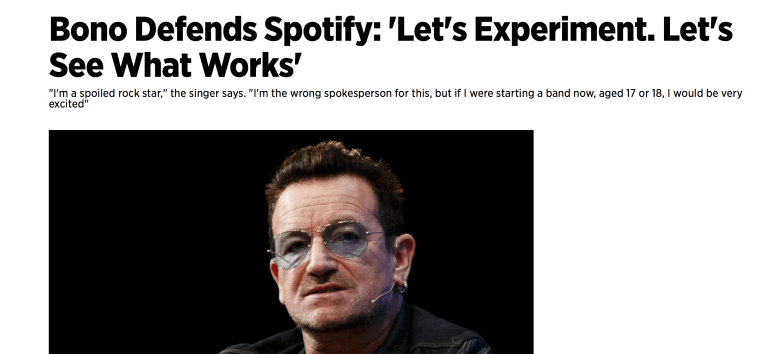
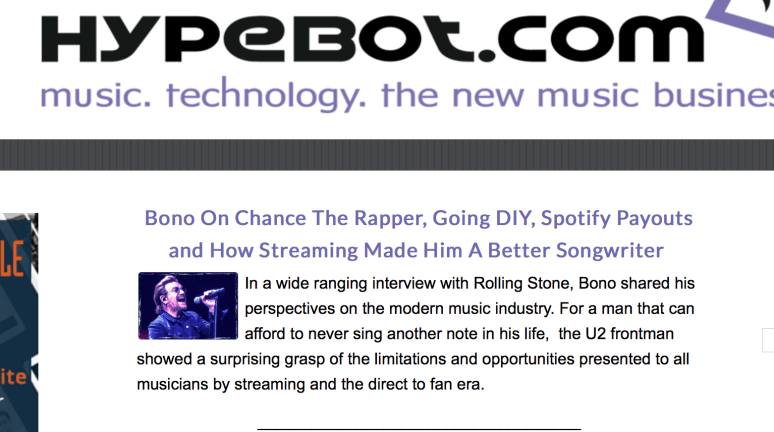
Bono, you know the singer in U2. Also a venture capitalist.
Anyway this is a joke that has been floating around the music business since probably the early 1990s. There are a dozens of versions of it. I have no idea who originally came up with the joke. But here’s the version told to me by the late Don Smith:
An old 60’s hippy bass player is performing his usual Sunday afternoon gig at the local hippy coffee house outside of Santa Rosa in Mendocino County. They are right in the middle of “Going Up Country” in the style of Canned Heat when he collapses from a heart attack and dies. The bass player having lived a good life wakes up at Heaven’s gate and is greeted by St. Peter. As St. Peter is giving him a sort of orientation walk around, the bass player notices that there is a band playing somewhere. The bass player interrupts St Peter and asks “is that a live band playing.” St. Peter says “I was about to get to that” St Peter motions the bass player to follow him. He leads him down a narrow gap between two clouds into what is apparently Heaven’s night club. On stage he sees Jimmy Hendrix plugging in his guitar and Keith Moon tuning up a drumset. St. Peter motions the bass player towards the bass rig. The bass player can hardly believe his eyes. He gets onstage picks up what appears to be his 1972 P-bass and plugs it into his mint condition Acoustic 360A with a reverse 18″ cab. Hendrix launches into Purple Haze and the bass player, now ecstatic, joins in. After a few more songs George Harrison comes up on stage and they play “My Sweet Lord” and “While My Guitar Gently Weeps.” Janis Joplin jumps up and for a final song they all break into a blistering rendition of “Piece of my Heart.” The band is about to leave, when Bono suddenly rushes up on stage Even though the musicians were all clearly about to take a break he cajoles everyone into staying. Bono and the band proceed to limp their way through “Beautiful Day” and “Vertigo,” Hendrix and Moon seem to have never even heard the songs and the whole thing ends with an embarassing smattering of polite applause. The bass player while casing his bass and putting his cords away notices St. Peter standing next to him. “What did you think?” St. Peter asks. The bass player says “It was great…but” pauses and after looking carefully around turns back to St Peter, “What’s up with Bono? I didn’t even know he was dead?” St. Peter laughs and says “That’s not Bono! That’s God. He just thinks he’s Bono.”
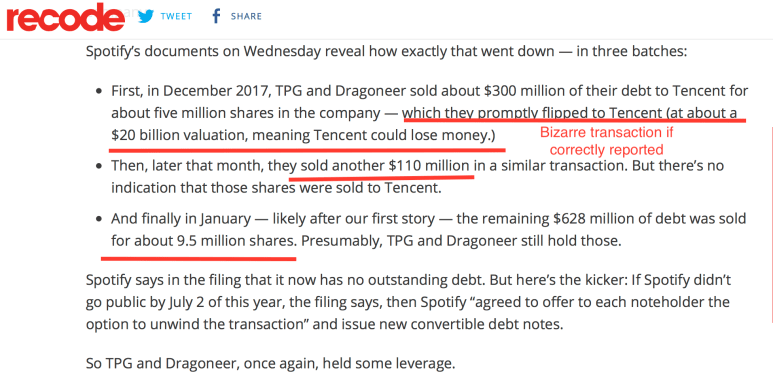
Here’s some screenshots that seem to tell a little story about Taylor Swift, Bono, Spotify and extremely powerful Wall Street private equity firms.
Spotify is stalking you (advertising campaign image by Spotify)
The public has woken up to the fact that Facebook is a spying and privacy violating machine. Governments in half a dozen countries have announced some sort of investigation into the company. What most people don’t realize is that Facebook is not unique. Virtually every free digital app is spying on you and sharing that data with 3rd parties. This includes the music streaming service Spotify.
However Spotify is unique. More than most other services Spotify and the Facebook platform are heavily integrated. When you sign up for Spotify from a web browser, you are encouraged to sign up using your Facebook login so they can associate your account with your profile. To illustrate just how integrated the companies are when I was offered a free premium account by Spotify (a sort of peace offering) somehow linking it to my email address reactivated my deleted Facebook account! I am not kidding.
And over the years many other people have complained about the tight integration between Facebook and Spotify. Particularly bothersome to many folks is that they often ended up sharing playlists, or songs they didn’t really intend to share.
There are probably two reasons for this. The first is probably relatively harmless. Major Facebook and Spotify shareholders overlap. Most notable are funds connected to Sean Parker (of Napster fame) and U2’s Bono (Elevation Partners and TPG). But less famous names and funds share investments in the company.
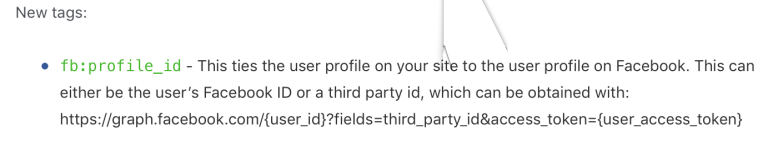
Screenshot from Facebook Open Music Graph Developers Page.
But the more important reason they are so tightly integrated is to harvest data. Folks who think Spotify is just a music platform are mistaken. The overwhelming number of streams on Spotify are on the ad supported tier. It is here that Spotify trades OUR songs for YOUR Data. And much of this data goes straight into the Facebook data mining machine. As far as I can tell this has been going since Spotify first launched in the US.
Most people are sophisticated enough to understand the difference between a public and private post. We live in a relatively free country where political dissent is tolerated; religious persecution is largely unknown and people do not need to hide their sexual preferences from the police. But in some countries if certain private information becomes public you could die.
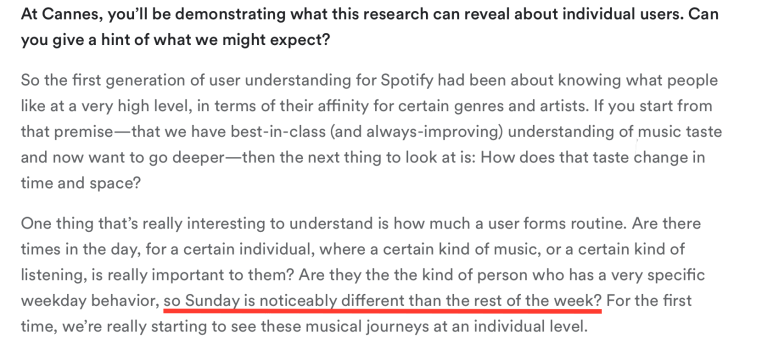
That is why I don’t understand why Spotify for Brands would brag about data harvesting of this kind:
Paging Chairman Xi, you’ve got some “cultists.”
Or perhaps worse? What about countries that punish/criminalize anything but super normative heterosexuality?
The first thing I noticed is that the tragic demonstration of the raw lobbying power of Big Tech: The litigation reach back safe harbor seems to still be in there which is designed to deny due process and other Constitutional protections to songwriters whose works are infringed prior to the enactment of the Music Modernization Act.
Plus the one-sided board of directors is still the inverse of the publisher/songwriter control in other countries, 70% publishers and 30% songwriters.
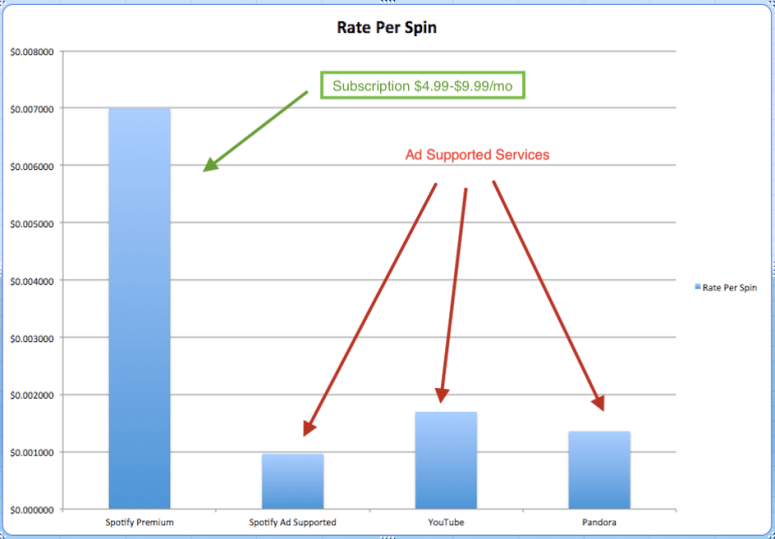
I posted this article in 2015. But it is perhaps more relevant today. Ad supported streaming services rely on packaging and selling user’s personal information. Ad supported streaming underpays artists. Artists and consumers interests are completely aligned.
Subscription services pay artists better and don’t need to compromise consumer privacy. #DeleteTheFreeTier
Rates are “all in” at source. Calculations based on royalty statements from a catalogue of 1500 titles 2014. Exception is Pandora which was calculated from 2nd quarter 2015 statements (higher than 2014).
In the fight for fair pay artists are not at war with the Internet or really even the streaming services, we are at war with the online advertising industry. As we have demonstrated time and time again, subscription (paid) music streaming services pay at least 7 times the rate that the free services pay. When you see artists (like myself) post absurdly low royalty payments it’s usually from one of the services that is predominately ad supported. Above is a chart that illustrates this nicely.
So for artists the solution seems easy: get rid of ad-supported free tiers. The problem is that in order to do away with these ad-supported tiers we have to fight not…
The famous old Russian proverb reminds us to trust but verify. That’s been the story in the record business since the cylindrical disc. All the “modernization” in the world will not soothe songwriter’s genetic suspicion of their accounting statements.
The collective to be established by the Music Modernization Act (“MMA”) undertakes the obligation to handle other people’s money. It quickly follows that those whose money the collective handles need to be able to verify their royalty payments from time to time. This has been an absolutely standard part of every royalty-based agreement in the music business for a good 50 years if not longer.
But like every aspect of the MMA, one has to always remember that while all songwriters may be equal, some songwriters are more equal than others. The MMA creates a two tier system–those who opt out of the compulsory blanket license by the mutual agreement of a rights owner and a digital service in the form of a voluntary agreement and those who do not. Those who do not have this opt-out right appear to receive payment directly from the collective instead of directly from the service–adding another set of hands and transaction costs. (It must be said that this group receiving payment under the compulsory blanket license will presumably also include those who currently have a voluntary license with digital services that is not renewed it in future.)
The collective undertakes the responsibility of accounting should anticipate concerns of songwriters regarding verifying the accuracy of the statements and payments it renders. However, the MMA provides no supervisory oversight and in my view has a rather punitive black box clause that allows “unmatched” royalties to be paid on a market share basis to publishers, and then on to their lucky songwriters pro rata. This suggests that everyone who is in that lucky songwriter’s chain, like managers, business managers and lawyers working on a percentage basis may also get a share of these black box distributions in compensation.
So on the face of it, the MMA creates a relatively large category of people who have an economic interest in the black box. You can be cynical and think that they have an interest in the black box being as large as possible (meaning the accounting controls are as weak as possible), or you can agree with five-time Grammy winner Maria Schneider that if the “lucky” songwriters actually knew that they were being paid with money that belonged to the “unlucky” songwriters, they would be angry about that unfairness. Emphasis on the “actually knew”.
Or you could say, let’s not go either direction–let’s set up transparency and controls so that the incentives are properly aligned to create the smallest black box possible. No publisher needs the writer-relations headache of suspicious minds, and the collective should do what it can to be above reproach. Here are a couple solutions to increase the trust level: Add oversight of the collective by the Office of the Inspector General (as a quasi-governmental organand at least designated by the Copyright Office and operating under the control of the Copyright Office, and also tighten up the audit clauses in the MMA to treat songwriters auditing the collective the same as the collective is treated by the digital services.
The Inspector General
One way to make sure that the collective–a quasi governmental organization in my view–is run honestly is to make it subject to oversight review by one of the U.S. Government’s many Inspectors General. Rick Carnes of the Songwriters Guild of America suggested this to Rep. Doug Collins at the University of Georgia Artist Rights Symposium in a question from the floor.
For example, the Library of Congress (currently where the Copyright Office is housed) has an Inspector General. Since the Copyright Office has a lot to do with the creation and periodic review of the collective, they could save themselves a bunch of Freedom of Information Act requests from angry songwriters by having an Inspector General review the collective annually (or better yet, in real time).
My understanding is that giving an IG jurisdiction over the collective will require some enabling legislation, but I think it’s something well worth looking into. It would give the songwriters of the world a true-blue fiduciary to represent their interests as well as comfort that they had a line of appeal with some teeth short of expensive litigation.
Audits
The Inspector General is not in the current draft of the MMA, but audits are–both audits of the collective by songwriters and audits by the collective of digital music services. We’ll focus on audits of the collective in this post. It should be said that under the current compulsory license now in effect (i.e., pre-MMA), songwriters get no audit right, so the fact that there is an audit right at all is an incremental improvement.
Unfortunately, the MMA’s audit right still keeps songwriters away from auditing the right party–the digital services–and keeps that upstream data away from them. Plus, all audits under MMA appear to be subject to confidential treatment. I don’t think there’s a good reason to keep these secret. If a smart auditor finds a flaw in the collective’s accounting systems, that flaw should be disclosed and there should be an automatic true up of everyone affected.
But first, let’s realize what an “audit” actually is. It is a term of art in the music business and really means a “royalty compliance examination” which is solely focused on making sure that statements and payments rendered conform to the contract concerned, or in this case, the statutory requirements of the compulsory blanket license.
(It also must be said that as Maria notes, the MMA specifically exempts the collective from any responsibility for incompetent royalty accounting other than “gross negligence”, which usually means blatant indifference to a legal duty or something along those lines–assuming the collective’s board or employees actually have a legal duty to account correctly which it may not.)
The person conducting a royalty audit is typically not a certified public accountant as there is nothing about conducting this examination that requires a knowledge of Generally Accepted Accounting Principles (“GAAP”), financial accounting, or Sarbannes Oxley compliance. It is, in fact, quite rare for a royalty audit to be conducted by a CPA, and I’ve even had lawyers conduct an audit because the analysis involved is mostly that of contractual, or statutory, interpretation. Analysis of music industry-specific contracts is typically not part of the training of CPAs. So even if an auditor is a CPA, the skills needed to conduct the audit are typically learned through on the job training.
What is very common, however, is for someone on the receiving end of the audit to try to require the auditor be a CPA, arguably to increase the cost of the audit on the person owed money. CPAs often bill at higher rates than do royalty auditors, which creates a disincentive for audits. What is also common is for lawyers to think that every time they draft a clause about anyone conducting anything having to do with accounting, that they need to limit the person doing that examination to a CPA, because…well, because… This is what I call stupid lawyer tricks, and the CPA requirement is something that is routinely negotiated away in record deals and publishing deals if you have an ounce of leverage.
Here’s the preamble of the MMA’s audit clause for audits of the collective:’
A copyright owner entitled to receive payments of royalties for covered activities from the mechanical licensing collective may, individually or with other copyright owners, conduct an audit of the mechanical licensing collective to verify the accuracy of royalty payments and distributions by the mechanical licensing collective to such copyright owner
Remember–copyright owners under the compulsory are not allowed to audit the service, although the collective may audit the service. (And, of course, voluntary agreements are governed by their terms regarding audits and are not subject to the compulsory.)
Limiting the audit right to “copyright owners entitled to receive payments” means that if songwriters have an administration or co-publishing agreement, they will probably not be able to conduct an audit of the collective (even if their administrator or co-publisher is a board member of the collective). Because the audit is limited to “verifying the accuracy” of prior payments, the audit of the collective will not be able to look “upstream” to the service making the payment and may not be able to look at payments made to the collective, just the payments by the collective.
The audit shall be conducted by a qualified auditor, who shall perform the audit during the ordinary course of business by examining the books, records and systems of the mechanical licensing collective, as well as underlying data, according to generally accepted auditing standards and subject to applicable confidentiality requirements prescribed by the Register of Copyrights…
Sounds good, right? A “qualified auditor” is a defined term, however:
QUALIFIED AUDITOR.—The term ‘qualified auditor’ means an independent, certified public accountant with experience performing music royalty audits.
Again, I don’t think that the auditor needs to be both a CPA and have experience. Experience is enough. For example, if the auditor has performed audits for members of the collective’s board of directors, perhaps that would be enough.
The qualified auditor shall determine the accuracy of royalty payments, including whether an underpayment or overpayment of royalties was made by the mechanical licensing collective to the auditing copyright owner(s); provided, however, that before providing a final audit report to such copyright owner(s), the qualified auditor shall provide a tentative draft of the report to the mechanical licensing collective and allow the mechanical licensing collective a reasonable opportunity to respond to the findings, including by clarifying issues and correcting factual errors.
This clause is a problem. First, the auditor is hired–and has a professional duty–to find underpayments of royalties. That’s what they look for. The auditor does not have a duty to do the collective’s work for it and find overpayments. The auditor is not hired to find overpayments, they are hired to find underpayments.
The collective should hire its own accountants to review its royalty statements, and it surely will do so if it gets an audit notice. Otherwise the US Government is placing a heavy burden on the auditor and the copyright owners to look for overpayments as though the auditor played the role of a public financial accounting firm looking for accuracy on behalf of stockholders.
Plus, the requirement to force that auditor to give the collective the audit report before giving it to the people who hired that auditor is a bit much. Fair enough to meet and confer at the work paper stage to make sure there weren’t inaccuracies in the analysis, but that should not place any prohibition on whether the auditor’s own client can see the report first.
If this is really the role that the Government wants the auditor to play, then by all means let’s make any miscalculations by the collective available to the public and publish them in the Federal Register. Let’s not have the auditor’s findings subject to any confidential treatment. If that brings down a host of other audits or a need to restate millions of royalty payments, then so be it. Because we are not just looking for underpayments we are searching for the truth, right?
I don’t think so. And the next part of the audit clause shows why:
The auditing copyright owner(s) shall bear the cost of the audit. In case of an underpayment to the copyright owner(s), the mechanical licensing collective shall pay the amounts of any such underpayment to the auditing copyright owner(s), as appropriate. In case of an overpayment by the mechanical licensing collective, the mechanical licensing collective may debit the accounts of the auditing copyright owner(s) for such overpaid amounts, or such owner(s) shall refund overpaid amounts to the mechanical licensing collective, as appropriate.
Like so many other parts of the MMA, this is essentially an “ad terrorem” clause, or a right coupled with a penalty if it is exercised. What I think this means is that regardless of how much the underpayment might be–including both a material and nonmaterial amount–the songwriter bears 100% of the cost of the audit. The songwriter’s auditor has to look for overpayments (and bill their client for that extra review), and if the auditor finds any, the auditor has to report the overpayment. The songwriter then not only has to repay that amount (whatever “as appropriate” means), but also pay for the expense of finding it.
Compare this to the rights of the collective when auditing a digital music service:
The mechanical licensing collective shall pay the cost of the audit, unless the qualified auditor determines that there was an underpayment by the digital music provider of 10 percent or more, in which case the digital music provider shall bear the reasonable costs of the audit, in addition to paying the amount of any underpayment to the mechanical licensing collective. In case of an overpayment by the digital music provider, the mechanical licensing collective shall provide a credit to the digital music provider.
So what’s good for the goose is not good for the gander. When the collective is auditing upstream, the collective gets the benefit of that standard underpayment penalty. That means that the service has to pay for the cost of the audit if the underpayment exceeds a fixed percentage, in this case 10%. If there is an overpayment, the collective never has to repay the overpayment, just credit the account with an offsetting amount.
There should be no obligation on the part of the songwriter to have to find overpayments and if an overpayment is found in the normal course, it should simply be credited (which is the effect of the collective’s audit clause on songwriters downstream).
Songwriters should get the same underpayment protection on audit costs that the collective enjoys.
Appointing an Inspector General and cleaning up the audit clause would certainly make the MMA more fair for songwriters than it currently is.
Who you Gonna Call? Law Enforcement and Artists’ Rights
Amanda Williams, Songwriter, Songwriter Advocate Detective Superintendent Peter Ratcliffe, Police IP Crime Unit City of London Police Carlos Linares, VP Anti-Piracy Legal Affairs RIAA Ellen Seidler, Filmmaker, Writer, Producer, Digital Citizens Alliance Kevin Phelan, Senior Supervisory Agent,FBI Palo Alto CA
1:15- 2:15 PM
Chris Castle of MusicTech Policy once remarked, “If someone is stealing your musical gear, it’s clear you call the police. If someone is stealing your musical catalogue, who do you call?” Most of the time the answer is “call a lawyer and file a federal copyright infringement lawsuit.” However, this presents several problems. An artist would have to track down the culprit, not an easy task when operators of website may be located in foreign countries or ownership masked by shell registrations. Second, a plaintiff must have hundreds of thousands of dollars to proceed in federal court. This is not a practical solution for most independent songwriters and musicians.
There are however other actions that artists may initiate. The federal government has several units that deal with criminal intellectual property theft that can often help. In addition, it’s entirely possible that these websites may be committing other crimes such as fraud, tax evasion and/or money laundering. Other federal units may be activated to investigate these suspicions. Similarly, these crimes may also violate state laws. Many states also have their own copyright laws, rights of publicity, false advertising and consumer protection statutes that may come into play. Some of the most surprising and effective anti-piracy law enforcement operations in recent years have come from the City of London’s Police Intellectual Property Crime Unit. Is it possible an artist in the US could one day call the local police?
The UGA Terry College Music Business Certificate Program hosted an Artists’ Rights Symposium Jan 22-23 2018. Over 250 people attended the symposium. Above is the video of the Grassroots Artists Advocacy Panel.
An Overview of the State of Grassroots Artists’ Rights Advocacy
Mala Sharma, Georgia Music Partners Blake Morgan, Performer, #IRespectMusic Miranda Mullholland, Performer, Advocate, Roaring Girl Records Doria Roberts, Performer, Activist Rick Carnes, Songwriter, Songwriters Guild
2:30-3:30 PM
In addition to the organization of the grass roots advocacy groups, the panelists discuss; messaging; effective use of social media; consumer education; constructively interacting with federal, state and local government representatives; lobbying for legislation; and discouraging companies from doing business with royalty deadbeats. Panelists also discuss lessons learned from these successful campaigns and map them onto current problems.
David Israelite of the NMPA and Mitch Glazier of the RIAA have penned an op-ed for Variety Magazine, in which they extoll the virtues of various copyright reform proposals before congress. While I agree with them on the Classics Act (fixes pre-1972 loophole) and AMP Act (helps producers/engineers receive royalties from digital royalty streams) every day I find myself liking the MMA less and less.
Perhaps it’s because the folks pushing it come out with idiotic statements like this:
“Streaming services have been sued multiple times by music creators who have not been paid properly, preventing them from fully investing in the potential of their platforms”-Israelite/Glazier
That’s right litigious songwriters have prevented streaming platforms like Spotify from investing in their platform. Yup, in 2011 Spotify et al talked to a magic future-predicting genie who told them they should save their money because starting in 2016 they would be sued by songwriters. Makes sense.
I guess that’s why upon launch in 2011 they didn’t build any sort of system to license and pay royalties to independent songwriters. And thats why they paid obscenely low royalties right from the start. Conserving money! Our future lawsuits made them pay shitty and infringe in the past! Whoah! It’s all quantum mechanics and shit!
We independent songwriters can relate. While we were not being paid royalties we were also unable to “invest in our platforms.” You know housing, food, transportation, childcare, healthcare etc. Must have been really tough on Spotify, and they have to cover that 30 million dollar a year lease on their offices in the World Trade Center.
And now here come the NMPA and RIAA to save the day. While we appreciate their attention to matters, songwriters should ask themselves a couple questions:
What were the NMPA, RIAA (and their lapdogs AIMP, and AI2M) doing 2011-2016 while streaming services were failing to pay large numbers of member/songwriters?
This is a guest post (translated from German) by Volker Rieck. Mr. Rieck has spent considerable time investigating Private Layer a web hosting company that seems to be favored by many copyright infringing sites. Unfortunately Rieck’s investigation has been stonewalled by the quasi governmental organization RIPE.
According to Wikipedia: “RIPE or The Réseaux IP Européens Network Coordination Centre (RIPE NCC) is the Regional Internet Registry (RIR) for Europe, the Middle East, and parts of Central Asia. It is headquartered in Amsterdam.”
Ostensibly RIPE gets its authority from ICANN which in turn used to get its authority from The US Department of Commerce via NTIA. That changed at the end of the Obama administration. ICANN is more less independent now but is supposed to consult closely with government. Since ICANN has (swank) offices in Los Angeles, we would hope that “closely consulting with government” would include US government. Including the US Trade Representative.
Alas, like so many poorly governed international organizations ICANN/RIPE is quickly showing signs of arrogance and unaccountability. After reading Rieck’s report I would argue that RIPE is corrupt. They are clearly transmitting fraudulent information to the public. When the error was pointed out they did not correct it. Thus they are complicit. So it is fair to ask, is RIPE the FIFA of the Internet? Who knows. We will never know unless someone with authority looks into it. There is no way that rights holders can force RIPE to properly follow their own rules.
However the United States Trade Representative could surely ask the US Department of Commerce/NTIA to look into it. Aren’t they across the hall? If that doesn’t work why not The Justice Department? Certainly the following questions need to be asked by federal authorities: What part of the RIPE charter allows you to keep in good standing members that provide false public information? What kind of public interest organization thinks it’s their “duty“ to provide the public with fake registration data? What part of your charter mandates you protect members clearly involved in mass copyright infringement? You guys are either total idiots or criminal enabling scumbags: which is it?
Tweet this at staff of US Trade representatives and Department of Commerce and/or NTIA. Rights holders should exercise their 1st amendment rights and loudly protest this blatant failure of governance. You are the victim. Don’t let them get away with it.
-David Lowery
++++++++++++++++++++++++++++++++++++++++++
Internet self-government á la RIPE: A paradise for criminals
By Volker Rieck
Every year in January, the office of the United States Trade Representive (USTR) publishes a list of the worst offenders on the Internet for the past year. This concerns both haptic goods, i. e. counterfeits, replicas, etc. and infringements of intellectual property rights in the form of the non-regulated distribution of films, books, music, software, apps, etc.
The list includes names like the Chinese e-commerce giants Alibaba and Taobao, but also websites like Movie4k, Libgen, The Pirate Bay or Openload.
Contributors to the list include associations such as the Motion Picture Association of America (MPAA) on behalf of the US film industry or the Recording Industry Association of America (RIAA) on behalf of the US music industry.
The role of the RIPE NCC Internet self-administration system will be highlighted here.
Groundhog day
The name of one particular host provider has appeared on the USTR list year after year: Private Layer from Panama or Switzerland. In this respect, the report is not all that clear.
This company provides server space and bandwidth to other “companies”.
According to the USTR report, Private Layer’s “customers” in 2017 included sites such as 1337x. to or primewire.ag. Other sites using the services of Private Layer include youwatch.org, firedrive.com or sockshare.com. All of these are sites that violate the rights of third parties.
The USTR report contains a note about Private Layer to the effect that the operators act more or less anonymously and do not react to information about rights infringements, and that Private Layer’s customers act in the same way.
A closer look at the company therefore appears worthwhile.
Private Layer is a member of RIPE NCC (Réseaux IP Européens), one of five organisations worldwide that are primarily responsible for the allocation of IP addresses and so-called Autonomous System Numbers (ASN). Without such autonomous systems and IP addresses, accessing the Internet and individual websites would be impossible.
The area in which RIPE NCC effectively acts as an arm of the Internet self-government ICANN includes Europe and parts of Asia.
It does not include Central and South America, which fall under the aegis of its sister organization, LACNIC.
Nevertheless, a company such as Private Layer from Panama can become a member of RIPE NCC, receive an Autonomous System Number (ASN) and assign IP number ranges that it has previously received from RIPE NCC.
A question to RIPE NCC as to why a Central American company can do business in Europe so easily with the help of RIPE NCC was answered after several e-mails: if a company has activities in Europe, it can also become a member of RIPE NCC.
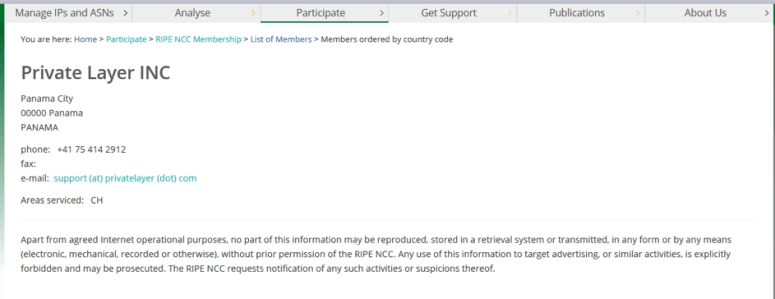
So far, so logical. But to think that the Panamanian company is running a data center in Switzerland would be to set oneself up for a disappointment: while the address in the RIPE NCC database indicates a location in Zurich, this is merely the address of a letter distribution center. In German law, a PO box cannot be the registered office of a company. And by any understanding, a post box is most certainly not a data center.
If the company has no registered office in Switzerland, then the company should be located at the Panama address RIPE has recorded.
But even here it cannot be found. A personal visit to Panama in 2015 at the address given by RIPE NCC led to an office building, but no Private Layer Inc. company could be located there. There was no Private Layer office on the 17th floor, no mailbox and no Private Layer bell button.
Screenshot: Official company information of Private Layer at RIPE NCC in 2015
The way to Zurich
RIPE NCC does not operate a so-called GEO IP database. But other services like Maxmind from the USA do. Such a database can be used to determine where the data center assigned to a specific IP is located.
In the case of Private Layer, this is actually Zurich, but not the PO box mentioned above, but one of the Zurich branch offices of the US company Equinix Inc. where Private Layer has either rented servers or space for its own hardware in Equinix’s data center.
The role of Equinix will not be discussed further in this context.
Everything has a price
Let’s have a look at the price list of Private Layer. The smallest server there costs 89 US dollars per month. The servers on offer are not exactly up to date from a technical point of view. They have a processor that Intel introduced to the market in 2010, and it is therefore difficult to compare the server rental price with those of competitors: finding vendors with such outdated hardware is not easy.
Screenshot: Website of Private Layer with server offers in February 2018
In Germany servers with about 4–6 times the performance (better processors, more memory etc.) can be rented for less than half the price. So it is not the ruinously expensive price point that explains why Private Layer has been able to remain operating in the market for so long.
Private Layer’s selling point is, rather, explained by the USTR report: Private Layer offers a so-called hidden feature. The company’s own operators are anonymous, and Private Layer guarantees the same anonymity and uncontactability to its “customers”.
Private Layer’s customers shy away from the public eye. Nearly all of the WhoIs entries (showing who runs the domain) of the sites hosted at Private Layer have been obscured by special WhoIs services. Attempts to reach the site operators in cases of rights infringements only ever lead to a contact form, never to the operator or even to any company at all.
But the route via the renter of the servers, Private Layer, is also a dead end. As described above, the company’s registered office is either a PO box in Switzerland or a non-existent address in Panama. Documents cannot be served with return confirmation of receipt, and nobody can be reached.
So Private Layer is an attractive proposition for those willing to pay far above the market rate for a weak server in exchange for being able to carry out their business undisturbed and without having to worry about unpleasant investigations.
All fake – we don’t give a damn
How can a non-existent company with a PO box in Zurich become a member of an organization (RIPE NCC) that is responsible for the smooth operation of the Internet?
A company whose business purpose is to provide infrastructure and protection for those who violate rights?
This is exactly the question we put to RIPE NCC. The answer we received is astonishing.
Of course RIPE NCC attaches great importance to accurate data. However, a distinction is made between the member data (i. e. internal and highly private data) and the contact data shown externally.
Accordingly, the internal data is checked by comparison with official company documents.
For external data, the RIPE NCC member only has to observe one thing: an address and an e-mail address must be given. Neither are verified, and RIPE NCC emphasizes that it is not possible to ensure that members also respond.
Screenshot: Fake data of Private Layer at RIPE NCC at the 7th of February 2018
Telephone calls useless – no response, e-mails were ignored, the postal address is a joke
In cases of obviously false data, RIPE “can” contact a member for clarification – with the emphasis on “can”.
Only if a member does not reply or if data proves to be incorrect “can” RIPE NCC exclude it according to its statutes – again with the emphasis on “can”. According to its own statements, RIPE does not see itself in a punitive role: it only wants to provide data. It doesn’t really matter what the quality of the data is. On request, it was emphasized that a person reporting abuse has no entitlement to be informed about the further progress of the case.
Nor do law enforcement agencies fare much better in their quest for information. In a separate section on the website, RIPE NCC explains that only public information is shared in response to enquiries from LEA (Law Enforcement Agencies), because the privacy of members is important. As is clear from the example of Private Layer, this information is fake and therefore worthless, quite apart from the fact that these fakes can be viewed in the RIPE NCC database at any time.
Further information would not be released without a court order or another official order. According to Dutch law, of course. As stated on the RIPE NCC website:
“In such cases, the RIPE NCC strives to protect the interests of its members and will not provide any confidential or private information to LEAs without a court order or other legally enforceable order or request under Dutch law.”
In the case of EWEKA, a court in Northern Holland has ruled that RIPE NCC would also be obliged under Dutch law to surrender the owner’s information in the event of copyright infringements without a court order.
It is plain that the diffusion of responsibility prevails at every level from top to bottom.
The victims are the rights holders whose rights are infringed on a daily basis and who have little chance of defending themselves against this, because deception and trickery are rife at every level.
Conclusion
The time has come to look more critically at the role of Internet self-government and at self-regulation through ICANN/RIPE NCC. The way in which this is managed creates almost lawless spaces that are a dream for every criminal. The example of Private Layer proves this conclusively and is unfortunately not an isolated example.
(In 2016, RIPE received 374 Abuse Reports in total (p. 19 RIPE NCC Annual Report). These have apparently had no consequences; most of them are still under investigation.)
Instead of doctoring the symptoms of undesirable developments on the Internet, their root causes should be analyzed and clearly regulated. Just as in the analogue world, where even a small market stall at a weekly market needs to have a clearly identifiable proprietor.
Imagine a situation involving the sale of contaminated food in which the market owner refused to release the data of the seller citing his own rules and the privacy of the seller.
On February the 13th 2018,7 days after the announcement at RIPE NCC, completely wrong data about Private Layer will continue to be published there.
The legislature should ask itself why it allows the most basic rules of the Internet to be determined by a network of non-democratically legitimized institutions that go so far as to cooperate actively in facilitating violations of the law.
Volker Rieck is Managing Director of the content protection service provider FDS File Defense Service. His expertise in the area of Internet piracy is widely recognized. FDS regularly works on studies relating to issues around piracy. It also supports law enforcement authorities with its data.
Guest Post from the legendary guitarist Marc Ribot. One point that Mr. Ribot makes we would like to further emphasize at the outset: without DMCA reform there is no “market” for Copyright Royalty Judges to set rates under the MMA. This comes on the heels of a paper from Stan Liebowitz at the University of Texas. The Liebowitz study clarifies how the safe harbor, contrary to its intended purpose, creates an inefficient and unfair advantage for UUCs when bargaining with copyright owners, meaning that UUCs either do not pay for copyright permissions or, if they pay something, they pay less than the market rate.
____________________________________
The following article examines the effect of ECM’s switch to Spotify – and the larger, tectonic shifts in the industry of ECM’s move is part –on indie jazz labels and artists: and suggests a course of action.
The Red Ink Beneath Streaming’s “New Dawn”
“structural” failure, “not viable” “we’re fucked”
The Music Modernization Act (MMA) , creates a mechanism for setting of rates and payment of royalties to publishers by streaming services, while insulating the services from liability for claims outside its structure. It is widely seen as clearing the way for Spotify’s long awaited IPO.
This, in turn, is seen as a harbinger of the coming of Age Of Streaming.
I don’t think there’s been so much unanimous celebration of a “new dawn” since Joseph Stalin grew a mustache.
The MMA will indeed, if adopted with the changes proposed by Music Answers and others in the indie world, hopefully expand collection and distribution of songwriter royalties for interactive streaming. But even at the most optimistic outcome, streaming is simply not viable for the majority of indie recording musicians and labels. [1]
And it never will be viable, as long as internet giants like Google/YouTube can profit from copyright infringement with impunity by hiding behind the “safe harbor” clause of section 512 of the DMCA.[2] [see glossary of acronyms at the end of the article].
Until then, for the majority of indie artists, the MMA will at best re-arrange the deck chairs on the Titanic, and at worst, weaken the coalition that might have made a real solution possible.
In genres such as jazz, where clusters of small labels have been able to survive the already devastating effects of bit torrent/piracy and YouTube et al’s legal infringement (60% collapse of industry revenue) by creating niche markets based on physical object sales and legal downloads, the signs are already clear that this consolidation/rationalization of streaming (of which the MMA is a component) will drive many of the current labels out of business.
What does “not viable” mean? It means that where once revenue received from the sale or licensing of a recording amounted to more than the cost of producing it, now, it doesn’t.
“Our issue with streaming is so much greater than just whether an organization like A2IM can double the payout from Spotify from $0.004 per stream to $0.008 per stream. The issue is more structural cause we’re fucked at either payout rate.”
(Yulun Wang, co-owner Pi Recordings).
The problem isn’t just that streaming rates aren’t viable, its that they are displacing forms—cd’s, vinyl, and legal downloads—that are (or were).
I’m an indie artist who has lost money on three of the last four cds I’ve made. What made them possible at all was the investment of record companies like Pi, whose co-owner is quoted above.
(Pi happens to specialize in jazz: the economics for indie labels in rock, classical, or other niche markets are similar).
After an initial attempt to distribute through Spotify resulted in receipts of less than $200 — for the entire catalogue!— Pi withdrew.
Pi’s experience with Spotify is typical of small labels on other streaming platforms as well.
John Zorn’s Tzadik label has been a central institution of NYC’s Downtown New Music scene since the early 90’s . Recently, the entire Tzadik catalogue was (accidently, and against John’s specific instructions) placed on Google’s streaming network for 6 months. When John found out about this, he immediately withdrew the catalogue: his 6 months of streaming had produced over 250,000 streams, generating: $300 in total for the entire catalogue.
Tzadik’s total annual budget for recording is c/a $60,000usd. [3]
You don’t need a supercomputer to see what the $300 dollars in 6 months “Age Of Streaming” will do to Tzadik.
That’s what “not viable” means.
What has enabled Pi and other small Jazz labels to survive outside the streaming world thus far has been the existence of a market for CDs and downloads. What in turn kept that market viable was that other important jazz labels, notably ECM, had also withheld their catalogues from Spotify. This meant that a significant jazz buying public participated in the CD/vinyl economy: ie: they owned cd players and turntables, and acculturated to going to stores, visiting Bandcamp, Amazon, or label websites, to order their music.
Below is the reaction from Yulun Wang, one of the two co-owners of Pi Recordings to news that ECM had finally capitulated to Spotify:
“ECM embracing streaming so wholeheartedly feels like a dagger to the heart – We had long felt that they were part of some informal bulwark of independent jazz labels who were the final holdouts from the streaming platforms. With them falling, it just makes it more difficult for us to continue hold out…
Of course this past weekend it was announced that Cuneiform, a fine jazz label that has been around for over three decades, has decided to take time off to reconsider their future.
I hate to be so dark, but it’s just looking so bleak. [4]
Yulun isn’t an engaged artist rights activist. In fact he tended to be fairly apolitical on these issues…until recently.
“Structural” Failure, “Not Viable” “We’re Fucked”
This isn’t just a problem for labels.
It costs me as an artist 5-15 thousand to make a record: and months to years of work.
On a recording I released with a label other than Pi that did stream with Spotify, I made c/a $260 from Spotify for the first 18 months—the prime sales period.
When I asked what passage of the MMA would really mean, a trusted insider to MMA negotiations (and an MMA supporter) told me: “you know those artist checks you get from Spotify? Well, now you’ll get another one for publishing.”
If the rationalization of streaming further displaces the physical object and legal download market that used to pay for my recordings and leaves me with $520 for a $10,000 expense…?
That’s what “We’re Fucked” means.
If, for Taylor Swift, streaming was a bad deal, for indie artists and their labels, particularly those catering to emerging artists, or to niche markets like Jazz, Classical, and experimental, the damage is often terminal.
Whether the MMA will make that deal more beneficial for small songwriters rests heavily on the degree to which indie songwriters advocates like Music Answers succeed in amending it.
But its beneficiaries will in either case not include most indie labels or non-songwriting recording musicians. [1]
The root cause of the damage is not Spotify per se. Spotify is, first of all, legal: unlike YouTube or the pirate sites, its business model is not dependent on the mass violation of artists’ copyrights. I see no reason to disbelieve Spotify’s claim that they are charging consumers, and maybe even paying artists, as much as the market will bear.
The underlying problem is that there IS no market…nor can there possibly be one, so long as YouTube and pirate sites make our work available, without our consent or remuneration, for free.
And YouTube et al will continue to do so as long as section 512 of the DMCA gives them a special privilege “safe harbor” protection from liability for the damage we suffer when they do.
The “grim” reality faced by Pi and other indie labels or the musicians whose recordings they finance[d] isn’t going away until YouTube et al’s special privilege “safe harbors” are made contingent on their adopting real measures[2] for stopping mass infringement. The technology already exists for doing so—without hurting “fair uses”.[3] The legal framework for protecting start-ups or “small business” OSPs[4], or ANY business for which adoption poses a problem is already written into the DMCA.
Section 512 reform wouldn’t “force” anyone to do anything.
But if major corporate online platforms specializing in the distribution of content (like YouTube) failto take reasonable action to address infringement, including through the use of readily available technologies to avoid providing access to clearly infringing materials, they would lose their special privilege Safe Harbor protection from normal liability.
If section 512 reform passes, we get a market back. If it doesn’t we don’t.
All the rest is hype: NO industry can survive in competition with an open Black Market making its products available for free. Sadly, ours is no exception.
SO WHAT CAN WE DO?
The real practical solutions to the current market failure have already been written: The Music Community Response to the Copyright Offices inquiry on section 512 of the DMCA.[5]
In order for there to be a market in recorded music, these solutions now need to turned into law.
And in order for that to happen, we’re going to need all the Music Community signatories to commit their full energy and resources to reforming section 512.
Make no mistake: Google, YouTube, and others making billions annually in ad-based and data mining profits on infringing content do not like 512 reform. They’re going to fight it tooth and nail…and they have the sharpest teeth and nails that money can buy. Any realistic chance that such powerful opposition can be overcome lies in the hope that the Music Community’s power can be expanded – for example by mobilizing the memberships of its mass organizations – not reduced.
The coalition which drafted and signed that “Music Community” document, including the AFM, SAG-AFTRA, A2IM and, (after negotiating amendments) SGA, have stuck together to endorse the MMA, even though their non-songwriting or small songwriting memberships will benefit only marginally, if at all, from the bill’s passage.
Its time for those “Music Community” coalition organizations whose members will benefit from MMA—NMPA, SESAC, ASCAP and BMI –to return the favor by demonstrating in some tangible form their commitment to fighting for 512 reform now.
Some trustworthy advisors have warned that failure to pass the MMA would kill the chance for ANY pro-artist legislation—including section 512 reform—for at least 10 years.
Others have claimed that making the MMA’s passage contingent on section 512 reform is simply not realistic.
But “realism” cannot mean participating in the rationalization of our own extinction. Drowning under 3 feet of water instead of four is not an acceptable compromise.
If the MMA’s “Grand Bargain” being negotiated by our leaderships paves the way for streaming to kill cds and downloads, leaves us with $500 to pay $10,000 bills, drives labels that used to fund our records out of business, and splits the coalition that would have enabled meaningful reform, then why should we care whether it passes?
The large majority of my union’s recording members are indie musicians.
What good does it do us to read from a distance of the gleaming benefits and protections of a union contract while, like the urban slum dwellers of Blade Runner, our real lives consist of scavenging to self-finance recordings in the wreckage of the recording economy (or doing sessions for equally cash starved indie labels or artists subject to the same impoverishment)?
And what good will it do any AFM or SAG AFTRA member if, as some have predicted, the Major labels – which DO pay scale – are only backing the MMA to pave the way for Spotify’s IPO, after which they can cash in their equity, write golden parachute contracts for their chief executives, downsize into distribution offices for their back catalogue, and cease (directly[6]) funding new recording?[7]
Beneath the unanimity of the Music Community’s support for the MMA, there is deep dischord, with many quietly pushing for amendment behind the scenes; and many others (including trusted artist advocates David Lowery, and atty Chris Castle opposing the bill outright.
My union, the AFM, supports the MMA. But my AFM Local, 802, has quietly urged the AFM to support Music Answer’s proposed amendments.
Having attended an open meeting on the MMA at local 802, I can tell you that even such conditional support was contentious among rank and file union members.
If the MMA’s backers want to keep simple narratives of unanimous musician uplift and support in the public eye, if NMPA, ASCAP, and BMI want to deliver the MMA’s substantial benefits to their big publisher and major songwriter members, and if their Music Community union allies want to avoid a rank and file revolt, then I would advise all the above to take immediate steps to ensure inclusion of Music Community section 512 reform in Senator Goodlatte’s proposed comprehensive reform bill.[8]
If such attempts prove impossible to achieve, the Music Community organizations—ALL OF THEM– should present tangible proof that they are willing to develop, FUND, and commit to a campaign to fix the real problem: 512 of the DMCA.
Maria Schneider and Chris Castle’s opposition to the MMA has focused on the ways the bill’s fine print undermines some of the gains for songwriters advertised as it goals. Other pro-artist groups—SGA, SONA, and Music Answers – have pursued the bill’s amendment, rather than its defeat, because, while acknowledging many of the same critiques as the bill’s opponents, they believe that its aggregate effect, if amended, would be beneficial for songwriters.
But while feverishly guarding the castle walls against the MMA’s hidden effects on songwriters, we may have permitted the real Trojan horse to pass through the main gate unopposed: and that horse is strategic: the undermining of the basis for unity of the ONE coalition – the “Music Community”[9] which up till now has included major labels, major publishers, and major songwriters– that can achieve section 512 reform.
It is my strong suspicion that if indie artists/musicians wait till after the MMA passes to try to get the Music Community to win or commit to 512 reform, we— and small songwriters– are going to be left with about as much negotiating power to achieve that goal as the Trojan women[10] after their city’s defense was breached.
I want to be clear that I consider payment of royalties to songwriters — the stated intention of the MMA– entirely justified and fair. And I’m grateful to Hakim Jeffries, Bob Goodlatte, and the MMA’s other congressional supporters for their efforts to redress this longstanding injustice.
But the economic survival of the majority of working recording musicians[11] and the labels which finance them is dependent on 512 reform. That statement is true today, and will be radically more true in the future streaming economy that the MMA will help create. [12]
Our representatives can address our grave concern by acting to put their budgets and political leverage where their USCO policy statements[13] are. We need an actionable plan to win section 512 DMCA reform NOW—while united action is still possible. “Call us after the MMA is passed” won’t do.
Because if the MMA means that our realistic hopes for section 512 reform are being sold, then as far as I’m concerned: Spotify can keep its $260 spare change, and, to paraphrase Johnny Paycheck, they, and Google, and ALL the powerful organizations which have signed on to it can ‘take this “Grand Bargain”… and shove it.’
A GLOSSARY OF ACRONYMS:
A2IM American Association of Independent Music: the indie label trade organization.
AFM American Federation of Musicians: the musicians union
DMCA: Digital Millenium Copyright Act of 1997-98: the US law governing copyright on the internet.
MMA: Music Modernization Act.
NMPA National Music Publishers Association: representing large publishers
RIAA, Record Industry Association of America: the major label trade organization.
SAG-AFTRA Screen Actors Guild—American Federation of Television Radio Artists: the union representing vocalists and actors.
SGA, Songwriters Guild of America, an indie song writers organization.
SONA Songwriters of North America: an indie songwriters organization
Jobs: although the indie sector is a minority of market share, it provides the large majority of work.
Culture: every single current pop genre began as a niche market. If you kill the cultural goose, no more golden omelettes.
[2] > end special privilege ‘safe harbor’ protections for corporate Online Service Providers (OSPs) with ‘red flag’ knowledge of mass infringement.
>end the game of whac-a-mole: reform the DMCA so that a single take-down notice effects the take-down of all identical files on a site…permanently.
> The technology to protect our rights – without harming freedom of speech or genuine ‘fair uses’ — exists now: and should be made standard (Standard Technical Measures, or STM’s) for all major hosting platforms specializing in the delivery of content. No “Safe Harbor” for for major corporate Online Service Providers (OSPs) which fail to adopt STM’s.
[3] See Audible Magic’s 2016 submission to the Copyright Offices inquiry on Section 512 of the DMCA
[4] The figure cited by a PRO-artist advocate for defining “small” was capitalization of 30 million usd or less.
The bullet points in footnote 6 are consistent with its recommendations.
[6] The practice, already begun, of licensing non-union indie recordings would no doubt continue.
[7] And what good will it do our culture and economy? Back catalogue sales are great: but we didn’t become a world emulated cultural model or a major exporter of music by funding the dead.
[10] suffice it to say that 3000 years after the sacking of their city, the word Troia still means prostitute in Italian.
[11] including small songwriters who will receive some benefits under the MMA. Songs large and small don’t produce income if they’re not brought to market in the form of a recording. We all rely on section 512 reform to restore a healthy market for recording.
[13] Music Community Response to the USCO Inquiry in section 512 ibid.
[1] note: although indie artists’ work accounts for a minority of market share, it represents a large majority of employment in the industry, and we represent an even larger majority of working artists.
[4] I’ve heard similar expression from other indie labels and musicians, but it rarely finds its way into the media. Then again, no major conglomerate is paying the publicists who might put it there.
Not only does the move to streaming favor the large-back- catalogue Majors against their indie competitors, but the Major Labels all have equity in Spotify, whose coming IPO would not benefit from the amplification of voices such as Yulun’s.












 The Trichordist

You must be logged in to post a comment.