
DGA president Christopher Nolan’s call for studio accountability echoes the American Federation of Musicians’ campaign—and points toward a larger question about AI, copyright, and human identity.
“We’re very focused at the guild about holding the studios to account for protecting their copyrights.”
— Christopher Nolan, President, Directors Guild of America, Deadline, November 7, 2026
Christopher Nolan has put his finger on an important problem in the entertainment industry’s response to artificial intelligence: the companies that own copyrights are not necessarily the people whose creativity gives those copyrights their value. In a November 7 interview reported by Deadline, Nolan, speaking as president of the Directors Guild of America (DGA), explained why directors must hold studios accountable for protecting their films against unauthorized AI exploitation.
Christopher Nolan’s point is straightforward. Directors generally do not own the copyrights in the films they create, the studios do. But directors’ livelihoods, residuals, and economic interests depend on how those copyrights are protected and monetized. Nolan’s position is that the DGA has a legitimate interest in holding studios accountable for how they protect and exploit those copyrights particularly in the AI context. And especially that that AI licensing and especially use by the studios themselves do not overreach.
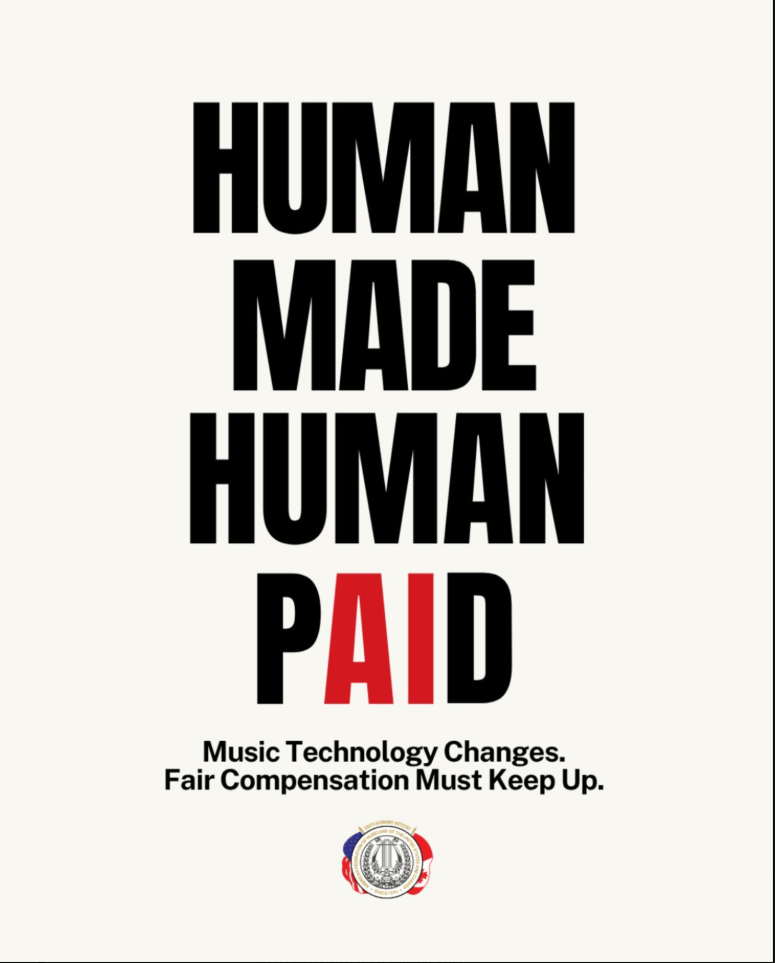
That position strongly resonates with the American Federation of Musicians’ Human Made, Human Paid campaign, organized around three principles: consent, credit, and compensation. “I’m so confused” isn’t an answer in response to the technology. As Mr. Nolan says in his interview: “[Studios] sort of want to portray it as this Frankenstein’s monster that can get out of control and can change the world without them having any accountability for it. We have to strongly resist that.”
Launched in October 2026 in connection with negotiations over the AFM’s Sound Recording Labor Agreement (SRLA), Human Made, Human Paid calls on the major record labels to recognize and compensate the musicians whose recorded performances are being licensed for AI. As the AFM has publicly explained, its demands are straightforward: consent, meaning the right to approve or refuse AI training on musicians’ work; credit, meaning transparent recognition of their performances; and compensation, meaning a direct share of revenue when catalog recordings generate value through AI licensing. AFM President Tino Gagliardi has emphasized that labels cannot vigorously protect their master copyrights while disregarding the musicians who made those recordings. The union has also challenged the labels’ failure to pay contractual new-use compensation arising from AI licensing. These positions are set out in the AFM’s October 20 campaign announcement and its November 1 SRLA bargaining update.
Both unions are confronting a fundamental imbalance in the creative economy. The companies that own or control copyrighted works are negotiating with AI developers, while the human beings whose performances and creative contributions made those works valuable may have limited control over what happens next.
But the musicians’ argument goes one important step further.
Copyright Is Not Personhood
Nolan’s argument is principally about copyright ownership and accountability. Studios own films, but directors have a substantial interest in ensuring that those copyrights are protected and properly exploited. The AFM can make much the same argument about sound recordings. Record companies may own the masters, but the musicians who performed on those recordings have a legitimate interest in how their work is exploited and whether they share in the resulting economic value.
There is, however, another category of rights that cannot simply be folded into copyright ownership: the rights of the human person, or what are called personhood rights (h/t Professor Mary Jane Radin and her Stanford Law Review article 34 Stan. L. Rev. 957 (1982)). A record company may own a sound recording of Jay Graydon or Skunk Baxter playing guitar. That ownership does not, by itself, give the company ownership of their names, identities, or legally protected attributes of persona. Those are different rights with different legal foundations.
Copyright is a creature of federal positive law. Rights of publicity and related protections for name, image, likeness, voice, and identity arise from separate bodies of state law concerned with the individual, including state statutory and common-law protections. But the distinction between owning a recording and owning the musician’s identity remains fundamental.
A copyright owner that grants an AI license knowing the licensee will operationalize the creator’s name cannot credibly treat that use as incidental to licensing the work. That knowledge exposes the licensor on several fronts: breach of its warranties to the licensee for granting rights it does not hold, breach of its contract with the talent (including the implied covenant of good faith and any applicable guild-agreement terms), and potentially other claims.
A license to exploit a master recording is not automatically a license to exploit the person who performed on it in AI.
That distinction becomes increasingly important when generative AI systems accept a creator’s name as a prompt and produce music associated with that musician’s recognizable characteristics. The issue is not confined to whether an output copies a protected sound recording. It also concerns the independent use of a human identity to offer a commercial product.
What About Directors?
The personhood question is hardly limited to musicians. Consider a user asking an AI system to “make it look like a Christopher Nolan movie.” The system may associate Nolan’s name with particular visual characteristics, editing techniques, narrative structures, or other features associated with his films.
Whether that conduct violates any legally protected aspect of Nolan’s identity is a separate question. Nevertheless, the example illustrates how a person’s name can become an operational instruction to a generative AI system. There may be practical differences between musicians and film directors in establishing such claims.
A recognizable singer’s voice or a guitarist’s distinctive performance may be more readily associated with a particular individual than the visual and narrative characteristics of a feature film involving hundreds of creative contributors. A director’s creative identity may be more thoroughly integrated into the collaborative work. That does not diminish directors’ interests. It simply illustrates why the legal analysis must extend beyond copyright ownership and examine the particular identity-related use.
There is also a work-for-hire distinction. Section 101 of the Copyright Act expressly permits qualifying specially commissioned contributions to audiovisual works to be works made for hire, subject to statutory requirements, including a written agreement. Sound recordings are not separately enumerated in that provision. Both categories may nevertheless qualify under the independent employee-within-the-scope-of-employment prong.
But—neither form of work-for-hire ownership automatically transfers every independent personhood right of the contributing creator.
Accountability Cannot Stop at the Copyright Office
Mr. Nolan also challenges the suggestion that artificial intelligence is somehow too complex for ordinary rules of responsibility. As he said “AI is too big a catchall term. It’s describing too many things and it’s being used by companies to absolve themselves of responsibility,” on the Hollywood Insiders podcast. Amen, brother.
That is a crucially important point. AI is not a safe harbor despite the efforts of White House AI Czar David Sacks to make it one. Companies remain responsible for the activities they undertake, the rights they acquire, and the rights they may infringe.
Christopher Nolan also discussed the inclusion of language in the credits of The Odyssey warning against using the film for AI training. Its significance is unmistakable: the copyright owner is asserting control over how the work may be used. The same principle ought to inform the treatment of human contributors.
It is entirely possible to protect a studio’s or record company’s copyright while overlooking the independent interests of the directors, actors, musicians, and other artists whose contributions are embodied in the work.
That’s why the AFM’s Human Made, Human Paid campaign is about more than dividing up licensing revenue. Its demands for consent, credit, and compensation recognize that human creators have interests that are not exhausted by the ownership of copyright.
And it is why the protection of personhood deserves a central place in the AI debate rather than being treated as an afterthought.
A Common Cause for Creative Guilds
Christopher Nolan’s comments also suggest an opportunity for common ground among the creative guilds. The DGA, AFM, SAG-AFTRA, and other organizations represent people whose professional contributions are routinely incorporated into copyrights owned or controlled by someone else. Their contractual relationships and legal rights differ, but they share an interest in ensuring that AI commercialization does not erase the people who supplied the underlying creativity.
There is no reason to assume that every guild will approach these questions identically. Copyright, contractual participation, employment protections, and rights of publicity may lead to different legal strategies. But a shared principle is emerging: ownership of copyright in the finished creative work should not be confused with ownership of the human creator.
Nolan’s call for studios to protect their copyrights reinforces the AFM’s insistence that the economic benefits of AI licensing should not bypass the musicians whose performances made those copyrights valuable. The additional importance of personhood is that it gives the discussion a foundation independent of the copyright transaction itself. A studio can own the film. A record company can own the master. Neither proposition, standing alone, answers what happens to the human identity of the director, actor, singer, or musician.
Human Made, Human Paid is ultimately about both propositions: protecting the value of human creativity and protecting the human beings who create it.
Christopher Nolan’s intervention is a welcome reminder that both questions belong at the center of the emerging AI economy.

