2010 A Brief History Of Spotify, “How Much Do Artists Make?” @SXSW #SXSW (Shill By Shill West)

SXSW Rewind… Back in 2010 during Daniel Ek’s Keynote Speech an audience member who identified themselves as an  independent musician asked how much activity it would take on Spotify to earn just one US Dollar. The 27 year old wunderkind and CEO of the company was stumped for an answer… Five years later we have a pretty good idea why.

2010… #SXSW Rewind…


Live Blog: Spotify CEO Daniel Ek Says Music Service Now Has 320,000 Paid Subscribers | TechCrunch

Q: How many plays equals one dollar?
A: Depends on the type on contract with the publisher/record labels. We share the rev we bring in. You can’t really equate to ‘per play’ we look at all our ad rev. Creates a bucket. For instance how do you account for a purchase of a song. There is no easy answer to your question. Over time our ad revs are growing, number of downloads growing. Amount of rev we bring in is growing.


Will Spotify Be Fair to Artists? | Technology Review

I couldn’t help noticing, however, Ek’s artful dodge to the question of how artists are paid by his service. The subject was broached by an audience member, who identified himself as an independent musician and thanked Ek profusely for the great application. He wanted to know how much he would be paid.

“It’s complicated,” was, in essence, Ek’s reply. But he did reveal that it’s a revenue sharing model; artists get paid a proportion of whatever Spotify gets paid, presumably based on the number of plays on the site they receive.

Ek’s reply was disappointing because this is the million dollar question for many music sites.


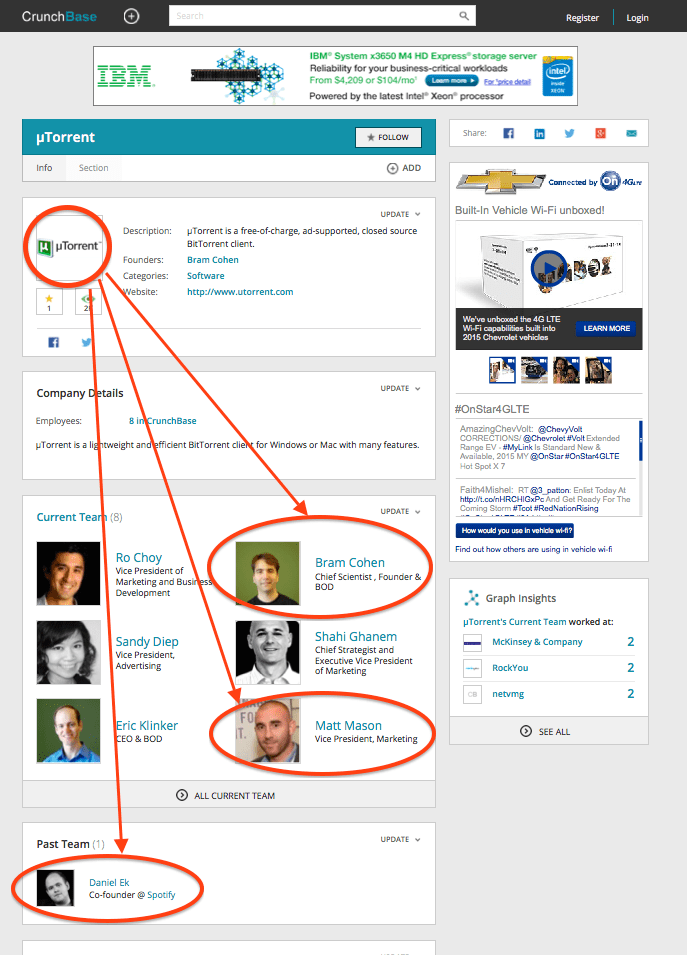
Dodgy from the start. What do you expect from one of the co-founders of U-Torrent… Economics only a pirate could understand?


A Tale of Two Pirates? Daniel Ek (uTorrent) and Kim Dotcom (Megaupload)


USA Spotify Streaming Rates Reveal 58% of Streams Are Free, Pays Only 16% Of Revenue


How to Fix Music Streaming in One Word, “Windows”… two more “Pay Gates”…

YouTube’s Content ID : $375.00 Per Million Views… aka “Block In All Countries”…

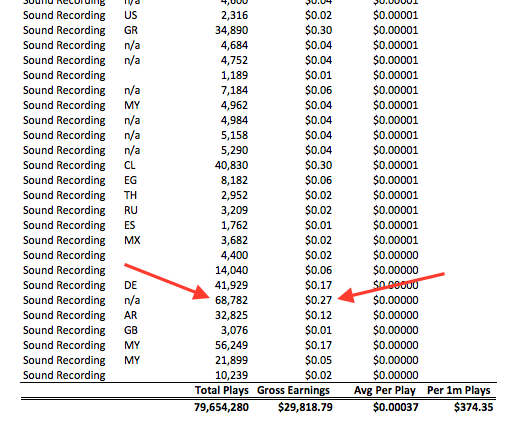
We’ve been supplied nearly a year’s worth of Content ID data from a mid-sized indie label. Over the course of about a year here’s what the data shows:
Content ID

After nearly a year and 80 million plays, the net average per play amounts to less than $375.00 per MILLION Plays on YouTube. Ok, that’s just for the sound recording, there are two other parts to the uploaded copyright, the musical composition and the video content itself. Assuming each of the three parts earns an equal share (why would they not, but how would we know given YouTube’s usual secrecy sauce?), then the full amount payable by YouTube for 1 Million plays via Content ID would be $1,125, or $.001125 per play (on average).

We know that on directly uploaded videos where the creator or rights holder is claiming all three copyrights they are being paid more than $1,125 per million plays on average. So why is the revenue reduced when claimed on Content ID?

The other interesting thing about this data is that there is ZERO consistency on what one play is worth. For example, in what world, and under what circumstances is nearly 70,000 plays worth less than $.30? We’ve heard that the major labels may have a per play floor (or indirectly get the equivalent in off the books “breakage”), but after reviewing this data even that is hard to believe.

The lack of openess, transparency and consistency makes it virtually impossible to determine what the true value of a play is within a single category like a Sound Recording let alone comparing the comparable rates paid for Song Writing and the Video itself. Oh yeah, and there’s no audit clauses either – how convenient.

It is still shocking and amazing to us that after a decade YouTube is still not profitable and is being subsidized by Google’s monopoly money from search and data scraping, and yet digital music executives have been trying to sell us on this as the future of revenue for musicians. How is it that after a decade YouTube can not make a profit? If this is the new financial standard for record labels we can see that it’s starting to work! Is this the genius business model labels are embracing? No profit for a decade? If this is the new standard then we suppose everything is fine…

YouTube’s Content ID presents the same problems and challenges of virtually every other ad-supported streaming platform – it’s just math, and it doesn’t work.

There is an even darker side to YouTube that is exposed in Content ID. Even though the video pictured below was eventually removed from YouTube (via a manual DMCA claim) it illustrates the core problem of YouTube in general.

Here’s the music of Jack White being used to sell Sex Tourism and perhaps even Human Trafficking and Sex Slavery.

Note the Ads by Google with the fine print asking YouTube users to “chat now” or “send gift” for asian girls in Thailand and China as well as filipinocupid.com.

Artists have no consent over where their music is being used, or for what their music is impliedly endorsing or selling. It’s not a big leap from the above to political uses where an artist’s song can be exploited to endorse political candidates, ideologies and issues to which the artist is philosophically opposed.  Like human trafficking.

We have a hard time believing artists would lend their consent to these types of videos (if they knew at all), but then again, you never know when dangling that carrot of thirty cents of revenue in front of them…

So in a world where Spotify is paying about $5,000 per million plays on sound recordings, YouTube by comparison is paying less than $375 for the same million plays. So let’s add this up.

On YouTube artists have no consent and are granted no licenses for the (infringing) distribution for the majority of their work and they’re paid less than 1/10th of what Spotify pays for the same sound recording. Wow, just wow. Ya’ll doing the math on this?

If you thought that Spotify was problematic as an ad-supported streaming platform one has to wonder what could possibly be attractive about YouTube… Oh, you don’t have a choice. You do what YouTube and Google tell you to do as we saw with Google’s “notice and shakedown” practices with Zoë Keating and indie labels. The great decade long experiments of ad-supported streaming are a disaster for artists and rights holders while cannibalizing transactional revenues that once sustained the industry.  Not to mention Google taking down an eye popping 180 million infringing videos from YouTube.

Although streaming is no doubt the future of distrbution, the mismanagement of this transition may well be the worst planned in the history of the industry.

Our advice to artists, particularly artists who own their recordings, is it’s time to take a pass on that $375 per million views and toggle your Content ID setting to “Block In All Countries.” How about adding a little scarcity and reality back into the economics of online music distribution? If YouTube wants to monetize your work maybe they can come up with a fair license.

It’s just math. Just say no…
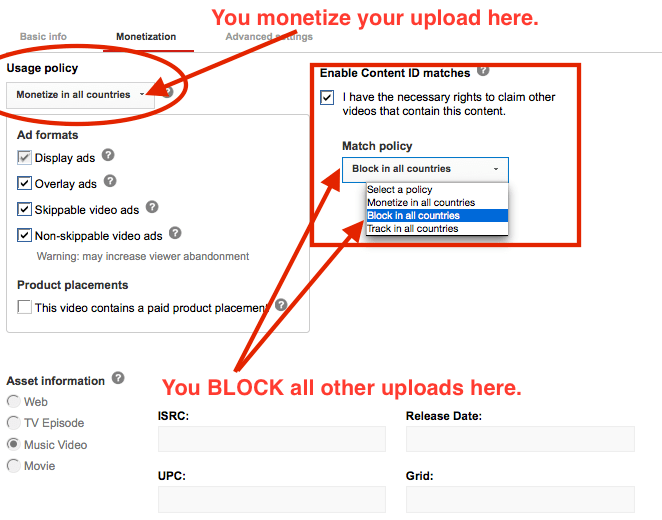
Block_In_All_Countries

OK, let’s review, you can enable Content ID and make $375 per 1 million views, or you can Block In All Countries. The choice seems pretty obvious, doesn’t it? It’s pretty stunning when Spotify start to look like the good guys.



It’s Just Math : Digital Music Execs Exit, But will the Pivot to Paid Subs Be Enough To Save The Record Biz?

Back in October of 2014 we asked the question “Who will be the First Fired Label Execs over Spotify Fiasco & Cannibalization?“. Now we know. In one week, two senior major label digital music execs have resigned. First Rob Wells on Monday, and on Friday David Ring followed.

Screen Shot 2015-02-24 at 12.18.56 AM

We don’t know if these resignations are related to the realization that Spotify actually is cannibalizing transactional revenues, or that YouTube Music Key will do more and worse, but the timing is suspect given recent statements by label chief Lucian Grange.

“We want to accelerate paid subscriptions… Ad-funded on-demand is not going to sustain the entire ecosystem of the creators as well as the investors” – Lucian Grange

Spotify has been a disaster from bad artist relations to the catalyst for declining transactional revenues. We celebrate the move for more aggressive positioning to paid subscriptions, but even at current rates of $9.99 a month it’s hard to see subs gain the marketshare and revenue needed to compensate for the rapidly declining transactional revenues. In 2014 Itunes revenues dropped by double digits with Apple reporting a decrease of 13%-14% year to year. This following a decrease in overall digital revenues in 2013 (the first decrease ever in digital format sales since their inception).

So that’s two consecutive years of reduced revenue in what should be a growing market segment. So what went wrong? In a word, Spotify. Two more, YouTube.

In other words, Free Doesn’t Pay…

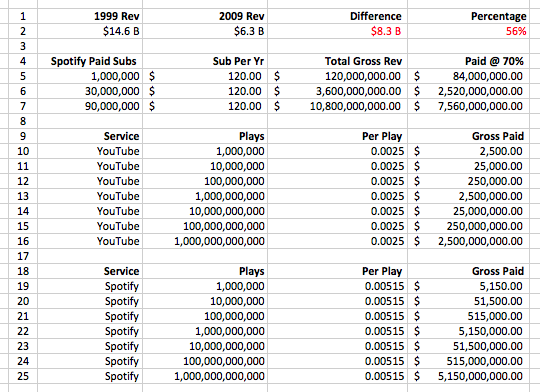
We’ve said it before and we’ll say it again, it’s just math. Below is a table we first published two years ago in February of 2013 when we asked the question, “Music Streaming Math, Can It All Add Up?”.

streamingmath

Although the aggressive move to paid subscriptions is a very positive one, we’re still concerned when looking at the numbers in the tables above when put in the context of the current state of the mature subscription based businesses (see below).

Netflix only has 36m subscribers in the US, no free tier, and massive limitations on available titles of both catalog and new releases. Sirius XM, 26.3m in the US as a non-interactive curated service installed in homes, cars and accessible online. Premium Cable has 56m subscribers in the US paying much more than $10 a month and also with many limitations. Spotify… 3m paid subscribers in the US after four years. Tell us again about this strategy of “waiting for scale.” Three Million Paid… Three…

* 3m Spotify Subs Screen Shot
* 26.3m Sirius XM Subs Screen Shot
* 36m Netflix Subs Screen Shot
* 56m Premium Cable Subs Screen Shot
* $7b Music Business Screen Shot

Of course none of this is to say that streaming can’t work. It can. It’s that Spotify (and YouTube) are just really bad music business models that have unsustainable economics and exploit artists because they are financial instruments and not a music companies.

Let’s be clear about this. We do believe that streaming is the future of music delivery and distribution, but thus far the transition has been horribly mismanaged. What is needed is clear leadership to define the models and value propositions that work for all stakeholders. We’ve made some suggestions in our common sense post “Streaming Is the Future, Spotify Is Not. Let’s talk Solutions.

We’re open minded about new business models, but before people get ahead of themselves with wild claims about a $100 Billion Record Business based on magic unicorn math we need to get back to earth, and get out the calculators.

It’s just math.


Out there waiting

Music Technology Policy

When the years have done irreparable harm
I can see us walking slowly arm in arm
Just like that couple on the corner do
Girl, I will always be in love with you

When I look in your eyes
I’ll still see that spark
Until the shadows fall
Until the room grows dark

Then when I leave this Earth
I’ll be with the angels standin’
I’ll be out there waitin’ for my true companion

From True Companion by Marc Cohn

I have always believed there is no human loss greater than the loss of a spouse.  Parents, of course, will immediately disagree, but that’s OK.  When you have struggled through tough times together and prevailed, every close call reminds you of how indescribably dear your spouse is.

It’s also a reminder of the inevitability of having to take on life alone for one of you because one of these days…

View original post 86 more words

An Interview with Andrew Shaw of PRS for Music on Negotiating with Google, a guest post by Jonathan David Neal

Essential reading for artists from Music Tech Policy.

Music Technology Policy

[Editor Charlie sez: BASCA came out in support of indie labels being bullied by YouTube as well as YouTube’s own bullying of songwriters by demanding a deal with PRS for Music that is soooo secret the PRS can’t even tell its own members what the terms are! This is absurd and BASCA is to be commended for PRS to refuse to continue its culture of secrecy–in the age of “transparency”. 

This post is by Jonathan David Neal and originally appeared in The Score, the membership publication of the Society of Composers and Lyricists.  You can read his blog at Composer’s POV. PRS for Music is the principal music licensing body for performances of music in the United Kingdom and is roughly the equivalent of ASCAP, BMI and SESAC for UK residents.  Although this interview is from 2009, it gives you some insight into Google’s over the top negotiation tactics and how…

View original post 3,664 more words

The Revolution Shall be Monetized: Zoë Keating Confirms YouTube Learned Nothing From Indie Labels

Artists who do not stand up to defend their rights, will lose their rights. Please support Zoë Keating by distributing the links to these reports and posts.

Music Technology Policy

…there was lunch in the larger, first floor cafeteria where, in the corner, on a small stage there was a man, playing a guitar, who looked like an aging singer-songwriter Mae’s parents listened to.

“Is that….?”

“It is,” Annie said, not breaking her stride.  “There’s someone every day.   Musicians, comedians, writers….We book them a year ahead.  We have to fight them off.”

The singer-songwriter was signing passionately…but the vast majority of the cafeteria was paying little to no attention.

“I can’t imagine the budget for that, ” Mae said.

“Oh god, we don’t pay them.”

The Circle, by Dave Eggers

Once again, Zoë Keating provides a leading voice for artists rights and leads by personal example.  In her compelling viral blog post, “What Should I Do About YouTube,” Zoë describes a recent encounter with the demands of YouTube the definitive “new boss” monopoly video service owned by Google.

She…

View original post 669 more words

* MUST READ * YouTube’s Heartbreaking Extortion Of Musicians Begins… | Zoë Keating Explains New Rules

Below is the opener, after that – it gets worse…

“My Google Youtube rep contacted me the other day. They were nice and took time to explain everything clearly to me, but the message was firm: I have to decide. I need to sign on to the new Youtube music services agreement or I will have my Youtube channel blocked.
This new music service agreement covers my Content ID account and it includes mandatory participation in Youtube’s new subscription streaming service, called Music Key, along with all that participation entails. Here are some of the terms I have problems with:

1) All of my catalog must be included in both the free and premium music service. Even if I don’t deliver all my music, because I’m a music partner, anything that a 3rd party uploads with my info in the description will be automatically included in the music service too.

2) All songs will be set to “montetize”, meaning there will be ads on them.

3) I will be required to release new music on Youtube at the same time I release it anywhere else. So no more releasing to my core fans first on Bandcamp and then on iTunes.

4) All my catalog must be uploaded at high resolution, according to Google’s standard which is currently 320 kbps.

5) The contract lasts for 5 years.”

Seriously the whole post is an absolute must read, in full, probably at least two or three times to have it all sink in.

READ THE FULL POST ON ZOE KEATING’S BLOG:
http://zoekeating.tumblr.com/post/108898194009/what-should-i-do-about-youtube

A Guide to Music Performance Royalties, Part 1

A nice primer for musicians and songwriters from Music Tech Policy.

Music Technology Policy

Let’s start at the beginning.  Broadly speaking, each recording of a song contains two copyrights: the copyright in the “musical work” or what is commonly called the “song” and the copyright in the recording of the song, commonly called the “track” or the “master”.

90% of all mistakes made by anyone in discussions of the online music business (and really the music business in general) starts right there. If you made this mistake, don’t feel self-conscious.  You are not alone, believe me.  Sometimes shockingly not alone.

Ownership and the Inception of CreationA song is not a recording and a recording is not a song. Each can be, and usually is, created by different people.  Songs are created by a “songwriter” (usually teams of songwriters coming together to write a single songs or many songs).  Recordings are created by “artists,” usually teams of artists known as a group or…

View original post 479 more words

Wondering Sound: “David Lowery Has Become Most Important Spokesperson for Artists Rights In Digital Era”

‘In the last three years, David Lowery has become perhaps most the important and ardent spokesperson for artist rights in the digital era. Who is he?’

Balanced, funny and in depth profile of fellow Trichordist writer David Lowery.  Must read.

READ THE FULL STORY AT WONDERING SOUND:
http://www.wonderingsound.com/feature/david-lowery-digital-music-cracker-interview/

Courtesy of the Pirate Party: Lessig tells "Hollywood" to "get over it" and accept unauthorized downloading–will Kagan distance herself?

This is Larry Lessig and what he thinks of hard working creative professionals trying to make a living in the arts, “Get Over It”…

Music Technology Policy

News from the Goolag:

I’m sure that President Obama’s Supreme Court nominee Elena Kagan is very smart, very well qualified and is going to get confirmed. However, I distinctly remember being told that the Obama campaign gave assurances to many in the copyright community that as President, then-Senator Obama would not choose a radical approach to copyright. It is my understanding that Lessig’s self-professed influence with Barack Obama was a topic that was specifically discussed and was rejected by the campaign.

Now it is a free country and no one can stop anyone else from saying something nice about them. But when the person who is saying something nice is in the radical fringe it might be a good idea to make clear exactly what your association with them is and whether you support their views. Particularly when your endorser describes himself as a “copyfighter”.

Lawrence Lessig is one of…

View original post 912 more words