A Response to Steve Albini About The Internet and Musicians by UNSOUND Film Director

The Trichordist

By Count Eldridge

My rebuttal to Steve Albini’s bullet point post. Steve Albini’s poorly reasoned piece was posted, so I feel obligated to try to correct some of the glaring misinformation. I’ve spent the past 2 years working on a documentary called Unsound that addresses the issues that Steve brings up in his post.

You can read the original story here:
http://www.stereogum.com/1678835/steve-albini-thinks-the-internet-solved-the-problem-with-music/news/

On free global music sharing: “The single best thing that has happened in my lifetime in music, after punk rock, is being able to share music, globally for free. That’s such an incredible development.”

It is only an incredible development if you give CONSENT to share that music. Steve seems to have missed the most important aspect of ‘sharing’. Its not sharing without consent.

On consumer choice: “Record labels, which used to have complete control, are essentially irrelevant. The process of a band exposing itself to the world…

View original post 1,328 more words

Grooveshark “Offline by Christmas”… | Digital Music News

Infringement should not be a business model.

On September 29th, the United States District Court in Manhattan found Grooveshark guilty of massive copyright infringement, and specifically named CEO Sam Tarantino and CTO Josh Greenberg as bad actors. Now, the curtains are starting to drop: just days after that decision was rendered, federal judge Thomas Griesa issued another decision that removed all doubt that the plaintiffs — a total of 9 recording labels — had triumphed in the case.

READ THE FULL POST AT DIGITAL MUSIC NEWS:
http://www.digitalmusicnews.com/permalink/2014/11/21/grooveshark-offline-christmas

Is Irving Azoff sending a signal to all digital services and is Pandora receiving 5×5?

Here we go…

Music Technology Policy

Is Irving sending a signal to all digital services?  Oh, I just betcha he is.

There’s actually a pretty simple answer to the very public demand letter to YouTube from Irving’s Global Music Rights.  If Irving’s GMR has the public performance rights to these high profile songwriters it’s probably because the writers transferred their songs to GMR from wherever they were.  The songs had to start somewhere.

If those songs transferred out of the ASCAP, BMI and SESAC environment, then it’s likely that none of them are subject to blanket licenses granted by those societies.  That also means that those songs aren’t part of the US government’s iron fisted control over songwriters, either.  Which means that unlike at least ASCAP and BMI, GMR is under no obligation to license anything to anybody.

That means that it’s possible that anyone who had a blanket license with the societies now has to…

View original post 204 more words

Timing is Everything: Sirius May be Barred from Appealing California Loss to Turtles #irespectmusic

The Sirius legal smackdown means things don’t look so good for Pandora…

Music Technology Policy

Rut ro.  For those of you following along, remember that Flo & Eddie won a tremendous victory against SiriusXM on a motion for summary judgement in federal court before U.S. District Judge Philip Gutierrez in California in a putative class action on behalf of all pre-72 recordings.

Sirius appealed the Turtles case.

Also recall that the major labels filed a separate case in California state court before California Superior Court Judge Mary H. Strobel.  The labels essentially won that case when California Judge Strobel followed similar reasoning to federal Judge Gutierrez .  However, the California judge handed down her opinion after Sirius filed its appeal in the federal case applying California law.

So because Sirius lost both cases, the Turtles may be able to stop the Sirius appeal in the band’s federal court case if they can rely on the decision in the major label State court case.

Two parallel cases in…

View original post 711 more words

Absolute Must Read : How To Make Streaming Royalties Fair(er) | Medium

The record industry has completely disconnected the relationship between artists and their fans whereby the artists catalog is now an aggregated asset to leverage (the label’s) equity in a tech start up that is subsidized by musicians. Not cool.

This is an excellent piece by Sharky Laguna that looks at how all models utilizing divisible revenue pools are fundamentally unfair to the relationship between the artist and the fan. In short, the plays by each consumer should be compensating ONLY the artists that, that person plays (makes sense, right?). Further more 100% of the consumers subscription fee should only pay the artists that individual listens too – no matter how few or how many plays the consumer gives each artist.

Under this proposed revised accounting method, each consumer is once again reconnected directly to the artists they chose to support. This is exactly the kind of thinking that should be happening at the labels and music tech companies.

In a nutshell: Royalties should be paid based on subscriber share, not overall play share.

If I pay $10 and during that month I listen exclusively to Butchers Of The Final Frontier, then that band should get 100% of the royalties. I didn’t listen to anyone else, so no one else should get a share of the $7 that will be paid out as royalties from my subscription fee.

Please read the full post at MEDIUM:
https://medium.com/@sharkyl/how-to-make-streaming-royalties-fair-er-8b38cd862f66

USA Spotify Streaming Rates Reveal 58% of Streams Are Free, Pays Only 16% Of Revenue

Since we published the Streaming Price Bible we’ve been getting data submissions to crunch the numbers. According to one set of data it appears Spotify is reporting seven different streaming rates (in a single month). But the most interesting discovery in the data is the percentage of free streaming volume and revenue versus paid streaming volume and revenue.

We knew there were two price tiers (Free & Paid) but we didn’t anticipate discovering the other five tiers, even as limited as they are.

StreamingRatesandPercentagesUSA


As we had suspected, the majority of consumption is generating the least amount of revenue.

Oh, and for those of you keeping score at home the net summed per stream rate, for all streams divided by all revenue is .00352 in the aggregate. That’s .00169 per stream LESS than reported earlier this year in the Streaming Price Bible of .00521. Just another indication that as streaming models mature the price per stream will continue to drop. Add to this that even Spotify executives have admitted as much.


FreePaidChart

If you have data that looks different than ours, send it our way and let us crunch it. This is the problem when there is such a profound lack of openess and transparency. There also appears to be an overall lack of consistency. Let’s have some real “disruptive innovation” by “sharing” our Spotify statements and comparing the numbers.

[The per play rates noted above are aggregated. In all cases the total amount of revenue is divided by the total number of the streams per service  (ex: $5,210 / 1,000,000 = .00521 per stream). Multiple tiers and pricing structures are all summed together and divided to create an averaged, single rate per play.]

RELATED:

Apple Announces Itunes One Dollar Albums and Ten Cent Song Downloads In Time For The Holidays! | Sillycon Daily News


Who will be the First Fired Label Execs over Spotify Fiasco & Cannibalization?


Streaming Is the Future, Spotify Is Not. Let’s talk Solutions.


Spotify Per Stream Rates Drop as Service Adds More Users…

WE NOW HAVE THE PROOF. STREAMING RATES HAVE PEAKED.

As we noted yesterday The UN is airlifting calculators and behavioral economics textbooks to Hollywood and Silicon valley. So soon we hope some of the executives being paid to do the math on streaming will actually do the math on streaming.

In the meantime we crunched the numbers and it appears that Spotify rates per stream have peaked and are now dropping as they add more users.

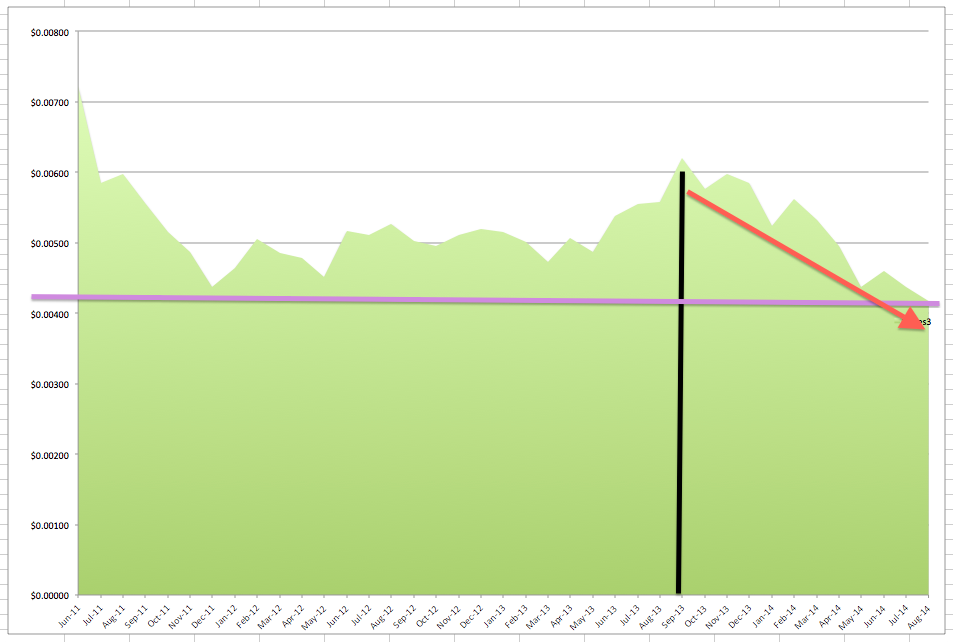
Per stream rates started to decline in Sept 2013 (black vertical line) and  continue to drop. Here’s the graph which runs from June 2011 – Aug 2014, from left to right.

SpotifyNetMONTHLY_Charted


Spotify rates per spin appear to have peaked and are now declining. 

Per stream rates are dropping because the amount of revenue is not keeping pace with the  number of streams. There are several possible causes:

1) Advertising rates are falling as more “supply” (the number of streams) come on line and the market saturates.

2) The proportion of  lower paying “free streams”  is growing faster than the proportion of higher paying “paid streams.”

3) All of the above.

This confirms our long held suspicion that as a flat price “freemium” subscription service  scales the price per stream will drop.  AND as the service reaches “scale” the pool of streaming revenue becomes a fixed amount.  The pie can’t get any larger and adding more streams only cuts the pie into smaller pieces!  Don’t expect it to be any different for the newly announced YouTube music service.

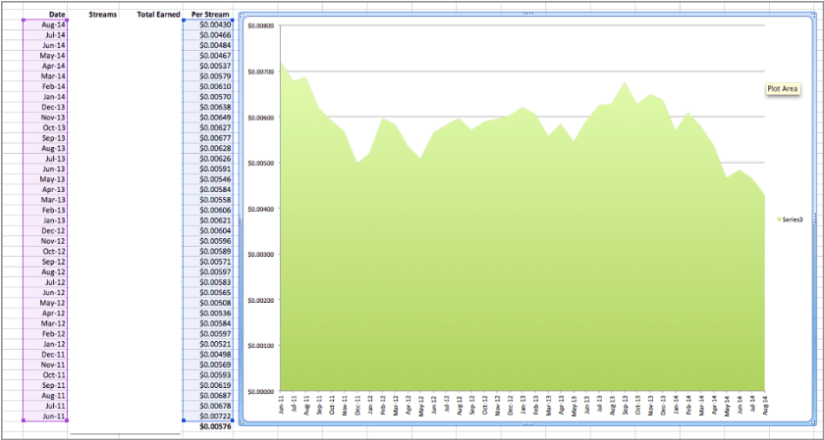
You can see this more clearly if you remove the US figures from the calculation and use only the more mature ROTW markets.  In this calculation the streaming rate decline is even more pronounced.  Yikes!

Screen Shot 2014-11-15 at 5.35.14 PM

If you exclude the US and look at the more “mature” ROTW Spotify markets the decline is even more pronounced. 

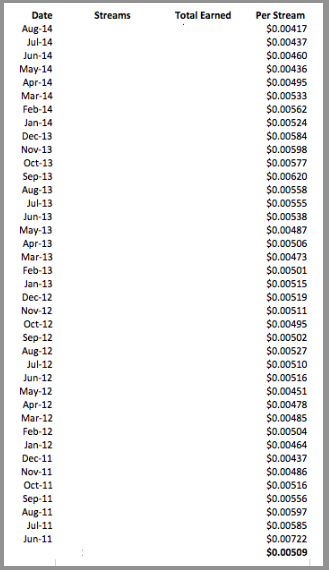
And the full data (for the first graph) is below…

SpotifyNetRateByMonth

The data above is aggregated. In all cases the total amount of revenue is divided by the total number of the streams per service  (ex: $5,210 / 1,000,000 = .00521 per stream). Multiple tiers and pricing structures are all summed together and divided to create an averaged, single rate per play.

Copyright Critics Don’t Quite Get Artists | The Illusion Of More

A must read from David Newhoff for all creators with many points, well made.

Further, if it is true that a copyright-free future could shrink the pool of producers to those already financially secure (as predicted above), this suggests that all of the non-remunerative benefits of copyright might be of even greater value to those authors still willing and able to produce. And in the absence of those rights, we could easily see a reduction not only in the number of producers, but also in the number of works produced by that elite few. In a practical example, imagine the trustafarian artist working in the most altruistic manner, producing wonderful works solely to be experienced; he doesn’t care about money, but he does have to accept that McDonald’s can use his work to sell hamburgers, which betrays everything he is expressing. It is not farfetched to imagine the artist in this example will withhold works from public view, even if he continues to produce for his own pleasure.

READ THE WHOLE POST AT:
http://illusionofmore.com/copyright-critics-dont-get-artists/

The Streaming Price Bible – Spotify, YouTube and What 1 Million Plays Means to You!

Several of our posts on streaming pay rates aggregated into one single source. Enjoy…

[UN to Airlift Calculators, Behavioral Economics Textbooks to Digital Music Industry]
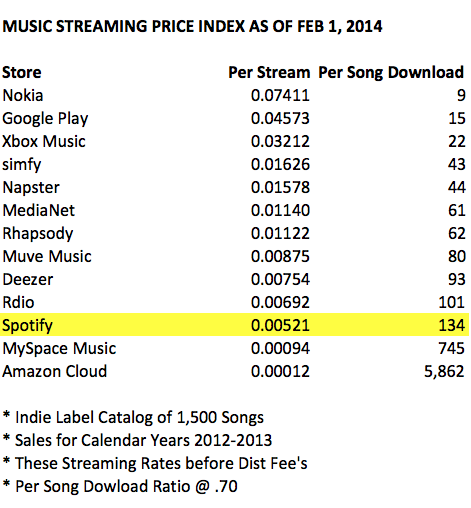
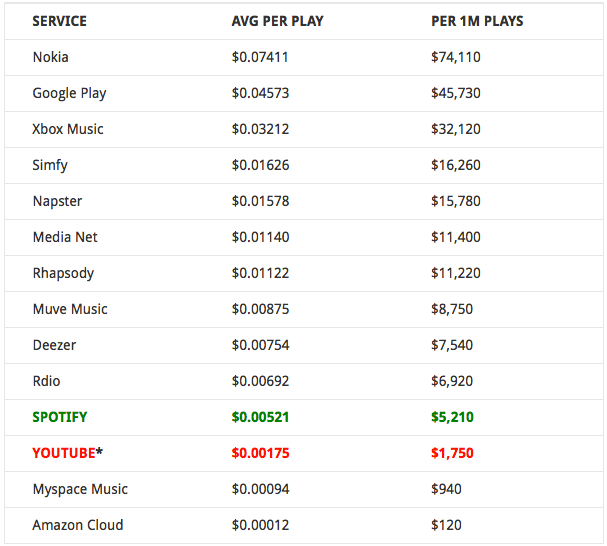
musicstreamingindex020114[EDITORS NOTE: All of the data above is aggregated. In all cases the total amount of revenue is divided by the total number of the streams per service  (ex: $5,210 / 1,000,000 = .00521 per stream). In cases where there are multiple tiers and pricing structures (like Spotify), these are all summed together and divided to create an averaged, single rate per play.]

If the services at the top of the list like Nokia, Google Play and Xbox Music can pay more per play, why can’t the services at the bottom of the list like Spotify and YouTube?

We’ll give you a hint, the less streams/plays there are the more each play pays. The more plays there are the less each stream/play pays. Tell us again about how these services will scale. Looking at this data it seems pretty clear that the larger the service get’s, the less artists are paid per stream.

So do you think streaming royalty rates are really going to increase as these services “scale”? No, we didn’t either.

[ BREAKING! Apple Announces Itunes One Dollar Albums and Ten Cent Song Downloads In Time For The Holidays! | Sillycon Daily News ]
 

StreamingPriceIndexwYOUTUBE

We’ve been waiting for someone to send us this kind of data. This info was provided anonymously by an indie label (we were provided screenshots but anonymized this info to a spreadsheet). Through the cooperative and collaborative efforts of artists such as Zoe Keating and The Cynical Musician we hope to build more data sets for musicians to compare real world numbers.

In our on going quest for openness and transparency on what artists are actually getting paid we’d love to hear from our readers if their numbers and experience are consistent with these numbers below. At the very least, these numbers should be the starting point of larger conversations for artists to share their information with each other.

Remember, no music = no business.

whatyoutubereallypaysFor whatever reason there appear to be a lot of unmonetized views in the aggregate. So let’s just focus on the plays earning 100% of the revenue pool in the blue set. These are videos where the uploader retains 100% of the rights in the video including the music, the publishing and the video content itself.

Plays  Earnings  Per Play
2,023,295 $3,611.84 $0.00179
1,140,384 $2,155.69 $0.00189
415,341 $624.54 $0.00150
240,499 $371.47 $0.00154
221,078 $313.47 $0.00142
TOTALS TOTALS AVERAGE
4,040,597 $7,077.01 $0.00175

So it appears that YouTube is currently paying $1,750 per million plays gross.

We understand that people reading this may report other numbers, and that’s the point. There is no openness or transparency from either Spotify or YouTube on what type of revenue artists can expect to earn and under what specific conditions. So until these services provide openness and transparency to musicians and creators, “sharing” this type of data is going to be the best we’re going to be able to do as East Bay Ray comments in his interview with NPR.

As we’re now in a world where you need you need a million of anything to be meaningful here’s a benchmark of where YouTube ranks against Spotify.

Service  Plays  Per Play  Total  Notes 
Spotify To Performers/Master Rights 1,000,000 0.00521 $5,210.00 Gross Payable to Master Rights Holder Only
Spotify To Songwrtiers / Publishers This revenue is for the same 1m Plays Above 0.000521 $521.00 Gross Payable to Songwriter/s & Publisher/s (estimated)
YouTube Artist Channel 1,000,000 0.00175 $1,750.00 Gross Payable for All Rights Video, Master & Publishing
YouTube CMS (Adiam / AdRev) ** 1,000,000 0.00032 $321.00 Gross Payable to Master Rights Holder Only

The bottom line here is if we want to see what advertising supported free streaming looks like at scale it’s YouTube. And if these are the numbers artists can hope to earn with a baseline in the millions of plays it speaks volumes to the unsustainability of these models for individual creators and musicians.

Meet the New Boss: YouTube’s Monopoly on Video | MTP

It’s also important to remember that the pie only grows with increased revenue which can only come from advertising revenue (free tier) and subscription fees (paid tier). But once the revenue pool has been set, monthly, than all of the streams are divided by that revenue pool for that month – so the more streams there are, the less each stream is worth.

All adrev, streaming and subscription services work on the same basic models as YouTube (adrev) and Spotify (adrev & subs). If these services are growing plays but not revenue, each play is worth less because the services are paying out a fixed percentage of revenue every month divided by the number of total plays. Adding more subscribers, also adds more plays which means that there is less paid per play as the service scales in size.

This is why building to scale, on the backs of musicians who support these services, is a stab in the back to those very same artists. The service retains it’s margin, while the artists margin is reduced.

[** these numbers from a data set of revenue collected on over 8 million streams via CMS for an artist/master rights holder]

Here’s what 1 million streams looks like from different revenue perspectives on the two largest and mainstream streaming services.

Service  Units Per Unit  Total  Notes 
Spotify 1,000,000 $0.00521 $5,210.00 Gross Payable to Master Rights Holder Only
Spotify same million units as above $0.00052 $521.00 Gross Payable to Songwriter/s & Publisher/s (est)
YouTube 1,000,000 $0.00175 $1,750.00 Gross Payable for All Rights Video, Master & Publishing
YouTube CMS Master Recording (Audiam / AdRev) 1,000,000 $0.00032 $321.00 Gross Payable to Master Rights Holder Only
STREAMING TOTALS  3,000,000 $7,802.00 TOTAL REVENUE EARNED FOR 3 MILLION PLAYS ON SPOTIFY AND YOUTUBE 
Itunes Album Downloads 1,125 $7.00000 $7,875.00 Gross payable including Publishing

Here are some compelling stats on the break down of what percentage of videos on YouTube actually achieve breaking the 1 million play threshold, only 0.33%

CHART OF THE DAY: Half Of YouTube Videos Get Fewer Than 500 Views | Business Insider

Some 53% of YouTube’s videos have fewer than 500 views, says TubeMogul. About 30% have less than 100 views. Meanwhile, just 0.33% have more than 1 million views.

That’s not a huge surprise. But it highlights some of the struggles Google could have selling ads around all those unpopular videos, despite the money it has to spend to store them.

An artist needs to generate THREE MILLION PLAYS on the two largest and most popular streaming platforms to equal just 1,125 album downloads from Itunes. This is an important metric to put in context. In 2013 only 4.8% of new album releases sold 2,000 units or more. So if only 4.8% of artists can sell 2,000 units or more, how many artists can realistically generate over four million streams from the same album of material?

in 2013 there were 66,565 new releases, only 3,237 sold more than 2,000 units = 4.8% of new releases sold over 2,000 units

in 2013 there were 915,482 total releases in print, only 14,856 sold more than 2,000 units = 1.6% of ALL RELEASES in print sold more than 2,000 units.

This is even more important when you start to consider that many artists feel that growing a fan base of just 10,000 fans is enough to sustain a professional career. Note we said solo artists because these economics probably need to be multiplied by each band member added for the revenue distribution to remain sustainable. So a band of four people probably need a sales base of 40,000 fans to sustain a professional career for each member of the band.

Each 10,000 albums sold on iTunes (or 100,000 song downloads) generates $70,000 in revenue for the solo artist or band. To achieve the same revenue per 10,000 fans in streams, the band has to generate 30 million streaming plays (as detailed above) if they are distributing their music across the most common streaming services including Spotify and YouTube.

In 2013 the top 1% of new releases (which happen to be those 620 titles selling 20k units or more) totaled over 77% of the new release market share leaving the remaining 99% of new releases to divide up the remaining 23% of sales.

This appears to confirm our suspicion that the internet has not created a new middle class of empowered, independent and DIY artists but sadly has sentenced them to be hobbyists and non-professionals.

Meanwhile the major artists with substantial label backing dominate greater market share as they are the few who can sustain the attrition of a marketplace where illegally free and consequence free access to music remains the primary source of consumption.

What’s worse is that it is Silicon Valley corporate interests and Fortune 500 companies that are exploiting artists and musicians worse than labels ever did. New boss, worse than the old boss, indeed.

So whose feeling empowered?

RELATED:

UN to Airlift Calculators, Behavioral Economics Textbooks to Digital Music Industry

Streaming Is the Future, Spotify Is Not. Let’s talk Solutions.

Who will be the First Fired Label Execs over Spotify Fiasco & Cannibalization?


#irespectmusic Blake Morgan on his CNN Interview and the Latest Spotify Debacle

#irespectmusic Blake Morgan on Spotify and Artists….

Music Technology Policy

MTP: I watched your CNN interview with Poppy Harlow and you made some significant points that don’t get picked up much.  Let’s start with the last one:  Spotify could be the next Myspace.  I think we all remember when Myspace was viewed as the Second Coming and then one year it just evaporated.  I was trying to remember the CEO’s name. What about Spotify reminds you of Myspace?
Blake Morgan: The false idea that Spotify is inevitable and gargantuan. In fact, if they don’t evolve, they may find themselves more like Goliath. And we all know what happened to Goliath, right? If you don’t, just ask MySpace. Streaming is not itself in question here, any more than MySpace’s failure called the idea of social media into question. It didn’t. Its failure was a reflection on MySpace, and its model. Same thing here. Streaming may or may not be a viable…

View original post 824 more words