SoundExchange’s CEO says it’s time radio starts paying all music creators fairly for their work.
On Monday, a group of radio broadcasters penned a letter in support of the National Association of Broadcasters’ (NAB) push for deregulation of the $14 billion radio industry. Their letter was based on the NAB’s petition to the FCC this past June, in which the NAB sought to allow expanded broadcaster ownership of radio stations (i.e., increased consolidation) throughout the country. The NAB’s justification: broadcasters must adjust their business model to the realities of the new streaming world.
As a representative of the many creative parties who help craft music, we are frequently on the opposite side of issues from the NAB. And while I can’t comment on NAB’s specific requests, I was delighted to find so much common ground in their FCC filing in June….
I agree with the NAB that the law should “finally adopt rules reflecting competitive reality in today’s audio marketplace” and should “level the playing field” for all entities in the music economy.
If radio truly wants to modernize, it can start by taking a giant leap into the 21st century and paying all music creators fairly for their work. Stop treating artists like 17th century indentured servants, just so radio can reap bigger profits. If radio wants to have rules that reflect the music industry of today, then that should apply across the board.
We should resolve this gaping unfairness to artists before we begin talking about allowing radio to consolidate even further.
EU Hackathon is right! Google’s sleazy EU lobbying firm at the center of the controversy over spam email, robo call, and twitter bot campaign against MEPs supporting articles 11 and 13 of copyright directive.
I am republishing this from the MusicTechPolicy blog as this is completely relevant to our coverage of information warfare style tactics used to overwhelm communications channels with MEPs on copyright directive. See here, here and here. Much of this activity came from groups associated with Google and appears to have been controlled and directed by Google’s lobbyist N-Square. This should be investigated as the use of these tactics will likely increase as Google now faces a steep antitrust fine from the EU.
by Chris Castle
As MTP noted in Fair Copyright Canada and 100,000 Voters Who Don’t Exist back in 2009, the legitimate desire by governments to use the Internet to engage with the governed is to be admired. But there have been incredible and probably illegal uses of the Internet to overwhelm elected officials with faux communications that reek of Google-style misinformation and central planning in the hive mind of the Googleplex.
We saw this again with the Article 13 vote in Europe last week with what clearly seems to be a Google-backed attack on the European Parliament for the purpose of policy intimidation. That’s right–an American-based multinational corporation is trying to intimidate the very same European government that is currently investigating them for anticompetitive behavior and is staring down a multi-billion dollar fine.
Vindictive much?
Advocacy against Google’s interests on artist rights and copyright issues (not to mention human trafficking, advertising illegal drugs and counterfeit goods) can no longer be just about making a good argument to policy makers. It has to anticipate that Google will pull these DDOS-type stunts capitalizing on what seems to be the element of surprise.
Except there shouldn’t be any surprise.
There is a real problem with policy-by-DDOS governing. For example, Cass Sunstein, then the Administrator of the Obama Office of Management and Budget, issued a memo in 2010 to the heads of executive branch departments and regulatory agencies which dealt with the use of social media and web-based interactive technologies.
Specifically, the Sunstein memo warned that “[b]ecause, in general, the results of online rankings, ratings, and tagging (e.g., number of votes or top rank) are not statistically generalizable, they should not be used as the basis for policy or planning.” Sunstein called for exercising caution with public consultations:
To engage the public, Federal agencies are expanding their use of social media and web- based interactive technologies. For example, agencies are increasingly using web-based technologies, such as blogs, wikis, and social networks, as a means of “publishing” solicitations for public comment and for conducting virtual public meetings.
The European Parliament would do well to take a page from Sunstein’s thinking and limit the amount of anonymous contact that anyone can have with MEPs when the European Parliament is suffering a DDOS-style attack.
But the most important thing for the European Commission to take into account is that a company that is the target of multiple investigations is using the very market place monopoly that caused the competition investigations to intimidate the European government into bending to its will on Article 13. (That, of course, is the biggest difference between the Europeans and Article 13 and the Americans and SOPA–the US government had dropped the US antitrust investigation into Google and it had unparalleled access to the White House. So the two are really nothing alike at all.)
The European Commission needs to launch a full-blown criminal investigation into exactly what happened on Article 13, particularly since there is another vote on the same subject coming in September. Properly authorized law enforcement acting swiftly can set sufficient digital snares to track the next attack which surely is coming while they forensically try to figure out what happened.
Advocates need to understand that Google is a deadly force and this is the endless war. Good arguments are clearly not enough anymore, particularly as long as the government and law enforcement do nothing to protect democratic values from bully boy tactics.
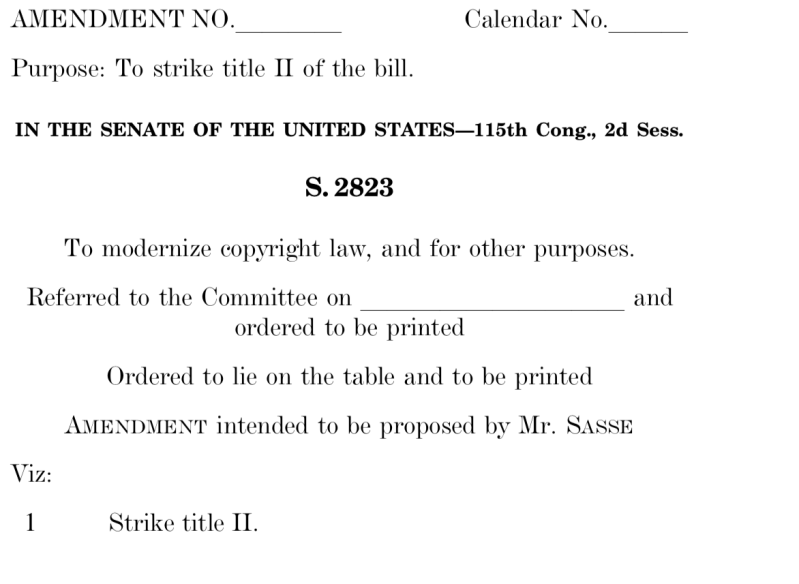
In case you were scratching your head about why Nebraska Senator Ben Sasse decided to stick his beak into trying to continue discrimination against recording artists who had the misfortune to record before 1972–here’s a possible explanation. Maybe he was just getting his beak wet?
Remember, Senator Sasse introduced an amendment to the Music Modernization Act in the dead of night the day before the markup of MMA in the Senate Judiciary Committee. While Senator Ron Wyden–another data center beneficiary of Amazon, Facebook and Google–was at least trying to dress up his complicity in a Chanel suit and Louboutin shoes. Senator Sasse went the more direct route:
Now why might Senator Sasse be so interested, particularly given Nebraska’s musical history? It turns out that there is quite the competition between Nebraska and Iowa for Silicon Valley’s data center business, particularly given the renewable energy profile of each state (wind is 37% of Iowa’s electricity production and about 20% of Nebraska (including hydro). That checks the box for Silicon Valley.
Of course, as we see from Senator Sasse’s tone deaf foray into copyright lobbying, Silicon Valley thinks they can play the rubes in return for building data centers in their state, just like they did with Senator Ron Wyden and the people of Oregon. What does stiffing pre-72 artists have to do with data centers? Nothing. What does it have to do with playing footsie with royalty deadbeats like Google and Facebook?
Everything.
And rumor has it that there is a deal in the wings for a new Google data center in Nebraska. Which also explains a lot.
But somehow, Facebook knows that its Silicon Valleyness may not be that popular with the rubes.
According to the Data Center Dynamics site, Facebook has been going to great lengths to hide its involvement in massive data centers being built in Nebraska, which gives “Cornhusker Kickback” (or Facebook Fakeout) a whole new meaning:
Operating under the alias Raven Northbrook, Facebook has its eyes on Nebraska, DCD can exclusively reveal.
Late last year, local council officials granted approval for a large data center project in Sarpy County, Nebraska, but the company behind the huge facility was kept a secret.
Now, DCD can confirm that the corporation hoping to build four 610,000 square foot (56,670 sq m) data center halls at the Sarpy Power Park is Facebook.
Sarpy County documents reveal that the company, which is publicly represented by infrastructure engineering and design solutions company Olsson Associates, goes by the name Raven Northbrook.
So maybe the Sasse sledgehammer amendment to discriminate against pre-72 artists is easily explained–just another swamp dweller swamping up the cash.
This is, of course, the classic back stabbing we have come to expect from Public Knowledge, so is par for the course. What that means, of course, is that Google gets to screw the pre-72 artists andget their new reachback safe harbor that the songwriters and publishers gave up.
We need to move on this quickly. If you can call your Senator and ask them to oppose the Sasse amendment to the Music Modernization Act (bill number S. 2823), that would be great. You can look up your Senator’s information on Phone Congress at this link. Choose “Any Other Topic Not Listed Here” on the pull down “Topic” menu.
Who took on the Standard Oil men
And whipped their ass
Just like he promised he’d do?
Ain’t no Standard Oil men gonna run this state
Gonna be run by folks like me and you
Kingfish, written by Randy Newman
If you’re one of the small group that has actually read the Music Modernization Act, I think you’d have to come away with the idea that this is legislation by the big boys for the big boys. Nowhere is this unfortunate flaw more apparent than in the way that digital media companies “modernize” the way they treat themselves. No wonder Digital Media Association (Amazon, Apple, Google, Pandora, Spotify) and the Internet Association (Amazon, Facebook, Google, Pandora, Spotify) love it so much–it’s just the same old story from Standard Oil or United Fruit.
But is MMA really intended for the biggest corporations in commercial history playing footsie or should we believe the sales pitch that it is intended for the innovative startups and new entrants?
It is not surprising that startups were apparently excluded from the legislative process that created MMA and are themselves silent–or silenced–observers.Given that Google, Amazon, Apple and Spotify are on the other side, startups know which side butters their bread and what will happen if they voice any criticisms.Like the python in the chandelier, nothing really need be said; startups know what happens if they challenge the big boys, particularly Google and Amazon who probably host their companies, serve their advertising or drive traffic to them.
The MMA permits these massive and aggressive incumbents to ultimately decide how much startups pay for access to the blanket license that we are told by DiMA’s CEO will unleash innovation and “fuel the next wave of creativity“. Yet–if startups can’t afford to buy in to the license, it won’t do them much good, and as drafted the MMA allows their incumbent competitors to decide how much that buy-in will cost any startups or other of the much ballyhooed new entrants. This all before a startup has to pay royalties to the collective–and in addition to any royalties.
How can this be fair? It’s easy when your lobbyists write the rules.
The Congress delegates the government’s authority under the Music Modernization Act by creating two main bodies around the new government-mandated blanket license: The “mechanical licensing collective” which is to represent those with songs to be licensed and the “digital licensee coordinator” which is to represent music users wishing to license those songs under the new blanket mechanical license. Music users will answer to the “digital licensee coordinator,” presumably under some membership agreement yet to be drafted.
Both these bodies are supposedly approved by the Register of Copyrights (the head of the U.S. Copyright Office), but the Register has the unenviable position of being constrained to appoint certain types of entities or people by statutory criteria in the MMA.
One of those criteria is very majoritarian, if not downright oligopolistic–and I would suggest that for both the collective and the digital licensee coordinator the math alone limits the Register’s choice to one entity. Here’s the relevant language for how the Register selects the collective:
“[The Register must choose an entity that] is endorsed by and enjoys substantial support from copyright owners of musical works that together represent the greatest share of the licensor market for uses of such works in covered activities, as measured over the preceding 3 full calendar years;”
And here’s the mirror version of the relevant language for how the Register selects the “digital licensee coordinator” (or “DLC”):
“[The Register must choose an entity that] is endorsed by and enjoys substantial support from digital music providers and significant nonblanket licensees that together represent the greatest share of the licensee market for uses of musical works in covered activities, as measured over the preceding 3 full calendar years”
So one thing seems true for both the collective and the coordinator: They can only be entities enjoying “substantial support” by at least a plurality if not a majority of their respective markets on either side of the same coin. I’m not quite sure how that definition presents a choice to the Register–more like it allows the biggest players to dictate the Register’s choice. (How can there be two pluralities much less two or more?)
I would submit that this structure is a long-term recipe for disaster.
Others have and are writing about the conflict-ridden aspects of the collective, so I will focus here on the digital licensee coordinator which is equally, if not more, conflict-ridden than the collective.
By definition then, startups–who are potential music users most in need of the blanket license without having to pay minimum guarantees–are evidently excluded from any possibility of becoming the digital licensee coordinator. The Congress effectively prohibits the Register from appointing one of them as the DLC, even if they were brave enough to raise their hand (see Yelp in the EU antitrust ruling against Google).
And don’t forget a main selling point of the MMA: The music users (i.e., the “licensees”) pay an “administrative assessment” to cover the costs of running the mechanical licensing collective. (An inherent conflict?) The MMA authorizes the DLC to “equitably allocate the collective total costs across digital music providers…but shall include as a component a minimum fee for all digital music providers.” (Although note that the assessment as a whole and perhaps the allocation ultimately has to be approved by the Copyright Royalty Judges–and good luck to startups being able to afford to appeal to the CRJs or a higher court.)
Plus the MMA authorizes the DLC to “[e]ngage in efforts to enforce notice and payment obligations with respect to the administrative assessment….” AND the DLC also gets to set the “dues” payment for each “member.”
So if a startup wants the blanket licence, they have to pay a share of the assessment apparently determined by a representative of their biggest competitors PLUS a membership fee. And then they get to pay royalties to the collective. Note that this is a radical departure from the current law and adds another gatekeeper in between songwriters and their money.
If a startup fails to make all these payments, they can lose the blanket license even if they have paid all royalties on time. No one can tell you what the minimum fee will be or the startup’s share of the assessment. In fact, as new startups will likely enter the allocation for “membership” all the time, a real time percentage allocation for each “member” of the DLC will likely change pretty much constantly. Plus the collective can enforce the blanket license royalties and the DLC can enforce the assessment payments and membership “dues” (aka rents).
It’s also important to realize that there is an exponential difference between the group of companies that the Register takes instruction from on the MLC compared to the group instructing the Register for the DLC. Candidates for the DLC include Amazon, Apple, Google and Spotify–three of the biggest companies in commercial history plus the streaming platform that is easily the dominant actor in its relevant market both in the U.S. and many other countries. This basically assures that no startup will ever be included as the DLC absent a government-mandated rotation.
The Music Modernization Act is a great opportunity to do something positive for the market rather than continue to reenforce the most dominant incumbents in history (see 60 Minutes, “The Power of Google“). After all, it was their own carelessness and “permissionless innovation” that got us to this point.
Here’s some free advice to Congress: Go wild. Require appointing a startup or two or three as the DLC from time to time. And since you’re dictating many attributes of the MLC’s board, if you really want to go truly off the reservation, require one of those startups to be from some place like Austin, Athens, Northern Virginia or Salt Lake–anywhere but Silicon Valley. Wouldn’t that be real modernization rather than real entrenchment?
As a wise old Member of the Texas Congressional delegation once told me, they get to climb the ladder to the American Dream like everyone else. What they don’t get to do is pull the ladder up behind them once they get to the top.
By limiting the choices of who can be the DLC, the government is mandating control to only the biggest of the big. And giving them an antitrust exemption as the cherry at the top of the ladder.
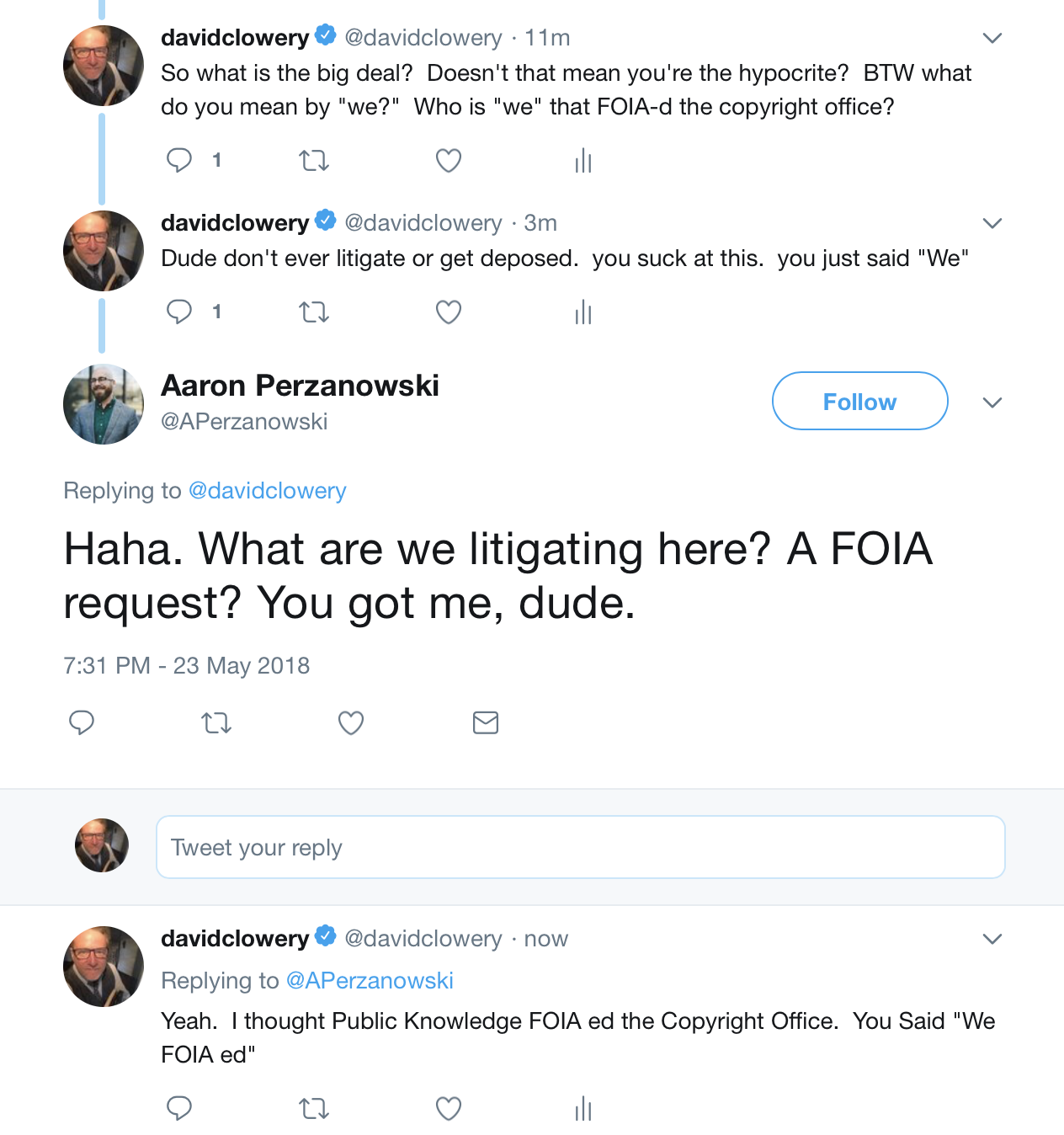
40 IP Law Professors wrote a letter to the US Senate opposing The Classics Act. Most of the claims in the letter have been previously debunked by Terry Hart here. Google funded astroturf Public Knowledge has distributed the letter. This raised some eyebrows. Lowery was trying to get at least one of the 40 Law Professors to reveal who actually authored the letter. Lowery was repeatedly stonewalled. One of the signers Law Prof Aaron Perzanowski seemed to threaten Lowery with a defamation suit, for previously noting that Prof Perzanowski appears in the Google Academics Inc report. Perzanowski (a lawyer) was clearly attempting to dissuade Lowery from pursuing this line of questioning.
From Wikipedia:
A strategic lawsuit against public participation (SLAPP) is a lawsuit that is intended to censor, intimidate, and silence critics by burdening them with the cost of a legal defense until they abandon their criticism or opposition.[1] Such lawsuits have been made illegal in many jurisdictions on the grounds that they impede freedom of speech.
BTW Lowery eventually found other sources that report the letter was proposed and organized by Google outside counsel Mark Lemley and Stanford Prof Phillip Malone. It’s still not clear who wrote the text.
This isn’t some petty twitter dust up. There is an important public policy concern, because the U.S Senate was presented the letter as if it was a spontaneously organized letter by a group of independent IP Law Professors. The story seems to be much more complex. If Google did have a hand writing this letter, or encouraging it, Senate staff should be advised.
Really great news! It was recently announced that the head of the Justice Department’s Antitrust Division will speak at the National Music Publishers Association annual meeting in June!
As David said a few weeks ago before this announcement, Mr. Delrahim is reviewing hundreds of DOJ consent decrees that have accumulated over the decades to see if these government orders should be continued. This review includes the ASCAP and BMI consent decrees that Mr. Delrahim specifically mentioned in an address at Vanderbilt Law School earlier this year. He seems to have come to this idea all by himself.
What’s really great about this is that it could mean the end of consent decrees in a relatively short period of time. Since it’s never happened before, we don’t know exactly how the end of the consent decrees would impact ASCAP and BMI, but presumably the impact would be positive and quick. Goodbye rate court! The smart money would probably be on existing rate court cases continuing, but disallowing new cases. (Mr. Delrahim has been clear that the enforcement side would remain in place, meaning we guess that actual antitrust law violations would be dealt with case by case, just no ongoing regulatory oversight by unelected rate courts. Example would be Global Music Rights awesome antitrust case against the broadcasters after the broadcasters brought one against GMR.)
It could possibly open the door to both organizations getting into the mechanical licensing administration business in competition with whatever comes of the collective established by the Music Modernization Act (which permits voluntary licenses outside of the collective). In fact, BMI has already said they intend to pursue licensing outside of performances because their consent decree allows them to do so unlike ASCAP’s:
BMI is also evaluating the option of licensing beyond the performing right. We have long believed our consent decree allows for the licensing of multiple rights, which is why four years ago we asked the DOJ to amend our decree to clarify that ability, among other much-needed updates.
Of course, the last thing that anyone would want is for the DOJ to end the consent decrees, just to be replaced by some other bunch of regulations or bureaucracy. For once, broadcasters will just have to suck it up.
So it’s a great idea that NMPA is inviting Mr. Delrahim to speak to the publishers who are most in the position to take advantage of a new dawn in songwriter freedom. Many if not most of the NMPA members will be in the voluntary licensing category under MMA and outside the collective. They would be in a fantastic position to support a one-stop shop for performance and mechanical licensing from ASCAP and BMI in line with what SESAC/HFA can offer, and presumably GMR could do as well.
From what we have gathered, on May 15, the Senate [held a hearing] on the Music Modernization Act (which now includes the Classics Act and the AMP Act). It’s flying through the walls of government faster than anything we’ve ever seen. Some call it unprecedented. Some say it’s been a long time coming. The music member organizations are touting this as if we are finally getting our moment in the sun. But are we really?
ASIDE FROM CREATING A DATABASE — IS THE MMA A LANDMARK OR LANDMINE FOR MUSIC CREATORS, PRODUCERS, AND PERFORMERS?
There are arguments on both sides from within the music creator community, and it is hard to know who is “right.” All we know is that all of the “member” organizations that directly impact how musicians and music creators get paid (the AFM, ASCAP, BMI, SoundExchange) have communicated to their members to support this bill, to sign numerous petitions to Congress to ensure it passes, etc., without much member discussion on what the cons are of the legislation. In addition, the advocacy organizations (NARAS, SONA, NSAI, the SCL) have also trumpeted support without much point by point member discussion or debate, which to us is deeply concerning.
Is the MMA truly a landmark win for ALL music creators? Will money start flowing to the “little guy” who doesn’t have a publishing deal and plans to utilize streaming services to distribute his/her music, who is totally DIY, who doesn’t understand/care about the inner workings of the music industry and what the difference is between AFM, SAG-AFTRA, ASCAP, BMI, SoundExchange, and Advocacy-only groups such as NARAS, SONA, and NSAI? (This, by the way, is the majority next generation DIY musicians who upload millions of tracks into the streaming services every year.) What will REALLY change for that DIY music creator, producer, or performer? Can he/she plan to retire off of the whopping increase in earnings that passing the MMA will provide? Will they be able to figure out how to register to get their windfall in time before the publishers who are behind the MMA claim it?
If the MMA legislation is so much of a windfall moment for all music creators, producers, and performers — why is it so hard to find a concrete example (or have the advocacy groups even CREATE an example to relate to) of a DIY music creator and how the MMA will help him/her earn more income for their music (or musical contribution) from streaming? Why haven’t the member organizations provided examples of “if you wrote this, recorded this, produced this, and/or released it on a streaming platform, this is how passing the MMA will improve your music creator/producer/performer life” as a part of their non-stop rally of support for this bill? And what about the musician unions? If they want musicians to support the MMA, why haven’t they provided any examples of how a session musician (or lead singer) who played/sang on a track that is now released on a streaming service will benefit?
YOU HEARD IT HERE FIRST: THE “LANDMARK” DATABASE WILL MAKE OR BREAK THE MMA’S (THE MLC’s) SUCCESS
[Editor Charlie sez: As David Lowery has posted, it’s looking like the Senate version of the “Music Modernization Act” may not include the CLASSICS Act which would require royalty deadbeats at the Digital Media Association, SiriusXM and Pandora to pay their fair share of performance royalties for our legacy artists who recorded before 1972. This loophole has been exploited and defended by the head of the Digital Media Association while he was formerly at SiriusXM and Pandora. David caught him promoting a position from Google shills Public Knowledge and now Terry Hart has called out Professor Mark Lemley for trying to pull the bait and switch from the House bill to the Senate version of MMA (which means “Music Modernization Act” not “Make More Algorithms”). Professor Lemley has plenty of entries in the “Google Academics” database, a handy tool for tracking Google’s influence.]
While several pieces of music legislation have been introduced in the Senate, there is not a single comprehensive package yet. We are encouraging our Senate allies to bring these many issues together into a single, comprehensive Music Modernization Act, like the bill passed in the House.






You must be logged in to post a comment.