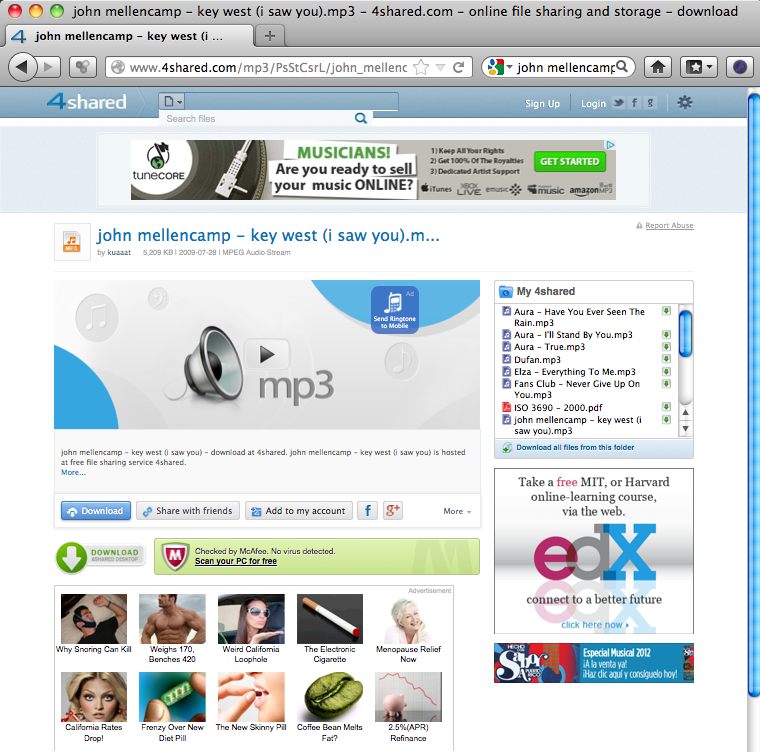
Well this is Embarrassing, a Tunecore Ad on 4Shared…

When doing random searches on illegal and infringing sites, you never know whose ads might pop up… Artists pay Tunecore to distribute their albums and music on paid platforms, and Tunecore pay’s pirate site 4Shared to give the artists music away for free…

MellencampTUNECORE

Read John Mellencamp’s excellent editorial on The Huffington Post,

Why is thievery allowed to continue on the Internet? And why do people think it’s so impossible to correct? Right after radio was invented, they played music and sold advertising. Then it dawned on some: “Hey, they’re playing our music, and they’re selling advertising on our backs; we should get paid.” So performing rights organizations like ASCAP and BMI were established with the express intention of protecting the intellectual property of artists who create it.

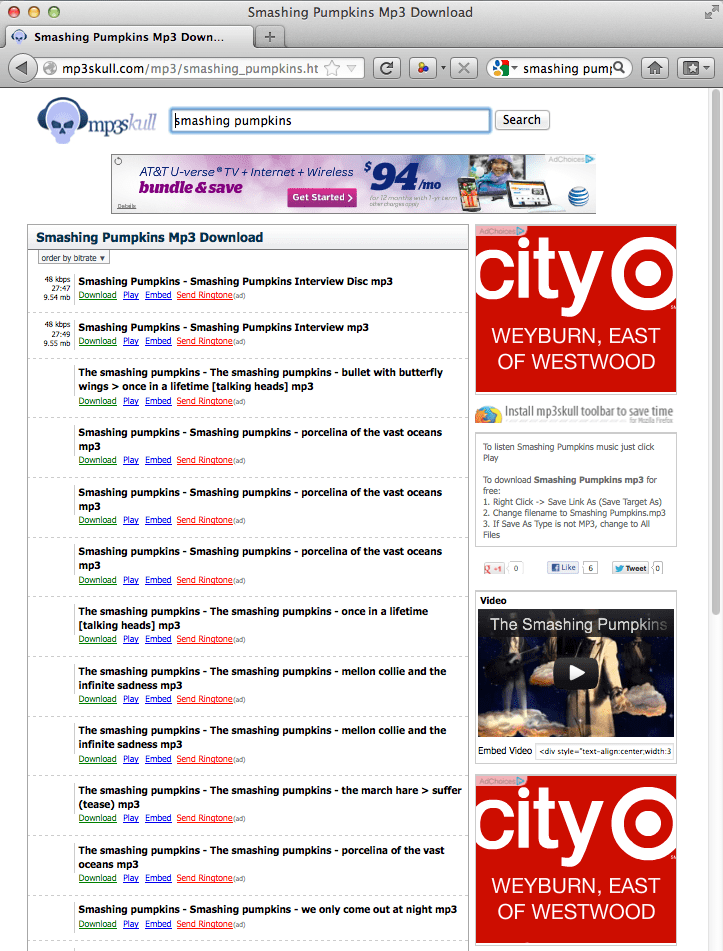
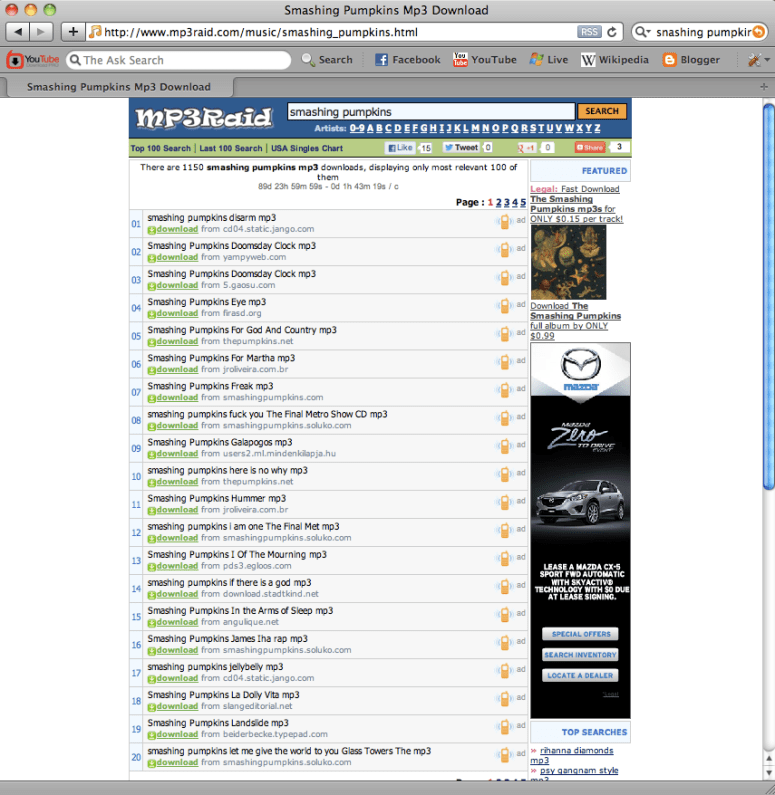
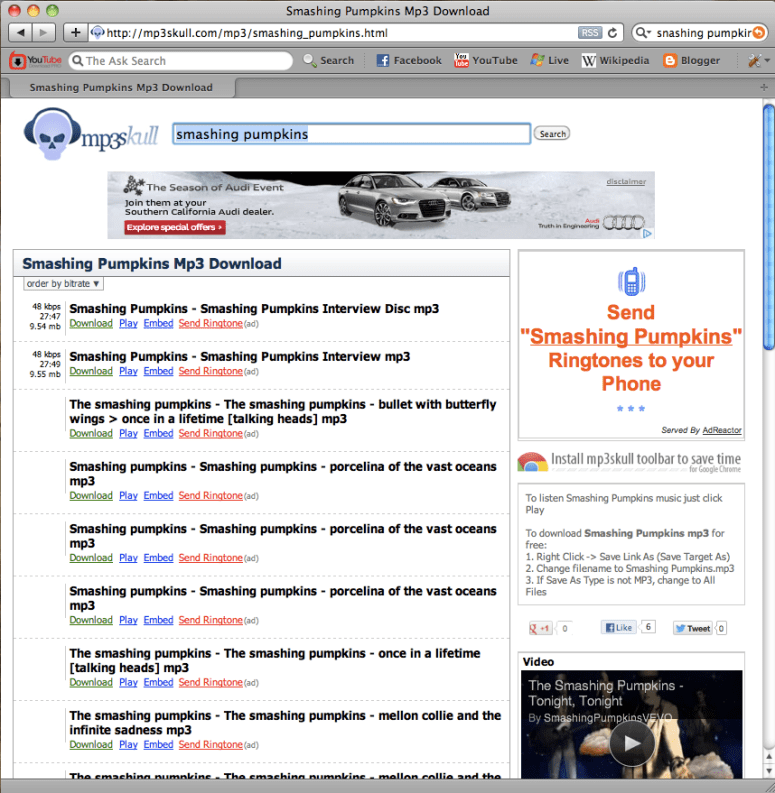
Billy Corgan Exploited By… Citi Bank, AT&T, Target, Virgin Atlantic, Mazda, Neiman Marcus, Musicians Friend, Hertz, BMW, Audi, Boston Market, Urban Outfitters, Williams Sonoma

At SXSW in 2012 Billy Corgan shared his thoughts about the music business from his perspective, including his thoughts that you can’t really make money in the music business anymore. Billy is probably right that musicians can’t really make money in the music business anymore, but it appears there is plenty of money being made by internet sites dedicated to infringement as well as the ad networks and payment processors who allow the sites to profit from the musicians work.

Surely these advertisements are not appearing without being paid for, and there actually is money is being paid to finance and support the operation of major piracy sites (as reported by Google’s own transparency report). What’s worse is that the money financing these major piracy sites ripping off artists and creators are being paid by well know major consumer brands and corporations. See below…

Citi Bank – 4Shared
AT&T – 4Shared
AT&T – Mp3Skull
Target – Mp3Skull
Virgin Atlantic – IsoHunt
Mazda – Mp3Raid
Neiman Marcus – Mp3Skull
Hyundai – Mp3Skull
Musicians Friend – 4Shared
Hertz Rent A Car – 4Shared
BMW – 4Shared
Audi – Mp3Skull
Boston Market – 4Shared
Urban Outfitters – 4Shared
Williams Sonoma – IsoHunt

SP_4sharedAudioCitiATT

SP_ATTTargetMP3Skull

SP_ishunt_VirginAtlantic

SP_mazdapumpkinsmp3raid

SP_mp3skullHyndai

SP_MusiciansHertsBMW

SP_pumpkinsAudioMp3Skull

SP_UrbanOutFitters4Shared

SP_WilliamsSonomaIsoHunt

Ending Decade Old Arguments : How the Promise of the Internet has Failed Artists and Musicians…

As Jaron Lanier tells it, Ted Nelson envisioned his version of the internet (Xanadu) as a single walled garden where everyone could be both a consumer and a producer. Ideas and art could be exchanged in a frictionless environment where a truly free market would emerge. People could make their wares available for free, or charge for them. However, once a price was set, the market would then determine the demand for that information be it a song, poem, movie or software. This truly free and open market would have empowered creators of all kinds access to a marketplace the likes of which we’ve never seen. Ted’s vision would have truly empowered creators and democratized distribution. Unfortunately, Ted’s vision has not come to be.

Much has been written about the record industry in particular failing to “adapt and evolve” to the new online digital economy. Whereas this may have been a valid argument in 2002 it holds little water a decade later in 2012. In the past decade we’ve seen many new offerings to consumers for legal and licensed music services tailored to many different consumer lifestyles. The tip of the iceberg includes such well known offerings as Itunes, Spotify, Pandora, Rhapsody and literally hundreds of others. And yet despite there being over 500 legal music services neither sales nor revenue have begun any significant rebound. The one thing these services still require, that piracy does not, is payment.

Let’s take a look back. In 1999 in the USA there were probably ten thousand retail points of sale for physical music, Tower, Sam Goody, Target, Walmart, etc. At the time they were selling $20 dollar physical discs – much of the overhead due to physical packaging, manufacturing, shipping, stocking fees and the overhead of real human beings being employed in record stores who need to eat, have shelter, etc.

These physical retail locations also had all the problems of supply side inventory management – a band would be on tour, and no stock would be in that market, a song would be played on the radio and the album would quickly be out of stock, etc. An artist could get placed on a TV show or featured in a commercial and suddenly there is demand, but no availability. These supply side inventory issues combined with limited points of sale were a massive problem for the artists and the record industry.

Digital distribution has none of these problems. Today someone can walk from their living room to their computer (or it may be on their lap) to purchase the latest hot song, featured in Gossip Girl. Or not even, they can buy the song/album on their iphone while watching the TV show or in a movie theater or at a club or concert.

So today in 2012 there are an estimated 500 million retail points of sale for prerecorded music via itunes alone. Just stop and think about this for a second. We went from ten thousand points of sale to five hundred million points of sale in less than a decade and removed all of the supply side inventory issues… wow. The promise, size and scale of the internet should have seen sales of pre-recorded music increase, massively.

There is frequent argument made that if music cost less, it would sell more… well, we now have 99 cent songs and $9.99 albums and sales have dropped by half in a decade…

So the recording industry adapted by:
1) removing inventory problems
2) making music instantly available
3) allowing for songs to be sold individually at a price never before possible and…
4) dropped the price of the album by half of the retail list price of a decade ago

All of this should be a net positive, not a net negative except for one very big thing, payment is now optional to everyone, and there are no consequences for not paying… So let’s be clear about what the problem is when talking about potential solutions.

The problem is not a lack of viable new business models, the problem is the proliferation of illegally distributed recordings being monetized by advertising on infringing websites. There is money in the distribution of recordings on the internet, the problem is the majority of that money is being made illegally and not paying the artists a penny.

Weekly Recap News & Links Sunday December 9, 2012

Grab the coffee!

Happy Holidays, it’s been a slow week at The Trichordist following the ongoing IRFA and RSC meltdowns…

FROM AROUND THE WEB:

The Drum:
* New international reports will name and shame brands which advertise on websites that feature pirated film and music content

Background Briefing with Ian Masters:
* Is the Door Closing for Musicians in Digital Age?

AdLand:
* Selling the Canadian government and wives on the same networks : demand accountability now
* Let the social media Cola Wars begin
* Istagram pulls twitter integration, need to puff their own site stats to ‘monetize’ and keep investors happy

Paid Content:
* If you want to hurt pirates, target their ad money says rockstar

Seeking Alpha:
* Pandora, The Underpants Gnomes, And Sirius XM

Vox Indie:
* (Another) Misleading Study (Sort of) Claiming Piracy is Good for the Movie Biz…
* Google Search #FAIL Means More $$$ for Them

Copyhype:
* Does Copyright Involve Scarcity?

Ethical Fan:
* Torrent Freak: US BitTorrent Traffic Grows 40% from 2011 (Sandvine)

Torrent Freak:
* NZBMatrix Shuts Down Citing Piracy Troubles
* Record Labels go to High Court to Force More ISPs to Block Pirate Bay
* Pirate Bay Proxy Loses Domain Name to Anti-Piracy Boss

Digital Music News:
* US Album Sales Down Just 4% On the Year…
* iTunes 11: Be Very Afraid, Spotify…
* Major Labels: We Spend Up to $1.4 Million Developing a New Artist…

The Illusion of More :
* The Opaqueness of Transparency
* Why isn’t the Internet breaking?
* Google Protects IP (its own)

The Washington Post:
* Justice Department meets with firms seeking Google antitrust probe

Business Insider:
* Google Is One Vote Away From Being Slammed With A Massive Anti-Trust Suit By The FTC

Weekly Recap & News Sunday Dec 2, 2012

Grab the coffee!

Recent Posts:
* Lars Was First And Lars Was Right
* Zoë Keating’s Request for Internet Transparency met w/ usual Hypocrisy
* The Most Important Fact Academics and The Copyleft Neglect to Mention: Copyright is Optional.
* Giving Thanks for Creators Rights and Copyright
* Congressional Research Service Memo on Constitutionality of IRFA Section 5
* Other Than That Mr Westergren, How Was The Play? IRFA Gets An Ass Whupping
* Or Pandora Could Add Another Minute Of Advertising And Raise Their Revenue 50%
* Video of the “Radio Active” panel at The Future of Music Summit 2012.
* The Internet Radio Fairness Act’s Attack on Free Speech
* This photo says it all
* Google’s Serial Obfuscation: Music Canada,BPI, Billboard Question Whether Google Has Really Lowered Pirate Sites Search Rankings
* IRFA is the Broadcast Industry’s SOPA. Censors Free Speech
* IRFA and the Future of Music Policy Summit: Why Would FOMC Miss An Opportunity to Defend Artist Rights?

IRFA-APLOOZA:

Seeking Alpha :
* The Internet Radio Fairness Act Will Fail

Ars Technica :
* Pandora’s Internet radio bill hits a wall of opposition in Congress

CNET :
* Pandora’s Web radio bill is doomed — well, for now

House Judiciary Committee – Video of the Hearing:
* Music Licensing Part One: Legislation in the 112th Congress

WELL, THIS IS EMBARRASSING – OOOPSIES! THE RSC’s FICTIONAL LOOK AT COPYRIGHT IS RECALLED IN LESS THAN 24 HRS:

Techdirt:
* House Republicans: Copyright Law Destroys Markets; It’s Time For Real Reform
* That Was Fast: Hollywood Already Browbeat The Republicans Into Retracting Report On Copyright Reform

Precursor Blog:
* The Copyright Education of Mr. Khanna — Part 2 Defending First Principles Series

Copyhype:
* Republican Study Committee Policy Brief on Copyright: Part 1
* Republican Study Committee Policy Brief on Copyright: Part 2

Music Tech Policy:
* Critiquing The “Free Culture” Book Report or “The Copyright Education of Mr. Khanna”

FROM AROUND THE WEB:

Mercury News:
* German lawmakers call Google campaign ‘cheap propaganda’

“The campaign initiated by Google is cheap propaganda,” said conservative lawmakers Guenter Krings and Ansgar Heveling.

“Under the guise of a supposed project for the freedom of the internet, an attempt is being made to coopt its users for its own lobbying,” the two said in a statement.

Stereogum:
* Deconstructing: Pandora, Spotify, Piracy, And Getting Artists Paid

Pitchfork:
* Making Cents – Damon Krukowski of Galaxie 500 and Damon & Naomi breaks down the meager royalties currently being paid out to bands by streaming services and explains what the music business’ headlong quest for capital means for artists today.

The Cynical Musician:
* Reco’nize: The Original Cynical Musician (Lars Ulrich)

Billboard:
* Songwriters Are Left Out of Pandora’s Royalty Plan: Guest Post by Downtown Music’s Justin Kalifowitz

The National Review Online:
* Myths and Facts about Copyright

VoxIndie:
* How Are Google’s Anti-Piracy Search Policies Working?

Digital Music News:
* We’ve Written Some of the Biggest Songs In History. And This Is What Pandora Pays Us…
* If You Stream a Song Once a Day, When Does It Pay the Same As a Download?
* My Song Was Played 3.1 Million Times on Pandora. My Check Was $39…
* Finally: A Solution for Pandora’s Financial Problems…

Torrent Freak:
* IMAGiNE BitTorrent Piracy Group “Sysop” Jailed 40 months
* BitTorrent Site Owners Fear European Domain Name Seizures
* Canada Set For Mass BitTorrent Lawsuits, Anti-Piracy Company Warns

Music Tech Policy:
* The Artists, United, Can Never Be Defeated
* Too Big to Fix Part 1: YouTube’s Thimblerig, or What’s Inside Your Black Box Today Mr. Schmidt?

Copyhype:
* Friday’s Endnotes – 11/30/12
* A Brief History of Webcaster Royalties
* The Purposes of Copyright Law and “Anti-Copyright” Arguments

Worth an encore, Lars Ulrich predicts the demise of Artists Rights to Internet Robber Barrons in 2000 on The Charlie Rose Show.

Giving Thanks for Creators Rights and Copyright

It’s been said that the only thing more sacred than a human being sharing their love, is their labor. We agree. Copyright is the institution to protect the innovative artists, musicians, filmmakers, photographers, writers, illustrators and creators of all types. We are thankful for Copyright.

One of the enduring myths that we constantly hear from those who would deny individuals these fundamental protections of their labor is that copyright is an instrument of corporations to exploit artists and creative innovators. Fortunately this myth is not true. It is in fact very much a lie that copyright is for corporations. Copyright is the instrument that protects the individual from exploitation by and from the tyranny of exploitation by corporations.

Copyright is what grants the individual liberty as expressed in the freedom of choice as to who (if anyone) and how the creator allows their work, labor and love to be exploited. Exploitation in this sense is not a bad word, in so far as the creator has the right to determine who, where and how their work is exploited. Without copyright the individual is powerless from such unwanted exploitation, without consent or compensation. This is why copyright, in it’s essence, very much an issue of human and labor rights.

We are thankful for copyright and to all of our representatives and government officials who do so much good work on our behalf to protect the integrity of the individual spirit as expressed in our art.

Those who are against copyright are also fundamentally against personal liberty and aggressively against the pursuit of the freedom of choice. These are the people who wish to exploit artists for their own personal or corporate gain and like to suggest that artists would be better off without copyright. This is simply not true.

There are those who point to democratized services available to musicians such as TuneCore and CDBaby which allow any musician to access distribution such as Itunes, Spotify and others without the need for a record label. We wholehearted support these services as pro-choice for the power of the individual to make the decisions that are important to them.

These services that provide more choices to artist to determine how they choose to exploit their own work are only viable because the individual artist has the choice to use these services and not sign to a traditional record label. Without copyright, the artists ability to make these choices does not exist. The choices would be made for the artist without any ability determine the uses or the compensation for those uses. This would mean more predatory exploitation of artists, not less.

Copyright is Pro-Choice. Anti-Copyright is Anti-Choice, or Pro-Exploitation.

We think few artists would be in support of losing these rights for all the reasons detailed thus far. Opposition to copyright is opposition to individual rights and supports the unchecked corporate exploitation of artists which we have unfortunately witnessed for the past decade plus online.

We hear from many who are outraged by the wrong doings of record labels, and justifiably so. So let us be clear, any wrong doing should be unacceptable be it by record labels, or those exploiting artists online such as the many illegally operating and infringing business such as the pirate bay and others who literally pay artists nothing, not one penny. The logical disconnect that somehow record labels are bad and the illegally and infringing online businesses are good defies any reasonable justification. Unless of course the motivation is not actually the empowerment of artists, but rather the profits of these tech companies.

So lets get the facts straight. Artists have been given the choice of whom they wish to be in business with. Does anyone really think that artists will be better off with less protection of their work? There is no basis in reality for this assertion and as of this writing, over a decade into the digital economy no new robust middle class of professional musicians has been established in the one place where this theory is being tested. The exploitation economy has failed miserably to create a new sustainable professional middle class of musicians.

For those with an axe to grind with major labels and the RIAA please take note of this, without copyright, the record labels who are more powerful than the individual could just as easily take the artists work without compensation. Surely those who advocate for weaker copyright are not suggesting the records labels should be given more power over the artist? The same would be true of television producers and film studios. If these massive corporations were granted weaker copyright, than artists and creators would be subject to unrelenting exploitation. You can not weaken copyright in one area and not others. The true fallacy of the argument for weaker copyright is that in the areas where copyright is well enforced, creators are compensated greater than where copyright is weaker. This is just common sense.

Weakening copyright would not be isolated to just how rights are granted on the internet, but rather, the individual would be catastrophically disenfranchised. Those with power would exploit those with less power, be it by record labels, film studios, television producers or internet technology companies (as we’ve seen). We need to look no farther to the internet to see this already happening where copyright law is hopelessly out of date for the protection of individual freedom and where artists are so hopelessly disenfranchised and under compensated for their work.

Perhaps it is Metallica’s Lars Ulrich who first (and correctly) noted that “If the record labels are not going to get the money, the internet companies are – and if the internet companies are not going to pay artists that is profiting illegally.”

Copyright provides the foundation for each artist to make individual choices about how to leverage their work. So the truth is that every artists who has signed to a record contract has done so of their own free will, and negotiated contracts which have been reviewed lawyers. As a result of this protection of copyright the record labels must compensate the artists in exchange for a grant of rights. On the much of the internet however, there is no grant of rights, no consent and no compensation. This is categorically unacceptable.

In closing we are thankful for copyright in giving us, the innovative artists, writers, authors, photographers, filmmakers and creators the ability to chose a course of individual freedom and liberty that is fundamental to the ideals of good, fair and honest people everywhere.

Weekly Recap and News Sunday Nov 11, 2012

Grab the coffee!

Recent Posts:
* Madison Avenue and Media Piracy, Are Online Ad Networks the Birth of SkyNet?
* Bad News, Good News, Bad News. Internet Radio “Fairness” Act Sponsor and Conservative UT Congressman Chaffetz Taunts Musicians; Admits to Belief in Evolution; Urges Government Interference In Markets.
* Muzzling Free Speech By Artists: IRFA Section 5 Analysis
* Lobbyist For CCIA Makes All Kinds of Wild Claims About Copyright Management Organizations. BMI ASCAP SOCAN SAMI Included in Charges of Corruption.

From Around The Web:

Copyhype:
Friday’s End Notes 11/09/12 (Essential Weekly Reading)

Dan Ariely
How to Stop Illegal Downloads
“Before it was my book being illegally downloaded, I was more on the “Information wants to be free” end of the spectrum. The sudden, though predictable, shift in my feelings when I found my own work being downloaded for free was a jarring experience.”

Digital Music News
Goldman Sachs Is About to Invest $100 Million In Spotify…
Dear Pandora, You Totally Suck. Signed, Songwriters…
Pandora Is Now Suing ASCAP to Lower Songwriter Royalties…

TechCrunch:
Spotify Is Having A Good 2012: Revenues Could Reach $500M As It Expands The Digital Music Market

Billboard:
Songwriters Are Left Out of Pandora’s Royalty Plan: Guest Post by Downtown Music’s Justin Kalifowitz

The Hill:
NAACP blasts Pandora-backed Internet royalty bill

The New York Times:
A Clash Across Europe Over the Value of a Click

The Precursor Blog:
Google’s Top Ten Anti-Privacy Quotes — Part 3 In Google’s Own Words Series
“We know where you are. We know where you’ve been. We can more or less know what you’re thinking about”Google Chairman Eric Schmidt 10-1-10 per the Atlantic

Torrent Freak:
Supreme Court Rejects Hearing For Pirate Bay’s Peter Sunde
RapidShare Limits Public Download Traffic to Drive Away Pirates
“Six-Strikes” BitTorrent Crackdown May Target Private Trackers

Columbia Journalism Review:
Audit Notes: digital ads, margins of error, freehadists – French publishing’s online revenues make the Americans look good

Music Tech Policy:
IRFA and the Future of Music Policy Summit: Why Would FOMC Miss An Opportunity to Defend Artist Rights?
Stretching the Possibilities of Offensiveness, Pandora Demonstrates How to be Ugly at Scale

The Washington Examiner:
Report: Google and Facebook competing for an Obama cabinet slot

Digital Trends:
Sorry, Internet, SOPA had zero effect on election day results
“Of the 24 House Members up for reelection who co-sponsored or otherwise supported the highly contentious anti-piracy legislation, all but three won reelection on Tuesday. This includes Republican Rep. Lamar Smith, of Texas, SOPA’s author and chief co-sponsor who became the Internet’s Enemy No. 1”

ChinaDaily:
Free Online Music in China Coming to An End?

Bad News, Good News, Bad News. Internet Radio “Fairness” Act Sponsor and Conservative UT Congressman Chaffetz Taunts Musicians; Admits to Belief in Evolution; Urges Government Interference In Markets.

Rep Jason Chaffetz R-UT “conservative” Republican from Utah and sponsor of the ironically named “Internet Radio Fairness Act” shocked his constituents by accidentally admitting to his belief in dinosaurs and evolution while attempting to taunt musicians and urging government interference in markets.  In response to musicians opposition to his bill he told The New York Times.

“The old-school dinosaurs are trying to help, but they’re stuck in the tar,” he said. “They can go talk to the pterodactyls.”

Never mind the taunt doesn’t make any sense. It brings up some intriguing questions:

Old school dinosaurs?  Are there new school dinosaurs? Who are the dinosaurs trying to help?  Musicians? Or Pandora? Or are the Musicians the dinosaurs?  Wouldn’t the pterodactyls be flying around and not stuck in the tar pits?  And who’s supposed to talk to the pterodactyls ? the other dinosaurs? Or the musicians? Do the pterodactyls represent internet radio? Are pterodactyls the implied “new school” dinosaurs? And I’m not trying to be purposely obtuse but I’ve been to the LaBrea tar pits and it was mammals like mastodons and sabre toothed tigers that got stuck in the tar pits.  Not dinosaurs.  Is this part of the metaphor I don’t understand? Is this a zen koan? Is the Congressman operating on a higher level of consciousness?

All kidding aside, should we really be surprised that Chaffetz could be so ideologically flexible? And to be clear there is nothing wrong with being ideologically flexible to a certain extent.  According to Wikipedia the anti-gay marriage conservative Utah legislator  is half brother of actor John Dukakis the adopted son of Governor Dukakis.  Chaffetz was originally a democrat.  Indeed he was the chair of the Dukakis For President campaign in Utah. Later in life he switched party affiliations to the Republican party.   With strong support for gay rights and democratic policies coming from his father and extended family thanksgiving dinners must be pretty complicated affairs at the Chaffetz house!

So it should be no surprise that this supposed free market advocate could be “ideologically flexible”  enough to sponsor a bill that asks the government to set prices; to pick winners and losers; and force musicians through government mandate to bail out a private company that continues to stick with a bad business model (one minute of ads an hour). Oh and this private company happens to be a campaign donor.

What happened to the free market ideals?  I guess that’s for dinosaurs.

Madison Avenue and Media Piracy, Are Online Ad Networks the Birth of SkyNet?

In the mythology of the Terminator Sci-Fi movies it is a military defense computer system (SkyNet) that achieves consciousness through artificial intelligence and declares war on human beings. In reality, it appears the first computer networks to declare war on us may be advertising networks, ad bots, and online AI advertising auctions.

If one is to believe the various people responsible for the millions (er, uhm billions) of dollars flowing through online advertising networks (Google alone is estimated to be $30b annually) you could easily believe the machines have already achieved consciousness as no human being we speak to seems to have an actual understanding of how online advertising networks function.

It all appears to be a mystery as to how the money changes hands down stream, and how to determine who is getting paid from what specific ad placements and on what specific sites.  We had one ad network executive tell us privately “we can not control where the ads end up”.

Really?  So the online ad networks are Skynet?

This would seem to an alarming problem for buyers of advertising including such respected brands as Wendy’s, Yahoo, BMW, Adobe, Cadillac, LG, Target, Westin Hotels, Priceline, Hyatt Hotels, Weight Watchers, VISA, State Farm, Mini Cooper, ADT Security and even Presidential Candidate Mitt Romney.

It would probably be pretty embarrassing for a multinational electronics company like LG and a Presidential Candidate to both be advertising on two of the Top 20 most infringing sites in the world, wouldn’t it? Uh oh, don’t look now…
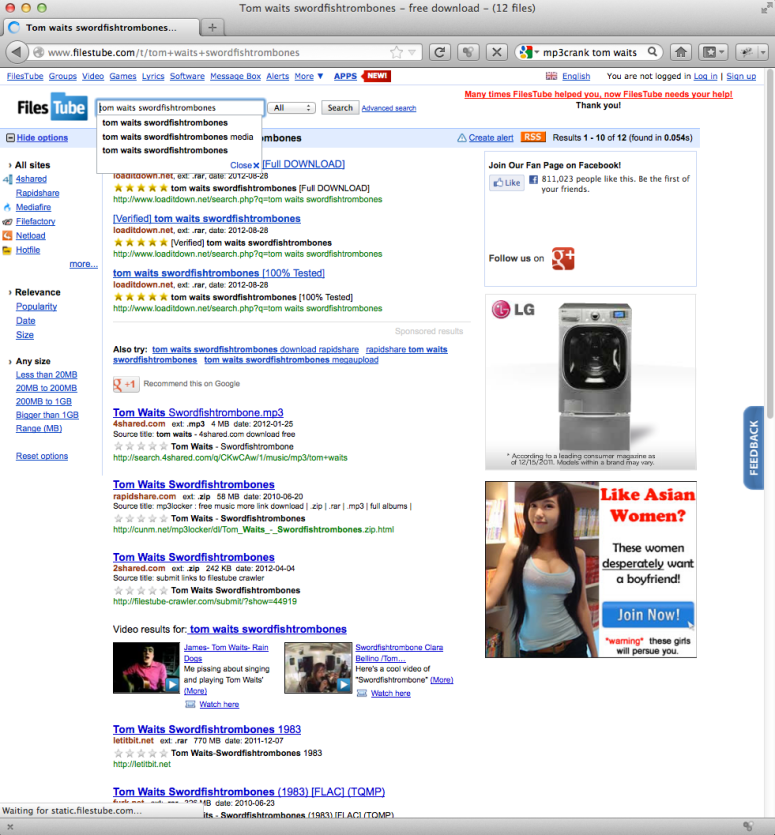
If the machines are already in control we should probably be worried, but we do think it’s odd they would be so focused on a capacity that only seems to transfer wealth from artists, musicians, filmmakers, authors and other creators to internet millionaires running ad networks and pirate sites.

Certainly if Google and the other ad networks had knowledge of the top infringing sites say through a publicly accessible transparency report based on DMCA notices, they would not be serving ads to those businesses operating far beyond the intention of the law? Certainly if they knew that just the Top 20 infringing sites had over 2.3 Million claims in just one month, than Google and the other advertising networks would clearly make a best practices “no fly zone” for advertising on those sites, wouldn’t they?

We’d much rather see this advertising revenue directed towards legally operating and legitimate media outlets such as television, newspapers and magazines who no doubt are also in need of revenue in an ever competitive marketplace. Why finance the pirates who are illegally exploiting others in the creative industries? How much money is being lost from legitimate media outlets to media pirates?

Below is a random sampling of artists exploited by these Madison Avenue Brands and the sites hosting the advertising. We wonder who is serving these ads, and paying these sites because everyone we talk to denies advertising on these sites and seems to know nothing about it.

TOM WAITS Exploited By Wendy’s, Yahoo, BMW, Mitt Romney, Adobe, Cadillac, LG, Target, Westin Hotels, Priceline, Hyatt Hotels, Weight Watchers, VISA, State Farm, Mini Cooper, ADT Security

* BMW on Kick Ass Torrents
* Mitt Romney, ADT Security on 4Shared
* Adobe, Mini Cooper on FilesTube
* Cadillac on FilesTube
* LG on FilesTube
* Target on Mp3Crank
* VISA, State Farm on Mp3 Crank
* Wendy’s on Kick Ass Torrents
* Westin on Kick Ass Torrents
* Priceline, Weight Watchers on 4Shared
* Hyatt on 4Shared
* Weight Watchers, Hilton on 4Shared
* Yahoo on Dilandau
* Urban Outfitters on FilesTube

U2 Exploited by United Airlines, Jet Blue, HP, State Farm, Westin, Urban Outfitters, Sprint, AT&T, Amazon, Disney Resorts, Crate and Barrel

* United Airlines x2 on h33t
* United Airlines on mp3 bear
* United Airlines on FilesTube
* Jet Blue and Kayak on h33t
* Hewlett Packard and State Farm on mp3skull
* Westin Hotels on 4shared
* Westin Hotels on mp3raid
* Urban Outfitters on mp3skull
* Sheraton Hotels on mp3skull
* Century 21 on 4shared
* Alaska Airlines on torrent reactor
* State Farm on torrent reactor
* Sprint on torrrent reactor
* Sheraton Hotels on 4shared
* Hewlett Packard x2 on filestube
* Hewlett Packard and State Farm on mp3skull
* Hewlett Packard on h33t
* Rejuvenation on filestube
* Disney Resorts on torrent reactor
* Crate & Barrel on Files Tube
* Charter Cable on mp3 raid
* AT&T on mp3skull
* Amazon on 4shared

These two examples above are just the tip of the iceberg, and it’s not just the most well known and respected mainstream artists who are effected. Perhaps even more so it is the smaller artists who have been the most hard hit by this diversion of revenue without compensation Aimee Mann, Neko Case, Talib Kweli, Death Cab For Cutie and Jared Leto to name a few.

It would also appear that Google makes plenty of money serving ads on sites that it knows are infringing. Here is Google’s Doubleclick serving an ad for Jeep on http://www.dilandau.eu   This is a site that Google’s own transparency report ranks as the 24th most copyright infringing site in the world.  Isn’t knowingly providing money to an illegal enterprise a RICO predicate?

One would think with this kind of information there would be a move to improve the situation for rights holders, but looking at this graph it appears to be getting worse, much worse.
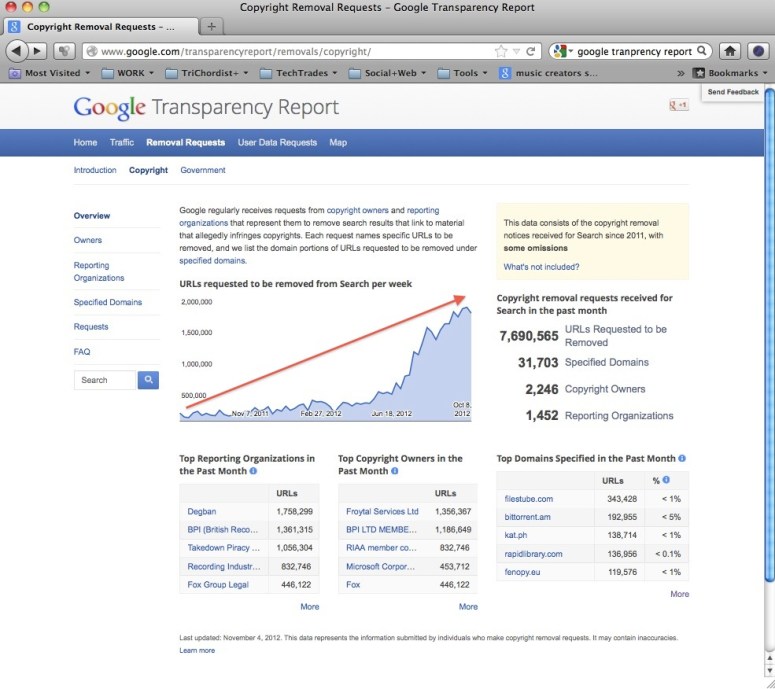
The bottom line is, we wonder how such mass scale, enterprise level and generally sketchy businesses can continue to go unchecked without any reporting from the mainstream media (who also depend on ad dollars that are now going to competing businesses engaged in media piracy and mass scale copyright infringement).

Once upon a time no one thought twice about “accounting irregularities” at Enron and we all know how that story ended. So who’s gonna ask the hard questions and get some real answers? Operators are standing by…