
Music is the Product. | Adland.tv

Yup. Music is the product. Justin Vernon talks about Bon Iver and advertising.  The music is the product, not just the business card to book advertising and sponsorship gigs which some would like to suggest – and here’s why…

We did a photo shoot for Bushmills. To be clear: They gave us a bunch of money and we were able to finish without borrowing. It was great for us, and everybody that worked at the company was great, and I love Bushmills and wanted to do the deal because my dad loved Bushmills — we bond over Irish whiskey.

But the problem is that it isn’t just Bushmills. It’s run by a corporation, and you kind of forget that they’re not interested in you or really what you’re doing. They’re interested in your popularity and your reach, and it felt really sickening after a while. Not badmouthing Bushmills the company, but I regret it.

I regret it because it wasn’t us and they put my face on a fucking billboard, even though it was a cool billboard and I was with my brother and my sound engineer and we’re buds and we got drunk while we had the photo shoot. I just missed it. I missed the mark on that one and I let it all kind of get to me. It just doesn’t feel right after the fact, you know?

READ THE FULL STORY AT ADLAND:
http://adland.tv/adnews/music-product/971380697
UK police are waging war on piracy sites’ funding — and it’s working | Business Insider

Ad Funded Piracy. Follow The Money. It’s not about sharing, it’s about profits.

Most big piracy sites don’t charge their users a fee, but are still able to profit off of copyright infringement. Why? Because the operators plaster their pages in advertising.

But British police now say they are making major headway in tackling this: On Wednesday, the Police Intellectual Property Crime Unit (PIPCU) announced that Operation Creative, launched in 2013, has led to a 73% decline in advertising “from the UK’s top ad spending companies on copyright infringing websites.”

READ THE FULL POST AT BUSINESS INSIDER:
http://www.businessinsider.com/operation-creative-piracy-73-percent-decrease-pipcu-2015-8

Marketers: Stop Advertising on Pirate Sites | Advertising Age

The first three things to know about online piracy; Follow the money. Follow the money. Follow the money.

My own show, “Hannibal,” was the fifth most-stolen TV show during its first season on the air, despite being available for legal digital streaming the very next day. While I appreciate the enthusiasm of our fans, as executive producer I am responsible for all production costs for the show. Piracy directly affects my bottom line, including the wages for hundreds of cast and crewmembers.

I have been blessed with a successful, 30-plus-year career in entertainment. During that time, I have seen how the growth of online piracy directly impacts the economics of creativity. Piracy jeopardizes the rights of creatives to be compensated for their work — making it even harder to build a career in a creative field. It forces companies to either shrink their production budgets or commit to fewer, less risky projects. And ultimately, it harms audiences by limiting the types of stories that creatives can tell.

It’s a real lose-lose, unless you are the operator of a pirate site.

READ THE FULL STORY AT ADVERTISING AGE:
http://adage.com/article/digitalnext/advertisers-profit-piracy/299924/

The Crowdsourcing Scam | The Baffler

It’s all the same Silicon Valley scam. Whether you are a musician or a cab driver, this about labor, and you could be next…

Silicon Valley calls this arrangement “crowdsourcing,” a label that’s been extended to include contests, online volunteerism, fundraising, and more. Crowdsourced work is supposed to be a new, more casual, and more liberating form of work, but it is anything but. When companies use the word “crowdsourcing”—a coinage that suggests voluntary democratic participation—they are performing a neat ideological inversion.

The kind of tentative employment that we might have scoffed at a decade or two ago, in which individuals provide intellectual labor to a corporation for free or for sub-market wages, has been gussied up with the trappings of technological sophistication, populist appeal, and, in rare cases, the possibility of viral fame.

But in reality, this labor regime is just another variation on the age-old practice of exploiting ordinary workers and restructuring industrial relations to benefit large corporations and owners of the platforms serving them. The lies and rhetorical obfuscations of crowdsourcing have helped tech companies devalue work, and a long-term, reasonably secure, decently paying job has increasingly become a MacGuffin—something we ardently chase after but will likely never capture, since it’s there only to distract us from the main action of the script.

READ THE FULL POST AT THE BAFFLER:
http://thebaffler.com/salvos/crowdsourcing-scam

Stop calling it the “Sharing Economy.” That isn’t what it is. | Olivier Blanchard

What it is, is the Exploitation Economy…

“Disruption rocks though!”

No, it doesn’t. The right kind of disruption rocks. The kind that has value, that solves a problem, that improves an imperfect system. But disruption for the sake of disruption is just noise. It can even be destructive, and that doesn’t rock. It doesn’t rock at all.

Because Apple was “disruptive,” anything deemed disruptive now somehow borrows from Apple’s cachet. “Disruption” has become another meaningless buzzword appropriated by overzealous cheerleaders of the entrepreneurial clique they aspire to someday belong to. And look… every once in a while, someone does come up with a really cool and radical game-changing idea: Vaccines, the motorcar, radio, television, HBO, the internet, laptops, smart phones, Netflix, carbon fiber bicycles, drought-resistant corn, overpriced laptops that don’t burn your thighs in crowded coffee shops… Most of the time though, “disruption” isn’t that. It’s a mirage. It’s a case of The Emperor’s New Clothes, episode twenty-seven thousand, and the same army of early first-adopter fanboys that also claimed that Google Plus and Quora and Jelly were going to revolutionize everything have now jumped on the next desperate bandwagon. What will it be next week? Your guess is as good as mine.”

READ THE FULL POST AT OLIVIER BLANCHARD:
http://olivierblanchard.net/stop-calling-it-the-sharing-economy-that-isnt-what-it-is/

Uber and the Lawlessness of ‘Sharing Economy’ Corporates | The Guardian

It’s not only about musicians and creators, we are just the first to be effected.  The same Silicon Valley scam is going to exploit more and more people. Read on…

“Nullification is a wilful flouting of regulation, based on some nebulous idea of a higher good only scofflaws can deliver. It can be an invitation to escalate a conflict, of course, as Arkansas governor Orville Faubus did in 1957 when he refused to desegregate public schools and president Eisenhower sent federal troops to enforce the law. But when companies such as Uber, Airbnb, and Google engage in a nullification effort, it’s a libertarian-inspired attempt to establish their services as popular well before regulators can get around to confronting them. Then, when officials push back, they can appeal to their consumer-following to push regulators to surrender.”

READ THE FULL STORY AT THE GUARDIAN:
http://www.theguardian.com/technology/2015/jul/28/uber-lawlessness-sharing-economy-corporates-airbnb-google

Michael Price: Composer for Sherlock blames Google and YouTube for suppressing rewards songwriters receive | Independent UK

More artists, performers, songwriters and composers are getting it.

“YouTube are effectively paying incredibly low rates and are not a willing partner to negotiate licences and that pulls down the rates from someone like Spotify, which has to compete in their free service with YouTube,” he told The Independent on Sunday.

“The value from the music we create is being sucked out into the companies that aggregate it, [but] YouTube … are not happy to set adequate streaming rates. There is a huge shift of value from artists to tech companies.”

READ THE WHOLE STORY AT THE INDEPENDENT UK:
http://www.independent.co.uk/news/media/michael-price-composer-for-sherlock-blames-google-and-youtube-for-suppressing-rewards-songwriters-receive-10447054.html

How to ignore YouTube completely: One Direction’s radical gamble | Music Business Worldwide

Good luck Sony, let’s see how this goes with the “User Pirated Content” at YouTube…

Search YouTube for 1D’s new comeback single Drag Me Down, and you’ll discover Harry, Niall, Louis and Liam are nowhere to be found.

Sony won’t confirm it, but the major appears to have a taskforce stamping out any attempt to upload the track onto the platform.

Why? Because One Direction are using their colossal social media presence (Twitter: 24.5m; Facebook 37m; Instagram: 9.7m) to actively push fans towards iTunes and Spotify instead.

READ THE FULL STORY AT MUSIC BUSINESS WORLDWIDE:
http://www.musicbusinessworldwide.com/how-to-ignore-youtube-completely-one-directions-radical-gamble/


YouTube’s Content ID : $375.00 Per Million Views… aka “Block In All Countries”…


What YouTube Really Pays… Makes Spotify Look Good! #sxsw


Why .002 is Greater than .001 and Why 90 Days is Better than Forever…

There’s been a lot of talk and understandable dissent surrounding Apple’s free tier payment of the reported .002 per play during each consumers 90 day free trial period. We now live in a world of lessor evils.

Here are three things that we may want to keep in mind…

One:

Eliminating the Unlimited Free, Ad-Supported, On-Demand Access to Music is Job #1. Apple Music and Tidal are both positive steps in that direction.

Two:

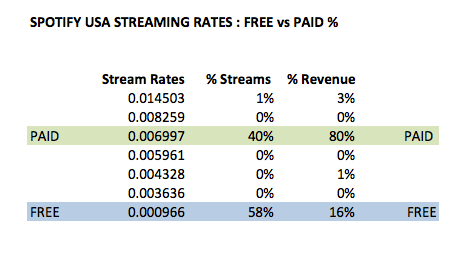
.002 is DOUBLE .001 which is what Spotify is paying on it’s ad-supported free tier (see chart below). Yes, we’d love Apple to pay the full ride. Yes, Apple can afford to pay the full ride. Yes, we support any action that influences Apple to pay the full ride – but as a compromise we could be doing worse, and in fact we have been for over five years since the Spotify launch.

Three:

90 Days is Limited. Ad-Supported is forever. This is the big problem. Even if  Spotify was limiting their ad-supported free tier to 90 Days, Apple is still paying DOUBLE. But the real problem is that Spotify is FREE FOREVER. It’s time to keep the eye on the prize here.

Three Steps to a Sustainable Digital Music Ecosystem:

1) Eliminate the Unlimited Free, Ad-Supported, On-Demand Access to Music

2) Windowing

3) Tiered Pricing, based on Access and Consumer Value Proposition

That’s really it. It’s not really any harder than this and we can already see these models working for the Film and TV businesses.


Streaming Is the Future, Spotify Is Not. Let’s talk Solutions.


Why Spotify is not Netflix (But Maybe It Should Be)


Why Digital Exec’s ARPU is Bad Math and also Bad Philosophy for Artists.