Grooveshark “Offline by Christmas”… | Digital Music News

Infringement should not be a business model.

On September 29th, the United States District Court in Manhattan found Grooveshark guilty of massive copyright infringement, and specifically named CEO Sam Tarantino and CTO Josh Greenberg as bad actors. Now, the curtains are starting to drop: just days after that decision was rendered, federal judge Thomas Griesa issued another decision that removed all doubt that the plaintiffs — a total of 9 recording labels — had triumphed in the case.

READ THE FULL POST AT DIGITAL MUSIC NEWS:
http://www.digitalmusicnews.com/permalink/2014/11/21/grooveshark-offline-christmas

Absolute Must Read : How To Make Streaming Royalties Fair(er) | Medium

The record industry has completely disconnected the relationship between artists and their fans whereby the artists catalog is now an aggregated asset to leverage (the label’s) equity in a tech start up that is subsidized by musicians. Not cool.

This is an excellent piece by Sharky Laguna that looks at how all models utilizing divisible revenue pools are fundamentally unfair to the relationship between the artist and the fan. In short, the plays by each consumer should be compensating ONLY the artists that, that person plays (makes sense, right?). Further more 100% of the consumers subscription fee should only pay the artists that individual listens too – no matter how few or how many plays the consumer gives each artist.

Under this proposed revised accounting method, each consumer is once again reconnected directly to the artists they chose to support. This is exactly the kind of thinking that should be happening at the labels and music tech companies.

In a nutshell: Royalties should be paid based on subscriber share, not overall play share.

If I pay $10 and during that month I listen exclusively to Butchers Of The Final Frontier, then that band should get 100% of the royalties. I didn’t listen to anyone else, so no one else should get a share of the $7 that will be paid out as royalties from my subscription fee.

Please read the full post at MEDIUM:
https://medium.com/@sharkyl/how-to-make-streaming-royalties-fair-er-8b38cd862f66

USA Spotify Streaming Rates Reveal 58% of Streams Are Free, Pays Only 16% Of Revenue

Since we published the Streaming Price Bible we’ve been getting data submissions to crunch the numbers. According to one set of data it appears Spotify is reporting seven different streaming rates (in a single month). But the most interesting discovery in the data is the percentage of free streaming volume and revenue versus paid streaming volume and revenue.

We knew there were two price tiers (Free & Paid) but we didn’t anticipate discovering the other five tiers, even as limited as they are.

StreamingRatesandPercentagesUSA


As we had suspected, the majority of consumption is generating the least amount of revenue.

Oh, and for those of you keeping score at home the net summed per stream rate, for all streams divided by all revenue is .00352 in the aggregate. That’s .00169 per stream LESS than reported earlier this year in the Streaming Price Bible of .00521. Just another indication that as streaming models mature the price per stream will continue to drop. Add to this that even Spotify executives have admitted as much.


FreePaidChart

If you have data that looks different than ours, send it our way and let us crunch it. This is the problem when there is such a profound lack of openess and transparency. There also appears to be an overall lack of consistency. Let’s have some real “disruptive innovation” by “sharing” our Spotify statements and comparing the numbers.

[The per play rates noted above are aggregated. In all cases the total amount of revenue is divided by the total number of the streams per service  (ex: $5,210 / 1,000,000 = .00521 per stream). Multiple tiers and pricing structures are all summed together and divided to create an averaged, single rate per play.]

RELATED:

Apple Announces Itunes One Dollar Albums and Ten Cent Song Downloads In Time For The Holidays! | Sillycon Daily News


Who will be the First Fired Label Execs over Spotify Fiasco & Cannibalization?


Streaming Is the Future, Spotify Is Not. Let’s talk Solutions.


Music Streaming, New Money Vs. Old and the Market Cap of All Music… | The Cynical Musican

A must read post from The Cynical Musician:

“In a hypothetical future that is nothing but streaming (a depressingly real possibility, given that everything but streaming is going down the drain), the size of the industry is capped at 70% of streaming service revenue. There’s no way to grow the industry, because there’s no new money coming in. The subscription revenue pays for all present and future consumption, it doesn’t matter how many (or few) hot new releases there are. In fact, it doesn’t even matter what music is on the service or how popular it is. The size of the pie is fixed from the start.”

READ THE FULL POST HERE:
http://thecynicalmusician.com/2014/11/new-money/

The Streaming Price Bible – Spotify, YouTube and What 1 Million Plays Means to You!

Several of our posts on streaming pay rates aggregated into one single source. Enjoy…

[UN to Airlift Calculators, Behavioral Economics Textbooks to Digital Music Industry]
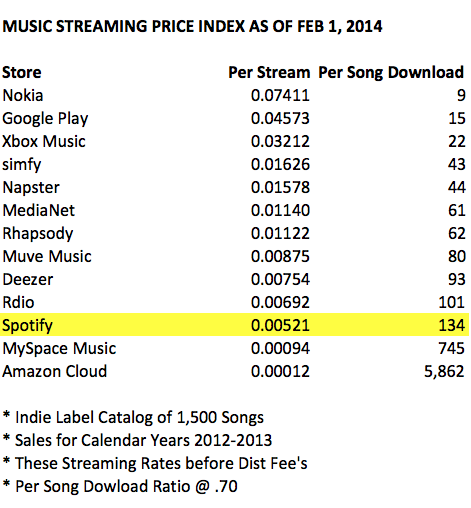
musicstreamingindex020114[EDITORS NOTE: All of the data above is aggregated. In all cases the total amount of revenue is divided by the total number of the streams per service  (ex: $5,210 / 1,000,000 = .00521 per stream). In cases where there are multiple tiers and pricing structures (like Spotify), these are all summed together and divided to create an averaged, single rate per play.]

If the services at the top of the list like Nokia, Google Play and Xbox Music can pay more per play, why can’t the services at the bottom of the list like Spotify and YouTube?

We’ll give you a hint, the less streams/plays there are the more each play pays. The more plays there are the less each stream/play pays. Tell us again about how these services will scale. Looking at this data it seems pretty clear that the larger the service get’s, the less artists are paid per stream.

So do you think streaming royalty rates are really going to increase as these services “scale”? No, we didn’t either.

[ BREAKING! Apple Announces Itunes One Dollar Albums and Ten Cent Song Downloads In Time For The Holidays! | Sillycon Daily News ]
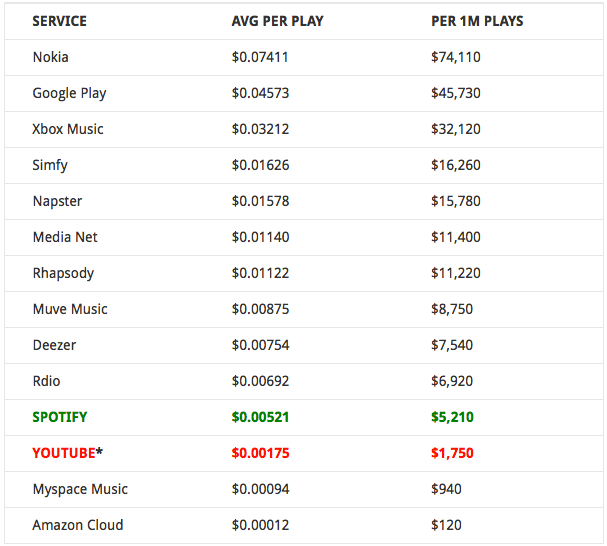
 

StreamingPriceIndexwYOUTUBE

We’ve been waiting for someone to send us this kind of data. This info was provided anonymously by an indie label (we were provided screenshots but anonymized this info to a spreadsheet). Through the cooperative and collaborative efforts of artists such as Zoe Keating and The Cynical Musician we hope to build more data sets for musicians to compare real world numbers.

In our on going quest for openness and transparency on what artists are actually getting paid we’d love to hear from our readers if their numbers and experience are consistent with these numbers below. At the very least, these numbers should be the starting point of larger conversations for artists to share their information with each other.

Remember, no music = no business.

whatyoutubereallypaysFor whatever reason there appear to be a lot of unmonetized views in the aggregate. So let’s just focus on the plays earning 100% of the revenue pool in the blue set. These are videos where the uploader retains 100% of the rights in the video including the music, the publishing and the video content itself.

Plays  Earnings  Per Play
2,023,295 $3,611.84 $0.00179
1,140,384 $2,155.69 $0.00189
415,341 $624.54 $0.00150
240,499 $371.47 $0.00154
221,078 $313.47 $0.00142
TOTALS TOTALS AVERAGE
4,040,597 $7,077.01 $0.00175

So it appears that YouTube is currently paying $1,750 per million plays gross.

We understand that people reading this may report other numbers, and that’s the point. There is no openness or transparency from either Spotify or YouTube on what type of revenue artists can expect to earn and under what specific conditions. So until these services provide openness and transparency to musicians and creators, “sharing” this type of data is going to be the best we’re going to be able to do as East Bay Ray comments in his interview with NPR.

As we’re now in a world where you need you need a million of anything to be meaningful here’s a benchmark of where YouTube ranks against Spotify.

Service  Plays  Per Play  Total  Notes 
Spotify To Performers/Master Rights 1,000,000 0.00521 $5,210.00 Gross Payable to Master Rights Holder Only
Spotify To Songwrtiers / Publishers This revenue is for the same 1m Plays Above 0.000521 $521.00 Gross Payable to Songwriter/s & Publisher/s (estimated)
YouTube Artist Channel 1,000,000 0.00175 $1,750.00 Gross Payable for All Rights Video, Master & Publishing
YouTube CMS (Adiam / AdRev) ** 1,000,000 0.00032 $321.00 Gross Payable to Master Rights Holder Only

The bottom line here is if we want to see what advertising supported free streaming looks like at scale it’s YouTube. And if these are the numbers artists can hope to earn with a baseline in the millions of plays it speaks volumes to the unsustainability of these models for individual creators and musicians.

Meet the New Boss: YouTube’s Monopoly on Video | MTP

It’s also important to remember that the pie only grows with increased revenue which can only come from advertising revenue (free tier) and subscription fees (paid tier). But once the revenue pool has been set, monthly, than all of the streams are divided by that revenue pool for that month – so the more streams there are, the less each stream is worth.

All adrev, streaming and subscription services work on the same basic models as YouTube (adrev) and Spotify (adrev & subs). If these services are growing plays but not revenue, each play is worth less because the services are paying out a fixed percentage of revenue every month divided by the number of total plays. Adding more subscribers, also adds more plays which means that there is less paid per play as the service scales in size.

This is why building to scale, on the backs of musicians who support these services, is a stab in the back to those very same artists. The service retains it’s margin, while the artists margin is reduced.

[** these numbers from a data set of revenue collected on over 8 million streams via CMS for an artist/master rights holder]

Here’s what 1 million streams looks like from different revenue perspectives on the two largest and mainstream streaming services.

Service  Units Per Unit  Total  Notes 
Spotify 1,000,000 $0.00521 $5,210.00 Gross Payable to Master Rights Holder Only
Spotify same million units as above $0.00052 $521.00 Gross Payable to Songwriter/s & Publisher/s (est)
YouTube 1,000,000 $0.00175 $1,750.00 Gross Payable for All Rights Video, Master & Publishing
YouTube CMS Master Recording (Audiam / AdRev) 1,000,000 $0.00032 $321.00 Gross Payable to Master Rights Holder Only
STREAMING TOTALS  3,000,000 $7,802.00 TOTAL REVENUE EARNED FOR 3 MILLION PLAYS ON SPOTIFY AND YOUTUBE 
Itunes Album Downloads 1,125 $7.00000 $7,875.00 Gross payable including Publishing

Here are some compelling stats on the break down of what percentage of videos on YouTube actually achieve breaking the 1 million play threshold, only 0.33%

CHART OF THE DAY: Half Of YouTube Videos Get Fewer Than 500 Views | Business Insider

Some 53% of YouTube’s videos have fewer than 500 views, says TubeMogul. About 30% have less than 100 views. Meanwhile, just 0.33% have more than 1 million views.

That’s not a huge surprise. But it highlights some of the struggles Google could have selling ads around all those unpopular videos, despite the money it has to spend to store them.

An artist needs to generate THREE MILLION PLAYS on the two largest and most popular streaming platforms to equal just 1,125 album downloads from Itunes. This is an important metric to put in context. In 2013 only 4.8% of new album releases sold 2,000 units or more. So if only 4.8% of artists can sell 2,000 units or more, how many artists can realistically generate over four million streams from the same album of material?

in 2013 there were 66,565 new releases, only 3,237 sold more than 2,000 units = 4.8% of new releases sold over 2,000 units

in 2013 there were 915,482 total releases in print, only 14,856 sold more than 2,000 units = 1.6% of ALL RELEASES in print sold more than 2,000 units.

This is even more important when you start to consider that many artists feel that growing a fan base of just 10,000 fans is enough to sustain a professional career. Note we said solo artists because these economics probably need to be multiplied by each band member added for the revenue distribution to remain sustainable. So a band of four people probably need a sales base of 40,000 fans to sustain a professional career for each member of the band.

Each 10,000 albums sold on iTunes (or 100,000 song downloads) generates $70,000 in revenue for the solo artist or band. To achieve the same revenue per 10,000 fans in streams, the band has to generate 30 million streaming plays (as detailed above) if they are distributing their music across the most common streaming services including Spotify and YouTube.

In 2013 the top 1% of new releases (which happen to be those 620 titles selling 20k units or more) totaled over 77% of the new release market share leaving the remaining 99% of new releases to divide up the remaining 23% of sales.

This appears to confirm our suspicion that the internet has not created a new middle class of empowered, independent and DIY artists but sadly has sentenced them to be hobbyists and non-professionals.

Meanwhile the major artists with substantial label backing dominate greater market share as they are the few who can sustain the attrition of a marketplace where illegally free and consequence free access to music remains the primary source of consumption.

What’s worse is that it is Silicon Valley corporate interests and Fortune 500 companies that are exploiting artists and musicians worse than labels ever did. New boss, worse than the old boss, indeed.

So whose feeling empowered?

RELATED:

UN to Airlift Calculators, Behavioral Economics Textbooks to Digital Music Industry

Streaming Is the Future, Spotify Is Not. Let’s talk Solutions.

Who will be the First Fired Label Execs over Spotify Fiasco & Cannibalization?


How to Fix Music Streaming in One Word, “Windows”… two more “Pay Gates”…

We’ve written about this before in two posts, Why Spotify is not Netflix (But Maybe It Should Be) and Streaming Is the Future, Spotify Is Not. Let’s talk Solutions. In Both posts we talk at length about how the problem is not technology or streaming itself, but rather the very restricted business models and poor economics that currently exist. No amount of selective double speak from Daniel Ek will change the bad math that Spotify can not scale at current rates.

Jason Aldean now joins Taylor Swift in removing his music from Spotify which leads us to wonder how many more artists with the ability to do so will remove their new releases and/or catalogs as well. This may also be a good time to revisit those two previous posts mentioned above.

So here is the question, is the record business really utilizing the new digital platforms correctly to address the current market place? Perhaps by looking at the options available to consumers from movie streaming, rental and download businesses we can find more robust and flexible opportunities for artists.

At the very least windowing releases allows artists, their managers and even labels the ability to manage and maximize current revenue streams more effectively. Windowing opens up strategic decisions about tier based pricing relative to the value proposition for both the artist and the consumer. Windowing may not fix all of the problems artists are facing in music streaming but it will be a great first step towards recognizing that the artists should have some direct participation in deciding how their work is consumed.

It’s not that streaming can’t work. It can. It’s that Spotify is a bad business model that has unsustainable economics and exploits artists because it is a wall street financial instrument and not a music company.

Pay Gates may be another solution (which is essentially a window). For example, Spotify premium paid subscribers could access the new Taylor Swift record, but not those using the free version of the service. This also allows artists to determine which songs can be accessed for free for greater promotional value, and which songs are intended to maximize revenue.

Why does Spotify unilaterally get to dictate to artists, managers and labels how to best maximize their relationships and revenues with their own fans?

As Spotify is a destination platform, and not a discovery platform we could see where the current hit singles are only available to paid subscribers while select album tracks could be accessible for free. The tracks on the free tier are monetized only by advertising revenue which pays very little, but there may be a promotional benefit to build awareness on lesser know songs.

Even the old school record business had tier based pricing. There were front-line, mid-line and budget pricing tiers. Front-line titles were often deeply discounted for premium in-store positioning. Mid-line titles were discounted as an incentive to stimulate more sales from recent catalog titles. Budget titles were mostly oldies and very deep back catalog. Primitive as they were, these were windows.

Yes, we know the choir of “or else they’ll steal it” from piracy apologists will claim that anything less the complete devaluation of music as fodder for advertising revenue is pointless. We’ll take our chances with Jason Aldean, Taylor Swift, Adele, Coldplay, Beyonce’, The Black Keys, Thom Yorke and the growing number of artists that are either removing their catalogs from Spotify, or windowing them.

Bring on the windows and pay gates! Let’s see some “innovation” and “disruption” that actually works for artists and not just the new boss. The outcry (from Spotify) of artists removing their songs also proves another very important point – all music is not equal. If some weekend hobbyist does not put their music on Spotify or pulls it off Spotify it doesn’t make headlines. Taylor Swift, Adele, Beyonce, The Black Keys, Thom Yorke, etc – all make headlines because people  actually do VALUE professional music. Professional music, has a professional price.

If Spotify is such a good business for artists, why not let each artist decide if Spotify works for them? Why does Spotify publicly shame artists to convince them how good they are? The lady doth protests too much, wethinks…

It’s funny how long it’s taken the record industry to realize that if you keep allowing something to be given away for free there is no incentive to pay. Who knew?

calculator


RELATED:

Why Spotify is not Netflix (But Maybe It Should Be)


Streaming Is the Future, Spotify Is Not. Let’s talk Solutions.


Spotify’s Daniel Ek is Really Bad At Simple Math, “Artists Will Make a Decent Living Off Streaming In Just a Few Years”

Jay Frank’s Magical Mystery Streaming Math… Or, Brotha Can Ya Spare A Calculator?

Music industry exec and blogger Jay Frank commented on our post BUT SPOTIFY IS PAYING 70% OF GROSS TO ARTISTS, ISN’T THAT FAIR? NO, AND HERE’S WHY…. Jay’s comment is typical of the thinking that has landed the record industry where it is today (losing money and in trouble).

It’s hard to tell from the comment whether Jay actually believes what he’s saying in the same way someone who bought a million dollar house with no money down, on a zero percent, 5 year ARM convinced themselves there was no housing bubble…

If they [Spotify] go from 10m to 100m free users, they’ll be able to charge much larger premium rates, and may even strike deals with some acts. That could easily result in $1b in artist royalties, given some other media models. This now puts Spotify at $3.5b in artist royalties per year. Pretty good.

To your point, though, that’s still half of the $7b number you put out there.

Right, no kidding “that’s still half of the $7b number”. To be fair to Jay, you should read his whole comment in context at the link above.

However, by his own admission he is still coming up short by $3.5b. If you factor that in with the analysis of the projected revenue losses from YouTube’s Music Key that’s another estimated $2.3b in the hole. But the simple truth is much easier to see, revenue keeps dropping as it has for the past 13 years while piracy apologists and digital music snake oil salesmen have yet to show any increase in actual overall net revenue from recorded music sales.

YouTube’s MusicKey Will Cause $2.3 Billion In Music Industry Losses… | Digital Music News
http://www.digitalmusicnews.com/permalink/2014/11/03/youtubes-musickey-will-cause-2-3-billion-music-industry-losses

By Jay’s logic, digital albums would sell for one dollar not ten while digital song downloads would be priced at ten cents and not one dollar. That’s not the case for good reason and illustrates quickly and effectively why Spotify paying 70% of gross is moot. We don’t think labels would agree to getting paid 70% on one dollar album albums and ten cent songs. Of course the labels don’t have 18% equity in Itunes either…

The larger truth and common sense is that Spotify economics don’t work in the same way $1 album downloads and $.10 song downloads don’t work – there’s not enough scale to make the economics sustainable. If Jay truly thinks you can more than double the revenue from transactional downloads by reducing the price by 90% we’ve got a bridge in Brooklyn we’d like to sell him very cheap.

In terms of “highly selective math” Jay continues his comment from above:

To your point, though, that’s still half of the $7b number you put out there. True, but that presumes that Spotify is the only player in town. While they may be a major force, there will also be other internet radio, satellite radio, video streaming, other streaming competitors and probably still physical and digital retail sales. Add to that greater ubiquity in tracking usage with increasing penetration of smart mobile devices combined with declining mobile data cost…and I feel like we’re starting to approach $10b a year.

And that’s just the U.S.

Ok, so let’s see that $10b a year in revenue streams plotted out and lets take a closer look at it. Here’s what subscription based services look like right now. Netflix only has 36m subscribers in the US, no free tier, and massive limitations on available titles of both catalog and new releases. Sirius XM, 26.3m in the US as a non-interactive curated service installed in homes, cars and accessible online. Premium Cable has 56m subscribers in the US paying much more than $10 a month and also with many limitations. Spotify… 3m paid subscribers in the US after four years.

Tell us again about this strategy of “waiting for scale.” Spotify is Three Million PaidThree… Oh, and that’s just the U.S.

* 3m Spotify Subs Screen Shot
* 26.3m Sirius XM Subs Screen Shot
* 36m Netflix Subs Screen Shot
* 56m Premium Cable Subs Screen Shot
* $7b Music Business Screen Shot

Hey, it’s just math… but in the meantime Jay, you may want to look at this:

Streaming Isn’t Saving the Music Industry After All, Data Shows… | Digital Music News
http://www.digitalmusicnews.com/permalink/2014/06/26/streaming-isnt-saving-music-industry-new-data-shows

A Detailed Explanation on Why Streaming Has Failed… | Digital Music News
http://www.digitalmusicnews.com/permalink/2014/10/02/detailed-explanation-streaming-failed

You can email Paul Resnikoff at paul@digitalmusicnews.com

calculator


RELATED:

Streaming Is the Future, Spotify Is Not. Let’s talk Solutions.

Music Streaming Math, Can It All Add Up?

Who will be the First Fired Label Execs over Spotify Fiasco & Cannibalization?


BUT SPOTIFY IS PAYING 70% OF GROSS TO ARTISTS, ISN’T THAT FAIR? NO, AND HERE’S WHY…

Spotify is not paying sustainable rates for the cost of goods. Look – it’s like this, if something cost you $100 to make, and someone else sells it for $10… it doesn’t matter that you are getting 70% of the gross, you’re still over 90% unrecouped on a per unit basis. This is the problem with Spotify, is that it undervalues the true cost of goods (including R&D, etc).

Artists agreeing to streaming their music on Spotify are essentially agreeing to sell albums for One Dollar and Songs for Ten Cents… Oh Wait, Spotfiy actually pays way less than that… (calculated on a per stream basis).

This is why arguments about marginal percentages miss the point completely. It’s about simple math and simple economics.

The cost of music is not in the distribution of music (which is cheap). The cost of music is in the human labor of the CREATION of music (which is expensive).

The cost of goods is greater than the marginal cost to distribute those goods. Stop confusing the product with the container.

The CREATION of music is also more than the cost of RECORDING music. The cost of music is in the sustainable needs of the human labor for food, shelter, clothing, etc.

Spotify can not scale and work at current economics… One More Time…

SPOTIFY MATH FOR THOSE OF YOU AT HOME WITH CALCULATORS:

Just show us the math where streaming scales, we’ll wait. Spotify has 3m paid in the US at $10 each.

$10 x 12 mos = $120 per year. Pay out 70% that’s a gross of $84 per year per subscriber. Simple Math.

That $84 per sub is in revenue to all artists in rights holders. Times that by 3m and you get a whopping $252m a year in a $7b business.

Multiple that by 10, to get 30m subs @ $10a month and that’s only $2.5b a year… and that’s a big IF Spotify ever gets to 30m paid in the USA… and IF they do, that’s ONLY 2.5b in revenue against the $7b now…

So you effectively cut the revenue to everyone by 1/2 to 2/3rds… how does this math work without raising the price of subscriptions? It doesn’t.

It’s just math.


calculator


RELATED:

Music Streaming Math, Can It All Add Up?

Who will be the First Fired Label Execs over Spotify Fiasco & Cannibalization?

Streaming Is the Future, Spotify Is Not. Let’s talk Solutions.

Why Taylor Swift Is Winning The War On Streaming – It’s About The Math Silly, not Technology…

Streaming is Good, the Economics are bad – Get It?

There’s a media pile on claiming that Taylor Swift is going to lose her war on streaming… really? Is there a war on streaming? No. There is no war on streaming. The battle is over economic injustice, not technology. We’ve written about this before…

Streaming Is the Future, Spotify Is Not. Let’s talk Solutions.

and

Why Spotify is not Netflix (But Maybe It Should Be)

The record business would do well to look at the solutions and marketplace that the film industry has developed with varied and robust consumer options in the streaming landscape. These include different access and payment models, not one business for all.

So let’s get this straight, and go right to the heart of the issue. It’s just math, and it’s simple math at that. We’ll ask again if anyone can show us how streaming scales to sustainability for artists and rights holders. Let’s see it, because this is how it looks to us…

SPOTIFY MATH FOR THOSE OF YOU AT HOME WITH CALCULATORS:

Spotify has ONLY 3m paid in the US at $10 each.

$10 x 12 mos = $120 per year. Pay out 70% that’s a gross of $84 per year per subscriber. Simple Math.

That $84 per sub is in revenue to all artists in rights holders. Times that by 3m and you get a whopping $252m a year in a $7b business.

Multiple that by 10, to get 30m subs @ $10a month and that’s only $2.5b a year… and that’s a big IF Spotify ever gets to 30m paid in the USA… and IF they do, that’s ONLY 2.5b in revenue against the $7b now…

So you effectively cut the revenue to everyone by 1/2 to 2/3rds… how does this math work without raising the price of subscriptions? It doesn’t.

It’s just math.

So please get your arguments right. No one is arguing against streaming as a technology or distribution mechanism. They are arguing over the fact that these piss poor business models can not exist or operate without artists subsidizing VC funded or publicly held companies.

If these business models are so bad that they can not afford to pay for the cost of goods to maintain a sustainable ecosystem it’s time to go back to the drawing board and start over. That has nothing to do with streaming, technology or distribution and everything to do with exploitative economic injustice.

It’s just math silly.


When Iggy Pop can’t live off his art, what chance do the rest have? | The Globe and Mail

But a new reality has tripped him up and it’s the same one shafting artists all across the world: Namely, that everyone wants to listen, and no one wants to pay. This week, Iggy gave a lecture for the British Broadcasting Corp. called Free Music in a Capitalist Society. Artists have always been ripped off by corporations, he said; now the public is in on the free ride, too: “The cat is out of the bag and the new electronic devices, which estrange people from their morals, also make it easier to steal music than to pay for it.”

To keep skinny body and maverick soul together, Iggy’s become a DJ, a car-insurance pitchman and a fashion model. If he had to live off royalties, he said, he’d have to “tend bars between sets.” As I listened to his enthusiastic stoner Midwestern drawl, I thought: If Iggy Pop can’t make it, what message does that send to all the baby Iggys out there? In a society where worth is judged by price, for better or worse, what are you saying to someone when you won’t pay for the thing he’s crafted?

READ THE FULL STORY AT:
http://www.theglobeandmail.com/globe-debate/when-iggy-pop-cant-live-off-his-art-what-chance-do-the-rest-have/article21154663/