Music Streaming Now Generates Trillions Of Plays — But Are Royalties Keeping Up? | Billboard

A lot of advertising gets slathered on A Trillion Streams, and served to the most highly prized consumer demographic… no wonder Google/YouTube, Spotify and Pandora are so opposed to non-free, subscription based models that could actually compensate musicians and songwriters fairly.

The headline number in the report is 1,032,225,905,640, or 1.03 trillion, the number of song plays on Pandora, Rdio, Spotify, SoundCloud, Vevo, Vimeo and YouTube that the company tracked in the first six months of this year. It’s a startling number, much larger than anything we’ve seen before it.

It’s safe to say not all 1.03 trillion plays were royalty-bearing streams. Some had a royalty in the 0.05 to 0.1 cents per stream range typical of subscription services. Many of the Pandora streams had a U.S. statutory rate for pure-play webcasters of 0.14 cents plus a smaller amount for publishers (some Pandora streams had a higher royalty applied to streams by subscribers). And SoundCloud, a new entrant to licensed, monetized streaming, most certainly had many non-monetized streams.

Yes, it’s safe to say not all 1.03 trillon plays were royalty-bearing streams. No kidding. For most musicians and songwriters a trillion streams still means the same thing, a couple hundred bucks, if they’re lucky…

READ THE FULL STORY AT BILLBOARD.COM
http://www.billboard.com/biz/articles/6663811/music-streaming-now-generates-trillions-of-plays-but-are-royalties-keeping-up

UK police are waging war on piracy sites’ funding — and it’s working | Business Insider

Ad Funded Piracy. Follow The Money. It’s not about sharing, it’s about profits.

Most big piracy sites don’t charge their users a fee, but are still able to profit off of copyright infringement. Why? Because the operators plaster their pages in advertising.

But British police now say they are making major headway in tackling this: On Wednesday, the Police Intellectual Property Crime Unit (PIPCU) announced that Operation Creative, launched in 2013, has led to a 73% decline in advertising “from the UK’s top ad spending companies on copyright infringing websites.”

READ THE FULL POST AT BUSINESS INSIDER:
http://www.businessinsider.com/operation-creative-piracy-73-percent-decrease-pipcu-2015-8

Pay the Band | Memphis Flyer

Brice S Newman of Memphis details why support for the Fair Play, Fair Pay bill is essential for all musicians and creators to support.

There are four parts to the initiative, which includes a comprehensive bill that gives music creators pay parity. First, legislation would establish a process for setting fair-market royalty rates, not some pathetic low royalty rate that is decades old.

Second, the legislation would create a performance right for artists on terrestrial radio in the U.S., so that artists can get paid when their performances are on the radio. This is how it’s done in much of the rest of the world.

Third, this legislation would close a 1972 loophole and would guarantee that veteran performers receive royalties.

Fourth, the legislation would codify royalty payments to producers — the people behind the songs. If we can make all this happen, I am sure we will be paid back many times over in good music that’s been created by musicians who deserve to make a living.

READ THE FULL STORY AT THE MEMPHIS FLYER:
http://www.memphisflyer.com/memphis/pay-the-band/Content?oid=4073778

Michael Price: Composer for Sherlock blames Google and YouTube for suppressing rewards songwriters receive | Independent UK

More artists, performers, songwriters and composers are getting it.

“YouTube are effectively paying incredibly low rates and are not a willing partner to negotiate licences and that pulls down the rates from someone like Spotify, which has to compete in their free service with YouTube,” he told The Independent on Sunday.

“The value from the music we create is being sucked out into the companies that aggregate it, [but] YouTube … are not happy to set adequate streaming rates. There is a huge shift of value from artists to tech companies.”

READ THE WHOLE STORY AT THE INDEPENDENT UK:
http://www.independent.co.uk/news/media/michael-price-composer-for-sherlock-blames-google-and-youtube-for-suppressing-rewards-songwriters-receive-10447054.html

Did Google & YouTube just Scam The Entire Record Business into Free Streaming Licenses? MusicKey is MIA…

Remember all the controversy over YouTube’s ad-free streaming subscriber service, MusicKey? If the words “Google” and “Ad-Free” sound like a complete contradiction, you are not alone.

MusicKey_AdFree

Ok, so where is it? We tried to sign up, but we’ll be notified later when the service is available.

whenMusicKey

Remember how one of the requirements was ALL OF YOUR MUSIC also had to be licensed for FREE STREAMING on YouTube or your promotional videos would be blocked or banned from the site?

Did you forget? No worries, here is the recap from Zoe Keating’s blog that brought the issue to light.

1) All of my catalog must be included in both the free and premium music service. Even if I don’t deliver all my music, because I’m a music partner, anything that a 3rd party uploads with my info in the description will be automatically included in the music service too.

2) All songs will be set to “montetize”, meaning there will be ads on them.

3) I will be required to release new music on Youtube at the same time I release it anywhere else. So no more releasing to my core fans first on Bandcamp and then on iTunes.

4) All my catalog must be uploaded at high resolution, according to Google’s standard which is currently 320 kbps.

5) The contract lasts for 5 years.

So, “All songs will be set to “montetize”, meaning there will be ads on them.” That’s one hell of a trade-off to get some subscription money, but maybe it won’t be so bad once that MusicKey money starts rolling in right? YouTube and Google have a HUGE amount of users to convert to PAYING SUBSCRIBERS, right?

Hahahahahahahahahaa. You fell for that gag? Seriously? Here’s what YouTube says about that little side business of PAID SUBSCRIBERS…in an interview between YouTube Senior Exec Robert Kyncl and Music Ally: YouTube Music Key delay ‘nothing too serious’ says senior exec.

“We’ll always have ad-supported: that’s our core, and we’ll never stop focusing on it.  It’s in Google’s DNA to be in the ad-supported business.

Subscription is just an add-on. It’s an adjacent business that we’re building.”

Suckas… You seriously thought Google who has slathered the internet with advertising on “User Pirated Content” across multiple platforms was going to pivot to a paid subscription model to move away from advertising on it’s flagship video streaming site? Really? Seriously?

You saw that five year term, right? So MusicKey is a no show for subscriber revenue but thanks to that five year term the largest streaming service in the world, that pays the least amount per stream now has licenses for the next half decade. As the kids say, LOL.

Don’t worry about MusicKey not showing up anytime soon with that Paid Subscriber Money, in the meantime enjoy your life’s work as a YouTube auto-generated music video and playlist, for free.

Oh MusicKey we would have loved to have known you – now all we have is our catalogs of master recordings being monetized on old-school YouTube for pennies on the dollar of every other streaming service including Spotify. Wow, just wow.

And Speaking of Spotify, guess who has a seat on the board to make sure that their “ad-supported DNA” remains the primary focus of that music streaming service? Three guesses… Yup, it’s Google.

Here’s a trip down MusicKey memory lane…

April 2014 : Exclusive: ‘YouTube Music’ Is Launching This Summer… | Digital Music News

June 2014 : Artists who don’t sign with YouTube’s new subscription service to be blocked [Updated] | Ars Technica

June 2014 : F*&K It: Here’s the Entire YouTube Contract for Indies…| Digital Music News

November 2014: YouTube’s MusicKey Will Cause $2.3 Billion In Music Industry Losses… | Digital Music News

January 2015 : YouTube Is Removing Any Artist That Refuses to License Its Subscription Service…| Ars Technica

April 2015 : If You Don’t Agree to YouTube’s New Ad-Free Terms, Your Videos Will Disappear…|Digital Music News

June 2015 : YouTube Music Key delay ‘nothing too serious’ says senior exec | Music Ally

Exhausting… Why would anyone trust these people? All hail “User Pirated Content“… and if that doesn’t work just come up with a non-existent paid subscriber streaming service that auto-generates music videos and playlists on the free, ad-supported platform. At least that part is working, right?

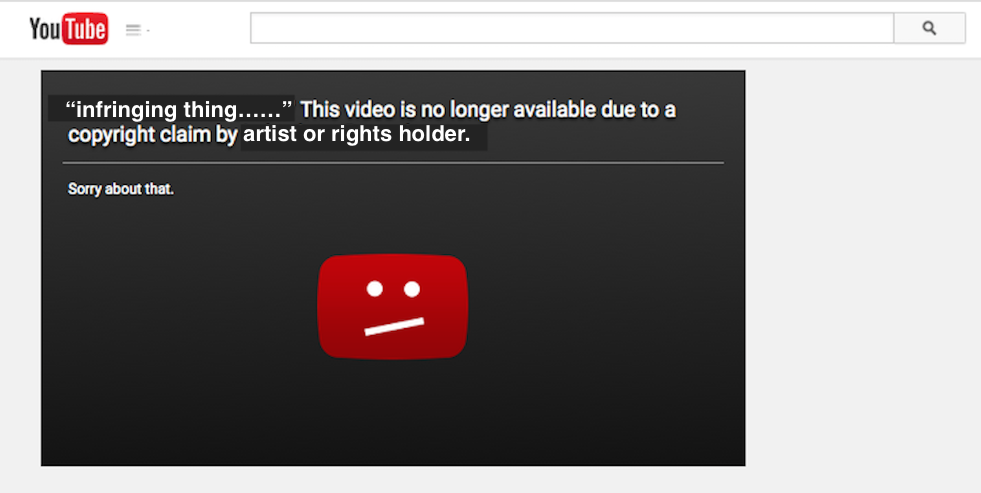
Let’s talk about transparency for a second. Why is it that YouTube would be excluded from Google’s own DMCA tracking report? It couldn’t be because DMCA notices and takedowns of infringing material YouTube dwarf even the most notorious of pirates sites say like The Pirate Bay? No, that wouldn’t be the reason would it?

553k_InfringingBusinessesMaybe #adbusters and #blackspot really do have it right…

Fun with Digital Royalties | The Cynical Musician

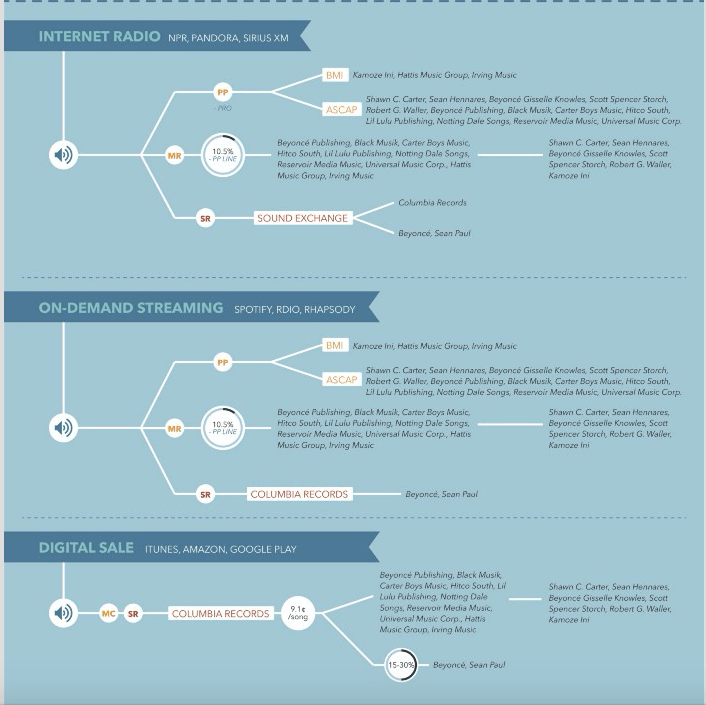
The excellent blog “The Cynical Musician” has accepted our challenge to debunk the  latest Berklee College of Music/Rethink Music set of flow charts on digital music royalty flow.  Really excellent work by Faza. It’s devastating to Berklee.  Check it out. While this whole exercise has been fun for us,  it has to be embarrassing for a $60k a year academic institution that offers a degree in the “music business” to demonstrate that they fundamentally do not understand how digital royalties work.  

The Trichordist posted a challenge to disassemble Rethink Music’s royalty chart today and I do so love a challenge. I won’t be pasting the whole of it – just the juicy bits – so make sure you read their post.

Let’s start with the breakdown of internet radio royalties:

Read the Full Post :  Fun with Digital Royalties | The Cynical Musician.

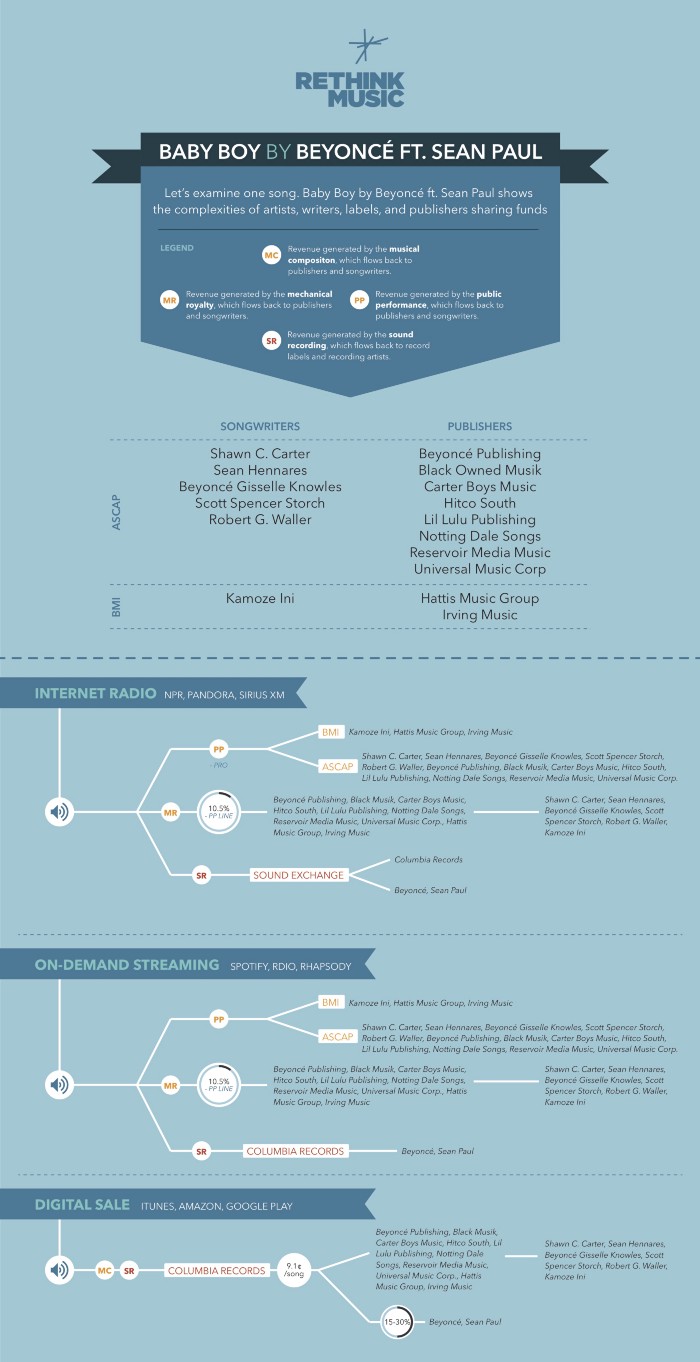
$100 Dollar Prize! Be First To Illustrate all the Flaws in this @BerkleeCollege of Music Chart


Screen Shot 2015-08-07 at 11.52.32 PM

MC = musical composition, SR = sound recording, PP = public performance, MR = Mechanical Royalty (by which they really mean the so called “streaming mechanical” ).

Berklee College of Music/Rethink Music just issued a rather defensive follow up  in response to our criticism of their original Kobalt Music/Google Ventures funded report on fair pay and transparency in the music business.

Well we must confess we’ve been laughing our asses off all day at these guys. Why? Because while Allan Bargfrede and Panos Panay have been busy taking the low road by suggesting we are luddites and comparing us to “birthers” (WTF right?), they’ve also been distributing digital royalty flow charts that are completely wrong . Guess they thought we stupid and ignorant artists wouldn’t notice.

There are at least two major errors in the flow charts above, maybe more depending on what the authors were trying to illustrate (it’s actually not clear).   I teach a music publishing and digital royalties class at UGA.    I teach undergraduates but I guarantee you that after week ten 90% of them will be able to spot the errors in these charts. I will be using these faulty charts on my tests in the fall!

So look I don’t want to come out and explain what’s wrong here. Let’s have a little fun here.  First person to most accurately describe the flaws in this chart and submit a hand drawn “markup”, chalk, paper or whiteboard illustration of the errors gets $100 “professor whiteboard” prize!  We will publish winning submission here.

Here is a link to a higher res copy.

flawed rethink music followup

http://web.archive.org/web/20150808043822/https://medium.com/@allenbargfrede/music-paid-fairly-5df29f2b3924


How to ignore YouTube completely: One Direction’s radical gamble | Music Business Worldwide

Good luck Sony, let’s see how this goes with the “User Pirated Content” at YouTube…

Search YouTube for 1D’s new comeback single Drag Me Down, and you’ll discover Harry, Niall, Louis and Liam are nowhere to be found.

Sony won’t confirm it, but the major appears to have a taskforce stamping out any attempt to upload the track onto the platform.

Why? Because One Direction are using their colossal social media presence (Twitter: 24.5m; Facebook 37m; Instagram: 9.7m) to actively push fans towards iTunes and Spotify instead.

READ THE FULL STORY AT MUSIC BUSINESS WORLDWIDE:
http://www.musicbusinessworldwide.com/how-to-ignore-youtube-completely-one-directions-radical-gamble/


YouTube’s Content ID : $375.00 Per Million Views… aka “Block In All Countries”…


What YouTube Really Pays… Makes Spotify Look Good! #sxsw


@BerkleeCollege Shows They Aren’t Serious, Responds to Our Criticism with Straw Man Argument

Professor Whiteboard Trichordist vs Berklee item 1

Berklee College of Music has still not addressed our fundamental criticism of their report. 

A few days ago I had an email conversation with Panos Panay who may or may not have authored the flawed Berklee College of Music report on transparency and fair pay in the music business.   In our conversation he indicated that he thought our list of omissions were valid criticisms of their report.  I encouraged him to issue a follow-up report or letter.

Yesterday Berklee did indeed issue a follow-up.  But it was less of an actual correction or update and more of a defensive “fuck you.”  Yes, they squandered their opportunity to have a real discussion, by following up with a bullshit straw man argument, that completely misrepresents our criticism of the report.  These guys are not interested in a real and honest discussion.  Therefore don’t expect an honest discussion at their conference either. In other words don’t waste your money.

Here’s what they say about our criticism in their follow up:
“Some have questioned the role of digital services in this debate. It is important to remember that most online music services pay 70% of their revenue to rights holders (except YouTube, who should be encouraged to pay more than their current 50%), and we believe that this technology for distribution is a good thing. It is impossible to put the “Internet genie back in the bottle” — let’s not forget that the main source of industry woes 5 years ago was piracy — and at least a business model has evolved that has people paying for music again” 

Classic straw man argument.

We don’t think “the technology” is a bad thing, and we are not trying to put the “internet genie back in the bottle.”  If you want to put it in terms of “internet genies” we are asking the internet genies to drop their NDAs and to exhibit more transparency on advertising revenues and expenses.   This is clearly illustrated in the whiteboard photo above.  Further the email record clearly  indicates that Panay understands our criticisms.  The only conclusion is that Berklee knowingly misrepresented our criticisms of their report.

This is classic demagoguing.  Trying to neutralize your critics by dishonestly claiming they are saying something they are not.  Berklee implies we are “trying to put the internet genie back in the bottle”  or somehow we are against streaming technology because they wish to portray us as hopeless luddites that are completely out of touch with the modern world. Yet facts are facts, our criticism illustrates a deeper understanding of the revenue flow in the digital world than their sloppy and biased report.

I don’t understand how someone at an academic institution can engage in this sort of demagoguing and still have a job.   My academic institution would really have a problem with me issuing an official statement in the name of the institution that engaged in this level of dishonesty.

At the very least from a public relations stand point Berklee needs to learn to stop “poking the bear.”  Especially this bear.  They just gave us at least five new posts on why rights holders and artists should NOT go to their “Rethink”  conference.


BUT SPOTIFY IS PAYING 70% OF GROSS TO ARTISTS, ISN’T THAT FAIR? NO, AND HERE’S WHY…


Why Digital Exec’s ARPU is Bad Math and also Bad Philosophy for Artists.