The always entertaining David Newhoff has an excellent new blog post on the success of efforts to reign in advertising sponsored piracy. The amount of “premium” advertising from major brands has shrunk dramatically. The advertising remaining on the sites are sketchier and the sites are now often loaded with malware.
“As many readers know, the piracy universe is still largely supported by advertising. The majority of the ads on many sites are “non-premium,” which is a polite way of saying sleazy. These are usually promos for snake-oil products, VPNS to hide your identity so you can pirate more, and “dating” services offering men the opportunity to spend hundreds of dollars to exchange sexy emails with Sabrina in Odessa, who is more likely to be Todd in Duluth.”
Everyone in this photo is directly or indirectly funded by Google. From left: ALA President Jim Neal; Re:Create Executive Director Joshua Lamel; Prue Adler, associate executive director, Federal Relations and Information Policy; Matt Schruers, vice president for law and policy at the Computer and Communications Industry Association; Jonathan Band; Katherine Oyama, senior policy counsel for Google; and Carrie Russell, director of the Program on Public Access to Information at ALA’s Office for Information Technology Policy. (Photo hot linked from American Library Magazine).
The American Library Association has honored Jonathan Band for his “service” to libraries. Complete and utter Google sponsored propaganda. They didn’t even bother to hide it.
And If you mean by “service to libraries” coming up with the most far fetched rationale for librarians to weigh in against artists and on the side of enterprise scale mass piracy operations going all the way back to Grokster? Then yes, service to libraries. Most recently they submitted an amicus in Cox v BMG case. They didn’t even have a dog in the fight. The logic of the brief (written by Band) is so tortured and convoluted I think he wrote it on acid. Just joking. Clearly it is difficult to make points that Google wants to make in a brief that is technically submitted by librarians. It’s not his fault. Although that would have been great if he actually wrote it while on acid.
But copyright and DMCA is not the only time that Band led librarians into darkness. Google’s continuing obsession with pornography, sex trafficking and minors as some kind of “internet freedom” is consistently echoed by the librarians. SESTA sponsors Senators Portman and Blumenthal should pay attention here. The ALA has encouraged members to not install filters that would prevent minors from accessing hardcore pornography on public computers. As CBN reported in February:
“The ALA Office for Intellectual Freedom told CBN News “we follow the law about providing internet access to minors, which varies from state to state,” but also explained that it opposes the indiscriminate “filtering” of sexual content. “Librarians encourage parents and children to talk with one another. Families have a right to set their own boundaries and values. They do not have the right to impose them on others,” the office said.”
8 year olds dude.
Think about this for a moment. If some fucked up parent or guardian thinks it’s okay for 8 year olds to look at XXX sites in libraries, libraries will permit that? I wonder what Child Protective Services has to say about that. We can’t wait for Band to drag libraries into the SESTA debate. Every one knows about this report right?
An extremely important blog to read on issues facing artists and rights holders. These are largely all man made problems (if by man you mean a small handful of tech company lawyers). Digital services create a problem. Blame it on rights holders and then the “solution” always seem to require sacrifices for artists. Castle doesn’t say this, but how can the reader not conclude that this is an orchestrated strategy. Take for instance the pre-1972 sound recording issue. The digital services paid royalties on the pre-1972. Then one day they stopped. All at once. As Pee Wee Herman might say “mmmm collusiony.” Then when a solution is proposed it always ends up with artists and rights holders being asked to make concessions on a problem digital services have created.
I’m not a lawyer but the whole fucking thing looks like a racket. By this I mean the trade organizations themselves, DiMA and the MIC-Coalition are behaving like a cartel or conspiracy that encourages law breaking (mass copyright infringement) that results in strong arming artists into lower prices. While these fucks thinks its some kind of game this literally takes food from the mouths of performers and songwriters children.
But here is the really fucked up thing, if one looks just below the surface there seems to be a single lawyer that pops up over and over again. Nearly every time this racket is executed we find Chris Harrison. DMX, Sirius, Pandora and now DiMA.
What the fuck did we ever do to you Mr Harrison? Can’t you find something better to do with your life?
So songwriters, performers, engineers and producers the next time you fall a little short and can’t pay that medical bill for your kids. Think about this guy. He’s at the center of the whole racket time and time again.
Read Chris Castle’s excellent Music Tech Policy summary of all the problems tech created for songwriters and performers and how these have been used as leverage against us.
It is very likely that we will hear about a move to make significant amendments to the Copyright Act at some point before the beginning of campaign season in 2018. There are a high number of copyright-related bills that have been introduced in the House of Representatives in the current session, so brace yourself for an “omnibus” copyright bill that would try to cobble them all together Frankenstein-style.
A Frankenstein omnibus bill would be a very bad idea in my view and will inevitably lead to horse trading of fake issues against a false deadline. Omnibus bills are a bad idea for songwriters and artists, particularly independent songwriters and artists, because omnibus bills tend to bring together Corporate America in attack formation.
The MIC Coalition
When you consider that Google and Facebook are part of Corporate America (not to mention Apple), the odds of the independent songwriter and artist, but…
Listen dumb asses. This isn’t our first fucking rodeo. We know what you are up to with multiple URLs of the same story. It’s called Googlewashing or Google Bombing.
Torrent Freak is trying to create noise in the search ranking system. So since they decided to step into it with us, let’s point out what we know about Torrent Freak and ask why they may be trying to mess with page rank of our story and site:
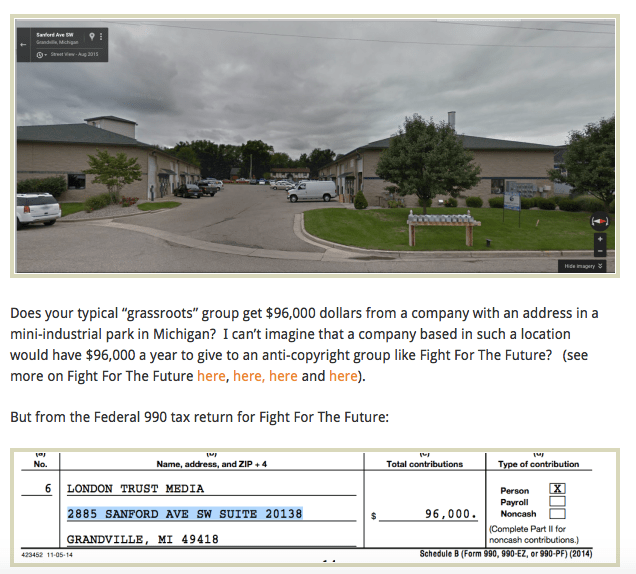
Torrent Freak apparently received money from a mysterious VPN based in an industrial park in Michigan. This company, Private Internet Access (which is in turn owned by London Trust Media) for a long time had a “hard coded” advertisement on the Torrent Freak website. It is not unreasonable to assume that this was (is) a significant source of income for Torrent Freak which has no other visible means of support. We can’t imagine they advertised/endorsed PIA/London Trust Media for free.
This same company also funds the grassroots non-profit Fight For The Future. We take Fight for the Future to task in the same article for it’s mass copyright infringement campaign against the MLK estate. Fight for the future has also hosted “hard coded” advertisements for PIA/London Trust Media. (Not even sure how that works as a tax exempt non-profit).
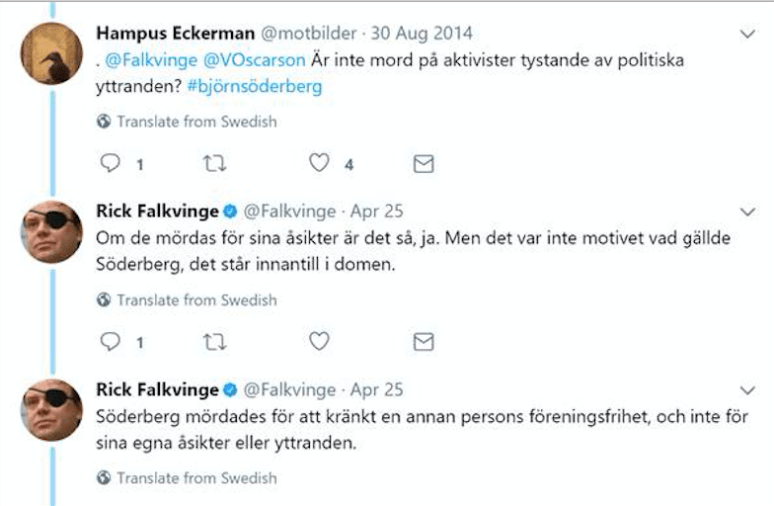
We’d also like to take this opportunity to remind everyone that Rick Falkvinge the founder of The Pirate Party is an officer at the PIA subsidiary of London Trust Media. We didn’t bring it up in the last article but Rick ” Falkvinge has his own history as a Nazi apologist. A Swedish acquaintance noted noted “(Below) is one example (in Swedish), where Falkvinge claims that the murder of labour union activist Björn Söderberg in 1999 by Nazis had nothing to political ideology, but was payback for outing the killers to media as Nazis (like that is any better).”
Not saying anything criminal is going on here with all these strange interconnections and actions. So consider this a friendly reminder. If you’re already doing something wrong, adding collusion and conspiracy is usually a penalty multiplier. It can even turn something not illegal into something illegal. Since this all essentially gets back to mass copyright infringement (a RICO predicate) you might want to be a little more careful.
The Scheißebin of History. Pirate, Nazi memorabilia collector and self confessed Hitler fan Kim Dotcom graces the cover of Wired Magazine. (Ironically this is “hot linked” from Socialist Appeal article in which they seem to praise Dotcom and Pirate Bay as somehow socialist.)
Let’s just start at the Godwin conclusion. There is no other way around it.
Why is it every time we dig a little deeper into the pro-piracy and torrenting movement we find key figures associated with “white nationalists,” Nazi memorabilia collectors, actual Nazis or other similar bigots? And why on earth do politicians, journalists and academics sing the praises of these people?
Let’s start with the heir to the Swedish Wasabröd fortune Carl Lündstrom. Lündstrom went to jail for being the money behind The Pirate Bay. Here he is on the Swedish “European heritage” oriented program Red Ice. This is from the description of his interview on the Red Ice YouTube channel:
“In the members’ hour, we discuss the impact mass immigration has had on property and housing in Sweden. Carl argues that there would be less problems now had Swedes prevented their properties from being used to house migrants. We touch on the role of the media in the ongoing invasion of Europe, with Carl telling us that the pro-refugee propaganda was targeted at prospective immigrants to make Europe seem very appealing. We discuss how these supposed refugees bring with them the very conditions which they flee, and how this process spells the end of Sweden as a safe, high-trust society. The members’ hour also covers the motivations of the elite, terrorism, and the need for idealists to take action.”
Watch the show. I wonder which “identity gang” Carl will be aligning himself with in prison? Wonder who will play him in the Swedish reboot of Oz?
How does Kim Dotcom tie his shoes?
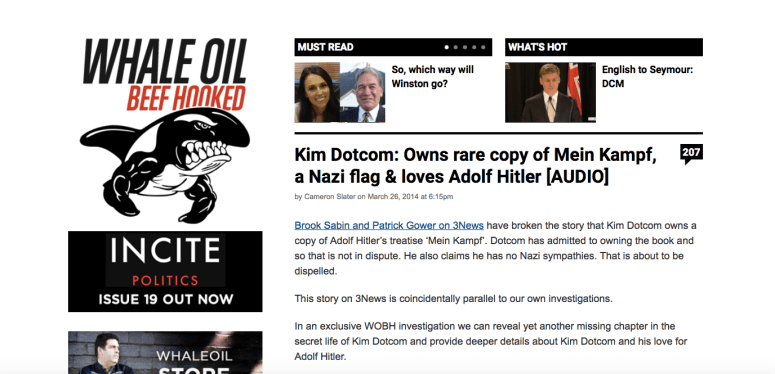
It has been widely reported that the MegaUpload founder owns a signed copy of Hitler’s Mein Kampf. Less well known are Kiwipolitical blogger Cam Slater claims that Dotcom had a Nazi flag displayed in his basement and regularly engaged in Nazi chants:
One former staff member spoken to by WOBH (who wishes to remain anonymous due to ongoing threats from Dotcom) in our ongoing investigations of the REAL secret life of Kim Dotcom has told us that regularly, at dinner, Nazi salutes would be made and Nazi chants like “Heil Hitler” and “Sieg Heil” were made, especially if the guests were mainly German.
Slater is controversial but many of his reports on Dotcom have turned out to be accurate. Certainly Dotcom’s claim that the Mein Kampf was simply an “investment” has been undermined by the surfacing of pictures of Dotcom wearing a SS Nazi helmet.
“Zwei peanuts are walking down der straße….”
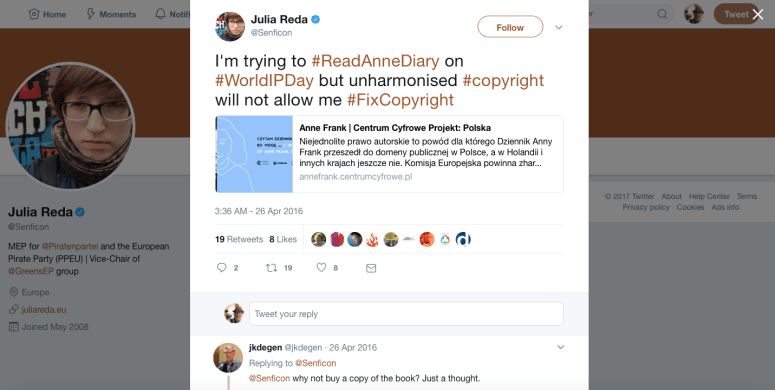
Next there is the Pirate Party’s lone European Parliament MP Julia Reda. I don’t really know what to make of her except to say that this German politician really should find something other than the Anne Frank Diary and the Anne Frank Foundation to use as an example of a work that should be freely available in the public domain. Think of all the copyrighted works out there for which she might reasonably argue a claim of public domain. She decided to pick the Anne Frank diary. Hmm.
Further as a member of EU Parliament perhaps she should refrain from actively pirating the book in collaboration with her twitter followers. After all sales of the book are used by the Anne Frank Foundation to fight anti-semitism. It’s really quite a bad look for any MP, German or not. (Even if it is just the make-believe LARPing RPG EU Parliament.)
Or maybe that is the point? Defund the Anne Frank Foundation. Cause you know I read in the twittersphere that copyright producing media conglomerates are controlled by you-know-who.
Seriously though, she doesn’t seem to want to apologize or retract her comments even after it is clear she has hit a very wrong note. Here she is a month later doubling down.
After apparently expanding eastward into Poland Reda couldn’t find a free copy of Anne Frank Diaries! She then complained very loudly on twitter!
Reda clearly has her priorities in order, she can’t let fighting anti-semitism interfere with “stitching.” The internet might break or something. Imagine a world in which Etsy is devoid of unauthorized Anne Frank Diary themed embroidery. The horror! …Oh wait what’s that? Stichting not stitching. (I really did make this mistake in earlier version of blog). Sorry my Dutch is rusty, ever since Kayak broke up and I stopped reading Dutch slave ship manifests, I haven’t had much use for it. Anne Frank Stichting as in the tourist attraction the Dutch government set up that whitewashes the role of the Dutch in the genocide? This reference is even worse for Reda. Tone fucking deaf again. Basically the Dutch government set up the Stichting and then has proceeded to claim ownership or jurisdiction over the Anne Frank Diary against the wishes of the Anne Frank Foundation which was established by Anne Frank’s family. The Dutch government is objectively trying to dispossess Anne Frank of something once again. Besides if you were the Anne Frank foundation, would you want a Dutch government run by Geert Wilders performing “scientific research” on the Anne Frank diaries? What sort of further whitewashing do the Dutch require? But I digress.
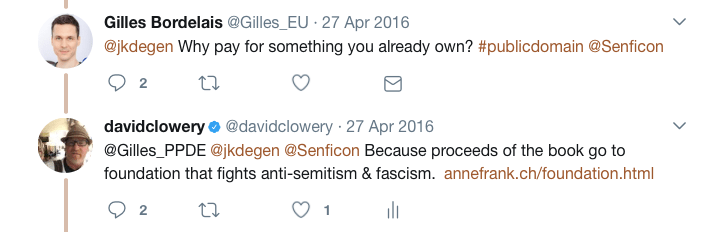
In the exchange above Canadian author John Degen wryly asks Reda why she doesn’t just buy a copy? Degen’s point is the ebook is available for sale virtually worldwide. Reda is apparently unwilling to pay for a copy. Instead Reda engages in pure demagoguery in an attempt to vilify The Anne Frank Foundation. Remember this is a member of the EU parliament. Talk about weiße people problems (all entendres intended)!
(Also perhaps someone familiar with the ethics rules of the EU parliament can tell me why is a member of EU parliament still sitting when she is clearly trying to incite mass copyright infringement against the Anne Frank Foundation? In the US mass copyright infringement is a RICO predicate. I mean I know the EU parliament is just make-believe-play-acting LARPing game but this has to be against the rules. Who has a rulebook? I sold mine with my Warhammer 40k kit).
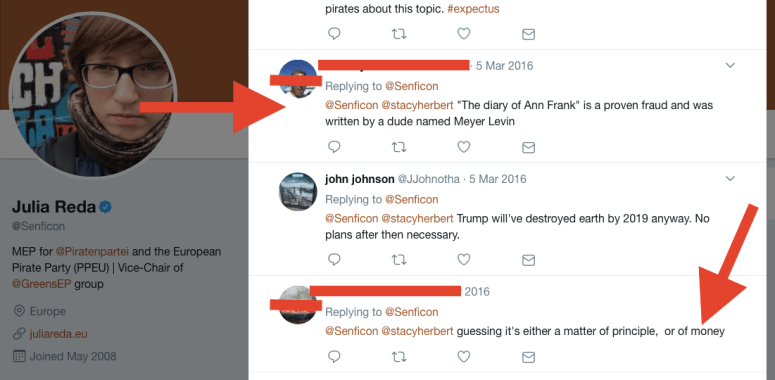
Reda’s non-apology makes me wonder if she is not in fact incredibly tone deaf but instead “dog whistling” to her pirate and far right constituency. Because I’ve heard in the twittersphere that you-know-who controls the copyright producing media conglomerates. Maybe she has heard the same thing? Indeed look at the comments of many who follow her.
Perhaps Reda observing the dwindling fortunes of the Pirate party has decided she needs to appeal to German white nationalist voters for re-election? I write this bit of stupidity only because it is slightly more plausible than a German EU MP choosing the Anne Frank Diaries as the target of a mass copyright infringement campaign. I mean if you wrote that into a tele novella script the producer would force you to remove it as completely implausible!
But let’s not lay all the blame on the German.
Who is the clean cut looking Gilles Bordelais? He describes himself as a Reda “minion” (EU parliament employee?). He appears to be carrying on a 77 year tradition of Belgians collaborating with Germans to dispossess certain people of their rights in The Low Countries. He claims that “we” (Europeans) already own the Frank diary. While its possible, does anyone know how it is that Frank died at such a young age and failed to produce any heirs? Thus making the ownership of her copyrights a bit cloudy? Bicycle accident perhaps? I seem to recall it was during an earlier period of European law “harmonization” there was some dispossession of Jewish properties and bicycles in The Low Countries.
But let us not forget that even the US has it’s own stupid bigots committing macro-agressions disguised as progressive politics. Look no farther than the Fight For The Future. We have covered Fight For the Future extensively and their copyright infringement campaign against the MLK estate. Read more here and here.
Fight for the Future is simply an astroturf group run by a former Google lobbyist. FFTF employed exactly the same tactics against the MLK Estate that Reda used against the Anne Frank Foundation. Specifically they manufactured fake outrage by purposely misleading people into thinking that the I Have a Dream speech was unavailable to the public when in fact you could instantly purchase it for $2.99 from the iTunes store. There was no need to illegally share it. How the fuck does even an astroturf organization that claims to be progressive end up organizing mass copyright infringement campaign against the estate of THE American civil rights icon? Does anyone have a fucking clue over there?
Or better yet how big does the shill paycheck (New America Foundation = Google) have to be for a magazine like Slate to cover this as a really good progressive idea, when in actuality it’s a horrible regressive macro-aggression? Vice media did the same thing. So did Boing Boing. So did Mashable. The last two further helped by publishing the infringing links and encouraged people to join in the “sharing.” Sure it isn’t like any of these journalists went out and started a white nationalist party but its pretty fucking stupid that they didn’t seem to realize that they were taking money from The MLK estate and instead giving it to Google/Eric Schmidt by driving traffic to YouTube.
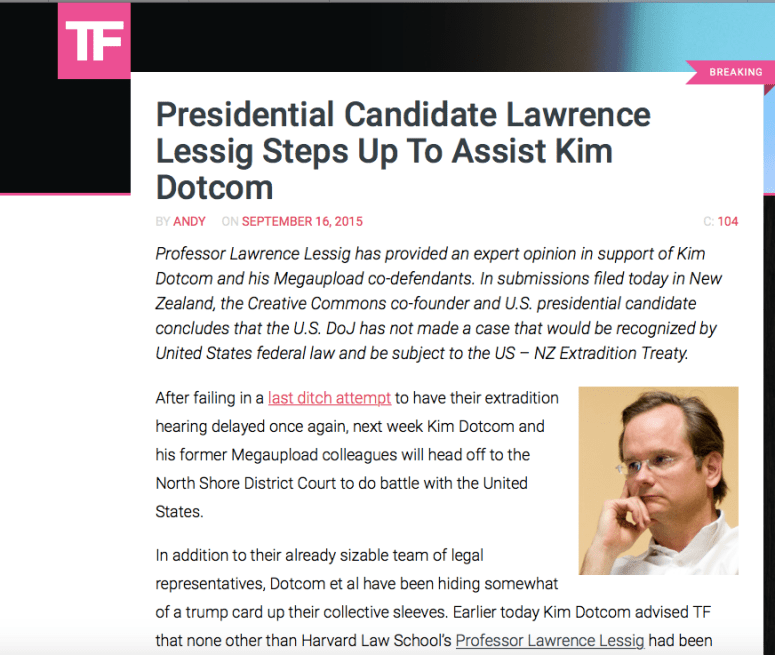
Then you have the famous “copyleft” Harvard law professor and “progressive” democratic presidential candidate Lawrence Lessig weighing in on the side of Dotcom. This is even after it was quite clear that Dotcom had a Hitler obsession. Not saying that Dotcom doesn’t deserve good counsel, but why the fuck would a “progressive” presidential candidate volunteer to defend Dotcom in the middle of a presidential campaign? Surely there were other attorneys willing to do so.
Content Creators Coalition (c3) Warns Congress About Artist And Songwriter Opposition To “Transparency in Music Licensing and Ownership Act”
Washington, D.C. – The Content Creators Coalition (c3) today sent the following letter to the leaders of the House Judiciary Committee warning that consideration of H.R. 3350, the so called “Transparency in Music Licensing and Ownership Act,” would spark a backlash in the artist community and could derail the Committee’s work to create a consensus copyright reform legislation:
The Honorable Bob Goodlatte, Chairman
The Honorable John Conyers, Jr., Ranking Member
House Committee on the Judiciary
2138 Rayburn House Office Building
Washington, DC 20515
Dear Chairman Goodlatte and Ranking Member Conyers:
As an artist and songwriter-run advocacy organization, we write to express our strong opposition to H.R. 3350, the “Transparency in Music Licensing and Ownership Act.” Recognizing the importance of this issue to our constituents…
The Impact of Piracy on Music Creators: What To Make of the “Unearthed” Study
By Neil Turkewitz
This week a variety of outlets are reporting on a 2014 study commissioned by the EU to examine the impact of piracy on sales, and are howling in protest that this study was buried by the Commission since it didn’t support the pre-conceived political conclusion that EU action was necessary in light of the known impact. Luckily the persistence of the Pirate Party’s Julia Reda has unearthed this gem which theoretically calls into question the Commission’s intended agenda, and Reda herself is suggesting that it “may not be too late” to be used to stop the EU from proceeding in its quixotic attempts to save a creative community that according to her, needs no saving.
I am sorry, but this is crazy talk–some of it no doubt intentional, and some of it flowing from a misunderstanding of what it means to not find statistical evidence of causality. IBT went with the sensationalist headline: “EU Buried Study That Found No Impact From Piracy On Entertainment Industry,” http://www.ibtimes.com/eu-buried-study-found-no-impact-piracy-entertainment-industry-2592661, notwithstanding that its own article contradicted this supposed “finding.” And Newsweek went with “INSIDE THE PIRACY STUDY THE EUROPEAN UNION HID: ILLEGAL DOWNLOADS DON’T HARM OVERALL SALES,” http://www.newsweek.com/secret-piracy-study-european-union-669436, again ignoring the fact that the study made no such finding.
And those partisans parading this study as proof of lack of harm are also surprisingly quick to assert causality in the action of the EU–burying the report because it didn’t support their political agenda, and failing to consider alternative reasons…say, that they felt it didn’t add enough probative evidence that would help in decision-making, and that it was likely to be misunderstood as implying the lack of correlation between piracy and sales in ways that confused the public. I personally don’t know what relevant officials in the EU were thinking, but this latter alternative not only seems plausible and likely, but sound.
So let’s go back to what the study “found.” As reported in TorrentFreak, the key conclusions were: “In general, the results do not show robust statistical evidence of displacement of sales by online copyright infringements…That does not necessarily mean that piracy has no effect but only that the statistical analysis does not prove with sufficient reliability that there is an effect.” https://torrentfreak.com/eu-piracy-report-suppression-raises-questions-transparency-170922/ It does not mean that piracy doesn’t impact sales, only that they were unable to prove this effect based on the data they had at their disposal. In other words, they could not disprove the null hypothesis. You know, just like scientists couldn’t disprove the null hypothesis about the effect of smoking on health for decades, or present efforts to disprove the null hypothesis on the effect of human activity on the climate. There are about a million reasons for failure to disprove the null hypothesis, but mostly they come down to one thing–understanding causality in complex relationships in which it is nearly impossible to establish control groups is incredibly complex. Essentially economists are looking for a straight line in a ball of thread. Truth is, we know many things that statistics can not prove. The truth can be more than the sum of its unknowable parts.
So tell me again how to interpret the failure of the study to disprove the null hypothesis! Does anyone truly believe that piracy was not a material factor in the dramatic reduction of revenue even as consumption has increased? I will grant that statistical proof of causality is hard to come by (at the end of this post, I have listed some references for peer-reviewed literature on the subject) but that is principally due to the limitations of statistical analysis in a complex and non-linear world rather than an observation of the world in which we live and breathe.
We may not be able to statistically prove our existence (i.e. disprove the null hypothesis that there is no connection between our awareness of self and our actual existence), yet most of us have little trouble in assuming that we are not imaginary.
Reda, TechDirt and others want people to reject their knowledge and sensible understanding of the world based on a study that doesn’t stand for the proposition they advance. Small wonder if the EU decided to not release a non-finding based on a concern that it would be intentionally misused. I haven’t spoken to anyone in the Commission and have no idea why they decided to refrain from publishing this study–all I can do is observe that if they were concerned about it being used to advance nonsensical arguments, they were sadly prescient.
One word before closing. TorrentFreak also summarized the report as follows: “So, it appears that products that are priced fairly do not suffer significant displacement from piracy. Those that are priced too high, on the other hand, can expect to lose some sales.” I hope to explore this at greater length in subsequent posts, but it is truly straight out of Alice in Wonderland. Given issues of compression and bandwidth, movies were not as immediately affected as some other forms of entertainment, and thus retained their value. Music files on the other hand were small and easily distributed and transferred. The ubiquity of free music drove the perceived fair value of music to near zero, and licenses then reflected this perceived value. There is nothing fair about this–indeed, perhaps the most pernicious and lasting effect of piracy on music creators is that they are forced to operate within licensed environments based on the perception that recorded music has little if any value. This effect of piracy has consequences far greater and far more lasting than the straight substitutional effects the study sought to examine.
Neil Turkewitz
For a useful overview of peer reviewed literature, see this from Stephen Carlisle: http://copyright.nova.edu/copyright-piracy-entertainment-industries/ Or as Danaher, Smith & Telang wrote in their 2016 paper, The Truth about Piracy: “So what should you do when the theory is inconclusive? Study the data, of course. And fortunately, economists and other academics have been gathering data and using it to study these questions since the early days of Napster, in 2000—which means we have plenty to work with. When we recently surveyed the peer-reviewed academic literature, we found 25 journal articles that analyze the impact of piracy on sales, which we’ve summarized in tables 1 and 2 below. What we discovered in reviewing these papers was a broad consensus: 22 of the 25 papers found that piracy reduces the revenue producers make from legal sales.” https://techpolicyinstitute.org/2016/02/02/the-truth-about-piracy/ Or see this 2016 paper from Stan Liebowitz entitled: “How much of the decline in sound recording sales is due to file-sharing?” http://econpapers.repec.org/article/kapjculte/v_3a40_3ay_3a2016_3ai_3a1_3ap_3a13-28.htm
He’s worked with Carole King, Ani DiFranco, and a host of great Texas artists — but can music producer Mark Hallman keep his studio open in the age of streaming?
Everybody is talking about Spotify and the pros and cons of “free.” Musician and first-time filmmaker Rain Perry confronts a big issue by telling a small story – of the longest continuously operating recording studio in Austin, Texas, and the shopkeeper who runs it, Mark Hallman.
After recording Carole King, Ani DiFranco and many great Austin artists, Mark is struggling to keep the studio open in the era of streaming. Funny, sweet and insightful, with great music and interviews, The Shopkeeper captures the joy, resolute spirit and frustration of musicians today.
Starring:
Ani DiFranco
Charlie Faye
Colin Gilmore
Eliza Gilkyson
Johnny Goudie
Jon Dee Graham
Mark Hallman
Noell Hampton
Sara Hickman
Iain Matthews
Tom Russell
Will Sexton
and many more
The pop and rock song is financially dead. I will no longer waste my time and energy with this endeavor. The ability to be paid fairly for my time and effort to create non-dramatic musical works has been decimated by the federal government.
1) The DOJ Antitrust Division, flouting intent of law and constitutional limitations, has turned monopoly regulation on its head by treating songwriter licensing organizations as anti-competitive monopolies. Meanwhile they force us to license our work at below market rates to genuine-holy-shit-these-guys-are-a-danger-to-democracy information monopolies like Google and Amazon (and soon Facebook). To benefit these monopolies they force us to violate private contracts and subject us to ex post facto rule making. Meanwhile these monopolies through their trade organizations (for instance “The Mic-Coalition”) openly collude and conspire to lower rates to songwriters, Yet the DOJ antitrust division completely ignores this anti-competitive behavior. Lawyers shuttle back and forth between DOJ antitrust and Silicon Valley and no one raises an eyebrow. It’s like the fucking Cali Cartel runs the joint. (Editor note: May I? The Mountain View Cali-fornia Cartel?)
2) The federal government through the compulsory mechanical license regime also forces us to license our songs to record labels and digital services at below market rates. These rates are fixed by the Copyright Royalty Board which is required to consider evidence of market rates. However in the last proceedings the CRB used as market rate “evidence” secret agreements between music conglomerates and digital services. The proceedings never disclosed the details of these agreements to the public. The details of these “market rates” were redacted. That’s right secret evidence was used against songwriters and they never got to examine the evidence!!!!!! WTF? What kind of fucking banana republic are we living in? Recordings of these songs are THEN distributed by record labels through the whole digital music ecosystem where we are again subject to exploitation described in #1. Thank you sir may I have another?
This is not to say I won’t continue to record music. Instead of writing traditional non-dramatic pop or rock songs I will go the extra mile and create “dramatico-musical” works (think, musicals, traditional opera or rock opera). I’ve already experimented with this once. You see this sort of work is distinct under copyright law from a simple non-dramatic pop or rock song. At this point these works have managed to escape some of the usurious regulation by the federal government and crony capitalist sponsors. In particular it’s difficult to apply the compulsory mechanical license in these situations. This also provides a way around some (but not all) of the outrageous abuses of the DOJ antitrust regulations. Thus by adding a dramatic narrative, visuals, or choreography to a work, a songwriter is able to regain many of the rights taken without compensation by the federal government. And yes I do mean “takings” in the constitutional sense.
While repositioning or reimagining our musical works in this way may be a good thing, sadly, it also highlights the wild injustice to which songwriters have been subjected.
Let’s not put up with this shit anymore.
I seriously urge other performer/songwriters to investigate this course of action and consider if you won’t ultimately be better compensated by adapting this as a creative strategy.
Episode #94: Recently, a bill was introduced by Republican congressman Jim Sensenbrenner which calls for the creation of a comprehensive database of compositions and recordings. The “Transparency in Music Licensing and Ownership Act” claims to make things easier for coffee shops, bars and restaurants who want to license music to play in their establishments. To many in the music industry, the bill seems like a wolf in sheep’s clothing with the potential cause big problems. On this episode we dig deep into the bill with Future of Music Coalition’s Kevin Erickson and attorney Chris Castle.





 The MIC Coalition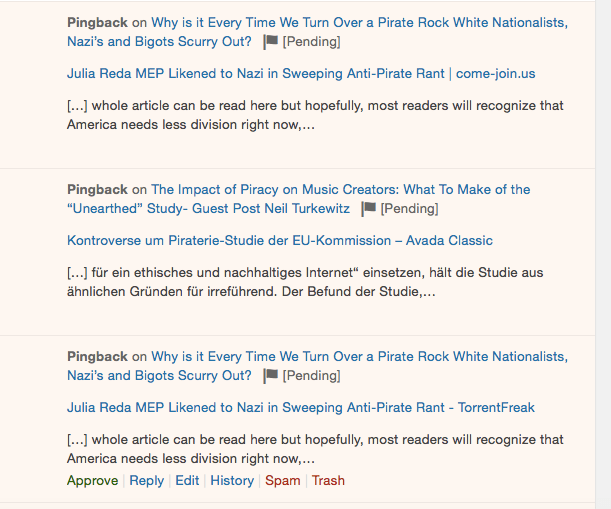







 The Trichordist
You must be logged in to post a comment.