New Math $.00666 : Billboard’s New “Consumption” Chart, Free Streams and the End Of Meaningful Metrics?

The purpose of a chart is to provide meaningful metrics to determine the relative value of a title in the marketplace. The new Billboard 200 “consumption” chart moves away from the traditional metric of album sales. In doing so, the new chart also creates questions about how meaningful this new information will be to artists, managers and labels. As album sales continue to decrease a method of measurement that addresses today’s environment is absolutely important.

The move from a “Sales Chart” to a “Consumption Chart” acknowledges what we already know…  More music is being consumed than ever before and conversely musicians are being compensated less than ever before, for that consumption.

Track Equivalent Album sales for measuring the volume of individual songs by a single artist has been a helpful and accurate method of comparing unit sales in the ala carte song era of Itunes (and others) in that every 10 song sales equal one album. This is easy to quantify as logically ten songs sold at 99 cents really does equal the revenue of one album at $9.99. So for comparative purposes this makes sense both in terms of the underlying logic and the economic reality.

But the new Billboard chart has a bigger problem when incorporating streams. The new metric of 1,500 streams per album and 150 streams per song would make sense if there were in fact a fixed price point for streams of $.00666 (as in $.0666 x 150 = $.99 and $.00666 x 1,500 = $9.99). We’re gonna have some fun with this, stay tuned…

Maybe Billboard has a sense of humor in that the calculation of streams to song and album equivalent’s are $.00666 per stream?

It get’s worse because we know from our Streaming Price Bible that neither Spotify or YouTube are paying anywhere near those rates on an summed, averaged per stream rate. From what we’ve heard Billboard is excluding plays from YouTube (for now) but we have a feeling streaming from YouTube Music Key will be included just as those are from Google Play.

The problem here is that the free tiers dilute how meaningful this data is actually going to be to everyone. As we pointed out in one data set we reviewed Spotify’s free streams accounted for 58% of total plays, but only 16% of revenue in the USA. On YouTube (by any name) the amount of streams to revenue is likely to be far more extreme.

FreePaidChart

What’s worse is that we can clearly see that over time, as fixed revenue streaming services scale the per stream rate will drop. The bigger the services scale, the less each stream is worth. This is unless of course the labels demand a minimum per stream rate that actually matches the metric the chart is suggesting ($.00666 – retail) and no streams from free tiers should be included.

Suddenly, we’re not feeling so lonely on this point, see here:

WME’s Marc Geiger Sides With Taylor Swift, Calls Free Streaming Services ‘F—ed Up’ | Billboard

Add one more name to the list of industry figureheads who’ve sided with Taylor Swift in her battle with Spotify: Marc Geiger, William Morris Endeavor’s head of music, who called the ubiquity of free, ad-supported streaming music services “a f—ed-up, torturous thing for 15 years”

And…

Essay: Why Streaming (Done Right) Will Save the Music Business | Billboard

As the first music-streaming service to be licensed by all major labels — and the No. 2 on-demand music service in the United States — it may surprise you to learn that we at Rhapsody support, and generally agree with, the decision by Taylor Swift and other artists to not make their new albums available on free streaming services immediately after release.

If we can all agree that Free Streams are problematic for the business, why can’t we agree that free streams are bad for a chart?
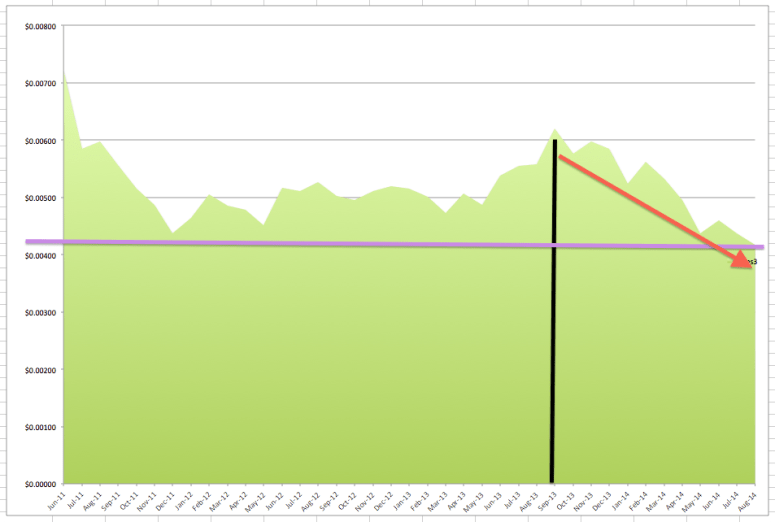
SpotifyNetMONTHLY_Charted

Combining the free and paid steams defeats the purpose of what the chart is attempting to achieve, a meaningful metric of paid consumer demand.

Free streams must be filtered out of the chart for it to be meaningful.

Giving away a million of something to gain chart positoning is not new and has been controversial. Lady Gaga’s “Art Pop” album benefited from a 99 cent sale at Amazon.com. However albums given away for free by Jay-Z (in partnership with Samsung) and U2 (in partnership with Apple) have not qualified for charting. There is a reason why.

Add to this YouTube views are known to be gamed regularly with many services offering “pay for plays”. We’re also seeing a growth market for services that provide “pay for plays” on Spotify as well. We recognize that in the early days of Soundscan there were attempts to game that system as well by buying off heavily weighted indie stores with free goods, cash or both.

In a digital world where more consumers are streaming on free tiers than paying subscriptions, where the price per stream is falling as services scale, and where there is no fixed price point as a baseline one has to wonder what the true value of the new chart will really be? If it is to illustrate just how wide the gap is between consumption and revenue, then that may be it’s only real purpose.

It’s not like any of this is new, or news. Big Champange, Music Metric and others have been tracking not only sales data but social media metrics for engagement, free streams (youtube and soundcloud) and even p2p filesharing data for years. If we’re going to get honest about “consumption” charts The Pirate Bay has a Top 100 why not include those rankings? To be clear, this is sarcasm, not an actual suggestion. It also illustrates the grossly mislead notion of including free streams in the new chart. It’s not that hard to determine how we are not making money…

REALTED:

Streaming Is the Future, Spotify Is Not. Let’s talk Solutions.

Why Spotify is not Netflix (But Maybe It Should Be)

How to Fix Music Streaming in One Word, “Windows”… two more “Pay Gates”…


Grooveshark “Offline by Christmas”… | Digital Music News

Infringement should not be a business model.

On September 29th, the United States District Court in Manhattan found Grooveshark guilty of massive copyright infringement, and specifically named CEO Sam Tarantino and CTO Josh Greenberg as bad actors. Now, the curtains are starting to drop: just days after that decision was rendered, federal judge Thomas Griesa issued another decision that removed all doubt that the plaintiffs — a total of 9 recording labels — had triumphed in the case.

READ THE FULL POST AT DIGITAL MUSIC NEWS:
http://www.digitalmusicnews.com/permalink/2014/11/21/grooveshark-offline-christmas

Absolute Must Read : How To Make Streaming Royalties Fair(er) | Medium

The record industry has completely disconnected the relationship between artists and their fans whereby the artists catalog is now an aggregated asset to leverage (the label’s) equity in a tech start up that is subsidized by musicians. Not cool.

This is an excellent piece by Sharky Laguna that looks at how all models utilizing divisible revenue pools are fundamentally unfair to the relationship between the artist and the fan. In short, the plays by each consumer should be compensating ONLY the artists that, that person plays (makes sense, right?). Further more 100% of the consumers subscription fee should only pay the artists that individual listens too – no matter how few or how many plays the consumer gives each artist.

Under this proposed revised accounting method, each consumer is once again reconnected directly to the artists they chose to support. This is exactly the kind of thinking that should be happening at the labels and music tech companies.

In a nutshell: Royalties should be paid based on subscriber share, not overall play share.

If I pay $10 and during that month I listen exclusively to Butchers Of The Final Frontier, then that band should get 100% of the royalties. I didn’t listen to anyone else, so no one else should get a share of the $7 that will be paid out as royalties from my subscription fee.

Please read the full post at MEDIUM:
https://medium.com/@sharkyl/how-to-make-streaming-royalties-fair-er-8b38cd862f66

Apple Announces Itunes One Dollar Albums and Ten Cent Song Downloads | Sillycon Daily News

Satire – but not by much.

Apple Computer announced today that for it’s Itunes Music Store to remain competitive in the digital distribution marketplace for music they would be changing their retail pricing of album downloads to one dollar and song downloads to 10 cents each. The pricing change will be effective on black Friday for this holiday season. “Since we purchased Beats music and are competing directly with Spotify we recognized the need for more competitive pricing structures based on what consumers may be willing to pay”, an Apple spokesman said. He continued, “Spotify has proven that as long as we’re paying 70% of gross, the retail pricing is irrelevant, irrelevant! We are even contemplating 10 cent albums and one cent songs to further achieve parity with music streaming services!”

Record label executives rejoiced in the move as one source exclaimed,” I don’t know why we didn’t think of reducing the retail price of downloads by 90% years ago. It’s still money, right? It’s so simple that this is really the only way to grow the business to $100b annually while competing with piracy.”


calculator

How to Fix Music Streaming in One Word, “Windows”… two more “Pay Gates”…

We’ve written about this before in two posts, Why Spotify is not Netflix (But Maybe It Should Be) and Streaming Is the Future, Spotify Is Not. Let’s talk Solutions. In Both posts we talk at length about how the problem is not technology or streaming itself, but rather the very restricted business models and poor economics that currently exist. No amount of selective double speak from Daniel Ek will change the bad math that Spotify can not scale at current rates.

Jason Aldean now joins Taylor Swift in removing his music from Spotify which leads us to wonder how many more artists with the ability to do so will remove their new releases and/or catalogs as well. This may also be a good time to revisit those two previous posts mentioned above.

So here is the question, is the record business really utilizing the new digital platforms correctly to address the current market place? Perhaps by looking at the options available to consumers from movie streaming, rental and download businesses we can find more robust and flexible opportunities for artists.

At the very least windowing releases allows artists, their managers and even labels the ability to manage and maximize current revenue streams more effectively. Windowing opens up strategic decisions about tier based pricing relative to the value proposition for both the artist and the consumer. Windowing may not fix all of the problems artists are facing in music streaming but it will be a great first step towards recognizing that the artists should have some direct participation in deciding how their work is consumed.

It’s not that streaming can’t work. It can. It’s that Spotify is a bad business model that has unsustainable economics and exploits artists because it is a wall street financial instrument and not a music company.

Pay Gates may be another solution (which is essentially a window). For example, Spotify premium paid subscribers could access the new Taylor Swift record, but not those using the free version of the service. This also allows artists to determine which songs can be accessed for free for greater promotional value, and which songs are intended to maximize revenue.

Why does Spotify unilaterally get to dictate to artists, managers and labels how to best maximize their relationships and revenues with their own fans?

As Spotify is a destination platform, and not a discovery platform we could see where the current hit singles are only available to paid subscribers while select album tracks could be accessible for free. The tracks on the free tier are monetized only by advertising revenue which pays very little, but there may be a promotional benefit to build awareness on lesser know songs.

Even the old school record business had tier based pricing. There were front-line, mid-line and budget pricing tiers. Front-line titles were often deeply discounted for premium in-store positioning. Mid-line titles were discounted as an incentive to stimulate more sales from recent catalog titles. Budget titles were mostly oldies and very deep back catalog. Primitive as they were, these were windows.

Yes, we know the choir of “or else they’ll steal it” from piracy apologists will claim that anything less the complete devaluation of music as fodder for advertising revenue is pointless. We’ll take our chances with Jason Aldean, Taylor Swift, Adele, Coldplay, Beyonce’, The Black Keys, Thom Yorke and the growing number of artists that are either removing their catalogs from Spotify, or windowing them.

Bring on the windows and pay gates! Let’s see some “innovation” and “disruption” that actually works for artists and not just the new boss. The outcry (from Spotify) of artists removing their songs also proves another very important point – all music is not equal. If some weekend hobbyist does not put their music on Spotify or pulls it off Spotify it doesn’t make headlines. Taylor Swift, Adele, Beyonce, The Black Keys, Thom Yorke, etc – all make headlines because people  actually do VALUE professional music. Professional music, has a professional price.

If Spotify is such a good business for artists, why not let each artist decide if Spotify works for them? Why does Spotify publicly shame artists to convince them how good they are? The lady doth protests too much, wethinks…

It’s funny how long it’s taken the record industry to realize that if you keep allowing something to be given away for free there is no incentive to pay. Who knew?

calculator


RELATED:

Why Spotify is not Netflix (But Maybe It Should Be)


Streaming Is the Future, Spotify Is Not. Let’s talk Solutions.


Spotify’s Daniel Ek is Really Bad At Simple Math, “Artists Will Make a Decent Living Off Streaming In Just a Few Years”

Jay Frank’s Magical Mystery Streaming Math… Or, Brotha Can Ya Spare A Calculator?

Music industry exec and blogger Jay Frank commented on our post BUT SPOTIFY IS PAYING 70% OF GROSS TO ARTISTS, ISN’T THAT FAIR? NO, AND HERE’S WHY…. Jay’s comment is typical of the thinking that has landed the record industry where it is today (losing money and in trouble).

It’s hard to tell from the comment whether Jay actually believes what he’s saying in the same way someone who bought a million dollar house with no money down, on a zero percent, 5 year ARM convinced themselves there was no housing bubble…

If they [Spotify] go from 10m to 100m free users, they’ll be able to charge much larger premium rates, and may even strike deals with some acts. That could easily result in $1b in artist royalties, given some other media models. This now puts Spotify at $3.5b in artist royalties per year. Pretty good.

To your point, though, that’s still half of the $7b number you put out there.

Right, no kidding “that’s still half of the $7b number”. To be fair to Jay, you should read his whole comment in context at the link above.

However, by his own admission he is still coming up short by $3.5b. If you factor that in with the analysis of the projected revenue losses from YouTube’s Music Key that’s another estimated $2.3b in the hole. But the simple truth is much easier to see, revenue keeps dropping as it has for the past 13 years while piracy apologists and digital music snake oil salesmen have yet to show any increase in actual overall net revenue from recorded music sales.

YouTube’s MusicKey Will Cause $2.3 Billion In Music Industry Losses… | Digital Music News
http://www.digitalmusicnews.com/permalink/2014/11/03/youtubes-musickey-will-cause-2-3-billion-music-industry-losses

By Jay’s logic, digital albums would sell for one dollar not ten while digital song downloads would be priced at ten cents and not one dollar. That’s not the case for good reason and illustrates quickly and effectively why Spotify paying 70% of gross is moot. We don’t think labels would agree to getting paid 70% on one dollar album albums and ten cent songs. Of course the labels don’t have 18% equity in Itunes either…

The larger truth and common sense is that Spotify economics don’t work in the same way $1 album downloads and $.10 song downloads don’t work – there’s not enough scale to make the economics sustainable. If Jay truly thinks you can more than double the revenue from transactional downloads by reducing the price by 90% we’ve got a bridge in Brooklyn we’d like to sell him very cheap.

In terms of “highly selective math” Jay continues his comment from above:

To your point, though, that’s still half of the $7b number you put out there. True, but that presumes that Spotify is the only player in town. While they may be a major force, there will also be other internet radio, satellite radio, video streaming, other streaming competitors and probably still physical and digital retail sales. Add to that greater ubiquity in tracking usage with increasing penetration of smart mobile devices combined with declining mobile data cost…and I feel like we’re starting to approach $10b a year.

And that’s just the U.S.

Ok, so let’s see that $10b a year in revenue streams plotted out and lets take a closer look at it. Here’s what subscription based services look like right now. Netflix only has 36m subscribers in the US, no free tier, and massive limitations on available titles of both catalog and new releases. Sirius XM, 26.3m in the US as a non-interactive curated service installed in homes, cars and accessible online. Premium Cable has 56m subscribers in the US paying much more than $10 a month and also with many limitations. Spotify… 3m paid subscribers in the US after four years.

Tell us again about this strategy of “waiting for scale.” Spotify is Three Million PaidThree… Oh, and that’s just the U.S.

* 3m Spotify Subs Screen Shot
* 26.3m Sirius XM Subs Screen Shot
* 36m Netflix Subs Screen Shot
* 56m Premium Cable Subs Screen Shot
* $7b Music Business Screen Shot

Hey, it’s just math… but in the meantime Jay, you may want to look at this:

Streaming Isn’t Saving the Music Industry After All, Data Shows… | Digital Music News
http://www.digitalmusicnews.com/permalink/2014/06/26/streaming-isnt-saving-music-industry-new-data-shows

A Detailed Explanation on Why Streaming Has Failed… | Digital Music News
http://www.digitalmusicnews.com/permalink/2014/10/02/detailed-explanation-streaming-failed

You can email Paul Resnikoff at paul@digitalmusicnews.com

calculator


RELATED:

Streaming Is the Future, Spotify Is Not. Let’s talk Solutions.

Music Streaming Math, Can It All Add Up?

Who will be the First Fired Label Execs over Spotify Fiasco & Cannibalization?


Let The Heads Roll…More Genius From The Record Industry Braintrust or Mark Mulligan Gets a Calculator…

Happy Halloween and welcome to the scary stupid post of the day…

We’ve been saying this for a long time, music streaming math just doesn’t add up. Would someone please buy some calculators for the record industry braintrust that keeps making these stupid deals? Seriously, it’s just math and it’s not that hard… even Mark Mulligan is getting it… no kidding…

$2.3 Billion In Net Loss To Artists and Labels Per Year

The report extrapolates that YouTube Music Key will generate $400 million in revenues in its first year. But over the long run it will also be responsible for more than $2.6 billion in lost subscription revenue yearly. That’s a negative net impact of $2.3 billion in lost music revenue every year, according to the study.

Ok, that’s YouTube. Let’s revisit how the Spotify math works…

If you own a calculator, let’s just do the math one more time, real slow and simple like…

1) Spotify and former uTorrent CEO Daniel Ek says Spotify only needs 40m paid subscribers for streaming to be sustainable for artists. But that math just doesn’t work.

2) $10 per month subscription = $120 per year per subscriber

3) $120 per year, per subscriber paying out 70% of gross to rights holders equals $84 per subscriber, per year.

4) $84 per subscriber, per year x’s 40 million subscribers equals $3.4b per year in top line gross revenue to ALL rights holders. That’s $3.4b for labels, artists, publishers and songwriters combined.

5) $3.4b per year is HALF of the current revenue of $7b per year where the domestic business has been flat lined.

6) Assuming you could DOUBLE the subscription base to 80m PAID in the USA within two years by dropping the price in HALF to $5 per subscriber per month you still only gross (wait for it…) $3.4b a year in revenue.

We know this is shocking to the math impaired, but doubling scale (imagined as it is) while cutting the subscription fees in half, actually nets you the same amount of money. Shocking the things one can learn with a calculator or a spreadsheet.

Maybe we’re all screwed, but we will not go quietly and we’re gonna call it how we see it on the race to the bottom. We will document the stupidity undoing the business. Maybe it’s time for Lucian Grange to get out that axe again and let people know what time it is? #stopthemadness

READ THE FULL POST AT HYPEBOT:
http://www.hypebot.com/hypebot/2014/10/youtube-music-service-could-cost-artists-labels-23-billion-in-lost-income.html

RELATED:

Music Streaming Math, Can It All Add Up?

Who will be the First Fired Label Execs over Spotify Fiasco & Cannibalization?

Streaming Is the Future, Spotify Is Not. Let’s talk Solutions.

This Weekend in NYC : Benefit for Content Creators Coalition (c3): Defend Artists’ Rights: Economic Justice in the Digital Domain! w/ Marc Ribot, John Zorn, and friends

A Benefit Concert for c3

Featuring John Zorn, Eric Slick (Dr Dog), Steve Coleman, Marc RibotHenry Grimes, Marina RosenfeldTrevor Dunn, Brandon SeabrookSatomi Matsuzaki (Deerhoof), Amir ElSaffar, and more!

The event will also feature a short screening of highlights from Michael Count Eldridge’s upcoming documentary film “Unsound”.

General Admission: $20 pre-sale (ends at noon on 10/18) $25 at Doors

Special Artist Rights Supporter tickets include reserved balcony seating and access to a one hour meet and greet prior to the show // Doors at 7pm

TICKETS :
https://web.ovationtix.com/trs/pe/9950804

MORE INFORMATION:
http://roulette.org/events/benefit-content-creators-coalition-c3-defend-artists-rights-economic-justice-digital-domain-w-marc-ribot-john-zorn-friends/


Streaming Is the Future, Spotify Is Not. Let’s talk Solutions.

It’s not that streaming can’t work. It can. It’s that Spotify is a bad business model that has unsustainable economics and exploits artists because it is a wall street financial instrument and not a music company.

We’ve previously published a couple posts on streaming music where we explore how access models and windowing are working for the film industry and could serve as a guide to the record business. We’ve also shown how transactional music purchases have made legal music consumption the best value in the history of recorded music.

The key to building streaming business models that make sense and are sustainable is to increase the subscription fees, utilize well thought-out windowing models and experiment with new pricing tiers for access based services.

Historically the music business has employed the use of special markets such record clubs  (remember 11 CD’s for one penny). It’s not that record clubs were bad, in fact numerous studies found them to be great source of additional revenue if managed in a way that did not cannibalize front line sales. (Remember 12 month record club holdbacks?) Now we need to strike the same balance with streaming services.

So let’s get real, the Spotify business model and streaming math just does not work and can not work in it’s current form.

Here are five suggestions to get music streaming back on track as a viable business model.

1) Minimum Payment Per Play

You want to give your service away? Fine, but artists and rights holders are not going to subsidize your business by devaluing our work. No plays without a minimum royalty–including the “free service”–and all plays pay at paid subscription rates. If you can’t sustain your business doing this, then you need to rethink how your business works. Your bad business model is not our problem. Maybe an unlimited, non-graduated free tier is a really, really, really bad idea. 30 Day trial offer, ok. Virtually unlimited free access, no.

2) Windowing

The music business must embrace windowing to maximize revenues across all distribution channels and platforms. It’s so basic we can’t believe artists and labels are not utilizing this to greater effect. The first 30 days of a new release could be limited to transactional streaming access by the day, week, or the month at different price points. Likewise, perhaps only two songs from an album are made available on streaming platforms for the first year of release. There are many unexplored variations and options.

3) Transactional Streaming

The music business needs to embrace new models such as “transactional streaming” much like VOD exists for film versus transactional downloads or physical product. There is no reason why streaming distributors should have every title, ever released, for one fixed, flat price. Again, new releases in particular should be priced as transactional streams where the consumer can chose between low cost limited access to a new release, or pay more for a transactional download.

4) Tiered Pricing based on Access and Consumer Value Proposition

Just like cable tv and SiriusXM, one possible solution is to create price tiers based on access. For example, catalogs can be curated into genre and lifestyle packages. Creating bundled packages adds value to both the end user and the streaming service. Individual packages can be as little as $4.99 a month, and complete access could priced at $49.99 a month. Again, there are many unexplored variations and options.

5) Move Beyond Stockholm Syndrome

The answer to every attempt to introduce real world economics to the marketplace can not be met with “or else they’ll steal it.” We already know that. They have been stealing it for over a decade (thank you Mr. Ek for your contributions to uTorrent). The film industry is not approaching streaming with a gun to it’s head offering every title ever made on every platform for one low monthly fee. Itunes is the single most successful dedicated online music business ever, and it doesn’t have a “free-tier”.

Isn’t it odd that companies like Pandora and Spotify that are not profitable and don’t support artists are thought to behold some kind of gnostic wisdom of economics that defies all logic and reason? Last year Twitter lost $645 million dollars. Record labels have been profitable for over half a century with a sustainable ecosystem that invests in artists and new talent, while also creating hits and stars. It’s time to leave the rainbow unicorn school of economics and faith healing behind and develop real business models based on real economics.

Anyone remember the dot com bubble? Where is mp3.com now? Things can and do change fast in web/tech. Any talk of the “record industry” without MySpace in 2004 and you would have been laughed out to the room. Where is MySpace now? Spotify can (and very well may) quickly become MySpace. So let us all focus on how to make streaming actually work for all stakeholders and not only those with equity… it’s just math.

RELATED:

Who will be the First Fired Label Execs over Spotify Fiasco & Cannibalization?

Why Spotify is not Netflix (But Maybe It Should Be)

Mythbusting : Music Is Too Expensive!?

c3 ‪”#thatsongwhen 10k people listened, the artist got paid $60 and the major labels got stock options.”

c3, The Content Creators Coalition is enlisting musicians and songwriters to share their true stories of Spotify plays, payments and thoughts to raise awareness around unsustainable digital service royalty structures. Join in.

If you care about the economic rights of artists in the digital domain, join us in hijacking Spotify’s new twitter hashtag campaign. Got your own numbers to share? Like so: Fun with new Spotify hashtag campaign: “#thatsongwhen 10k people listened, the artist got paid $60 and the major labels got stock options.”

We do believe in digital. But current rates are not sustainable. Spotify is using our music like venture capital and promising better returns later while they pay their employees and hire expensive ad firms to create the above hashtag campaign.

thatsongwhenSarahManningthatsongwhenTessaMakesLove thatsongwhenMarilynCarino

FOLLOW c3 ON FACEBOOK:
https://www.facebook.com/ContentCreatorsCoalition
https://www.facebook.com/pages/ccc-nycorg/