
Pandora: money trumps morality, ran ads for anti-gay group.

Screen Shot 2014-08-15 at 1.12.23 AM


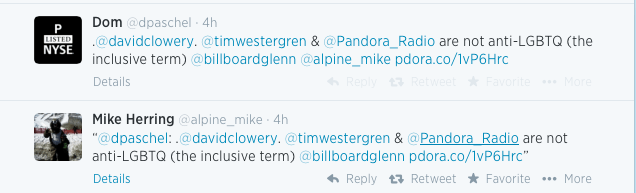
Above Pandora CFO Mike Herring shows how down with the gays Pandora really is!  The link goes to a custom Pandora radio station for “Oakland Pride Radio.”   Wow that’s really going out on a limb there Pandora! I bet some of your best friends are gay! I wonder what Oakland Pride thinks of Pandora using them as a prop to excuse their donations to an anti-gay demagogue?  And what will they say when they find out Pandora ran ads for “Speak Up University?”   


When I worked for Pandora, I took my job seriously. My title was “Listener Advocate”, and, as a listener myself, I tried to bring the opinions of the listeners to the company. Of course, most of our job was helping people to be able to simply listen to the online station, sort of minimal tech support. However, there were several legitimate things that we initiated meetings with management about, and many times these were met with new ways to word our responses to ameliorate listener concerns.

After I had been there for about a year, and had responded to many complaints about specific ads, we started hosting tons of ads for Meg Whitman, who was running as the republican candidate in the California gubernatorial race, 2010. She came from being CEO of Ebay, (then to Hewlett-Packard afterwards) and was rich as hell, and apparently spent more of her own money on the race than any other political candidate in history ($144 million, $178 million including donations). The company was thrilled to take her money and run her ads all the time, which of course generated complaints, which I thought a lot about, and then brought them to the company.

I advocated on behalf of establishing a rule that we take ads only selling goods and services, and nothing dogmatic (i.e. politics or religion.) The company’s party line was that we would accept any advertising that ran on “major mass media”, ignoring the fact that the term “major mass media” is essentially so vague as to be meaningless. For example, we explicitly stated that we would not accept advertising about pornography or gambling, while Clear Channel, which is obviously mass media, ran billboards advertising gambling casinos all up and down the state.

I had several conversations with Joe Kennedy and Tim Westergren about this. Joe basically heard me out and then dismissed me. With Tim it was more difficult. One thing that I pointed out to him was that when we played political or dogmatic ads, it reflected on the company’s political stance. He absolutely did not believe that, he said “TV stations always run advertising for all political parties”. I said, “yes, but we see television companies as being driven only by money, so we distrust them implicitly.” Tim, as well, refused to believe that his public political action had any bearing on how the company was seen by the public-at-large. I thought that this was very short-sighted of him, and said to him that simply because he was very visibly active in politics, for example asking our listeners to advocate on the company’s behalf vis-a-vis royalty rates or other congressional mandates, that anything political that the listener hears on Pandora would be viewed with the inherent politics of the company in mind.

I brought up the hypothetical situation of running ads promoting Proposition 8, which was on the California ballot at that time, which was opposing same-sex marriage.

Tim blew me off on this, adding cryptically “I’d love to argue about this, I’m a student of Chomsky!” If he actually were, I would think he would currently be living in some sort of nightmare of cognitive dissonance. Anyway, I still advocated the idea of only advertising goods and services, and questioned the whole idea of trying to be parochial to “major mass media”. If we wanted to be a shining light in the field of “radio”, we should make our own rules, we absolutely did not have to be mini-Clear Channels. I tend to think that making our own rules about such things would work out better in the end, both internally and externally.

I didn’t realize at the time how the lip service we gave to being “pro-music” and being “about music” was covering that fact that it was, indeed, in the end, all about money, and only about money. Being moral has nothing to do with business, especially if you are in the United States, and, it seems, especially if you in the tech world. One of the engineers came by my desk and mentioned that the Meg Whitman ads were paying dollars where other paid nickels, so she was gonna get those ads placed in any case. (She lost that election, regardless.)

It was the following year that the company held its IPO and became a publicly traded entity. Then it got really bad. While Joe Kennedy claimed “an IPO is just another round of funding”, being even more beholden to the investors started to become evident. The advertising and programming choices became even more suspect, listeners began wondering what was happening. And along with the political things, came advertising that was even weirder. We got many complaints about “Speak Up University”, who appear to be a support group for “straight Christians”, but a little more research into the Speak Up organization proves it to be essentially and anti-gay hate group, among other things.

(It’s a fallacy to think that any dominant culture would need support in the face of abused minorities, the same way that there is no such thing as “masculinism” battling the tenets of feminism: feminism strives for equality; being against it is being for the current inequality of all people, regardless of gender. Nonetheless, there is so much misunderstanding of it that people are duped into thinking that they should be against it because somehow it promotes more power to one side (women in this example,) instead of simply promoting equality. One would think that the anti-gay marriage proponents believed that allowing it would make it mandatory—or Worse!)

I brought this up to the management, again. This, surely, was a moral line we should not cross in our blind acceptance of money for political or dogmatic advertising. This slightly stirred things up, partially because my team had several gay members, to say nothing of those who were simply trying to advocate morality and refused to accept that there was any difference between people regardless, and hence advertising that is divisive or hateful in any way should be avoided. We never really got closure on this, as the advertising sales people were the cream of the business crop, in their own little money-driven world, and couldn’t be bothered so much with whom they sold to, so long as they sold time or web space.

I realized at this point that the entire area of “customer service” within Pandora was backwards. The listeners were not the customers, the advertisers were. The listeners got music in exchange for listening to ads. That was the deal. Again, music was irrelevant, we could have been pumping sausage through a pipe into their mouths all day long, in exchange for watching ads. But the public perception of the company was still that it was somehow “pro-music and musicians.”

I tried to accept this all, but still had to speak out when we ran ads for “Minnesotans for Marriage”, another anti-gay hate group opposing gay marriage in Minnesota. And, looking around, our very team was segregated: the gay contingent was off to one end by themselves…This time was the last straw for management, I was brought into a meeting and told to “stop questioning decisions that had been made by the company”, that is, get with the program or get out. They said “you have some tough decisions to make”. The next day I was told to clean out my desk. Many people asked me about whether I wrote this article after I was fired (I didn’t, but it is all true.) Take a look.

http://www.buzzfeed.com/reyhan/tech-confessional-how-pandoras-ipo-changed-every

Losing my job was bad, of course, that always is, and it makes one a pariah in the tech world to simply care about the morality of what is done. I wrote this a year later: http://jsegel.wordpress.com/2013/03/21/pandora-now-a-year-down-the-road-from-me/

(To repeat some of that blog entry, when I was told by the new over-manager  “you can’t keep questioning things that the company has already made decisions on”, I replied that of course I have to keep questioning! What if people hadn’t kept questioning during the civil rights protests in the 1960s? He became really angry and reared up and said, you can’t compare these things to racial issues! I said, “uh, yes you can, I’m talking about civil rights, this ad is for an anti-homosexual group…?” When I left that day and went to a yoga class, I spoke with an expert: none other than Angela Davis was a student in the same yoga class that I went to in Oakland. She was fairly adamant that I was on the right track!)

In the past two years, Tim Westergren has proven that all he really cared about all along was the money, he and many of the other upper management and investors have been cashing out millions of dollars in stocks all the while lobbying against royalty rates to pay for the music that supposedly the whole Pandora concept is based on. And as he, and the company, become more and more politically involved, it reflects more and more on the company as a whole.

Now it has come out that Tim and Joe and others even donated to the radical right wing anti-gay congressman Jason Chaffetz. Presumably, they simply did this to throw money at him to sponsor IRFA, the “Internet Radio Fairness Act” (a very Orwellian name!) Of course doing so supports him in his entire agenda. So, they really don’t care? Or is the company based in such a sense of pseudo-morality that these people like Tim are actually supporting Chaffetz’ anti-gay agenda? How could we know?

If it is that, then this company is sick at its core. If it is only about money, then the company is amoral. That same sort of amorality and hypocrisy permeates the rich industrialists of the world, see here for example regarding the Koch family.

In any event, the Pandora bosses have made out like bandits already, so I doubt they care what happens. Maybe the company will wither, and in its withering prevent similar IPO-based “funding”.

We can only hope that they are replaced by music streaming companies that really care about music.


-post by Jonathan Segel
Individual Songwriters Come Out In Droves, Submit Large Number Of Comments To DOJ

Thank you readers.  You all rock!

When a government agency like The Copyright Office or The Department of Justice asks for comments,  they usually generate a few dozen. And the vast majority of these are from lobbyists, trade groups and law firms engaged in policy fights.

So this week the Capitol has been buzzing about the surprising number of comments that INDIVIDUALS submitted to the DOJ on the consent decree that governs songwriters.  There were over 180 comments from individuals submitted!   And we recognize that many of these comments are from fellow songwriters and readers.   We have made our voices heard.

So let’s keep it going.  Tweet the link to your DOJ comment at us and we will retweet it!  @thetrichordist

Here’s my own comment. 


@jannarden is Banned on Newcap Stations Through Patented QuickHitz Infringement Machine

Music Technology Policy

As you know, Canadian artist Jann Aden spoke out against the vile “QuickHitz” radio format that cuts songs in half to sell more advertising.  Jann singled out the AMP radio station in Calgary, which is one of 100 or so stations owned by the Newcap Radio chain in Canada.  Jann indicated in a slightly obscure tweet last week that she’d been banned from the station by “Steve Jones”.

I find it hard to believe that jocks on a station would actually believe that slicing and dicing songs without artist consent was a good idea.  But radio is a tough business and I don’t blame them for wanting to keep their jobs.  However, this is exactly the kind of market power abuse we expect from the National Association of Broadcasters (who at the moment strives to keep the U.S. government’s boot on the throats of songwriters.  Why?  Because “this…

View original post 325 more words

@jannarden gets the Lars Treatment from QuickHitz Broadcaster

Astonishing bullying against an artist by apparently unregulated broadcasters.

Music Technology Policy

We’re trying to get confirmation of what actually happened, but it looks like Canadian artist Jann Arden was banned from a 100 station radio chain in Canada–because she spoke out against a radio format that literally cuts recordings in half. Why would anyone even think of such a vile format? My guess up is that it’s just so the stations can sell more advertising.

This is kind of like YouTube for radio.

Remember that Canadian broadcasters are supposed to help foster Canadian artists, and most of them do. This is why I have to believe that this format is all about the bean counters who love money and not the jocks who love music. Giving artists the Lars treatment is what we expect from SiliconValley money grubbers who profit from piracy. At least the pirates steal the entire song.

And banning an artist from the peoples airwaves because she spoke…

View original post 20 more words

Is the QuickHitz Format the Sweeney Todd of Radio? The Incomparable @JannArden Stands Up for Artist Rights

Music Technology Policy

Jann Arden has made some of the best records of the last 20 years and is a Canadian treasure.  I first heard her when she was signed to A&M Records and have been a fan ever since.  So when Jann speaks up about music, I’m all ears.

Jann is speaking up about the latest attack on artist rights:  The “QuickHitz” radio format that chops up records.

According to the QuickHitz website:

QuickHitz is a game-changing mass appeal music format built especially for the needs and lifestyle of today’s multitasking, attention challenged listeners. Imagine more music per hour than any other radio station ever!  QuickHitz is a break-out alternative to Top 40 radio that immediately repositions the competition with a fresh approach to music discovery and all the interactivity of Social Media. Quite literally, QuickHitz is “twice the music in half the time.”

“Twice the music in half the time”.  “How…

View original post 479 more words

The Royal Scam Part 1: How the rush for the equity trough trades artist royalties for stock

“All animals are equal, but some animals are more equal than others.”

Napoleon in Animal Farm by George Orwell

The U.S. Copyright Office has raised a relevant question in its request for comments on music licensing:

Please address possible methods for enhancing transparency in the reporting of usage, payment, and distribution data by licensees, record labels, music publishers, and collective licensing entities, including disclosure of non-usage-based forms of compensation (e.g., [1] advances against future royalty payments and [2] equity shares).

Many artists and indie labels are probably not even aware that some deals they are being asked to opt-in for have some hidden economics that make the deal better, and often much better, for some artists or labels than others.  We first noticed this underhanded approach in the DMX-type deals where companies like DMX paid early adopters to take a low royalty in return for a big advance that may have been non recoupable.  Then they hold out that low royalty as an MFN type rate to others without disclosing the advance paid to the early adopters.  We’ve seen it perpetuated in the Spotify deals and maybe some other recently announced licensing deals.

Why is this a problem?  Because it’s not formally disclosed to the less equal animals, and sometimes it hides behind the NDA culture that Google has introduced into the music business.  It’s also a problem because those who need the money most are paid the least.

This is different than the “I’ll give you some stock if you say something nice about me to your friends” deals that we see all the time.  Those are corrupt for a different reason, the same reason that payola is against the law on radio and TV (and we all know how much Pandora wants to be treated like a radio station and YouTube thinks they’ve replaced TV).  Be careful what you wish for.

Thankfully, the U.S. Copyright Office is now focused on these under the table payments as a matter of public policy and we commend them for that stance.

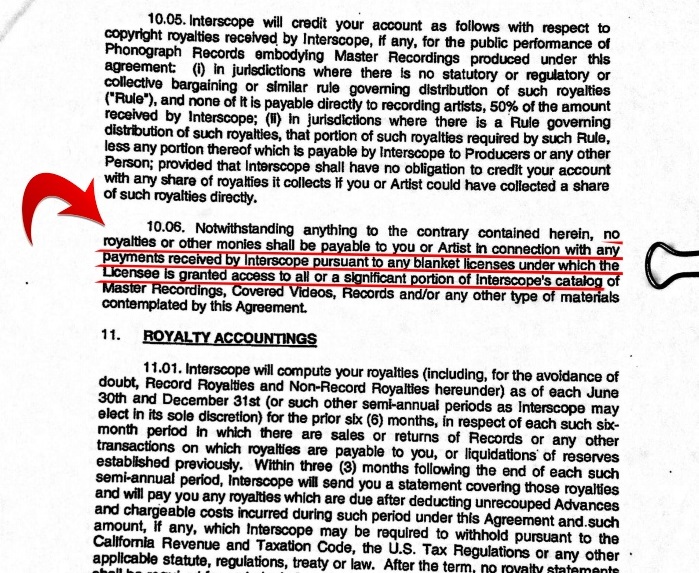
Digital Music News has done a great job of surfacing this issue of the inequity of equity.  As Paul Resnikoff reported (How Streaming Services are Screwing Lady Gaga (and Every Other Artist), there are clauses in artist agreements, even highly negotiated ones, that deny artists a share of advances that are made for a label’s entire catalog in a clause like this one that Paul posted:

gagacontract small

Focus closely on what this clause actually says:  If the label gets “payments…pursuant to any blanket licenses” for the label’s catalog, the artist–the one whose contract it is–doesn’t get any of those “payments.”  Paul uses this clause to attack the equity that labels got in streaming services.  He’s kind of right, but not for the reason you might think.

This clause is a very old concept in record deals and it has a legitimate above the table rationale and also a below the table one.  If a label makes a distribution deal for a blanket license of their entire catalog they typically negotiate a minimum guarantee, sometimes called an “advance”, against revenues that come in for their catalog during the life of that distribution deal.  The minimum guarantee is paid up front by the distributor, so it is a kind of bet by the distributor that the catalog will produce enough money to recover (or “recoup”) the minimum guarantee from royalties otherwise payable to the licensing label.  (Leave aside for the moment whether this is a “license” or a distribution deal for sales–see the Eminem litigation.)

That advance earns out over time depending on how the label’s catalog sells.  Advances are typically “recoupable but nonreturnable.”  The advance is recoupable, i.e., applied against the label’s share of the catalog’s sales during the distribution term.  The advance is “nonreturnable” meaning it doesn’t have to be paid back if the label’s share of revenues during the deal don’t equal or exceed the amount of the advance.  If the label is “unrecouped” at the end of the deal, the label keeps that delta.

Example:  Label X gets an advance of $100 from Distributor Y for the country of Airstrip One.  The deal lasts 5 years.  At the end of 5 years, Label X’s catalog has earned $90.  Distributor Y just sends royalty statements to Label X showing an unrecouped balance and doesn’t have to pay the $90-because Label X has already had it in the form of the advance.  If the deal is still unrecouped when it ends–meaning Label X got a bigger advance than it earned–then Label X keeps the extra $10.

From Label X’s point of view, Label X still has to pay its artists their royalties for the $90 of sales.  Say Label X has three artists, Hear, See and Speak.  Assume that artist Hear earns $85, See earns $5 and Speak has no sales.  (It’s actually more complicated because the artists will get less than 100% of the money, but leave that aside.)

The advance, then, is a kind of bet that Distributor Y makes on the Label X catalog.  It’s paid in cash and it’s paid up front, like ante.  Because that advance is a payment against actual future sales, there’s really no fair way to divide it up among the artists on the day that the deal is done, that is, before there are any sales.

This is the reason that you get for why this clause is in there.  That’s the “above the table” reason.

Here’s the “below the table” reason.  What if Label X was very valuable to Distributor Y, either because it was a huge catalog without which Distributor Y wouldn’t really have much of a business, or it was just a very hit-rich catalog and was likely to continue to be valuable to Distributor Y in Airstrip One.  Label X could very easily say to Distributor Y, you know that $100?  I have to share that with my artists.  How about you pay me $20 of that flat and just give me an $80 advance?  Meaning–Distributor Y pays Label X $20 on a nonrecoupable basis (“flat”) and Label X puts that money in its pocket.  And because it’s a “payment” for the blanket license, the label doesn’t have to share it with any artist.

Is it fair?  Is a nonrecoupable payment just a way to get a higher royalty or revenue share for the label?  That depends on how you look at it, but one thing that is certain is that the reason that the label is able to get this nonrecoupable payment is because of the value of the catalog.  That value is a mix of the work product of the label’s investment in the artist, but it’s also partly the value of the present and future work product of the artists.  And you won’t be surprised to know that we think it’s largely the work product of the artists.

Consider another aspect of the same example.  If the deal with Distributor Y is a true license, most of the time the revenue is split 50/50 with the artist (this is what the Eminem case was all about.)  However that advance earns out, you can see that if there is a portion of the money that is nonrecoupable, the nonrecoupable part is not shared with the artist.  Distributor Y will still have to pay Label X for sales occurring after the advance part is recouped, so it’s not like the artists are not getting paid for their sales.  (Assuming that Label X is accounting properly.)  There’s just a chunk of cash that never hits the artist royalty statement because it is paid directly to Label X as what some might call a vig.

The practice has been that when the label leverages the work product of their artists to get a payment for the label that they don’t share, they trot out this clause that Paul has found as the justification.  It’s still often kind of revenue neutral for the individual artists, it’s not like the label said give me this money and underreport sales, or give me this money and I won’t audit you.  Well…maybe they did say I won’t audit you.  But from the artist perspective the deal should be revenue neutral.

Now consider the same facts, but in addition to the nonrecoupable payment, Label X also demands shares of stock in Distributor Y.  Distributor Y says hold on there–I already gave you the nonrecoupable payment and you want stock, too?  What are you giving me for the stock?  Hmmm….who is not at the table here?  Let’s take their money.  So the label says sure, if you give me stock and a nonrecoupable payment, I will let you [increase your distribution fee/decrease the royalty base price/decrease the net sales on which the artist royalty is calculated/increase the reserves that are never liquidated] that determines the royalty I have to pay to the artist.  But only by a believable amount.  Say 10-20%.  This works particularly well in places like say Venezuela, China or Cambodia.  Or on the Internet.  Any place no one expects to get a decent accounting.  Or feels lucky to get any payment at all due to rampant piracy.  (Remember the three legged stool from Old Boss, New Boss.)

Why does this happen?  Because if you are not at the table, you are on the menu.

Back to Lady Gaga’s contract.  Do you think that this clause also covers stock that was extracted in return for a lower royalty rate?  In other words, what if the clause that Paul quotes ended with “in return for lowering your royalty rate to an abysmal and unsustainable level while your label gets rich beyond their wildest dreams”?  Or even if it said “payments in cash, shares of stock or other securities or other things of value”?  How do you think that would go down with the artist’s representative?

Another part of the vig is what happens at the end of Distributor Y’s contract if Label X is unrecouped.  Frequently, Distributor Y is allowed to extend the term under some conditions to try to recoup the unrecouped balance.  This doesn’t go on forever but it might be another 6 months or a year.  In the land of Internet where the living is easy, the fish are jumpin’ and the cotton is high, when the deal is over, the unrecouped balance often is not rolled into additional time on the contract.  Instead, the term is renegotiated and a new advance is paid for a new deal.  This pocketing of the unrecouped balance is sometimes called “breakage.”  Does Label X share the breakage with their artists?

What do you think?

If this is just a miscalculation by Distributor Y, that’s one thing.  If, on the other hand, Distributor Y for the Land of the Internet overpays the advance by what anyone would find to be an amount that is highly unlikely to recoup, and also has a crappy accounting system so that the accountings that Label X will use to account to their artists underreports sales–like reducing the percentage of net sales in the physical world–who benefits?  If Label X gets a big enough nonrecoupable payment, high enough breakage and enough shares of stock in a company that is likely to go public or have a big exit–while still making most of its current revenue from sources other than the Land of the Internet–do they really care that much?  Particularly if they distribute some of those shares of stock to Label X executives to hold personally?  Who’s going to complain?

If you’re not at the table, you are on the menu.

Of course if Label X lacks market power, it is unlikely that Label X will be able to extract any of these vigs.  And this leads us to the indie labels’ claims against YouTube.

To Be Continued.

The Consent Decrees Violate Individual Rights. My comments to DOJ.

What follows are the comments I submitted to the DOJ against the  ASCAP/BMI consent decrees. You have until the end of the day today to submit comments.  http://www.justice.gov/atr/cases/ascap-bmi-decree-review.html


The Consent Decrees Violate Individual Rights.


I am an American songwriter, a member of BMI and a member of the bands Cracker and Camper van Beethoven. I’m submitting this comment on my own behalf in opposition to the ASCAP and BMI consent decrees. I believe these government actions essentially are a compulsory license outside of the Congress and take away songwriters’ rights to due process of law.


Just to be clear, I am not saying that Justice Department consent decrees in general are oppressive. I am saying that the way these particular consent decrees operate is oppressive to songwriters. That operation is oppressive because of the extremely long period of time they have been in effect, because they take away our valuable property rights to negotiate our own licenses, and they essentially force songwriters into being judged guilty before we’ve even expressed ourselves.


Why Songwriters Matter


Most discussions surrounding the consent decrees start with a striking fiction: The consent decrees only apply to BMI and ASCAP but not to individual songwriters. From a songwriter’s perspective, this is extraordinary sophistry.


As a practical matter, all American professional songwriters have to join one of ASCAP, BMI or SESAC in order to earn a living from their chosen craft. Sure, it’s possible that SESAC (which is not yet under one of the government’s consent decrees) might invite someone like me to join. But they are known to be more difficult to join than ASCAP or BMI.


The only certain choice for all songwriters is joining one of ASCAP or BMI. And that means that the vast majority of songwriters are subject to the consent decree from the time they write their first song. Unless something is done about it, they will remain subject to the rate court until they write their last song and even beyond the grave.

The DOJ has essentially created a single exchange within the federal courts that requires songwriters to join a regulated PRO in order to participate in the market.


So in practice as soon as an individual decides to take the tiniest steps towards being a professional songwriter they immediately fall under one of the two consent decrees and the jurisdiction of one judge in one court. Let’s dispense with the fiction that the consent decrees do not apply to songwriters and hence dispense with the fiction that it does not limit the rights of individuals—living, dead and yet to be born.


The Single Exchange Takes My Right to Negotiate


The government limits my ability to participate in a free market; it takes my property rights without due process or just compensation; it even limits my kind of speech (public performance of my songs) as I must participate in this process or effectively forgo compensation when I perform my songs in the public square.  I know that there’s always the theoretical possibility of a direct license outside of the consent decrees, but as a practical matter, I can tell you that is very rare because it is rarely offered.


I am not a lawyer or a constitutional scholar but I believe the consent decrees violate the American social contract for many reasons, not the least of which is that in practice songwriters are singled out for the government’s scrutiny before they have done anything except engage in speech and create songs. When you are on the receiving end, this feels like a kind of writ of attainder. Allow me to explain.


A) Typically when we limit the rights of individuals in the manner prescribed by the consent decrees one of three things must occur:


1) Legislative action by elected officials.

2) Judicial proceedings finding a particular individual (not a class of individuals similar to that individual) guilty of something.

3) The individual must consent to have his/her rights limited (usually to avoid judicial proceedings or because they participated in an election).


As an individual songwriter the consent decrees effectively compel me to submit to this process. At least the compulsory license in the Copyright Act is a legislative action by elected representatives and if I don’t like that rule I can work to get someone unelected. Under the consent decrees, generations of songwriters are powerless to stop the government from taking our rights without that legitimacy—for decades. I do not understand how the Department of Justice has the authority to force us to submit to this process.


B) As soon as an ASCAP writer creates their first song, the writer is forced into a court proceeding that was opened in 1941, seventy three years ago.   The BMI consent decree is from 1964, fifty years ago. Many songwriters who are subject to the consent decrees weren’t even born when the Department of Justice opened the cases.


Even if I accept the premise that I am guilty until I can prove to the government that I am not, and that my licensing decisions require review by a federal judge at great social expense, what possible justification can there be for my decisions today being subject to a case opened so long ago? This seems like some arbitrary federal assignment of “original sin” to a class of Americans. Does the federal government have a crystal ball? Can they see into the future? Can they read my thoughts? How do they know that every single member of this class is doing something wrong? How is that possibly Constitutional?


C) How many of the government’s court cases are “open” for 73 years or even 50 years? How is that not a violation of due process? Why am I and all future songwriters required to pay for whatever misdeeds that occurred decades ago?


D) I can’t emphasize enough that from my point of view as a songwriter, the consent decrees act as a kind of compulsory license by government edict. The government compels songwriters to allow music services to use our songs whether we like it or not. And unlike the Copyright Act, I can’t complain directly to rate court except at great expense. There is nobody to get unelected if we don’t like the rate court’s decision except very indirectly.


As Ari Emmanuel once said, “Fair is where we end up.” He would be wrong in the case of these consent decrees. In practice the consent decrees effectively substitute the opinion of a federal judge for that of a fair negotiation to set the rates at which those services compensate my fellow songwriters and me. After 73 years this has effectively become an unlegislated compulsory license. The consent decrees walk and talk like a compulsory license and after decades of practice they effectively are a compulsory license. At least with a compulsory mechanical license we know where we will end up on the rate.


E) Essentially the consent decrees take valuable rights to negotiate the exploitation of property from over 500,000 Americans simply because they write songs. And there is no end in sight. (Not to mention the foreign songwriters whose works get swept up and who can’t afford to complain to the WTO.)


F) If we must live under consent decrees, why must all the cases be heard before the same judge in New York City? Not only do the consent decrees unfairly impose the government on songwriters, they also force music services to make their case before a single judge in New York City—twice, once for ASCAP and again for BMI. This is a very expensive process that only the most well-heeled services can afford.


Why shouldn’t a service be able to bring their rate case in San Francisco, Los Angeles, Nashville, Austin, Athens—or any federal court?   Respectfully, are two federal judges in New York the only federal judges in the entire country capable of trying PRO cases? Surely that can’t be true.


I believe that the decrees have become a crutch on which those well-funded music services that can afford the litigation have come to depend. Instead of actually innovating and improving their revenues they use the rate courts as a perceived competitive advantage at great expense to their own shareholders, songwriters and, of course, the taxpayer.


There’s also a question of how many new entrants don’t come into the market at all because they are scared off by the expense of the rate court process and the uncertainty of litigation.


So not only have the operation of these consent decrees created a single market inside a federal court, I suggest that the consent decrees actually limit access to that market to the number of potential buyers who can afford the millions in legal fees required to participate. I think most songwriters would say that they want to license their works to innovators, and yet access to the rate court market is limited to the rich innovators as a practical matter.


Yes—in practice the consent decrees may well be anticompetitive.


Are the ASCAP and BMI Consent Decrees Unconstitutional?


I pose this question not because I’m a learned lawyer or constitutional scholar. I pose it because I can tell you that living under these consent decrees feels oppressive and I have found that when the government acts oppressively it is often acting outside of the Constitution.


This is not to say that the government should not pursue claims against songwriters if we actually do violate the antitrust laws. I’m not asking for a free pass. We should get the same treatment as Google, Microsoft or anyone else.   It’s also not to say that there wasn’t some justification for the consent decrees long ago.


But from this songwriter’s perspective, that time has passed. As James Madison wrote in Federalist 44, “[government] interference is but the first link of a long chain of repetitions, every subsequent interference being naturally produced by the effects of the preceding.” Respectfully, I suggest that Madison could have been describing the Kafka-esque rate courts.


David Lowery

Aug 1st 2014

Athens Georgia


DOJ Has Collusion Backwards. Google and YouTube Executives Move Into Spotify.

As the guardian reported last week, a high ranking Google Executive has taken a seat on Spotify’s Board. This weekend we learned that the Google/YouTube’s Shiva Rajaraman is moving from YouTube to Spotify.  Rajaraman was part of the team launching YouTube’s music subscription service that would compete with Spotify.   While it is quite common for technology executives (and entertainment executives)  to move from one company to another, and for one company to have a seat on the board of another company, the fact that both of these companies are involved in licensing songs and recordings should raise concerns with The DOJ. Why?  Because it makes a mockery of the consent decrees that govern songwriters in their negotiations with these services. Because in effect the consent decrees are now backwards. There is a very real possibility of collusion and anti-competitive behavior from the services. (some would argue it’s already happened with YouTube’s indie label outrage.)  Couple this with the enormous resources that these companies have and it seems pretty ridiculous to keep songwriters under the consent decree.

One of the rationales of the World War II/Cold War era consent decrees was that songwriters and their PROs (our equivalent of unions) could collude against broadcasters (and now webcasters ) to fix prices.  But remember the consent decrees were enacted in the days that radio station ownership was severely limited. In 1941 ASCAP had a very strong negotiating position when it was up against individuals that might own one or two radio stations.   But those ownership limits have since been lifted and we now have companies like Clear Channel with over 840 stations.  In the digital realm we have Google/YouTube which is in effect an online video monopoly. Pandora has 77% of the webcasting market and is a near monopoly.   Everyone knows the internet wants only one or two of each kind of service,  it seems prone to monopoly. So it seems a little strange to think the federal government needs to protect these effective monopolies from  songwriters.

It’s even stranger when you consider the NOW very real possibility for collusion that exists on the part of broadcasters and webcasters.  Google/YouTube essentially has a seat on the board of Spotify and the Rajaraman has left YouTube for Spotify.   Are we really supposed to believe that details of deals and negotiations with Spotify are not gonna get back to YouTube?   Are we supposed to believe the deals the major labels  cut with YouTube won’t get back to Spotify?  We already know that Google/YouTube conspired with other technology firms to depress wages for software engineers by entering into an illegal agreement with other firms to not “poach” each others engineers.   Shouldn’t the DOJ be examining Google/YouTube and now Spotify for collusion?   Instead of songwriters?

And this isn’t even taking into account that the major labels own a large portion of Spotify?  This is a clusterjam™  of epic proportions.

The DOJ has collusion backwards.  The consent decree should not be pointed at the songwriters. And you can do something about this.  The DOJ has solicited comments on the consent decrees. You have till the end of the day wednesday.   You can be passionate but be polite:

http://www.justice.gov/atr/cases/ascap-bmi-decree-review.html

Although the DOJ has a series of specific questions on which it seeks comment, you can also make general comments about the fairness and even abolishment of the consent decrees.

You can read my fairly detailed comments which question the constitutionality of the entire process at the end of this article:

https://thetrichordist.com/2014/08/03/call-to-action-songwriters-submit-comments-to-the-doj-on-the-consent-decrees-now/


Call to Action: Songwriters Submit Comments to the DOJ on the Consent Decrees Now.

The DOJ is reviewing the WWII era consent decrees that force songwriters under federal court supervision for supposed anti-competitive practices.  Yes the awesome power of the federal government is being used to protect multi-billion dollar companies like Clear Channel, Sirius, Pandora, YouTube/Google, Amazon and Spotify from hippy freak songwriters. Considering that many of these companies are effective monopolies it’s a stunning abuse of federal power on behalf of a few politically connected corporations.

The consent decree forces songwriters to allow these services to use our songs while a single appointed for life judge (song czar) sets our rate of compensation.   You may remember that I posted that my million spins on Pandora earned me less than $17?   I can’t even opt out of this service, how is that even fair?  That’s how this kind of outrage occurs.  This amounts to an government mandated subsidy from songwriters to some of the largest companies in the world.

If you are a songwriter, please submit comments.  The DOJ specifically would like to hear from you.  If you don’t’ understand the legalese just make a simple statement about how you feel about the compensation from these digital services that results from these consent decrees. Be passionate but polite.  Here are the instructions:

http://www.justice.gov/atr/cases/ascap-bmi-decree-review.html

Here are my comments. I took a constitutional approach. You don’t have to be as esoteric or as detailed. Simple heartfelt comments are just as important.


The Consent Decrees Violate Individual Rights.


I am an American songwriter, a member of BMI and a member of the bands Cracker and Camper van Beethoven. I’m submitting this comment on my own behalf in opposition to the ASCAP and BMI consent decrees. I believe these government actions essentially are a compulsory license outside of the Congress and take away songwriters’ rights to due process of law.


Just to be clear, I am not saying that Justice Department consent decrees in general are oppressive. I am saying that the way these particular consent decrees operate is oppressive to songwriters. That operation is oppressive because of the extremely long period of time they have been in effect, because they take away our valuable property rights to negotiate our own licenses, and they essentially force songwriters into being judged guilty before we’ve even expressed ourselves.


Why Songwriters Matter


Most discussions surrounding the consent decrees start with a striking fiction: The consent decrees only apply to BMI and ASCAP but not to individual songwriters. From a songwriter’s perspective, this is extraordinary sophistry.


As a practical matter, all American professional songwriters have to join one of ASCAP, BMI or SESAC in order to earn a living from their chosen craft. Sure, it’s possible that SESAC (which is not yet under one of the government’s consent decrees) might invite someone like me to join. But they are known to be more difficult to join than ASCAP or BMI.


The only certain choice for all songwriters is joining one of ASCAP or BMI. And that means that the vast majority of songwriters are subject to the consent decree from the time they write their first song. Unless something is done about it, they will remain subject to the rate court until they write their last song and even beyond the grave.

The DOJ has essentially created a single exchange within the federal courts that requires songwriters to join a regulated PRO in order to participate in the market.


So in practice as soon as an individual decides to take the tiniest steps towards being a professional songwriter they immediately fall under one of the two consent decrees and the jurisdiction of one judge in one court. Let’s dispense with the fiction that the consent decrees do not apply to songwriters and hence dispense with the fiction that it does not limit the rights of individuals—living, dead and yet to be born.


The Single Exchange Takes My Right to Negotiate


The government limits my ability to participate in a free market; it takes my property rights without due process or just compensation; it even limits my kind of speech (public performance of my songs) as I must participate in this process or effectively forgo compensation when I perform my songs in the public square.  I know that there’s always the theoretical possibility of a direct license outside of the consent decrees, but as a practical matter, I can tell you that is very rare because it is rarely offered.


I am not a lawyer or a constitutional scholar but I believe the consent decrees violate the American social contract for many reasons, not the least of which is that in practice songwriters are singled out for the government’s scrutiny before they have done anything except engage in speech and create songs. When you are on the receiving end, this feels like a kind of writ of attainder. Allow me to explain.


A) Typically when we limit the rights of individuals in the manner prescribed by the consent decrees one of three things must occur:


1) Legislative action by elected officials.

2) Judicial proceedings finding a particular individual (not a class of individuals similar to that individual) guilty of something.

3) The individual must consent to have his/her rights limited (usually to avoid judicial proceedings or because they participated in an election).


As an individual songwriter the consent decrees effectively compel me to submit to this process. At least the compulsory license in the Copyright Act is a legislative action by elected representatives and if I don’t like that rule I can work to get someone unelected. Under the consent decrees, generations of songwriters are powerless to stop the government from taking our rights without that legitimacy—for decades. I do not understand how the Department of Justice has the authority to force us to submit to this process.


B) As soon as an ASCAP writer creates their first song, the writer is forced into a court proceeding that was opened in 1941, seventy three years ago.   The BMI consent decree is from 1964, fifty years ago. Many songwriters who are subject to the consent decrees weren’t even born when the Department of Justice opened the cases.


Even if I accept the premise that I am guilty until I can prove to the government that I am not, and that my licensing decisions require review by a federal judge at great social expense, what possible justification can there be for my decisions today being subject to a case opened so long ago? This seems like some arbitrary federal assignment of “original sin” to a class of Americans. Does the federal government have a crystal ball? Can they see into the future? Can they read my thoughts? How do they know that every single member of this class is doing something wrong? How is that possibly Constitutional?


C) How many of the government’s court cases are “open” for 73 years or even 50 years? How is that not a violation of due process? Why am I and all future songwriters required to pay for whatever misdeeds that occurred decades ago?


D) I can’t emphasize enough that from my point of view as a songwriter, the consent decrees act as a kind of compulsory license by government edict. The government compels songwriters to allow music services to use our songs whether we like it or not. And unlike the Copyright Act, I can’t complain directly to rate court except at great expense. There is nobody to get unelected if we don’t like the rate court’s decision except very indirectly.


As Ari Emmanuel once said, “Fair is where we end up.” He would be wrong in the case of these consent decrees. In practice the consent decrees effectively substitute the opinion of a federal judge for that of a fair negotiation to set the rates at which those services compensate my fellow songwriters and me. After 73 years this has effectively become an unlegislated compulsory license. The consent decrees walk and talk like a compulsory license and after decades of practice they effectively are a compulsory license. At least with a compulsory mechanical license we know where we will end up on the rate.


E) Essentially the consent decrees take valuable rights to negotiate the exploitation of property from over 500,000 Americans simply because they write songs. And there is no end in sight. (Not to mention the foreign songwriters whose works get swept up and who can’t afford to complain to the WTO.)


F) If we must live under consent decrees, why must all the cases be heard before the same judge in New York City? Not only do the consent decrees unfairly impose the government on songwriters, they also force music services to make their case before a single judge in New York City—twice, once for ASCAP and again for BMI. This is a very expensive process that only the most well-heeled services can afford.


Why shouldn’t a service be able to bring their rate case in San Francisco, Los Angeles, Nashville, Austin, Athens—or any federal court?   Respectfully, are two federal judges in New York the only federal judges in the entire country capable of trying PRO cases? Surely that can’t be true.


I believe that the decrees have become a crutch on which those well-funded music services that can afford the litigation have come to depend. Instead of actually innovating and improving their revenues they use the rate courts as a perceived competitive advantage at great expense to their own shareholders, songwriters and, of course, the taxpayer.


There’s also a question of how many new entrants don’t come into the market at all because they are scared off by the expense of the rate court process and the uncertainty of litigation.


So not only have the operation of these consent decrees created a single market inside a federal court, I suggest that the consent decrees actually limit access to that market to the number of potential buyers who can afford the millions in legal fees required to participate. I think most songwriters would say that they want to license their works to innovators, and yet access to the rate court market is limited to the rich innovators as a practical matter.


Yes—in practice the consent decrees may well be anticompetitive.


Are the ASCAP and BMI Consent Decrees Unconstitutional?


I pose this question not because I’m a learned lawyer or constitutional scholar. I pose it because I can tell you that living under these consent decrees feels oppressive and I have found that when the government acts oppressively it is often acting outside of the Constitution.


This is not to say that the government should not pursue claims against songwriters if we actually do violate the antitrust laws. I’m not asking for a free pass. We should get the same treatment as Google, Microsoft or anyone else.   It’s also not to say that there wasn’t some justification for the consent decrees long ago.


But from this songwriter’s perspective, that time has passed. As James Madison wrote in Federalist 44, “[government] interference is but the first link of a long chain of repetitions, every subsequent interference being naturally produced by the effects of the preceding.” Respectfully, I suggest that Madison could have been describing the Kafka-esque rate courts.


David Lowery

Aug 1st 2014

Athens Georgia


After YouTube’s Indie Label Catastrophe, Why Did Spotify Let Google Buy Its Way Onto Their Board of Directors?

You’ve all been following YouTube’s absolutely tone deaf “take it or leave it” brinksmanship strategy with indie labels represented by Merlin and WIN.  This one sided “negotiation” appears to still be grinding on.  Why would it take so long?  Why wouldn’t YouTube simply say, we’ll treat you like everyone else and close up the problem.

So what is Google’s next move to calm the waters?  Google buys its way onto the Spotify board and the Spotify board allowed them to do it.

If we ever needed proof that Spotify intends to keep screwing artists and songwriters, we just got that confirmation.  Without so much as blinking an eye, Spotify embraces Google like a long lost brother returning to the family.  Whether this is just the first step toward Google buying Spotify or a step toward a “powered by Spotify” Google music service will be told in the future.

But what we definitely know is that two companies have joined together to pursue their common goal of paying minuscule royalties to songwriters and artists.

By welcoming Google onto its board, Spotify has lost the last shred of a fig leaf for screwing artists and songwriters.  With Spotify, you just get reamed because the deals are awful and you’ll never participate in any of the stock that Spotify gave to major labels and their senior executives (and probably some select superstars).   These under the table advances and equity shares in exchange for lower royalties are so bad that even the U.S. Copyright Office has raised it as a concern!

But with Google you get reamed because the royalty rates are absurdly miniscule when paid by Google’s legitimate front businesses like YouTube and are actually negative when you take into account the pirate sites Google profits from through its unscrupulous AdSense business.

Doesn’t Spotify have enough artist relations problems without adding Google to the list?

Not if Google writes a big enough check!  There’s a couple ways that Google could invest in Spotify.  They could buy newly issued shares (probably in a new series of preferred stock) OR…Google could buy existing shares from existing stockholders.  For example, if you were an executive of a major label who had gotten Spotify stock and you were thinking of “pulling a Jimmy” and getting some island money, one way you could do it would be to sell your shares to Google (sometimes called a “selling stockholder”).

But whatever happened, Spotify has now embraced the pariah of the music business.  Google is on their board, votes on everything the board votes on, including royalty rates, under the table money, the works.

Not only that, but why would Google allow Spotify to renew their deals through the Harry Fox Agency when Google owns Rightsflow?

If Spotify had artist and writer relations problems before, that’s nothing compared to what they’re going to have.