Today, SoundExchange joined organizations from across the entertainment community to ask Congress to address the unique nature of our community’s work when it develops an aid package in response to the coronavirus pandemic. Payroll tax holidays, paid leave, and other types of assistance have been raised for consideration by our nation’s leaders, but they may never reach the many workers in the music industry who don’t have a single, long-term employer.
You can find the full text of the letter below or download a pdf here.
—
Dear Speaker Pelosi, Leader McConnell, Leader McCarthy, and Leader Schumer:
As united representatives of the large and diverse American entertainment community, we offer our sincere gratitude for your immense efforts to address the COVID-19 pandemic and to provide much needed aid.
We understand the sacrifices our country is making and appreciate our shared responsibility. We will make the necessary adjustments to our lives but, unfortunately, there is no option for many in the entertainment community to work from home. Our home is on the road, on the studio lot or in the theater, in venues across the country that must close during the pandemic, in front of live audiences or with cast members who cannot gather. For now, those performances – and our jobs – have vanished, along with the costly and personally devastating investments we can never recover. Without help, we know that many in our community will find themselves homeless, hungry, and unable to tend to their medical needs.
The economic pain cuts even deeper, touching not only performers and musicians, but also managers, producers, promoters, stagehands, drivers, and countless others who are feeling the immediate repercussions of this new reality. This unprecedented economic loss caused by canceled performances and production shutdowns is being played out in bars, nightclubs, theaters, stadiums, concert halls, studios, and festivals in every state, sidelining thousands of workers.
The entertainment community will do what it can to support its members, but this moment calls for the unmatched capabilities of Congress. As you navigate the difficult path to providing necessary aid to distinct sectors of our economy, we ask that you specifically address the unique nature of our work. Payroll tax holidays, paid leave, and other typical assistance may never reach many in the entertainment community; in fact, direct financial aid remains one hopeful – and perhaps best – solution to replacing lost income and offering some semblance of economic sustainability.
We propose a similar benefit to the Emergency Paid Leave in Division C of HR 6201, along with emergency unemployment insurance access, available to those who cannot work due to a canceled performance or a production shut down. This fund and expanded unemployment insurance access and benefits would ensure that hundreds of thousands of families across the country can continue to pay rent, put food on the table, and care for their children during this public health emergency. In addition, we encourage you to be as inclusive as possible when crafting emergency paid leave, tax credits, and other programs – the unique nature of our industry means rules that require beneficiaries to have had a single, long-term employer will simply leave our entire workforce behind.
We all look forward to the end of this crisis. Certainly, entertainment will help us get through it. But we must take care of the many people in the American entertainment community who will help us heal, rebuild, and bring us back together, in public and in spirit.
Thank you very much.
Sincerely,
Actors’ Equity
Alliance for Recorded Music (ARM)
American Association of Independent Music (A2IM)
American Federation of Musicians (AFM)
Americana Music Association
Artist Rights Alliance (ARA)
The Azoff Company
The Broadway League
California IATSE Council
Christian Music Trade Association (CMTA)
Country Music Association (CMA)
Gospel Music Association (GMA)
CreativeFuture
Department for Professional Employees, AFL-CIO (DPE)
Digital Media Association (DiMA)
Directors Guild of America (DGA)
Entertainment Union Coalition
Full Stop Management
Global Music Rights (GMR)
Independent Music Professionals United (IMPU)
International Alliance of Theatrical Stage Employees (IATSE)
International Bluegrass Music Association (IBMA)
Live Nation
Music Artists Coalition (MAC)
Music Business Association (MusicBiz)
Music Managers Forum – US
Nashville Songwriters Association International (NSAI)
National Music Publishers’ Association (NMPA)
Paradigm Talent Agency
Recording Academy
Recording Industry Association of America (RIAA)
Screen Actors Guild – American Federation of Television and Radio Artists (SAG-AFTRA)
[This is a version of a letter I sent to the Senate Subcommittee on Intellectual Property on March 10 to call attention to various discrepancies in the proposed witness list, especially the undisclosed presence of the Pirate Party at a hearing at the world’s greatest deliberative body. And typically, Julia Reda never disclosed her affiliation in her witness bio or in her written testimony. Why so secretive? You can watch the video of the hearing here. Apparently the rules of the subcommittee prevented Senators from questioning the witnesses, which allowed Google’s amen chorus to simply spew propaganda into the hearing record.]
I want to thank the Subcommittee on Intellectual Property for holding the referenced hearing. Digital piracy is of ongoing concern to all contributors to the creative community be they photographers, film makers, authors, songwriters, musicians or featured artists. This is particularly true after catastrophes like the cancellation of SXSW in the Live Music Capitol of the World. Creators very often feel overwhelmed by the forces that use the Internet and the U.S. banking system to unlawfully extract value from their copyrights. Digital piracy seems to benefit everyone in the piracy supply chain except the creators of the works driving these racketeering operations.
Unfortunately, the hearing witness list seems to indicate an overwhelming influence of Google and Google proxies as well as a representative of the Pirate Party. However gloomy this turn of events may first appear for creators, it presents an opportunity for the Subcommittee to question the witnesses about the influence of Big Tech on efforts to reign in pirate operations, particularly off shore pirate operations. I raise a few points of reference that I hope may prove useful to the Subcommittee and respectfully ask that you request that this letter be made a part of the Subcommittee’s record for the hearing.
Off Shore Pirates Profit by Interfering in US Markets
Unlike the historical pirates who were declared hostis humani generis under admiralty law, or the modern pirates who hijack cargo ships such as the Maersk Alabama and are stopped by Operation Allied Protector, digital pirates defy the nation state relatively openly and brazenly. Digital pirates leverage anonymity, geography and extradition treaties to wrap themselves in the laws they cherry pick and use as loophole-driven alibis. They also engage in lawfare and have organized political movements from Kim Dotcom’s Internet Party to the Pirate Party. Pirates also embrace a host of academics and corporate legal departments that push their views. For example, Stanford hosted a July 2007 Pirate Party cash-preferred political fundraiser for anonymous donors that also had stops at the Googleplex[1] and the O’Reilly conference. The examples go on and on.
Despite the penetration of streaming services, music piracy is still a major problem for creators. According to the IFPI, “forty percent of Internet users access unlicensed music content.”[2] The Subcommittee’s focus on the issue is of great public policy importance.
There is a long history of pirate websites locating themselves outside of the United States but marketing themselves to U.S. users in a deceptive manner that makes it difficult for consumers, including both consumers and brands, to distinguish an illegitimate site from a legitimate one. As the UK’s Serious Organized Crime Agency warned advertisers, “By incorporating advertising from recognized brands the website administrator attempt[s] to make the site appear legitimate.”[3]
This practice is most pronounced with sites that profit from U.S. content by selling advertising or subscriptions to enrich themselves from trafficking in pirated works.[4] There is a continuing controversy regarding the source of the advertising[5]published on these illegal sites coming from Google entities through various intermediaries and resellers[6] as well as the use of the banking system to fund the pirates.[7]
The leading torrent site to this day is The Pirate Bay which has a recent Alexa rank of the 169th most visited site on the Internet.[8] Founded in Sweden 17 years ago[9] contemporaneously with the Pirate Party, The Pirate Bay personifies the off-shoring of piracy and has been consistently mimicked by hundreds of other pirate sites such as YTS.It, 1337x, RARBG, NYAA.si, Torrentz2, EZTV.io, LimeTorrents, FitGirl Repacks and Tamil Rockers. Pirate streaming sites follow the same offshoring practice and are an even bigger source of piracy than torrents.
These pirate sites invariably purport to wrap themselves in the DMCA safe harbors but locate themselves in havens outside of the U.S. that are well outside the reach and resources of creators forced to play the Superbowl of international whack-a-mole. These pirate sites have no intention of subjecting themselves to the jurisdiction of U.S. courts but want the benefits of U.S. law, all the while marketing themselves in the U.S. in direct competition with the creators, including creators, whose works they steal.[10]
The digital pirates’ fascination with creating these offshore “pirate utopias” (or “Temporary Autonomous Zones” or “TAZ”) dates back to the 1991 hacker’s handbook by the anarchist Peter Lamborn Wilson entitled “The Temporary Autonomous Zone, Ontological Anarchy, Poetic Terrorism.”[11] Julian Assange promoted the idea of a TAZ-type “offshore publications center” for Wikileaks in the 2009 document “Here be Dragons: Going from Defense to Attack.”[12] Assange proposed Iceland as an offshore center and pirate utopia that would allow Wikileaks to operate freely. Birgitta Jónsdóttir, a founder of the Iceland Pirate Party,[13] was one of the sponsors of the “Icelandic Modern Media Initiative”[14] that would have essentially codified Assange’s goals and is gradually coming to fruition at the Icelandic Parliament. Again, the idea was to establish an off-shore haven for activity that would otherwise be illegal—a geographical safe harbor or TAZ well beyond the legislative safe harbors that largely accomplish the same purpose inside major economies like the United States in the name of protecting “intermediary liability” for the largest corporations in commercial history.
Pirates embrace the nation they spurned once they get caught. Companies like Megaupload[15] located themselves in Hong Kong but put up a smokescreen of complying with the DMCA notice and takedown procedures while marketing themselves in America. They often use the U.S. banking system to receive illicit payments from users or advertising revenue from companies like Google and Adbrite.[16] Even in the handful of cases where copyright owners are able—at great expense beyond the means of most creators–to get these massive infringers in front of a U.S. judge such as with the Panamanian company Hotfile,[17] the defendant tries to wrap themselves in the protection of the DMCA safe harbor.
The Justice Department’s well-known experience with trying to extradite the Megaupload conspirators since 2012 is a prime example of the lengths to which these brazen racketeering organizations will go to avoid U.S. justice while simultaneously claiming the protection of U.S. law. If the Megaupload conspirators ever do find themselves before Judge O’Grady, they will no doubt seek the protections of the DMCA because they argue Megaupload is “just like Google.” In fact, Google submitted an amicus brief in the Hotfile case arguing that massive infringers should be protected by the DMCA—which makes Google’s shadowy presence at the Subcommittee even more telling.
Drafters of the DMCA would probably never have thought of themselves as creating a pirate utopia, but the safe harbor concept is near and dear to the Pirate Party, its backers and supporters. Statutory safe harbors—or protection from “intermediary liability” as Google might call it–are more than a little reminiscent of the TAZ. It is thus striking that the Subcommittee is to hear from Julia Reda, the long-time representative of the Pirate Party in the European Parliament, as well as so many other beneficiaries of Google’s support.
Pirate Party Witness Will Offer Big Tech’s Anti-Copyright Propaganda
I find it hard to understand why the Subcommittee has invited a leader of the European Pirate Party to testify at a hearing devoted to learning from efforts to reign in digital piracy in other countries. I also find it rather odd that Ms. Julia Reda failed to disclose her German Pirate Party association in her public witness biography or her witness statement when last accessed today, which is ambiguous at best and misleading at worst. And typical of the duplicity we have come to expect from her.
Ms. Reda was the sole representative of the Pirate Party in the European Parliament for many years.[18] Her Pirate Party affiliation is directly relevant to her testimony. The Pirate Party, as the name implies, is closely tied to promoting piracy using the tiresome shibboleth of “sharing culture” in the words of Ms. Reda, or conversely the equally empty vessels of making copyright “progressive” and “fit for the future,” or simply the vague “access to knowledge” meme favored in Open Society Institute circles.[19]
Or just make international copyright even weaker—to the great detriment of the property rights of creators already under attack from multiple sources. [20]
It also must be said that Big Tech has tried for years to get creators to believe that digital piracy actually helps artists and songwriters because it drives fans to shows and movie theaters. Digital music services would have us believe that the artist data they can generate helps with routing tours and that benefit makes up for low royalties. However implausible that assertion is, if there’s no touring or touring is severely cut back due to public health concerns, then both piracy and the income transfer to pirates becomes even more important to all creators.
The Pirate Party has had a close connection to the notorious criminal infringer The Pirate Bay. In fact, the Pirate Bay’s co-founder Peter Sunde ran for the EU Commission Presidency on the Pirate Party slate at the time of his arrest, conviction and imprisonment in Sweden for massive copyright infringement.[21] The Pirate Party reportedly offered to host the Pirate Bay on the servers of the Swedish Parliament.[22]
According to Wired Magazine,[23] the Pirate Bay inspired the creation of the Pirate Party in 2006—regardless of whichever came first, the two are synonymous today. The connection between piracy and the Pirate Party is abiding and sustained over a generation. Indeed the German Pirate Party’s youth operation—“Junge Piraten”—is devoted to the ongoing generational transfer of its goals.[24] Anyone who observed the Pirate Party’s tactics in the recent European Copyright Directive debate at the European Parliament should have no doubt that Ms. Reda is a dedicated opponent of copyright and an equally dedicated supporter of piracy masquerading as “sharing culture” or “progressivism.”
Plus, it must be said that Ms. Reda’s efforts to stop the Copyright Directive were as close to Google’s own lobbying effort as one is to two. This includes such extreme tactics as spamming MEPs, lobbying the children of elected officials through Twitter to try to persuade their parents to oppose the Copyright Directive (sometimes referred to as #Article13) and promoting the #saveyourinternet spamming and Twitter bot campaign along with Google and particularly YouTube.[25] Google was caught spamming Members of the European Parliament on the Copyright Directive by the Times of London in an independent investigation. According to The Times, “Google is helping to fund a website that encourages people to spam politicians and newspapers with automated messages backing its policy goals[,] intended to amplify the extent of public support for policies that benefit Silicon Valley[.]”.[26] This may sound reminiscent of what the U.S. Congress was subjected to during SOPA.
Given Google’s éminence grise at the hearing, it is no surprise that of all the elected representatives who the Subcommittee could have invited, it is Ms. Reda who finds her way into the U.S. Senate. Reda-watchers assume she will be dining out on the platform afforded her in the Senate for years to come. Hopefully, Ms. Reda does not intend to export her European Parliament lobbying tactics against Senators in the United States.
Google Dominates the Subcommittee Witnesses
It is also striking that Google is so well-represented among the witnesses at the Subcommittee’s hearing—yet its name is never mentioned. Texans are asked to pay no attention to who is behind the curtain. A little bit of research reveals the connections.
Professor Smith’s own Carnegie Mellon biography[27] lists four separate research grants from Google. The Carnegie Mellon Privacy and Security Lab received a $1,050,000 cy pres award[28] in the controversial Google Referrer class action as well as a $350,000 cy pres award in the Google Buzz settlement.
Google is a leading member of the Computer and Communications Industry Association[29] which is a frequent critic of artist rights advocates and a reliable amicus brief for Google’s extreme business practices alongside NGOs like the Electronic Frontier Foundation, R Street and Engine Advocacy.
Daphne Keller is a former Google senior lawyer responsible for Google’s crown jewel of search and now works as “Director of Intermediary Liability” at the Stanford Center for the Internet and Society PACS.[30] The Center was itself was launched with at $2 million gift from Google.[31]
As Ms. Keller well knows, Google’s own Transparency Report[32] shows the company has received over 4 billion DMCA takedown notices for infringing material in Google search alone. This is what is meant by “intermediary liability” (or more appropriately, no liability for self-defined “intermediaries”). Is there another company in commercial history that when told it has infringed 4 billion times views the same ongoing infringement technique as a feature not a bug? Does anyone believe that Google’s search algorithm is not behaving foreseeably exactly as designed due to lack of resources, complexity of scale or any other reason? Or is Google instead distorting every possible safe harbor loophole and copyright exception to maximize its profits by maximizing the value gap? Google would no doubt argue that the reason they receive so many takedown notices is because of the scale of Google’s monopoly operation–which is like the arsonist arguing that they should be excused from punishment because they light a lot of fires. Perhaps fighting digital piracy begins at home.
Both Professor Samuelson’s Berkeley Center for Law and Technology and the Samuelson Law, Technology and Public Policy Clinic received $500,000 and $200,000 respectively from Google as part of the controversial Google cy pres awards recently called into question at the U.S. Supreme Court in the Frank v. Goes case.[33] Of course, Google is a major benefactor of the Berkeley law school. Professor Samuelson is a prime mover[34] in the American Law Institute’s controversial end run around the Congress with its nascent “Restatement of Copyright” as the Subcommittee well knows.[35]
Recent Google and Facebook Cy Pres Awards
And if Ms. Reda’s past devotion to piracy were not evidence enough, she is now associated with the Berkman Center, which itself has received sustained corporate funding from Google including $500,000 and $750,000 in two separate cy pres awards from Google in controversial class action settlements.
As the sole connection to a foreign government whose practices are evidently intended to inform the Subcommittee, Ms. Reda seems an odd choice, certainly when there is no countervailing representative of which there were many (such as MEPs Helga Truepel or Axel Voss or Commander Karen Baxter of the City of London Police).
I hope that some of this information may prove useful to you in questioning the witnesses on behalf of creators and in achieving the goals of the hearing.
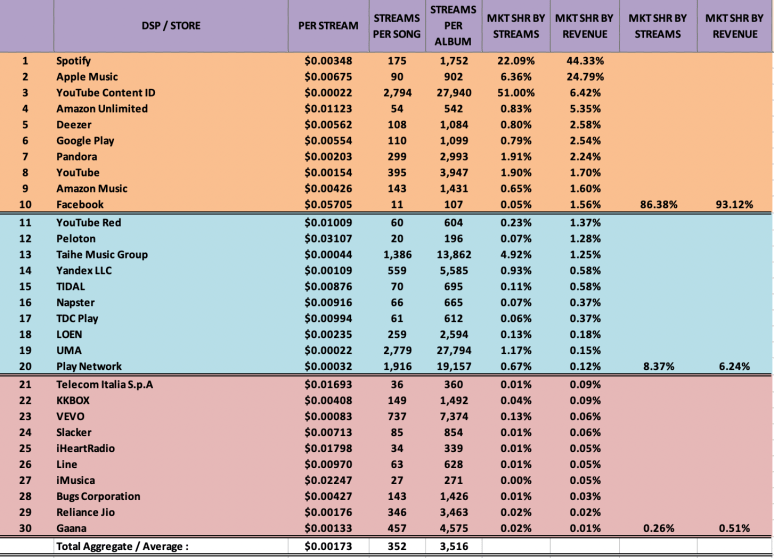
This data set is isolated to the calendar year 2019 and represents a mid-sized indie label with an approximately 350+ album catalog now generating over 1.5b streams annually. Streaming is now a fully mature format, and it is also the number one source of revenue for recorded music. Streaming in all configurations now accounts for 64% of all recorded music revenues. Head on over to the RIAA US sales database [here] to check out the numbers. Pro Tip: Remember to adjust for inflation!
We are keeping a simplified chart again this year. We’ve extended to the top 30 streamers which represent 99.87% of all streaming dollars. The Top 10 streamers account for over 93% of all music streaming revenues (down from 97% last year). The Top 5 account for over 83% of all streaming dollars (down from 88% last year). The drop in overall revenues in the Top 5 and Top 10 are the result of YouTube’s Content ID pulling down the overall revenues / per stream.
The biggest takeaway by far is that YouTube’s Content ID, shows a whopping 51% of all streams generate only 6.4% of revenue. Read that again. This is your value gap. Over 50% of all music streams generate less than 7% of revenue.
This is the first time we have not seen the Spotify per stream rate drop since the service launched a decade ago. The Spotify per stream rate has stabilized moving up just slightly to .00348 from .00331. In other words Spotify is paying out about $3,300 – $3,500 per million plays. We’re working with a very large sample that has aggregated all streams and revenue against both subscription and ad supported revenues for a single per stream average. This overall average is helpful for anyone who wants to calculate gross revenues by simply looking at the numbers on Spotify itself. For those who may not know, there is a simple “trick” to see the streams of any song on Spotify. On the desk top app, go to the album view and hover your mouse/cursor over the ||||||| at the far right side of any song, just to the right of the song length. Once there the plays for the song will materialize just below the song length.
Using our average, the song above has earned between $4,026 – $4,270.78 (gross before distribution fees) on Spotify at 1,220,224 plays.
Apple Music is again the best value per stream accounting for nearly 25% of all streaming revenue on only 6% of consumption. Spotify generates the most overall revenue of any streamer (no surprise) at 44% of all streaming revenue on 22% of consumption. As stated before, and which can not be overstated enough, You Tube’s Content ID is the major issue limiting growth contributing only 6% of revenues on over half of all streams, at 51% of total consumption. That’s a staggering statistic.
Apple’s per stream rate also stabilizes this year hitting a per stream rate of .0675 which is much closer to where it was two years ago at .00783. Our numbers from 2018 showed a dramatic drop in Apple’s rate at .00495 which we attribute to an expansion into new territories and a large number of 90 day free accounts that had not matured to fully paid subscribers.
In looking at the per stream rates for song and album equivalents, you might want to read this article by Billboard (as of 2018) on the current calculation of how many streams equal an album for the purposes of charting. The report states that, “The Billboard 200 will now include two tiers of on-demand audio streams. TIER 1: paid subscription audio streams (equating 1,250 streams to 1 album unit) and TIER 2: ad-supported audio streams (equating 3,750 streams to 1 album unit).” Our numbers suggest however it would be more fair to average all revenues, against all streams (including content ID), and that actually lands at about 3,516 streams per album across the board.
These numbers are from one set of confidentially supplied data for global sales. If you have access to other data sources that you can share, we’d love to see it.
HOW WE CALCULATED THE STREAMS PER SONG / ALBUM RATE:
As streaming services only pay master royalties (to labels) and not publishing, the publishing has to be deducted from the master share to arrive at the comparable cost per song/album.
$.99 Song is $.70 wholesale after 30% fee. Deduct 1 full stat mechanical at $.091 = $.609 per song.
Multiply the above by 10x’s and you get the album equivalent of $6.09 per album
[EDITORS NOTE: All of the data above is aggregated. In all cases the total amount of revenue is divided by the total number of the streams per service (ex: $5,210 / 1,000,000 = .00521 per stream). In cases where there are multiple tiers and pricing structures (like Spotify), these are all summed together and divided to create an averaged, single rate per play.]
There is an unsurprising discussion going on about song titles in the metadata deliberations regarding the regulations mandating the conduct of the Mechanical Licensing Collective quango. The least surprising part of the discussion is that the services change song titles as it suits them.
This explains why you can get your song metadata all nice and pristine and yet your payments are still screwed up because somehow the titles got changed. It’s not a surprise–they’ve been doing it for years. Unless the services are prohibited from continuing this boneheaded..there I said it..practice, their supposed great yearning for the database in the sky will come a cropper.
The DMPs do not have the same method for altering metadata, and their alterations significantly increase the difficulty of matching. There was a discussion of the DLC’s example of changing the sound recording licensor’s metadata for the “Radio Edit” version of the song “Hello,” so that the song title becomes “Hello (Radio Edit).” It was noted that the MLC’s musical works database will have the musical work title “Hello.” Whereas the unaltered sound recording licensor’s 5-character title “Hello” will be a direct match to the MLC’s musical works database title, the 18-character “Hello (Radio Edit)” is much less of a match in the eyes of an automated string comparison algorithm. Similarly, the MLC does not see merit in the DLC’s argument that each DMP should be allowed to alter metadata such as to remove characters that they deem “illegal” (and there is no standard or consensus on what is an illegal character) as this will only hamper matching efforts.
Let’s acknowledge that there’s nothing new here–this problem has been around for years and was allowed to fester into a business practice. I first wrote about it in the context of the “address unknown” debacle where all concerned allowed services to change song titles and then claim they couldn’t find a copyright registration for the title they changed. Sound Kafka-esque? Mais certainement.
Here’s an example from the address unknown filings that started in 2016. Google filed an address unknown for “Fragile’ by Sting. Bizarre, you say? Yes, of course. But here it is:
Notice that Google affirmed that Google was not able to find “Fragile” written by Sting in the public records of the Copyright Office. (Leave aside the absurdity that “Google can’t find [X]”.)
And yet, guess what I found in the public records of the Copyright Office after about a 20 second search:
Dang.
What do you know, “Fragile” written by Sing is in the public records of the Copyright Office. But of course Google only affirmed they couldn’t find “Fragile (Live)” which at best is the title of the recording, not the song. But it’s the song title Google chose to look for, not the actual title of the song–and the compulsory mechanical license available under the address unknown theory is for the song not the sound recording. So wouldn’t you think that the party relying on that compulsory license should have to search for the correct work? Or else…what? Maybe for starters they don’t get to rely on the address unknown because they had the address available to them and chose not to look. And you know what they say–you can’t find what you don’t look for.
Google, Spotify and other services (but not Apple) got away with this loophole of a loophole because they were allowed to. And this isn’t the only one, by the way. There are likely hundreds of thousands of songs that the services claimed they couldn’t find in the Copyright Office records because the service changed the name of the song and then looked for the name they made up. Some might call this fraud (or a violation of 18 USC Sec. 1001, making false statements to a Congressional agency). (I wrote a pretty extensive article on this in 2017 for the ABA Entertainment & Sports Lawyer. I wish it were old news.) So why were the services allowed to get away with this? Don’t let the revolving door hit you on the way out. (And speaking of revolving doors, see Is it Time for the Inspector General to Review the Copyright Office’s Administration of Address Unknown NOIs?)
Now after all the hoorah of the Music Modernization Act Title I (the MLC part) the services are still trying to get away with this hogwash. And who can blame them? They were allowed to get away with it before so why not keep doing the fraud? Of all the predictable insults, this one is probably the most predictable because the services were allowed to get away with it in the millions of “address unknown” songs at a time when serious and sustained opposition might have stopped it. Some things are worth suing over more than others.
Should they keep getting away with it? It will likely just make the black box bigger. Parce que l’enfer, c’est les autres.
[Editor Charlie sez: Great to see Texas Music Office and SoundExchange partnering to give Texas artists and producers a chance to sit down directly with SX to get their questions answered on digital royalties and payments. And it’s not even SXSW! More of this please!]
The Financial Times reports that the parent of mass copyright infringer* TikTok plans to launch a streaming service:
The Chinese company behind the popular video app TikTok is set to go head-to-head with the likes of Spotify and Apple in the music streaming market with the launch of its own rival service.
ByteDance is in talks with the world’s largest record companies — Universal Music, Sony Music and Warner Music — for global licensing deals to include their songs on its new music subscription service, according to people familiar with the matter.
Oh really. So let me get this straight. Executives at the major music conglomerates have largely sat on their hands while TikTok/Bytedance has engaged in a pattern of willful mass copyright infringement against songwriters, and now are gonna help TikTok/Bytedance launch a streaming service? Not if I can help it.
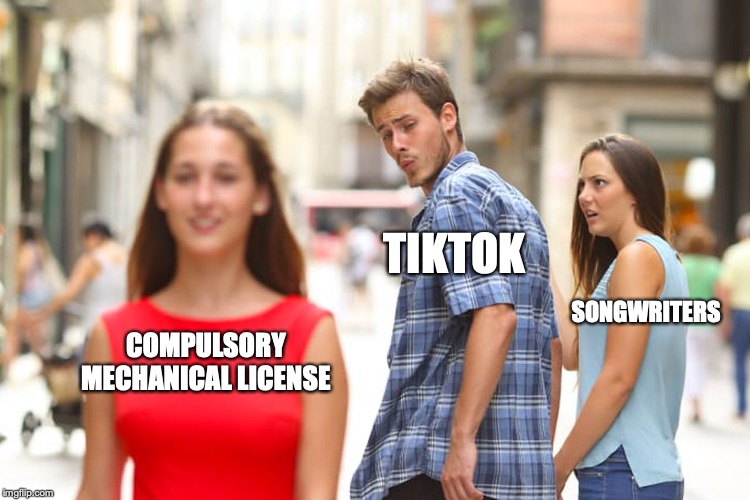
Starting in 2021 all streaming services will get a streaming mechanical license through the Copyright Office/MLC. Regulations that govern the federal compulsory mechanical license already forbid mechanical licenses on unlicensed recordings. This was originally designed to keep old school bootleggers from taking advantage of the federal license. In my opinion, regulations should be updated to prevent mass digital infringers like TikTok from using the compulsory license. Obviously, the copyright office would have to distinguish between a company that might “incidentally” infringe on a limited number of songs and a company like TikTok that apparently has no licenses at all for compositions, knows this, and refuses to license. But it’s not impossible.
The Copyright Office should be required to conduct a review or at least hold a public hearing before they allow a company to take advantage of the federal compulsory license. Why? If the federal government is going to take away songwriters individual right to license their work, the feds should make sure they aren’t, in turn, licensing to scofflaws, scammers, and criminals. Seems sensible right? Further, I caution against farming out this process to the MLC as they have already demonstrated they are not keen on transparency or oversight. The revolving door between big publishers that dominate the MLC and digital services invites corruption and cronyism. The Copyright Office should make sure that independent writers are not forced to license to a company ripped them off in the past.
Failing to vet licensees will create an extreme moral hazard for the copyright office. Licensing willful mass infringers would effectively make the copyright office complicit in money laundering, as a company like TikTok could take dirty money from infringing activities and effectively wash it by creating a licensed service. My hope is the Copyright Office address this matter in the next few weeks.
++++++++++++++++++++++++++++++++++++++++++++++
*There is a false narrative going around the music business that TikTok only infringes because they host User Generated Content. Thus it is protected from claims of infringement by the DMCA safe harbor. This is absolutely not true. Spend some time with the app and verify this, but in short, it clearly offers “sounds” to users to use in their videos. These sounds do not come from the users’ devices. They come over the network connection via the TikTok app. (Distribution! exclusive right 3) Next It makes copies of those sounds on the users’ devices. (Copies! exclusive right 1). Users are not copying and distributing. TikTok is. Thus like Grooveshark, it does not get the benefit of the DMCA safe harbor. It has now hired some of the smartest music licensing lawyers in the world. Yet TikTok knowingly and wilfully continues to commit mass copyright infringement. WTF? If I was a lawyer working at TikTok? I would make sure I can pay my mortgage without a law license!
We are definitely not implying that anyone has done anything wrong. We just really like this picture of a document shredder.
TikTok is a Chinese state-controlled company and one of the largest music platforms in the world. Yet according to multiple sources in the music industry, most of the songs they offer to their users are not licensed. I can personally confirm that TikTok distributes at least 2 dozen of my copyrights for which they have no license.
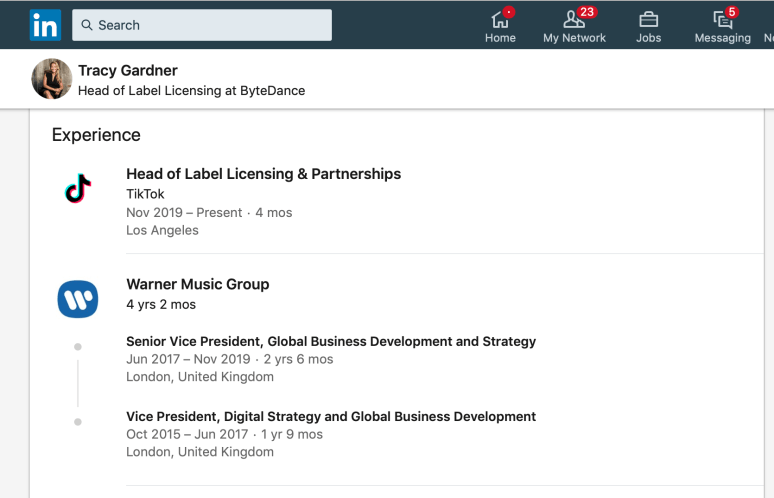
This is why it’s especially troubling that a number of major label licensing executives are now working for TikTok after negotiating very limited licenses for their old labels. This is not a great look. Artists and songwriters can honestly wonder if their works were sold on the cheap by executives looking for a better paying tech job. To be clear I’m not saying there was commercial bribery, but I wouldn’t be surprised if potential investors, bankers (WMG and UMG are promising IPOs), or even CFIUS ask for communications between former licensing executives and TikTok just to make sure there was no hanky panky. Remember we are talking about a Chinese state-directed firm engaged in ongoing theft of US intellectual property. Remember anyone can ask for an investigation. I have a feeling this will eventually get someone’s attention…
Sadly for the major labels, this comes after they fought to overcome artist suspicions that labels (and managers) traded lower royalties for Spotify equity. To counteract these suspicions labels went out of their way to distribute profits from the Spotify IPO to artists on a pro-rata per-stream basis. (Curiously managers did not-Editor.) Will these high profile executive defections to the music industry’s biggest licensing scofflaw undo the goodwill (dearly) purchased with that Spotify IPO distribution? We shall see.
Adweek reports that TikTok is celebrating Black History Month.
TikTok is marking Black History Month with special edition stickers and by showcasing videos from some of the inspiring African-American creators on its platform.
Creators can add stickers with positive affirmations to their videos, such as Black History Month, Expression Without Limits and Make Black History.
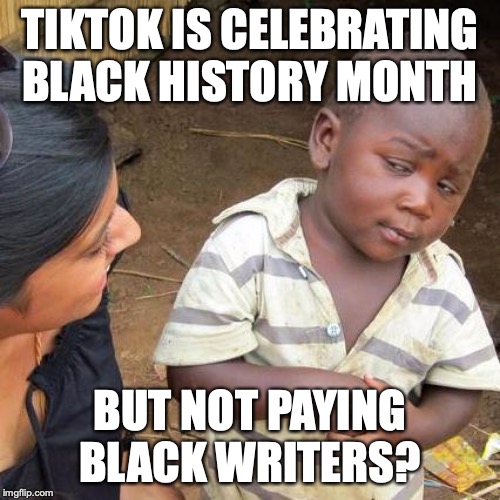
We find this to be a disgusting bit of bullshit virtue signaling. Why? With the possibly a couple rare exceptions*, TikTok is not paying writers performance or mechanical royalties despite the fact they clearly publicly perform,make available and distribute copies of songs to their billion or so users. Sure they are not only stiffing persons of color, they are stiffing white writers as well, but given the fact that Black writers and performers are generally overrepresented in the music business, one could argue this is a kind of algorithmic racism that on average and over the long term takes money from POC and gives it to the executives at TikTok.
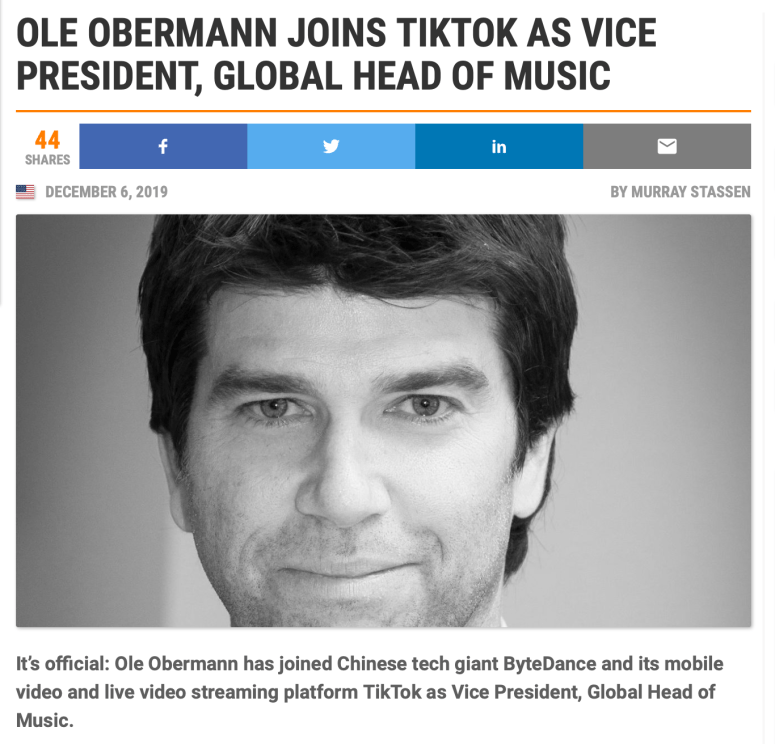
Former Warner Music Group Executive Ole Oberman. And…
Former Rights & Repertoire chief at GEMA and ICE attorney Dr. Joern Radloff. And…
Tracy Gardner former SVP Global Business Development at Warner Music Group.
Finally, does anyone notice a pattern here? Key executives responsible for negotiating on behalf of songwriters and artists, suddenly switch sides and TikTok gets a free pass to infringe?
This will get ugly.
*Sources at one major label report that TikTok has licenses for a “very small number of recordings” with the rest of their catalog unlicensed. Sources at a large publisher report no licenses with TikTok at all.
George Johnson is not a household name but he’s one of my heroes. If you are a songwriter you probably should pay attention to what this scrappy indie songwriter is doing. He may end up being a hero to you as well. The screen capture above says it all. One lone songwriter against the US federal government, Amazon, Google, Pandora, Spotify, The National Music Publishers Association (NMPA) and Nashville Songwriters Association International (NSAI).
Wait, isn’t NMPA and NSAI on our side? I mean they represent copyright holders and songwriters? Why are they “intervening” against George and alongside the digital services? Well, that’s a damn good question. If you ask the music publishing good ole boys/girls/x in Nashville, LA, and NY, George is some kind of songwriter zealot a crank or hopeless idealist. But is he? He makes a pretty good argument that the Copyright Royalty Judges, digital services, publishers and NSAI have made an illegal (and likely unconstitutional) deal in the most recent mechanical royalty rate hearings.
George has zeroed in on something publishers, performing rights organization and (purported) songwriter associations don’t want you to know: They agreed to a $0.00 royalty rate for songwriters on free trials and “promotional” streaming, with the latter defined as an offering “for which the service receives no monetary consideration” (CFR 385.31 b). Since YouTube and other digital services are primarily in the business of amassing data on you to help them later serve you ads, that is clearly a loophole big enough to drive a Mack truck through.
Here’s where George is 100% right. The Copyright Royalty Board is required by law to set “reasonable rates.” Zero is not a reasonable rate because it’s not a rate at all. Nor is it an “equitable division of profits” as required. There is no “division of profits” if one side is getting zero. As George so eloquently notes:
In 2013, Pandora had paid 14 executives approximately a half-a- billion dollars ($500 million) in stock options and bonuses, but argued that the company was losing money, then insisted that they would go out of business, or be “disrupted” if the zero-cent royalty rate was raised. Is it an equitable division of profits between the 7,446,327 million- dollars a year Pandora CEO Tim Westergren [J.A. A604, GEO Ex. 4079] is still taking from the company compared to the $.000 cents Pandora still “pays” each songwriter — transferring the value of songwriter copyrights to him and top Pandora executives? $42,503,792 million dollars to be exact for the fiscal year 2018.
“…nor shall private property be taken for public use, without just compensation.”- Excerpt Fifth Amendment US Constitution.
Finally, it doesn’t take a genius to notice zero is clearly an unconstitutional taking. Something of value is taken by the government, given to a third party without any compensation. Zero is impossible to read as just compensation. Slam dunk.
The smartest folks in the room, are once again proven to be total fucking idiots. The NMPA and NSAI have abandoned all pretense of looking out for songwriters and publishers. But really that’s okay. They also made it incredibly easy for a handful of “cranky” songwriters to turn this into a constitutional challenge.
[Welcome Senator Tillis to shining sunlight on the astroturf “Restatement of Copyright”, which in our view is a epitoma suprema of Silicon Valley shillery. The letter that Senator Tillis refers to is the December 3 letter his colleagues and he sent to the American Law Institute asking some questions about the proposed Restatement (which isn’t all that proposed anymore as the drafting is moving along briskly). I gather from Senator Tillis’s op ed that he hasn’t gotten a reply yet. Which must mean that the mumbletank in the Silicon Valley policy laundry hasn’t quite figured out how to reply. But here’s the question that no one seems to have asked yet: Who is paying for the Restatement of Copyright? I don’t mean which non-profit accountability blocker wrote the check, I mean who is the ultimate donor who is the source of donor directed funds?]
With millions of jobs and over a trillion dollars at stake, as lawmakers, we must ensure copyright laws continue to protect the livelihoods of our nation’s creators.
It is for this reason that we have sent a letter questioning the effort by a well-established legal organization to “restate” and reinterpret our copyright laws for the nation’s judicial system. Last time we checked, Article I of the Constitution specifically grants Congress the authority to make laws to allow for individuals in the creative industries to be fairly compensated – not law professors.








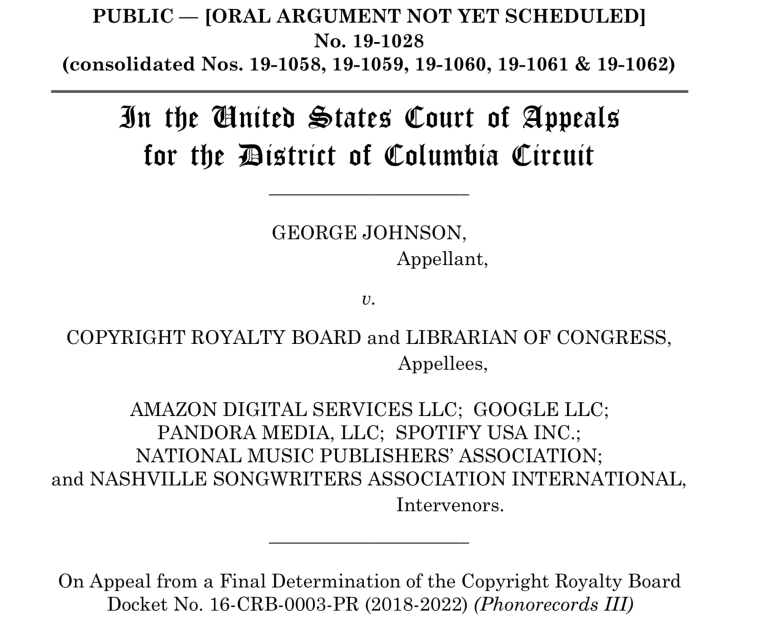 George Johnson is not a household name but he’s one of my heroes. If you are a songwriter you probably should pay attention to what this scrappy indie songwriter is doing. He may end up being a hero to you as well. The screen capture above says it all. One lone songwriter against the US federal government, Amazon, Google, Pandora, Spotify, The National Music Publishers Association (NMPA) and Nashville Songwriters Association International (NSAI).
 The Trichordist
You must be logged in to post a comment.