Authors Push Back on NTIA framing of Internet Policy Priorities


This is in response to the the National Telecommunications and Information Administration’s “Notice of Inquiry on International Internet Policy Priorities.”  This seemingly obscure agency has enormous influence over federal internet policy. The NTIA has asked for comments on Internet Policy Priorities. 

An ad hoc coalition of performers, songwriters, musicians, authors, and academics have submitted this letter to push back on the basic framing of the question in hopes of starting a dialogue that better reflects present day realities. 

Docket Number:

180124068–8068–01

Re: International Internet Policy Priorities

SUBMISSION OF THE AD HOC COALITION FOR COPYRIGHT AND DIGITAL PROSPERITY

The individuals and organizations identified below are a diverse group of performers, songwriters, musicians, authors, academics and others who share an abiding interest in expanding opportunities for the creative sector through internet commerce. The internet has the capacity to fuel a cultural renaissance, and enhance economic competitiveness. Alas, far too much of that potential has been lost as a result of the culture of lawlessness and lack of accountability that define broad swaths of the internet ecosystem. Recent events have helped to promote an awareness that societies are not prepared to accept lack of responsibility as the default setting for judging conduct on the internet. For internet commerce to drive global prosperity, it must be built on a framework that demands accountability. The NTIA document makes the following observation: “restrictions on the free flow of information are jeopardizing the economic, social, and educational opportunities provided by the internet. Perhaps even more importantly, the free flow of information on the internet enables basic human rights, such as the freedom of expression.” We believe that is misleading and incomplete. It is a more accurate reflection of the world to observe that while some restrictions jeopardize economic, social and educational opportunities, these opportunities are even more fundamentally limited and challenged by the absence of modern copyright laws to protect expression—the lack of accountability in the internet ecosystem rather than a surfeit thereof.


While the NTIA observation may be true for a certain limited number of countries operating under authoritarian rule, it does not accurately capture the nature of challenges in the US and other democracies. In short, we find the underlying premise of this exercise to be ill-considered and incomplete. NTIA is in fact not making a neutral observation of the world, but setting forth a partisan perspective on the nature of the challenges we confront in the internet space. It is predicated on a definition of freedom that examines only the existence of restraints and not whether expression is empowered. This celebration of a negative freedom risks creating a freedom in which expression is legally possible but practically impossible to exercise. It is a flawed vision that assumes a fixed and culturally neutral definition of “free flow of information” and “freedom of expression” when neither concept is capable of being understood absent context. It is a reflection of the cyberlibertarianism that has served as the guide for the first twenty years of the commercial internet, and which has failed us in many respects.   As articulated below, we urge a course correction based on the understanding that a failure to protect expression is inconsistent with freedom of expression, and that this more realistic freedom is dependent upon the rule of law and an appreciation for national sovereignty which reflects cultural, social and political distinctions between Nations.


In this relatively short submission, we highlight our belief in the potential of the internet to drive creativity and prosperity, but note that this potential will not be realized unless societies demand the technology neutral application of the law. We can not allow conduct to take place via the internet that we would find intolerable in the physical world, yet there are many who would lead us down that path. Internet freedom can not, in a civilized world, mean the freedom to act without regard to legality, and to be free of the consequences of one’s conduct.


To pave the way for the transformation to healthy digital commerce, it is necessary to establish the conditions for digital commerce to succeed in ways that have thus far eluded us. That includes a number of elements, but ultimately requires the development of more mature principles of law and business than those that propelled the first 20 years of innovation on the internet. As with many paradigm shifts, the first generation of internet policy-making was mostly predicated on governments and institutions getting out of the way of private actors. While that must remain a core element of future governance strategies, it is clear that it is, on its own, inadequate in addressing the needs of societies, workers and businesses in the new economy. Securing the technological application of the rule of law — and modifying the law where appropriate — are the prerequisites for advancing the digital economy and creating global prosperity.


We should strive to eliminate barriers and reduce costs for operating global services, including a liberalized framework for cross-border transmission of data, while providing means for governments to enforce their sovereign authority and to protect their nationals through the application of national laws. Web 1.0 assumed an homogenized global market without legal or cultural differences, and treated national prerogatives as impediments to the free flow of information. If we want to expand the growth of the “digital economy,” we must develop new modalities and tools for segmenting markets. While that seems a heretical thought from the standpoint of Web 1.0, it is increasingly obvious that it is a critical condition of expanding trust in the expansion of the digital economy. Web 1.0 thinking was too binary to sustain the development of a new global economy. To capture the potential of new technologies to drive global and shared prosperity, we need to marry discipline, restraint and freedom, understanding the multi-faceted nature of a freedom that doesn’t only contemplate lack of restraints on the actor.


Many of the elements of driving the global digital economy have been expressed in one forum or another, and many of them are quite obvious. We should eliminate unnecessary restraints on cross-border data flows. That has been a clear objective for businesses and some governments for some time now, but has been understood by others as a scorched earth campaign resting on the assumption that any restraint is unnecessary. It is time to move on — the only way that we can liberalize data flows is through explicit recognition that this doesn’t eliminate sovereignty. Governments have a responsibility to their people to uphold national laws regardless of the means by which commerce/information is distributed. Enhancing the legal and practical ability to uphold national laws should allow us to drive greater consensus about removing impediments to global data flows. Again, the key is to moderate the pervasive winner-takes-all approach of web 1.0 ideology.


That begins with a clear recognition that all restraints on data flows are not a form of digital protectionism. That includes various measures related to what we might deem censorship, as well as measures aimed at protecting privacy or otherwise applying the rule of law to communications or conduct affecting the relevant jurisdiction. A 21st century digital trade agenda needs to be far more pluralistic than the simple flat-earth, idealistic and culturally insensitive notions underlying the early development of the internet. Technology may allow information to easily cross borders, but that doesn’t eliminate national differences and the continued importance of national sovereignty.


Acknowledging that will facilitate the development of normative structures and global legal commitments that will foster global commerce based on countries taking the least restrictive measures to limit the flow of information and ability to do business across borders. But to achieve that, we need to cultivate trust at various levels — including trust that facilitating the growth of global digital markets does not equate to a loss of sovereignty. Governments have chosen to limit data flows or to force localization as a means of sustaining control, and have thereby increased costs and the stymied the development of global commerce that could bring significant benefits to their consumers.


Clarifying the jurisdiction of national courts to adjudicate online conduct without regard to the geographic location of the actor (assuming a proper nexus with the state asserting jurisdiction that doesn’t offend due process and fairness) could go a long way towards eliminating business costs associated with localization or other restrictions on data flows. But we will not prevail if our agenda for liberalization is seen as a demand for countries to demur to US practices and cultural preferences. That is not a winning strategy. There was much discussion of balkanization standing in the way of globalized prosperity and freedom during web 1.0. But this vision failed to acknowledge that our virtual world touches and affects people and businesses in ways that are very tangible, and that governments were not prepared — and more importantly, were right to not be prepared — to be relegated to addressing 20th century conduct. That technology allows borders to be crossed instantaneously doesn’t make those borders any less meaningful. By labeling every restriction as leading to a balkanized net or as an impediment to the free flow of information, we failed to articulate a sustainable model for internet governance which allowed us to make the critical distinctions between digital protectionism and reasonable efforts to uphold national laws in a technology neutral manner.


USTR has set out its “Digital 2 Dozen” which usefully sets out some basic trade objectives for expanding digital commerce, essentially outlining the framework for the least restrictive rules for digital trade while allowing flexibility to protect national sensitivities. We support these particulars, but note that they address only one aspect of expanding digital commerce — agreement of governments to refrain from overt digital protectionism. However, to sustain the growth and vitality of global digital commerce, nations need to work together to develop consensus on underlying issues of trust and security that, left unaddressed, will undermine the health of the global trading system. Gaps in cybersecurity, privacy and consumer protection will inevitably create unbearable strains on the digital ecosystem, leading to new restrictions on data flows and/or the introduction of new inefficiencies in global commerce. It is therefore critical that we seek to harmonize, to the greatest extent possible, national approaches to these key issues to engender greater trust in the ability of global institutions and bodies to address harms. Enhancing accountability of all actors in the internet ecosystem is a critical component of driving trust in the digital economy. Attempts to liberalize the rules of digital commerce will fail if advocacy is understood as an endorsement of lawlessness and/or an attempt to apply the First Amendment or other US laws as the default principles for global commerce. To support a global digital economy, and not just propel a global information commons, nations and businesses must coalesce around a series of rules that establish certainty and security in commercial transactions. We must build rules from the ground up and not merely encourage government restraint.


As participants in the creative community, we have witnessed first hand how the absence of adequate rules related to internet conduct can have dramatic and negative consequences on the ability of cultural/creative workers to sustain themselves from their craft—much to the detriment of societies. Luckily governments around the world have begun to understand how economic stability and cultural diversity have been harmed by rules which fail to require internet platforms to operate with a reasonable duty of care, and are beginning to reexamine internet governance principles adopted twenty years ago.


The European Commission has been particularly engaged, and is presently considering amendments to its framework of internet governance, work on which began in 2015 with the issuance of a Communication which reflected its recognition that the framework of legislation established in the mid-1990’s was no longer adequate. The Commission wisely observed: “An effective and balanced civil enforcement system against commercial scale infringements of copyright is central to investment in innovation and job creation. In addition the rules applicable to activities of online intermediaries in relation to copyright protected works require clarification, given in particular the growing involvement of these intermediaries in content distribution. Measures to safeguard fair remuneration of creators also need to be considered in order to encourage the future generation of content.”


The understanding of the need to rebalance rules is a very welcome reexamination of internet rules adopted in the late 1990’s (i.e. the era of dial-up and bulletin boards) that were designed to ensure that intermediaries were not held liable for third party content uploaded onto their networks over which they had no control or knowledge. The principles underlying safe harbors in the US and EU were sound, and helped to drive innovation in the digital space. However, they are clearly showing their age and are no longer operating as intended. Instead of providing reasonable protection to intermediaries that are operating responsibly, they have created incentives for online services involved in content distribution to implement architectures and practices to create plausible denial of knowledge of infringement, or willful blindness. One often hears the term “DMCA license” when no license is established under the DMCA. Safe harbors were not intended as alternatives to licensing for content distributors, but too often they have become just that. And takedown has replaced reasonable care in the conduct of intermediaries. But takedowns only occur once injury has already taken place, and infringing content is quickly re-uploaded in any event. In short, while notice and takedown may have worked in a more innocent and less technologically advanced age, it operates as a continuing injustice in an environment in which platforms engage in the willful distribution of infringing materials, subject only to the requirement to delete specific files when they are notified.


It is a matter of the first importance that we achieve clarification that only intermediaries that are truly passive and neutral with respect to the content that they host or communicate are eligible for safe harbors. Creators are dependent upon the effective functioning of the internet in order to grow and thrive, and would join others in opposing measures which placed unreasonable burdens on internet platforms or services. But simply clinging to 20 year old norms in an environment of rapid technological change is irresponsible, and we should encourage examination and experimentation. There are some in the US who, while touting “disruption” will insist on absolute fealty to the status quo. But if we are going to seize the potential for economic growth and job creation presented by developments in technology, we must look forward, and not merely cling to the past.


Particularly as the world’s greatest producer of copyright works, we believe that the United States should be as supportive as possible of efforts to create a more robust digital marketplace for the creative sector. Ensuring that safe harbors meet their intended purpose of promoting responsible conduct is a key element of a healthy digital future, and deserves your support. There has been an explosion of interest in the United States due in large part to issues which arose in connection with Cambridge Analytica/Facebook, but the underlying issues of internet governance go far beyond that. Facebook is not an outlier — they are an example, and far from the worst one, of maintaining governance strategies that essentially abandon democratic governance. Of pursuing a parochial vision of freedom based on cyberlibertarian principles that ignore the effects of one’s actions. Of celebrating permissionless innovation without due regard for making distinctions about what actions should require permission and/or oversight. Of believing that disruption on its own is worthwhile without regard for consequences.


We in the arts community have been canaries in the coal mine, and our experience is instructive. We have witnessed first hand how language of freedom is used to justify theft, and how the protection of expression is characterized as inconsistent with freedom of expression. As societies around the globe confront the implications of present internet business models, it seems a most appropriate occasion to recognize the unique role of artists in the flowering of free expression, and in creating the kind of world that we wish to inhabit. The author, Marty Rubin captured this nicely: “Artists, by their free expressions, encourage others to be free. This is the quality that makes works of art enduring.”


Yet, many groups continue to suggest that the protection of expression is a form of censorship or restriction on fundamental freedoms. We must end this assault on our humanity and the misappropriation of fundamental human rights. If the protection of expression is itself a restriction on freedom of expression, then we have entered a metaphysical Wonderland that stands logic on its head, and undermines core, shared global values about personhood. It is time to open the curtains and see these practices for what they are.


We must use this “Facebook moment” to rethink the celebration of disruption for its own sake. Disruption as a way of shaking up the status quo may be great, but not where the disruption is effected by facilitating theft or otherwise ignores the consequences of conduct. No reasonable definition of innovation should serve as an invitation to, or protection of, a business model based on the theft of intellectual property. It is a matter of the greatest importance — to our economy, our culture and our very humanity, to fully reflect the importance of consent and rules in the networked environment — a framework which promotes openness, not anarchy, and firmly rooted in celebrating works of expression that reflect and fuel our appreciation of the freedoms associated with expression.


There will always be individuals or enterprises who are prepared to steal whatever they can, but we can — and must — stop providing moral cover by conflating copyright enforcement with censorship, or by misapplying notions of internet freedom or permissionless innovation so that they extend to an embrace of lawlessness.


The potential of the internet and other communications technologies to drive economic growth, prosperity and cultural production has been greatly undermined by distortions in the marketplace caused by the lack of adequate governance that allows companies to illegally traffic in what are essentially stolen goods. Many of those who profit from the status quo like to disguise their self-interest in rhetoric about free expression. It is long past time to end this dangerous charade. We are not serving free speech by making it harder for creators to earn a living from their original expression. Free societies can no longer tolerate the continued indifference to the rights of creators.


We define our society by the extent to which we empower the exercise of free will and the ability — legal and practical, to determine the use of our identities and our property. Recent focus on the relationship between privacy and consent must serve as an invitation to examine the broader issues of consent and platform responsibility, or we will end up addressing only a symptom and not the cause. If the lesson of recent developments is that we should delete Facebook, then we will have sorely missed the point, and will continue to rely on a false narrative that human agency is a sufficient check on the functioning of tech platforms even as human agency is effectively eroded. What’s needed is democratic governance — the application of law and incentives for accountability.


Neil Turkewitz, on behalf of the following individuals and organizations who have come together in this ad hoc coalition for copyright and digital prosperity.


Richard Bennett, Founder, High Tech Forum

Jason Berman, former Chairman & CEO of the Recording Industry Association of America (RIAA) and IFPI

William Buckley Jr., Executive Director, FarePlay

Stephen Carlisle, Copyright attorney and former law professor

Chris Castle, Attorney

Dean Kay, Songwriter: “That’s Life” Curator: The Dean’s List

Phil Galdston, songwriter, co-founder Music Answers

David Golumbia, Associate Professor of Digital Studies, Virginia Commonwealth University

Alan Graham, Author, CTO & Co-Founder OCL

Devlin Hartline, Assistant Director, Center for the Protection of Intellectual Property

Hugh Hansen, Professor of Law & Director, Fordham IP Institute

Andrew Keen, Author of “How To Fix The Future”

David Lowery, Singer/Songwriter Camper Van Beethoven and Cracker

Brian McNelis, Music Executive

Blake Morgan,  Artist & songwriter, founder of #IRespectMusic campaign

David Newhoff, Writer

Mary Rasenberger, Executive Director, The Authors Guild

East Bay Ray, guitarist, co-founder, songwriter of Dead Kennedys

Marc Ribot, Guitarist, and Chair of Artist Rights Caucus of Local 802 AFM

Chris Ruen, author of “Freeloading”

Maria Schneider, Composer, bandleader

John Simson, Executive in Residence and Program Director, Business & Entertainment, Kogod School of Business, American University

Jonathan Taplin, Director Emeritus, Annenberg Innovation Lab, University of Southern California

Amanda Colleen Williams on behalf of Songpreneurs Community, https://www.songpreneurs.com/about

David Wolfert, songwriter/composer, co-founder Music Answers

Doug Wood, composer, co-founder Music Answers


Note: Unless otherwise specified, members of this Ad Hoc Coalition are signatory in a personal rather than representational capacity

EU MEPs Hacked: More than Half #DeleteArt13 Tweets Appear to be from Sock Puppets

The twitter account used in this example is largely dormant.  Except every once in a while it is used to promote some suspect contest or website.  Thousands of tweets use this exact same template. 

To be clear. This is not a robust statistical survey.  It’s based on my random sampling of tweets to MEPs.  But it looks like in any 24 hour period the majority of tweets to MEPs opposing article 13 are coming from suspect accounts.  I encourage others to verify this.  Once the July 5th voting date passes, I encourage the European Parliament to investigate the use of suspect twitter accounts to influence voting. Why?  Because this is an attempt to subvert your democratic processes.  MEPs and staff may contact me and I can suggest a couple approaches to rigorously analyze this. Remember that MEP Julia Reda, SaveTheINternet.eu, Copyright4Creativity and EDRI (An EC funded civil society) Is actively sharing links to robo tweet, email and call MEPs.

This account is newly created twitter account and links to a tumbler blog that was created the same day.  The photo depicts the musical duo “I Don’t Know How You Found Me.”  But this is not their official account. Hundreds of accounts used in the twitter campaign against Article 13 use other peoples photos as profile pics. This has marks of professionalism as they don’t actually claim to be “I Don’t Know How You Found Me.” But the account description is: “How did you find this account.”   A little bit of thought went into creating this account. 

Suspect accounts?

  1. Newly created accounts
  2. Very low number of followers
  3. Claim country different than language used in tweets
  4. Accounts dormant for long periods of times
  5. Very little unique content (Only retweets etc)

O

5 out of 6 tweets directed at MEP Axel Voss are identical.  

Automated generation of tweets.

The vast majority of the tweets are clearly coming from an automated source as they have identical formats.

Those operating the robo tweet operations seems to periodically target specific country MEPs. 

Specific MEPs and Countries Targeted

The last 24 hours suggest that whoever is automating these sock puppet tweets has focused on Irish MEPs.  Previously we saw Portuguese and Polish MEPs targeted.  This is clearly not an organic movement.  Some entity with vast resources is directing this campaign.


#SaveYourInternet Dog Whistles to Far Right with Pepe: Desperation or Stupidity?

One of dozens of memes featuring “Pepe” urging calls to EU members of parliament against copyright directive. The image is recycled from a Southern Poverty Law Center listed group. 

For those of you not familiar with meme culture and Pepe the Frog you might want to start here.  The point of this article is not to debate whether every time some kid uses the Pepe meme it is racist.  Indeed as the linked article notes Pepe began life as a harmless comic character. However there is no doubt that Pepe has been adopted by many far right groups as a kind of anti-PC signifier. Or worse. The creator of Pepe recently killed off Pepe in his comic strip because he was distressed by its recent association with racism and antisemitism.

That is why it is absolutely stunning that opponents of the EU Copyright Directive Article 13 seem to be cultivating support from the far right by using Pepe memes.

There’s always a possibility that the ever insular copyleft doesn’t realize that not all “meme” culture is cute kittens and doesn’t understand the significance of Pepe.  Indeed Hanlon’s razor warns: never attribute to malice what can be adequately explained by incompetence and stupidity.

SaveYourInternet.eu website allows anyone to repeatedly robo call MEP.  MEPs of their choosing.  So they can target specific MEPs.  This is how they hack democracy. 

However anecdotal reports show that the MEPs that have been targeted with automated robo calls have largely been Eastern European MEPs with significant anti-immigrant or white nationalist movements.

Further we have previously documented the Copyleft and Pirate associations with the far right.

See here:

German Pirate Party MEP harassment of the Anne Frank foundation.

https://thetrichordist.com/2016/04/28/eu-pirate-party-mep-julia-reda-germany-doesnt-want-to-pay-for-diary-of-anne-frank/

And of course How do pirates tie their shoes?  In little nazis of course…

https://thetrichordist.com/2017/09/26/why-is-it-every-time-we-turn-over-a-pirate-rock-white-nationalists-nazis-and-bigots-scurry-out/

What is clear is that the “don’t break the internet” crowd has cried wolf one too many times.  And their attempts to raise a cybermob are falling short.  As of yesterday there were only 800 #DeleteArticle13 tweets on twitter.  And a cursory examination shows that about 80% of those tweets are from sock puppet accounts.

So is the appeal to far right trolls design or desperation?   SaveYourInternet.eu are you purposely targeting far right twitter users?

+++++++++++++++++++++++++++++++++++++++++

Update. So it is not stupidity. It was plan all along. Looks like Pirate Party MEP has been reaching out to far right. See screen capture of tweet below:


Content Creators Coalition & MusicAnswers Applaud the Revision and Passage of the Music Modernization Act by the Senate Judiciary Committee — Artist Rights Watch

[A brief word–TheTrichordist and MusicTechPolicy are always there to provide a platform for the songwriters, artists, musicians and vocalists when grassroots needs to be heard.  We all have to thank the Content Creators Coalition, MusicAnswers and especially Maria Schneider for enduring the tactics used against them in their unwaivering fight for fairness and transparency for the creator community.  The good protective changes to MMA in Senate Judiciary are due to their efforts and the kind willingness of Senators Grassley and Feinstein to listen to compelling ideas presented by effective advocates.

We also thank all of our readers and supporters for helping to get the word out and taking action.  We would be nowhere without you.  If MMA passes, the collective’s operations will require hyperdiligence from the grassroots creator community around the world, so we commit to keeping the heat on for fairness, transparency and honesty.  In the end, the example set by these brave leaders C3, MusicAnswers and Maria teach us that community is the oversight.  We commit to doing our share of these future tasks and then some if called upon.  We invite you to do the same.]

PRESS RELEASE

[Washington, D.C.] – The Content Creators Coalition and MusicAnswers released today the following statement on the Senate Judiciary Committee’s vote in support of the Music Modernization Act.

C3 and MusicAnswers applaud the Senate Judiciary Committee’s vote to advance the Music Modernization Act, while incorporating key changes we had urged to make the legislation stronger, more transparent, and more equitable.

The MMA will strengthen the music ecosystem and all its participants, including songwriters, publishers, performing rights organizations, artists, record companies, music services and fans. It ensures digital music services will pay fair royalties for every song they stream, establish a better standard for determining royalty rates, and eliminate some out-of-date provisions of the PRO consent decrees. In return, digital music services get certainty, legal protection, and new streamlined tools to bring more music to more people at lower cost.

It’s a reasonable bargain, and, therefore, we have consistently and publicly supported the basic construct of the legislation.

We are especially grateful that the Senate Judiciary Committee, led by Chairman Chuck Grassley (R-IA) and Ranking Member Dianne Feinstein (D-CA), was willing to engage with our organizations on ways to improve the bill and include in the Managers Amendment approved today key protections for creators and the public.

As a result, the MMA now provides greater transparency, including rigorous audits to make sure that royalties are flowing to the correct parties, a commitment to educating all music creators about their rights and the royalties due them collected under the new Music Licensing Collective (MLC), a requirement to study and follow best practices in order to find the proper owners of unclaimed royalties, and increased clarity regarding who owns the data generated by the new system.

While we support the legislation and are proud of the changes we have achieved as artist and songwriter advocates, we continue to have concerns about three key issues: whether the entity that is designated as the MLC is being foreordained by the bill and precludes competition with the MLC; the composition of the Board of Directors of the MLC, which is unduly tilted towards major publishers; and the methods used to distribute royalties from works where even using best practices the authors could not be identified.  We urge the full Senate and the House to consider further improvements to those flawed provisions and we call on the Copyright Office to ensure in implementation of the final legislation that no stakeholder group can dominate the MLC and that all royalties are distributed in a fair and equitable and non-self-interested manner.

The process leading to this moment has been strong in many ways. But it has also included its fair share of divide-and-conquer tactics and efforts by powerful incumbent forces to crowd out grassroots organizations like ours and to divide the music community within itself.  We believe that we are strongest when we respect and support each other – a lesson too many in our business still have yet to learn.

We are deeply appreciative of the partnership c3 and MusicAnswers have forged. Together, we represent thousands of writers, producers, performers, and music business professionals, and over the past few weeks we have worked steadfastly to pursue improvements in the MMA. We look forward to future collaboration and welcome the involvement of other collaborative groups and individuals.

via Content Creators Coalition & MusicAnswers Applaud the Revision and Passage of the Music Modernization Act by the Senate Judiciary Committee — Artist Rights Watch

Did a Wyden Campaign Donor Fund Hedge Fund Operated Out of Senator’s Basement?

This blog normally concerns the rights and revenues of artists. Senator Ron Wyden of Oregon has consistently been on the wrong side of these issues. Wyden opposes the “Classics Act” that corrects what is essentially a typo in copyright law.  A typo that allows multi-billion dollar digital services like Google, Spotify, Pandora and Sirius to withhold royalties to performers that recorded before 1972 (the year sound recording copyrights were federalized).   Unfortunately due to biases built into the music industry before 1972 this means that African American artists are disproportionately harmed by this loophole.  That is why the Oregon NAACP has called out Wyden on his opposition to the classics act.

Wyden has falsely characterized the bill as a windfall to record labels. He also falsely claimed to his constituents that performers would not receive any money from the Classics Act.  The Senator either did not read the bill or is lying.  The terms of the classics act are as plain as day.

So since the Senator is so concerned with unearned windfalls, let’s turn the table and look at his own families finances. Let’s see if perhaps the powerful Senator and his family benefitted from unearned windfalls.

What is up with this:

http://www.businessinsider.com/hedge-fund-born-in-senators-basement-after-son-has-de-shaw-internship-2011-2

Wyden’s son Andrew Wyden went from interning at DE shaw (19 Billion in assets) to owning his own hedge fund in a matter of months.  As the article notes David Shaw (Principle at D. E. Shaw) has been a frequent contributor to Sen Wyden and also supported his Super PAC:

Apparently it’s extremely rare for college kids to “get to intern on a D.E. Shaw portfolio for the summer,” said Brian Marshall, who used to run the fund.

But a D.E Shaw spokesperson assured Bloomberg, “Adam went through the same rigorous vetting and interview process as all other D.E. Shaw group interns.”

The reason observers might think otherwise is because David Shaw has donated thousands of dollars to Senator Wyden’s election and re-election campaigns in 2004 and 2010. Shaw and his wife each gave the maximum $4,800 each that they’re allowed to donate for any single election cycle, to Wyden.

Shaw also contributed $5,000 in 2010 to Holding Onto Oregon’s Priorities, a political action committee established by Wyden, according to Campaignmoney.com

Other articles report that Andrew Wyden (the junior) started with 3 million dollars.  Who gives a 26 year 3 million dollars to run a hedge fund out of a Senators basement?  It must be someone who knows the son very well.  Perhaps a rich former employer like D.E. Shaw?  To be clear I’m not definitively stating that D. E, Shaw gave the Andrew Wyden his stake.  I have no evidence to support it.  But the money came from somewhere.  Both the senator and the son know where the money came from.  They could clear this up.  But if they continue to remain silent, I say it is fishy enough that it should be investigated by someone.  This is above my pay grade, but here are some suggestions: Senate ethics? SEC? FEC? FBI? Any and all?

ESPECIALLY since Wyden the junior had an extraordinarily good first year. Up 90% in the first year.  According to Absolute Return magazine:

Wyden’s best personal trade last year was an investment in IDT Corp. starting in February, when the Newark, New Jersey, telecommunications company traded at an average of $4.84 a share, he said. IDT now is at $23.90

Lucky bet? Could be.  I mean the stock of many thinly traded telecommunications companies trade in a volatile manner.  Especially if they they have patents or spectrum that are positively impacted by FCC decisions. Pop. But IDT is no ordinary telecommunications company.  In fact it’s misleading to consider it a pure telecommunications play.  Here are some highlights from their 2008 annual report ( I couldn’t find later annual reports):

There are three possible issues with IDT holdings. Senator Wyden is on the house Energy and Natural resources committee.  IF (and that’s a big If), the Senator was privy to any information that would impact IDT’s two energy businesses  (and hence stock price) what safeguards were in place to assure this kind of information didn’t go to his son? Fair question since his son’s hedge fun was operated out of the senators Washington DC townhouse.  Second, the value of the wireless spectrum that IDT owned could potentially impacted by the Senators action or inaction.  Wyden is no stranger to the wireless spectrum issues.  He was instrumental in getting 3g spectrum freed up from the pentagon for use by commercial telecommunication companies.  Advance knowledge of the senators action or inaction could materially affect value of IDT spectrum and hence the stock price of IDT.

To be clear.  I have no evidence of wrongdoing, but there is something not quite right about letting a sitting senator’s son operate a hedge fund out of the senators home. It deserves further examination.

Finally I’ve heard the Senator is a fan of the movie The Big Lebowski.   Might we remind him what “happens when you find a stranger in the Alps?”

+++++++

See also this article

https://www.thedailybeast.com/get-elected-get-your-kids-rich-washington-is-spoiled-rotten

Here Comes the Shiv: Sen. Sasse to Move to Strike the CLASSICS Act and Screw Pre-72 Artists With the MMA Bait and Switch— Music Technology Policy

Trichordist readers will not be surprised to learn that Senator Sasse is circulating an amendment to strike the CLASSICS Act from the Senate version of the Music Modernization Act. The amendment appears to have been drafted by the Google Shills at Public Knowledge–bringing the bait and switch right on cue.

This is, of course, the classic back stabbing we have come to expect from Public Knowledge, so is par for the course.  What that means, of course, is that Google gets to screw the pre-72 artists and get their new reachback safe harbor that the songwriters and publishers gave up.

We need to move on this quickly.  If you can call your Senator and ask them to oppose the Sasse amendment to the Music Modernization Act (bill number S. 2823), that would be great.  You can look up your Senator’s information on Phone Congress at this link.  Choose “Any Other Topic Not Listed Here” on the pull down “Topic” menu.

via Here Comes the Shiv: Sen. Sasse to Move to Strike the CLASSICS Act and Screw Pre-72 Artists — Music Technology Policy

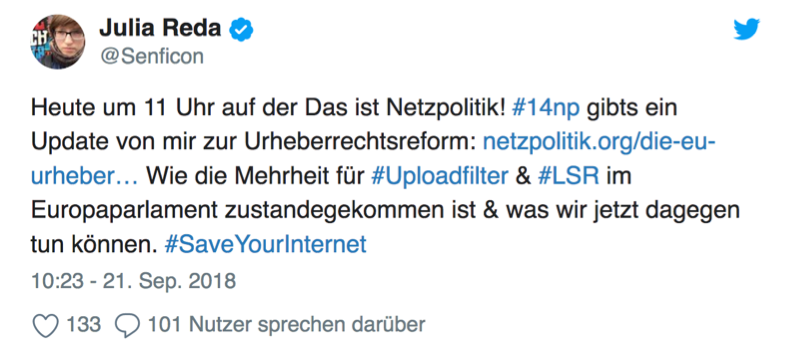
Meanwhile in Europe Is Google Attempting to Hack the EU Parliament with Robo Calls, Emails and Fake News?


Think it’s a coincidence that Google’s search algorithm returns exclusively negative or outright fake news on EU proposed copyright revisions? 

Google is the first imperialist power of the 21st century.  It has no qualms about subverting democratic processes whenever those processes threaten it’s profits.  Most of the time we see these power grabs in the US.  For instance Google used stolen emails to derail a Mississippi State investigation into it’s advertising practices. Most recently Google used it’s pet Senator (Ron Wyden) to try to derail an anti child sex trafficking bill. Wyden was one of only two Senators to oppose the overwhelmingly popular bill.  WTF right?  Makes you wonder what they have on him.

There are so many cases of Google strong arming government officials it would take fifty pages to list them all.  Suffice it to say that in almost all these cases Google upends the democratic processes when government actions in some small way threaten googles internet advertising and web hosting businesses.  From Google’s perspective it makes sense as Google is willing to monetizes any and all web traffic with no oversight, and with no regard to how abhorrent that traffic may be. Google does not give a shit that it may be enabling child prostitution rings, the opioid crisis, or radicalizing lone wolf terrorists.  Any regulation that requires even minimal oversight and might cut into Google’s $110 billion yearly profit(profit not revenue) is attacked by Googles vast network of lobbyists, astroturf groups, google-funded think tanks, paid bloggers, and academics.

The last few years we have seen Google turn their efforts towards subverting democratic processes outside the US.  In some ways they have been more effective in places like EU where they are unaccustomed to the kind of subversive political/academic/NGO practices honed by Big Tobacco.  In the U.S. we have been partially inoculated. Europeans fall hook line and sinker for this shit.

Case in point.

The EU parliament legal affairs committee recemt;u voted to approve a new copyright directive  giving authors, performers and songwriters much more control over how their work appears online. The directive would require online platforms to pro-actively manage their platforms so that creators could decide when and if their content appears on digital platforms and under what financial terms.

This does not make Google/YouTube very happy because currently they enjoy an massive subsidy from creators because they essentially use whatever they want  whenever they want. As usual they claim that it is their “users” who are doing the infringing. Not Google. Never mind that Google is making billions slinging ads against all this unlicensed content.

As the directive comes up for a vote in the full parliament, I now see Google deploying the exact same tactics against the Copyright Directive that they have used against copyright measures in the United States.  For the EU readers let me give you some examples from the US and you can tell me if you see similarities in their attack on the copyright directive in EU.

Fake grassroots organizations.  In the U.S. Google has consistently used  groups like Fight For The Future.   Fight For The Future purports to be a grassroots organization but it is actually run by a Google lobbyist. Despite claiming to have millions of followers, when they tried to stage a protest in San Francisco before a copyright roundtable they couldn’t get a single real individual to show up. Astroturf.  Fake.

https://thetrichordist.com/2016/05/13/astroturf-fight-for-the-future-is-toast-anti-copyright-protest-gets-9-rsvps-on-facebook/

Twitter bots:   During the last round of Copyright Office hearings on safe harbors we observed that the vast majority of tweets against copyright reform were coming from anonymous accounts that were only active when copyright issues were being considered. Fake.

Robo Emails/Comments: Fight for the Future the astroturf group run by Google lobbyist has repeatedly bombarded congress, and federal agencies with identical automated emails and comments. We demonstrated that the “tool” they provided from their website, didn’t verify identity; allowed users from outside US to vote; and allowed repeated voting by simply reloading page.

https://thetrichordist.com/2016/04/19/exactly-86000-identical-comments-the-illegal-comment-bombing-of-dmca-notice-takedown-review-by-google-proxy-fight-for-the-future/

Paid Academic Research.  This has got a lot of press in the US.  But basically Google has been paying academics that then produce papers that it uses to lobby US and EU governments.  Many of these papers are poorly researched and little more than opinion pieces.  See here:

https://googletransparencyproject.org/articles/google-academics-inc

Robo Calls/Boiler Rooms:  I was in a US Senate office in May when Fight For The Future was conducting a phone campaign on net neutrality.  If you go to the Fight For The Future website you are eventually prompted to put in your phone number and then an automated system rings a (your?) senator and connects your phone to the call.  The senate office can not verify your phone number, exchange or area code.  Net neutrality is extremely popular policy and even an astroturf group like FFTF should have no problem finding people to phone senators. However… Two staffers were handling phone calls right in the lobby, and I could hear the callers.  The Senator hails from a state in the deep south.  Yet not a single caller seemed to share the Senators accent. I mentioned this to the staffers. Their reply: “Yeah we think these are professionals.”  To  be clear.  I don’t know if these callers were part of the the Fight For The Future phone campaign.  But it was during this period.  And they certainly seemed to be reading from a similar script.

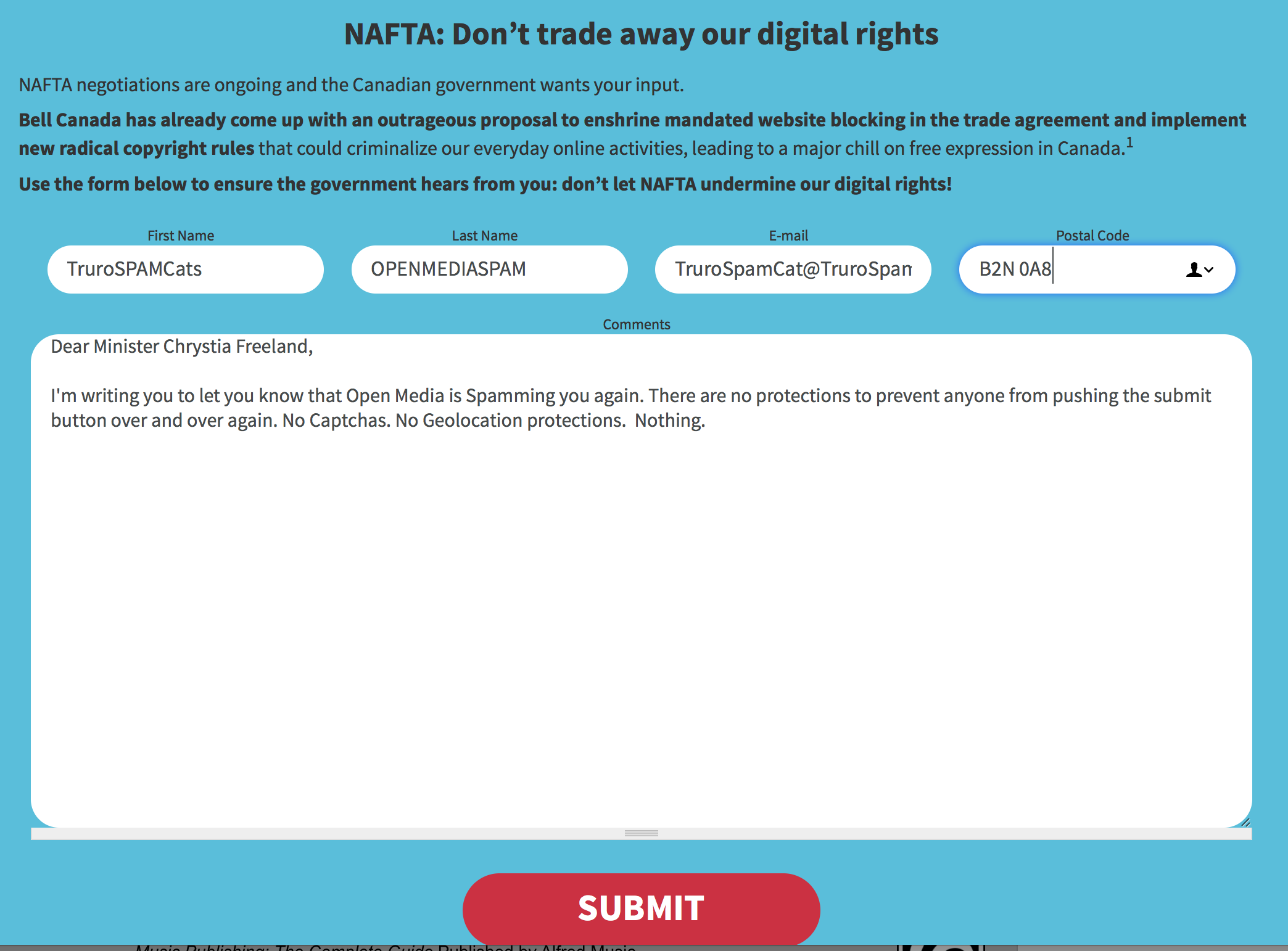
I just checked and these tools are still live.  I sent the email above despite the fact it’s a fake email address.  I then reloaded the page used my real email, phone number and zip code and I was able to place a call to congress.  Strangely I was connected to a random congressional office ( Not related to my phone number, IP location or the postal code.)  I told the polite staffer who answered the call that I was very concerned about Federal Emergency Management Agency using high altitude aircraft to spray mind altering chemicals on my hometown as it was producing strange behavior in my cats.  All twelve of them.  Poor staffers. ( I later identified myself and told the staffer I was conducting an experiment for a article I was writing).

I can almost guarantee you that Google is using the exact same techniques to overwhelm MEPs phones and emails at this very moment.

DON’T LET GOOGLE HACK YOUR DEMOCRACY!

++++++++++++++++++++++++++

UPDATE

+++++++++++++++++++++++++++

In fact there is at least one of the web pages producing robo calls. This is from the Google proxy Open Rights.  I have not tested it but reports from readers is that it works and there is no limit on the number of calls. And email addresses are not verified.


Seriously, What is Sen Ron Wyden’s Problem? Cruel, Ignorant or Corrupt?


One of the things the Music Modernization Act (MMA) does is fix what is essentially a typo in copyright law that allows a handful of digital services (Google, Sirius, Pandora etc) to not pay royalties to performers on Pre-1972 recordings.  This part of the Music Modernization Act is commonly referred to as “The Classics Act” or “Classics Provisions.”

The Music Modernization Act passed the House without a single no vote. 415-0. Rarely do we see this sort of bipartisan consensus in the US Congress.  Even the Dec 8th 1941 declaration of war against Japan was not unanimous. Part of the reason the bill enjoys such wide support in US House of Representatives is because the Pre-1972 loophole seems ridiculously unfair. It violates everyone’s – republican, democrat, liberal conservative- EVERYONE’s sense of fair play.

Except Senator Ron Wyden. He’s fine with unfair play.  He’s fine with stiffing creators to benefit a few billionaires.

Yes, Senator Ron Wyden the progressive democrat from the bluest of blue cities, Portland Oregon.

You see Senator Ron Wyden is threatening to block the bill. Unless of course he gets his amendment that would gut the provisions that restore digital royalties for Pre-1972 performers.

Wyden is willing to go against his constituents, the unions and even the NAACP! (African American performers would seem to be disproportionately harmed by the loophole.) Metaphorically this is the hill on which Wyden is prepared to die.

What the fuck is Ron Wyden’s problem?

Is he just a blackhearted and cruel person?  Is he lazy and just doesn’t understand the issues? My limited interactions with the Senator makes me think no. Is there a financial motive? Perhaps even good old fashion corruption?  Seriously.  He would seem to have put himself into a lose-lose position, with no political upside. It’s a question worth asking.

Consider this:

People think of Google as a California company, but Google has massive server farm operations in the state. Google is one of the companies that benefits enormously from the pre-1972 loophole.  You think that it’s an accident that Wyden is the one U.S. Senator against the bill?  I don’t.  Has anyone looked at this?  I mean investigate him.

Also what is up with this:

https://dealbreaker.com/2011/02/son-of-senator-starts-hedge-fund-out-of-dads-basement-following-de-shaw-summer-internship/

Wyden’s son runs a hedge fund out of the Senators basement?  What could possibly go wrong? I wonder who the “investors” are in that hedge fund?  Maybe someone should look into that as well.  I mean who gives a 26 year old 3 million dollars to start a basement hedge fund?

I mean that literally.  Who gave the original 3 million?


@soundexchange: SXWorks Announces New Services for Music Publishers and Songwriters — Artist Rights Watch

PRESS RELEASE


JUNE 12, 2018

SXWorks Announces New Services for Music Publishers and Songwriters

NOI Premium Expands on NOI LOOKUP Tools

WASHINGTON, DC – June 12, 2018 – SXWorks, a subsidiary of SoundExchange, today announced that it has developed two new services to expand upon NOI LOOKUP, the innovative new tool launched in January to help music publishers and songwriters search the more than 70 million address unknown Notice of Intention to Use (NOI) filings made with the U.S. Copyright Office.
NOI Premium Services, available beginning today from SXWorks, will give publishers and songwriters more opportunities to claim unpaid mechanical royalties from digital service providers (DSPs) and facilitate communication for creators with DSPs and the Copyright Office.

“Development of NOI Premium Services is a direct result of interest in our NOI LOOKUP service and the demand for more services from the publishers who use NOI LOOKUP,” said Michael Huppe, Chairman of the Board of SXWorks. “Since the introduction of NOI LOOKUP, songwriters and publishers have asked us to advance our efforts to help them get paid fairly and accurately.”

The new NOI Premium Services unveiled today are Works Claiming and Recordation.

Works Claiming helps publishers submit ownership claims and works shares to a digital service provider (DSP) for its use of a musical work. NOI Premium Services customers upload their works claims to SXWorks. SXWorks then sorts, formats and aggregates the uploaded file and forwards the rights owner’s claim and information to the proper contact at the DSPs identified by the publisher that filed NOIs for the musical work in question. A flat fee of $100 covers the cost of submitting up to three Works Claiming spreadsheets during a one-year period, each with up to 500 titles listed.

Recordation services take the Works Claiming tool a step further. If a songwriter or publisher requests the Recordation service, SXWorks will facilitate submission of the proper information and documents to the Copyright Office so the Office’s records are current and DSPs can locate a publisher’s contact information and ownership data. The recordation fee is $75 per submission plus fees charged by the Copyright Office.

“These new services represent the next step in the evolution of NOI LOOKUP. We know that giving publishers more control by creating new tools will help us chip away at the problem surrounding NOIs and unpaid royalties,” Huppe said. “It’s also important to note that NOI LOOKUP and NOI Premium Services represent the latest innovation – following our International Standard Recording Code (ISRC) Search and our new Music Data Exchange (MDX) program launched last month – to help publishers and songwriters by bringing transparency and efficiency to the music industry.”

To learn more about the new Works Claiming and Recordation services, read our FAQs here.

About SXWorks
SXWorks provides global services to music publishers to support multiple licensing configurations. SXWorks, a subsidiary of SoundExchange, is governed by a board consisting of leading music publishers and SoundExchange executives. SXWorks was created in conjunction with the 2017 acquisition of the Canadian Musical Reproduction Rights Agency Ltd. (CMRRA). CMRRA represents the mechanical rights of music publishers and administers the majority of songs recorded, sold and broadcast in Canada.

via @soundexchange: SXWorks Announces New Services for Music Publishers and Songwriters — Artist Rights Watch

Joke of the Week: Sen @RonWyden Claims He’s Pro Artist

Sen Rony Wyden has just posted a medium blog in which he makes the rather astonishing claim he is helping artists.

Let’s look at how Ron Wyden has tried to “help” artists in the past:

  • He sponsored the Orwellian-named “Internet Radio Fairness Act” that would have slashed artists pay from digital services.  In some cases would have slashed artist royalties 70%.  The bill never got out of committee as it was so obviously a give away to Google, Pandora, Spotify and other digital services.
  • Ron Wyden opposed anti-piracy protections in the SOPA bill. Most people don’t understand SOPA.  They fell for the “don’t break the internet” bumper sticker slogan rather than looked at the details of the bill. Since the SOPA act failed in 2012, many countries including the UK have enacted similar but much stronger anti-piracy provisions. None of the dire consequences predicted by Wyden and his google funded anti-copyright fellow travelers ever emerged. Wyden has never acknowledged he was demonstrably wrong on the SOPA provisions that would have helped artists.
  • Ron Wyden has consistently opposed all sensible and bipartisan reforms to the whac-a-mole DMCA takedown notice routine that companies like Google exploit. Whac-a-mole because they allow infringing files to repopulate their servers within minutes.  Basically Google makes hundreds of millions if not billions of dollars by exploiting this loophole.  (Remember Ron Wyden’s home state of Oregon hosts vast data centers for Google).
  • Although he will deny it, Ron Wyden tanked TPP because it’s intellectual property rights provisions didn’t weaken copyright sufficiently. There is no other reasonable conclusion.  Ron Wyden will say he opposed TPP because it would hurt American workers, but if you look at the timeline, Wyden was a proponent of TPP until Google didn’t get what they wanted on copyright. Under mock pressure from astroturf Fight For The Future (an anti-copyright group led by a Google lobbyist) Wyden changed his  position.
  • Ron Wyden opposes the Classics Act which would fix the Pre-1972 loophole which allows digital services and billionaire owners to avoid paying the royalties to performers that had the misfortune to record before Feb 15 1972. Unequal protection under the law.
  • On top of that the “progressive” Senator has not acknowledged what is a pretty ugly and obvious truth: the pre-1972 loophole disproportionately harms African American artists.  Sad artifact of history, but a disproportionate share of songs were developed and popularized by African-American artists but the biggest hits were performances by white artists. The pre-1972 loophole freezes these unfair biases in place. For instance: Percy Sledge’s Sea of Love doesn’t get royalties; but Michael Bolton’s Sea of Love does. How can anyone with a conscience live with this?
  • Ron Wyden just proposed a bill called ACCESS (clever right?) It is essentially the Classics Act but it is laden with loopholes that would allow services like Google and likely even The Pirate Bay, to continue to exploit artists without pay. One clause requires the rights holder to notify the service they are infringing (like they don’t already know), and then allows the service 180 days to correct their behavior.  6 months of royalty free use?  WTF?  There are also impossible to fulfill recordation and notification requirements that create holes that again would disproportionately harm African American artists because they were more likely to record on small specialty labels without the legal and economic resources that the major labels enjoyed. There is a reason international treaties on copyright discourage registration formalities.  Onerous formalities (like Wyden’s) end up disenfranchising independent and less sophisticated artists. Do you think those are white kids in the suburbs of Portland?

But even all this doesn’t really give you a sense of the deceit Wyden is willing to engage in to protect companies that have data centers in his state.

So let’s take a closer look at his blog post   “A Better Way to Protect Artists”

The deceit starts with Wyden not explaining to the reader that all the protections he supposedly provides in his bill (ACCESS) are also in the Classics Act which he opposes.

“For absolutely every living artist who recorded before 1972, my bill would give you new rights and new revenue from digital streaming, while also creating a uniform copyright law across the whole country.”

This is what the Classics does.  What Wyden is not telling you is that he has basically cloned the bill and inserted  a  billion dollars worth of loopholes into the act. ACCESS to legacy artists wallets is more like it.

But Wyden continues.  Next he makes the spurious claim that the genuinely pro-artist Classics Act somehow “locks away” ideas.

Artists deserve to be compensated for their work, but at the same time, we shouldn’t lock up ideas for decades after the creator has passed away.

This is the #1 bogus argument that every anti-copyright dead ender makes. Seriously Senator, if there is one question you need to answer, this is it: How does paying artists for a stream of their performance lock away that work?  Huh?  We are waiting. I guarantee you that Wyden won’t answer because nothing is “locked up.”  As a general rule when ANYONE in politics says they are doing something to  “benefit the public” it almost always turns out that “the public” is a large corporation in their district. Quite progressive right.  Really looking out for the little guy there.

The second obfuscation the Senator engages in,is the notion that copyright protects ideas. I only bring this up because Wyden is extremely educated on this matter and he has to know he is engaging in a deception on this point. Copyright does not protect ideas. Copyright only protects unique expression. Huge difference. There are hundreds of court cases and hundreds of years of academic literature that clearly lay this out. Shameless demogoguery designed to whip up hysteria never goes out of fashion.

Wyden continues:

“That’s why researchers like the Library Copyright Alliance (which includes the American Library Association), the Internet Archive and the Society of American Archivists all have endorsed my ACCESS to Recordings Act.”

All of these orgs are Google funded or rely on Jonathan Band for policy positions.  Jonathan Band of course is one of the star academics in Google Academics Inc report. So, a bunch of orgs that effectively act as proxies for Google support your bill.  Oh and Google just happens to have large tax exempt data centers in Oregon sucking down cheap electricity subsidized by ordinary Oregon ratepayers. Nothing funny going on here. The Senator might also want to note that the Internet Archive thinks they have some duty to distribute copies of Dabiq the official ISIS propaganda magazine. Brewster Kahle and his fellow Internet maximalist ideologues at Internet Archive are the worst kind of pseudo-intellectual bubble dwellers. They don’t give a fuck what kind of mayhem results from their irresponsible actions.  (I’m from San Bernardino County I’d be glad to introduce the Senator to some people…) That’s a real winning coalition  Next time maybe the Senator can get slightly more sympathetic astro turfers to support his bill. See if big tobacco has any.

But it doesn’t end there.  Wyden continues with his corporatist oligarch friendly propaganda.

Wyden repeats the widely debunked claim that proposed Classics Act creates a 144 year copyright for sound recordings in 1923 that are covered by state copyright law. The 144 year copyright term, which applies to a very narrow class of sound recordings was created by the 1995 copyright legislation.  It has nothing to do with the Classics Act.  That ship has sailed long ago. Here Wyden seems to be engaging in The Big Lie tactic.  Repeat a false claim until people think it’s true.  And this is a sitting US Senator. Tellingly this line of attack was first trotted April 26th by Mark A. Lemley who was (is?) outside counsel for Google.

Rent-A-Senator™ Wyden?

Here are some more howlers:

“To be clear, I support one of the goals of CLASSICS, and the reason it is supported by artists — to open up the revenue from new digital streaming services to older artists. Due to pending litigation, or the threat of litigation, virtually all streaming services are making payments to the copyright owners — often record labels. But, without the safeguards in federal law, we don’t know whether or how distributions are being made to the artists.”

First.  Does Wyden really think it’s a good thing that artists had to sue to get their money?  It’s not like most artists have a couple hundred thousand dollars sitting around to file a federal lawsuit against Google or Sirius.  Does he think they do?   Wyden is such a corporate whore now he doesn’t even know when he’s saying completely tin eared shit like this. Dude get out of the bubble once in a while.

Second.  Most artists have not received their money because the digital services are still appealing the class action.  They won’t get their money for years. I expect that hundred of artists will pass away before the money is ever paid.

Third. This:

But, without the safeguards in federal law, we don’t know whether or how distributions are being made to the artists.

WTF? This is exactly what the Classics Act does.  Safeguards to ensure the artists are paid directly via SoundExchange.  You get it? He is opposing a bill that does exactly this.  It’s total bullshit. He is simply trying to hide the fact his ACCESS  Act simply inserts a bunch of safe harbors and loopholes into the Classics Act.  And these are loopholes that will absolutely save digital services hundreds of millions if not billions of dollars; will result in artists being paid less; and these artists will be disproportionately African American.

Wyden is absolutely not a friend of artists.  The record is clear.