Canadian Government Funded Group Spamming Canadian Negotiators on NAFTA

It ain’t gonna spam itself. Spoiler alert: it’s the same group involved in recent EU cyberturfing on Copyright Directive.

The Problem: 

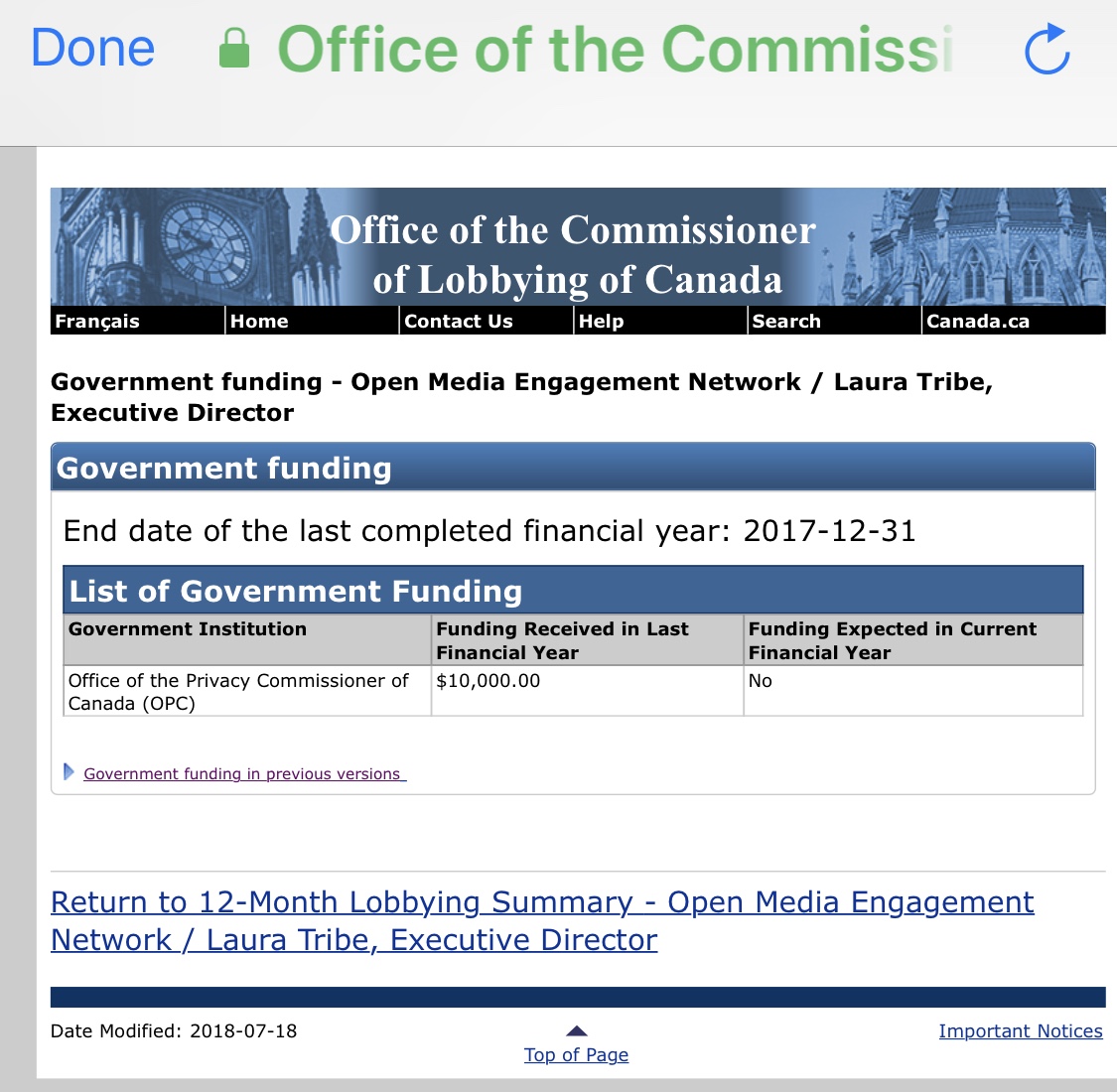
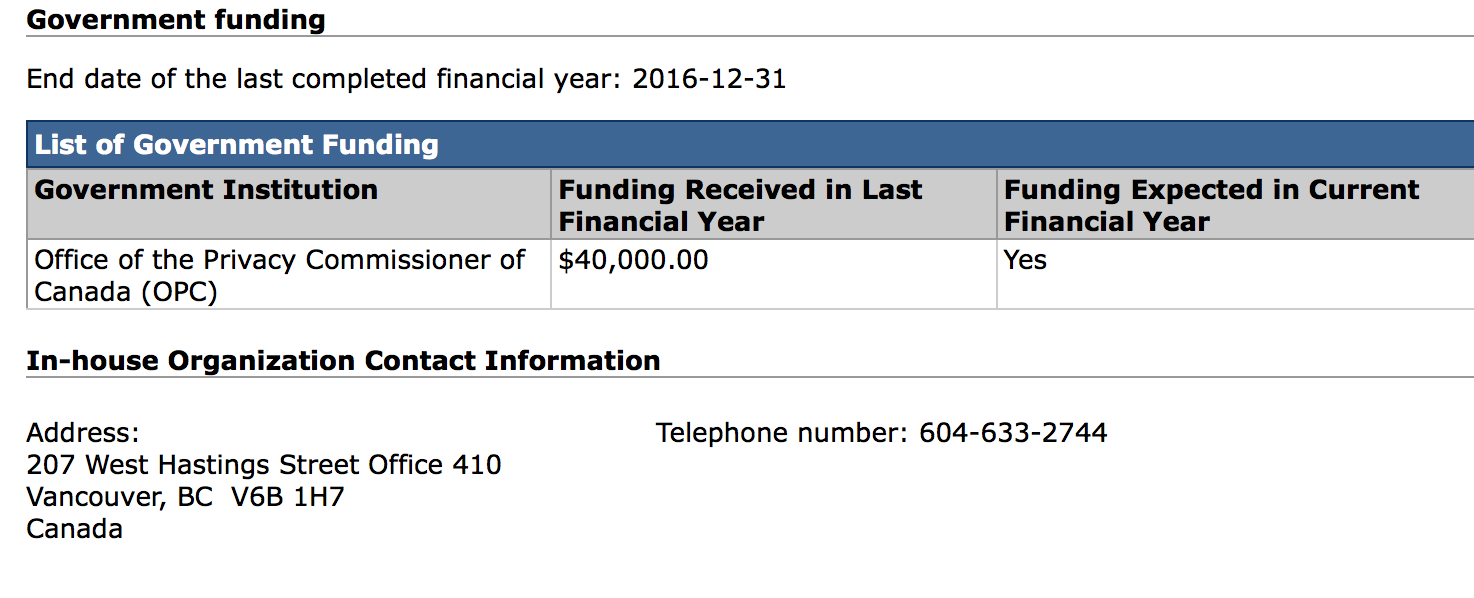
Office of the Privacy Commissioner of Canada provided funds to one of the Google backed astroturf groups engaged in a spam email campaign against Canada’s Minister of Foreign Affairs Chrystia Freeland. The emails urge her to reject the NAFTA treaty based on objections to IP provisions that would strengthen rights of Canadian artists.

Yes, while Freeland is facing a difficult negotiation with the US, the Office of the Privacy commissioner appears to be making it even harder by helping undermine her efforts.

It is very important that Canadian policy makers take a hard look at this group (Open Media) and ask the OPC why they funded this group in the first place. As we have seen in US on FCC net neutrality hearings, this sort of spamming activity by the likes of Open Media seems designed to overwhelm the channels through which ordinary constituents communicate with government officials. It drowns out the voices of ordinary citizens, and replaces them with robotic corporate and special interest crafted messages. It is appalling that the Canadian Government funds a group that is using tactics The Frankfurter Allgemeine Zeitung has called “political hacks.”

A Little Background On Open Media and What Happened in Europe.

In the last few weeks, The Times of London, The Frankfurter Allgemeine Zeitung and this blog have written extensively about the Vancouver BC group OpenMedia.Org and it’s role in spamming the EU parliament as they voted on the new Copyright Directive. By “spamming” we mean tweets, robo calls, fake emails and even faxes. These pre-formatted communications often contained misleading or outright false claims about the copyright directive.  Unfortunately this “cyberturfing” campaign worked and Open Media was able to fool enough MEPs into thinking there was a genuine grassroots backlash, they voted to push back deliberations on the copyright directive.

More importantly the fake grassroots uprising established a false narrative that the law was “controversial” and would do terrible things it does not in fact do.  Factually incorrect claims about banning memes and jail time for The Beatles were repeated in the popular press. Disinformation triumphed.  Hybrid information warfare enthusiasts everywhere were surely delighted!

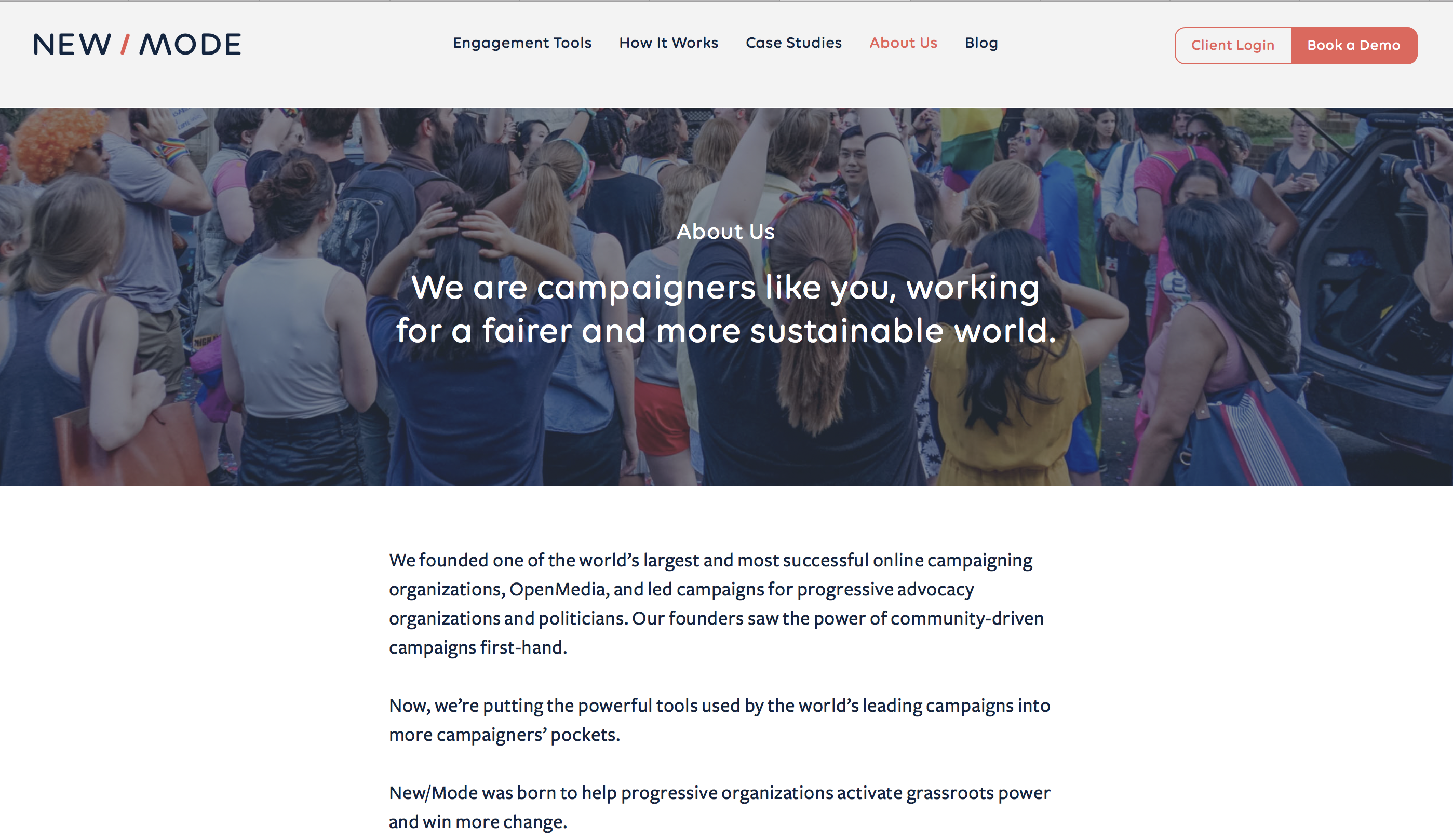
Open Media does appear to be a non-profit. But we are not sure exactly how to describe this opaque organization. It’s not really a civil society. It acts more like a trade industry group. The Commissioner on Lobbying lists it as an “engagement network” that employs lobbyists  Is that a thing? We do know it is at least partially funded by Google and other US internet interests; It files lobbying reports with the Canadian Government; and has what appears to be a for profit subsidiary (New/Mode) that markets its services to other aligned groups (like SaveYourInternet.eu).  One of the directors of Open Media was also Google’s former public policy chief in Canada 2007-2014.

In summary, what the EU learned about Open Media in last few weeks:

This is just a summary. There are a series of articles published by this blog, Billboard Magazine, The Times of London and The Frankfurter Allgemeine Zeitung that fully cover the EU Parliament cyberturfing by Open Media and associates. These are mostly collected in a reference section at the end of this post.   I urge you to read the articles at the end of this blog as these support our assertions below:

  • Open Media was key player in fake grassroots movement #SaveYourInternet that massively spammed the EU parliament with emails, robo calls, tweets, and faxes. Open Media provided the automated web tools and “cloned” websites.
  • It was a fake grassroots movement. Despite the claims that they had millions of supporters, when the leaders of #SaveYourInternet tried to organize rallies turnout was dismal. Like 18 people in Stockholm dismal.
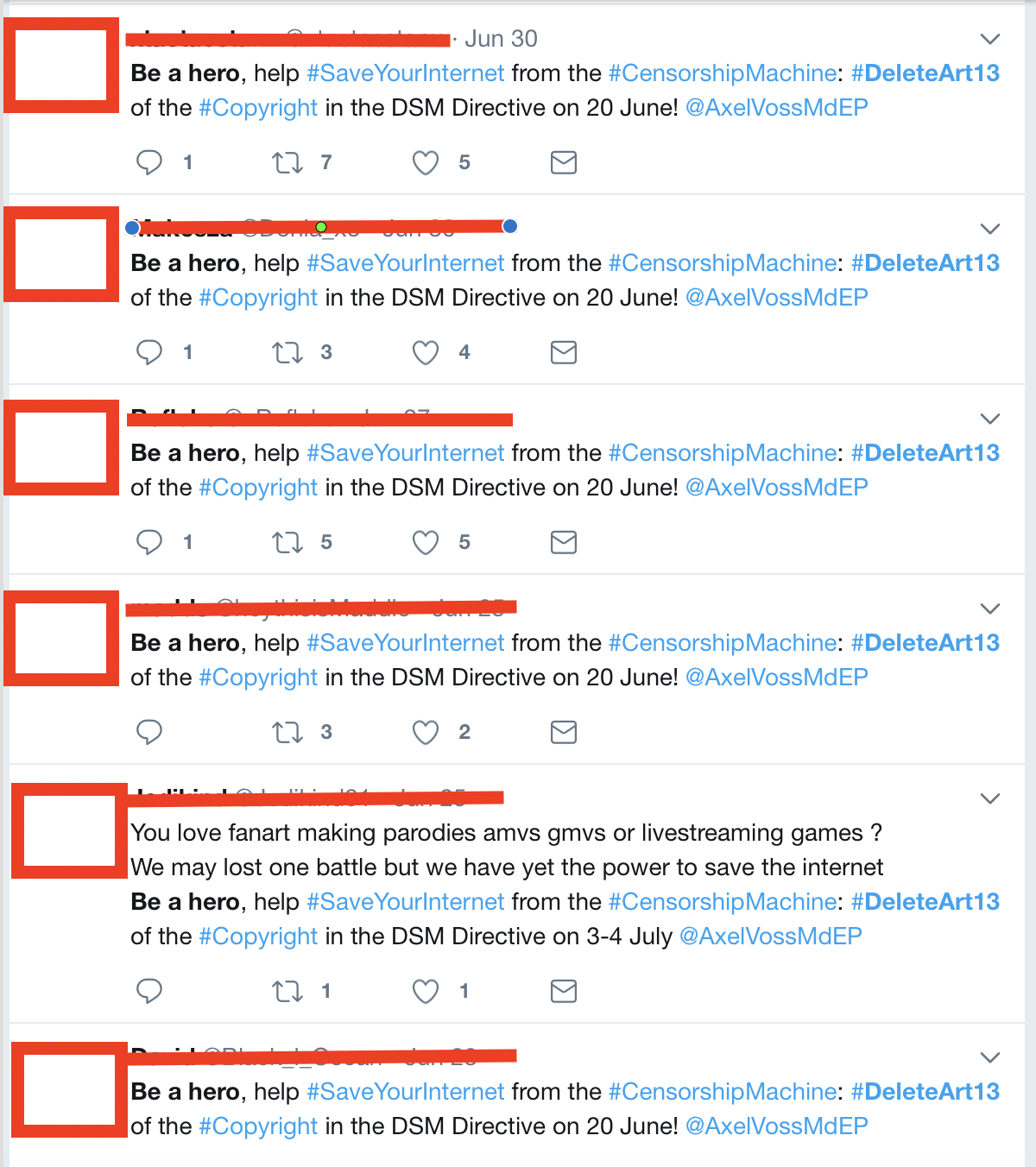
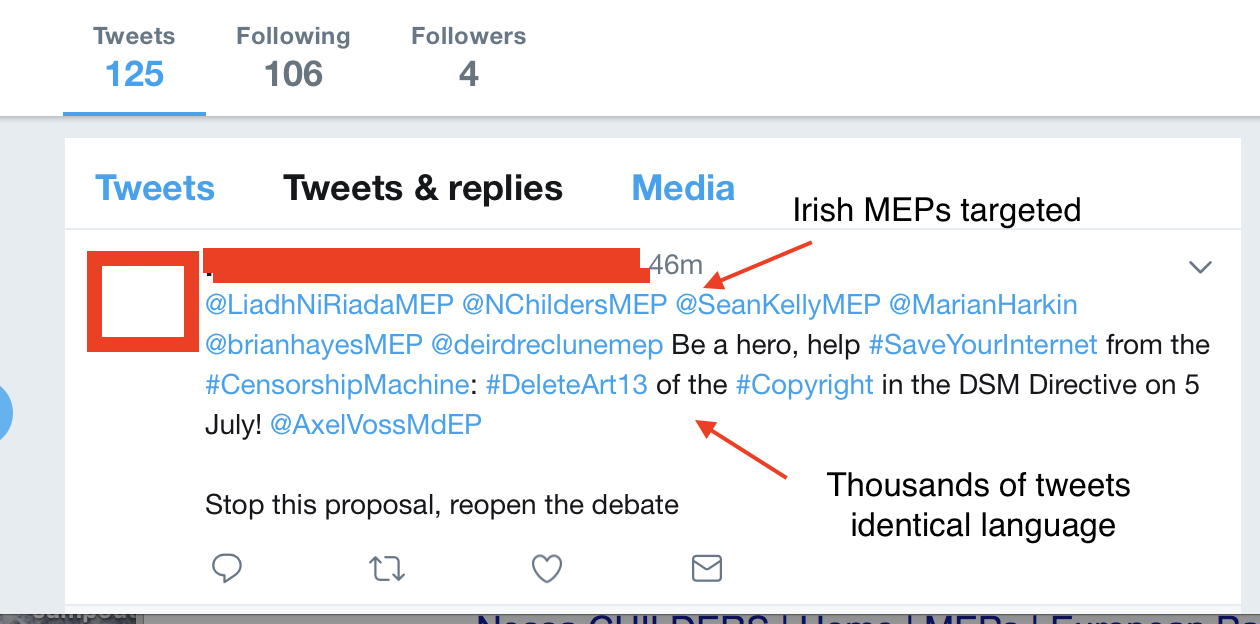
  • Tweets, emails and web traffic exhibited irregular patterns that appeared non organic. Tweets/Emails were identical. Phone calls were scripted. Traffic was sent at odd times of day.  Clear evidence of “command and control” was observed as specific country MEPs were selectively targeted for long periods. Then targeted countries and MEPs abruptly shifted en masse. Open Media brags on own website about ability to do this.  (Independent researchers #DeleteArt13 tweets from July 4-5 can be found here)
  • Analysis of tweets and website traffic, showed % of traffic from member states wildly out of proportion with population.
  • A lot of activity from Poland was in English.
  • Activity was often steady through overnight hours.
  • Analysis of tweets showed most originated outside the EU. Content Creators Coalition (C3) an Artists Rights non profit in US, analyzed tweets carrying #DeleteArt13 hashtag and found 88,000 came from Washington DC. Only 72,000 came from entire EU.  Here.
  • Web tools provided by Open Media (To SaveYourInternet.EU) did not check for valid email addresses, physical addresses, verify identity or check to see if IP addresses were in EU, and phone calls were permitted from North American numbers.  Try it yourself. 
  • Web tools provided by Open Media allowed users to simply reload page and send hundreds of emails and tweets opposing NAFTA. Try it yourself
  • No Captcha’s were ever required, allowing easy automation by potentially malicious third parties.  Try it yourself. 
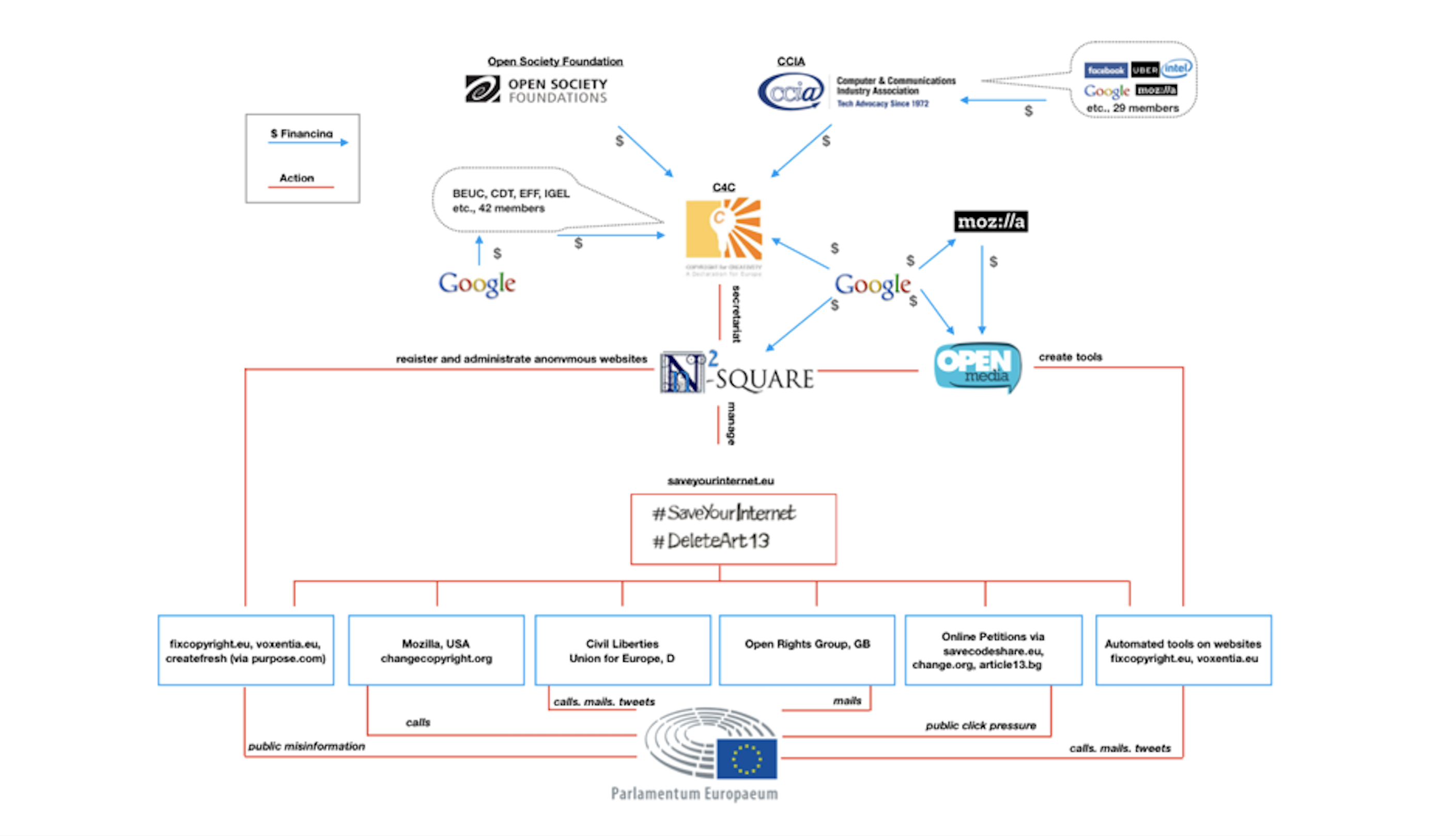
  • The #SaveYourInterent campaign was directed by Google’s “Secretariat”  N-Square in Brussels.
  • Opinion is still divided in the EU parliament but many now openly question if there ever was any real opposition to copyright directive.

Now it’s happening in Canada.

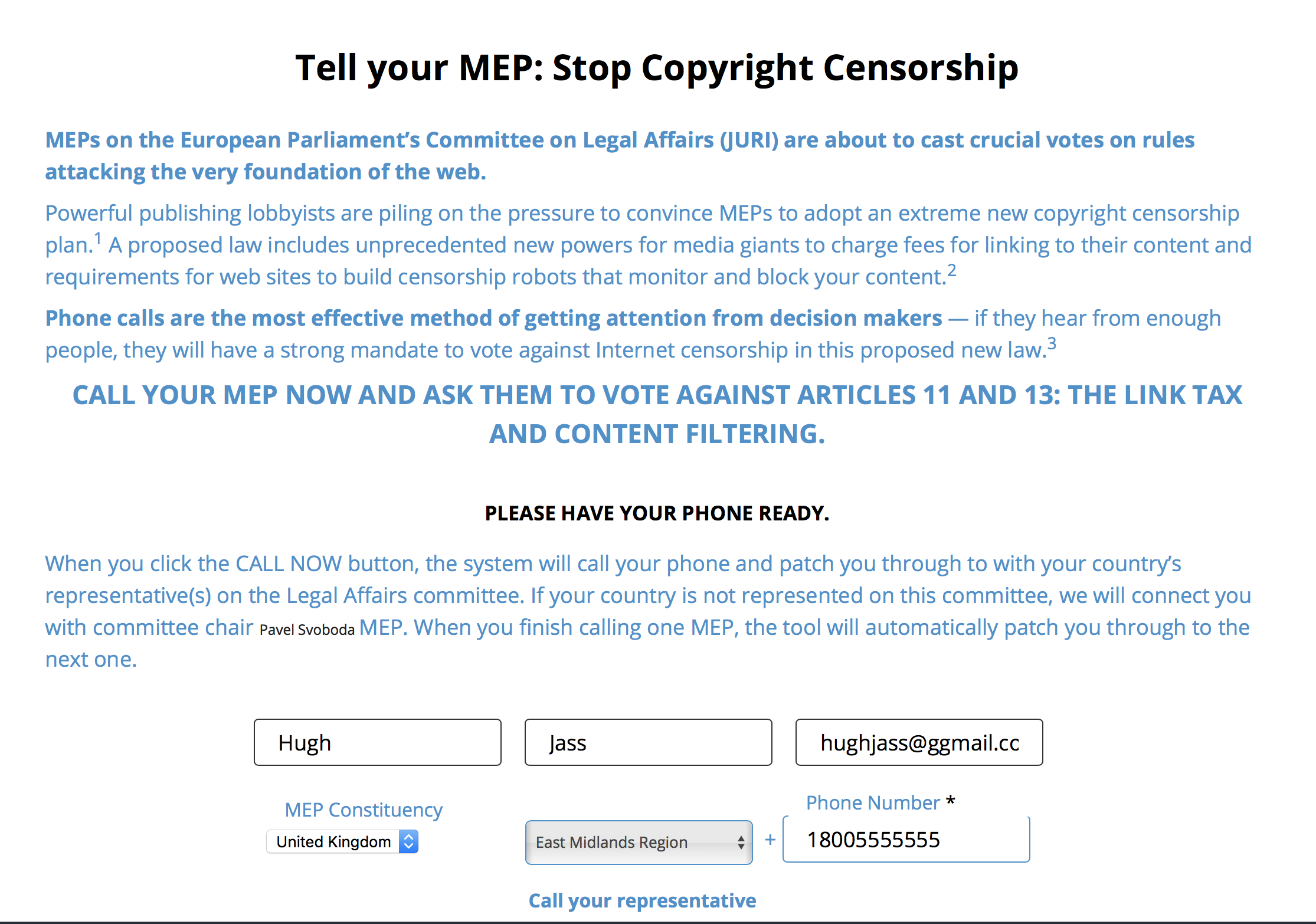
As Fake Daniel Therrien Fake Commissioner of Privacy I demonstrate how easy it is to spam Foreign Minister Freeland with anti-NAFTA messages. Go fullscreen it’s worth the 60 seconds.

Now it appears that Open Media is trying to torpedo IP protection provisions in the NAFTA treaty.  They are sending out dubious emails that speculate wildly or mischaracterize the facts.  These emails are directed at Canada’s Foreign Minister and they make wild and unsupported claims about NAFTA IP provisions.  Also  the spam email has a curious  little “rider” paragraph at the end that seems to imply that TPP has been a disaster for Canada. Is that true? It’s only been in effect a few months! So a by-product of this campaign is it falsely gives the impression that hundreds of thousands of Canadians are upset with the TPP.  I find it extremely unsettling that the Office of Privacy Commissioner of Canada provided funds to an opaque Google-funded organization that is attempting to undermine the Canadian Prime Minister on trade policies. Shouldn’t this activity be reported as lobbying or something?

Regardless, think of the implications for Canadian democracy:

Anyone can go to this website, impersonate Canadians and send as many emails as they want to Freeland.  In video above a Fake Daniel Therrien  OPC Commissioner of Canada repeatedly spams Freeland.

  • No Captcha
  • No geolocation check of IP address
  • No email verification
  • Allows repeated emails
  • Easy to impersonate anyone
  • Easily used with keystroke automation

No Protections To Guard Against Automation

I automated 25 spam emails and received 25 separate verifications from Open Media that my emails were sent to Freeland. It should be noted the “thank you” email included a solicitation for money. And by “automation” I mean I just had to hit “back” button on my browser and then “send” button on webform. Not exactly brain surgery.  This is a complete fraud.

Note: I always let recipient know these were tests and demos. I did this by changing my name to a short explanation. It is clearly working as “ThisWasDemoOfOpenMediaSpam” got a thank you email. Additional precautions were taken so targets would not mistake these communications for real constituent communications.

Why Do Silicon Valley Interests Object to IP Provisions that would protect Canadian creators. 

In the US we have long grown suspicious of groups like Open Media as their agendas seem to always exactly match the public policy positions of Google and other Silicon Valley interests.  We have come to view these groups as simply extensions of Silicon Valley corporation’s public policy operations.

Google in particular is extremely aggressive in lobbying against copyright protections. No surprise we see them trying to meddle in Canadian politics through a dubious “engagement network.”  Basically any $CAN paid to creators on its YouTube platform is one less dollar that goes to the billionaires Sergey Brin and Larry Page.  In particular YouTube relies upon what is arguably an illegal anti-competitive scam, whereby licensed versions of music videos must compete alongside “User Uploaded Content.”   In many cases (certainly in my own personal experience with my own videos) the revenues generated by the UGC content does not go to the rightful owner of video. Example this is a UGC instance of one of my songs. I have no idea where the ad revenue goes.  I can only assume Google keeps this money. Judging by Google’s enormous global lobbying efforts to prevent any copyright reforms that would force them to correct this kind of abuse, one can reasonably conclude this is an enormous profit center for Google. (Sum all those unlicensed videos streams across millions of commercially made music videos and the sums are likely staggering). In this case the NAFTA IP provisions would likely make it harder for Google pocket this undeserved revenue. Thus It makes sense that Google would fund a Canadian “engagement network” like Open Media that seeks to torpedo the entire NAFTA accord over this one little issue. Clear return on investment there.

(I don’t know how to put this in polite phrasing and still convey the outrageousness.  So apologies in advance.)

That said, It makes no fucking sense for Office of Privacy Commissioner of Canada to fund this activity. It hurts Canadian creators, but more importantly it undermines Canada’s own sovereignty. Government offices funding groups attempting to undermine Canadian sovereignty? Wow.

There are usually only two reasons for involvement by government officials in this sort of subterfuge:

  1. Incompetence
  2. Corruption

Or both. Either require firing of those responsible in the OPC.

It happened before in Canada Why is Canada Letting it Happen Again? 

Read this from 2009.  This all happened once before.

https://musictechpolicy.com/2009/11/10/100000-voters-who-dont-exist/

Canadian government officials can maybe excused for doing something stupid the first time round.  Not the second time round. Investigation is warranted. Firings and even criminal and civil penalties should be contemplated.

+++++++++++++++++++++++++++++++++++++++++++++++

What Should Canadian Creators Do?

This is a hack of your democracy by US corporate interests aided by your own government. Do something about it.

Write The Minister of Democratic Institutions

The Honourable Karina Gould.

Twitter handle @karinagould

Facebook https://www.facebook.com/karina.gould/

Email (For those of you that do not participate in data mining operations conducted by US social media platforms)

karina<dot>gould<at>parl<dot>gc<dot>ca

Write Chief Spam Compliance Officer  Steve Harroun

Office Twitter Handle  @CRTCeng

Email (For those of you that do not participate in data mining operations conducted by US social media platforms)

steve<dot>harroun<at>crtc<dot>gc<dot>ca

Write The Office of the Conflict of Interest and Ethics Commission of Canada.

Twitter @CIEC_CCIE  English

Twitter @CCIE_CIEC French

Ethics Commissioner Mario Dion

Email (For those of you that do not participate in data mining operations conducted by US social media platforms)

mario<dot>dion@parl<dot>gc<dot>ca

Write Justice Canada.

It is not clear who at Justice Canada would be responsible for investigating this sort of activity. However since it goes beyond spam and has a distinct odor of corruption, I believe that Justice Canada should at least be made aware of this activity.

Here is the generic Twitter account @JusticeCanadaEN

Here is the Twitter account of  Minister Wilson-Raybould, Minister of Justice and Attorney General @MinJusticeEn

I don’t know if this guy (Alexandre Kaufman) is the guy to write but he has reportedly filed spam complaints in the past with CRTC.

Can’t hurt to try him:

Alexandre Kaufman Senior Counsel Department of Justice Canada

https://www.canadianlawlist.com/listingdetail/contact/alexandre-kaufman-621701/

He doesn’t appear to have social media accounts. Here is his email.

akaufman<at>justice<dot>gc<dot>ca

+++++++++++++++++++++++++++++++++++++++++++++++++++++++++++++++++++++

Reference Articles:

Observations from this blog as EU cyberturfing campaign was occurring:

Meanwhile in Europe Is Google Attempting to Hack the EU Parliament with Robo Calls, Emails and Fake News?

#SaveYourInternet Dog Whistles to Far Right with Pepe: Desperation or Stupidity?

EU MEPs Hacked: More than Half #DeleteArt13 Tweets Appear to be from Sock Puppets

https://thetrichordist.com/2018/07/04/is-google-running-hybrid-information-warfare-attack-on-eu-parliament/

https://thetrichordist.com/2018/07/06/final-thoughts-information-monopolies-information-warfare-vs-democracy/

Post Mortem and Other Press:

https://thetrichordist.com/2018/07/28/the-google-funded-astroturf-group-that-hacked-the-eu-copyright-vote-in-pictures/

https://www.thetimes.co.uk/article/google-funds-activist-site-that-pushes-its-views-rg2g5cr6t

http://www.faz.net/aktuell/feuilleton/debatten/eu-urheberrechtsabstimmung-anatomie-eines-politik-hacks-15743044.html

http://www.dailymail.co.uk/sciencetech/article-6031363/Google-funding-campaign-group-spams-policymakers-newspapers.html

Anatomy of a Political Hack – Guest Post Volker Rieck

How Google Funded OpenMedia.org Lets Anyone Easily Hack Canadian Copyright Consultation

https://www.billboard.com/articles/business/8472479/european-copyright-protests-draw-small-crowds-after-online-avalanche-column

Dismal Turnout For Anti-Copyright Directive Protests in EU Suggests Little Real Opposition
Dismal Turnout For Anti-Copyright Directive Protests in EU Suggests Little Real Opposition
Guest Post by Volker Rieck.  Translated from German.  Original here. 

Astroturf instead of grass roots: When clicktivism meets hard reality

Last weekend, several organizations called for a “Day of Action” with demonstrations throughout Europe against the planned EU Copyright Directive.

Among the supporters of the events were the Pirate Party, the Left, the Greens and the network association Loade.V. (FDP).

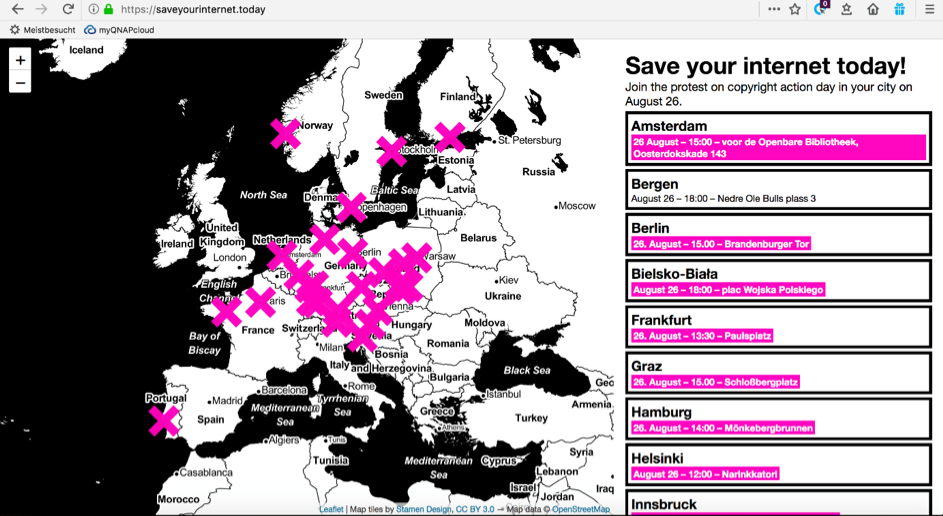
The saveyourinternet.today website created an overview map of all 27 demonstrations.

Although this page, like many other pages of the campaign, has no legal notice or stated privacy policy as required by GDPR it has nonetheless been linked by Change.org and others—groups that ordinarily assert an interest in privacy.

In any case the cards weren’t put on the table. Again.

Illustration: Saveyourinternet.today with calls and links to the demonstrations. Operator of this site unknown, data protection notice missing. The WhoIs details lead to WhoIs Guard in Panama.

The “Day of Action” in Germany

The first event was Mainz on Saturday, August 25, 2018, where prominent members of the Bundestag such as Tabea Rösner (Die Grünen) and Manuel Höferlin (FDP) spoke.

Nevertheless, they only spoke in front of about 30 participants.
While the poor attendance at the event in Mainz was notable – it was far from the worst showing of the day for the declared opposition to the copyright directive.
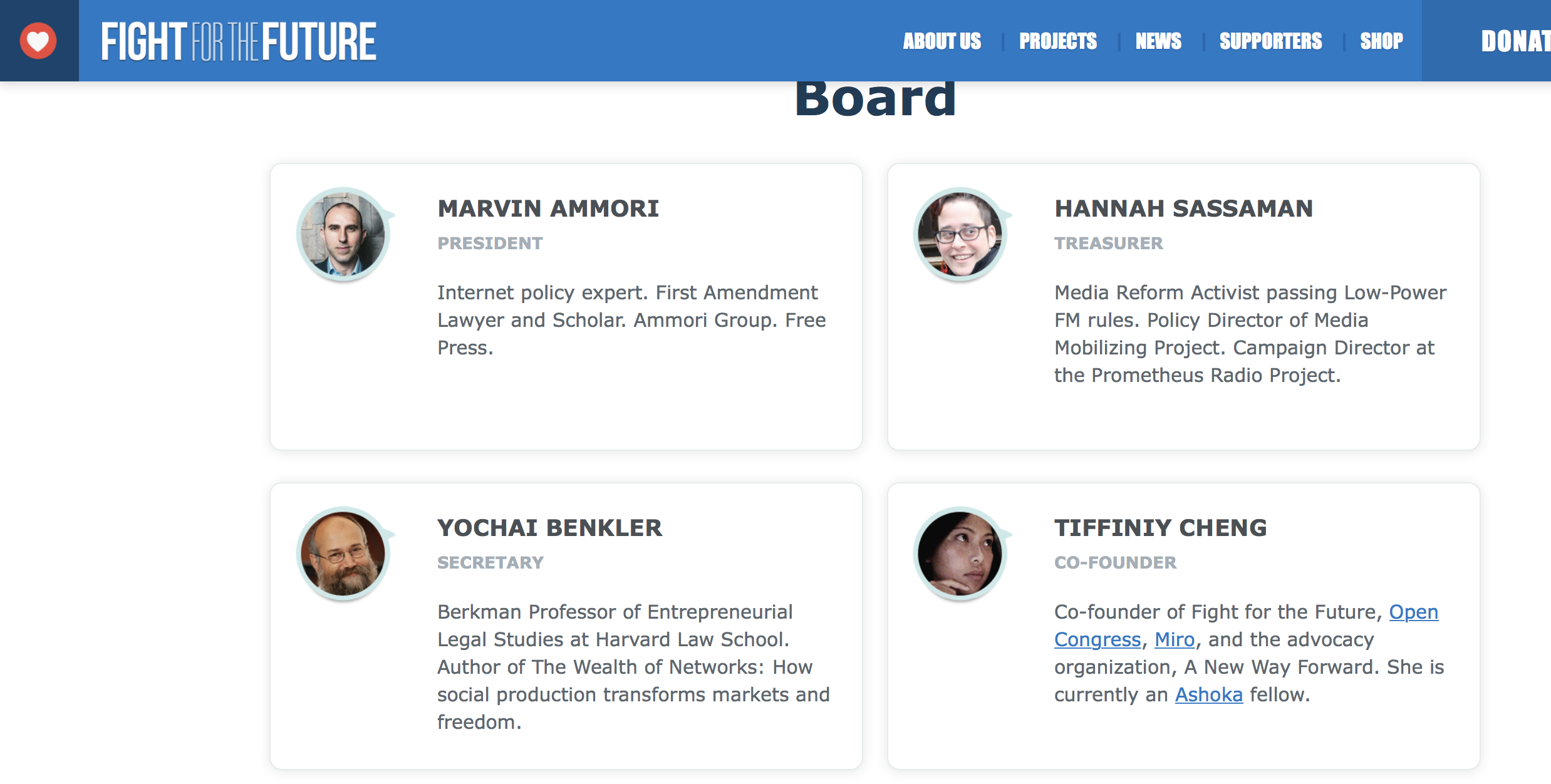
On Sunday, other cities followed, including Hamburg. Patrick Breyer, the former member of parliament for the Pirate Party in Kiel, also spoke in front of about 40 demonstrators.

Breyer stressed that 1 million supporters have already been collected for a petition against the directive at Change.org. He also defended himself against accusations that the petition had been supported by bots, which seemed a bit strange in view of 40 participants.

Illustration: Final photo of the rally in Hamburg, approx. 40 participants.

Pirates are obviously capable of self-reflection. Demonstrator Malte Huebner quickly aired his displeasure on Twitter that day.

“The visibility of the Hamburg #saveyourinternet demonstration is catastrophic.
We are standing there like a bunch of flat earthers that warn of reptiloids from the dark side of the moon. The scope of #article 13 cannot be conveyed with this approach.”

But it was even worse for the young pirate when the first passers-by appeared.

“Oh Shit, ‘The Pirate Party still exist? Weren’t you for pedophilia and kid porn?’”

The main event took place in Berlin at Pariser Platz. According to various estimates, it was probably the largest event of the campaign with around 100 participants, although the alleged driving force was the MEP Julia Reda. This is an astonishingly small number for the central event of a campaign!

Reda had stated in advance that with broad support the accusations that there were relatively few people behind the online campaign could be refuted.

If broad attendance was to be understood as an affirmation of the actual support of Europeans, then surely the converse is also true – the lack of broad support would suggest the opposite conclusion. The crowds, or the absence therefor, have spoken. It is now essential that major media who have largely reported the Pirate’s assertions that the directive is “highly controversial” recognize they have been following noise rather than signal. It’s not always the case that where there’s smoke there’s fire. Sometimes it is just smoke.

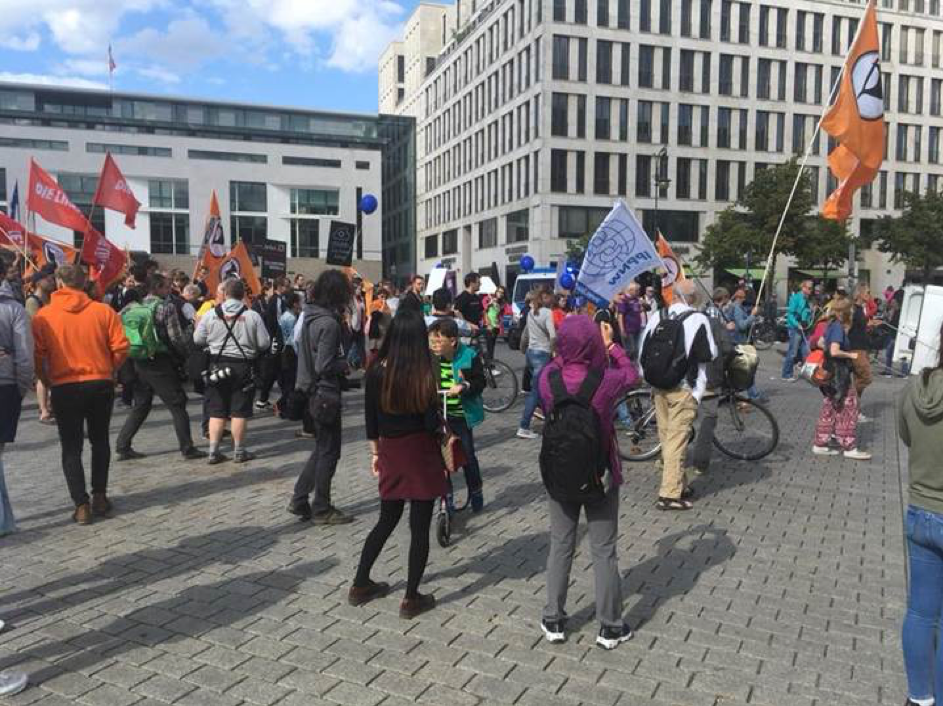
Illustration: The “Day of Action” at Pariser Platz in Berlin, approx. 100 participants

In other German cities, too, participation seemed to be similarly moderate. The city of Munich attracted only about 30 protesters.

Illustration: The “Day of Action” at Marienplatz in Munich, approx. 30 participants

A projection based on 15 of the total of 27 events throughout Europe, which attracted a total of around 400 participants, suggests that the maximum number of participants across Europe would be 800, as there were also locations with no shows. Even in the home country of the Pirate Party, Sweden, more precisely in Stockholm, there were only 15 participants.

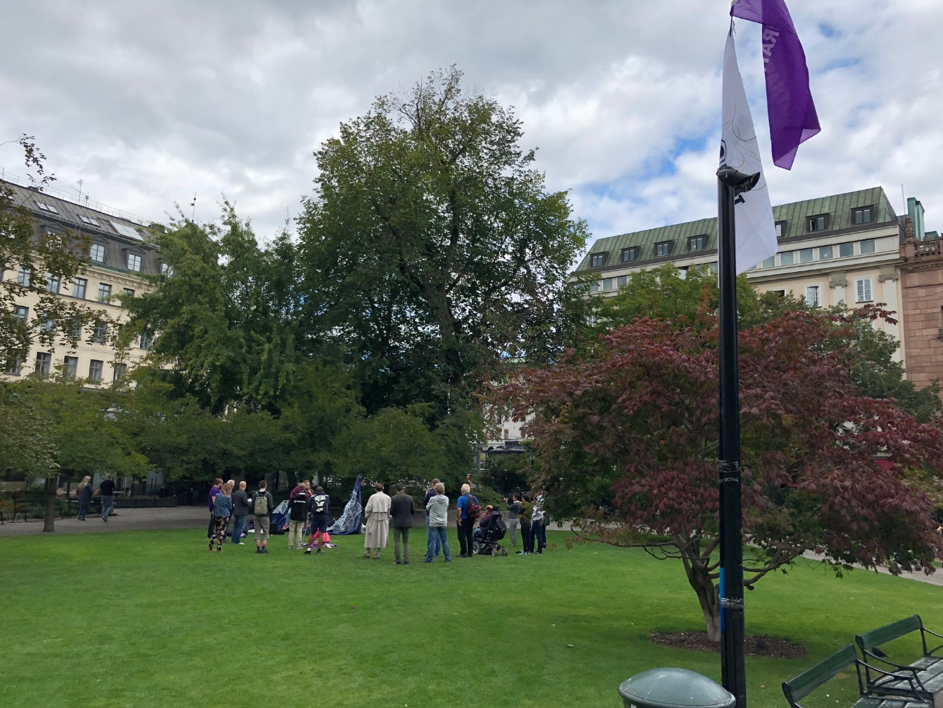
Illustration: The protest in a park in Stockholm, about 15 participants. No, this is not the yoga group that usually meets there.

Poland is not lost yet

Poland was supposed to be the backbone of the anti-directive campaign, after all organizers had a few years ago managed to get 10,000 people out to protest ACTA, so surely, they would step up where there German counterparts had failed. Not this time. In total, there were an estimated fewer than 100 people across 6 different rallies in Poland. As in Germany, this should send a message to media, members of the European Parliament, and the public.

There were more police officers in Lodz than demonstrators. A total of 6 (six!) participants gathered. And who knows how many there would have been in Krakow (40 participants) if the mayoral candidate Konrad Berkowicz (Wolność party) had not used the demo on his own behalf and his supporters had increased the number of participants.

The hashtag of the campaign should therefore better be #1of8hundred and not #1of1million. That would be closer to reality.

Estimates of the number of participants in detail:

Berlin 100
Hamburg 44
Vienna 38
Cracow 35
Karlsruhe 32
Stuttgart 30
Warsaw 30
Munic 25
Katowice 25
Helsinki 18
Stockholm 18
Prag 16
Amsterdam 15
Paris 15
Lodz 6
Total 447
Average 30

A lot of noise from a few activists

So there seems to be a large numerical discrepancy between the digital protest and the number of actual opponents of the planned EU Copyright Directive.

The campaign claims to have one million signatories at Change.org, yet only 0.08% of the signatories gather to go to a demonstration.

Of course, click and demonstrations are two different ways of expressing opinions. One click is done in seconds, while a demonstration can be cumbersome.

However, the question arises how such a small core of visible opponents of the EU directive throughout Europe was able to generate so much digital noise among MEPs in July. And how could this noise, which was produced by so few, have had such an impact on so many members of the European Parliament?

The technical tools provided by the initiators of the saveyourinternet.eu website via partner sitesplay a central role here.

They have ensured that MEPs’ mailboxes were overfilled, and their Twitter accounts flooded in the week before the vote in early July.

The meagre result of the “Day of Action” must not remain hidden from EU parliamentarians.

It is almost certain the same tools will be used again before the next vote on 9/12/2018 (12.09.2018). Every Member must consider his or her decision carefully.
It is of vital importance that parliamentarians not be misled by manufactured and hyperbolic outrage, nor by media that lazily reports the existence of imaginary controversies.

Last weekend’s “demonstrations” told an important story. Not the whole story of course, but an important one nonetheless.
Governments around the world are struggling with how to translate online comments into an understanding of the will of the people. One thing is abundantly clear – They do not convey a fair representational sense of the public – particularly given the existence of marketing tools to facilitate a form of uncritical hashtag clicktivism. Astroturf is easily disguised as grassroots. This has now been exposed in Europe via last week’s protest. It is a lesson that must not be ignored by the European Parliament.


How Google Funded OpenMedia.org Lets Anyone Easily Hack Canadian Copyright Consultationi

This is the same group that the Times of London covered.  This is the group behind the massive spamming of the EU parliament on the copyright directive.

https://www.thetimes.co.uk/article/google-funds-activist-site-that-pushes-its-views-rg2g5cr6t

Here I demonstrate how anyone in the US can repeatedly “spam” the Canadian copyright consultation with this website.  I can multiply my voice hundreds of times hitting the browser back button and resend.   You don’t need to mask IP address or fake a Canadian IP. You just need a single Canadian postal code.  Easy enough to Google and get a postal code.  I used the postal code for the town of Meat Cove at the top of Cape Breton Island.

All I Can Figure is these 42 Overpaid IP Law Professors Hate to See Musicians Paid; Love Billionaires

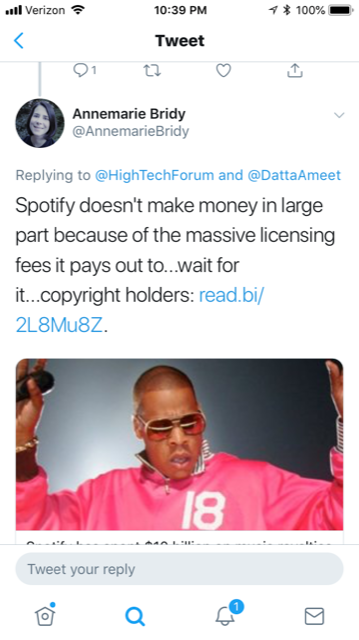
By “copyright holders” Prof Annemarie Bridy means musicians and songwriters. Prof Bridy attitude is typical of IP law profs.  Aw, poor streaming services can’t make money because they have to pay the producers of the only product they sell! Capitalism is sooooo hard!!

Kiss up Kick down:  IP law profs love the loophole that benefits  a handful of billionaires. Musicians? Not so much.

I’ve been musing on this for months now.  Every since I saw the “42 IP law professors” letter opposing the closure of the pre-1972 digital royalty loophole I thought “Really? how can intelligent people be FOR keeping a ridiculous loophole in place that only benefits a handful of billionaires?”

The Pre-1972 loophole is perhaps the ugliest recent episode in a very ugly history of copyright malfeasance by tech companies and digital broadcasters. In 2012 two companies, Pandora and Sirius XM unilaterally decided there was a loophole in federal law that allowed them to skip royalties to artists recorded before 1972 (the year sound recording copyrights were federalized). Other companies soon followed. Up until then it was the commonly held view that these digital royalties were required for state AND federal copyrights and folks like Aretha Franklin were paid for performances of RESPECT. In fact Apple and many other companies continue to pay these royalties.

Needless to say, lawsuits resulted and are slowly winding their way through courts. One day they may settle the issue. But in the meantime American Icons like Franklin have passed away without being paid those royalties. Yet the very same multi-billion dollar digital companies who cheated those performers on their death beds, will gladly pay tribute to them with specials and playlists. Think of the advertising dollars.  And not a penny goes to their estates.  Shameless.

The house of representatives recognizing an obvious injustice created The Classics Act to fix this bill. It was rolled into the omnibus Music Modernization Act and passed the house unanimously.  When it got to the Senate trouble started.

That’s where the 42 IP law professors come in. Now lets give them the benefit of the doubt first. The lP law professors on the surface would seem to have reasonable arguments that point out technical issues with the bill. However two things quickly became apparent.

1). There arguments were misleading and in some cases completely wrong. Other IP scholars began to debunk their arguments.  Here is a good one from law prof Matthew Barblan at George Mason University.

2) The subsequent public statements of many of these professors seemed to indicate they think artists don’t deserve to be paid. The technical legal arguments were cover for pure regressive anti worker anti artists hostility. Oh and did I mention that at least 15 of them were funded directly or indirectly by Google?

The common argument they began to advance was that fixing the loophole would be a “windfall” to these legacy artists.

Windfall?

Let’s get this straight. So you get paid by your boss until 2012. Right?  Then your boss stops paying you when under the law she should pay you. Congress steps in and proposes a bill that forces your boss to pay you.  In the framing these law professors propose hat would be a “windfall.”

What fucking amoral shithole planet do these folks live on?

42 IP Law Profs on average make tax subsidized $189,000 a year but musicians are paid too much? Especially dead ones!

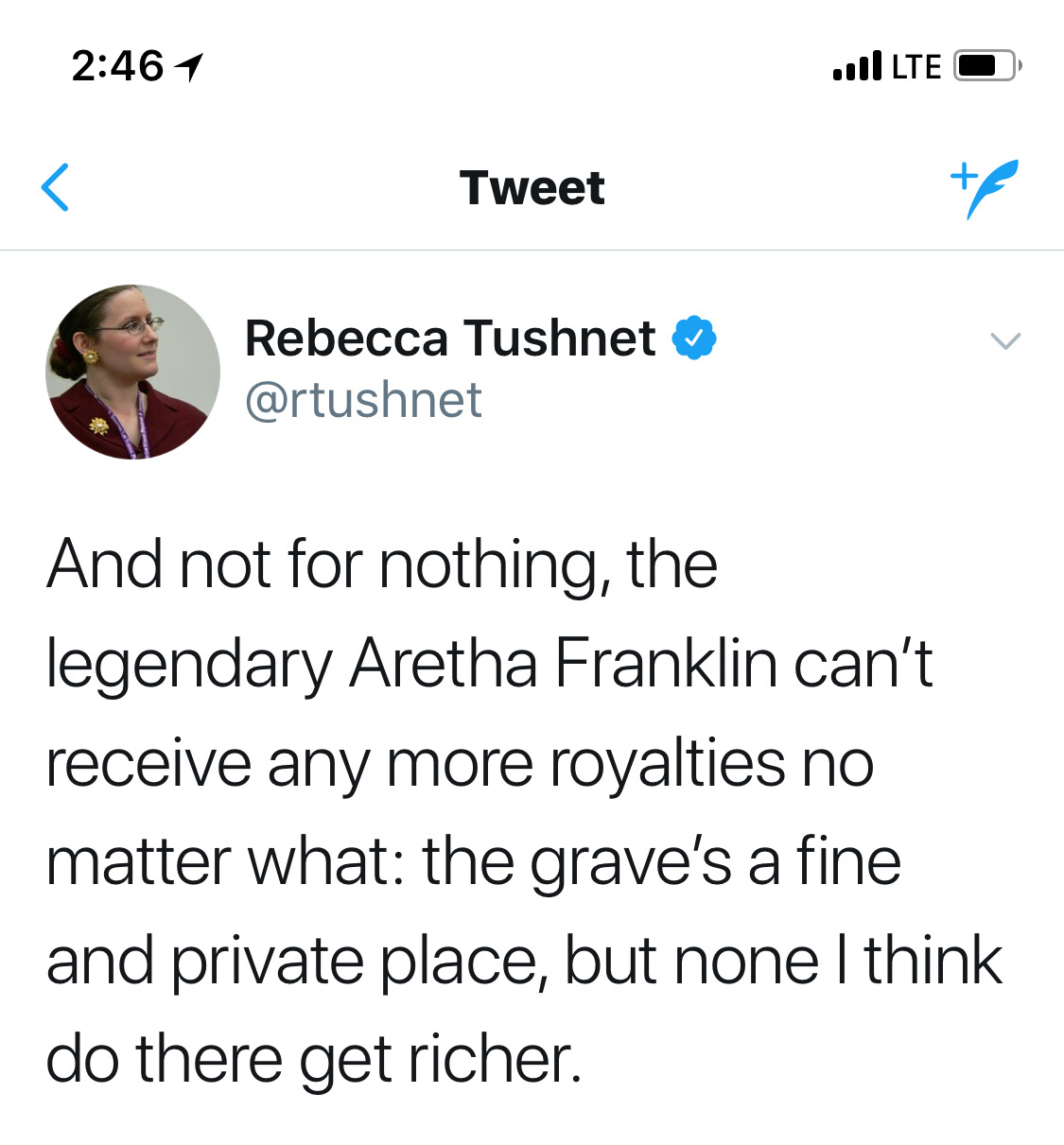
I guess Tushnet’s theory was if she dressed up a tasteless insult in prose maybe no one would notice a pompous white Harvard professor was making fun of a recently departed African American woman. Harvard: Making America Pompous Again.

But as of late their arguments have gotten even more harsh  And I think it’s time we just throw this crap back it in their faces.  Are IP law profs paid too much? Are they receiving “windfalls” from US taxpayers?

I went through public records for the public universities and then used Glassdoor estimates for private universities.  These estimates are imperfect.  But if you take the 42 law professors on the list it’s pretty reasonable to conclude they are making on average $189,000 a year. Many of these professors also do outside work.  Let’s not forget universities have some of the best health and pension benefits for employees. Then consider the work hours?  A full professor generally only teaches a couple course a year.  How many hours a year do you think one of these law profs works?

A recent Princeton study showed musicians made on average $21,300 a year.  Now how many hours a year you think a musician works?

Do you think a single one of these ivory tower dwellers could survive a single week on the road?  “Oh no we might have to talk to a truck driver or convenience store clerk in western Nebraska!”

And yet virtually to a person these law profs twitter feeds are filled with vague progressive sentiments and slogans for the #resistance.   Fauxgressives. Corporate sellouts. Rent-a-profs.  Cause you can.   The letter itself was written by Google lawyer and they signed it.

The Let Them Eat Cake List 

Here are the professors.  See them on twitter or facebook?  Make them explain their opposition to closing the pre-1972 loophole. It only benefits a few white digital billionaires but will disproportionately harming performers of color.  Make them address that. Time to make these folks take responsibility for their actions.
Melissa B. Alexander
University of Wyoming College of Law

John R. Allison
McCombs School of Business at The University of Texas at Austin

BJ Ard
University of Arizona James E. Rogers College of Law

Derek E. Bambauer
University of Arizona James E. Rogers College of Law

Mark Bartholomew
University at Buffalo School of Law

Robert Brauneis
George Washington University Law School

Michael Carrier Rutgers Law School

Michael W. Carroll
American University Washington College of Law

Ralph D. Clifford
University of Massachusetts School of Law

Thomas Cotter
University of Minnesota Law School

Brian Frye
University of Kentucky College of Law

Kristelia A. Garcia
Colorado University Law School

Shubha Ghosh
Syracuse University College of Law

Jim Gibson
University of Richmond School of Law

Eric Goldman
Santa Clara University School of Law

Paul J. Heald
University of Illinois College of Law

Stacey Lantagne
The University of Mississippi School of Law

Mark A. Lemley Stanford Law School

Lawrence Lessig Harvard Law School

David Levine
Elon University School of Law

Yvette J. Liebesman
Saint Louis University School of Law

Jessica Litman
University of Michigan Law School

Lydia P. Loren
Lewis & Clark Law School

Brian Love
Santa Clara University School of Law

Glynn Lunney
Texas A&M University School of Law

Mark McKenna
Notre Dame Law School

Mike Mireles
University of the Pacific, McGeorge School of Law

Ira S. Nathenson
St. Thomas University School of Law

Tyler T. Ochoa
Santa Clara University School of Law

Aaron Perzanowski
Case Western Reserve University School of Law

Jorge Roig
Touro Law Center

Matthew Sag
Loyola University Chicago School of Law

Zahr Said
University of Washington School of Law

Pamela Samuelson
UC Berkeley School of Law

Sharon Sandeen
Mitchell Hamline School of Law

Jason Schultz
New York University School of Law

Lea B. Shaver
Indiana University McKinney School of Law

Jessica Silbey
Northeastern University School of Law

Kevin L. Smith
University of Kansas School of Law

Katherine J. Strandburg
New York University School of Law

Rebecca Tushnet Harvard Law School

Alfred C. Yen
Boston College Law School


@mikehuppe: Broadcast Radio Makes an Ironic Plea for Fairness — Artist Rights Watch

SoundExchange’s CEO says it’s time radio starts paying all music creators fairly for their work.

On Monday, a group of radio broadcasters penned a letter in support of the National Association of Broadcasters’ (NAB) push for deregulation of the $14 billion radio industry. Their letter was based on the NAB’s petition to the FCC this past June, in which the NAB sought to allow expanded broadcaster ownership of radio stations (i.e., increased consolidation) throughout the country. The NAB’s justification: broadcasters must adjust their business model to the realities of the new streaming world.

As a representative of the many creative parties who help craft music, we are frequently on the opposite side of issues from the NAB. And while I can’t comment on NAB’s specific requests, I was delighted to find so much common ground in their FCC filing in June….

I agree with the NAB that the law should “finally adopt rules reflecting competitive reality in today’s audio marketplace” and should “level the playing field” for all entities in the music economy.

If radio truly wants to modernize, it can start by taking a giant leap into the 21st century and paying all music creators fairly for their work. Stop treating artists like 17th century indentured servants, just so radio can reap bigger profits. If radio wants to have rules that reflect the music industry of today, then that should apply across the board.

We should resolve this gaping unfairness to artists before we begin talking about allowing radio to consolidate even further.


Read the post on Billboard

h/t Artist Rights Watch

Anatomy of a Political Hack – Guest Post Volker Rieck

Editor note:  This has been translated from original german text here. Of particular significance Mr. Rieck suggests that the websites associated with the  political hack,  OpenMedia, New/Mode, SaveYourInternet EU and (their cloned sub-websites appear to violating e-Commerce directive proper disclosures (ownership) and New/Mode violating GDPR on user data.

Anatomy of a Policy Hack Part 2 – The Organization of Hacks

As mentioned in a previous article, saveyourinternet.eu’s campaign was primarily responsible for the flooding of MEPs’ mailboxes with ready-made e-mails their Twitter accounts with automated tweets and their phones with switched phone calls including call guidelines.

Who is behind safeyourinternet.eu?

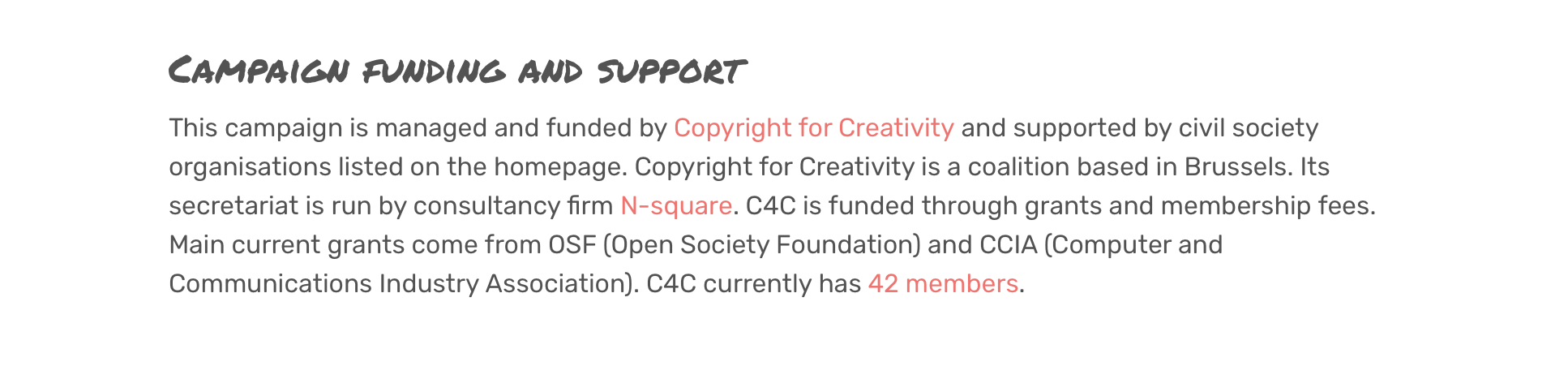
The campaign was organized by the organization Copyright for Creativity (C4C) and its secretariat N-Square. The C4C has 42 members (EFF, Edri, BEUC etc.) and, according to its own statements, is mainly financed by the Open Society Foundation (the foundation of George Soros) and the Computer & Communications Industry Organization. Members of this American industry association include Amazon, Cloudflare, Facebook, Mozilla, Google and Uber.

Who exactly was in charge?

To carry out the campaign, N-Square (a lobby company of the KDC Group, which also works for Google, among others) links to various campaign sites. Unfortunately, it is not always clear who is behind it, because only half of the partners and tool pages involved in the saveyourinternet campaign have an legal notice.
Not even saveyourinternet.eu itself has an about us, only further links.
The imprint obligation of the e-commerce directive is ignored.
Only on a second glance over a WhoIs-Lookup one learns that the page was registered by the C4C. The conglomerate C4C, KDC Group, N-Square has registered other websites that  also play a role in this hack: fixcopyright.eu and voxscientia.eu.   Neither of these organizations disclose who created them. Only through a Whois query can you trace it back to the KDC Group.

Who needs the EU data protection basic regulation?

The basic EU data protection regulation (GDPR), which has been in force since the end of May, naturally also applies to companies operating campaign sites in Europe.
In the case of the sites registered by the KDC Group and N-Square, however, this does not seem to matter to them.
Particularly critical at liberties.eu is the transmission of visitor data to the North American New Mode, the commercial subsidiary of Open Media, without reference in a data protection declaration. Platinum sponsors of Open Media include Google and Mozilla.
Only the Open Rights Group website has a data protection declaration in accordance with the basic regulation. All others are in breach of Article 13 of the GDPR.
A GDPR-compliant data protection declaration, in particular information on the processing of consumer data, is missing in all other cases. Responsible persons are not be named.

Arm in arm with supporters of piracy

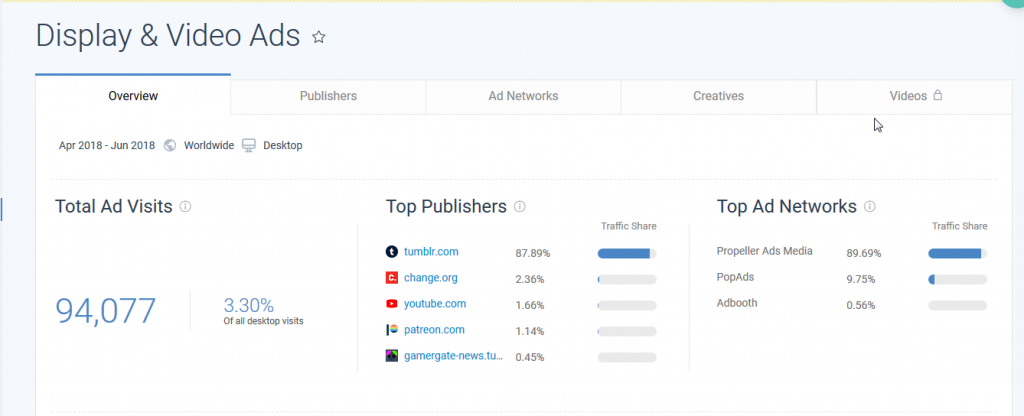
A further analysis of the traffic of Saveyourinternet.eu is very informative. Most of the visitors until the end of June came from Poland. This could have to do with the fact that there were Polish origin pages on which banners were placed. These banners were booked via the dubious English/Russian advertising network Propellerads. According to a study by the British company Incopro, Propellerads was the No. 2 ad network in 2015 that finances piracy sites through advertising. On illegal sites that violate copyrights commercially, Propellerads is an integral part of the advertising environment.

Illustration: Adtraffic to saveyourinternet.eu, 90% ads by Propellerads by Similarweb

Where are you from?

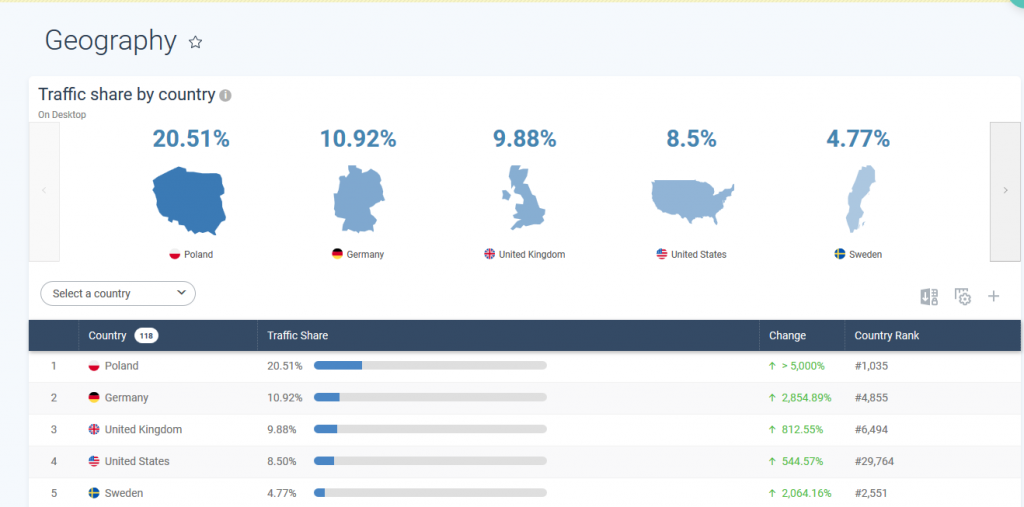
Visitors from the USA, who ranked 4th in the visitor hit list Saveyourinternet.eu, were also able to contact MEPs via the tools.
US blogger David Lowery describes in his blog Thetrichordist how he himself was able to reach EU deputies in the UK.

Illustration: Traffic share per territory by Similarweb

How much does a hack like this cost?

As several MEPs have told us, they have received between 50,000 and 70,000 emails.
If we assume that the Full Toolkit (Best Value) for 50,000 mails plus an additional package for 25,000 mails was ordered at New/Mode, the entire DDoS attack ADD “WOULD” cost only 549 US Dollar, i.e. about 470 Euro. That is only 0.60 euros per MEP.
Always assuming that several MEPs were bombarded with mails at the same time with one click.

Illustration: Price for the Full Toolkit (Best Value) at New/Mode

Conclusion

Ultimately, US companies from the Internet economy financed significant parts of a campaign in Europe to influence EU legislation.

What looked like grassrootes movement from the outside was in fact a classic form of astroturfing – designed to create the appearance of a popular movement.

Given the absence of any type of verification and the active marketing of this campaign outside of the EU, it remains entirely unclear the extent to which non-EU nationals and/or bots were involved in the generation of automated or semi-automated messages against articles 11 and 13 of the directive.

The campaign relied on dubious advertising marketers and many of the parties involved do not in the least meet minimum requirements for legal notice obligations and basic data protection regulations. There is massive violation of both.

This campaign was developed and executed precisely to create confusion about its sources, supporters and modalities, and to prevent a clear understanding of its true nature.

It is a matter of the greatest and immediate importance that the EU consider how to respond to such stealth attacks on the democratic institutions of the EU, and to ensure that such lobby-driven DDoS attacks will not endanger its ability to work fairly in support of the EU nationals and interests in the future. There is every reason to suspect that the same parties wil engage in similar, if not, identical tactics in the lead up to September vote on the directive, and therefor essential that steps be taken now to ensure against manipulation of our political processes by foreign and non-human actors.

The Google Funded Astroturf Group that Hacked The EU Copyright Vote (In Pictures)


Who Hacked the EU Copyright Directive Deliberations?

The EU parliament just went through a couple of contentious weeks in which they were overwhelmed with tweets, letters, emails and phone calls opposing Article 13 a section of the Copyright Directive that would have forced companies like Google to police their platforms better for copyright infringement. Last week we published a guest post by Volker Rieck in which he described in detail how a small group of anti-copyright ideologues apparently created a fake grassroots uprising against the EU copyright directive by essentially multiplying their numbers with bots.

Today I introduce you to the Google funded group that appears to have been behind virtually every single one of these fake grassroots political attacks. Including the #DeleteArt13 campaign.


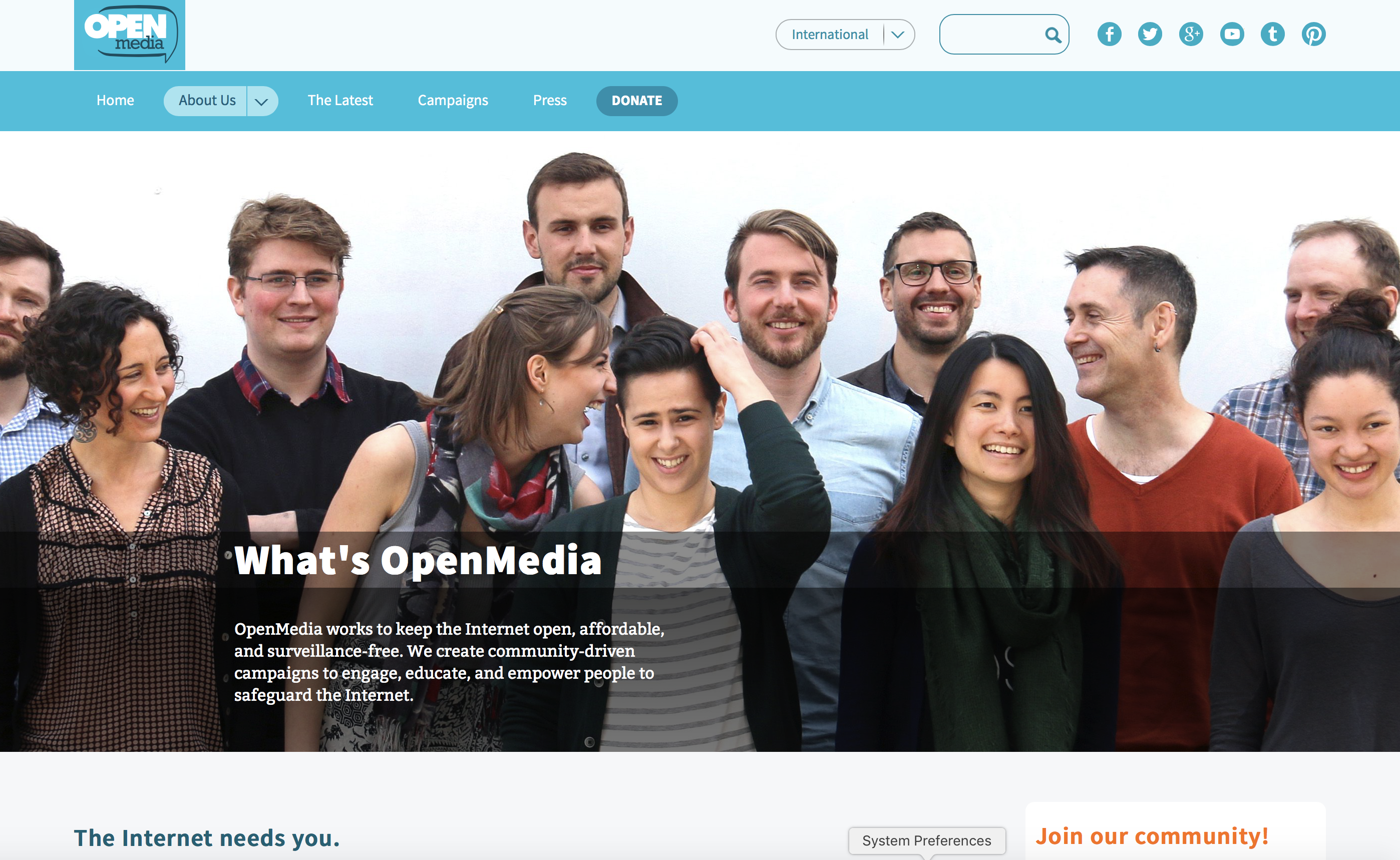
Meet OpenMedia.org.   What a wholesome looking bunch of progressive-ish political activists!  They’re based in Vancouver BC.  A friendly town. A clean, modern, Pacific rim high tech banking city. Very multicultural, sort of like Seattle except without the crazy drug addicts with super-human-Chinese-research-chemical strength swinging shopping carts over their heads. No Vancouver is a nice place to raise your children and start an astroturf group that supports the regressive interests of Silicon Valley cyber-libertarians.

Yay!

OpenMedia.org counts Google as a “platinum supporter” whatever that means.  Mozilla Foundation which receives $300 million annually from Google is another “platinum supporter.” Then there is the super weird and mysterious Private Internet Access.  Ostensibly PIA (legal name London Trust Media) is a commercial VPN. But when you dig beneath the surface it’s ownership and corporate structure is to put it mildly opaque.

There are many other Google connections but one above all should be noted: board member Jacob Glick is the former head of the Public Policy and Government Relations for Google Canada. You think they still talk?

So what does OpenMedia do?  They fight aggressively against any sort of regulation that would harm Google and Silicon Valley’s bottom line. SOPA, Net Neutrality, DMCA Takedown Staydown and the EU copyright directive.


But doesn’t Google have like a zillion academics, think tanks and astroturf groups already doing that for them?  Yes. That is true. So what is so interesting about OpenMedia.org?  It’s how they go about supporting Google and other silicon valley companies.  They specialize in creating “grassroots” campaigns.  Only these aren’t really grassroots campaigns. They are pure astroturf.  Their campaigns make heavy use of automated tools that allow a single person to repeatedly spam targets with tweets, emails, robo-calls, robo-faxes and even automated letters!  How do they do that?

Meet New/Mode Purveyors of the Finest Democracy Hacking Tools.


Meet NewMode.net.  New/Mode is some kind of arms-length commercial subsidiary of OpenMedia.org. Which in turn is funded and directed at many levels by Google and Google associated groups.  Not sure how non-profits work in Canada, but the ownership structure as described on their home page seems odd.

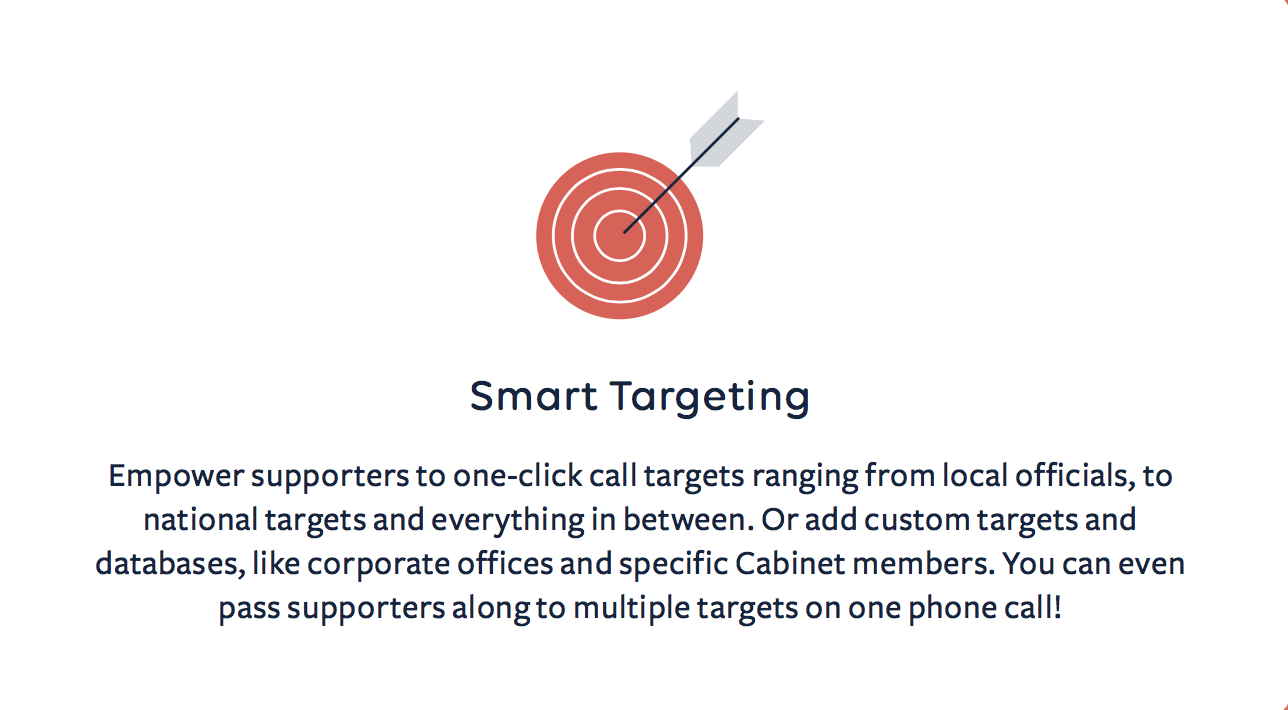
Here’s what they do.  One-click calling.  One-click email. One-click faxing. Fairly predictable. Storm social? hmm like the sock puppet tweet storm we saw directed at the MEPs last month?   Letters to the editor? WTF? Automated letters to editors? (more on that in a minute).

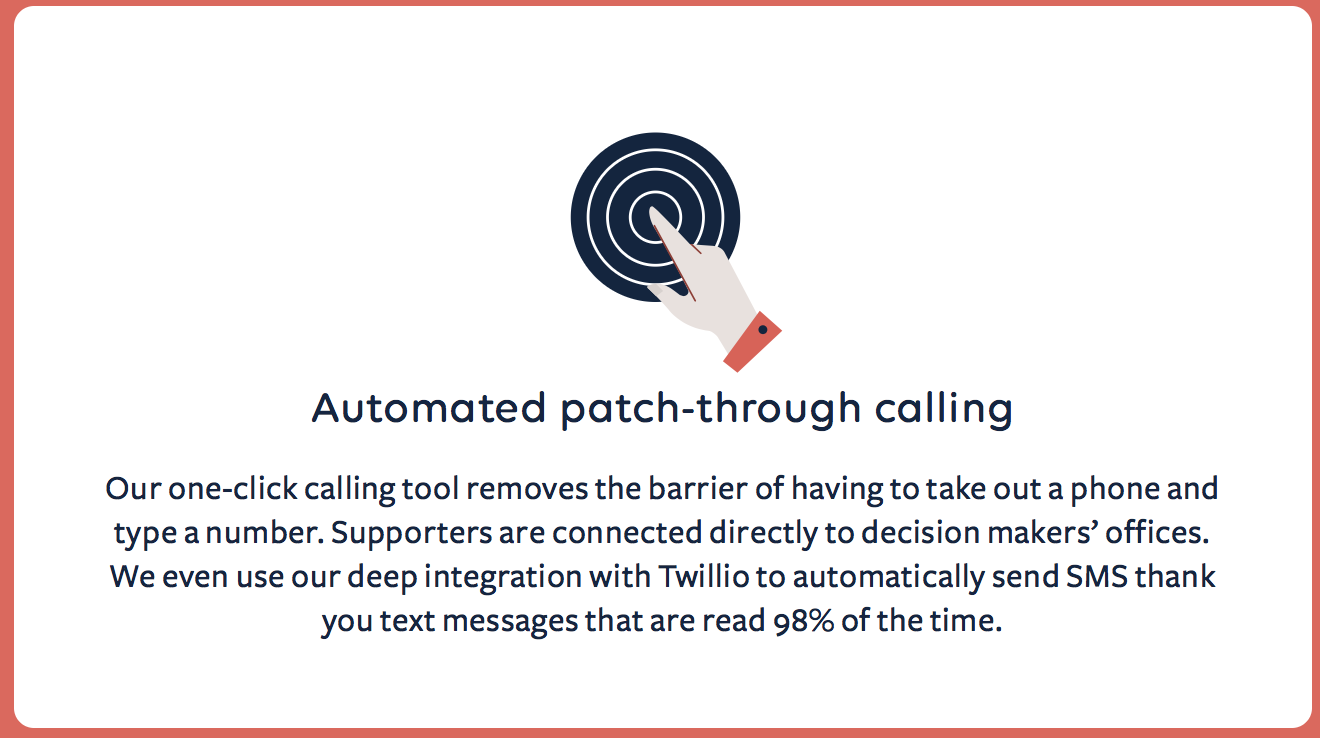
Let’s look at one click calling. Pure clicktivist nonsense.  I tested this out a while back. A user can put in any postal code.  No one checks. I put in a postal code for a rural city in the northern plains of the US and I was connected to the office of someone who was not my congressman. I was scripted to behave as if I was a constituent.

Even better. If you stay on the line, the service keeps connecting you to additional “targets.”  So one person can easily call 20-40 “targets” in an hour.

Democracy Hacking Tools in Action


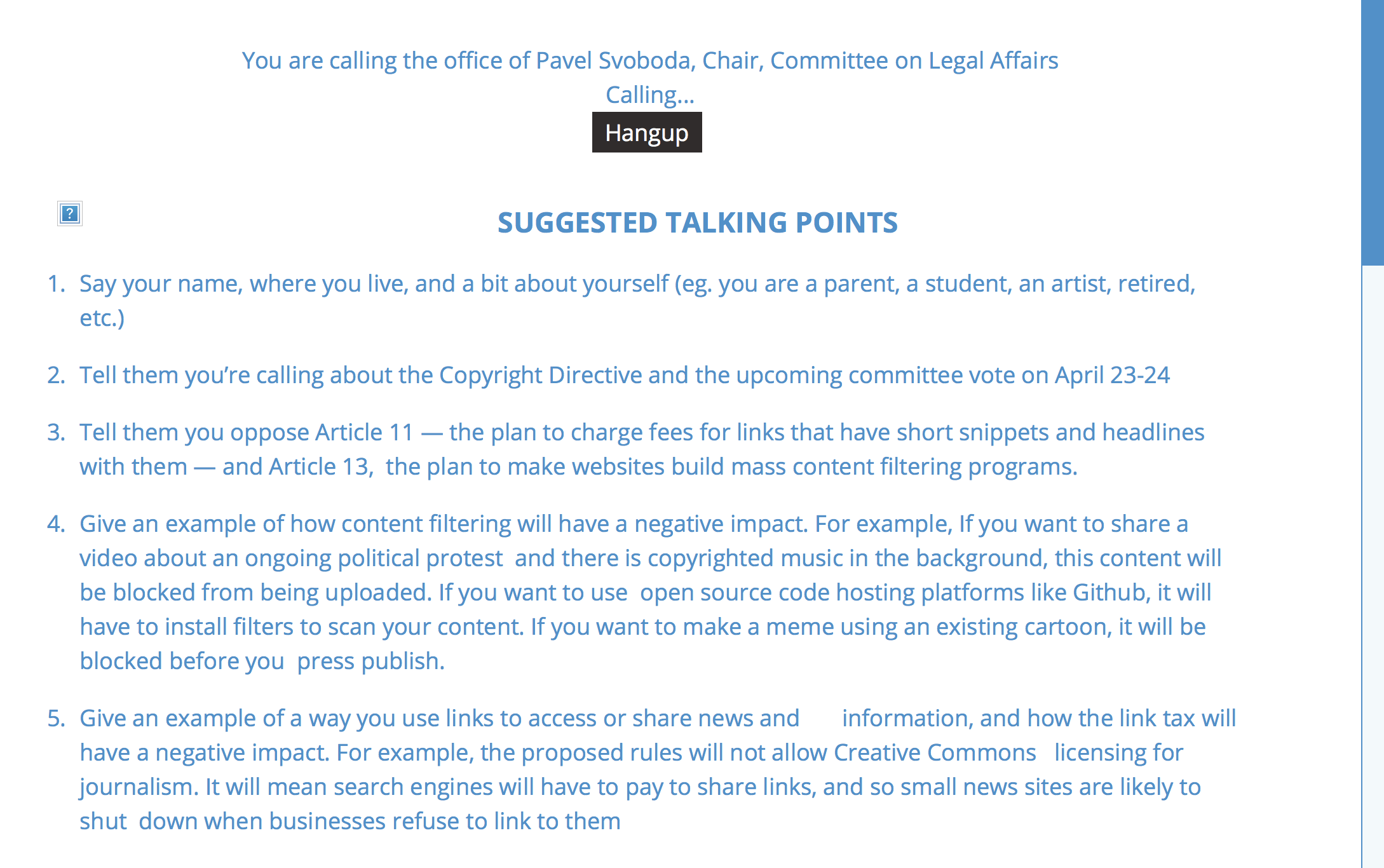
During the #DeleteArticle13 campaign I was able to dial UK MEPs using New/Modes tool. Even though I was using a US phone number! NewMode and OpenMedia didn’t seem to care. Why should they?  Any cybermob is a good mob right?

They helpfully gave me talking points. This is your democracy. This is your democracy on bots.

(Since I originally posted this piece I checked the calling feature again.  It still works. Even with US number. See screenshot above)

Microtargeting a Tweet Storm


New/Mode isn’t just about spam email and robo-calling.  They do so much more. Want a tweet storm?  Just like the one directed at Euro MEPs on article 13?  I wonder how all these sock puppet tweets were generated? They were coming out at about 3 to 5 a minute in the wee hours of the morning Brussels time.  A lot of sleepless constituents! Is meth still popular in EU?

Oh look! Those aren’t sleepless constituents. New/Mode provides exactly the tool you need to create your own middle of the night tweet storm. No Meth required!

And New/Mode lets you target exactly who you want to target. Just direct the information warfare firehose at a single wavering MP somewhere.  More effective.

 As we reported in an earlier blog, we observed the “grassroots” tweet storm behaved as if someone was in command and control.  The tweets focused on certain countries MEPs for long periods of this time, then suddenly shifted to a different country.   This is not organic grassroots behavior.

Google Command and Control

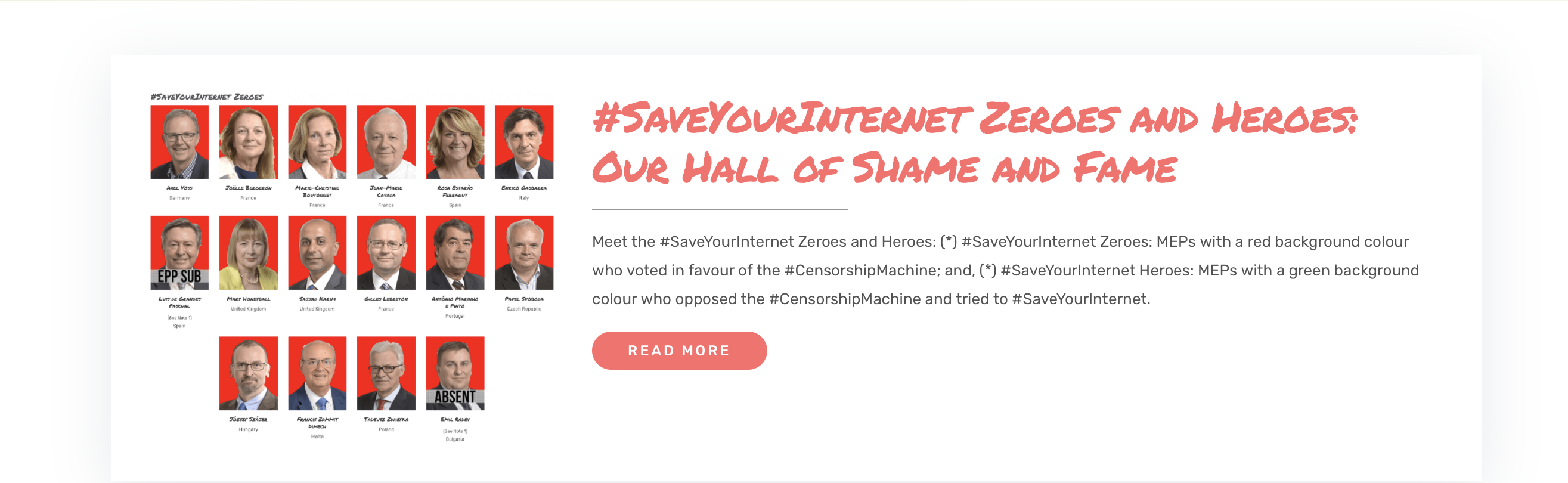
Tweet storm targets were the same as those MEPs highlighted on the SaveYourInternet.eu website. SaveYourInternet.eu used the New/Mode web tools for tweets, email and robo calls.


SaveYourInternet.eu website is operated by Google’s lobbyist in Brussels N-Square.  Get the picture? MEPs were cyber bullied by fake mobs under the command and control of a Google lobbyist.  How is this even legal?

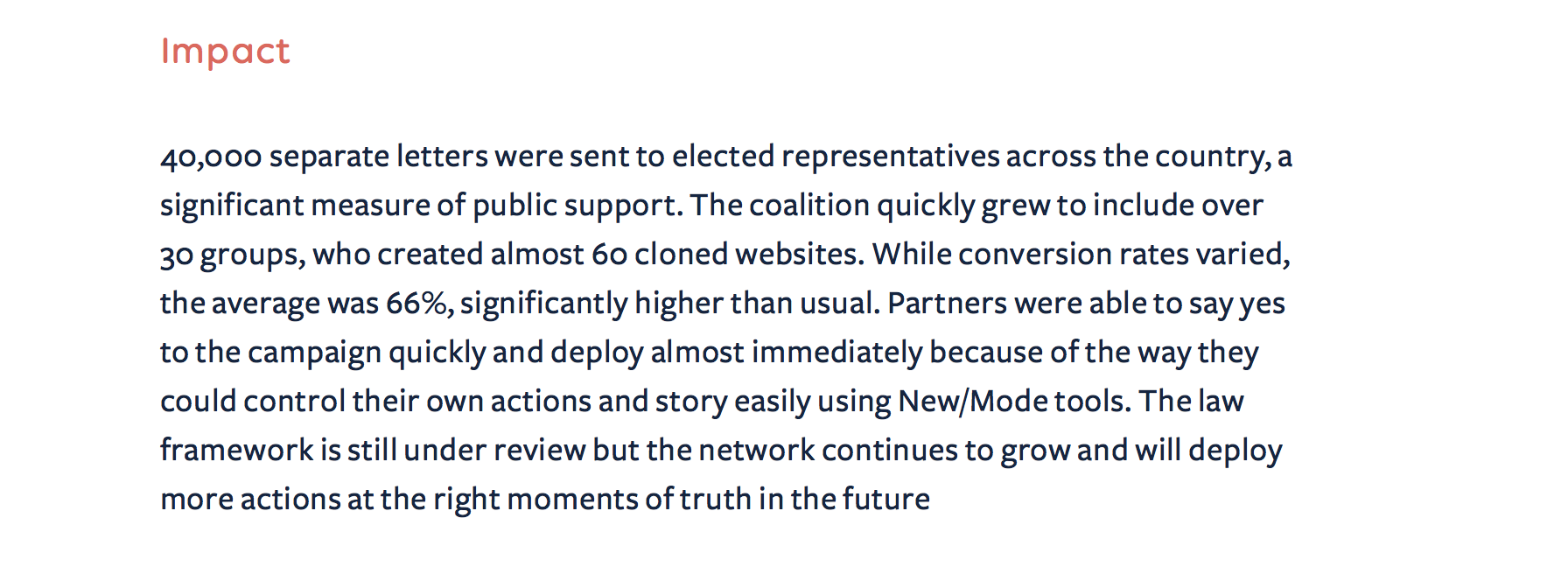
In the US command and control has been effectively run by Marvin Ammori via Fight For The Future.  Fight for the Future employs the same New/Mode tools to mount it’s fake grassroots campaigns.  Ammori is/was outside counsel to Google, and is currently associated with at least three other Google funded institutions including the Center for Internet and Society.

I Love the Smell of Hacked Democracy in the Morning: Past Targets

The US Federal Communications Commission was targeted by New/Mode tools last year:

https://www.usatoday.com/story/tech/talkingtech/2017/11/29/net-neutrality-comments-mostly-came-bots-and-fake-email-addresses-pew-finds/904439001/

The Trans Pacific Partnership  trade agreement was derailed largely due to disinformation spread with this Open Media New Mode enabled tool.  Here is the OpenMedia.org “cloned” website that first deployed the tools:

https://stopthesecrecy.net

Original opposition was based on intellectual property provisions, but Trump (and to a lesser extent Sanders) hijacked the movement and turned it into a jobs issue.  (You see what happens Larry when you find a stranger in the Alps?)
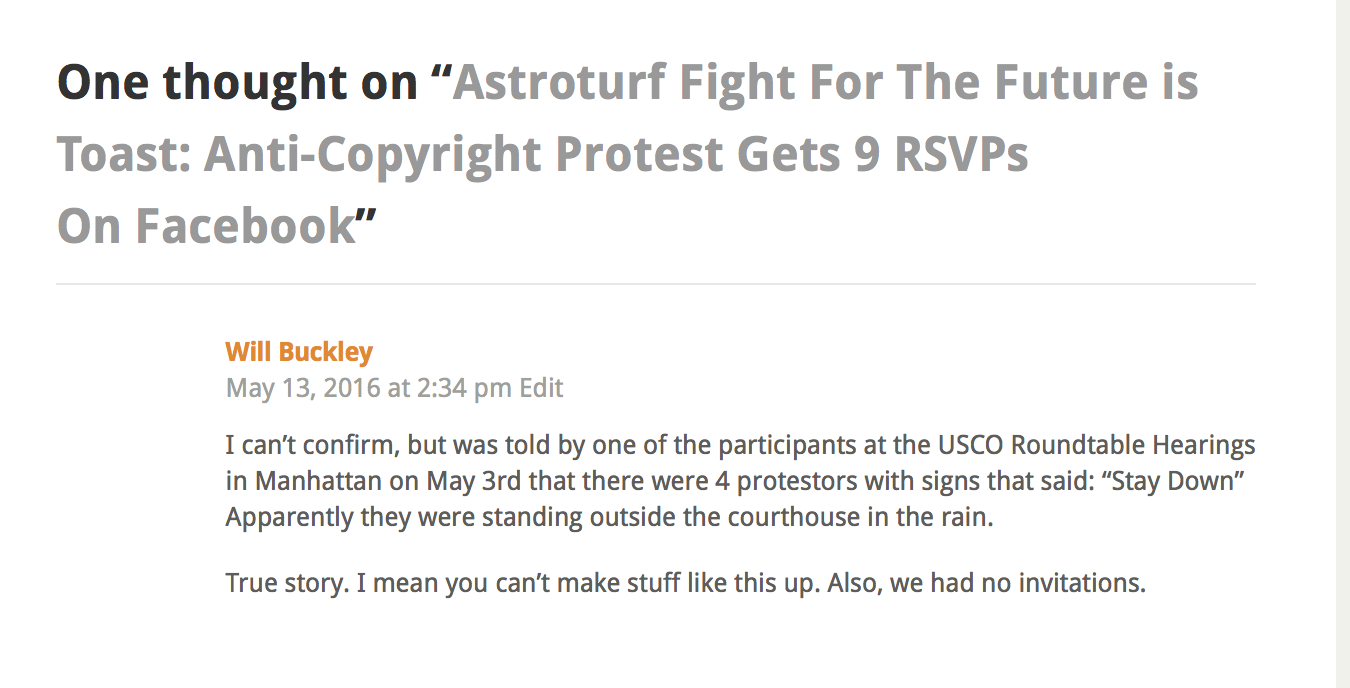
In 2016 the US Copyright Office  “consultation” was similarly bombed with identical comments using a similar tool.

Exactly 86,000 Identical Comments: The Illegal Comment Bombing of DMCA Notice & Takedown Review By Google Proxy “Fight For The Future”

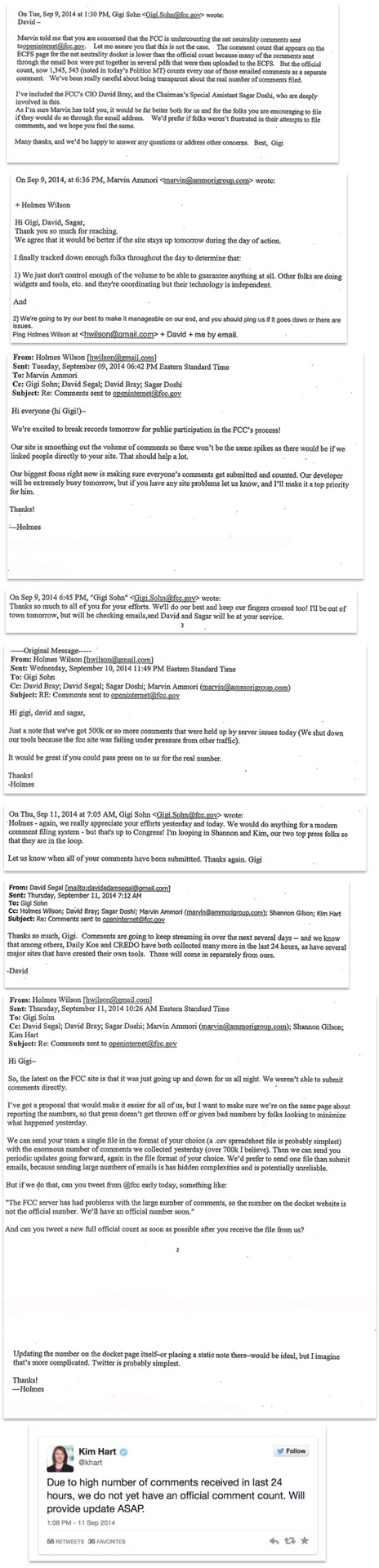
Also 2014 a similar use of automated commenting tools targeted and crashed the FCC website. Freedom of Information requests later revealed that FCC staffers with close ties to Google helped the group that generated the bot comments post the comments anyway.  See emails here

These are all DDoS attacks that seek to overwhelm the voices of real  constituents by drowning them out with a flood of corporate sponsored spam. There is no other way to describe this other than a hack of the Democratic processes.


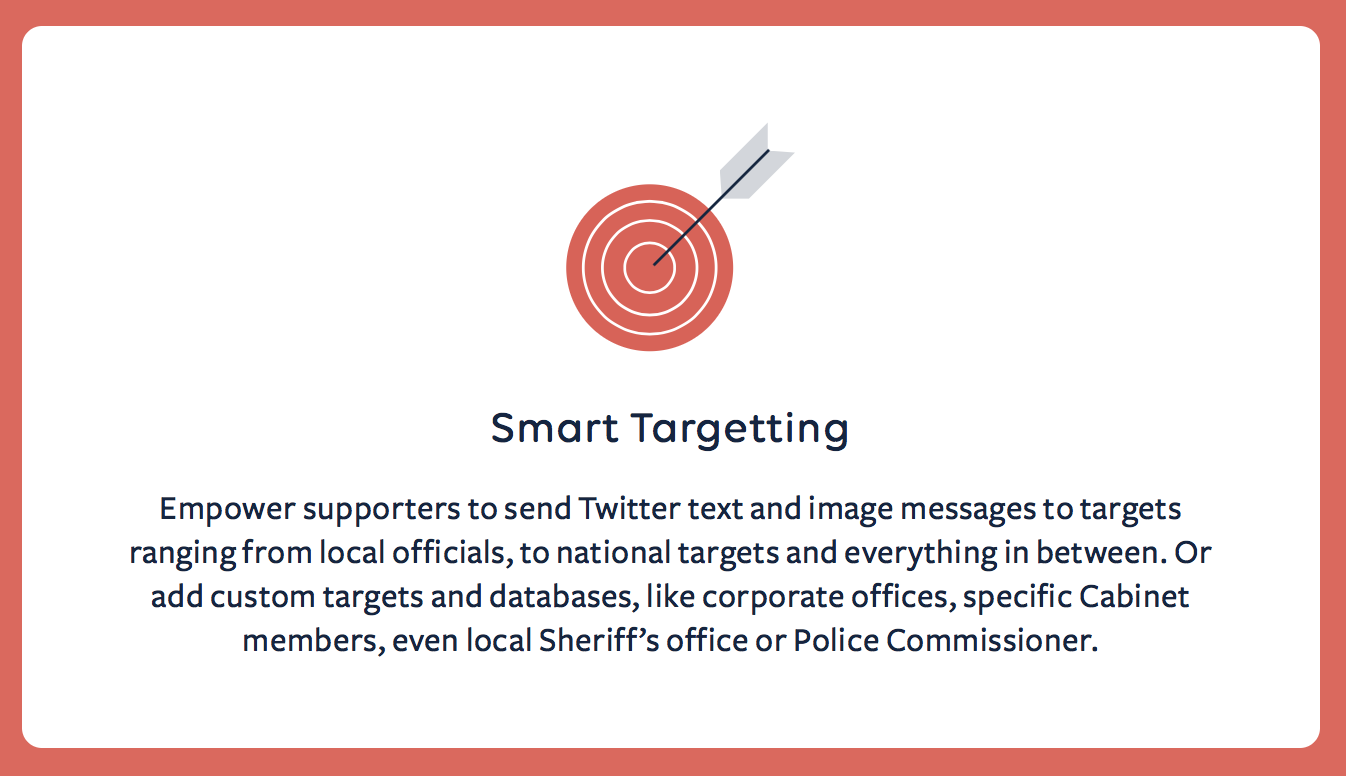
New/Mode also brags that it can create “clone” websites to make it appear as if there are a broad range of groups supporting the same action.  In screenshot above they brag about creating 60 “cloned” environmental group websites in Canada to put pressure on the Trudeau government.  While the end goal of this environmental campaign may be laudable, ends never justify means. Especially if it means you hand Canadian democracy over to astroturf groups controlled by Silicon Valley interests. Maybe Canada’s federal government in Ottawa ought to have a look at what’s going on all the way down at the other end of the country in Vancouver.  Seems sketchy to me.

And it is Fake Grassroots


As we have noted repeatedly on the Trichordist, when Google funded/directed astroturf groups that use the New/Mode tools then try to turn their cyber-brownshirts into boots on the ground very few (if any) people show up.

In 2016 Fight For The Future launched a campaign against the US Copyright Office consultations on copyright reform. Fight or the Future claimed to have crashed the Regulations.gov website with New/Mode tool. (Is this something to brag about?)  Fight for the Future claimed it was because tens of thousands of folks responded to their online campaign and overwhelmed the regulations.gov portal to comment on US Copyright Office consultations.  At the same time Fight For The Future organized a rally.  However only 4 people showed up to protest in person.  Judging by signs all four were pro-copyright. Apparently they showed up to oppose the non-existent Fight For The Future protestors.  Doesn’t make sense. A group that can get tens of thousands of folks to leave comments on wonky federal regulations  but they can’t get anyone show up for a protest?

Similarly there are only 37 individuals in the photo of the  “huge” white house rally to keep title two net neutrality at FCC.  This was also organized by Fight For The Future. So the online campaign generated millions of comments, emails and phone calls and 37 people show up to protest at the White House?   This does not pass the smell test.

Over in Europe reports indicate something similar happened.  The biggest #DeleteArt13 rally in Berlin had less than 150 participants.  Where are all the millions of folks who sent tweets, emails and phone calls to EU parliamentarians?

The simplest explanation is that most of the online protestors don’t really exist.

Fake, fake fake.  Pure fakery.

It Gets Worse: New/Mode Hacks Print Media


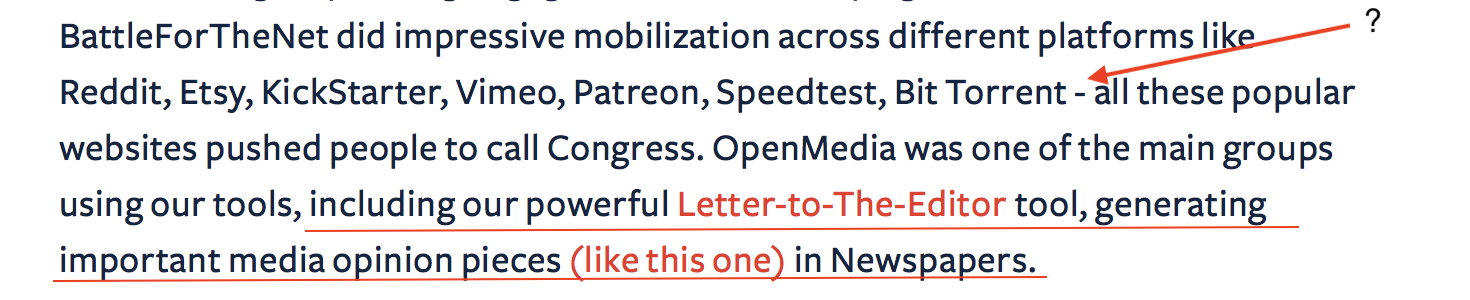
But forget the EU and Canada for now. The thing that stopped me in my tracks was this tool that allows a small team of individuals to write a “letter to the editor” to every local newspaper in the US.


Clearly these folks at Open Media know that they are up to no good. “Randomize subject lines and content to deliver an original authentic story to editors.”  This is pure shillery.  No I take that back. This is pure fuckery.  And they are fucking with our democracy at a very local level.  Turns out Canadians aren’t nice at all.

They even bragged about it and linked to robo letters that were published in small town newspapers.  What is wrong with these people?

Hack Me?  HACK YOU!


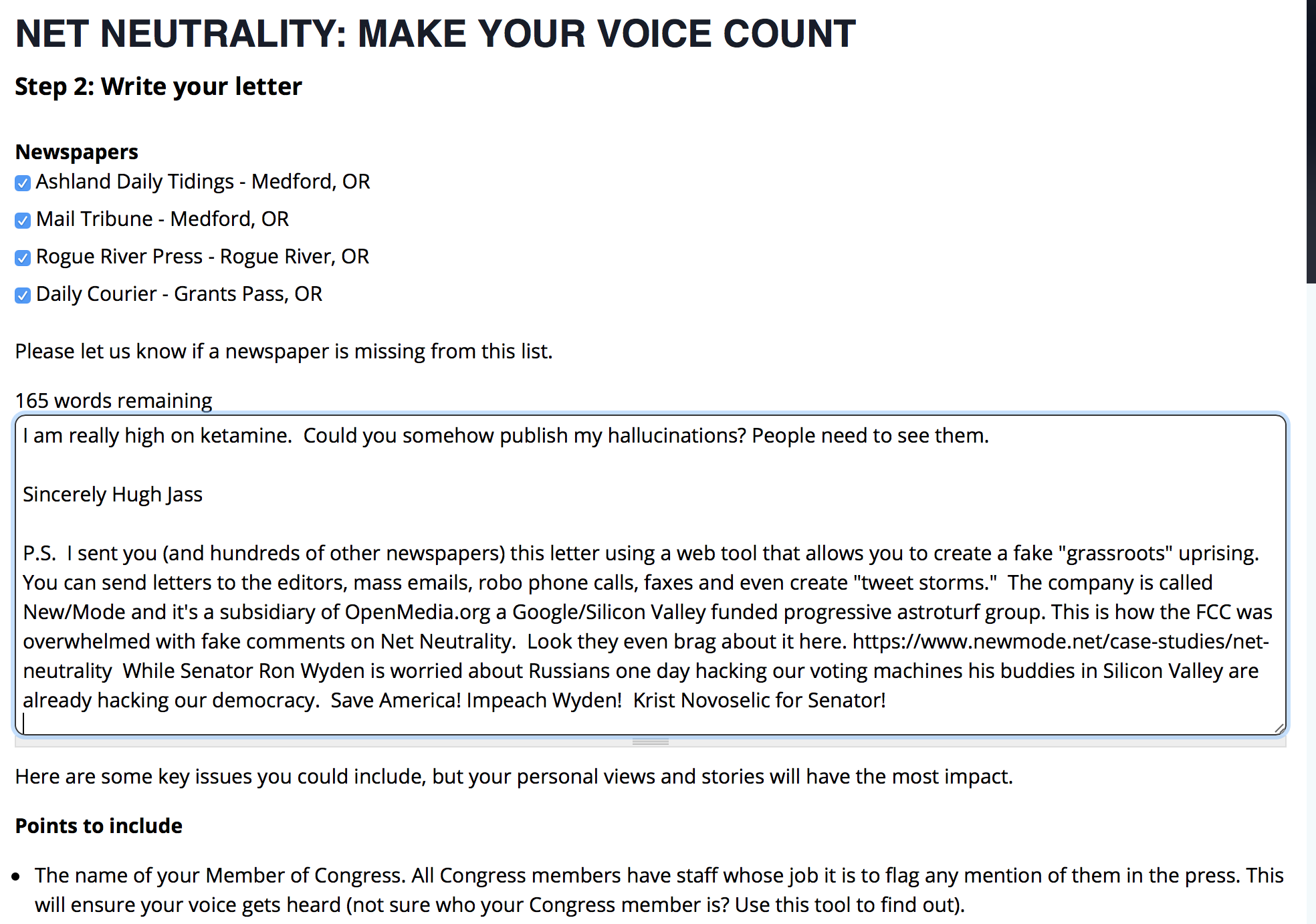
Just to demonstrate how fucked up this is,  I repurposed the Net Neutrality letter to the editor. I replaced their text with my own and sent the following letter to every small town newspaper in Oregon. It took maybe five minutes?  The joke in the letter is that Sen Ron Wyden of Oregon has proposed a bill to prevent hacking of federal elections by mandating paper ballots.  The problem is that Wyden clearly does not have a clue as to how our democracies will be hacked.  Our democracies will be hacked by hybrid information warfare techniques.  NOT ballot tampering. The creation of fake grassroot movements and disinformation is what will kill our democracy.  OpenMedia.org and New/Mode are already deploying the tools that will kill our democracy. But given the fact Wyden is sometimes referred to as “The Senator from Google” don’t expect him to do anything about it.  (Also Google and Oregon? See here)

Oh and Krist Novoselic is the former bass player of Nirvana.  And he does have political aspirations.  See his book

Can’t be any worse than Senator Ron “Hedge Fund In My Basement” Wyden.


Article 13: Anatomy of a Political Hack- Guest Post by Volker Rieck

Guest post by Volker Rieck.
Translated from German. Original article is here
http://webschauder.de/anatomie-eines-politik-hacks/ ‎

The anatomy of an assault on politics

The New Testament narrates numerous miracles attributed to Jesus Christ. One of them is the feeding of the multitude: Jesus is described as having multiplied a few loaves and fish so that five thousand people could eat and were satisfied.

The debate over the new EU Copyright Directive towards the end of June 2018 was characterized by a similarly remarkable form of multiplication. But what was being multiplied in this case was not bread or fish, but protest – or rather the appearance of protest.

To begin at the beginning …

In September 2016, EU Commissioner Günther Oettinger put forward proposals for a Directive on Copyright in the Digital Single Market.

Time passed, and Oettinger moved on to a new role within the Commission, but the wheels of bureaucracy continued to churn until the European Parliament’s Committee on Legal Affairs (JURI) was due to vote on the proposed directive.

In the run-up to the vote, observers may have wryly recalled the dictum of German parliamentarian Peter Struck that no bill ever exits parliament in the form it enters it. The directive’s rapporteur Axel Voss (CDU/EPP) had the pleasure of steering a process in which numerous changes and additions to the text were negotiated before it was formally adopted by the JURI Committee and Voss was finally given a mandate to proceed to negotiations with the EU member states.

Julia Reda’s simple slogans

The only member of Germany’s Pirate Party with a seat in the European Parliament, Julia Reda, opposed the proposed legislation from a very early stage. Her campaign grossly oversimplified and distorted the issues at stake. Reda’s “link tax”, coined to attack Article 11 of the directive, is marvellously short and sweet, but that anybody could believe in all seriousness that it would be possible to impose a tax on linking to texts (we know taxes are collected by the tax authorities, right?) is – albeit involuntarily – rather funny.

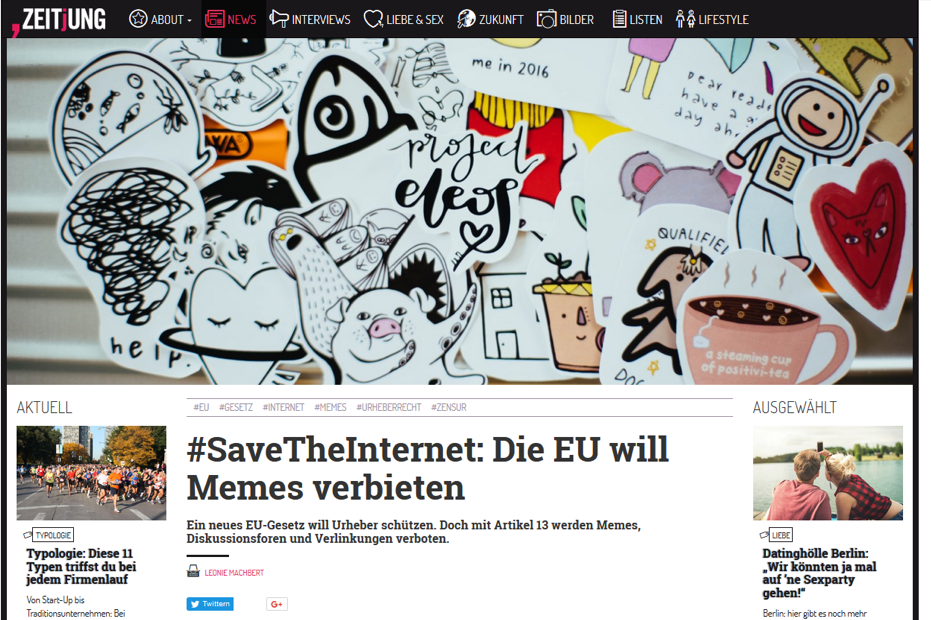
The battle cries of “upload filter” deployed in opposition to Article 13 of the directive were not much better. Upload filters were not and are still not mentioned in the directive, but the term is eminently suited to stoking fear. And Reda did indeed succeed in her efforts to fool some of her supporters into believing that EVERYTHING on the internet will be filtered in the future if the directive is adopted in its current form and that memes– yes, even people’s much-beloved memes – will all be banned.

Illustration: Screenshot from Zeitjung.de. “The EU wants to ban memes”


What nobody (again) seemed to have read and/or understood

While this was completely at variance with the actual content of the directive, that appeared to be of merely tangential interest. What the directive proposed was that platforms (and only platforms) would be strongly encouraged to enter into license agreements with rightsholders covering user uploaded content.
Responsibility for taking out licenses would rest with the platforms, and end-users would be completely in the clear. The idea was simply that platforms would have a duty to maintain transparency to ensure correct licensing and the proper distribution of payments made for licenses to rightsholders. Under the directive, operators of a platform which had not concluded a licensing agreement would have been liable for unlicensed content on their platforms. How operators chose to keep their platforms clean would have been up to them. But preventing copyright violations would have come within their remit of responsibility.

Had you stayed silent, you would have stayed philosophers (to paraphrase Boëthius loosely)

And that, in a nutshell, is the content of Article 13 of the directive. Not that it mattered a jot; many commentators seem to have persistently shunned the intellectual effort required to read a current version of the draft legislation and understand the legislator’s intentions before piling in to make their own arguments. From the internet associationsof the political parties to Sascha Lobo, who wrote not once but twice in Der Spiegelabout “censorship machines”. If only the commentators had simply read the draft text that so perturbed them! Then, perhaps, they might have noticed that the users of a platform which had not licensed content would, for the first time, have gained extensive rights including an entitlement to mediation in the event of finding themselves blocked. By that point, at the latest, it ought to have become evident that the cries of “censorship” were misplaced. Perhaps the critics were simply defeated by the challenge of procuring and understanding a current version of the text?

They want censorship machines, or do they not?

But coming back to content-sharing platforms, the real issue here, let us look at one of the most successful ones, YouTube. The directive is interested only in regulating platforms like this, not in open-source platforms or sales platforms.

For years now, YouTube has been using its Content IDsystem. This system allows rightsholders who submit content to determine what should happen when users view it. The available options span the gamut from monetization (an end user uploads a video with music, for example, and the rightsholder gets a share of any advertising revenue generated) all the way to – please be brave now, Sascha Lobo and Julia Reda – blocking the video. The primary purpose of this system is to prevent third parties from generating revenue with content they have no entitlement to exploit.

What’s more, Copyright Matchis now also ready for deployment. This new system resembles a light version of Content ID. Its primary purpose is to assist YouTubers seeking to assert their rights when duplicate videos are uploaded. The first person to upload a video is automatically notified of duplicate uploads and afforded the opportunity to determine how the platform handles these duplicates. The range of options again extends – and please be brave now, dear net activists – all the way to blocking.

Has anybody condemned these options as censorship? Seemingly not. There have been no protests in the streets against Content ID and Coypright Match, and there has been no public outcry over YouTube’s “censorship machines”. Julia Reda, Sascha Loboand LeFloid, another irate YouTuber, have (right up to the present) refrained from deleting their YouTube channels or adding black sashes of mourning to protest against these upload filters.

The protesters take to the streets

This brings us nicely to the issue of the rallies against the new directive. A demonstration was held, of course. It took place on 24 June 2018 in Berlin. Rather unfortunately for the protesters, it rained that day; otherwise they would have been able to count the usual hordes of tourists at the Brandenburg Gate among their numbers.
Under the circumstances, only those who had turned up to protest were counted, an estimated 150 people. As with an earlier demonstration focused on the ancillary copyright of press publishers, the turnout was so low that there were presumably more press photographers than activists in attendance.
Even when they are initiated by the broadest of coalitions, protests like this tend to suffer from the internet’s 1-9-90 rule: 90% of net users are entirely passive, 9% click on “like” buttons now and again, and only 1% actively upload content.

This explains why campaigns like “Right To Remix” have puttered on for years without gathering much momentum: the vast majority of people are simply not interested.

When civil rights protesters play hardball

But those intent on scuppering the directive had not yet exhausted their firepower. What came now was the hour of the bots, the automatically generated emails, the automatically placed phone calls and the miraculous multiplication of protest, or rather its simulation. In the week before the plenary vote in the EU parliament on whether the adoption of the report by the JURI Committee and the negotiation mandate given to Voss should be allowed to stand,the inboxes of EU parliamentarians were flooded with automatically generated emails. Some EU parliamentarians reported having received 60,000 emails. In total, 6 million emails appear to have been dispatched to EU parliamentarians in this fashion. Compare that number to the handful of protesters in Berlin.

Almost all the emails were identical in content, phrasing and formatting, and many even came from one and the same sender, presumably following the logic that more is better. A very large number of them were sent from the domain Opendata.eu.

This site has no content. It was registered by an English limited company which is in turn a majority holding of a US Inc. that trades in domains and provides services. No civil rights initiative appears to be involved.
Did accepting responsibility for the relentless online bombardment of parliamentarians seem too risky?

The picture was repeated on Twitter, where accounts were flooded with spam, but also threats.

What happened? Sites such as Saveyourinternet.eu made tools available that enable this kind of email carpet bombing. The supporters of this site include an array of internet lobby groups such as the Electronic Frontier Foundation (EFF).

Anyone who believes that the EFF are a grassroots civil rights movement should take a look at this report.
Is it necessary to mention at this point that a large number of the groups orchestrating protests are fundeddirectly or indirectly by groups with an obvious interest in the failure of reforms?

But Wikipedia also jumped aboard the bandwagon. The directive is entirely irrelevant for Wikipedia, which confined itself to condemning it in generic terms as an attack on the free internet Wikipedia understands itself as part of. This was, for all intents and purposes, rather like BMW owners protesting in response to a recall of specific Volkswagen models ordered by the Federal Motor Transport Authority and citing it as evidence of a general war on the motorist. It can only be assumed that the close ties binding Julia Reda’s office manager and his former employer were able to influence Wikipedia’s stance.

Even Mozilla joined the fray. Newsletter subscribers were invited to phone EU parliamentarians. The “Call now” button even appeared in four different places in a newsletter. And of course the calls were free.
The costs were small change for an organization which received over 500 million dollars in royalties for integrating search engines into its browser Firefox in the year 2016 alone.

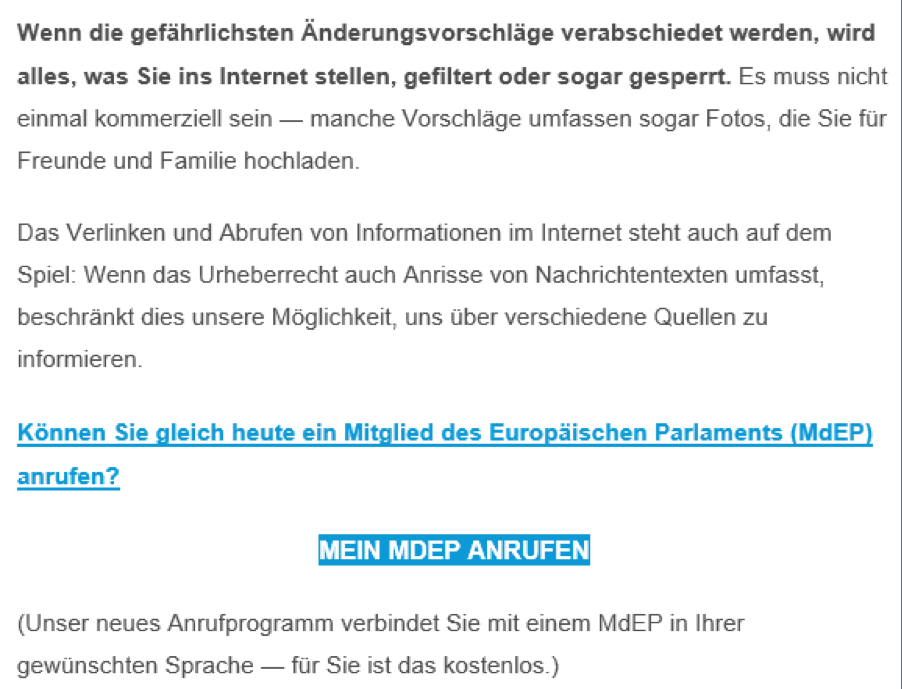
Illustration: An extract from Mozilla’s campaign email: “everything you put on the internet will be filtered, and even blocked.”

EU parliamentarians reported that callers had followed scripts. The phone calls, just like the emails, relied on prefabricated phrases. It was just too bad that many callers could make little response to questions or counterarguments.


This persistent harassment via email, telephone and Twitter took its toll on EU parliamentarians. Many were absent during the vote. Perhaps they took thethreat of murderso seriously that earlier proponents of the legislation now opposed the directive, or perhaps they even believed the canned protests had been real. Whatever the circumstances, the outcome was clear: the motion to allow the trilogue negotiations to proceed received only 278 of the necessary 299 votes.


What do these events signify for political processes?

Individual citizens are perfectly entitled to voice their concerns, doubts and problems in dialogue with their representatives in the EU parliament. But this case makes a mockery of this right. Emails citizens had formulated themselves were bound to be lost without trace in the deluge of automatically generated texts. And that, in fact, is exactly what this orchestrated protest was designed to achieve: the drowning out of nuanced arguments by a vast wave of simulated protest.

Just like in the Bible: a miracle of multiplication. In this case, however, no miracle-working was involved; the heavy lifting was performed by technology. ByDDoS, to be precise.

Is this the future? Are those with better technology destined to win even when the better arguments are not on their side? If that comes about, minorities will find it very difficult to make themselves heard – let alone to participate in the process of political decision-making – unless they are able to afford the requisite technology. But even assuming equal access to resources, surely the weighing up of arguments should still count for more than the number of preformatted spam emails, threats or scripted phone calls that can be mustered?

Now, at the latest, the EU must analyse these events in depth and take precautions against politics being hacked in this fashion again. Governance by shitstorm cannot be in the interests of democratically elected governments, and it most certainly cannot be in the best interest of voters.


@shirleyhalperin: Variety Reveals $1,500,000,000 First Unmatched Payment to Collective Under Music Modernization Act — Artist Rights Watch

Wow Wow Wow! $1.5 Billion in unpaid songwriter royalties? Why isn’t this all caps page news? How is this possible? I wouldn’t blame anyone for rethinking position on MMA.This seems like it needs investigation not legislation.  Front Artist Rights Watch:

[Now we understand what the rush is!] The DSPs are holding some $1.5 billion in unmatched mechanical royalties. If the MMA passes, that money would be passed through to the MLC which would match it to the songwriters and publishers. Read the post on Variety
via @shirleyhalperin: Variety Reveals $1,500,000,000 First Unmatched Payment to Collective Under Music Modernization Act — Artist Rights Watch
6 Oregon Musicians That Would Make a Better Senator than Ron Wyden (And never had hedge fund in basement).


Senator Ron Wyden doesn’t seem to understand that he represents a state with a very dynamic music scene.  Over the last two decades Portland, the state’s largest city has become arguably the most dynamic music scene in the entire  country. Yet Wyden has twice now thrown songwriters and performers under the bus, in order to protect a few tech billionaires from California. Yes these billionaires happen to have server farms out in eastern Oregon but these server farms at most employ a few hundred folks. Portland OR alone has thousands of professional musicians.

But it’s not just that Wyden doesn’t understand this, or has forgotten about those musicians in his state. He is actively hostile to their interests.  Check it.

First in 2013 Wyden introduced the Orwellian “Internet Radio Fairness Act.”   This bill would have created “fairness” for internet radio by slashing performer and songwriter pay as much as 70%. It also placed extraordinary restraints on speech of songwriters and performers, threatening prosecution for any group of songwriters or performers that discussed digital licenses and rates with their colleagues. The language of the bill was so broad and regressive it would have punished members of a single band that collectively blogged negatively about bad digital licensing deals. We are not making this up. The congressional research office eventually stepped in because the bill was so bad. Under withering criticism Wyden abandoned the bill.

See our series on this bill:

Muzzling Free Speech By Artists: IRFA Section 5 Analysis

The Internet Radio Fairness Act’s Attack on Free Speech

Congressional Research Service Memo on Constitutionality of IRFA Section 5

But now Wyden has taken it up a notch.  According to rules of the US Senate a single senator can put a hold on a bill.  Despite the fact the House of Representatives passed the Music Modernization Act 415-0 Wyden intends to put a hold on a consensus bill. What an egomaniac.  To put this into perspective the Dec 8th 1941 declaration of war on Japan and Germany was not unanimous.  The Music Modernization Act enjoys more consensus than WWII!  But Wyden intends to stand in the way.

But it’s even worse.  When you drill down into Wyden objects to what is perhaps the least controversial part of the bill. The part of the bill that extends digital royalties to performers that recorded before 1972.  This “pre-1972 loophole” in digital royalties is pretty much a copyright law typo.  Surely the authors of the 1995 act that formalized digital public performance royalties did not intend to exclude pre-1972 performers.  Indeed until 2013 most digital services paid royalties to pre-1972 performers. It wasn’t until Wyden’s first bill was shot down that Pandora, Sirius and other digital services began to aggressively exploit the loophole.  Coincidence?  Maybe.  But I think not.

This is skullduggery of the highest order. Now consider who is one of the biggest beneficiaries of this loophole: Google/YouTube.

As previously noted Google along with all the other Silicon Valley firms have large server farms out in Eastern Oregon.  And Wyden is eyeball deep in Silicon Valley politics.

As a recent commenter on this blog put it:

Ron Wyden, got his political start as a fairly conservative Democrat, which was necessary for his initial success because outside the Portland metropolitan area (and Eugene of course), the other two-thirds of Oregon’s population is very conservative.

Oregon has always had a boom or bust economy based on agriculture or dwindling natural resources, and pretty much every politician of every skunk stripe collectively bent over and grabbed ankles when the tech sector unbelted and began plowing the “Silicon Forest” with their plastic thingies and their ones and zeros. As you might expect, Google now owns Oregon. QED.

Pretty much all you need to know about Wyden is that he is on the Intelligence Committee. You don’t even approach that gig unless you have been drinking the Kool-Aid for donkey’s years. – Ron or Donna

And indeed our reader is spot on. Oregon politicians have been especially pliant when it comes to Google. The Oregonian estimates that Oregon politicians have given Google tax breaks for a single data center in The Dalles worth $100 million dollars.  The data center has less than 200 employees.  That works out to $500,000 a job.   On top of that the data centers suck down most of the cheap hydro power that should arguably go to rate payers in Oregon.  Seems pretty weird, right?  Oregon enriching a bunch of California based companies for a handful of jobs? Someone somewhere must be making a lot of money on the deal.

Also consider this.  Who do you think has oversight over those federal hydropower rates? The rates the operators of those data centers pay? If you guessed The Senate Committee on Energy and Natural Resources you would be correct. And who might be on that committee?  Ron Wyden.

The presence of these large data centers is a net negative to the citizens of Oregon.  So why does Ron Wyden feel obliged to do the bidding of Google on a music bill?  Whether it’s ignorance or greed the result is the same.  Ron Wyden sucks at representing citizens of Oregon.  Sure he pleases many Oregon residents when he goes after the trump administration, but surely there are plenty of other progressive democratic politicians in Oregon that would do the same without icky pro-Google Silicon Valley shillery.

Then there is also the matter of the senators adult son, Andrew Wyden, and his “hedge fund” ADW Capital. The one man hedge fund was started it in the Senators Washington DC townhouse in 2011. Andrew Wyden had just graduated from college and someone gave him 3 million dollars to start a basement hedge fund. If the initial 3 million in funds came from campaign donors (specifically longtime Wyden supporter D. E. Shaw) or other investors with business before the senate you could be looking at an FBI investigation.

Even if the senator is clean,  the optics are horrible. And it’s extremely poor judgement on the part of the senator.  If there turns out to be anything to this story it’s entirely possible that Oregon may be looking for a new Senator before his term is up.

So it’s not a joke to start considering who might replace Wyden in the Senate. Given the growing importance of music to the Oregon economy (surely music is responsible for 100 times the number of jobs that Google data centers created) I humbly suggest Oregon voters look at some smart entrepreneurial musicians to replace Wyden. I believe there are probably a number of Oregon musicians that would do a much better job of representing Oregon in the US Senate.

I asked this question on twitter and here are some of the suggestions:

Well the entire band can’t be Senator, but I suppose Chris like most people is thinking of Carrie Brownstein for her role in Portlandia.  Face and name recognition. We have to assume the campaign videos would be funny. Does she still live in Portland?  Well regardless state residency didn’t stop Cheney from running for Vice President. Regardless I wouldn’t discount Drummer Janet Weiss (also of Quasi). Secret weapon. Corin Tucker also a solid choice.

Again not sure he’s in Portland proper. I believe he still lives just across the state line in Washington. I always see him in shows in Portland so he’s certainly close. Again Cheney demonstrated it’s easy enough to move. And Krist does have a keen interest in politics.  In 2004 considered a run for Lt Governor of Washington.  He is also the author of  Of Grunge and Government: Let’s Fix This Broken Democracy.


Larry Crane, musician, engineer, producer, music entrepreneur and Tape Op magazine editor. This is my personal vote. Anyone that has had any experience in the studio knows that producing and engineering requires great diplomatic skills. Producing and engineering of a record requires forging grand compromises between many strong personalities and interest groups: labels, managers, and the performers themselves who are often internally conflicted. It’s a tough job Larry but your state needs you!

I always forget Patterson Hood lives in Portland now. Hood hails from the deep red state of Alabama. Yet he is a strong democrat. Patterson and his band Drive-by Truckers have deftly managed to embrace progressive causes (r.g. Black Lives Matter) w/o alienating the portion of their audience that identifies with conservatives. Who else to better bridge the divide between Portland’s urban population and deep red rural parts of the state. Also he is an extremely humble guy and would never even consider a senate run. All the more reason to send Mr. Hood to Washington.

Other suggestions

We love scott.  He already is Portland’s unofficial music ambassador.

Yes indeed. If Mr Matthews simply remained in his cabin in the woods making recordings and never went to DC for a single day, Oregon residents would surely be better off than sending Wyden back to DC.

Please suggest more Oregon Musicians in comments and we will add them to the poll.