The Constitutional Foundations of Intellectual Property Law

via copyhype:

Randolph May and Seth Cooper of the Free State Foundation look at some of the philosophical underpinnings that drove the inclusion of copyright and patent protection into the United States Constitution. According to May and Cooper, the origin of the right is explicitly Lockean, while the protection of the right is explicitly Madisonian. An engaging and enlightening read.

READ THE FULL REPORT HERE:
The Constitutional Foundations of Intellectual Property Law

Artists Rights Watch – Sunday Feb 3, 2013

Grab the coffee!

Recent Posts:
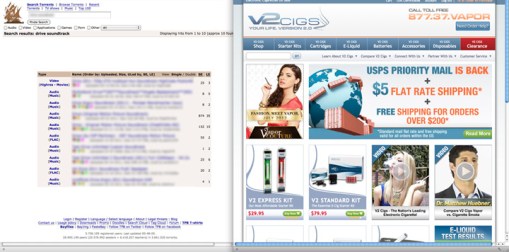
* Over 50 Major Brands Supporting Music Piracy, It’s Big Business!
* @pepsi and @beyonce @superbowl Ads Supporting Pirate Lyrics Site That Exploits Adele and Skyfall
* Derek Khanna is Wrong: Copyleft Mystery Man’s Misleading Memo Creates its Own Myths…
* It’s Not Whack A Mole if You Own the Mole: New York Times Coverage of Brand Sponsored Piracy
* Zero Dark Thirty, Best Picture Academy Award Nominee, Exploited by AT&T, Verizon, MetroPCS, Nissan, H&R Block, British Airways, Progresso, and more…
* #StopArtistExploitation – Tweet Daily for Artists Rights!
* Underreporting and No Accountability: Another Reason Streaming Royalties are So Small
* Internet Pay To Play: Payola’s Revenge – Guest Post by Robert Rial of Bakelite78

From Around The Web

LA WEEKLY:
* YouTube Stars Fight Back

“I woke up today hoping to make a video, but I went into a call with Machinima this evening and they said that my contract is completely enforceable. I can’t get out of it,” Vacas tells the camera. “They said I am with them for the rest of my life — that I am with them forever.

“If I’m locked down to Machinima for the rest of my life and I’ve got no freedom, then I don’t want to make videos anymore,” he says quietly.

The screen fades to black.

NEW YORK TIMES:
* Playing Whac-a-Mole With Piracy Sites
* As Music Streaming Grows, Royalties Slow to a Trickle

Spotify, Pandora and others like them pay fractions of a cent to record companies and publishers each time a song is played, some portion of which goes to performers and songwriters as royalties. Unlike the royalties from a sale, these payments accrue every time a listener clicks on a song, year after year.

The question dogging the music industry is whether these micropayments can add up to anything substantial.

“No artist will be able to survive to be professionals except those who have a significant live business, and that’s very few,” said Hartwig Masuch, chief executive of BMG Rights Management.

ADLAND:
* Online pirating: sponsored by many brands, and now, one government.

BUSINESS INSIDER:
* How Jobs In The Media Industry Got Demolished In The Last 10 Years [Charts]

The Bureau of Labor Statistics has put together a presentation on the recent history and direction of media jobs. It’s not pretty.

THE LEFT ROOM:
* Piracy, Free Books, etc

DIGITAL BOOK WORLD:
* Does Piracy Hurt Digital Content Sales? Yes

BRITISH JOURNAL OF PHOTOGRAPHY:
* Photographers find support in House of Lords in copyright fight

THE HOLLYWOOD REPORTER:
* Ray Charles’ Children Win Lawsuit Over Song Rights Termination

BLABBERMOUTH:
* TOOL Frontman Sounds Off On Illegal Downloading, Music Industry And Digital Distribution

“There’s a disconnect between people not buying music and not understanding why [bands] go away. There are people who are like monkeys in a cage just hitting the coke button. They don’t really get that for [musicians and artists] to do these things, they have to fund them. They have to have something to pay the rent.”

VOX INDIE:
* New Spotlight on Piracy Profitmongers

THE ILLUSION OF MORE:
* Think File Sharing is Sticking it to The Man? Really?
* On Being a Luddite

COPYRIGHT AND TECHNOLOGY:
* Yes, Piracy Does Cause Economic Harm

Decisions about business and policy have to be made based on the best information we have available. After a certain point, simply poking holes in studies — particularly those whose results you don’t happen to like — isn’t sufficient.

It may indeed, as the GAO suggested, be impossible to measure the economic effects of piracy with a large amount of accuracy. But if dozens of researchers have tried, all using different methodologies, then their conclusions in the aggregate are the best we’re going to do. Put another way, it will henceforth be very difficult to dislodge Smith and Telang’s conclusion that piracy does economic harm to content creators.

RAPIDTV NEWS:
* LATAM pay-TV operators unite against piracy

CIOL:
* Kamal Haasan fans help curb Vishwaroopam online piracy

BILLBOARD:
* Worldwide Independent Network Announces ‘Independent Manifesto’
* Blink-182’s Mark Hoppus Talks Piracy, Pros and Cons of Digital at MIDEM

“I believe that artists should be paid for their creativity. There’s no other industry where people can come in and take what you create for free and give it away for free and that’s acceptable.”

MUSIC ALLEY:
* U2 manager Paul McGuinness: ‘I don’t want to engage in Google-bashing, but…’
* Irving Azoff sticks it to Pandora and StubHub
* Midem 2013: How the Music Industry Manages Innovation

“We are the last fortress against this YouTube situation, and we are fighting hard on that,” he said. “The problem is the fair price, getting statements and getting all the business plans… The biggest problem to solve the YouTube deal is they want a non-disclosure deal, and we are not allowed by Germany law to do with any partners a non-disclosure [deal]. We have to do it open.”

DIGITAL MUSIC NEWS:
* Pandora Executives Cash Another $3 Million In January…
* Hey Advertisers: You Might Want to Ask VEVO for a Refund…

HYPEBOT:
* Myspace Allegedly Hosting Unlicensed Indie Music, Merlin Prepares Legal Response
* The Most Honest Interview About the Music Industry Ever, Featuring Jacke Conte of Pomplamoose

“YouTube seemed like a really incredible opportunity, but it’s not repeatable. I don’t know how to make it in the music industry. I don’t think anybody really knows how, and I’m unable to repeat what happened to Pomplamoose.”

PLAGIARISM TODAY:
* 4 New-ish Pro-Copyright Sites To Read

THE FEDERALIST SOCIETY:
* Laws of Creation: An Examination of Intellectual Property Rights

INSTITUTE FOR POLICY INNOVATION:
* Copyright and Innovation? No. Copyright IS innovation.

YAHOO:
* New Order’s Peter Hook: Musicians, Journalists Only People Who Don’t Get Paid for Work

Hook expressed astonishment that in the internet economy, consumers act aggrieved if musicians ask to be compensated for their music or if reporters object to having their stories re-purposed by other news organizations without getting credit or cash.

“If you love and respect music, you should pay for it,” Hook said.

COPYRIGHT ALLIANCE:
* Creators and Consumers Should Cut the Strings

TORRENT FREAK:
* Russia Wants To Fine Websites For Poor Copyright Takedowns
* University of Illinois Disconnects Pirating Students, Staffer Asked To Leave
* Pirate Bay Founder Could Be Prosecuted For Hacking “Within a Month”

VARIETY:
* Music retail giant puts tunes online (Amoeba Archives Project)

THE SCOTSMAN:
* New look at copyright key to digital boom

THE CALGARY HERALD:
* Your content is Freely Shared; their Profit is Closely Held

There’s enormous potential in this ‘Your Content, Their Profit’ crowd-sourcing business model, and it’s turned companies like YouTube, Google and Twitter into multi-billion-dollar corporations.

Whether you realize it not, what you post online (your words, your pictures, your pictures of other people, you name it) becomes someone else’s revenue generating opportunity as soon as you post it.

Top social networking sites build into their user agreements and conditions of use the automatic rights to profit from the content that’s posted (or stored or indexed).

JOHN BOSTOCK @ TED CONVERSATIONS:
* Meet the new Boss, Worse than the Old Boss

THE MAUI NEWS:
* Creators v. Consumers : Restating the Obvious

SAD RED EARTH:
* Aaron Swartz and “Hactivision”

Giving Thanks for Creators Rights and Copyright

It’s been said that the only thing more sacred than a human being sharing their love, is their labor. We agree. Copyright is the institution to protect the innovative artists, musicians, filmmakers, photographers, writers, illustrators and creators of all types. We are thankful for Copyright.

One of the enduring myths that we constantly hear from those who would deny individuals these fundamental protections of their labor is that copyright is an instrument of corporations to exploit artists and creative innovators. Fortunately this myth is not true. It is in fact very much a lie that copyright is for corporations. Copyright is the instrument that protects the individual from exploitation by and from the tyranny of exploitation by corporations.

Copyright is what grants the individual liberty as expressed in the freedom of choice as to who (if anyone) and how the creator allows their work, labor and love to be exploited. Exploitation in this sense is not a bad word, in so far as the creator has the right to determine who, where and how their work is exploited. Without copyright the individual is powerless from such unwanted exploitation, without consent or compensation. This is why copyright, in it’s essence, very much an issue of human and labor rights.

We are thankful for copyright and to all of our representatives and government officials who do so much good work on our behalf to protect the integrity of the individual spirit as expressed in our art.

Those who are against copyright are also fundamentally against personal liberty and aggressively against the pursuit of the freedom of choice. These are the people who wish to exploit artists for their own personal or corporate gain and like to suggest that artists would be better off without copyright. This is simply not true.

There are those who point to democratized services available to musicians such as TuneCore and CDBaby which allow any musician to access distribution such as Itunes, Spotify and others without the need for a record label. We wholehearted support these services as pro-choice for the power of the individual to make the decisions that are important to them.

These services that provide more choices to artist to determine how they choose to exploit their own work are only viable because the individual artist has the choice to use these services and not sign to a traditional record label. Without copyright, the artists ability to make these choices does not exist. The choices would be made for the artist without any ability determine the uses or the compensation for those uses. This would mean more predatory exploitation of artists, not less.

Copyright is Pro-Choice. Anti-Copyright is Anti-Choice, or Pro-Exploitation.

We think few artists would be in support of losing these rights for all the reasons detailed thus far. Opposition to copyright is opposition to individual rights and supports the unchecked corporate exploitation of artists which we have unfortunately witnessed for the past decade plus online.

We hear from many who are outraged by the wrong doings of record labels, and justifiably so. So let us be clear, any wrong doing should be unacceptable be it by record labels, or those exploiting artists online such as the many illegally operating and infringing business such as the pirate bay and others who literally pay artists nothing, not one penny. The logical disconnect that somehow record labels are bad and the illegally and infringing online businesses are good defies any reasonable justification. Unless of course the motivation is not actually the empowerment of artists, but rather the profits of these tech companies.

So lets get the facts straight. Artists have been given the choice of whom they wish to be in business with. Does anyone really think that artists will be better off with less protection of their work? There is no basis in reality for this assertion and as of this writing, over a decade into the digital economy no new robust middle class of professional musicians has been established in the one place where this theory is being tested. The exploitation economy has failed miserably to create a new sustainable professional middle class of musicians.

For those with an axe to grind with major labels and the RIAA please take note of this, without copyright, the record labels who are more powerful than the individual could just as easily take the artists work without compensation. Surely those who advocate for weaker copyright are not suggesting the records labels should be given more power over the artist? The same would be true of television producers and film studios. If these massive corporations were granted weaker copyright, than artists and creators would be subject to unrelenting exploitation. You can not weaken copyright in one area and not others. The true fallacy of the argument for weaker copyright is that in the areas where copyright is well enforced, creators are compensated greater than where copyright is weaker. This is just common sense.

Weakening copyright would not be isolated to just how rights are granted on the internet, but rather, the individual would be catastrophically disenfranchised. Those with power would exploit those with less power, be it by record labels, film studios, television producers or internet technology companies (as we’ve seen). We need to look no farther to the internet to see this already happening where copyright law is hopelessly out of date for the protection of individual freedom and where artists are so hopelessly disenfranchised and under compensated for their work.

Perhaps it is Metallica’s Lars Ulrich who first (and correctly) noted that “If the record labels are not going to get the money, the internet companies are – and if the internet companies are not going to pay artists that is profiting illegally.”

Copyright provides the foundation for each artist to make individual choices about how to leverage their work. So the truth is that every artists who has signed to a record contract has done so of their own free will, and negotiated contracts which have been reviewed lawyers. As a result of this protection of copyright the record labels must compensate the artists in exchange for a grant of rights. On the much of the internet however, there is no grant of rights, no consent and no compensation. This is categorically unacceptable.

In closing we are thankful for copyright in giving us, the innovative artists, writers, authors, photographers, filmmakers and creators the ability to chose a course of individual freedom and liberty that is fundamental to the ideals of good, fair and honest people everywhere.

CopyLike.Org – We Do This For The Love

Check out this Organization:
http://copylike.org/
https://www.facebook.com/copylike

We do this for the Love,
But unfortunately the supermarket
doesn’t accept love, they want money.

You might have heard that music is very cheap to make these
days and computers make everything easy, and you don’t even
have to be able to sing.

That’s partly true. Big businesses have made a lot of money
selling cheap crappy junk to you. But that’s not our fault,
we’re real artists, we make real art.

Art takes time, its not easy at all. If you don’t believe us
try writing a song or directing a movie.

We all need to eat and keep warm. If we want to charge
anyone for our work, why should we feel any shame?

Defend Copyright.
It’s All We Have Left.
COPYLIKE.ORG

FarePlay.Org – An Open Letter


Below is an open letter from FarePlay founder Will Buckley – Support FarePlay.
http://fareplay.org/
https://www.facebook.com/FarePlay

An open letter.

FarePlay is an advocacy group supporting the rights of individuals to control the distribution and sale of their Intellectual Property.

Our mission is to confront the misinformation and misperceptions voiced by illegal downloading proponents to justify their actions.

The proponents of online piracy would have you believe that illegal downloading is a victimless crime and they are “entitled” to distribute anyone’s work without permission.  They talk about wealthy super-stars and corporate greed to justify their action and would have you believe that without unrestricted, unlimited free access to copyrighted material no one would be aware of the great music and film that’s out there.

It is time the truth be told by the people whose lives are directly impacted; the creative community.

We need to involve the musicians and filmmakers and empower them to have an open discussion with their fans about the impossible challenges they face when people are unwilling to pay for their music and film.  An online community where artists can communicate with their fans about the importance of fan support without the fear of ridicule and recrimination.

Most importantly, we need to change the conversation.
Will Buckley
founder, FarePlay

CopyLike.Org – Evil Corporations, We Don’t Like Them!

Check out this Organization:
http://copylike.org/
https://www.facebook.com/copylike

We know that there are
evil corporations in the world.
We don’t like them.

With copyright laws, we get to decide who can use our work,
and how much that have to pay for it.

If we want, we can give it away for free to our favourite charity,
or as a gift to our fans and supporters.

If a company wants our music, we can tell them yes or no.
If they steal it, we can take them to court.

That’s one of the reasons we like copyright.

Defend Copyright.
It’s All We Have Left.
COPYLIKE.ORG

Artist Exploitation Calculator – Internet Edition

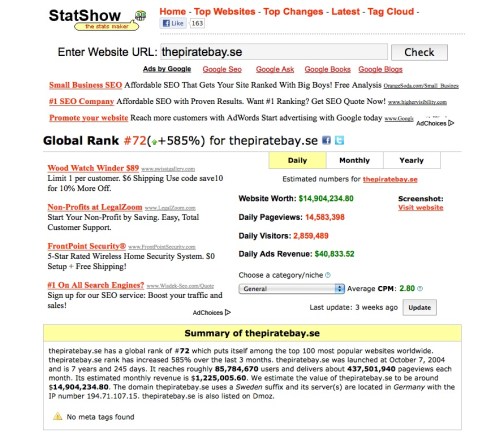
If there is any doubt left in anyone’s mind about the Exploitation Economy ripping off artists, this fantastic website shows the estimated revenue generated for commercial businesses on the backs of artists and creators without paying the artists a single penny.

Stat Show:
http://www.statshow.com/

The Pirate Bay – $14 Million Dollars Annually Estimated
http://www.statshow.com/thepiratebay.se

4 Shared – $11 Million Dollars Annually Estimated
http://www.statshow.com/4shared.com

Iso Hunt – $4 Million Dollars Annually Estimated
http://www.statshow.com/isohunt.com

And that’s just the tip of the iceberg, we also recommend reading:

Artists, Know They Enemy:
https://thetrichordist.wordpress.com/2012/06/05/artists-know-thy-enemy/

Ethical Fan – Wall Off Shame:
http://ethicalfan.com/2012/04/wall-of-shame-april-2012/

[ WHY ARENT MORE MUSICIANS WORKING ] [ ARTISTS FOR AN ETHICAL INTERNET ]

[ THE SKY IS RISING : MAGIC BEAVER EDITION ] [SF GATE BLUNDERS PIRACY FACTS ]
[ THE 101 ] [NEW BOSS / OLD BOSS ] [ SPOTIFY ] [GROOVESHARK ] [ LARRY LESSIG ]
[ JOHN PERRY BARLOW ] [ HUMAN RIGHTS OF ARTISTS ] [ INFRINGEMENT IS THEFT ]

None Dare Call it Theft

Is copyright infringement theft?

It’s a good question to ask on the internet if you want to spark another round of an endless discussion.

Opponents of the “infringement = theft” argument will marshal an impressive array of arguments.

There are the semantic arguments: theft has a settled meaning that doesn’t apply to infringement (ignoring centuries of usage to the contrary).

Then there are the legal arguments: you can’t sue someone for copyright infringement under theft laws. Leaving aside the fact that there is no single “theft” law — statutes different from state to state and country to country — this distinction only matters if you’re a prosecutor; doesn’t dictate how words can be used in common parlance. And I don’t believe anyone is seriously making the argument that the goal of calling infringement theft is to eventually bring infringement actions under theft laws.

In a recent New York Times article, author Stuart P. Green adds his own arguments to the debate. While generally more eloquent than what you normally find online, they are still not so convincing.

Green begins with his explanation of how we got here:

From its earliest days, the crime of theft has been understood to involve the misappropriation of things real and tangible. For Caveman Bob to “steal” from Caveman Joe meant that Bob had taken something of value from Joe — say, his favorite club — and that Joe, crucially, no longer had it. Everyone recognized, at least intuitively, that theft constituted what can loosely be defined as a zero-sum game: what Bob gained, Joe lost.

When Industrial Age Bob and Joe started inventing less tangible things, like electricity, stocks, bonds and licenses, however, things got more complicated. What Bob took, Joe, in some sense, still had. So the law adjusted in ad hoc and at times inconsistent ways. Specialized doctrines were developed to cover the misappropriation of services (like a ride on a train), semi-tangibles (like the gas for streetlights) and true intangibles (like business goodwill).

Green goes on to lay the blame on the current debate on, of all things, the 1962 Model Penal Code (?!?).

While superficially appealing, this story is an over-simplification (as any two paragraph summary of thousands of years of history can be). One could just as easily fashion a Green-esque history of property law to make the claim that taking someone’s pet is not theft.

After all, for thousands of years pets weren’t treated as property — it wasn’t until the early 20th century (much later than the appearance of copyright law) that the common law recognized taking cats and dogs as larceny. And today, you can find those who will argue that pets should not be considered property. It shouldn’t be hard to find scholars who will claim that pets should be “free as the air to common use” — and it’s not hard to imagine a site like “PetDirt.com” pointing to stories about Michael Vick to prove that it’s harmful to allow people to claim ownership over animals.

But it’s not as simple as that. You can easily find exceptions to this narrative throughout history, and property law is always evolving.

Next, Green makes it sound like the description of copyright infringement as theft is a recent phenomenon:

With intangible assets like information, patents and copyrighted material playing an increasingly important role in the economy, lawyers and lobbyists for the movie and music industries, and their allies in Congress and at the Justice Department, sought to push the concept of theft beyond the basic principle of zero sum-ness.

This claim has a certain appeal to the conspiratorially-minded. But it’s simply wrong.

People have used theft language to describe copyright infringement long before now. In fact, referring to unauthorized copying as theft has occurred before the term “copyright” appeared in the English language. Centuries before, even.

For example, Martin Luther placed a “Warning to Printers” on the inside of his 1541 German translation of the Bible. The warning read:

SO feret der Geitz zu / vnd thut vnsern Buchdrückern diese schalckheit vnd büberey / Das andere flugs balde hernach drücken / Vnd also der unsern Erbeit vnd Vnkost berauben zu jrem Gewin / Welchs eine rechte grosse öffentliche Reuberey ist / die Gott auch wol straffen wird

Avarice now strikes / and plays this knavish trick on our printers whereby others are instantly reprinting [our translation] / and are thus depriving us of our work and expenses to their profit, / which is a downright public robbery / and will surely be punished by God

Later writers would use the term “piracy” to describe unauthorized reprinting and plagiarism, such as Elizabethan pamphleteer Thomas Dekker, who encouraged his readers in 1603 to “Banish these Word-pirates, (you sacred mistresses of learning) into the gulfe of Barbarisme.”

It would not be until 1710 that the first copyright law would be passed — England’s Statute of Anne (though interestingly, the term “copyright” does not appear in the law and would not enter the language until the 1730s.) Since then, it’s not hard to find a wide variety of sources describing infringement as theft.

Some examples: An 1858 article in the Journal of the Society of Arts says, “All the legislation which has taken place upon the subject of Copyright in England has proceeded upon the just theory that an author or artist has a property in his work. Where, therefore, a Copyright work is literally copied, or copied with merely colourable alterations, it seems difficult to distinguish the moral guilt of such a theft from that of picking a pocket, and consequently that such an act of piracy ought to be punishable as a criminal offence.”

This dictionary from 1861 defines “piracy” as “infringement of the law of copyright; literary theft.”

The editors of the Round Table, a weekly U.S. journal, petitioned Congress in 1866 for an international copyright law, saying “this license for literary theft (for it is nothing less than theft) is beginning to affect our own writers and publishers. American works are daily reprinted in England, and at a less cost than the original publications.”

Legal treatises routinely made use of theft language, such as this 1886 treatise from R.R. Bowker: “After the invention of printing, it became evident that new methods of procedure must be devised to enforce common law rights. Copyright became therefore the subject of statute law, by the passage of laws imposing penalties for a theft which, without such laws, could not be punished.”

A letter printed in an issue of the Literary World from 1899 made the case that “An author’s brain work is as exclusively his own stock in trade as is any other work of any other artisan of any kind. Stealing brain work is as much a theft as stealing handiwork. Any person of ordinary intelligence can understand this fact. The copyright of all such work is the author’s own. If he chooses to delegate rights to reporters, well and good. He may do this as he does to his publishers, by royalty or by sale, according to mutually approved terms. But any right assumed otherwise than by permission of the author is downright robbery, according to all high standards of morality.”

These are only a few examples. Since the early days of copyright, infringement was, “frequently equated with theft.”

Indeed, not only has infringement routinely been described as theft, some have argued that it is worse than stealing tangible property.

German philosopher Johann Gottlieb Fichte wrote in 1793:

[I]n consideration of the fact that anyone is a thief who usurps the use of others’ property for his own profit, then the reprinter is without doubt a thief. If, furthermore, a theft is the more heinous when it involves things which by their very nature cannot be kept under lock and key, then the reprinter’s theft is one of the most heinous, since it involves something which necessarily lies open to the public, like air and ether. And if, finally, a theft is all the more heinous the nobler the objects it is perpetrated on, then it is the most heinous of all when it involves things that are creations of the mind.

And an 1840 book, An Historical Sketch of the Law of Copyright, noted:

For the printing a work, the sole right to which belonged to another, was looked on as little better than theft, and punished accordingly. Indeed, it was said, that such conduct was worse than to enter a neighbour’s house and steal his goods: for negligence might be imputed to him for permitting the thief to enter: but in the case of piracy of Copyright, it was stealing a thing confided to the public honour.

+++++++

The ancient Romans defined larceny as “Contrectatio rei alienae, invito domino cujus illa fuit” — “a diversion of the thing of another, contrary to the will of him, to whom it belongs.” Copyright gives creators an exclusive right to copy, perform or display, and make derivative works of their works, and copyright infringement is an appropriation of these things against the will of the copyright holder. For as long as copyright has been recognized by law, authors, philosophers, legal theorists and judges, and the general public have described infringement using theft language. The arguments that it is wrong to do so ignore logic and history.

What’s more, these arguments ignore the harm copyright theft causes the general public. Just last month, a Phoenix Center for Advanced Legal and Economic Public Policy Studies report demonstrated how “The existence of IP theft—even when assuming theft is costless to affect, produces consumption goods of quality fully equal to those consumers pay for, and does not suppress labor supplied—results in a reduction in social welfare” and “reduction in the rates of theft of intellectual property would benefit society (producers and consumers).”

So why do these arguments continue? At a basic level, they generally stem from this idea: it is wrong to call infringement theft because the word “theft” has moral overtones. But this begs the question that infringement is never an immoral act. Clearly that’s not the case.

Of course, saying that it’s sometimes appropriate to call copyright infringement theft does not mean we’re required to describe every act of infringement as theft. Someone who writes a fan-fic of a popular book, posted online for free, may end up with a work that a jury might find infringes the original, but I doubt few people would consider this theft — some authors even encourage such acts. There are plenty of other examples of online behavior involving non-commercial copying or transformative uses that, if put in front of a court, would be considered infringement but nevertheless would find few willing to describe as theft. So it’s worth being careful when using theft language.

However, that doesn’t mean it’s never correct to call infringement theft. When a service like Grooveshark, for example, doesn’t “pay the artists, the labels and/or the songwriters for the use of the music that’s making them tons of money”, it’s fitting to say they “knowingly and willingly use a legal loophole to steal from artists and songwriters.” For services like these, which seek to profit off creators’ labor without permission, it is very helpful to create clever semantic arguments that make their behavior seem not as bad as it is.

###

[ THE 101 ] [NEW BOSS / OLD BOSS ] [ SPOTIFY ] [GROOVESHARK ] [ LARRY LESSIG ]
[ JOHN PERRY BARLOW ] [ HUMAN RIGHTS OF ARTISTS ] [ INFRINGEMENT IS THEFT ]
[ THE SKY IS RISING : MAGIC BEAVER EDITION ] [SF GATE BLUNDERS PIRACY FACTS ]
[ WHY ARENT MORE MUSICIANS WORKING ] [ ARTISTS FOR AN ETHICAL INTERNET ]