Artist Rights Roundtable on AI and Copyright: Coffee with Humans and the Machines
Join the Artist Rights Institute (ARI) and American University’s Kogod’s Entertainment Business Program for a timely morning roundtable on AI and copyright from the artist’s perspective. We’ll explore how emerging artificial intelligence technologies challenge authorship, licensing, and the creative economy — and what courts, lawmakers, and creators are doing in response.
This roundtable is particularly timely because both the Bartz and Kadrey rulings expose gaps in author consent, provenance, and fair licensing, underscoring an urgent need for policy, identifiers, and enforceable frameworks to protect creators.
🗓️ Date: September 18, 2025 🕗 Time: 8:00 a.m. – 12:00 noon 📍 Location: Butler Board Room, Bender Arena, American University, 4400 Massachusetts Ave NW, Washington D.C. 20016
🅿️ Parking map is available here. Pay-As-You-Go parking is available in hourly or daily increments ($2/hour, or $16/day) using the pay stations in the elevator lobbies of Katzen Arts Center, East Campus Surface Lot, the Spring Valley Building, Washington College of Law, and the School of International Service
Hosted by the Artist Rights Institute & American University’s Kogod School of Business, Entertainment Business Program
🔹 Overview:
☕ Coffee served starting at 8:00 a.m. 🧠 Program begins at 8:50 a.m. 🕛 Concludes by 12:00 noon — you’ll be free to have lunch with your clone.
🗂️ Program:
8:00–8:50 a.m. – Registration and Coffee
8:50–9:00 a.m. – Introductory Remarks by KOGOD Dean David Marchick and ARI Director Chris Castle
9:00–10:00 a.m. – Topic 1: AI Provenance Is the Cornerstone of Legitimate AI Licensing:
Speakers:
Dr. Moiya McTier, Senior Advisor, Human Artistry Campaign
Ryan Lehnning, Assistant General Counsel, International at SoundExchange
The Chatbot
Moderator: Chris Castle, Artist Rights Institute
10:10–10:30 a.m. – Briefing: Current AI Litigation
Speaker: Kevin Madigan, Senior Vice President, Policy and Government Affairs, Copyright Alliance
10:30–11:30 a.m. – Topic 2: Ask the AI: Can Integrity and Innovation Survive Without Artist Consent?
Speakers:
Erin McAnally, Executive Director, Songwriters of North America
Jen Jacobsen, Executive Director, Artist Rights Alliance
Josh Hurvitz, Partner, NVG and Head of Advocacy for A2IM
Kevin Amer, Chief Legal Officer, The Authors Guild
Moderator: Linda Bloss-Baum, Director, Business and Entertainment Program, KOGOD School of Business
11:40–12:00 p.m. – Briefing: US and International AI Legislation
Speaker: George York, SVP, International Policy Recording Industry Association of America
Spotify recently rolled out a quiet but seismic change to its royalty system: if a track doesn’t get at least 1,000 streams in a 12-month period, it earns no royalties. Zero. The company claims this policy is about reducing “fraud” and redirecting money to “working artists,” but behind that PR gloss is a shift that disproportionately harms independent musicians and smaller rightsholders.
Let’s be clear—this isn’t just about removing noise from the system. It’s about redrawing the map of who gets paid in the streaming economy and who gets pushed out.
The Hidden Impact on Artists
At first glance, 1,000 streams might sound like a modest hurdle. But in the aggregate, this threshold excludes potentially millions of tracks from ever receiving a dime—even though Spotify continues to profit from their presence through ad revenue and user engagement. It’s easy to assume the affected tracks belong only to DIY artists or obscure creators. But that’s not necessarily true.
Spotify’s royalty model is track-focused, not artist-focused. You could have a single that racks up a million streams while the rest of the album struggles to clear a few hundred. Those lower-performing tracks—despite being part of a cohesive release—won’t earn a cent. Left to its own devices, the platform favors individual track performance over albums or an artist’s entire catalog. And that has sweeping implications not only for how artists are paid, but for how music is created, released, and valued in the streaming age.
It’s Not About Growing the Pie—It’s About Cutting Out the Bottom
The most revealing part of this policy isn’t what it claims to fix, but what it quietly avoids. Spotify is likely under enormous pressure—from major labels and rights holders—to raise the artist payouts. No matter how much Spotify denies the per-stream rate, there will always be a per-stream rate even if they pay a “stream share” to a label for the very simple reason that the label has to convert that revenue share into a per stream rate in order to allocate it to their several artists. That’s as simple as gross vs. net.
Plus we know just how bad the gross is from indie artists who get paid 100% of the “stream share”. It’s shit, ok? That’s why we know Spotify are under pressure to increase royalties.
But arbitrarily raising the total royalty pool would have consequences: it could trigger most-favored-nation clauses, obligate Spotify to pay more across the board.
Another way to raise royalties would be to “flatten” some of the minimum guarantee, i.e., make a portion of it nonrecoupable from future royalty payments. This was the practice with record clubs—a nonrecoupable payment has the added benefit of not being shared with artists as a kind of catalog-wide payment. This would also likely trigger MFNs, so that’s not super appealing either.
So by excluding low-performing tracks from the royalty pool, Spotify isn’t reducing fraud or increasing fairness. It’s reallocating revenue. And not randomly—it’s redistributing it upward. The money those artists would have earned is now being handed to the top-performing tracks, which overwhelmingly belong to major labels and large catalog owners.
Don’t you think that if the goal was to reduce costs, Spotify would just shrink the pie and pocket the difference? It seems to me that more money to fewer people is likely the real purpose of the 1,000-stream rule.
The Threat of Industry-Wide Collusion
Spotify isn’t alone. Amazon Music and Deezer have introduced similar thresholds, raising serious concerns about whether this is a coordinated move by dominant platforms to marginalize smaller rightsholders. When multiple major services adopt the same gatekeeping metric at the same time, and benefit in the same way, it’s not unreasonable to ask whether they’re acting in lockstep. In fact, this concept in antitrust law is called tacit collusion (or “conscious parallelism”) which occurs when competitors coordinate their behavior—such as pricing or output—without explicit agreements or communication. Instead of entering into a formal cartel, companies mirror each other’s pricing or business strategies, knowing that mutual restraint benefits all of them
Even if there’s no smoking gun, the outcome is clear: fewer royalties paid to emerging and independent creators, and more concentrated control over who makes money from streaming.
Playlists, Penalties, and Platform Power
Here’s the twist: just because a track falls below 1,000 streams and no longer qualifies for royalties doesn’t mean Spotify stops using it. These sub-threshold tracks don’t vanish—they become part of what we might call Spotify’s “shadow catalog”: music that still populates playlists, fuels the recommendation algorithm, and keeps users listening, but doesn’t generate payouts.
Every time a user plays a low-performing track, Spotify collects engagement data. That information feeds into its personalization systems, sharpening the algorithm’s ability to retain users and increase time-on-platform. That extra engagement helps Spotify serve more ads, train better models, and keep listener churn down. It also enriches Spotify’s advertising and data ecosystem, especially on the free tier where listening time directly translates to ad revenue.
In other words, these unpaid tracks are still part of the machine. Spotify uses them to optimize engagement and advertising—but without paying the creators a cent. It’s profit without payout. Value extraction without compensation. And in the long tail of the music economy, that adds up to millions of tracks silently pulling their weight for free.
So it seems that this is the quid for the pro quo.
A Cautionary Tale for Songwriters
The 1,000-stream threshold is a cautionary tale for songwriters as they approach Phonorecords V. What began as a “fraud prevention” tool is now a benchmark for excluding smaller rights holders from royalties altogether. Streaming services will point to these thresholds as precedent—arguing that if labels can accept payout limits, publishers should too. Without strong opposition, platforms could push for mechanical royalty thresholds that mirror streamshare rules, cutting off compensation to low-earning songs. This isn’t just about recorded music anymore. It’s a warning: once a gate is built, it can be copied—and used to lock out songwriters next.
A Royalty System That Punishes the Wrong People
Spotify’s royalty threshold is spun as a way to fight fraud and reward “working artists,” you know, kind of like don’t be evil. But in reality, it codifies a system where only the most popular tracks get paid—regardless of how much they contribute to the overall value of the platform.
And when other streaming services follow the same path, it stops looking like business as usual and starts to resemble a coordinated effort to narrow the market and marginalize everyone but the top-tier players.
This isn’t a royalty system built on fairness or transparency. It’s a redistribution scheme—not to help more artists earn a living, but to serve bigger slices to fewer people.
And that should raise alarms far beyond the music industry. Looking at you, Gail Slater.
One of the hallmarks of mania is the rapid rise and complexity of the rates of fraud. And did you know they’re going up?
The Big Short, screenplay by Charles Randolph and Adam McKay, based on the book by Michael Lewis
We have often said that if screwups were Easter eggs, Spotify CEO Daniel Ek would be the Easter bunny, hop hop hopping from one to the next. That’s is not consistent with his press agent’s pagan iconography, but it sure seems true to many people.
This week was no different. Mr. Ek cashed out hundreds of millions in Spotify stock while screwing songwriters hard with a lawless interpretation of the songwriter compulsory license. That interpretation is so far off the mark that he surely must know exactly what he is doing. It’s yet another manifestation of Spotify’s sudden obsession with finding profits after a decade of “get big fast.”
The Bunny’s Bundle
Let’s look under the hood at the part they don’t tell you much about. Mr. Ek evidently has what’s called a “10b5-1 agreement” in place with Spotify allowing staggered sales of incremental tranches of the common stock. Those sales have to be announced publicly which Spotify complied with (we think). And we’ll say it again for the hundredth time, stock is where the real money is at this stage of Spotify’s evolution, not revenue.
As a founder of Spotify, Mr. Ek holds founders shares plus whatever stock awards he has been granted by the board he controls through his supervoting stock that we’ve discussed with you many times. These 10b5-1 agreements are a common technique for insiders, especially founders, who hold at least 10% of the company’s shares, to cash out and get the real money through selling their stock.
A 10b5-1 agreement establishes predetermined trading instructions for company stock (usually a sale so not trading the shares) consistent with SEC rules under Section 10b5 of the Securities and Exchange Act of 1934 covering when the insider can sell. Why does this exist? The rule was established in 2000 to protect Silicon Valley insiders from insider trading lawsuits. Yep, you caught it–it’s yet another safe harbor for the special people. Presumably Mr. Ek’s personal agreement is similar if not identical to the safe harbor terms because that’s why the terms are there.
As MusicBusinessWorldWide reported, Mr. Ek recently sold $118.8 million in shares of Spotify at roughly the same time that he likely knew Spotify was planning to change the way his company paid songwriters on streaming mechanicals, or as it’s also known “material nonpublic information”.
As Tim Ingham notes in MusicBusinessWorldwide, Mr. Ek has had a few recent sales under his 10b5-1 agreement: “Across these four transactions (today’s included), Ek has cashed out approximately $340.5 million in Spotify shares since last summer.” Rough justice, but I would place a small wager that Ek has cashed out in personal wealth all or close to all of the money that Spotify has paid to songwriters (through their publishers) for the same period. In this sense, he is no different than the usual disproportionately compensated CEOs at say Google or Raytheon.
Stock buybacks artificially increase share price. Now why might Spotify want to juice its own stock price?
Spotify Shoves a “Bundled” Rate on Songwriters
Spotify’s argument (that may have caused a jump in share price) claims that its recent audiobook offering made Spotify subscriptions into a “bundle” for purposes of the statutory mechanical rate. (While likely paying an undiscounted royalty to the books.)
That would be the same bundled rate that was heavily negotiated in the 2021-22 “Phonorecords IV” proceeding at the Copyright Royalty Board at great expense to all concerned, not to mention torturing the Copyright Royalty Judges. These Phonorecords IV rates are in effect for five years, but the next negotiation for new rates is coming soon (called Phonorecords V or PR V for short). We’ll get to the royalty bundle but let’s talk about the cash bundle first.
You Didn’t Build That
Don’t get it wrong, we don’t begrudge Mr. Ek the opportunity to be a billionaire. We don’t at all. But we do begrudge him the opportunity to do it when the government is his “partner” so they can together put a boot on the necks of songwriters. This is how it is with statutory mechanical royalties; he benefits from various other safe harbors, has had his lobbyists rewrite Section 115 to avoid litigation in a potentially unconstitutional reach back safe harbor, and he hired the lawyer at the Copyright Office who largely wrote the rules that he’s currently bending. Yes, we do begrudge him that stuff.
And here’s the other effrontery. When Daniel Ek pulls down $340.5 million as a routine matter, we really don’t want to hear any poor mouthing about how Spotify cannot make a profit because of the royalty payments it makes to artists and songwriters. (Or these days, doesn’t make to some artists.) This is, again, why revenue share calculations are just the wrong way to look at the value conferred by featured and nonfeatured artists and songwriters on the Spotify juggernaut. That’s also the point Chris made in some detail in the paper he co-wrote with Professor Claudio Feijoo for WIPO that came up in Spain, Hungary, France, Uruguay and other countries.
Spotify pays a percentage of revenue on what is essentially a market share basis. Market share royalties allows the population of recordings to increase faster than the artificially suppressed revenue, while excluding songwriters from participating in the increases in market value reflected in the share price. That guarantees royalties will decline over time. Nothing new here, see the economist Thomas Malthus, workhouses and Charles Dickens‘ Oliver Twist.
The market share method forces songwriters to take a share of revenue from someone who purposely suppressed (and effectively subsidized) their subscription pricing for years and years and years. (See Robert Spencer’s Get Big Fast.). It would be a safe bet that the reason they subsidized the subscription price was to boost the share price by telling a growth story to Wall Street bankers (looking at you, Goldman Sachs) and retail traders because the subsidized subscription price increased subscribers.
Just a guess.
The Royalty Bundle
Now about this bundled subscription issue. One of the fundamental points that gets missed in the statutory mechanical licensing scheme is the compulsory license itself. The fact that songwriters have a compulsory license forced on them for one of their primary sources of income is a HUGE concession. We think the music services like Spotify have lost perspective on just how good they’ve got it and how big a concession it is.
The government has forced songwriters to make this concession since 1909. That’s right–for over 100 years. A century.
A decision that seemed reasonable 100 years ago really doesn’t seem reasonable at all today in a networked world. So start there as opposed to the trope that streaming platforms are doing us a favor by paying us at all, Daniel Ek saved the music business, and all the other iconographic claptrap.
Has anyone seen them in the same room at the same time?
The problem with the Spotify move to bundled subscriptions is that it can happen in the middle of a rate period and at least on the surface has the look of a colorable argument to reduce royalty payments. If you asked songwriters what they thought the rule was, to the extent they had focused on it at all after being bombarded with self-congratulatory hoorah, they probably thought that the deal wasn’t “change rates without renegotiating or at least coming back and asking.”
And they wouldn’t be wrong about that, because it is reasonable to ask that any changes get run by your, you know, “partner.” Maybe that’s where it all goes wrong. Because it is probably a big mistake to think of these people as your “partner” if by “partner” you mean someone who treats you ethically and politely, reasonably and in good faith like a true fiduciary.
They are not your partner. Don’t normalize that word.
A Compulsory License is a Rent Seeker’s Presidential Suite
But let’s also point out that what is happening with the bundle pricing is a prime example of the brittleness of the compulsory licensing system which is itself like a motel in the desolate and frozen Cyber Pass with a light blinking “Vacancy: Rent Seekers Wanted” surrounded by the bones of empires lost. Unlike the physical mechanical rate which is a fixed penny rate per transaction, the streaming mechanical is a cross between a Rube Goldberg machine and a self-licking ice cream cone.
The Spotify debacle is just the kind of IED that was bound to explode eventually when you have this level of complexity camouflaging traps for the unwary written into law. And the “written into law” part is what makes the compulsory license process so insidious. When the roadside bomb goes off, it doesn’t just hit the uparmored people before the Copyright Royalty Board–it creams everyone.
David and friends tried to make this point to the Copyright Royalty Judges in Phonorecords IV. They were not confused by the royalty calculations–they understood them all too well. They were worried about fraud hiding in the calculations the same way Michael Burry was worried about fraud in The Big Short. Except there’s no default swaps for songwriters like Burry used to deal with fraud in subprime mortgage bonds.
Here’s how the Judges responded to David, you decide if they are condescending or if the songwriters were prescient knowing what we know now:
While some songwriters or copyright owners may be confused by the royalties or statements of account, the price discriminatory structure and the associated levels of rates in settlement do not appear gratuitous, but rather designed, after negotiations, to establish a structure that may expand the revenues and royalties to the benefit of copyright owners and music services alike, while also protecting copyright owners from potential revenue diminution. This approach and the resulting rate setting formula is not unreasonable. Indeed, when the market itself is complex, it is unsurprising that the regulatory provisions would resemble the complex terms in a commercial agreement negotiated in such a setting.
It must be said that there never has been a “commercial agreement negotiated in such a setting” that wasn’t constrained by the compulsory license. It’s unclear what the Judges even mean. But if what the Judges mean is that the compulsory license approximates what would happen in a free market where the songwriters ran free and good men didn’t die like dogs, the compulsory license is nothing like a free market deal.
If the Judges are going to allow services to change their business model in midstream but essentially keep their music offering the same while offloading the cost of their audiobook royalties onto songwriters through a discount in the statutory rate, then there should be some downside protection. Better yet, they should have to come back and renegotiate or songwriters should get another bite at the apple.
Unfortunately, there are neither, which almost guarantees another acrimonious, scorched earth lawyer fest in PR V coming soon to a charnel house near you.
Eject, Eject!
This is really disappointing because it was so avoidable if for no other reason. It’s a great time for someone…ahem…to step forward and head off the foreseeable collision on the billable time highway. The Judges surely know that the rate calculation is a farce
But the Judges are dealing with people negotiating the statutory license who have made too much money negotiating it to ever give it up willingly although a donnybrook is brewing. This inevitable dust up means other work will suffer at the CRB. It must be said in fairness that the Judges seem to find it hard enough to get to the work they’ve committed to according to a recent SoundExchange filing in a different case (SDARS III remand from 2020).
That’s not uncharitable–I’m merely noting that when dozens of lawyers in the mechanical royalty proceedings engage in what many of us feel are absurd discovery excesses. When there are stupid lawyer tricks at the CRB, they are–frankly–distracting the Judges from doing their job by making them focus on, well, bollocks. We’ll come back to this issue in future. The dozens and hundreds of lawyers putting children through college at the CRB–need to take a breath and realize that judicial resources at the CRB are a zero sum game. This behavior isn’t fair to the Judges and it’s definitely not fair to the real parties in interest–the songwriters.
Tell the Horse to Open Wider
A compulsory license in stagflationary times is an incredibly valuable gift, and when you not only look the gift horse in the mouth but ask that it open wide so you can check the molars, don’t be surprised if one day it kicks you.
The last time we did this was back in 2014, so we thought it was time for an update. Not a lot of surprises but as we predicted when streaming numbers grow, the per stream rate will drop. This data set is isolated to the calendar year 2016 and represents an indie label with an approximately 150 album catalog generating over 115m streams. That’s a pretty good sample size. All rates are gross before distribution fees.
Spotify was paying .00521 back in 2014, two years later the aggregate net average per play has dropped to .00437 a reduction of 16%.
YouTube now has their licensed, subscription service (formerly YouTube Red?) represented in these numbers as opposed to the Artist Channel and Content ID numbers we used last time. Just looking at the new YouTube subscription service numbers isolated here, they generate over 21% of all licensed audio streams, but less than 4% of revenue! By comparison Apple Music generates 7% of all streams and 13% of revenue.
Speaking of Apple, they sit in the sweet spot generating the second largest amount of streaming revenue with a per stream rate .00735, nearly double what Spotify is paying. But, Spotify has a near monopoly on streaming market share dominating 63% of all streams and 69% of all streaming revenue. The top 10 streamers account for 99% of all streaming revenue.
To put this list in the context of our 2014 numbers we’re adding the chart below with the data sorted by the quantity of streaming plays required to match the revenue of a single song or album download. This is important as we work towards defining and setting a fair per stream rate and also setting an accurate economic equivalent of streams to songs and albums for the purposes of charting.
Billboard currently calculates 1,500 streams to one album for the purposes of charting, which at current streaming rates actually matches an economic equivalent. However, that is most likely a highly excessive numbers of plays to achieve that economic equivalent. But, more on that later…
Keep in mind every streaming service has a key piece of data that would allow artists and labels to set a fair per stream rate. Every on demand streaming service, Apple, Spotify, Tidal, Google Play all know how many times a song is played (per person) on average over time. This is the data that is key to setting fair streaming rates. Who will share this information? Apple, Jimmy Iovine, we’re looking at you.
HOW WE CALCULATED THE STREAMS PER SONG / ALBUM RATE:
As streaming services only pay master royalties (to labels) and not publishing, the publishing has to be deducted from the master share to arrive at the comparable cost per song/album.
$.99 Song is $.70 wholesale after 30% fee. Deduct 1 full stat mechanical at $.091 = $.609 per song.
Multiply the above by 10x’s and you get the album equivalent of $6.09 per album
[EDITORS NOTE: All of the data above is aggregated. In all cases the total amount of revenue is divided by the total number of the streams per service (ex: $5,210 / 1,000,000 = .00521 per stream). In cases where there are multiple tiers and pricing structures (like Spotify), these are all summed together and divided to create an averaged, single rate per play.]
Spotify just posted their financials and Paul Resnikoff at Digital Music News was quick to point out that the average Spotify employee salary is $168, 747.
Contrast that to the plight of songwriters. There would be no music business without the fundamental efforts of songwriters. Yet, there is not a free market in songs. The federal government sets compensation for songwriters/publishers based on a percentage of revenue. An abysmal below market rate. In effect a subsidy for streaming services. Last I checked this rate was working out to about $0.00058 per spin. This includes both the public performance (BMI/ASCAP) and the streaming mechanical (IF they happen to pay it).
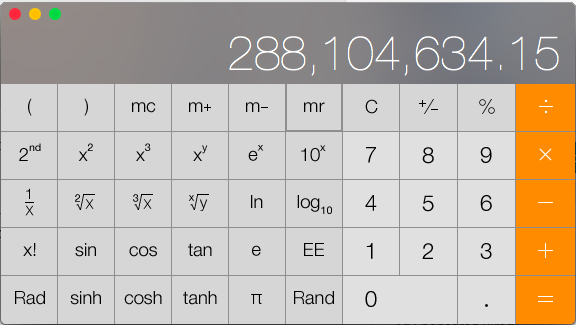
Best case scenario, if a songwriter retains all publishing rights to their song then a songwriter would need 288,104,634.15 spins to earn the reported average salary of a Spotify employee.
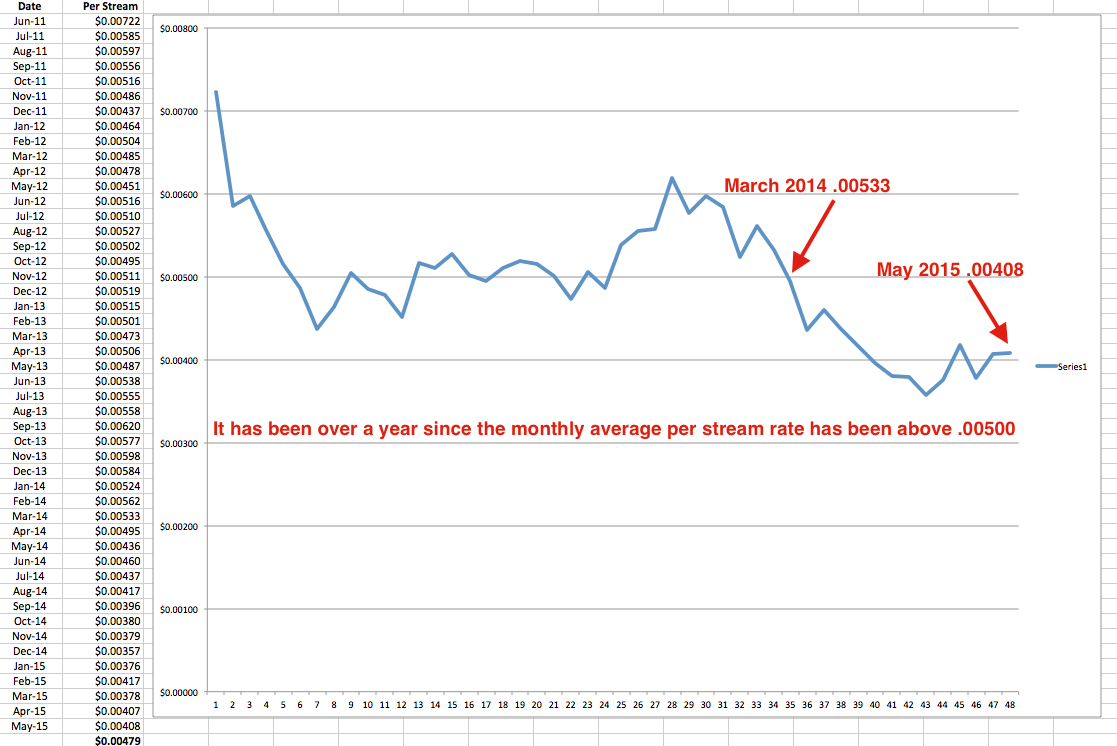
Down, down, down it goes, where it stops nobody knows… The monthly average rate per play on Spotify is currently .00408 for master rights holders.
48 Months of Spotify Streaming Rates from Jun 2011 thru May 2015 on an indie label catalog of over 1,500 songs with over 10m plays.
Spotify rates per spin appear to have peaked and are now on a steady decline over time.
Per stream rates are dropping because the amount of revenue is not keeping pace with the number of streams. There are several possible causes:
1) Advertising rates are falling as more “supply” (the number of streams) come on line and the market saturates.
2) The proportion of lower paying “free streams” is growing faster than the proportion of higher paying “paid streams.”
3) All of the above.
This confirms our long held suspicion that as a flat price “freemium” subscription service scales the price per stream will drop. As the service reaches “scale” the pool of streaming revenue becomes a fixed amount. The pie can’t get any larger and adding more streams only cuts the pie into smaller pieces!
The data above is aggregated. In all cases the total amount of revenue is divided by the total number of the streams per service (ex: $4,080 / 1,000,000 = .00408 per stream). Multiple tiers and pricing structures are all summed together and divided to create an averaged, single rate per play.
Since Spotify launched in 2010 the music business has been in an existential crisis. Convinced that ad-supported unlimited free access to on-demand music would ultimately grow recorded music revenues the major labels opted into what may be their worst decision ever. This decision aided by an estimated 18% (or more) equity position in Spotify has not grown overall music revenues over the past five years. In fact, for the year ending 2014 global revenues reported by the IFPI stated that revenues were at the lowest point in decades. So what to do?
For starters the first and most obvious solution would be to eliminate the unlimited ad-supported free access to on-demand music. This is the model that made ad funded, for profit piracy so popular on over half a million infringing links from unlicensed businesses served by Google search and delivered to your inbox by Google Alerts complete with social media sharing buttons. These unlicensed businesses are receiving hundreds of millions of DMCA notices annually from artists and rights holders. Let us not forget that this is also the same model that Daniel Ek helped to perfect as the CEO of u-torrent the worlds most installed bit-torrent client. Ek has said he’d rather shut down Spotify than give up his failed ad supported business model. We thought Spotify was built on converting ad supported (where Spotify board member Google makes money serving ads) to subscription (where artists make money). So much for that.
And this is who the record business is taking notes from? Perhaps that’s why Universal is restructuring. This may have seemed like a good idea to some senior executives but it turned out to be a complete disaster. Time to change.
Despite moves in the right direction by Tidal and Apple Music the optics for both of these companies at launch of their respective streaming models have been somewhere between missteps and an absolute disaster. Dismissing for a second that both Apple and Tidal could be the targets of public relations campaigns by competing corporations such as Spotify, Pandora and Google (YouTube) let’s look at what each is offering. Tidal and Apple Music offer nounlimited ad-supported free access to on-demand music. That means no business to those selling advertising… like, Google.
There is nothing more important to the future of the recorded music ecosystem than removing the unlimited ad-supported free access to on-demand music.
For all intents and purposes even free streaming is ownership and here’s how you can tell. If you can chose it, and access it, you essentially own it whether you pay for it or not. Streaming replaces ownership at the consumer level but does not compare to ownership on price. At some point there needs to be a market correction to properly value music consumption.
The launch of Tidal should have been a rallying cry for all artists to support a business model that limited free streaming, incentivized paid subscriptions through exclusive offerings and diversified consumer experiences with higher quality streaming formats. This is the model we should be focused on. As the Buddhist saying goes, “trust the teaching, if not the teacher.” In other words it doesn’t matter if you don’t like Jay-Z and Madonna. And securities laws makes the whole stock issue so difficult that Tidal would have been far better off saying they’d pay all participating artists a bonus in the cash from the company’s own stock sales rather than get down the rabbit hole of who gets stock and who doesn’t.
Unfortunately the celebrity that could have united a community, instead divided it through messaging that most would acknowledge appeared to be less than inclusive. Worse, the optics appeared to be elitist whereby those already rich and famous seemed to be more focused on their own fortunes as opposed to a sustainable ecosystem for the next generation of musicians.
Perhaps if each of the artists at the Tidal launch would have appeared with a developing artist they were supporting the messaging and optics would have been more inclusive and more about community than celebrity.
We have to acknowledge what kind of business we want going forward. Clearly, unlimited ad-supported free access to on-demand music is not working. Both Tidal and Apple Music do NOT have unlimited ad-supported free access to on-demand music. So what’s the problem?
Following the Apple Music launch Spotify announced it had achieved 75m global users (we love that, “users” no kidding) and 20m paid subscribers. So let’s look at the numbers in relationship to what Apple Music could bring to the market place. Keep in mind that 55m of Spotify’s user base are NOT paying for the service. Based on reporting we’ve been provided the free tier accounts for 58% of plays which is only 16% of the total revenue.
With all the back and forth between Apple and labels and the announcement last week by NMPA of the publisher’s deal—freely negotiated without government “help” by the way–it’s pretty clear that Apple announced Apple Music without all their ducks in a row contractually. This opened up an opportunity for haters who are just gonna hate. Now that the picture is becoming a bit clearer, we feel more confident than ever that most of the noise is coming from competitors who would like to create yet another consent decree situation but this time for artists and record companies.
So there are a few questions we need to ask about the launch of Apple Music to evaluate the trade-off for eliminating the unlimited ad-supported free access to on-demand music. But before we ask those questions, we need to understand the mechanics of the Apple Music ecosystem.
First, the 90 days free without payment at launch requires the understanding that all consumers will get 90 days free at Apple Music whether they sign up at launch or at any other point later. This means that some people will opt in at launch, some will opt in at some later time. Based on what we have seen of how these streaming subscription services scale we have to ask a few questions.
How many people will have access to opt into Apple Music Streaming on launch? We’ll assume it’s the entire installed user base who upgrade into iOS 8.4. Here’s some back of the napkin math from the iPhone 6 launch when Apple dropped that U2 album into everyone’s Itunes.
According to CBS News 33 Million people of the 500 Million Global Itunes users “experienced” the U2 album. That’s just 6.7 percent of Apple’s reported consumer base.
So what kind of adoption and conversion rate could one expect from the launch of Apple Music? 10 million paid subscribers? 20 million paid subscribers? 50 million paid subscribers? It’s hard to know, but anything north of 20 million pretty much beats Spotify on paid subscribers. And if you are looking for the company that has defined a paid music service, who you gonna call? Apple or Spotify? Who do you trust going forward?
What if Apple is able to convert 30 million or more consumers to paid streaming in only four months when it has taken Spotify five years to acquire 20 million paid?
Of course, Apple should use a couple of bucks from it’s 178 billion dollars in cash reserves to compensate musicians for the consumption of their music during the initial 90 day launch of Apple Music. This would incentivized artists to promote the service as being both fair and artist friendly and give Apple the thumbs up from the people that matter the most, the artists themselves. Apple’s purchase of Beats was a three billion dollar acquisition, so surely there’s enough money in those coffers to pay artists something.
Here’s some more perspective from asymco.com: In 2012, global music revenues were reported at $16.5 billion, with $5.6 billion coming from digital music. Of that $5.6 billion in music downloads, Apple paid labels $3.4 billion for iTunes sales, which is about 60% of the total digital revenues industry wide—IN LESS THAN ONE YEAR.
In 2012, Apple’s transactional digital model created more revenue for artists and rights holders in less than a year in then it took for Spotify to earn almost 6 years.
If we want to break the death spiral of unlimited ad-supported free access to on-demand music we have to embrace the trade-off of offering limited free trial periods as an incentive for consumers to make the switch.
And by the way—compare the classy way that Eddie Cue of Apple handled Taylor Swift compared to Daniel Ek who comes off like a semi-stalker. Who understands artist relations the best?
The problem with ad-supported unlimited free access to on-demand music is illustrated below showing Spotify domestic streams and revenues. It’s just math and it’s time to move on. Apple Music and Tidal are showing us the way.
Stop us if you’ve heard this one before… Spotify doesn’t cannibalize Itunes sales it actually increases them… Uh huh. That was the rap they wanted us to believe. Smart and cautious artists and labels seem to have been right by avoiding Spotify.
… there’s no evidence of Spotify or other streaming services negatively impacting music sales. More data like this could encourage artists and labels to promote their streaming music presences, and push acts like The Black Keys and Paul McCartney who’ve pulled their catalogues from Spotify to come back.
Paul Smernicki did some more defending at a Guardian conference. According to Music Ally, Smernick told the conference: “We’ve looked really really hard for evidence of cannibalisation, almost unobjectively. Across the business, we’ve been unable to find that evidence. And in [European] markets where Spotify has launched, the growth in the digital business has been about 40%, in territories where it doesn’t it’s around 10%. There’s a healthy ecosystem and it can be served by many of those services”.
Speaking to digital music site Evolver.fm in a pre-Grammys interview, Ek strenuously denied that his streaming service cannibalises sales of music through services such as Apple’s iTunes.
“There’s not a shred of data to suggest that. In fact, all the information available points to streaming services helping to drive sales,” he said.
Wilson points out that the number of digital downloads has increased-up 15% for albums and 6% for tracks in the first 46 weeks of 2012, according to SoundScan-suggesting that the widespread availability of free on-demand streaming hasn’t led to a sales apocalypse.
Rhapsody chief executive Jon Irwin says, “The only thing streaming music cannibalizes is piracy.”
So there you have it. Three years later and meanwhile back on earth the actual effects of Spotify on the transactional sales of recorded music have been a disaster. Which is why there are major changes happening at the major labels as Spotify licenses come up for renewal.
Since we published the Streaming Price Bible we’ve been getting data submissions to crunch the numbers. According to one set of data it appears Spotify is reporting seven different streaming rates (in a single month). But the most interesting discovery in the data is the percentage of free streaming volume and revenue versus paid streaming volume and revenue.
We knew there were two price tiers (Free & Paid) but we didn’t anticipate discovering the other five tiers, even as limited as they are.
As we had suspected, the majority of consumption is generating the least amount of revenue.
Oh, and for those of you keeping score at home the net summed per stream rate, for all streams divided by all revenue is .00352 in the aggregate. That’s .00169 per stream LESS than reported earlier this year in the Streaming Price Bible of .00521. Just another indication that as streaming models mature the price per stream will continue to drop. Add to this that even Spotify executives have admitted as much.
If you have data that looks different than ours, send it our way and let us crunch it. This is the problem when there is such a profound lack of openess and transparency. There also appears to be an overall lack of consistency. Let’s have some real “disruptive innovation” by “sharing” our Spotify statements and comparing the numbers.
[The per play rates noted above are aggregated. In all cases the total amount of revenue is divided by the total number of the streams per service (ex: $5,210 / 1,000,000 = .00521 per stream). Multiple tiers and pricing structures are all summed together and divided to create an averaged, single rate per play.]
[EDITORS NOTE: All of the data above is aggregated. In all cases the total amount of revenue is divided by the total number of the streams per service (ex: $5,210 / 1,000,000 = .00521 per stream). In cases where there are multiple tiers and pricing structures (like Spotify), these are all summed together and divided to create an averaged, single rate per play.]
If the services at the top of the list like Nokia, Google Play and Xbox Music can pay more per play, why can’t the services at the bottom of the list like Spotify and YouTube?
We’ll give you a hint, the less streams/plays there are the more each play pays. The more plays there are the less each stream/play pays. Tell us again about how these services will scale. Looking at this data it seems pretty clear that the larger the service get’s, the less artists are paid per stream.
So do you think streaming royalty rates are really going to increase as these services “scale”? No, we didn’t either.
We’ve been waiting for someone to send us this kind of data. This info was provided anonymously by an indie label (we were provided screenshots but anonymized this info to a spreadsheet). Through the cooperative and collaborative efforts of artists such as Zoe Keating and The Cynical Musician we hope to build more data sets for musicians to compare real world numbers.
In our on going quest for openness and transparency on what artists are actually getting paid we’d love to hear from our readers if their numbers and experience are consistent with these numbers below. At the very least, these numbers should be the starting point of larger conversations for artists to share their information with each other.
Remember, no music = no business.
For whatever reason there appear to be a lot of unmonetized views in the aggregate. So let’s just focus on the plays earning 100% of the revenue pool in the blue set. These are videos where the uploader retains 100% of the rights in the video including the music, the publishing and the video content itself.
Plays
Earnings
Per Play
2,023,295
$3,611.84
$0.00179
1,140,384
$2,155.69
$0.00189
415,341
$624.54
$0.00150
240,499
$371.47
$0.00154
221,078
$313.47
$0.00142
TOTALS
TOTALS
AVERAGE
4,040,597
$7,077.01
$0.00175
So it appears that YouTube is currently paying $1,750 per million plays gross.
We understand that people reading this may report other numbers, and that’s the point. There is no openness or transparency from either Spotify or YouTube on what type of revenue artists can expect to earn and under what specific conditions. So until these services provide openness and transparency to musicians and creators, “sharing” this type of data is going to be the best we’re going to be able to do as East Bay Ray comments in his interview with NPR.
As we’re now in a world where you need you need a million of anything to be meaningful here’s a benchmark of where YouTube ranks against Spotify.
Service
Plays
Per Play
Total
Notes
Spotify To Performers/Master Rights
1,000,000
0.00521
$5,210.00
Gross Payable to Master Rights Holder Only
Spotify To Songwrtiers / Publishers
This revenue is for the same 1m Plays Above
0.000521
$521.00
Gross Payable to Songwriter/s & Publisher/s (estimated)
YouTube Artist Channel
1,000,000
0.00175
$1,750.00
Gross Payable for All Rights Video, Master & Publishing
YouTube CMS (Adiam / AdRev) **
1,000,000
0.00032
$321.00
Gross Payable to Master Rights Holder Only
The bottom line here is if we want to see what advertising supported free streaming looks like at scale it’s YouTube. And if these are the numbers artists can hope to earn with a baseline in the millions of plays it speaks volumes to the unsustainability of these models for individual creators and musicians.
It’s also important to remember that the pie only grows with increased revenue which can only come from advertising revenue (free tier) and subscription fees (paid tier). But once the revenue pool has been set, monthly, than all of the streams are divided by that revenue pool for that month – so the more streams there are, the less each stream is worth.
All adrev, streaming and subscription services work on the same basic models as YouTube (adrev) and Spotify (adrev & subs). If these services are growing plays but not revenue, each play is worth less because the services are paying out a fixed percentage of revenue every month divided by the number of total plays. Adding more subscribers, also adds more plays which means that there is less paid per play as the service scales in size.
This is why building to scale, on the backs of musicians who support these services, is a stab in the back to those very same artists. The service retains it’s margin, while the artists margin is reduced.
[** these numbers from a data set of revenue collected on over 8 million streams via CMS for an artist/master rights holder]
Here’s what 1 million streams looks like from different revenue perspectives on the two largest and mainstream streaming services.
Service
Units
Per Unit
Total
Notes
Spotify
1,000,000
$0.00521
$5,210.00
Gross Payable to Master Rights Holder Only
Spotify
same million units as above
$0.00052
$521.00
Gross Payable to Songwriter/s & Publisher/s (est)
YouTube
1,000,000
$0.00175
$1,750.00
Gross Payable for All Rights Video, Master & Publishing
YouTube CMS Master Recording (Audiam / AdRev)
1,000,000
$0.00032
$321.00
Gross Payable to Master Rights Holder Only
STREAMING TOTALS
3,000,000
$7,802.00
TOTAL REVENUE EARNED FOR 3 MILLION PLAYS ON SPOTIFY AND YOUTUBE
Itunes Album Downloads
1,125
$7.00000
$7,875.00
Gross payable including Publishing
Here are some compelling stats on the break down of what percentage of videos on YouTube actually achieve breaking the 1 million play threshold, only 0.33%
Some 53% of YouTube’s videos have fewer than 500 views, says TubeMogul. About 30% have less than 100 views. Meanwhile, just 0.33% have more than 1 million views.
That’s not a huge surprise. But it highlights some of the struggles Google could have selling ads around all those unpopular videos, despite the money it has to spend to store them.
An artist needs to generate THREE MILLION PLAYS on the two largest and most popular streaming platforms to equal just 1,125 album downloads from Itunes. This is an important metric to put in context. In 2013 only 4.8% of new album releases sold 2,000 units or more. So if only 4.8% of artists can sell 2,000 units or more, how many artists can realistically generate over four million streams from the same album of material?
in 2013 there were 66,565 new releases, only 3,237 sold more than 2,000 units = 4.8% of new releases sold over 2,000 units
in 2013 there were 915,482 total releases in print, only 14,856 sold more than 2,000 units = 1.6% of ALL RELEASES in print sold more than 2,000 units.
This is even more important when you start to consider that many artists feel that growing a fan base of just 10,000 fans is enough to sustain a professional career. Note we said solo artists because these economics probably need to be multiplied by each band member added for the revenue distribution to remain sustainable. So a band of four people probably need a sales base of 40,000 fans to sustain a professional career for each member of the band.
Each 10,000 albums sold on iTunes (or 100,000 song downloads) generates $70,000 in revenue for the solo artist or band. To achieve the same revenue per 10,000 fans in streams, the band has to generate 30 million streaming plays (as detailed above) if they are distributing their music across the most common streaming services including Spotify and YouTube.
In 2013 the top 1% of new releases (which happen to be those 620 titles selling 20k units or more) totaled over 77% of the new release market share leaving the remaining 99% of new releases to divide up the remaining 23% of sales.
This appears to confirm our suspicion that the internet has not created a new middle class of empowered, independent and DIY artists but sadly has sentenced them to be hobbyists and non-professionals.
Meanwhile the major artists with substantial label backing dominate greater market share as they are the few who can sustain the attrition of a marketplace where illegally free and consequence free access to music remains the primary source of consumption.
You must be logged in to post a comment.